Lively, entertaining reviews of, and essays on, old and newer films and everything relating to them, written by professional author William Schoell.
Showing posts with label Aline MacMahon. Show all posts

Thursday, August 28, 2025

DIAMOND HEAD

Yvette Mimieux, Elizabeth Allen, Charlton Heston
DIAMOND HEAD (1962). Director: Guy Green.

Widower King Howland (Charlton Heston) is a wealthy land owner in Hawaii who lives with his sister-in-law, Laura (Elizabeth Allen of Donovan's Reef), and his younger sister, Sloane (Yvette Mimieux of The Time Machine). Sloane is in love with an islander named Paul (James Darren), who returns her feelings, but neither King nor Laura approve of the marriage. "We've never mixed blood," King says, as he tries to enlist Paul's half-brother, Dean (George Chakiris) in breaking up the romance. Dean may have reservations about the union, but he will not speak out against it, although his mother (Aline MacMahon of Babbitt) feels mixed marriages will dilute the Hawaiian minority. Complicating the whole situation is that the hypocritical King is having an affair with an Asian woman (France Nuyen) who is going to have his child. At a party to celebrate the upcoming nuptials between Sloane and Paul, a tragedy occurs ... 

Heston
Diamond Head
 may take advantage of some gorgeous scenery, but its dramatic value is somewhat lacking. The admirable attempts to denounce racism are half-hearted, especially when you consider that the three main "Hawaiian" roles -- Jimmy, Dean, and their mother -- are played by Caucasian actors. Heston displays his usual charisma, and  his performance is perfectly competent but unmemorable. Elizabeth Allen is okay in the thankless role of the sister-in-law secretly in love with her late sister's widower. Chakiris and MacMahon -- and to a lesser extent Darren -- are notable, and Mimieux gives a fairly strong and sensitive performance, as does Nuyen -- perhaps the best in the picture. Harold Fong makes an impression as King's major domo, Koyama, and Marc Marno is vivid as Nuyen's sleazy brother, Bobby. 

A sub-plot has to do with King planning to run for the state senate, and there are also a couple of obvious hints of his incestuous feelings for his sister. That being said, the movie has an absolutely horrible ending which I believe was tacked on by someone who let their common sense run away with them. 

Verdict: You might have a better time watching reruns of Hawaiian Eye. **1/2. 

Thursday, July 7, 2022

GOLD DIGGERS OF 1933

Ruby Keeler and Dick Powell
GOLD DIGGERS OF 1933 (1933). Director: Mervyn LeRoy. 

Carol (Joan Blondell), Trixie (Aline MacMahon) and Polly (Ruby Keeler) are roommates and struggling chorus girls. They are excited to learn that Barney Hopkins (Ned Sparks) is putting on another show, but disappointed when they discover he has no financial backer. But neighbor Brad (Dick Powell), an aspiring songwriter, says he has dough and wants to invest. Polly, who has a crush on Brad, is convinced that he is a infamous bank robber, but he's actually the wealthy scion of a stuffy Boston family. When Brad's brother Larry (Warren William) mistakes Carol for Polly and tries to buy her off, she decides to string him along while ruthless Trixie -- the oldest and least attractive of the trio -- sets her cap for Larry's lawyer Peabody (Guy Kibbee). Will true love conquer all? On yes, there are songs and dance numbers as well. 

Ginger Rogers and chorus cuties
The production numbers were put together by Busby Berkeley, and they are inventive and engaging (I especially loved the roller-skating baby!). The songs, by Warren and Dubin, include "We're In the Money" (warbled by Ginger Rogers, who plays a friend of the aforementioned trio); "Torch Song," well-sung by the very likable Powell; "Pettin' in the Park;" "In the Shadows;" and "The Forgotten Man." This last number, which is a poignant salute to forgotten and homeless WW1 veterans, adds some depth to an otherwise frothy, mindless movie and wisely ends the film without the usual clinch or upbeat finale. Trixie is a kind of sleazy character but the movie glosses over that. The cast is good and enthusiastic, putting over the material with aplomb. 

Verdict: All this and Powell, too! ***. 

Thursday, July 26, 2018

THE EDDIE CANTOR STORY

Keefe Brasselle (Cantor) and Jackie Barnett (Durante)
THE EDDIE CANTOR STORY (1953). Director: Alfred E. Green.

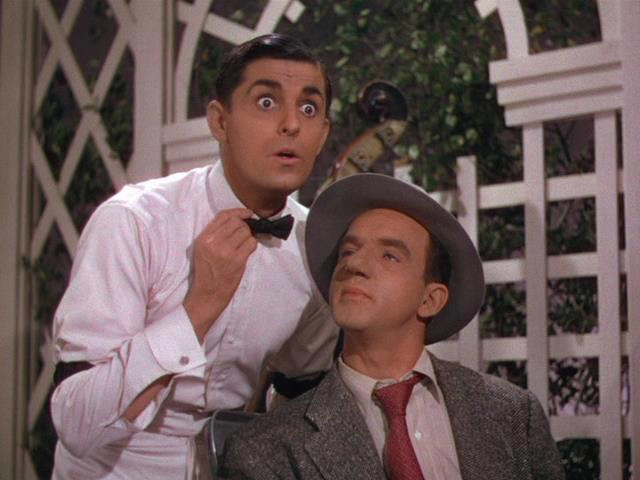
Even as a boy Eddie Cantor (Richard Monda) knew he wanted to be an entertainer. When a foolish do-gooder named Berk (David Alpert) wants to pack the kid off to an orphanage, claiming that his sturdy grandmother Esther (Aline MacMahon) can't take care of him, Eddie is fortunate to wind up with a theatrical couple who sponsor a children's revue instead. As Eddie (now played by Keefe Brasselle) falls in love with his childhood sweetheart, Ida (Susan Odin, and then Marilyn Erskine), he struggles to make a name for himself as an adult singing and dancing comedian. But the more famous Eddie gets, the more he neglects his wife, whose loneliness is palpable despite her having (eventually) five daughters to raise. Then serious health issues crop up and it looks like Cantor's career is over ... Eddie Cantor was still alive when this film came out, so the worst thing the movie says about the comic is that he was overly ambitious and addicted to applause and stardom, a fact that had a negative impact on his family life. The Eddie Cantor Story sticks to the basic facts about the man, even it it remains somewhat on a superficial level. However, Brasselle [Bannerline], outfitted with pop eyes and bigger teeth that generally disguise the actor's handsomeness. gives an excellent, well-studied impression of the famous performer. (One could argue that Brasselle, as is often the case in biopics, impersonates the man as he acts while performing as opposed to how he acts off-stage, but somehow this approach works.) Using the real Cantor's voice, Brasselle expertly recreates his routines from the Ziegfeld Follies as well as from such Broadway shows as Whoopee. The film boasts another excellent performance from Marilyn Erskine, who generally worked in television but should be much better known, as the grown-up Ida. Erskine explores every nuance of the character with her sensitive and splendid emoting. Aline MacMahon [The Young Doctors] is sterling as the loving, supportive grandmother, and there is very nice work from Arthur Franz [The Atomic Submarine] as a doctor who remains a loyal friend of the couple through thick and thin. Jackie Barnett does an amusing imitation of Jimmy Durante, and Will Rogers Jr. is cast as his father. Richard Monda is very winning and effective as Cantor as a child. Smaller roles are enacted by the likes of Chick Chandler (as a talent show host); Marie Windsor (as a jealous star); Gerald Mohr (as an old friend and bootlegger); Alix Talton (as a reporter;) as well as Ann Doran and Arthur Space. One is struck by the similarity between Cantor and friendly rival Al Jolson, who also performed in blackface. In his later years, Cantor did film and television work, and also became a spokesman for the March of Dimes. Cantor and his wife appear in the film's framing sequence, and he is given a classic closing line: "I've never looked  better in my life." Although two actors are credited with playing Cantor's parents (who died when he was an infant), they are either seen only in photographs, or their scenes were cut.

Verdict: Delightful biopic with top performances and snappy musical numbers. ***.  

Thursday, December 7, 2017

THE YOUNG DOCTORS

Ben Gazzara and Fredric March
THE YOUNG DOCTORS (1961). Director: Phil Karlson.

Dr. Joseph Pearson (Fredric March) is an experienced pathologist who finds himself with a new, younger colleague, Dr. David Coleman (Ben Gazzara). David sees a lot that's wrong with the operation in the hospital, but Pearson tells him that he has tried to do the things he suggests but is always told it costs too much money. Experienced, but hopelessly set in his ways, Joseph scoffs at the thought of a certain blood test for a pregnant woman that David feels is crucial, and he prevents the test from being made. Even as this is going on, David discovers that a nurse he is falling for, Cathy (Ina Balin) may face the loss of a leg due to bone cancer. While some of the medical information in The Young Doctors has to be taken with a grain of salt due to advances in medicine over the past fifty years, the picture works on an emotional and dramatic level and is not just a schlocky soap opera like many of the subsequent doctor movies that were made afterward. March is excellent, although he perhaps makes some odd choices in how he plays some of the final sequences. Gazzara [A Rage to Live] is also quite good, although he's never what you could call a charm boy in his romantic scenes, but Ina Balin [The Patsy] is as lovely and efficient as ever as nurse Cathy. Another fine performance is from Eddie Albert, doing some of the best work of his career as another doctor, particularly in a tense, beautifully-done sequence when he  operates on a baby that nearly dies. There's also surprisingly good work from Dick Clark as yet another doctor who is the father of said baby, and Aline MacMahon [Babbitt] scores as Dr. Lucy Grainger, who ministers to Cathy. Elmer Bernstein has contributed a nice score as well. Based on "The Final Diagnosis" by Arthur Hailey. The same year that this popular film was released came the debut of two famous TV medical dramas, Dr. Kildare and Ben Casey.

Verdict: Very absorbing drama with several expert performances and decided emotional impact. ***1/2.

Thursday, November 15, 2012

GUEST IN THE HOUSE

Ruth Warrick and Anne Baxter
GUEST IN THE HOUSE (1944). Director: John Brahm.

Dr. Dan Butler (Scott McKay) brings his girlfriend and patient Evelyn (Anne Baxter) to his family home for a rest cure, and she manages to bring simmering tensions to the surface. Others in the household include Dan's artist brother Douglas (Ralph Bellamy), his wife Ann (Ruth Warrick), their Aunt Martha (Aline McMahon), their little girl Lee (Connie Laird), the peppery maid Hilda (Margaret Hamilton) and her husband John (Percy Kilbride), as well as Miriam (Marie McDonald), who is Douglas' model and who some suspect is carrying on with the painter. Evelyn sets her cap on Douglas but although she's blamed for the events that transpire they seem precipitated more by the others' suspicions than by her manipulations. The cast makes the movie more interesting than it might have been otherwise, but Leave Her to Heaven the following year made much more of the theme of an emotionally disturbed, selfish woman causing havoc in a household. Baxter gives a typically vivid and appropriate performance, while the others are all on target as well, and there's a pleasant score by Werner Janssen, but this is a half-baked melodrama and little else. Well-directed by Brahm, who also directed The Undying Monster, The Mad Magician, Hangover Square, The Locket, and many episodes of such shows as Thriller, Alfred Hitchcock and The Man from U.N.C.L.E.

Verdict: At least it isn't predictable. **1/2.

Wednesday, April 1, 2009

KIND LADY (1935)


KIND LADY (1935). Director: George B. Seitz.

Mary Herries (Aline MacMahon) gives a cup of tea to an impoverished stranger, Henry Abbott (Basil Rathbone, pictured), and before long he's moving in to her townhouse with his wife, baby, and several friends and relatives. It's no secret that it's all part of a plot to separate the woman from her money and from everyone who cares about her. Eily Malyon and Barbara Shields are vivid as Mrs. Edwards and her idiot daughter Aggie, and Nola Luxford is effective as Mrs. Herries' worried maid, Rose. While the acting is good, the problem with the film is the lack of suspense and tension and an easy, too-quick resolution. Despite all its promise, this never really amounts to much.

Verdict: Disappointing but Basil's diction is always a delight. **.

Thursday, March 5, 2009

FIVE STAR FINAL


FIVE STAR FINAL (1931). Director: Mervyn LeRoy.

To drum up circulation a newspaper does a story on a woman who, twenty years before, murdered a man who knocked her up and refused to marry her. She was acquitted, married someone else, and now has a daughter who is engaged to a society fellow -- the daughter has no idea that her mother murdered her biological father. When the story breaks, there are serious repercussions in the family. This is the kind of dull, self-righteous drama that falls flat on its face due to its superficiality and ludicrous contrivances. Edward G. Robinson is lively as the editor who becomes disgusted with it all, and Aline MacMahon scores as his secretary. Boris Karloff offers an interesting performance as a weirdo reporter. H.B. Warner and Frances Starr are very effective as Mr and Mrs. Townsend, the doomed murderess and her husband, but Marian Marsh overacts as their daughter, Jenny. The picture moves fast but isn't very absorbing.

STOP READING IF YOU HAVEN'T SEEN THE FILM. No one ever makes the point that, even if the murdered man were a stinker, he didn't deserve to die, nor is the point made that Mrs. Townsend murdered her child's father. It's just accepted that homicide was somehow the only solution to her problem! Mrs. Townsend commits suicide, leaving her daughter, and the man who stood by her all those years, to fend for themselves, and Mr. Townsend, after finding his wife's body, also commits suicide, leaving the daughter he raised to face the music by herself! We're supposed to feel sorry for such utterly self-centered people? Talk about lousy parents! At the end of film Jenny blames the newspaper for the suicides, and even -- a chip off the old block -- pulls out a gun and tries to shoot them -- ridiculous! Five Star Final wants to engage the emotions but it certainly never engages the intellect. A script with much more depth might have helped this to amount to something.

Verdict: Even Eddie can't save this stinker. *.

Friday, November 7, 2008

ROSEANNA MCCOY


ROSEANNA MCCOY (1949). Director: Irving Reis.

"Don't talk with your knife in your mouth!"

Hollywood's look at the famous feud between the Hatfields and the McCoys of Kentucky has Roseanna McCoy (Joan Evans) falling in love with Johnse (sic) Hatfield (Farley Granger) while the relatives fuss, fight, sass, and shoot. The main problem with the film, besides a script that's half-baked, is the miscasting of the leads. Granger is no Kentucky mountain man by a long shot, and Evans [pictured with her godmother Joan Crawford], although not totally awful, is too inexperienced and passionless -- not to mention comparatively plain and pudgy-faced -- to amount to much of a heroine. The much more talented supporting cast is certainly interesting, however. Raymond Massey and Aline MacMahon, are Roseanna's parents, while Charles Bickford and Hope Emerson of Caged fame are the Hatfield folk. Arthur Franz, Marshall Thompson and Richard Basehart also have roles, and do fine with them, Basehart in particular. Gertrude Hoffman of My Little Margie and Mabel Paige of I Love Lucy and The Sniper also have small roles. But perhaps the best and most impassioned performance in the film is given by little Peter Miles, who plays "Little Randall" McCoy, and is the brother of Gigi Perreau (who was his sister in real life and in the film). Years later Miles wrote the novel upon which Robert Altman based his film That Cold Day in the Park. While there's some fairly exciting gun play at the climax, the entire project is mostly forgettable.

Verdict: Watch the Beverly Hillbillies instead. **.

Tuesday, March 18, 2008

BABBITT


BABBITT (1934). Director: William Keighley.

Loose adaptation of Sinclair Lewis' novel Babbitt features Guy Kibbee (pictured) in the title role of a family man and real estate entrepreneur who sees a chance to move up in the world by helping out in a shady deal that has to do with acquiring property for a new airport which will not only enrich his coffers but put him in good with his social betters. He also comes afoul of a viperish young lady named Tanis Judique (Claire Dodd) who is not above resorting to blackmail. Babbitt is also ostricized because he sticks up for an old pal (Minor Watson) who is so verbally flagellated by his wife (Minna Gombell) that he winds up shooting her. But Babbitt is fortunate enough to have a very wise and loving wife himself (Aline MacMahon) who not only puts up with his nonsense but bails him out of his problems. Frankly, the movie glosses over all kinds of borderline behavior on Babbitt's part and is certainly morally confused, but on the plus side it's a very entertaining, very well-acted, fast-paced comedy-drama that holds the attention throughout.

Verdict: An entertaining curiosity with great performances . ***.