Lively, entertaining reviews of, and essays on, old and newer films and everything relating to them, written by professional author William Schoell.
Showing posts with label Harry Stradling. Show all posts

Thursday, October 17, 2019

THE EDDY DUCHIN STORY

Tyrone Power and Kim Novak
THE EDDY DUCHIN STORY (1956). Director: George Sidney.

Eddy Duchin is a brash, talented pianist who comes from Boston to New York to play with a band, but discovers it's not as easy as he thought. Nevertheless he works his way up to becoming a bandleader (although how he does this is never quite shown). He also marries a socialite, Marjorie (Kim Novak), and the two have a son, Peter. Life seems wonderful for Eddy, but he doesn't know that there is more than one tragedy in his future.

Rex Thompson as Peter Duchin
The Glenn Miller Story (starring Jimmy Stewart) had already been filmed two years earlier, and eventually other musicians besides bandleaders, such as Gene Krupa, would get the biopic treatment. Although The Eddy Duchin story is heavily fictionalized with a lot of dramatic license, most of the basic facts of Duchin's life are presented unflinchingly, and in fact this is one "musical" that is quite depressing. There are many contrived, if moving, sequences in the film, such as one with Duchin bonding with a little Asian boy while in the service. Power's performance is good, but it's Hollywood acting, not the kind of consummate emoting that would signify a really great performance. Kim Novak is lovely and adept as Marjorie, and Rex Thompson is excellent as young Peter at about age ten. A sequence when Eddy has to give his son some particularly disturbing news has Thompson out-acting Power.

Victoria Shaw and Tyrone Power
Eddy Duchin also has a superior supporting cast, with James Whitmore as a club owner and loyal associate of Duchin's; Frieda Inescort and Shepperd Strudwick as relatives of Marjorie's who raise the boy; and Victoria Shaw [The Crimson Kimono] as Chiquita, another relative who befriends Peter and eventually becomes his mother. I wondered where Gloria Holden of Dracula's Daughter might be, then realized at the end that she had played  Eddy's mother (quite well by the way)! The film is greatly bolstered by a score by George Duning and especially Harry Stradling's superb widescreen cinematography.

One thing the film ignores, which might have contributed more drama to the screenplay, is that Duchin was Jewish, and Marjorie was bounced out of the social register when she married him.

Tyrone Power was 43 when he made this film, two years older than Duchin was when he died of leukemia. Power himself would be dead in two years. Even with make up and Hollywood lighting, Power, although still handsome, generally looks in his fifties or older.

Verdict: Moving if manufactured biopic with good performances and a beautiful and classy look to it, thanks to Harry Stradling. ***. 

Thursday, January 24, 2019

GYPSY

Ann Jillian, Rosalind Russell, Karl Malden
GYPSY (1962). Director: Mervyn LeRoy.

Rose Hovick (Rosalind Russell of Auntie Mame) is the stage mother to end all stage mothers, and she pushes her daughters Louise and June into the theater whether they want to go or not. Baby June* (Morgan Brittany and Ann Jillian) fears that her mother will never let her grow up, and Louise (Diane Pace and Natalie Wood), forced to dress like a boy, fears that she has no talent and will never please her mother. Acting as their manager is Herbie Sommers (Karl Malden of Time Limit), who wants to marry Rose and tries to keep her wilder aspects in check. When circumstances remove June from the act, Rose sets her sights on Louise, who will wind up attaining stardom in a way no one would ever have anticipated.

Paul Wallace as "Tulsa" with Natalie Wood
Gypsy is one of the most successful adaptations of a hit Broadway musical. The basic material, based on the memoirs of stripper Gypsy Rose Lee, was already there, along with a fine score by composer Jule Styne and lyricist Stephen Sondheim, but the movie is bolstered by several excellent performances, especially from Russell, Malden and Wood. True, the characters are all etched in very, very broad strokes, but it doesn't detract from the enjoyability of the piece.

"You Gotta Get a Gimmick." Bruce, Dane and Arlen
Along with songs that have become standards, such as "Small World," "Everything's Coming Up Roses," "Some People," and "Let Me Entertain You," there are gems like "You'll Never Get Away From Me," and "If Mama Was Married," among others ("Together" was filmed but cut from the final release). Although he doesn't have a great voice as such, Paul Wallace makes a positive impression as Tulsa, who dances in June's act and who inspires romantic feelings in Louise. "You Gotta Get a Gimmick" is one of the zestiest numbers in the movie, sung by a spirited trio of strippers (Betty Bruce, Roxanne Arlen, and particularly Faith Dane who "bumps it with a trumpet.")

Gypsy Rose Lee struts her stuff
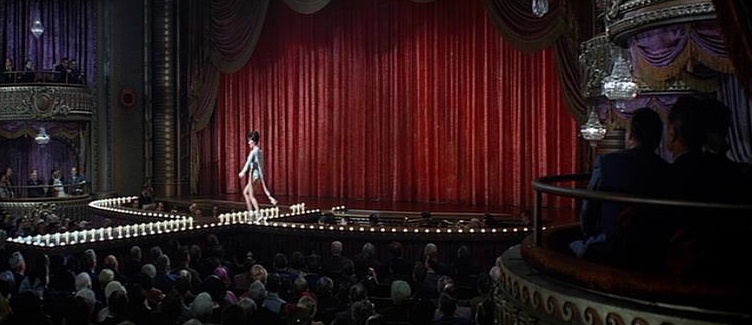
Although Rosalind Russell does do a little singing in this (such as the opening of "Rose's Turn"), most of her vocals were performed by Lisa Kirk (Broadway's Allegro), whose husky voice was probably chosen because it was more of a match to Russell's gravelly speaking voice. Unfortunately Kirk's singing is not especially euphonious in this, so they might just as well have let Russell handle all of it. Wood seems to do her own singing, but her off-key warbling perfectly fits her character. (The real Gypsy Rose Lee did not have much of a voice, and she was never as attractive as Natalie Wood!) Harry Stradling Sr.'s [Parrish] widescreen cinematography is a plus. Watch out for an amusing cameo by Jack Benny!

* "Baby June" grew up to become the successful actress June Havoc (not to be confused with June Haver, who married Fred MacMurray). She and her sister were estranged for many years, mostly over Gypsy, even though her depiction was not that negative. Her latter-day achievements after the events of Gypsy were completely eliminated of course. Her last theatrical film appearance was in Can't Stop the Music.

Verdict: Delightful! ***1/2. 

Thursday, April 2, 2015

PARRISH

Claudette Colbert looks at Troy Donahue with misgivings
PARRISH (1961). Writer/Producer/Director: Delmer Daves.

"If there's a death warrant for happiness, you've described it."

Ellen McLean (Claudette Colbert) gets a job as a sort of companion to Alison Post (Diane McBain), whose father, Sala (Dean Jagger), refuses to let Ellen's son, Parrish (Troy Donahue), live with them. Parrish nevertheless gets a job working Post's tobacco fields, and becomes friends with the vivacious if unsophisticated Lucy (Connie Stevens). Meanwhile Ellen finds herself drawn to the charismatic tobacco magnate, Jud Raike (Karl Malden), and Parrish soon finds himself with opportunities he may not desire, besides being in the middle of a love triangle with Lucy and Alison -- not to mention Jud's daughter, Paige (Sharon Hugueny). Parrish is a highly enjoyable light drama with some excellent performances. Although Troy Donahue is hardly in the league of the other actors, his brooding, intense quality works for the part and he even manages to do some genuine acting in certain scenes; he certainly doesn't ruin the movie as he did My Blood Runs Cold and may well have upped his game due to the influence of director Daves as well as Colbert and Malden; he proves a good listener if nothing else. Colbert gives a wonderful performance as the free-spirited mother who still has her standards; Connie Stevens and Diane McBain, one earthy, the other patrician, play with conviction; and Karl Malden, in a ferociously powerful performance, positively walks off with the picture. There is also fine work from Jagger [My Son John]; Hampton Fancher [Rome Adventure] as the slimy Edgar Raike; and Huguney as his love-happy sister, Paige. Director of Photography Harry Stradling [Suspicion] gives the picture a fairly glamorous sheen, and all of the aforementioned ladies -- and Donahue -- look stunning throughout. While nowadays the tobacco industry would be more deserving of an expose than a romance, Parrish is still a very entertaining picture. Max Steiner's insinuating musical score adds to the picture's class.

Verdict: Fine acting, interesting script, class production put this over. ***.

Thursday, September 12, 2013

SUSPICION

Lina (Joan Fontaine) suspects her husband wants to kill her
SUSPICION (1941). Director: Alfred Hitchcock.

Lonely heiress Lina (Joan Fontaine) meets the charming mountebank Johnnie (Cary Grant) and finally falls in love. The two get married and move into a huge house that Johnnie can clearly not afford. Lina discovers that her husband has an aversion to work of any kind, and an addiction to gambling, even selling antique chairs given to her by her father as a wedding present, for money. A friend named Beaky (Nigel Bruce) shows up and lets slip further information that unsettles the discomfited wife. After Lina fears that her husband might be involved in a death that occurred in Paris, she then suspects that he is planning to do away with her. But is she right -- or this time does two and two add up to five? Suspicion is a smooth, beautifully photographed [Harry Stradling] and handsomely produced thriller that features an outstanding performance from Fontaine and also boasts Grant at his best, never quite giving away whether he's a total rotter or not. Other notable players include Dame May Whitty and Sir Cedric Hardwicke as Lina's parents, and Leo. G. Carroll as Johnnie's cousin, from whom he embezzles. It's been said that the ending is tacked on and a bit of a cop-out, but it still works. Unusual scoring by Franz Waxman.

Verdict: Another smooth suspenser from the Master. ***1/2.