Lively, entertaining reviews of, and essays on, old and newer films and everything relating to them, written by professional author William Schoell.
Showing posts with label Robert Surtees. Show all posts

Thursday, July 13, 2017

TRIBUTE TO A BAD MAN

 Don Dubbins with his mentor, Cagney
TRIBUTE TO A BAD MAN (1956). Director: Robert Wise.

"You act like a man with a lot of ideas, all of them second-rate and none of them honorable." 

"A man doesn't die of a broken heart from his first love, only from his last."

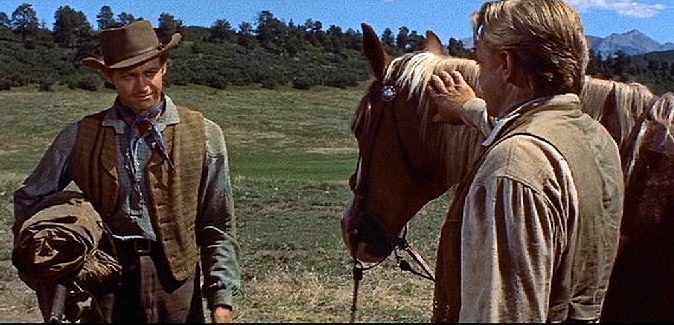
Young Steve Miller (Don Dubbins), who wants to be a cowboy or wrangler, winds up in the territory owned and run by Jeremy Rodock (James Cagney). Rodock has had to put up with people encroaching on his land and stealing horses and livestock for years, and he enacts his own rough justice, including hanging the perpetrators. The latest to earn his enmity is his old partner, L.A. Peterson (James Bell), and his son, Lars (Vic Morrow), but he may be wrong in his belief that either murdered one of his ranch hands. Rodock lives with Jocasta (Irene Papas, in her American debut), a woman with a past who is coveted by McNulty (Stephen McNally) and for whom Steve develops a growing infatuation. Finally tensions begin to boil over and Jocasta fears that Steve may develop the same hardness she sees in Jeremy, but is it possible that Rodock can mend his ways? Tribute to a Bad Man is an interesting western with some intriguing characters, and interactions among them, and the acting is uniformly good. Cagney is marvelous as the crusty autocrat with romantic leanings, and Papas gives a lovely performance as the woman he is devoted to. ("Introduced" in this film, Papas had already made several films overseas.) Don Dubbins was Cagney's protege, and the boyishly handsome actor always gives sensitive portrayals as he does here. McNally [The Lady Pays Off] and Morrow [Great White] make multi-dimensional villains, and James Bell and Jeannette Nolan [My Blood Runs Cold] score as Morrow's parents. Lee Van Cleef, Royal Dano, Peter Chong, and Onslow Stevens also make notable, if briefer, contributions. Cagney's patronage led to Dubbins appearing in this and These Wilder Years with Cagney, but the long career that followed consisted mostly of television work. This has nice widescreen Robert Surtees cinematography, adroit Robert Wise direction, a good Miklos Rozsa score, and a touching ending, although one could argue that the film certainly glosses over certain aspects of Rodock's character and actions.

Verdict: Romance and hangings in the wide open spaces. ***.

Thursday, September 15, 2016

QVO VADIS

The grandeur that was Rome courtesy of MGM
QVO VADIS (aka Quo Vadis/1951). Director: Mervyn LeRoy.

Marcus Vinicius (Robert Taylor) fights for the glory of Rome and its emperor, Nero (Peter Ustinov). He meets a woman named Lygia (Deborah Kerr) and the attraction is instant. Unfortunately, Lygia is a Christian and can't forget Vinicius' cruel soldier ways. Marcus then decides to enact an old Roman law that has Lygia forcibly taken away from her adoptive parents and brought to Nero's harem, where Marcus knows Nero has agreed to make a gift of her for him. But when Nero decides to blame the Christians for the burning of Rome, Marcus must decide on whose side he is really on, and if love will out. You can certainly quibble about certain aspects of Qvo Vadis, but as simple good story-telling and adept movie making, the picture is really a wonder to behold. Robert Surtees' cinematography is excellent, as are the scenic design, costuming, and matte paintings that make Rome seem even larger than it is. Miklos Rozsa also contributed an evocative score. As for the acting, Peter Ustinov gets the highest honors for his fascinating portrait of the petulant and often child-like, highly neurotic Nero. Kerr comes next, with her usual sensitive thesping, and even Robert Taylor, although certainly not on the level of those two, gives a good performance as Marcus. Leo Genn is fine as Marcus' uncle, although he is too perfunctory during his suicide scene. There are other notable performances from Patricia Laffan [Devil Girl from Mars] as Nero's nasty wife, Poppaea; Abraham Sofaer [Captain Sindbad] as Paul; Rosalie Crutchley [Blood from the Mummy's Tomb] as Acte, who loves Nero and runs his harem for him; Marina Berti as Eunice, a slave who adores her master, Marcus' uncle (the two have a moving death scene together); little Peter Miles [Roseanna McCoy] as young Nazarius, whose mother is killed when Rome burns to the ground; among others. Highlights of the well-directed film are the aforementioned burning of Rome; and the horrifying scenes of Christians being fed to the lions. There is a pre-Ben-Hur chariot battle, as well. Historians are still arguing over how accurate the assessments of Nero have been, so this picture must be taken with a grain of salt on that score.

Verdict: Almost as magnificent as Rome itself, and with its flaws as well, but this is splendid movie-making. ****.

Thursday, August 21, 2014

BEN-HUR

Stephen Boyd and Charlton Heston
BEN-HUR (1959). Director: William Wyler.

In 26 A.D. the Romans have taken over Jerusalem. Jewish Judah Ben-Hur (Charlton Heston) is reunited with his childhood friend Messala (Stephen Boyd), but earns his enmity when he refuses to help him in the Roman cause. When some tumbling masonry accidentally falls onto a Roman dignitary from a spot where Ben-Hur and his family are watching, Messala has all of them arrested, with Ben-Hur becoming a galley slave, and his mother (Martha Scott) and sister (Cathy O'Donnell) put in a dungeon and contracting leprosy. After an epic sea battle, Heston becomes adopted by the Roman consul Quintus Arrius (Jack Hawkins) and becomes known as an expert charioteer. Now Ben-Hur is ready to face his most hated enemy in the arena, leading to the chariot race to end them all. 

Ben-Hur could have been trimmed of an hour without losing any of its entertainment value, and while it has a strong story it survives on the strength of its set-pieces: the galley slave sequence; the sea battle; the crucifixion; and especially the outstanding chariot race which the whole movie leads up to. Heston [Bad for Each Other] is not bad as Ben-Hur, although it could be argued that he doesn't so much become the character as turn Ben-Hur into Charlton Heston. On the other hand, Stephen Boyd [Fantastic Voyage] gives the performance of a lifetime in his ferocious portrait of Messala. (Some, including the late Gore Vidal, have insisted that Messala's anger towards his old friend is caused by a frustrated homosexual attraction as, according to them, there seems no other good reason for his hatred -- as if his Roman pride and ambition, barely-suppressed anti-Semitism, and his unpleasant character couldn't be enough?) Haya Harareet [The Secret Partner] plays Esther, who loves Ben-Hur; she is capable but had few other credits. Ben-Hur is unnecessarily bloated, but it does boast attractive (if sometimes too prettified) settings, excellent matte paintings, generally skillful direction from Wyler, and fine photography by Robert Surtees and others. A scene with some beautiful trained Arabian stallions doesn't advance the story but one can see why it wasn't cut. Yakima Canutt, who co-directed several cliffhanger serials, worked on the chariot sequence (although it may be inaccurate to say that he "directed" it). Oddly enough, Wyler's The Big Country, also starring Charlton Heston, is more entertaining.

Verdict: Misses being a masterpiece, but has many fine moments. ***.