THE BLACK WIDOW (12 chapter Republic serial/1947). Directors: Spencer Gordon Bennet; Fred C. Brannon.
"Wait! Open the tunnels and we'll cremate them!" -- Sombra.
Sombra, aka The Black Widow (Carol Forman), heads a group of nasties who are out to take over America and are desperate to get their claws on a new rocket formula. Sombra takes orders from her father, Hitomu (Theodore Gottlieb), who appears in a special chair via molecular teleportation, and comes off more like a Yiddish comedian on the Borscht circuit than a world-class international villain. Two reporters investigate the Black Widow: Joyce (Virginia Lindley/Lee), who is experienced, and Steve Colt (Bruce Edwards), whose only experience is as a writer of detective fiction and who never misses a chance to be obnoxious and sexist with Joyce [true, he also saves her life on more than one occasion]. Forman [Federal Agents vs Underworld Inc.] who is Asiatic by way of Alabama, fairly drips with steely disdain and evil; Virginia Lee proves plucky and makes an acceptable heroine, but Edwards is utterly colorless as the alleged hero. Some of the cliffhangers in this are recycled, but there are nifty ones as well: Joyce, stuck in a crate, nearly tumbles out of an airplane, and is nearly beheaded by a falling pane of sharp glass. Then there's the old gag with a bomb in the car. The business with Sombra's henchmen using a gas to change the color of their car while in flight is clever. All in all this is a very entertaining Republic serial. Tom Steele and Ramsay Ames are also in the cast.
Verdict: Sombra will getcha if you don't watch out! ***.
Lively, entertaining reviews of, and essays on, old and newer films and everything relating to them, written by professional author William Schoell.
Thursday, November 13, 2014
THE AWFUL DR. ORLOFF
THE AWFUL DR. ORLOFF (aka Gritos en la noche/L'Horrible Dr. Orloff/1962. Director: Jesus [Jess] Franco.
With the assistance of the mute, disfigured servant Morpho (Ricardo Valle), Dr. Orloff (Howard Vernon) kidnaps young woman whom he uses in experiments to try to restore the beauty of his horribly scarred daughter, Melissa (Diana Lorys). Inspector Tanner (Conrado San Martin) is assigned to the case, in which several women have disappeared and descriptions are circulating of two sinister men. His fiance, opera singer Wanda (also played by Lorys), has seen the killer and stupidly decides to try to trap him on her own. Very reminiscent of Eyes without a Face, made two years earlier, almost to the point of being an imitation of it, The Awful Dr. Orloff is atmospheric and beautifully photographed by Godofredo Pacheco. There is full frontal nudity, much grabbing of naked breasts, and the film was undoubtedly considered sick for its day. The performances are adequate, but aside from the moody and poetic visual look of the film, this isn't especially memorable. Still, it's a lot better than many of Franco's movies [Count Dracula]. A Spanish-French co-production. For some reason in this the opera "Faust" is attributed to Meyerbeer instead of Gounod.
Verdict: Nice to look at if little else. **1/2.
VICE RAID
VICE RAID (1960). Director: Edward L. Cahn.
Tough gal Carol Hudson (Mamie Van Doren) is importuned to help her sugar daddy Vince Malone (Brad Dexter of Macao) frame vice cop Sgt. Whitey Brandon (Richard Coogan), who is threatening his modeling agency/call girl rackets. But then Carol's innocent, sweet sister, Louise (Carol Nugent) comes to town ... The best performance in this mediocre crime drama is from Barry Atwater as the sinister, kind of sexy Phil, who goes after the sister when he can't get Carol. Van Doren [High School Confidential] is competent, but she isn't riveting, and in this at least lacks that X factor that makes a big star. The other performances are at least professional. Nestor Paiva [Tarantula] has a small role.
Verdict: Low-grade melodrama with mostly minor-league performances. *1/2.
PASSION
PASSION (2012). Director/writer: Brian De Palma.
Christine Stanford (Rachel McAdams) is an advertising executive who takes credit for an idea developed by her assistant, Isabelle (Noomi Rapace). When Isabelle starts to assert herself -- and sleep with Christine's what-are-they-thinking? boyfriend, Dirk (Paul Anderson) -- Christine doesn't like it and humiliates her publicly. It all leads to bitchery of the extreme kind, as well as betrayal and murder. This is a remake of the mediocre Love Crime and is slightly better than the foreign original, though no world-beater. The film is more homoerotic than the original, but more likely because De Palma finds girl-on-girl action sexy than because of any desire to seriously explore lesbianism -- in fact, it's fairly exploitative and childish when it comes to the subject. The movie even goes so far as to present a lesbian as a blackmailing sexual predator! [In one stupid scene Christine calls an employee, Dani (Karoline Herfurth) a "dyke" and the latter lets her get away with it even though she just witnessed Christine kissing Isabelle on the lips!] Passion holds the attention and isn't badly acted, but it's nowhere in the league of De Palma's best movies, such as Carrie.
Verdict: Only for people who are easily titillated. **1/2.
Thursday, November 6, 2014
MOTHER IS A FRESHMAN
| Rudy Vallee, Loretta Young and Van Johnson |
Since her trust fund can't be accessed for several months, Abigail Fortitude Abbott (Loretta Young), a widow with a college-age daughter, has to figure out how to pay her bills. Most people would get a job, but instead Abigail decides to take advantage of a bizarre clause in her grandmother's will which allows anyone with her exact name to get a scholarship to her alma mater. So Abigail goes to classes at the same school as her daughter, Susan (Betty Lynn of Cheaper By the Dozen), but the two keep their relationship a secret. Wouldn't you know that both mother and daughter fall for the same handsome and charming Professor Michaels (Van Johnson)? Mother is a Freshman is highly-contrived but cute, with excellent performances, but it doesn't quite sustain the fun, although it's consistently pleasant. Barbara Lawrence [Kronos] plays another co-ed, and Rudy Vallee, once a singing idol, is again cast in middle-age as a stuffy unattractive-to-women type, in this case Abigail's lawyer, as he was in Unfaithfully Yours and other movies.
Verdict: Perky Loretta and dreamy Van make a good combo. **1/2.
STOP ME BEFORE I KILL!
STOP ME BEFORE I KILL! (1960). Director: Val Guest.
Race car driver Alan Colby (Ronald Lewis of Scream of Fear) is still recovering from a very serious highway accident and is on vacation with his wife, Denise (Diane Cilento of The Third Secret). Alan loves Denise, but has recurring feelings that he may harm or even kill her due to a neurotic nature he can't control. Denise seeks help from slimy psychiatrist David Prade (Claude Dauphin), whom most people wouldn't buy a used car from or anything else. Can Prade get to the root of Alan's psychological problems before disaster occurs? Stop Me Before I Kill! features a fine lead performance from Lewis, and a notable supporting performance from Francoise Rosay [September Affair] as David's mother -- the others are not bad, either -- but it's slowww, long, stagy and talky, and would have been better off as a half hour TV episode, although the "twist" in this can be seen coming practically from the first. An honest-to-goodness plot never really develops.
Verdict: A Hammer thriller that bores much more than it thrills. **.
MOTHRA VS GODZILLA
| Yuriko Hoshi, Akira Takarada, Hiroshi Koizumi |
A gigantic egg is found floating offshore and a greedy entrepreneur decides to claim it and exhibit it, even though the tiny little twins from Infant island tell him it is the giant moth Mothra's egg and it must be returned to avoid "problems." Concurrently, Godzilla reawakens from his recent burial [in Godzilla Raids Again, perhaps?] and goes on another rampage. Professor Miura (Hiroshi Koizumi), reporter Ichiro (Akira Takarada), and pretty photographer Yoka (Yuriko Hoshi) appeal to the islanders to send Mothra to battle Godzilla, as the former's egg is threatened by the big lizard. The battle between the big bug and a flabby-jawed Godzilla is pathetic, the process work is decidedly uneven (with a few effective shots), and even children probably found this to be ultimately tedious. There is some majestic music as well as the twins' awful songs to Mothra. Akira Takarada, known as "Mr. Handsome" in Japan for good reason, was also in the original Godzilla/Gojira. FX by Eiji Tsuburaya. At least Mothra is a colorful and "attractive" creation.
Verdict: For Godzilla completists only. **.
A BULLET FOR PRETTY BOY
A BULLET FOR PRETTY BOY (1970). Director: Larry Buchanan.
In this pretty much entirely fictionalized story of "Pretty Boy" Floyd (former pop singer/teen idol Fabian Forte), Floyd is a sympathetic figure who only fell into crime because he was unfairly accused of murdering the man who shot his father to death. Before long prison escapee Floyd is under the wing of a middle-aged madame named Beryl (Annabelle Weenick), robbing banks with confederates, and becoming a kind of handsome folk hero. Forte doesn't disgrace himself in the role but the acting isn't the main strength of this movie, which is clearly aimed at the non-discriminating drive-in market and wears out its welcome pretty quickly. Larry Buchanan was also responsible for Zontar the Thing from Venus. At least this has somewhat better production values.
Verdict: Nothing all that pretty in this low-grade melodrama. **.
NO BLADE OF GRASS
| Mediocre duo: Nigel Davenport and Jean Wallace |
Extreme pollution and a grain-destroying virus have combined to cause hunger and even cannibalism in parts of the world, and citizens of the UK are afraid it isn't long before the same thing happens to them. John Custance (Nigel Davenport), his wife, Ann (Jean Wallace), their children, and friend Roger (John Hamill) take off for a farm in the countryside but have a hell of a time getting there. Along the way they hook up with Pirrie (Anthony May), a casual murderer, but they descend into savagery just as much as everyone else. Eventually Custance is pitted against his own brother ... No Blade of Grass is well-directed by Cornel Wilde [The Naked Prey] -- who does not appear in the film but offers some narration -- but can't overcome its weak script and the miscasting of its two mediocre leads, Davenport [A Man for All Seasons] and Wallace [Jigsaw], although there are good performances from members of the supporting cast. There are some arresting sequences, such as the harrowing business when the family tries to get out of a mob-ruled city by car, and a tense stand-off between Custance and Pirrie over the daughter, Mary (Lynne Frederick). George Coulouris [Citizen Kane] has a small role as a gun shop owner. Despite all of the very grim goings-on, No Blade of Grass manages to become quite tedious after awhile. There is hardly a sympathetic character in sight.
Verdict: Unremittingly depressing, and not good enough to compensate for it. **.
JOURNEY TO THE UNKNOWN
![]() |
| George Maharis in "Miss Belle" |
This British import ran for one season and was produced by Joan Harrison, who worked on Alfred Hitchcock Presents, but if this show is any indication she had lowered her standards for scripts considerably for the later series. The majority of episodes not only would have been instantly rejected by Hitch, but are lame by any standard, with weak premises devoid of a final snap or twist. There are very few exceptions. "The New People" is an excellent, creepy, and suspenseful episode [directed by Peter Sasdy from Charles Beaumont] in which a young couple have very strange if fun-loving neighbors; the cast includes Robert Reed and a notable Milo O'Shea. "One on an Island" [from Donald Westlake] features a fine performance from Brandon De Wilde [All Fall Down] in an absorbing story of a young man shipwrecked on an isolated island. It shouldn't work at all but somehow it does. "Matakitas is Coming" stars Vera Miles as a woman who writes about murders for a magazine and finds herself locked in a library that has somehow gone back in time to the night a librarian was murdered by a maniac back in the 1920s. The murderer is creeping about, and so is the victim ... The episode has an excellent premise even if its execution is uneven and a little confusing. Also Miles is a little too perfunctory at times given her character's situation. "Somewhere in a Crowd," with David Hedison [Voyage to the Bottom of the Sea] giving one of his best performances (in a tale wherein the same group of people keep showing up at disasters), would have been one of the series' more memorable episodes were it not for the fact that it's a complete, uncredited rip-off of Ray Bradbury's 1948 short story "The Crowd." George Maharis appears in an unpleasant look at child abuse -- a woman raises her little nephew as a girl -- in "Miss Belle." And there were episodes even worse than that.NOTE: Some of the episodes from the show were strung together to make TV movies. One, Journey to the Unknown, features Joan Crawford as host and presents "Matakitas" and an episode with Patty Duke vacationing at the English seaside at an inn with a strange landlady.
Verdict: Three decent episodes does not a great series make. **.
DR. T AND THE WOMEN
DR. T AND THE WOMEN (2000). Director: Robert Altman.
Dr. Travis (Richard Gere with a white-haired dye job) is a Dallas gynecologist with an exclusive clientele. His wife Kate (Farrah Fawcett) has a public meltdown -- she takes off all of her clothing and steps into a fountain -- and winds up institutionalized, after which he embarks on an affair with new golf club employee, Bree (Helen Hunt of Empire Falls). Meanwhile his family and patients are bothering him with an assortment of problems: nurse Carolyn (Shelley Long) is secretly in love with Dr. T, and his daughter, Dee Dee (Kate Hudson of The Skeleton Key), has invited her former female lover (Liv Tyler) to her wedding (to a man) as maid of honor; Dee Dee's sister thinks the marriage is a mistake, for obvious reasons. [Bree has a supposedly open-minded but pretty stupid reaction to this whole rather contrived business.] Other cast members include Lee Grant as a shrink; Andy Richter, who makes no impression, as a buddy; Janine Turner as a neurotic patient; and Laura Dern. In its treatment of the lesbian couple the movie strikes some liberated, if awkward, sparks, but somehow it still seems old-fashioned and unsatisfying, although it's more watchable than a lot of Altman's[Popeye] movies. One interesting sequence graphically shows the miracle of child birth.
Verdict: Typically rambling and unfocused Altman with some good scenes and okay acting. **1/2.
Thursday, October 30, 2014
HAPPY HALLOWEEN!
HAPPY HALLOWEEN from Great Old Movies!
Here's a round-up of horror films and TV shows to check out during this sinister occasion!
Dress up, grab some pumpkin pie and cocoa -- or something stronger -- and watch a good -- or not so good -- horror flick this evening.
Have fun -- and, as always, thanks for reading!
Here's a round-up of horror films and TV shows to check out during this sinister occasion!
Dress up, grab some pumpkin pie and cocoa -- or something stronger -- and watch a good -- or not so good -- horror flick this evening.
Have fun -- and, as always, thanks for reading!
THE DEVIL WITHIN HER
![]() |
| Cute li'l fella |
Lucy Carlesi (Joan Collins) does an act with a dwarf, Hercules (George Claydon), who tries to take liberties with her in her dressing room. When she doesn't comply, he puts a curse on her. The result is that Lucy becomes suspicious of, and terrified by, her adorable baby boy, Nicholas, who is apparently possessed by the still-living Hercules and runs about committing fiendish murders, such as beheading Lucy's doctor (Donald Pleasence) with a shovel! The Devil Within Her is utterly absurd but entertaining, greatly abetted by the very good performances of Collins, Pleasence, John Steiner as a sleazy club owner, Tommy; Ralph Bates [Horror of Frankenstein] as Lucy's husband, Gino; Caroline Munro [The Spy Who Loved Me] as her sister, Mandy; and especially Eileen Atkins [Madame Bovary] as her sister-in-law, Sister Albana. It's Alive, which was made the year before and also featured a killer baby, at least gave its monster fangs and claws and a hideous appearance, but aside from a couple of illusions of the infant resembling the dwarf, this baby is just an adorable little tyke, making the whole project even weirder (the child is so angelic-looking that his gruesome acts seem rather comical). Peter Sasdy also directed Hands of the Ripper and many others. The original title of the film was Sharon's Baby even though the mother is named Lucy. While this film is by no means intellectual, one could claim that it cleverly exploits parents' fears about children and the life/financial changes the little dears bring about. Ray Bradbury once contributed just such a story to an EC horror comic in the fifties.
Verdict: Ridiculous but has a good cast and even some suspense. **1/2.
THE CURSE OF THE WEREWOLF
| Oliver Reed |
In a prologue, we meet a miserable landowner, the Marques Siniestro (Anthony Dawson), who wrongly imprisons a mute servant girl (Yvonne Romain), simply because she won't respond to his repulsive advances. In her cell the poor woman is raped by another prisoner (Richard Wadsworth), and then dies in child birth. Her son, Leon (Oliver Reed), is raised by the gentlemanly and compassionate Alfredo (Clifford Evans). Leon goes off to work for a wine merchant, and falls for the man's daughter, Christina (Catherine Feller). Christina's father objects to their romance, but Leon has a more serious problem -- when the moon is full the cursed man turns into a werewolf, running home to commit flesh-tearing murders. Director Fisher has done some excellent Hammer horror pictures, but somehow this misses, a victim of awkward continuity and Reed's overwrought performance, although the other cast members are good, especially Feller, and Hira Talfrey as the servant Teresa. Benjamin Frankel's musical score is a decided plus. This was based on Guy Endore's "Werewolf of Paris."
Verdict: A lesser Hammer despite the talent involved. **.
THE FLY II
THE FLY II (1989). Director: Chris Walas.
Martin (Eric Stoltz), the son of Seth Brundle from the remake of The Fly, fully grown at five [!], is raised in an isolated section of a laboratory, whose head, Bartok (Lee Richardson) -- although he pretends to be a father to the boy -- is only hoping to use the creature he'll turn into as a kind of weapon. Martin wants love, and nearly gets it in the form of employee Beth (Daphne Zuniga), but even she is horrified when Martin begins ... changing ... due to his mutated genes. Then the Martin-creature takes off after all of his tormentors with predictable if messy results. The Fly II starts off well -- has some good scenes such as when Martin discovers his beloved dog didn't die but was used in a ghastly experiment -- but quickly becomes schlocky, and not even very good performances from Stoltz, Richardson and others can salvage it, although it is fairly entertaining throughout and moves fast. At least it's better than Return of the Fly, the sequel to the original. Some of the characters in this, such as Dr. Jainway (Ann Marie Lee), are so odious that they seem like variations of Snidely Whiplash!
Verdict: Stick with the first and best. **1/2.
JACK'S BACK
JACK'S BACK (1988). Director/writer: Rowdy Herrington.
John Wesford (James Spader) works at a medical clinic in Los Angeles, which is currently besieged by a maniac who is reenacting the murders of Jack the Ripper exactly one hundred years after they originally occurred. Besides John, suspects include the strange shrink Dr. Battera (Robert Picardo), John's obnoxious boss Sidney Tannerson (Rod Loomis), his beefy co-worker Jack Pendler (Rex Ryon), and others. John comes across a murdered hooker named Denise (Danitza Kingsley), sees someone running from the scene, and then the movie does a 180 degree turn, with a new lead character turning up just as you're scratching your head at what's going on ... Spader and the other actors are fine, but Jack's Back substitutes a mid-movie twist for a solid plot, with the killer's motivations and logic unresolved, and the 100 Years Later Jack the Ripper premise pretty much goes nowhere. The BBC series Whitechapel: The Ripper Returns took the same idea years later and really ran with it. Cynthia Gibb plays Spader's co-worker and a potential love interest. This probably looked good on paper but it's sunk by its contrivances.
Verdict: Although there's some suspense of a minor kind, this is a Ripper movie you can live without. **.
EIJI TSUBURAYA: MASTER OF MONSTERS
EIJI TSUBURAYA: MASTER OF MONSTERS. August Ragone. Chronicle; 2007.
From the outset and in full disclosure I must say that with one or two exceptions, I'm not a big fan of Japanese monster movies/science fiction. I also wouldn't compare Japanese FX man Eiji Tsuburaya to the great stop-motion specialist Ray Harryhausen, especially when it comes to monsters. Harryhausen brought his creatures to life with painstaking stop-motion animation, while Tsuburaya used "suit-mation" -- a guy in, say, a Godzilla costume -- and some models. I have seen most of the films discussed in this book and have to say there is absolutely nothing to compare to the fight with the skeletons at the end of Jason and the Argonauts. To be fair, Tsuburaya did more than just work on monsters, and the book details his contributions to Japanese cinema while also examining some aspects of his private life. Master of Monsters is well-researched, and packed with loads of behind-the-scenes black and white and color photographs. An over-sized trade paperback, it is printed on thick paper stock. If you're interested in Japanese sci fi and how the films were made, this is definitely the book to get.
Verdict: For fans of Japanese monster movies -- all others beware. ***.
LIZZIE BORDEN TOOK AN AX
LIZZIE BORDEN TOOK AN AXE (2014 Lifetime telefilm). Director: Nick Gomez.
Lizzie Borden (Christina Ricci) is arrested and put on trial when her father, Andrew (Stephen McHattie of XIII) and stepmother Abby (Sara Botsford of Murder By Phone), are axed to death about an hour apart in their own home. Lizzie's sister Emma (Clea DuVall) sticks up for her sister but has nagging doubts, and the whole town turns against them. This look at the famous, unsolved murders offers nothing new, has stick-thin characters, provides little motivation, and is awash in a rock score that is not only inappropriate but gives the whole project a mindless veneer. The acting is okay enough, although to be fair to Ricci she really isn't given much of a character to play. Lizzie's alleged lover, actress Nance O'Neil [Transgression], is briefly portrayed by Andria Wilson, but there is little about Lizzie's possible lesbianism or how it may have influenced prosecutors. The movie gets a lot wrong about the case -- it's as if the writer just threw together a script based on conjecture and other movies and didn't do any research.
Verdict: Not much to this by-the-numbers look at an infamous murder case. **.
Sunday, October 26, 2014
Farewell Larry
![]() |
| Gloria Swanson with reporter Larry Quirk |
Larry Quirk was my best friend and longtime companion for 35 years. Larry had been an Army sergeant during the Korean War, a Hearst reporter covering the crime beat, a Hollywood columnist and publicity man, and the author of numerous books on movies and celebrities, such as the bestselling Fasten Your Seat Belts: The Passionate Life of Bette Davis and The Kennedys in Hollywood, to name just two. Larry and I collaborated on a few books as well.
It's fitting that of the two pictures I've chosen for this post -- one when Larry was relatively young, decades before I'd met him, and another when he was older -- the first features Gloria Swanson a year or two before she did Sunset Boulevard, a still from which graces this blog. After a solid body of books behind him, Larry began tendering "Quirk Awards" named for his uncle, James. R. Quirk, who edited and published Photoplay magazine back in the golden age. Therefore the second photo shows Larry giving Claudette Colbert an award in her dressing room when she was appearing on Broadway. Originally the awards were for films and actors, but when I began tendering them along with Larry we made them full-fledged performing arts awards, with venues ranging from the Roosevelt Townhouse to the 5 Oaks bar and Rose's Turn in the village, to St. Clement's Theatre on 46th street.
![]() |
| Larry with Claudette Colbert |
He was a true original, and I and others will miss him very much.
Rest easy, Larry.
Thursday, October 23, 2014
THE NIGHT OF THE IGUANA
| Deborah Kerr and Richard Burton |
"Don't make me take steps, Dr. Shannon ..." -- Judith Fellowes.
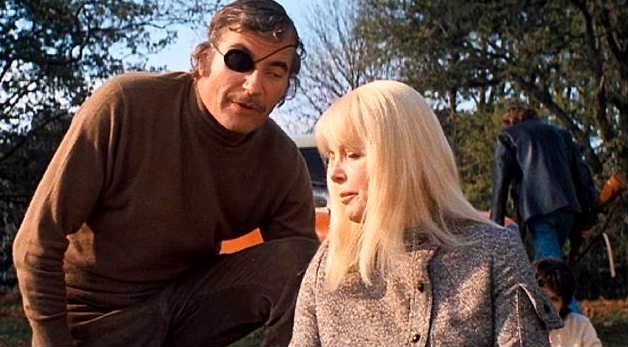
The former minister T. Lawrence Shannon (Richard Burton), who was locked out of his church, is now guiding ladies on a tour bus through Mexico. Young Charlotte Goodall (Sue Lyon) can't keep her hands off Shannon, inspiring the ire of her formidable guardian Judith Fellowes (Grayson Hall). Shannon takes the gals to a small hotel run by an old friend, Maxine Faulk (Ava Gardner), whose husband died a short while ago. While some of the tourist ladies put up a fuss, Maxine reluctantly admits the impoverished artist Hannah Jelkes (Deborah Kerr) and her aged poet father, Nonno (Cyril Delevanti) to her hostel. As these characters interact and Shannon faces dismissal from the tour business, will the man finally find himself "at the end of his rope," like one of the iguanas tied to the stairs? Like many Williams' adaptations The Night of the Iguana is a mix of the poetic and the pretentious, but it does have some very tender moments. Burton, Lyon and Delevanti walk off with the acting honors. Grayson Hall [House of Dark Shadows] is a bit overwrought, almost ridiculous at times, as Judith, but the whole idea of the fire-breathing repressed lesbian is terribly dated. Deborah Kerr [Edward, My Son] is good, but she doesn't quite get across the weary defeatedness of someone who is a caregiver to a man in his nineties [walking him around Mexico in the heat with little money could almost be considered elder abuse], and is apparently homeless besides -- where is the sheer desperation she would be feeling? Gardner [Seven Days in May] is not bad at all and suitably earthy; Bette Davis played the role on the stage. The poem that Nonno completes, written by Williams, of course, is beautiful. Despite its flaws, the movie casts a certain exotic and haunting spell.
Verdict: Imperfect but entertaining and well-acted, with some interesting characters. ***.
WORLD WITHOUT END
WORLD WITHOUT END (1956). Director: Edward Bernds.
Four American astronauts on a trip to observe but not land on Mars, wind up caught in a super-speed time warp and arrive on Earth in 2508 AD. There they find that one-eyed mutates rule over savage humans who roam the countryside, while the dregs of intelligent humanity hide inside a mountain HQ. The men are old and eunuch-like and wear hideous outfits, while the younger women are clad in glamorous gowns that show up sexy legs. Yes, welcome to the future -- or rather 1956! The astronauts also encounter two giant mutated spiders -- unconvincing mock-ups -- in a cavern. World Without End has a few ideas -- it's not as dumb, say, as Queen of Outer Space, also directed by Edward Bernds -- but most of them are recycled. Like Queen, this is also decked out in CinemaScope and Technicolor. The astronauts are played by Hugh Marlowe, Rod Taylor (who would have somewhat similar adventures in The Time Machine a few years later), Nelson Leigh (The Adventures of Sir Galahad), and Christopher Dark, while the attractive ladies are Nancy Gates, Shawn Smith (The Land Unknown), and Lisa Montell. Everett Glass plays aged Timmek, who rules the underground society, and Booth Colman is Mories, who can hardly wait to take over. The credits for most of these actors were largely on television. Not enough is made of the fact that the astronauts will never see their loved ones or time period again, but then this isn't exactly intellectual material. Very influential, for better or worse, on such later movies as Beyond the Time Barrier.
Verdict: Even big spiders can't save this from being rather boring. **.
JOHN WAYNE: THE LIFE AND LEGEND Scott Eyman
JOHN WAYNE: THE LIFE AND LEGEND. Scott Eyman. Simon and Schuster; 2014.
Examining the life and very long career of John Wayne from a largely positive angle, the book makes a case for him as a fine actor and misunderstood human being who had more facets to him than people realized. Frankly, the lengthy book probably won't change the minds of people who saw Wayne as distinctly limited, especially in his middle-aged years (although he could give very good performances and was more talented than his detractors would suggest) nor those who saw him as a swaggering hypocrite. Wayne became quite the war hawk when he was too old to serve in the military, but during WW2, when other actors with big careers enlisted, he fell back on deferments that other stars rejected. [His attempts to get into the O.S.S. do not seem that whole-hearted.] Eyman scrutinizes Wayne's friendships, romantic involvements, movies, and performances, and the book may make you want to search out such classics as Stagecoach and The Searchers, if you haven't seen them already. While Eyman does include some negative critical and political reaction to Wayne, his approach is, frankly, so worshipful at times that the book can't be considered objective by any standard -- but that, of course, is the author's right.
Verdict: Informative and well-done for the most part if just a bit slanted. ***.
A COLD WIND IN AUGUST
A COLD WIND IN AUGUST (1961). Director: Alexander Singer.
Iris Hartford (Lola Albright) has been disappointed by the men in her life, so she decides to slap the make on a boy this time, the super's 17-year-old son, Vito (Scott Marlowe). The two fall in love, but Vito can't deal with Iris' profession. Right away the movie has a problem because Scott Marlowe was actually 29 at the time of filming, and looks considerably older, so the whole idea of a supposed twenty year age difference is completely lost; Albright was 36. Marlowe gives a good performance, but can't quite compensate for his miscasting. Albright is much more interesting in this than she was in her white bread role on Peter Gunn, but the greatest actress in the world would have trouble making the confused and confusing, underwritten Iris come alive. Joe De Santis scores as Vito's father, Mr. Pellegrino, and Herschel Bernardi, also from Peter Gunn, is excellent as a "friend" of Iris who is clearly in love with her. Perhaps the most notable performance is given by Clarke Gordon as Iris' desperate ex-husband, Harry. This script should probably never have been filmed, at least not with these leads. Singer also directed Love Has Many Faces with Lana Turner.
Verdict: Under-baked, with titillation that goes nowhere slowly. **.
CAUGHT IN THE ACT
| Henry Armetta |
Mike Ripportella (Henry Armetta) is expecting the day of his daughter's wedding to be eventful, but he has no idea of exactly what a misadventure it will be. Mike works for a construction contractor, Brandon (Charles Miller of Phantom of Chinatown), but has no clue that his boss has been threatened by racketeers, and that he's been promoted because Brandon thinks he's too honest to play ball with them (and may inspire their ire more than Brandon). Then there's the hard, flashy blonde, Fay (Maxine Leslie) who jumps into Mike's car and inspires the jealousy of his wife, Mary (Inez Palange) -- the two women wind up sharing a jail cell after the cops come to arrest Mike, thinking he's a hoodlum. This comedy-melodrama of mistaken identities features a good performance from Armetta and the others. Iris Meredith of The Green Archer plays the daughter, Lucy. William Newell of The Invisible Killer plays the desk cop, Riley.
Verdict: Nothing special but amiable enough. **1/2.
THE BABY
![]() |
| David Mooney (Manzy) and Ruth Roman |
Social worker Ann Gentry (Anjanette Comer) is a widow who lives with her mother-in-law, Judith (Beatrice Manley). She asks to be assigned to the case of the Wadsworth family, who live in a big rundown house and live off the money given them by the state for the care of a member they call "Baby." Although he has the mind of an infant and sleeps in a crib, Baby (David Mooney/Manzy) is actually a grown man. Ann comes to believe that his problem isn't true retardation, but that for some reason his mother (Ruth Roman) is holding him back developmentally. In the meantime Baby is poked with an electric prod by his sadistic sister Alba (Suzanne Zenor); his other sister Germaine (Marianna Hill of The Astral Factor) takes off her clothes and climbs into the crib with him; and in an even more tasteless scene -- if that were possible -- his babysitter abuses him. But as awful as the Wadsworths may be, is it possible that Ann Gentry is even worse and has her own plans for Baby ...? The Baby is well-acted, especially by Mooney, but it is so exploitative of the mentally ill that it's rather hard to take at times. The movie gets points for originality, but little else. Even the plot twists are pretty sick. This is the kind of movie that does no one's career any good. Tod Andrews, who plays a doctor, was the star of From Hell It Came.
Verdict: Too repellent to be entertaining. For a more sensitive look at the mentally-challenged see A Child is Waiting. **.
88 MINUTES
88 MINUTES (2007). Director: Jon Avnet.
The testimony of FBI psychologist Jack Gramm (Al Pacino of The Recruit) helped put away a fiendish killer, Jon Forster (Neal McDonough), who is about to be executed. Gramm then gets a call in which an unknown person tells him he only has 88 minutes to live, a number that has special significance to him. Gramm figures Forster is behind it all, but who is his ally outside of prison? One of Gramm's students? His teaching assistant, Kim (Alicia Witt of Urban Legend)? Her motorcycle-riding boyfriend? His secretary, Shelley (Amy Brenneman)? The movie, with its hints of dark deeds in the past, numerous twists and red herrings, reminds one of a giallo film by Italian director Dario Argento, but without the cinematic flourishes or sick violence. The performances are good, and the slick movie moves fast enough to keep you from dissecting what's going on too carefully. Whatever its flaws, 88 Minutes is quite entertaining.
Verdict: Pacino treading water. ***.
Thursday, October 16, 2014
BEYOND THE TIME BARRIER
BEYOND THE TIME BARRIER (1960). Director: Edgar G. Ulmer.
Major William Allison (Robert Clarke) flies his plane on a test run and somehow manages to cross the time barrier, winding up in a dismal world 64 years in the future. Due to a cosmic plague from space travel, the inhabitants of the underground city he is taken to are mostly sterile deaf mutes, and there are mutants -- with very wrinkled bald pates -- groveling in a prison pit. People who have escaped the plague are contemptuously referred to as "Scapes." Both the Captain (Boyd "Red" Morgan) and Supreme (Vladimir Sokoloff), who are the rulers, suspect Allison of being a spy, although it's hard to imagine why anyone would want to spy on this pathetic "civilization." Other "spies," whose aircraft or spacecraft also crossed the time barrier in later years than Allison's, include General Kruse (Stephen Bekassy of Black Magic), Dr. Bourman (John Van Dreelen of The Leech Woman) and Captain Markova (Arianne Arden Ulmer, the director's daughter). The most sympathetic person in this futuristic world is Trirene (Darlene Tompkins), who seems to have some psychic power and is hoping to repopulate the world with Major Allison. The other "spies" want to help Allison get back to his time so he can prevent the plague, but perhaps they have something more sinister up their sleeves ... Clarke [The Hideous Sun Demon], who also produced, gives a good performance in this, but the movie is old comic book-level sci fi schlock: dying future societies with horrible mutants were nothing new even in 1960, and a couple of interesting ideas are not well-developed. The acting is generally good, with Arianne Ulmer, who had few other credits, credibly bitchy, and the expressive Tompkins, who was introduced in this picture, poor gal, getting things across with no dialogue; she had a few more credits than Ms. Ulmer. Both Sokoloff and Boyd, who wears a ridiculously long and pointy beard in this, had a great many credits. The ending is rather downbeat, especially given that the Major is a pretty decent guy.
Verdict: Could have used a few monsters to liven things up; Clarke deserved better. **.
THE FIRST TRAVELING SALESLADY
![]() |
| Very odd pairing: Clint Eastwood and Carol Channing |
In 1897 feminist Rose Gillray (Ginger Rogers) tries to make a killing selling corsets, but when that doesn't pan out she inveigles a job selling barbed wire in the wild west, but has to deal with a powerful rancher, James Carter (David Brian), who is opposed to the use of it. Rose has a sort of thing going with Charles (Barry Nelson,) who has a horseless carriage, while her assistant Molly (Carol Channing) becomes embroiled in a romance with Lt. Rice (Clint Eastwood) in one of filmdom's strangest pairings. The performances are all good in this, with Rogers affecting a high squeaky voice and Channing, sounding just like "Satchmo," just being her own weird self. James Arness [The Thing from Another World] and Tristram Coffin [Up in the Air] have smaller roles.
Verdict: Cute picture. ***.
Subscribe to:
Posts (Atom)


.jpg)