Lively, entertaining reviews of, and essays on, old and newer films and everything relating to them, written by professional author William Schoell.
Showing posts with label Rudolph Mate. Show all posts

Thursday, October 15, 2020

NO SAD SONGS FOR ME

Margaret Sullavan
NO SAD SONGS FOR ME (1950). Director: Rudolph Mate.

A young wife and mother (Margaret Sullavan) discovers she has inoperable cancer and tries to arrange for another woman -- a co-worker of her husband's -- to take over when she's gone. This sounds like very depressing subject matter, but while the movie is very moving, it's also uplifting due to the artistry of Sullavan, whose performance is compelling, affecting and restrained yet believable. Although you of course know the outcome from the first, the story is still unpredictable. Howard Koch's fine screenplay transcends soap opera, and the supporting performers (Wendell Corey as the husband, Viveca Lindfors as the co-worker who falls in love with him) are also excellent. The raw graphic treatment that you would see in a film of this subject today is avoided, but at the same time, Sullavan does not get more glamorous as her health worsens. Some might find the final scene a bit pat, but it works for this movie, and avoids a morbid air. Very worthwhile. This is "adult" material in the best sense of the word.

Verdict: Great. ***1/2.

Thursday, June 1, 2017

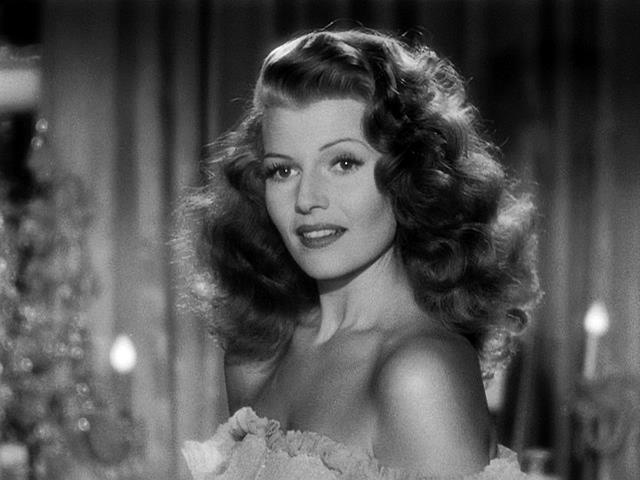
GILDA

Rita Hayworth
GILDA (1946). Director: Charles Vidor.

"Hate can be an exciting emotion. Very exciting. Hate is the only thing that can ever warm me." -- Ballin Mundson.

"If I'd been a ranch, they'd have named me the bar nothing." -- Gilda.

Down Argentine way just at the end of WW2, a hustler and crooked gambler named Johnny Farrell (Glenn Ford) is nearly robbed when a stranger on the docks with a spear in his cane comes to his rescue. The stranger is casino owner Ballin Mundson (George Macready), who hires Johnny to look after his interests. Some time later Ballin introduces Johnny to his beautiful wife, Gilda (Rita Hayworth), and both feign ignorance of the fact that they were once involved. Johnny and Gilda have a real love-hate relationship to add to the stew, and Ballin has a consortium with a bunch of Germans to add to the confusion. After a man is murdered in the casino, Ballin seems to commit suicide in his plane ... What to make of the modestly entertaining and often silly Gilda? Artificial and Hollywoodish as all get-out, with one-dimensional characters and one of the shortest climaxes in the history of the movies, Gilda has a few interesting twists and turns and is distinguished by the sex appeal and fine, constantly insinuating performance of Rita Hayworth, who makes the most of a standard role of the good-bad girl who is kept by wealthy men while loving the poor fellow she truly adores. Ford is not bad, if miscast, as the grubby borderline lowlife who winds up a kind of bodyguard/ersatz gunsel to Ballin (the narration he's given is unnecessary). Macready gives a good performance -- probably the longest and most famous of his career -- although some of his line readings are a little too matter-of-fact; one can think of other actors who might have played it in a somewhat more colorful and poetically sinister fashion. Steven Geray, Gerald Mohr, and Joseph Calleia all score as, respectively, a lowly casino employee who knows where the bodies are buried; a slimy guy with a hankering for Rita; and the police inspector who is concerned with the doings of the German consortium (even if no one in the audience is).

Some people* have had a different reading on Gilda, claiming that Johnny Farrell is a literal hustler on the bisexual side, Ballin's boyfriend, in fact, and that Johnny's self-hatred forced him to walk away from Hayworth before the story begins. This theory has it that Ballin needs to have power over attractive people of both sexes (one is reminded of Clifton Webb's character in Laura). Unfortunately, this take on the film makes it seem like a bad, regressive gay novel of the forties -- the tormented "queer" pulls away from the guy he's with and walks off into the sunset with a woman -- and while some advocates of this theory can point out certain lines and situations in scene after scene (and they may even have a point), they forget that many, many movies featured bad (and good) guys with live-in bodyguards and buddies, and this was never necessarily considered homoerotic. The proponents of this theory would have a lot to make of the Gilda imitation, Forbidden and many others as well.

Rudolph Mate has contributed some fine cinematography, but you would never know that the story takes place in Buenos Aires, as it has little Argentinian atmosphere. Gilda might be considered film noir except for the fact that its crime aspects are comparatively minimal. The pseudo-clever dialogue is often amusing.

* such as film noir specialist Eddie Muller on the Gilda DVD.

Verdict: Anyway, it's fun watching Hayworth do her "Put the Blame On Mame" number. **1/2.

Thursday, May 25, 2017

FORBIDDEN

FORBIDDEN (1953). Director: Rudolph Mate.

"There isn't one thing about you that I've ever forgotten."

In post-WW2 Macao, Eddie Darrow (Tony Curtis) comes looking for his lost lady love, Christine (Joanna Dru). A bitter Darrow is being paid money to bring Christine, who is the widow of a notorious gangster, back to the United States to help with a deal for one of her late husband's associates, but the truth is that she knows too much. Darrow comes to the aid of nightclub-casino owner Justin Keit (Lyle Bettger), who is assaulted in the street, and winds up staying in his home, ultimately learning that Christine is Keit's fiance. With Keit and his men on one side, and her husband's associates on the other, will Eddie and Christine live long enough to enjoy their rekindled romance? Forbidden takes all of the stock elements from much better pictures, tosses them around, and comes up with a brisk, entertaining, but forgettable romantic adventure. The performances are all good, with Curtis' dead-commonness not getting in the way of his characterization (such as it is); Dru attractive if a bit tame as the femme fatale; and Bettger [The Sea Chase] walking off with the movie as her dangerous fiance. Victor Sen Yung [Charlie Chan in Honolulu] gets to play two stereotypes: the inscrutable Oriental coming out with pithy sayings, and the philosophizing piano player. Arguably Curtis' best performance was in Sweet Smell of Success. Not to be confused with Macao.

Verdict: Call this Gilda once over lightly. **1/2.

Thursday, March 13, 2014

PAULA

Teaching Davey to speak: Rettig, Knox and Young
PAULA (1952). Director: Rudolph Mate.

After a miscarriage Paula Rogers (Loretta Young) is told by her doctor that she can't have any more children, and it is in this distracted mental state that she accidentally hits a young boy, David (Tommy Rettig), while driving home. Although she immediately gets out of her car and rushes to the child, an old man, Bascom (Will Wright)  -- who actually contributed to the accident -- decides unfairly that she is drunk and forbids her to accompany them to the hospital. As Paula's husband, John (Kent Smith) may lose a coveted position if there's any hint of scandal, Paula hides the truth and decides to help the boy behind the scenes. She becomes a kind of nurse's aid, befriends the boy -- who has lost his ability to speak due to the trauma, and is an orphan -- and eventually takes him into her home. But what happens when and if he recognizes her from that night? And there's still that horrible old man who claimed she was inebriated ...  Young gives a good performance and Rettig (Elopement), with his little, expressive face, is just marvelous. Alexander Knox (Son of Dr. Jekyll) plays a doctor who tries to get Davey to speak, and Kathryn Card (I Love Lucy) is cast as a nurse. While this is more of a light drama than a suspense film, it definitely has a lump-in-your-throat finale. Mate also directed the classic D.O.A.

Verdict: Minor but effective enough on its own terms. **1/2.

Thursday, June 27, 2013

FOREIGN CORRESPONDENT

Hitch makes his cameo appearance as McCrea races by
FOREIGN CORRESPONDENT (1940). Director: Alfred Hitchcock.

 "Politicians aren't generally called upon to do away with their guests, are they?"

As there are gathering storm clouds in Europe, reporter John Jones (Joel McCrea) is rechristened "Huntley Haverstock" by his publisher and sent off overseas to find out what he can. Among those he interviews are an important peace proponent, Van Meer (Albert Bassermann), and Stephen Fisher (Herbert Marshall), head of the Universal Peace Party, whose group is trying to avert a war. Jones initially comes into conflict with Fisher's daughter, Carol (Laraine Day) but then the two realize a growing affection and more. In the meantime there's an assassination [with a surprisingly bloody close-up], and Van Meer is kidnapped because he knows something about a "secret clause 27" in a treaty [a Hitchcock "McGuffin"]. Foreign Correspondent begins deceptively, almost like a romantic comedy, but it certainly becomes a consistently intriguing and well-directed thrill ride once the action begins. A sequence set in a windmill whose blades are turning in the wrong direction presents almost a textbook case of how to shoot and edit a tense suspense sequence, and is very well photographed by Rudolph Mate. A sequence where Jones has to deal with a hired killer at the top of Westminster Cathedral is also notable [although perhaps Hitch doesn't milk it for as much suspense as he could have]. The scenes with Van Meer being tortured and the reactions of the less bloodthirsty of the bad guys are memorable, and there's a superb climax on a plane that is shot down by a German ship -- this sequence is as thrilling and well-done [better-done] than anything you can see in the cinema today. McCrea and Day are fine; Marshall gives another excellent portrayal of a conflicted man; and there are notable turns by Edmund Gwenn (Them), Marlin Kosleck (The Flesh Eaters), Eduardo Ciannelli, Ian Wolfe, and the ever-wonderful George Sanders. [Gertrude Hoffman is in the plane crash sequence as well.] The picture gets a bit jingoistic -- understandable given the period -- and Alfred Newman's disappointing score only has one longing for Bernard Herrmann. Otherwise, this is a gem.

Verdict: Another Hitchcock masterpiece. ****.

Thursday, May 17, 2012

WHEN WORLDS COLLIDE

WHEN WORLDS COLLIDE (1951). Director: Rudolph Mate. Produced by George Pal.

Earth has a real problem. A star called Bellus is entering our solar system and bringing with it a planet named Zyra. Unfortunately as these planetary bodies approach earth, they will tear the planet apart in only eight months. At first scientists are unable to convince skeptical, frightened authorities of the sad truth of the matter, but eventually they find a wealthy benefactor, Stanton (John Hoyt), to fund the building of a rocket that can take forty or so people to Zyra to start human life anew. Although as handsome as a peacock, Richard Derr makes a human and appealing hero as pilot David Randell, with scientist's daughter Joyce (Barbara Rush) as his love interest. [There is a triangle with Dr. Tony Drake (Peter Hansen) but this never overwhelms the story, although it adds another dimension to it at times.] The movie never makes it clear whether or not Earth will be completely destroyed or if there's any remote chance of some people surviving the cataclysm [why bother to evacuate 8 million people out of New York if they're all going to die anyway and where exactly do you put them?] and the final throes of the planet are never shown, except for the tidal wave that engulfs Manhattan [there's a great shot of the island under water with overturned ocean liners in the harbor]. A sequel might have dealt with the fact that Zyra appears to have "man-made" structures on it at the finale. There are some moments of pathos but at only 80 minutes the film concentrates primarily on action. Derr also appeared in Terror is a Man and The Invisible Avenger as the Shadow. Hansen has had a long, long list of credits. Rush also appeared in Bigger Than Life with James Mason and many other movies. A miscast Larry Keating plays Rush's father, and while he has his moments, sometimes his delivery carries all the urgency of a man ordering liverwurst in a deli. Mate also directed such fine pictures as D.O.A. and No Sad Songs for Me.

Verdict: Fast-paced and satisfying if imperfect. ***.

Monday, August 25, 2008

SECOND CHANCE

SECOND CHANCE (1953). Director: Rudolph Mate.

Clare (Linda Darnell) used to be the girlfriend of a mobster, and has been on the run since the cops asked her to testify against him. A hit man (Jack Palance), who is infatuated with her, has been sent to kill her or bring her back. In the meantime, Clare has fallen for Russ (Robert Mitchum), a boxer trying to make his way back to the big time. The actors aren't able to do much to bring these one-dimensional characters to life, and most of the film is pretty dull and routine until the final quarter -- which is almost a knock out. The three principals and several others get trapped in a cable car dangling high over Mexico. Will Mitchum be able to swing to the nearby mountain and bring help before the cable completely snaps and they crash to the ground? Will Palance manage to knock off Clare in front of a police officer? Will there be a mile-high confrontation between Mitchum and Palance (anyone who can't answer that has never been to the movies). The climax is harrowing, to say the least; it's like you're watching a completely different movie. This was released in 3D, but the camera doesn't seem to take the slightest advantage of the process.

Verdict: Entertaining in spite of the many dumb moments. ***.

Wednesday, July 30, 2008

D.O.A.

D.O.A. (1950). Director: Rudolph Mate.

Frank Bigelow (Edmond O'Brien) is on vacation in San Francisco when an unknown person slips him a drink with luminous toxin in it, giving him only a few days to live. Distraught, angry, and confused, Bigelow sets out to find out who killed him and why. This is a completely absorbing, extremely well-acted, suspenseful, twisting, and ultimately heartbreaking movie, perfect on nearly every level. Mate keeps things moving at a fast and snappy pace, but you're always aware that an essentially decent man is facing an undeserved date, as is Paula, the woman back home (Pamela Britton) who loves him and whom he finally realizes he also loves. Billed as "Beverly Campbell," Beverly Garland certainly scores as the anxious Miss Foster, as does Laurette Luez as the malicious Marla and Lynn Baggett as the Widow Philips. Neville Brand is chilling as the psychotic Chester, and the scene with him taking Frank "for a drive" is extremely tense. The film is bolstered by superior work from composer Dimitri Tiomkin and cinmatographer Ernest Laszlo. Remarkable, unusual, and uncompromising.

Verdict: Superb! ****.