Lively, entertaining reviews of, and essays on, old and newer films and everything relating to them, written by professional author William Schoell.
Showing posts with label Anita Louise. Show all posts

Thursday, June 11, 2015

THE DEVIL'S MASK

Jim Bannon and Anita Louise
THE DEVIL'S MASK (1946). Director: Henry Levin. Based on a I Love a Mystery radio script.

A plane crashes on its way to South America, and among its cargo is a shrunken head. Meanwhile Janet Mitchell (Anita Louise of The Firebird) is convinced that her father was murdered on a trip into the jungle, and goes to her Uncle Leon (Paul E. Burns) for succor. Her chief suspects are her stepmother Louise (Mona Barrie) and Professor Logan (Frank Wilcox), who are supposedly having an affair. Private eyes Jack Packard (Jim Bannon of Unknown World) and Doc Long (Barton Yarborough) are hired by Louise, who is suspicious of Rex Kennedy (Michael Duane), an alleged gadabout who is keeping company with Janet. Then someone is killed with a Jivaro blow gun ... The Devil's Mask is minor in all departments but it has its intriguing aspects and the acting is okay, with insouciant Duane [The Return of the Whistler] the stand-out. There's some interesting business with the shrunken head as well.

Verdict: Okay, but a better movie with shrunken heads is The Four Skulls of Jonathan Drake. **1/2.


Thursday, June 26, 2014

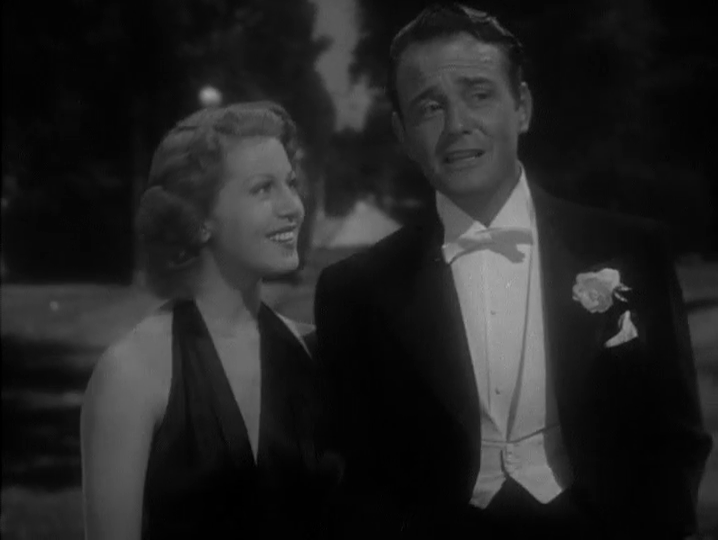
THESE GLAMOUR GIRLS

Lana Turner and Lew Ayres
THESE GLAMOUR GIRLS (1939). Director: S. Sylvan Simon.

"Darling, I'm in the most awful man-jam!"

Upper-crust Philip (Lew Ayres) sort of has a fiancee, but when he's inebriated he invites a dance hall girl, Jane (Lana Turner), to the big dance on campus over the weekend. It's a little awkward when she actually shows up where she has to deal with all the college snobs. Other characters include man-hungry Daphne (Anita Louise); stalwart Carol (Jane Bryan); chatty Mary Rose (Ann Rutherford); Jane's roommate, Mavis (Dennie Moore); Betty (Marsha Hunt), who hangs around college in desperate fashion even though she's older than the rest; and Joe (Richard Carlson), who isn't too proud to be a waiter in the dining hall. The movie leads into highly melodramatic developments concerning the character of Betty. Most of the performances are good, with Turner, Hunt [Raw Deal], and Moore getting top honors. Rutherford [Fighting Marines] basically plays Polly Benedict in college -- where's Andy? Simon also directed The Fuller Brush Man and many others.

Verdict: This glamor you can keep. **.

Thursday, May 8, 2014

CALL IT A DAY

Olivia de Havilland has a crush on Walter Woolf King
CALL IT A DAY (1937). Director: Archie Mayo.

"For utter indecency, give me the high-minded!"

Spring is in the air and romantic thoughts are surrounding the members of the veddy British Hilton family. Catherine (Olivia de Havilland) is thoroughly and painfully infatuated with a married painter named Paul (Walter Woolf King of Swiss Miss). Her brother Martin (Peter Willes) is smitten with the pretty next-door neighbor, Joan (Anita Louise). His father, Roger (Ian Hunter), finds himself pondering the possibility of an illicit relationship with a flirtatious client, while his wife Dorothy (Freida Inescort of Juke Box Rhythm) is pursued by Frank (Roland Young), who thinks she is the prospective bride his sister has picked out for him. You really want to like this movie with its memorable cast but it just sort of sputters along without reaching any great comedic or dramatic highlights and generally the characters are more types than real people. Yet de Havilland is wonderful, limning young unrequited love with unbridled passion, and King expertly portrays the man who is sorely attracted to her but also respectful of his wife, Ethel (a notable Peggy Wood of The Bride Wore Boots). Inescort, Hunter and Young also give excellent performances, and there's fine support from Bonita Granville and Una O'Connor. Archie Mayo also directed the superior Give Me Your Heart.

Verdict: Great cast and some good scenes but it's just nothing special. **.

Thursday, February 4, 2010

BRIDES ARE LIKE THAT


BRIDES ARE LIKE THAT (1936). Director: William C. McGann.

Bill (Ross Alexander) is an irresponsible and irrepressible young man who charges everything to his angry uncle (Joseph Cawthorn) and wants pretty Hazel (Anita Louise) to marry him. Unfortunately, she's already accepted the proposal of the much more practical if duller Dr. Jenkins (Dick Purcell, who much later played Captain America in the cliffhanger serial). Can Bill win Hazel away from Jenkins, and will he ever find a job? While the premise wasn't exactly original back in 1936, this is a fast-paced and amusing picture with solid acting from virtually everyone in the cast -- all of whom are funny. Ross Alexander makes a very appealing and likable hero. Kathleen and Gene Lockhart are great as Hazel's parents and even Purcell makes an impression. Mary Treen has more lines as usual and is swell as a disapproving friend of Hazel's family.

Verdict: Quick and snappy. **1/2.

Thursday, July 30, 2009

THE FIREBIRD


THE FIREBIRD (1934). Director: William Dieterle.

"It's modern youth trying to grope its way through the moral chaos that's all around us!"

In Vienna Carola Pointer (the always vivid Verree Teasdale) is happily married to John (that fine actor Lionel Atwill) but she's a bit stuffy, and troubled by their daughter Mariette's (Anita Louise) fascination with modern, erotic music such as Stravinksy's Firebird (which plays over the credits and sporadically thereafter), which Carola thinks is "for savages." Carola is shocked when a neighbor, the licentious Herman Brandt (Ricardo Cortez), confesses that, in modern parlance, he has always had a thing for her. Later on, Brandt is found murdered, and there's gossip about a woman being seen sneaking into his apartment at night on a regular basis. Suspicion falls upon household staff, John's sister, Carola -- there's suspense over exactly which woman was presumably succumbing to Brandt's charms and may have dispatched him. As a mystery this may not be great shakes, but it's the excellent acting from the entire cast that puts it over. This includes C. Aubrey Smith, who plays the wise, understanding policeman assigned to the case.

Verdict: More quaint than "savage" by today's standards, but an interesting curio. **1/2.

Monday, October 6, 2008

OUR BETTERS


OUR BETTERS (1933). Director: George Cukor.

"Think of the people who have married for love. After five years do they care for each other any more than those who married for money?"

An American gal named Pearl (Constance Bennett) marries an impoverished British Lord and becomes Lady Grayston, only to learn on her wedding day that all her husband is interested in is her money and that he already has a lover on the side. Thereafter cynical, sophisticated Pearl becomes the giver of some of England's most notorious parties. Her friends include gossipy Thornton (Grant Mitchell, the father in The Man Who Came to Dinner); Duchess Minnie (Violet Kemble Cooper) and the gigolo, Pepi (Gilbert Roland), that she's keeping; and Arthur (Minor Watson), a pleasant middle-aged man who's in love with her. Then there's the dance instructor, Ernest (Tyrell Davis), who shows up at the end and is as ludicrous a gay stereotype as anything in The Producers. Taken from a play by Somerset Maugham, the movie is full of good dialogue and has some funny scenes, especially a rib-tickler involving Pepi. Bennett is arch and hard and very good, Roland is amusing, and Cooper nearly steals the picture as the somewhat unrealistic, addle-pated, but hopelessly romantic Minnie. As Pearl's more upright younger sister, Bessie, Anita Louise gives one of the worst and most affected performances ever seen in a movie.
Verdict: An amusing, occasionally trenchant, trifle. **1/2.

Saturday, January 26, 2008

THE SISTERS


THE SISTERS (1938). Director: Anatole Litvak. NOTE: This review contains some important plot points.

Now this is pure soap opera. The movie follows three sisters – Bette Davis, Anita Louise, Jane Bryan -- and their romantic up and downs over the years, and even features (somewhat unnecessarily) the San Francisco earthquake. Louise marries an older man but falls for a much younger one. Bryan finds happiness with her sister's cast-off boyfriend, Dick Foran. Davis falls for failed writer Errol Flynn, who goes off to sea in desperation and leaves her in the lurch. Both Davis and Flynn felt the film should end with Davis rejecting Flynn when he shows up years later and marrying her devoted boss Ian Hunter, but the studio and audiences of the time preferred the “happier” ending of Davis being reunited with Flynn. The picture is well-acted (even Flynn is uplifted by Davis' obvious on and off-screen love for him) and well-produced, but it remains a minor soaper with an unrealistic and unsatisfying conclusion. Flynn's character is not developed that well, and the two other sisters are given short shrift. Another half hour added to the running time might have helped.
Verdict: For Davis fanatics primarily. **1/2.