Lively, entertaining reviews of, and essays on, old and newer films and everything relating to them, written by professional author William Schoell.
Showing posts with label Keefe Braselle. Show all posts

Thursday, July 26, 2018

THE EDDIE CANTOR STORY

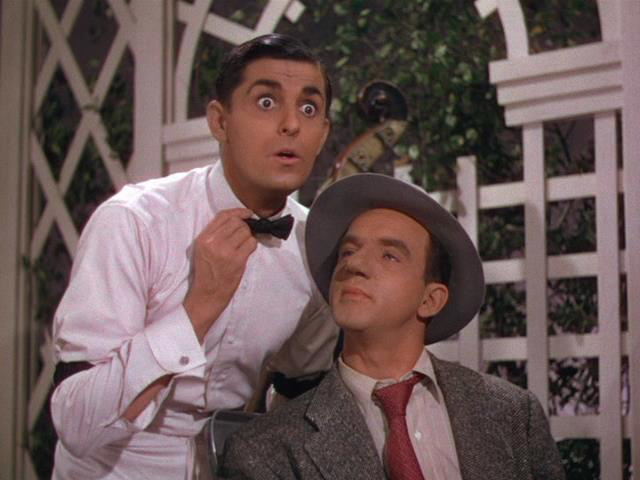
Keefe Brasselle (Cantor) and Jackie Barnett (Durante)
THE EDDIE CANTOR STORY (1953). Director: Alfred E. Green.

Even as a boy Eddie Cantor (Richard Monda) knew he wanted to be an entertainer. When a foolish do-gooder named Berk (David Alpert) wants to pack the kid off to an orphanage, claiming that his sturdy grandmother Esther (Aline MacMahon) can't take care of him, Eddie is fortunate to wind up with a theatrical couple who sponsor a children's revue instead. As Eddie (now played by Keefe Brasselle) falls in love with his childhood sweetheart, Ida (Susan Odin, and then Marilyn Erskine), he struggles to make a name for himself as an adult singing and dancing comedian. But the more famous Eddie gets, the more he neglects his wife, whose loneliness is palpable despite her having (eventually) five daughters to raise. Then serious health issues crop up and it looks like Cantor's career is over ... Eddie Cantor was still alive when this film came out, so the worst thing the movie says about the comic is that he was overly ambitious and addicted to applause and stardom, a fact that had a negative impact on his family life. The Eddie Cantor Story sticks to the basic facts about the man, even it it remains somewhat on a superficial level. However, Brasselle [Bannerline], outfitted with pop eyes and bigger teeth that generally disguise the actor's handsomeness. gives an excellent, well-studied impression of the famous performer. (One could argue that Brasselle, as is often the case in biopics, impersonates the man as he acts while performing as opposed to how he acts off-stage, but somehow this approach works.) Using the real Cantor's voice, Brasselle expertly recreates his routines from the Ziegfeld Follies as well as from such Broadway shows as Whoopee. The film boasts another excellent performance from Marilyn Erskine, who generally worked in television but should be much better known, as the grown-up Ida. Erskine explores every nuance of the character with her sensitive and splendid emoting. Aline MacMahon [The Young Doctors] is sterling as the loving, supportive grandmother, and there is very nice work from Arthur Franz [The Atomic Submarine] as a doctor who remains a loyal friend of the couple through thick and thin. Jackie Barnett does an amusing imitation of Jimmy Durante, and Will Rogers Jr. is cast as his father. Richard Monda is very winning and effective as Cantor as a child. Smaller roles are enacted by the likes of Chick Chandler (as a talent show host); Marie Windsor (as a jealous star); Gerald Mohr (as an old friend and bootlegger); Alix Talton (as a reporter;) as well as Ann Doran and Arthur Space. One is struck by the similarity between Cantor and friendly rival Al Jolson, who also performed in blackface. In his later years, Cantor did film and television work, and also became a spokesman for the March of Dimes. Cantor and his wife appear in the film's framing sequence, and he is given a classic closing line: "I've never looked  better in my life." Although two actors are credited with playing Cantor's parents (who died when he was an infant), they are either seen only in photographs, or their scenes were cut.

Verdict: Delightful biopic with top performances and snappy musical numbers. ***.  

Sunday, April 1, 2018

PUKEY REPEATS

PUKEY REPEATS (1946). Director: Federico Fellini.

Although the studio deemed the June Allyson comedy Pukey to be unreleasable, famed Italian director Federico Fellini caught a special screening of it during a trip to Hollywood and was -- bizarrely enough -- totally enchanted. He contacted Allyson and arranged to make another Pukey film which can be considered a sequel or a remake or both. In this the cookie-tossing singer Pukey (Allyson) decides to take up opera, with completely unamusing results. Although she can't even sing normally, she somehow manages to acquire a contract with La scala in Milan, where much of this was filmed. Keefe Braselle, who appeared in the first film, absolutely refused to be associated with the second, so he was replaced by Broderick Crawford, who makes a highly unlikely love interest for Allyson. You have to hear Allyson attempting to croak out "Nessum Dorma" from Puccini's Turandot to believe it! Fellini filled the film with his usual interesting and exotic faces, but the script -- based, believe it or not, on a play by Italian artist and WW 1 hero Gabrielle D'Annunzio -- is just abysmal.

Verdict: Dreadful! *.

Thursday, February 2, 2017

BRING YOUR SMILE ALONG

William Leslie and Constance Towers
BRING YOUR SMILE ALONG (1955). Director: Blake Edwards.

School teacher Nancy Willows (Constance Towers) leaves her job to go to New York and find work as a lyricist. Before you can say "are you kidding me?" Nancy just happens to discover that a composer named Marty (Keefe Brasselle) lives across the hall with his roommate, Jerry (Frankie Laine), an aspiring singer. Before long Nancy and Marty are writing successful tunes while Nancy worries about her fiance, David (William Leslie) back home and her developing feelings for Marty. Meanwhile Jerry becomes a big singing star. Bring Your Smile Along was a vehicle for Frankie Laine, who was very popular at the time. Aside from appearances in TV episodes, and one other movie besides this one, Laine generally played himself in pictures. He has a nice voice (despite occasionally irritating vocal tics), an appealing presence, and is not a bad actor for this kind of stuff; he makes a much better impression in this than he did playing himself in the earlier Sunny Side of the Street. Towers was introduced in this picture (this was also the first film for director Blake Edwards, who would make one more film with Laine) and is as lovely and adept as ever. Considering her fine singing voice -- she appeared on Broadway with Yul Brynner in a revival of The King and I -- you would think "Nancy" would have pursued a singing career instead of work as a lyricist. Brasselle and Leslie [Andy Hardy Comes Home], as the two men in her life, are both good, and both Lucy Marlow and Bobby Clark make an impression as, respectively, the secretary Marge, who falls for Laine, and the cute little neighborhood kid, Waldo. Some memorable songs include the title tune, "If Spring Never Comes," and "Mamma Mia." Towers remains married to John Gavin of Psycho fame.

Verdict: Strangely appealing if minor musical. **1/2.

Thursday, April 1, 2010

PUKEY


PUKEY (1946). Director: Rouben Mamoulian.

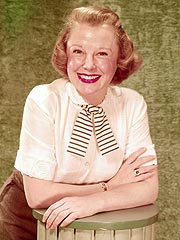
It's no wonder that this June Allyson (pictured) "comedy" was never released! Allyson plays an aspiring singer whose nickname is -- believe it or not -- Pukey. Therefore it shouldn't come as a surprise that every time she has to audition for someone, she gets so nervous that she has to run off and -- well, you know. Yes, Allyson spends most of the movie tossing her cookies [mostly off-screen, mercifully]. Keefe Braselle plays the love interest, an assistant producer who unaccountably thinks that Allyson has talent. The movie doesn't have a single laugh, and when the overly perky Allyson finally gets to sing, you'll wish you were anywhere else. A total dog. The movie, that is! Avoid this DVD at all costs!

Verdict: Could engender mass projectile vomiting amongst audiences! 1/2*.

Thursday, September 10, 2009

THE UNKNOWN MAN

THE UNKNOWN MAN (1951). Director: Richard Thorpe. 

Dwight Masen (Walter Pidgeon) defends a youth, Rudi (Keefe Braselle), who is accused of murdering a shop keeper's son as part of a protection racket. But there's a sinister figure behind the scenes, and when he gets murdered, too, Rudi also gets the blame. But the identity of this particular killer might be a big surprise. It would be criminal to give away the twists of this interesting, generally well-acted courtroom drama, but it certainly presents a bizarre, intriguing, and ultimately tragic situation. Lewis Stone is a judge, Ann Harding is Masen's wife, Richard Anderson is Dwight's son, and Barry Sullivan is the district attorney who prosecutes both cases. Pidgeon is better than usual. Konstantin Shayne is very affecting as the dead boy's devastated father. 

Verdict; A bit perfunctory but not without interest. **1/2.

Thursday, May 7, 2009

BANNERLINE


BANNERLINE (1951). Director: Don Weis.

Mike Perrivale (Keefe Braselle) is a brash cub reporter who is itching to tackle hard news. After interviewing a dying old professor, Hugo Trimble (Lionel Barrymore), who despairs that the town and the paper has allowed corruption to persist, he gets the idea of a fake front page that will indicate something is about to be done regarding those problems. At first this is intended to be one fake paper to please the dying man, but Perrivale and old-timer Josh (Lewis Stone) decide to put it in every paper for real. This brings Perrivale into conflict with the town's head crook Scarbine (J. Carrol Naish).

Bannerline holds the attention but its premise makes little sense. Why would any newspaperman think it's okay, under any circumstances, to print fake headlines in a paper that's supposed to record the truth? Why would Perrivale throw away his career when he's on the verge of getting married?The story doesn't work but at least there's some good acting. Barrymore could have acted his role in his sleep but he's fine, and Braselle makes an appealing leading man. Sally Forrest is his pretty girlfriend and Spring Byington her mother. [She offers her cheek to Perrivle for a kiss, but he kisses the old gal on the mouth instead. She says to her daughter: "You've got something here!"] Naish is as solid as ever.The best performance comes from Elisabeth Risdon as Barrymore's wise and devoted wife of many years.

Verdict: Pleasant cast; mediocre story. **.