Lively, entertaining reviews of, and essays on, old and newer films and everything relating to them, written by professional author William Schoell.

Thursday, January 20, 2011

DECOY (1946)


DECOY (1946). Director: Jack Bernhard.

Margo (Jean Gillie) wants all the good things in life, but the problem is that her boyfriend Frank (Robert Armstrong), in prison on death row, simply won't tell her or anyone else where he's hidden all the loot that he stole. So she cooks up a wild scheme along with another boyfriend (Edward Morris) and a doctor (Herbert Rudley) who happens to do work at the very prison where Frank is incarcerated. Sheldon Leonard plays, of all things, a cop who's trying to put everything together [Leonard still seems like a hood]. This is a fast-paced, well-acted film noir crime thriller with a terrific Gillie in control of all the men in her life and then some -- or so she thinks. Although Gillie (who was married to director Bernhard) was "introduced" in this picture, she had actually already appeared in several movies. An early death cut short what may well have been a promising career. Snappy and absorbing stuff.

Verdict: Possibly Monogram studios best picture ever? ***1/2.

TARZAN'S DESERT MYSTERY


TARZAN'S DESERT MYSTERY (1943). Director: William Thiele.

In this very entertaining Cheeta vehicle -- oh, yes, Tarzan (Johnny Weissmuller) and Boy (Johnny Sheffield) are along for the ride -- an absent Jane asks Tarzan to go to a certain jungle to obtain plants that can be used in a serum. But before he and Boy can get there, they have an adventure in the desert involving Prince Selim ( Robert Lowery), a young lady magician named Connie (Nancy Kelly), and bad guys played winningly by Otto Kruger and Joe Sawyer. In the aforementioned jungle Tarzan and company encounter some big lizards [courtesy of stock footage], carnivorous plants, and a giant spider that sets its sights on Boy trapped in its web. All this is lots of fun, but the highlight is when that wonderful chimp Cheeta puts on a show for the natives in the arab city.

Verdict: Cheeta [aka Cheetah] steals the show! ***.

GENE WILDER: FUNNY AND SAD


GENE WILDER: FUNNY AND SAD. Brian Scott Mednick. BearManor Media; 2010.

Gene Wilder had a small but interesting role in Bonnie and Clyde and really came to prominence when he appeared in the original film version of The Producers. He quickly developed his own quirky appeal that was seen to great advantage in such films as The Adventure of Sherlock Holmes Smarter Brother, Young Frankenstein, The Frisco Kid, and many others. Mednick has written an extremely entertaining and very readable bio of the actor, one which is clearly admiring but not sycophantic. As the author notes, Wilder is a very private man, but Mednick manages to etch a three-dimensional portrait of him in spite of it. We learn about his career highs and lows, his marriages [including a well-known union to Gilda Radnor that was not without its problems], and some of his attitudes towards his films and co-workers. Mednick makes clear that Wilder has had a more interesting and varied career than people may realize.

Verdict: Highly recommended for Wilder fans. ***.

THE JUNGLE


THE JUNGLE (1952). Director: William Berke.

Princess Sita (Marie Windsor), daughter of a progressive maharajah who is ill, returns to India to learn that villages are being decimated by sudden and inexplicable elephant stampedes. Rama Singh (Cesar Romero) her advisor, has hired a famous hunter Steve Bentley (Rod Cameron) to find out what's going on, but he reports that the elephants are being spooked by huge animals that appear to be prehistoric woolly mammoths or some hybrid breed thereof. The Princess and Rama, whose brother was killed by these creatures, travel to the affected areas to see if Benton's incredible story is true. "Filmed entirely in India," The Jungle offers a nice travelogue of the country along with an intermittently interesting storyline. The picture has its zany aspects, along with some clumsy editing, and so many singing natives that at times it almost seems like a musical! Presented in sepia tone.

Verdict: Not as terrible as it sounds but not so great either. **1/2.

ALFRED HITCHCOCK PRESENTS STORIES THEY WOULDN'T LET ME DO ON TV


ALFRED HITCHCOCK PRESENTS STORIES THEY WOULDN'T LET ME DO ON TV. Simon and Schuster; 1957.

This hardcover collection of short stories [also issued as two paperbacks] purports to represent tales that were too verboten to be permitted on network television in the fifties. Ironically, the very first story, "Being a Murderer Myself," was adapted as the episode "Arthur" for a later season of Alfred Hitchcock Presents. Robert Bloch's "Water's Edge" wound up on The Alfred Hitchcock Hour and I believe the somewhat homoerotic "Love Lies Bleeding by Philip MacDonald was adapted as well. M. R. James' "Casting the Runes" was turned into the far superior motion picture Curse of the Demon, and The Most Dangerous Game was also adapted as a motion picture. Perhaps the grossest story in the book, Ray Bradbury's "The October Game," could definitely not be adapted for TV. Once shocking, it now seems rather stupid. All in all, however, this is an interesting collection.

Verdict: Apparently Hitch just couldn't resist some of these. ***.

PIRANHA (2010)


PIRANHA (aka Piranha 3D/2010). Director: Alexandre Aja.

An undersea quake unleashes a horde of hungry prehistoric piranha who proceed to snack on and cause carnage among young people on spring break. Don't be fooled into thinking this remake of the 1970's Piranha is a horror film or monster movie as it's really directed at the kinds of people who seek out snuff films, true-life accident footage, and documentaries like Faces of Death [even if the film's gore isn't real]. You'd expect a movie about carnivorous fish attacking people to have some creative bloodiness and shock effects, but Piranha goes so over the top that it's simply too graphic and stomach-churning to be fun or remotely entertaining. It's not merely a mindless "frat boy" movie made for and by morons, but a monster movie filtered through a Columbine sensibility. While men are killed off in the film, the most excruciatingly horrible deaths are reserved for women, giving the film a misogynous tone that critics, even female ones, didn't seem to pick up on. Why an Oscar-nominee like Elisabeth Shue is starring in crap like this is anybody's guess, but she'd be better off doing a TV series [which co-star Jerry O'Connell did] than make movies like this. [What's next? Starring in the sequel for the Syfy channel?] The acting isn't bad, and the monsters are very well-designed, but director Aja [who should probably be known as Alexandre A--wipe] should have spent more time crafting suspense scenes and less on the vomitous, "lovingly"-detailed carnage [To be fair, the climax is somewhat suspenseful, but Aja is no Hitchcock]. Christopher Lloyd and Richard Dreyfuss of Jaws fame are also in this mess.

Some critics were soft on this movie because they were afraid of seeming un-hip, but come on -- movies like Piranha aren't hip -- they're beloved only by disaffected, misanthropic geeks who chuckle over a young lady getting pulled into an outboard motor out of their own self-hatred! Years ago movies like this were barely released for midnight showings by very minor production companies but Piranha was released by Dimension films -- in 3D no less -- with a massive advertising campaign. And this is progress? As one intelligent critic put it, Piranha doesn't seem to have been made for anyone -- human, that is.

Verdict: Atrocious and ugly beyond belief. 0 stars.

Thursday, January 13, 2011

THE OLD-FASHIONED WAY


THE OLD-FASHIONED WAY (1934). Director: William Beaudine.

"He's all dressed up like a well-kept grave."

Baby Leroy (pictured) stars in this great comedy -- okay, W.C. Fields is the real star, but little Leroy certainly has his most memorable part as Albert Pepperday, the nemesis of the Great McGonigle (Fields). Fields based much of the picture on his own early experiences in show business, and arguably this is his greatest role. Along with his daughter Betty (Judith Allen), her boyfriend and show biz hopeful Wallace (Joe Morrison), McGonigle travels from town to town with a troupe of actors putting on a performance of "The Drunkard." Pursued by the sheriff of the last town, McGonigle gets money from the local widow, Cleo Pepperday (Jan Duggan), promising her a part in the play. This is a very funny movie but it's distinguished by its poignant underpinnings as we come to understand McGonigle's sad, struggling life in the theater. For McGonigle, unlike Fields, there was no happy ending of true success. Fields is superb; Duggan is hilarious as she sings her seemingly endless song number for a distressed McGonigle; and Allen and Morrison are simply charming [the latter does a nice job with his "Little Bit of Heaven" number]. The dinner table sequence with Fields and Baby Leroy is a scream!

Verdict: A sublime classic comedy. ***1/2.

THE YOUNG RAJAH


THE YOUNG RAJAH (1922). Director: Phil Rosen.

"Men should be judged, not by their tint of skin, the Gods they serve, the vintage that they drink, nor by the way they fight, or love, or sin, but by the quality of thought they think."

Amos Judd (Rudolph Valentino), who is actually the son of a maharajah who was murdered in a palace coup, has been adopted by an American family and given an Ivy league education. He falls in love with Molly (Wanda Hawley), the son of Judge Cabot (Edward Jobson), but although Molly returns his feelings she just can't get past her own prejudice. To make matters worse, factions from India come to the U.S. determined to capture and murder the true heir to the throne. Amos has always had premonitions, and now seemingly foresees his own death. Turner Classic Movies presented this incomplete print of this "lost" movie by using many stills and title cards, although the second half contains a lot of the real footage. In any case, The Young Rajah is an interesting movie, and Valentino certainly exudes star charisma. Jon Miralis' music is a plus.

Verdict: See why Valentino got everyone excited. ***.

BATMAN (1989)


BATMAN (1989). Director: Tim Burton.

"I am the world's first fully-functioning homicidal artist." -- The Joker.

In Gotham City there are rumors of a bat-like creature preying on criminals. A mobster named Jack Napier (Jack Nicholson) falls into a vat of chemicals while battling this creature -- Batman (Michael Keaton) -- and turns into the grotesque Clown Prince of Crime, the Joker, who causes numerous deaths by poisoning various cosmetics and household supplies. Batman must then stop his nemesis from not only slaughtering thousands of Gothamites at a celebration, but must rescue his lady love, reporter Vicki Vale (Kim Basinger) from the Joker at a climax in a cathedral. Batman, whose human dramatics are awkwardly written and played, is more a campy black comedy than anything else, and is a bit slow and dull to boot. The movie is overlong and over-produced, although it gets points for its striking scenic design if little else. Keaton is miscast, and Nicholson walks off with the movie, although his psychotic Joker is never really scary. There are some moments that are dumber than anything in the old Batman serials. The climax, which may or may not have been intended as a homage to Vertigo's bell tower sequence, is stretched out to a tedious degree. Jack Palance and Michael Gough are good as hoodlum Grissom and Alfred the butler, respectively.

Verdict: All too typical of movies that pay more attention to production design and FX than they do to story and character. **.

MONSTER FROM GREEN HELL


MONSTER FROM GREEN HELL (1958). Director: Kenneth G. Crane.

Two scientists (Jim Davis and Robert E. Griffin) shoot animals into outer space to gauge the effect of radiation on them. Unfortunately, some wasps wind up being over-exposed and crash land in Africa in a place the natives call Green Hell. Now the wasps have mutated into gigantic monstrosities that threaten to overrun all of Africa. There's some okay stop-motion animation and the scenes with the monsters -- often portrayed by full-size mock-ups complete with out-sized stingers -- are fun. The movie is padded with exciting stock footage from previous jungle epics. Davis and Griffin aren't bad (especially the latter) but Barbara Turner as doctor's daughter Lorna is amateurish. Eduardo Ciannelli as a guide and Joel Fluellen as a concerned native add some flavoring to the proceedings. The giant wasps look nothing like they do in the film's poster. Good score from Albert Glasser, as usual. NOTE: For more on this film and others like it, see Creature Features: Nature Turned Nasty in the Movies.

Verdict: Generates some positive buzz. **1/2.

G-MEN VS. THE BLACK DRAGON


G-MEN VS THE BLACK DRAGON (15 chapter Republic serial/1943). Director: William Witney.

Agents Rex Bennett (Rod Cameron), Vivian Marsh (Constance Worth) and Chang Sing (Roland Got) are in a deadly battle with a Japanese society of saboteurs, the Black Dragon, and its leader, Haruchi (Nino Pipitone), a dapper little devil. One of the Black Dragon's nefarious schemes involves a paint that can explode ships. This is a terrific serial with furious fisticuffs in every chapter and a lot of exciting cliffhangers: Vivian is tied to a buzzsaw; Rex falls out of a skyscraper; Vivian is tied to a chair in a spear-trap; and there's a thrilling aerial battle in chapter eleven. Cameron and Got are fine but Worth and Pipitone are even better (Worth is especially good when she pretends to be a villainess). Cameron also played the same character in Secret Service in Darkest Africa. Very well-staged fight sequences and superior FX by Howard Lydecker.

Verdict: Snappy serial. ***.

V THE ORIGINAL MINI-SERIES (1983)


V (1983 four hour two-part mini-series). Written and directed by Kenneth Johnson.

Those who enjoy the new weekly V series may be interested in looking back at the original mini-series which aired nearly thirty years ago. My advice is not to bother, as the new TV show is much, much better, and the original V is nowhere near as good as the earlier sci fi alien invasion show The Invaders. Supposedly friendly aliens land on Earth in huge spaceships asking for our help and offering their knowledge in exchange. They are actually reptiles in human guise and eat mice, rats -- and people. They conspire against earth's scientists by fabricating a supposed plot by these scientists to conspire against them. In what seems like short order the aliens create an atmosphere of fear and paranoia, basically a police state, and have pretty much taken over, while some humans become quislings and collaborators. The analogy to Nazi Germany is cemented in a memorable scene in which a Jewish man explains to his son why he has to hide a scientist neighbor and her family. Marc Singer is a photojournalist who is pursued by the aliens even as he tries to expose them, and Jane Badler is Diana, a sadistic member of the invading force. The score sounds like an inept, pallid imitation of Herrmann's music for North by Northwest. Myron Healey, Andrew Prine, Robert Englund and William Russ are also in the cast.

Verdict: Somewhat entertaining but minor-league. **1/2.

THE PSYCHO LEGACY


THE PSYCHO LEGACY Written, produced and directed by Victor Galluzo.

This is a fair-to-middling rather superficial documentary focusing on Psycho, its three sequels [the last of which was made-for-cable], and the amazing influence of Hitchcock's masterpiece. There are file interviews with the late Anthony Perkins and Janet Leigh, but most of the actors interviewed appeared in Psycho 2 and the later films and not in the original. Now it's one thing to interview Robert Loggia, Olivia Hussey, Henry Thomas, Tom Holland, etc. but quite another to include quotes from individuals whose sole connection to Psycho is that they have horror oriented web sites or directed some direct-to-video slasher features! One silly guy in a backwards baseball cap, who is presumably a friend of the documentary's producer, remarks how Norman Bates [in the later films] attracts women half his age and he therefore sometimes wishes he was Norman -- yeah, right. [This kind of nonsense only cheapens the whole tone of the project.] Also too much is made of this business about how people feel "sorry" for Norman. An unintentionally comical moment occurs when Tom Holland, who wrote the screenplay for Psycho 2, says "I thought it was a terrific script!" Nothing like blowing your own horn! Mick Garris, who directed Psycho:The Beginning, probably comes off best.

Verdict: Okay overview, but Hitch deserves better. **.

Thursday, December 30, 2010

DEADLY MANTIS

DEADLY MANTIS (1957). Director: Nathan Juran. 

A gargantuan prehistoric preying mantis thaws out from its icy prison and makes it way down from the Arctic and toward Washington D.C. and then Manhattan, where it lodges inside a tunnel after popping quite a few people into its mouth. This is one of the few credible mechanical monsters to appear in a creature feature -- its skin is slick, it drips saliva, it's "altogether icky" and its utter lack of personality only makes it creepier. Craig Stevens is the stoic, nearly wooden Colonel Parkman, assigned to destroy the big bug; William Hopper is a helpful paleontologist; and Alix Talton is the nature mag photographer and nominal love interest. The best scenes, aside from the tunnel climax, have the insect climbing the Washington Memorial and flipping over a bus -- not to mention when it creeps up on an Army base and scares the bejeezus out of Talton. 

Verdict: A fun creature feature. ***. NOTE: To read more about this film and others like it, see Creature Features: Nature Turned Nasty in the Movies.

CONGO BILL

CONGO BILL 15-chapter Columbia serial (1948). Directors: Spencer Bennet; Thomas Carr. 

The heiress to the Culver circus may be a blond queen of a lost tribe in Africa known as Lureen (Cleo Moore). Congo Bill (Don McGuire), who works for the circus, is determined to find out, but he's unaware that the new managers of the circus would prefer that the heir to their business never be found. Congo Bill was actually a strip that appeared in Action Comics along with Superman and other heroes; he later metamorphosed into "Congorilla," who could exchange minds with a big ape. Congo Bill has a somewhat similar plot line to the far superior Tiger Woman, but that's where the resemblance ends. Unlike the Tiger Woman, Lureen basically does nothing for 15 chapters [she doesn't even show up until chapter six], and she's played inadequately by the busty but talentless Moore. McGuire could make an impression as a second lead or supporting player in such films as The Fuller Brush Man, but in this he displays little star charisma. There are some acceptable cliffhangers -- Bill caught in a turning mill stone; descending spikes etc. -- but this is one of Columbia's dullest serials. "Janu the Jungle Boy" from the comic book stories has been replaced with the older "Kohla. " 

Verdict: Watch Tiger Woman instead. **

SEX AND THE CITY 2


SEX AND THE CITY 2 (2010). Writer/director: Michael Patrick King.

While the first Sex and the City movie was pretty good, this disappointing sequel is more problematic. For one thing, at over two and half hours long it seems to go on forever. Second, there's no real plot to speak of, except that each of the women seem to be undergoing a kind of minor crisis. Carrie (Sarah Jessica Parker) is afraid her marriage with "Big" is going stale; Charlotte (Kristin Davis) has trouble dealing with the stress of motherhood; Miranda (Cynthia Nixon) is under-valued by her male boss; and Samantha (Kim Cattrall) is on a steady hormone diet to keep her body as youthful as possible. Then the movie throws in a long sequence in which the gals travel on a junket to the mid-eastern city of Abu Dhabi, and Sex and the City 2 almost turns into a travelogue or tourism short. However, there are some good scenes, including the ladies singing "I am Woman" during karaoke night at an Abu Dhabi night club, and the whole business with Samantha taking on the sexual oppressiveness and sexism of the middle east has some punch to it. Alas, with its gay wedding full of "fag" stereotypes -- and even Liza Minelli! -- the movie seems backward even as it's trying to be hip; in Sex and the City gay men are always depicted as swishy throw backs who exist solely to hold their girlfriends hands and do their hair! Sex in the City 2 is very well-acted by all, but it's only sporadically entertaining and often tedious.

Verdict: Maybe these gals should just retire.

THE MOTHERS-IN-LAW


THE MOTHERS-IN-LAW 1967 - 1969.

It must have looked good on paper. Get the wonderful Eve Arden and the talented Kaye Ballard together to play women whose children are married to one another. On top of that, the two families live next door to each other. And there are all sorts of problems, complications and feuding and fussing. If didn't really matter who played the husbands or the married children [in truth these actors were all competent if forgettable] as long as Arden and Ballard could successfully pull off a new team of Lucy and Ethel. Unfortunately, they don't. Even Lucille Ball and Vivian Vance as they got older and began to repeat themselves became much less fun as the comical couple after I Love Lucy -- a truly memorable sitcom -- went off the air and they dipped in the well once too often on The Lucy Show. [Let's not even talk about Here's Lucy or Life with Lucy.] It was a style of comedy that had its day and is still fun to watch in I Love Lucy reruns, but on The Mothers-in-Law it mostly didn't work. Much was made of the fact that many episodes of this series were written by people who'd done scripts for I Love Lucy, but a.) it was another era and b.) they were not writing for Ball, Vance, Arnaz and Frawley, and c.) even I Love Lucy had the occasional stinker episode. The Mothers-in-Law has the occasional laugh [Ballard does a dead-on impression of Bette Davis at her most affected], but mostly this show is made up of stinker episodes. Yes, Lucille Ball's lovably childish "Lucy" character was brilliantly brought to life by Ball, but in general it's not much fun watching grown-ups acting like eight-year-olds.

Verdict: Watch I Love Lucy instead where they did most of this shtick for the first time. **.

Thursday, December 23, 2010

CULT OF THE COBRA

CULT OF THE COBRA (1955). Director: Francis D. Lyon. 

In 1945 Asia a group of servicemen observe a secret ceremony of a cult whose women can turn into snakes, and are targeted for death when they return to the states. The architect of their demise is a beautiful woman, Lisa (Faith Domergue, who's not exactly Asian), who seems uncertain if she's doing the right thing -- but does it anyway. The victims are played by such familiar genre actors as Marshall Thompson (Fiend without a Face), Richard Long (House on Haunted Hill), William Reynolds (The Thing that Couldn't Die), as well as David Janssen. Domergue gets across the conflicted feelings of her character even if she's a little too cool at times. Ed Platt of Get Smart appears briefly as one of the cult members. Kathleen Hughes plays Long's love interest, Julia. Cult of the Cobra holds the attention, and while not a horror classic by any means [and not especially horrific in any case], it does have its moments. 

Verdict: More entertaining than it has any right to be. ***.

THE SILVER AGE OF COMICS by William Schoell


Ye humble blog owner's latest book is entitled THE SILVER AGE OF COMICS and has just been published by BearManor Media. The book is available at amazon.com, barnesandnoble.com and BearManor's web site as well.

Today the silver screen [not to mention the Broadway stage] is full of the exploits of numerous super-heroes but most of these characters have been around for decades. Superman and Batman date back to the 1930's of course, but even Spider-Man, Iron Man and Green Lantern have been around for over forty years. Characters such as the very popular X-Men [four films so far] and Fantastic Four [two movies] were first introduced in the sixties. THE SILVER AGE OF COMICS looks back with affection at those early comic books during the period which became known as the "silver age," when super-heroes -- who had fallen out of favor but for a few -- once again came back into prominence [where they remain to this day].

In this book you can read how DC Comics reinvented golden age heroes Flash and Green Lantern and others for the silver age and found they had gold on their hands, putting many of their heroes together into the super-popular Justice League of America [still going strong today]. Meanwhile Stan Lee, Jack Kirby, Steve Ditko and others tried a new, somewhat more "mature" take on "long-underwear" characters and turned also-ran Marvel Comics into a mighty comic book powerhouse. While DC had Superman, Batman and Wonder Woman, Marvel had Spider-Man, the Hulk, Iron Man, X-Men, and many, many others.

THE SILVER AGE OF COMICS is an entertaining, informative, critical and historical look back at the days when our favorite heroes were either invented or reinvented to thrill readers as they have been doing ever since. You can read about the most memorable stories, influential artists and writers, and how silver age comics began to show the social changes that were even then reverberating across the nation.

ON SALE NOW! More info here.

RODAN

RODAN (1956). Director: Inoshiro [Ishiro] Honda. 

"The strongest, swiftest creatures that ever lived." 

A shaft inside a mine has gone deeper than ever before, and men working below soon turn up dead and mutilated. The culprits are creepy [if unconvincing] giant worms with big bug-like metallic eyes. But they're nothing compared to what's uncovered by an earthquake inside a gigantic cavern near the mine: two huge flying, carnivorous reptiles of the species rodan that are related to the pternadon. These creatures have 500 foot wingspans and can fly at super-sonic speeds -- in other words, the earth does not need them. Shigeru (Kenji Schora), a young man who first discovered the monsters in the cavern, leads the military to their hiding place but they escape, using huge flapping wings to create cyclonic, city-destroying winds. Rodan is probably the best of the many Japanese giant monster movies, which for most people isn't saying very much. However, the film is well-directed, has suspenseful early scenes in the mines, and while the two Rodan aren't very scary-looking, they are nevertheless formidable giant monsters. Aside from the rubber beasties, Rodan has some very good effects work and good music for the finale. This American version of the movie has a prologue about atomic testing [which really has nothing to do with the movie or its monsters] and has some poetic narration at the end about how one of the monsters willingly dies because it can't save its mate. 

Verdict: Probably the best monster movie to come out of Japan. ***.

MADE-FOR-TV MOVIES


Satellitedish.org has published an interesting article on the “Top 10 Made for TV Movies of All Time.” See if any of the ones that made their list are on yours as well.

Here's the link.

Years ago there used to be "Movies of the Week" and now cable shows a steady diet of telefilms. A lot of made-for-TV movies were just rip-offs, imitations and derivations of theatrical movies, but there have also been many telefilms of genuine quality. Recommendations anyone?

ALFRED HITCHCOCK PRESENTS SEASON FIVE

ALFRED HITCHCOCK PRESENTS Season 5. 

38 more episodes of this endearing series hosted by the great Alfred Hitchcock. The best: "The Crystal Trench," a somewhat incredible but darkly amusing tale of romantic obsession; "No Pain," in which a man wants his wife murdered quickly and neatly and without her suffering; the bizarre "Specialty of the House" in which the blue plate special at an exclusive club's restaurant is quite unspeakable; "Day of the Bullet," in which a little boy [a wonderful Barry Gordon] feels so betrayed by his father that it influences his entire future life; "Madame Mystery," about a publicity man who wants to take advantage of an actress's death [the ending for this really packs a wallop]; "The Little Man Who was There," in which AHP producer Norman Lloyd seems to play the devil in the wild west; and "Graduating Class,": a very downbeat tale in which teacher Wendy Hiller tries to help a promising student to her ultimate regret. And there are many more memorable episodes as well. 

Verdict: One of the series' best seasons. ***1/2.

Wednesday, December 8, 2010

HAPPY HOLIDAYS!


Taking a week off to prepare for the holidays.

Great Old Movies will be back in the New Year, if not before!

HAPPY HOLIDAYS EVERYONE -- and thanks for reading!

William Schoell

Thursday, December 2, 2010

THE SEVENTH VEIL


THE SEVENTH VEIL (1945). Director: Compton Bennett.

Francesca (Ann Todd) is a deeply troubled and suicidal concert pianist whose guardian, her older cousin Nicolas (James Mason), a lame woman-hater, dominates her life and has kept her apart from the man she loves, a musician named Peter (Hugh McDermott). Dr. Larsen (Herbert Lom), a psychiatrist, treats Francesca and tries to determine what earlier events led her to want to take her own life. The performances in this are excellent, and there's a good use of classical music [and Ben Frankel contributed a memorable theme], although some may feel the "happy" ending is a little suspect. Todd and Mason became involved in real life. Beethoven's "Pathetique" figures in an important sequence.

Verdict: Twisted romance. ***.

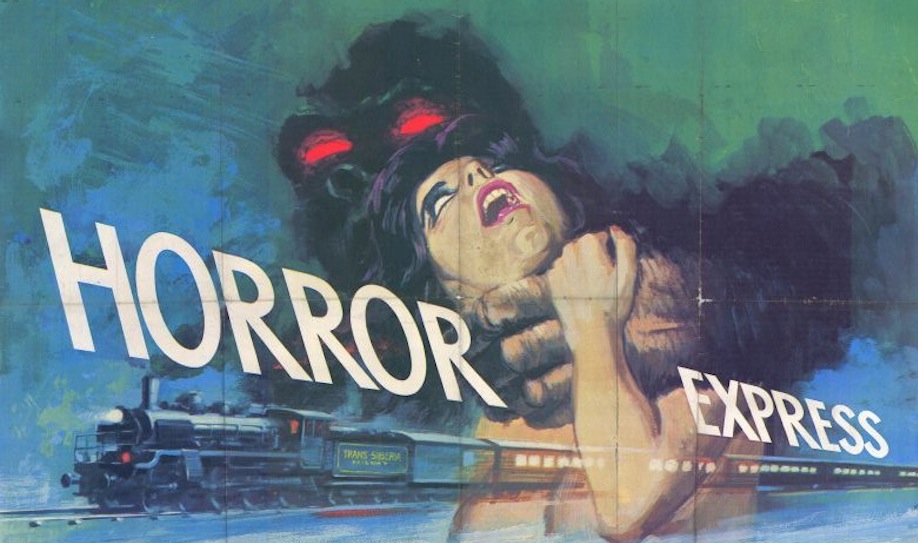
HORROR EXPRESS

HORROR EXPRESS (1972). Director: Eugenio Martin. 

Professor Alexander Saxton (Christopher Lee) arranges for an ancient fossil he has discovered to be shipped aboard a train upon which he is traveling, along with a colleague named Dr. Wells (Peter Cushing). However, this "fossil" turns out to be alive, able to emit reddish rays from its eyes that parboil a person's brains and turn their own eyes solid white. [It turns out that the creature's memories are stored not in its brain but in its eyes]. The monster is also able to transfer its consciousness into other people's bodies, as well as revivify its victims for more "fun." This period piece teaming horror great Lee with Cushing is not as memorable as one might have hoped for, but it does have some interesting sequences and concepts. Telly Savalas adds some spice as Captain Kazan who comes aboard the express late in the picture to try to figure out why so many are dying. Made in Spain. 

Verdict: An express you might like to take, but not to worry if you miss it. **1/2.

ALFRED HITCHCOCK PRESENTS: SEASON FOUR

ALFRED HITCHCOCK PRESENTS Season 4. 

A whole bunch of ironic, amusing, and suspenseful stories served up by the ever-droll Hitch. "Poison" features Wendell Corey in a tale of a snake in a bed. "Man with a Problem" finds Gary Merrill out on a ledge threatening suicide. "Tea Time" teams Margaret Leighton and Marsha Hunt in a tale of wife vs. mistress. "Mrs. Herman and Mrs. Fenimore" is a delightful tale of a miserly uncle and the two women in his life, Dora Merande and Mary Astor, both of whom are wonderful. Then there's the creepy "Waxwork," and Franchot Tone and Mary Astor again in "The Impossible Dream" about an aging actor. Bette Davis stars in "Out There, Darkness," about a woman who pays the price for her jealous actions, and there's nice work from Fay Wray in "The Morning After." Other notable episodes include "Murder Me Twice" with Phyllis Thaxter in a tale of reincarnation; "The Desert Shall Blossom," with two cowboys and a gangster; "Kind Waitress," with Olive Deering; "The Diamond Necklace" with the great Claude Rains; Dennis Day in "Cheap is Cheap;" and Robert Morse and Paul Douglas in "Touche." 

Verdict: More fun with Hitchcock. ***.

FRANCESCA DA RIMINI


FRANCESCA DA RIMINI. Opera by Riccardo Zandonai. The Metropolitan Opera 1985. Presented on Live from the Met. Stage Director: Piero Faggioni. TV director: Brian Large. Conducted by James Levine.

Francesca's (Renata Scotto) brother knows that she'll never marry Giancetto Malatesta (Cornell MacNeil) if she sees what he looks like, so he arranges a cruel trick. He has Giancetto's handsomer and younger brother Paolo (Placido Domingo) show up on the da Rimini estate, where it becomes love at first sight for the two [in a very passionate moment in which the two principals never sing, only the chorus in the background, and Francesca presents Paolo with a rose). Unfortunately, the scene in which Francesca discovers the truth is not depicted in this version of Gabrielle D'annunzio's play, but there's plenty of fireworks to come in spite of it. Try as they might, Francesca and Paolo can't quell their rising passion for one another, leading to sex and disaster, and a deeply moving, beautifully staged finale. With superior production design by Ezio Frigerio and beautiful costumes by Franca Squarciapino, this presentation by the famed Metropolitan opera is first-class virtually all the way through. Scott is perhaps not in the best voice, although no fault can be found with her acting. Domingo sings the pants off his third-act aria in which he explains how tormented he is by his separation from Francesca, and the two singers vividly display the proper amount of sexual and romantic excitation. Despite a tendency toward shrillness at times, Domingo is excellent, as is Cornell MacNeil as his frightening brother and William Lewis as the nasty Malatestina, a third brother who loses an eye in combat. Among the supporting cast, pretty Isola Jones makes a strong vocal impression as Francesca's devoted servant, Smaragdi.
Zandonai's music is attractive and powerful, intense with passion throughout, and full of forecasting of the terrible events that will transpire. A masterpiece.

Verdict: Perhaps the only time you'll see a severed head batted around the stage of the Met. ****.

SHE'S OUT OF MY LEAGUE


SHE'S OUT OF MY LEAGUE (2010). Director: Jim Field Smith.

Kirk (Jay Baruchel) works for airport security and Molly (Alice Eve) is a pretty event planner. The more average-looking Kirk thinks he hasn't got a chance with Molly, but to his delight, confusion, and severe apprehension, she seems to go for him. [Actually this is not such a big stretch as Eve is pretty but not "drop dead' gorgeous and Kirk isn't ugly by any means and has an appealing personality to boot]. Kirk's insecurity threatens to unravel everything, but Molly has her own secrets. Poor Kirk is saddled with a family made up of complete morons. The premise of this film isn't bad, the acting is good, and there are a few funny moments [such an an "accident" Kirk has just when he's about to meet Molly's parents] but just not enough to make this memorable. Geoff Stults plays Cam, a straight pilot who thinks Kirk is gay and rates his buddies as to how "hot" they are in a weird but funny sequence.

Verdict: Almost ... but not quite. **.