Lively, entertaining reviews of, and essays on, old and newer films and everything relating to them, written by professional author William Schoell.
Showing posts with label Burt Lancaster. Show all posts

Thursday, November 7, 2024

ROPE OF SAND

Burt Lancaster and Peter Lorre
ROPE OF SAND (1949). Director: William Dieterle. Colorized

Mike Davis (Burt Lancaster) is an African guide whose charge, Ingram (Hayden Rourke), goes off into forbidden diamond territory while he's sleeping. When Davis finds him, Ingram is near-death, clutching a load of diamonds. Davis leaves the diamonds and tries to get Ingram out of the desert. When police guards, led by Commandant Paul Vogel (Paul Henreid), come upon the pair, Ingram is dead and Davis is tortured, but refuses to tell where the diamonds are located. Two years later Davis is back in the territory, where diamond mogul Martingale (Claude Rains), who pretends to like Vogel but secretly despises him, decides to use a beautiful refuge, Suzanne (Corinne Calvet of Flight to Tangier), to get the location of the diamonds from Davis. A battle of wills ensues between Davis and Vogel as they fight it out for both diamonds and lady, with Martingale manipulating everyone behind the scenes and Toady (Peter Lorre) hoping to score as well. Meanwhile, Davis has decided to go for the gems come hell or highwater ... 

Claude Rains and Corinne Calvet
Rope of Sand
 is a seriously flawed film, but it is entertaining and well-acted enough to prove a good watch. There seems to be so much missing of the characters' back stories that while you're watching it you think it must be based on a long novel, not all of which made it onto the screen, but this is not the case. This was supposed to be a follow-up to Casablanca with Bogart and Bergman in the Lancaster and Calvet roles, but producer Hal Wallis had to be satisfied with three of the supporting cast of that film. John Bromfield (of The Big Bluff) has a smaller role as one of Henreid's officers. Dieterle's direction is assured, the performances -- especially Rains' -- are uniformly good, there is outstanding cinematography from Charles Lang [Wild is the Wind]  and an exciting score by Franz Waxman, but you may find it hard to tell if there's more -- or less -- here than meets the eye. Lancaster and Henreid have a nifty fist fight at one point. 

Verdict: Certainly it's not boring. ***.  

Thursday, January 19, 2023

SEPARATE TABLES

Rita Hayworth and Burt Lancaster

SEPARATE TABLES (1958). Director: Delbert Mann.

"I have no curiosity about the working classes." -- Mrs. Railton-Bell.

"Being alone in a crowd -- it's so painful ... frightening." -- Ann Shankland.

At the seaside Beauregard Hotel in Bournemouth, England -- where several people are permanent residents -- certain little dramas are unfolding. The highly snobbish Mrs. Railton-Bell (Gladys Cooper) has discovered the inappropriate behavior of Major Angus Pollock (David Niven), who has bored everyone with fictional stories of his allegedly heroic wartime exploits. Mrs. R-B gathers the other residents to vote on whether or not to insist that the man be thrown out of the hotel. Mrs. R-B's neurotically shy daughter, Sibyl (Deborah Kerr), who is exceptionally fond of the major, undergoes an emotional crisis when she learns of his illicit activities. Meanwhile, the proprietress, Pat Cooper (Wendy Hiller), who has become the lover of American resident John Malcolm (Burt Lancaster), discovers that his ex-wife, Ann (Rita Hayworth) is still in love with him and has taken a room in the hotel.   

David Niven and Deborah Kerr
Separate Tables
 was originally two plays by Terence Rattigan, sharing several supporting characters, that took place in the same location and were presented together on one evening in the theater, Although Rattigan was importuned to change this before the play debuted, the Major was originally a closeted homosexual and not a pervert who bothered women in a movie theater. (Although the movie is quite sympathetic to the major, it's a question how this would play in these post- MeToo days.) 

Separate tables indeed
The two plays have been intelligently put together and opened up (but not too much) and the film never appears stage bound or too talky, undoubtedly because Rattigan's dialogue is often excellent and perceptive. David Niven won a Best Actor Oscar for his portrayal and Deborah Kerr, who is outstanding, should have won but was only nominated. (Niven is quite good but a cut below Kerr. Hiller won Best Supporting Actress but was surprised by this, as she isn't onscreen very long and complained that her best scenes were cut.) Playing a comparatively superficial if vulnerable character, Rita Hayworth is effective as Ann, as is Burt Lancaster, although he really can't compare to some of these venerable British actors. Gladys Cooper and Cathleen Nesbitt as her friend are exemplary, as are Hiller, Felix Aylmer as Mr. Fowler, and Mary Hallatt as the brisk and self-sufficient Miss Meacham. Rod Taylor and Audrey Dalton have the thankless roles of a young couple temporarily staying in the hotel, their lines undoubtedly cut back to make room for the emoting of Hayworth and Lancaster.  Delbert Mann also directed the beautiful Middle of the Night and many others. 

Verdict: Superior British drama with some excellent performances. ***1/4. 

CONVERSATION PIECE

Burt Lancaster
CONVERSATION PIECE (aka Gruppo di famiglia in un interno/1974). Director: Luchino Visconti. 

In an absolutely gorgeous old house in Rome, there lives a professor (Burt Lancaster), a widower, who only wants to be left alone with his books, his art, and his housekeeper. An aggressive and vulgar woman, the Marchesa Brumonti (Silvana Mangano), importunes him to rent her the upstairs apartment for her daughter, Lietta (Claudia Marsani), Lietta's boyfriend Stefano (Stefano Patrizi), and the marchesa's younger lover, the German Konrad (Helmut Berger of Ludwig), who is also sleeping with Lietta. To his horror the professor discovers that this "family" is making wholesale changes to the apartment's very structure. In spite of his annoyance over this and other matters, the lonely professor comes to see these people as a surrogate family and seems to develop unspecified feelings for Konrad, who may not be as frivolous as he seems, leading to a literally  explosive finale.

Aging gay prostitute? Helmet Berger as Konrad
 
Visconti's penultimate film, Conversation Piece, which was filmed in English and has an English soundtrack (a dubbed Italian version is also available), is a modestly interesting failure that never realizes its potential. Although Burt Lancaster should be given credit for trying something challenging as a character actor in his later years, he is still too young and robust to make a convincing fussy old professor. The next most important character is Konrad, played by Visconti's then-boyfriend, but although Konrad is apparently strictly a hetero gigolo, he comes off -- as Berger generally did -- as a kind of sleazy aging gay prostitute, making his characterization rather unconvincing. We can hear his real voice for a change, but his accent is often too thick to be understood, and his acting in this is only adequate. 

Patrizi, Marsani and Mangano on the professor's balcony
Silvano Mangano can perhaps be forgiven for going over the top at times because she's playing an imperious, overbearing wealthy woman who is constantly jealous of the young man she actually seems to despise. Claudia Marsani is a bit too perky for my taste, but Stefano Patrizi makes a creditable Stefano. At one point the young couple and Konrad engage in a strictly straight menage-a-trois which is not terribly sexy. The lack of homoerotic material, aside from the vague intimation that the professor might be attracted to Konrad, actually makes the film seem more dated than daring. I confess that because the characters, including the professor, are so underwritten and the film so half-baked, that when somebody dies I actually laughed out loud. Dominique Sanda and Claudia Cardinale have cameos as, respectively, the professor's mother and wife. 

Verdict: Hardly Visconti at his best. **. 

Thursday, December 22, 2022

THE KILLERS

Virginia Christine, Burt Lancaster, Ava Gardner
THE KILLERS (1946). Director: Robert Siodmak.

Torpedoes Max (William Conrad) and Al (Charles McGraw) come to the town of Brentwood and (improbably) announce to people in the diner that they are going to kill a guy known as the Swede or Pete Lund (Burt Lancaster), which they do. The rest of the film presents assorted flashbacks from various points-of-view as insurance investigator Jim Reardon (Edmund O'Brien) tries to find out more about "Lund" and the reasons for his murder. Reardon hooks up with former cop Sam Lubinsky (Sam Levene) and discovers that the latter's old friend the Swede, actually Ole Anderson, a former boxer, was mixed up in a robbery plot as well as with a beautiful if duplicitous female named Kitty (Ava Gardner). But before Reardon's investigation is over, those two torpedoes just may have more work to do. 

Waiting for death: Burt Lancaster
The Killers is a fine and memorable piece of film noir. In his very first film, Lancaster gives a strong performance and he is backed up by an old pro in O'Brien. Conrad and McGraw certainly make in impression in their brief but chilling appearances. Levene and Virginia Christine (Anderson's old girlfriend and now Lubinsky's wife) are solid as well. And then there's Ava Gardner in her 27th film, but clearly still growing as an actress. She makes a good impression in the early scenes but doesn't quite cut it in her climactic moments. There are good turns from Phil Brown [Weird Woman] as Nick Adams, Vince Barnett as old Charleston, Albert Dekker as the architect of the robbery plot, Donald MacBride as Reardon's boss, Jack Lambert [The Unsuspected] as a member of the gang, Queenie Smith as Queenie, Anderson's sole beneficiary, and especially Jeff Corey as Blinky. (Charles Middleton plays a farmer but I didn't spot him.) Although Anderson is in some ways an unsympathetic character, you can't help but feel sorry for the miserable way in which he is played for a sucker. The Killers boasts an evocative score by Miklos Rozsa and fine photography by Elwood (Woody) Bredell. 

Verdict: Totally absorbing, very well-acted crime drama. ***1/4. 

Thursday, December 8, 2022

BURT LANCASTER: AN AMERICAN LIFE

BURT LANCASTER: An American Life. Kate Buford. Knopf; 2000. 

Tracing his pathway from the rough streets of New York's Harlem to a stint as an acrobat to his making his mark in motion pictures rather quickly, pretty much attaining stardom in his first film The Killers, this well-written and very absorbing biography offers a fascinating portrait of a complex individual. Lancaster was driven to succeed, something he achieved, but not without cost. Some friends and co-workers describe him with lavish affection while to others he was cold, distant, and occasionally cruel. While his wife nearly drank herself to death, Lancaster apparently did little or nothing to help her while he had numerous affairs and a long-time mistress (a passed-out spouse can be a convenience). On the plus side, Lancaster was dedicated to his art and tried his best to make worthwhile pictures instead of just appearing in junk for money (although eventually he would have to do that as well). 

Although Lancaster was not a kid when he became a bona fide movie star, he was young enough -- and it happened quickly enough -- for such rapid success to go to his head. There was one shocking report of violence against women while under the influence. The term "bisexual" is used over and over again in the book, but  Buford never really deals with it head on or provides any solid evidence of homosexual relationships, although eyebrows were raised in certain instances. Lancaster did have several gay friends and co-workers, and did an ad for AIDS awareness -- "Think Before You Act -- Don't Get Aids." Lancaster had several children but his relationship with his children isn't really examined that significantly (and we never learn the contents of his will). 

Whatever good or bad points Lancaster had, he made some memorable, or at least, famous motion pictures during his career, and gave some solid performances. From Here to Eternity, Come Back Little ShebaThe Swimmer (my favorite Lancaster film and performance), A Child Is Waiting, Elmer Gantry, and many, many others. However Buford is not a film critic, so don't expect in-depth analysis of his films, although she does go behind the scenes of many of the movies. 

Verdict: Imperfect but notable bio that delves a bit more than others into the life of this enduring star. ***1/2. 

ALL MY SONS

Burt Lancaster and Edward G. Robinson
ALL MY SONS (1948). Director: Irving Reis. Based on the play by Arthur Miller.

Industrialist Joe Keller (Edward G. Robinson) was acquitted of deliberately selling defective plane parts to the army during WW2, but his partner, Herb Deever (Frank Conroy), wound up in jail.  21 planes crashed, killing the pilots and crews, because of the faulty parts. Now Deever's daughter, Ann (Louisa Horton), is engaged to Keller's son, Chris (Burt Lancaster). Adding to the awkwardness of the situation is the fact that Ann used to be engaged to Chris' late brother, who died fighting overseas, a fact which his mother, Kate (Mady Christians), refuses to acknowledge. Into this gathering comes Ann's angry brother, George (Howard Duff), who believes that Joe is the true guilty party and let his own father take the fall. With so much at stake Chris confronts first Herb and then Joe, but what he finds out may not be at all to his liking. And then there's a letter written to Ann from Chris' brother overseas just before his death ... 

Lancaster, Horton, Fraser, Morgan
All My Sons
 is a powerful, well-written and well-acted drama of the kind you rarely see these days. An outstanding Edward G. Robinson heads the cast and etches a strong portrait of a man who just doesn't get it until he finally does. The other cast members, including Lancaster, are all impressive as well. The supporting cast includes Arlene Francis and Lloyd Hough as one set of neighbors and Elisabeth Fraser and Harry Morgan as another; these are also interesting characters even if their appearances are brief. Howard Duff is a pleasant surprise as George, a sad figure who only felt truly at home when he was with the Kellers and now must cut himself off from them forever. Louisa Horton, who was married to George Roy Hill for twenty years, debuted in this film and years later appeared in Alice, Sweet, Alice. Helen Brown has a nice bit as an alcoholic woman whose husband died, and who confronts Joe in a restaurant and calls him a murderer. Despite being opened up in an intelligent fashion, the film is at times stagey, with some wrong choices in line readings and the like, but mostly this is a superior and memorable drama. 

Verdict: Fascinating situations explored in depth and with compassion. ***1/4. 

I WALK ALONE

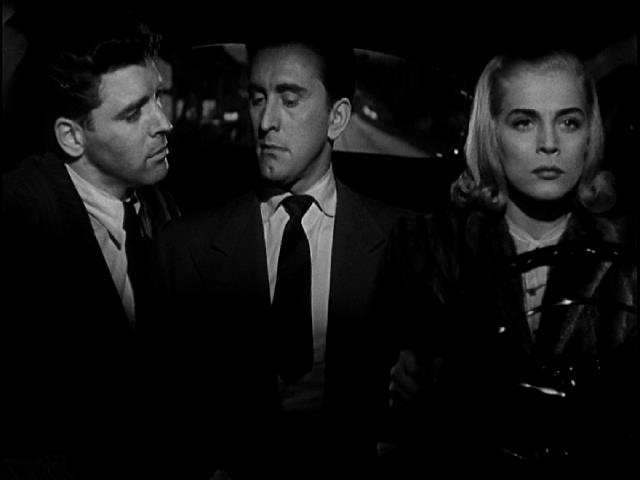
Burt Lancaster, Kirk Douglas, Lizabeth Scott
I WALK ALONE (1947), Director: Byron Haskin.

Frankie Madison (Burt Lancaster) and Noll "Dink" Turner (Kirk Douglas) were partners in a bootlegging operation that went south. Frankie went to prison for fourteen years while Noll opened up his own successful nightclub, and got a girlfriend in singer Kay Lawrence (Lizabeth Scott). Despite his relationship with Kay, Noll plans to marry bitchy socialite Alexis Richardson (Kristine Miller) for business reasons. Frankie makes it clear that what he wants is not just 50% of what's coming to him, but something to make up for all of those years he spent in jail. But even as Frankie and Kay grow closer, Noll may have other, less admirable plans for his old friend ... 

Kirk Douglas in a dramatic moment
I Walk Alone is fair-to-middling film noir. Frankly, it just never becomes as interesting or as explosive as you might hope. The performances are on target,  however, with especially good and slick work from Kirk Douglas, although Lizabeth Scott is a little odd and her romance with Frankie is never quite convincing. Wendell Corey is fine as a friend of Frankie's and an associate of Noll's, and there is also good work from George Rigaud as Maurice, who also works for Noll but isn't quite so  subservient; Mickey Knox as gunsel Skinner; Mike Mazurki as doorman/bodyguard Dan; and Kristine Miller as the delightfully predatory Alexis. When she manages to get Noll to agree to take her to the altar, she suggests that Kay sing "I Lost My Man" to the nightclub patrons -- what a bitch! Corey's death scene on a city street is quite well-handled.

Verdict: Comes so close but somehow misses. **1/2. 
Thursday, November 10, 2022

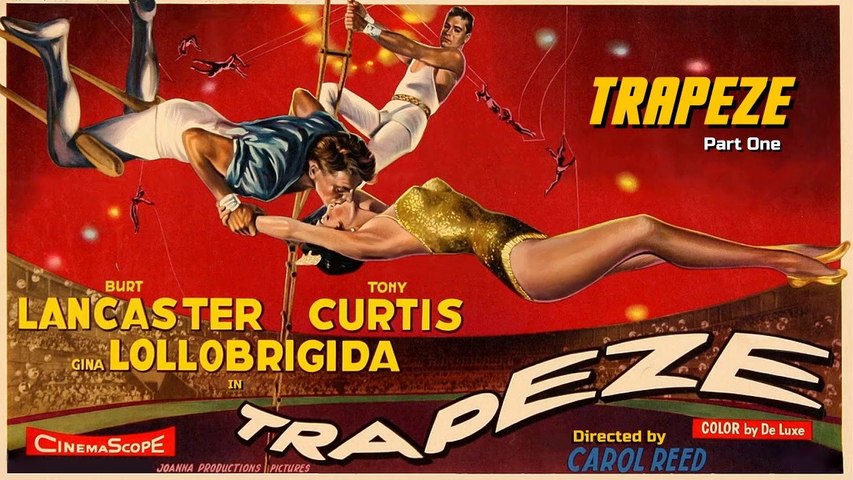
TRAPEZE

TRAPEZE (1956). Director: Carol Reed.

Bitter former acrobat Mike Ribble (Burt Lancaster) is working as a rigger for a Paris circus after falling and injuring himself while attempting a "triple" flip while performing high in the air. Tino Orsini (Tony Curtis) is an aspiring performer who talks Mike into teaming up with him for an act, hoping he can teach him to do the triple. Then there's the highly ambitious and beautiful Lola (Gina Lollobrigida of Woman of Straw) who manages to secure a position in their act while bouncing back and forth between both men. 

Lancaster, Lollobrigida and Curtis
While it's certainly understandable that both men would get the hots for Lola -- in my opinion Lollobrigida was always the sexiest and most beautiful of the Italian sex bombs -- falling in love with such a fickle and manipulative person is something else again. And one can't really see Lola falling for anyone but herself. But Trapeze is essentially a melodrama, and as such feelings are created in and discarded by the characters simply to serve the needs of the plot -- that's all there is to it. As a circus picture, Trapeze is only fair to middling. However, it comes alive during the aerial sequences, which are thrilling, skillfully intercutting the three main actors into the actions of real circus performers. Clearly they were each willing to be photographed doing some aerial work, although not high above the ground one supposes.

The performances are good. Curtis and Lancaster would reteam for Sweet Smell of Success the following year when Curtis would really come into his own. This is not Lollobrigida's first American film, but probably the biggest English role she'd had to that date. Her character is kind of impossible, and her transformation from opportunist to someone sincerely in love with one of the men isn't believable, but for that I'd blame the script. Others in the cast include Minor Watson (of Beyond the Forest) as a man from Ringling Brothers; Thomas Gomez as the fat and rather obnoxious boss of the Paris circus; Katy Jurado as Rosa, who is carrying a torch for Mike; and Gerard Landry as her husband. There are interesting and flavorful moments in the movie, but it's nothing very deep, although one senses everyone working on the film thought it would be. Malcolm Arnold's score is so overwrought at times that it approaches the comical.

All of the homoeroticism of the novel, The Killing Frost, upon which the film is based, was eliminated, although if you watch it carefully ... In the novel Tino is executed for murdering Lola, although she was actually killed by Mike, who was in love with -- you guessed it -- Tino! 

NOTE: It has been said that Lancaster, because of his background, did all of the trapeze stunts in the film except for the Triple. I think this has been very exaggerated. For one thing, Lancaster is clearly in front of a blue screen in some shots and if one freezes the film the aerialist playing Lancaster is clearly a different person in the long shots. 

Verdict: Stick with The Big Circus. **1/2. 

Thursday, July 7, 2022

ELMER GANTRY

  • Jean Simmons and Burt Lancaster
ELMER GANTRY
(1960). Director: Richard Brooks. 

 "He rammed the fist of God into me so fast that I never heard my father's footsteps." -- Lulu. 

Elmer Gantry (Burt Lancaster) is an operator who discovers there's money to be made and power achieved in the Evangelical movement, so he hooks up with one Sister Sharon (Jean Simmons) and her associate William Morgan (Dean Jagger), who doesn't quite trust Gantry. He and Sharon make a highly effective team but things are threatened when Lulu (Shirley Jones), an old girlfriend and preacher's daughter who's become a hooker, resurfaces in Gantry's life at an inopportune moment. The entire cast is fairly terrific, and that includes Hugh Marlowe [All About Eve; Earth vs. the Flying Saucers] in a supporting part as an anti-revivalism reverend; Arthur Kennedy as a reporter; and the always-flavorful Edward Anderson as Babbitt. Elmer Gantry is interesting and entertaining, but it doesn't always make its points very clearly, and one senses that its opportunities to say something have been blunted. The climactic fire is quite well-handled. The low point is Lancaster and Patti Page doing a duet, with Page in Full Female Vocalist mode. Nice score by Andre Previn. 

Verdict: Somehow less than the sum of its parts, but never boring. ***.

SOUTH SEA WOMAN

Burt Lancaster and Virginia Mayo
SOUTH SEA WOMAN
(1953). Director: Arthur Lubin. 

Through a series of misadventures Sergeant James O'Hearn (Burt Lancaster), his buddy and rival Davey (Chuck Connors), and the woman, Ginger (Virginia Mayo), that Davey is in love with wind up on an isolated island that seems untouched by the war except that any soldiers there wind up in jail. O'Hearn only pretends that he's gone AWOL, but Davey wants no part of the war, with the result that O'Hearn, of all people, winds up court-martialed. The movie is a long flashback detailing how he wound up in such a situation with the story veering from Shanghai to the French island of Namou. Too much talk in the courtroom sequences slows the movie down but there's some good action near the end when a commandeered yacht helmed by O'Hearn takes on the Japanese fleet! The three leads all give very good performances, as does Viola Vonn as the Frenchwoman Lillie Duval, and Arthur Shields [Daughter of Dr. Jekyll] as another resident of the island. Paul Burke plays an ensign at the court martial. 

Verdict: Entertaining if unremarkable. **1/2.

Thursday, March 4, 2021

SWEET SMELL OF SUCCESS

SWEET SMELL OF SUCCESS
(1957). Director: Alexander Mackendrick. 

"You're dead, son. Get yourself buried." 

Powerful newspaper columnist J. J. Hunsecker (Burt Lancaster), who seems to have an incestuous yen for his sister, Susan (Susan Harrison), is determined to keep her from marrying a musician (Martin Milner), and importunes press agent Sidney Falco (Tony Curtis) to help him break the couple up. This study of loathsome and immoral characters isn't really about show biz or newspapers or even columnists but it seems almost as hollow at its center as its protagonist. Part of the problem is that you never really believe Lancaster as Hunsecker, although by no means does he give a bad performance. Then the secondary love story isn't that convincing or moving. Susan Harrison and Barbara Nichols have some nice moments -- Milner is okay if a bit stiff -- but the picture is positively stolen by a ferocious, charismatic and altogether splendid performance by Tony Curtis. That's the main reason to watch the film. 

Verdict: Curtis' finest hour. **1/2.

Thursday, September 17, 2020

VENGEANCE VALLEY

Robert Walker and Burt Lancaster 
VENGEANCE VALLEY (1951). Director: Richard Thorpe.

Owen Daybright (Burt Lancaster) was taken in by cattle man Arch Strobie (Ray Collins), when he was a boy, and he grew up with Arch's son, Lee (Robert Walker). Owen has often had to cover for Lee, who can be irresponsible. Lee impregnated Lily (Sally Forrest) --  apparently before he married his wife, Jen (Joanne Dru) -- but Owen has to front for him. This causes Lily's two brothers, Hub (John Ireland) and Dick (Hugh O'Brian), to assume he is the baby's father, and they start gunning for him. Fearing the truth may come out, Owen tells Lee that he should take his wife and make a fresh start elsewhere, but Lee has other plans.

Out for blood: Hugh O'Brian and John Ireland
Vengeance Valley is strange. While this isn't technically a "B" movie, it has all the appearances of one, and aside from the business with the pregnancy,  it plays like something Roy Rogers could have starred in. The acting is all good, although Ray Collins, best-known as the detective on Perry Mason, sometimes seems disinterested. Carleton Carpenter is also in the cast as Hewie, a cowpoke who has a crush on Lily, and he's fine. Ted de Corsia also scores as another rancher who comes afoul of Owen. Director Richard Thorpe doesn't make the most of the film's dramatic moments, but the story is nothing special and doesn't live up to its title. This was Lancaster's first western.

Verdict: So-so western with a very good cast. **1/2. 

Thursday, January 23, 2020

COME BACK, LITTLE SHEBA

Oscar-winning Shirley Booth and Burt Lancaster
COME BACK, LITTLE SHEBA (1952). Director: Daniel Mann. Based on the play by William Inge.

"You didn't know I'd get old and fat and sloppy, but I didn't know it, either." -- Lola to Doc.

Lola Delaney (Shirley Booth) is a housewife who is always afraid that her husband, a chiropractor named Doc (Burt Lancaster), will fall off the wagon again. The couple got married years ago when Lola got pregnant, but she lost the baby, and fears that her husband feels trapped and disappointed with life and marriage. Doc does, of course, but he has a bond with Lola, although trouble appears when they take in a pretty young boarder named Marie (Terry Moore of Peyton Place). Marie becomes a symbol to Doc of lost youth and opportunity, just as Lola's old dog, Sheba (who probably ran away to die), is a symbol of her own faded dreams. When Doc comes to believe that Marie is not the sweet innocent he thought she was, he can't resist going to the bottle ...

Richard Jaeckel and Terry Moore
Shirley Booth played the role on the stage, and it would have been criminal for her not to repeat her part on the screen (she won a well-deserved Oscar for it). As she was not seen as being sufficiently box office, Lancaster was secured for the leading male role. Although Doc was always meant to be an older man, Lancaster is not as miscast as you might imagine. He's quite good, in fact, if not up to Booth. (One has to remember that Lola has become chubby and slovenly over the years, and there have been many cases of couples in which the husband is better-looking, or at least in better shape, than the wife.) Terry Moore also does some nice work, as do Richard Jaeckel [The Dark] as a football hero she dallies with and Richard Kelley as her fiance, Bruce. There are other good character performances in the film as well, including Lisa Golm's [Anna Lucasta] as a sympathetic German neighbor.

Terry Moore and Burt Lancaster
Come Back, Little Sheba is full of lovely and sad touches, such as Lola's phone conversation with her mother, when she desperately wants to come home for awhile, but her father, who has never forgiven her for past indiscretions, won't allow it. An amusing moment occurs when Lola tells Doc that she'll prepare him a hot meal if he comes home for lunch, but the "hot meal" turns out to be cottage cheese and buttermilk! The film is well-directed by Daniel Mann, and there's a nice score by Franz Waxman.

NOTE: I could only get a few minutes into a 1977 TV version of the play in which, incredibly, Laurence Olivier is even more miscast (and less effective) than Lancaster, and Joanne Woodward, also miscast, doesn't come even close to approximating Booth's genius. Booth had a pixilated, almost pathetic quality that made her just perfect for Lola.

Verdict: "Some things should never get old" -- A strong and touching drama. ***1/2. 

Thursday, July 11, 2019

BURT LANCASTER AT THE FILM FORUM

BURT LANCASTER FESTIVAL AT THE FILM FORUM. 

New York's Film Forum --located at 209 West Houston Street, west of Sixth Avenue (212-727-8110)-- is presenting a festival of Burt Lancaster films from Friday July 19th to Thursday August 15th, 2019.
Lancaster with Janice Rule in The Swimmer

The films include The KillersThe Swimmer (my favorite Lancaster performance), From Here to Eternity, The Leopard, Criss Cross, The Crimson Pirate, A Child is Waiting, Atlantic City, The Professionals, Brute Force, Birdman of Alcatraz, Desert Fury, Elmer Gantry, The Rainmaker, Seven Days in May, Judgment at Nuremberg, The Rose Tattoo, Sorry Wrong Number, and others.


For a complete list of films and more information click here

Thursday, April 26, 2018

THE UNFORGIVEN (1960)

Murphy, Lillian Gish, Doug McClure, Audrey Hepburn  
THE UNFORGIVEN  (1960). Director: John Huston.

A mysterious man named Abe Kelsey (Joseph Wiseman) wanders around the ranch of the Zachary family, and his presence causes consternation in old Mattilda Zachary (Lillian Gish). Apparently Abe is spreading stories that Mattilda's adopted daughter, Rachel (Audrey Hepburn), is not white but a "red injun." Members of the Kiowa tribe seem to think the stories are true, and want Rachel returned to them. Neighbor Zeb Rawlins (Charles Bickford) wants the truth, too, or there'll be no more business dealings with the Zacharys. Then one of Zeb's sons is murdered, Abe Kelsey is captured, and the whole thing comes to a boil ... The Unforgiven has a fascinating but ultimately contrived premise that doesn't make nearly enough of the situation and operates on an almost shamefully superficial level. There are some powerful scenes in the movie, but too many questions remain unanswered. It all ends in a bloodbath wherein the one-dimensional Indians are pretty much picked off like flies and a supposedly "happy" ending is tacked on. For a movie that some feel is about racial intolerance, it is staggeringly racist itself. The acting is generally good, although of the once-removed Hollywood variety, which is particularly evident in the climax. Wiseman is excellent as Abe, demented by loneliness and grief, and Gish [The Cobweb] has a tremendously good moment confronting him for what turns out to be the final time. Burt Lancaster plays Rachel's step-brother, who is secretly in love with her, this being one of the new breed of psycho-sexual westerns (while still being stubbornly old-fashioned as regards Native Americans). Doug McClure overdoes the boyish posturing a bit as Lancaster's youngest brother, but Audie Murphy is effective as his other brother, Cash. John Saxon also makes his mark as a cowboy who may be an Indian, as does Carlos Rivas [The Black Scorpion] in a nearly silent role as a tribe member who may be Rachel's true brother. Kipp Hamilton [War of the Gargantuas] is also good as Zeb's daughter, who is anxious to marry one of the Zacharys, and June Walker is excellent as her mother, Hagar. For obvious reasons, Audrey Hepburn was hardly the best casting choice for the role of Rachel. The attack on the ranch at the climax is admittedly exciting and well-staged, but in some ways unconvincing, while Franz Planer's widescreen cinematography doesn't make the most of the settings, and Dimitri Tiomkin's score, aiming for the unusual perhaps, is one of his worst, only serving to muff some sequences that could have been moving. Apparently director John Huston was hampered from really making the film he wanted to make, resulting in this rather hypocritical exercise.

Verdict: Hollywood Cowboys and Indians -- when it could have been so much more. **.   

Thursday, March 23, 2017

THREE SAILORS AND A GIRL

Gene Nelson, Jane Powell, Gordon MacRae
THREE SAILORS AND A GIRL (1953). Director: Roy Del Ruth.

"Are you certain Judy Garland started like this/"

When some submarine sailors on leave, including Twitch (Gene Nelson of So This is Paris) and Porky (Jack E. Leonard of The Fat Spy), want to spend their back pay on girls and booze, the more sensible "Choirboy" (Gordon MacRae) importunes them to invest the money instead. His original intention is Wall Street, but due to the intervention of producer Joe Woods (Sam Levene) and Broadway hopeful Penny Weston (Jane Powell), they wind up putting $50,000 in a hopeless show. But will the combined talents of George Abbot, Moss Hart, and Ira Gershwin (none of whom play themselves), not to mention the U. S. Marines, turn this turkey into a hit? Three Sailors and a Girl suffers from the same problem as the show-within-a-show, U.S.S. Texas, in that it has serious book problems. Not only is the script a mass of cliches, but the characters are paper-thin stereotypes. Fortunately, there's some pleasure in the movie, including a few funny lines, the beautiful voices of both MacRae and Powell, and the snappy dancing of Gene Nelson (his fancy footwork in a garage is one of the film's highlights). The songs were contributed by two Sammy's: Cahn  and Fain, and the songs are at the very least pleasant and one or two are memorable: "The First Time That We Kissed;" "There Must Be a Reason." Jack E. Leonard, who was introduced in this picture, seems to be channeling Lou Costello at times, but has an amiable, portly presence. Small roles are enacted by Merv Griffin, Paul Burke, Jack Larson, and Burt Lancaster, who plays a show biz hopeful who is rejected because he looks too much like Burt Lancaster. Archer MacDonald is quirky as librettist Melvin Webster, and Veda Ann Borg [Jungle Raiders] is vivid as Woods' girlfriend. By now Sam Levene could have played this fast-talking role in his sleep but he's very good. George Givot is fun as the ham opera star Emilio Rossi, possibly an affectionate parody of Ezio Pinza.  Jack E. Leonard eventually developed a more brash personality and was more of a stand-up
comic than actor.

NOTE: This is not to be confused with Three Girls and a Sailor; Three Girls and a Gob; Three Gobs and a Girl; A Girl, A Guy, and a Gob; Three Sailors Go to Paris with a Gal; Three Sailors Go to Paris with a Guy; Three Gay Sailors, a Guy, and a Gob; or numerous others.

Verdict: More "technicolor twaddle," but some fun. **.

Thursday, January 5, 2017

THE LEOPARD

Burt Lancaster and Alain Delon
THE LEOPARD (aka Il gattopardo/1963). Director: Luchino Visconti. Three hour Italian version with sub-titles.

"I've had seven children with her and I've never seen her navel." -- Fabrizio referring to his wife.

During the tumultuous changes in 19th century Italy, the aristocratic Prince Fabrizio (Burt Lancaster) lives with his family in a palace with more rooms than he can count. His nephew, Tancredi (Alain Delon), joins Garibaldi's forces at first but fights for the king later on. The prince's daughter, Concetta (Lucilla Morlacchi), is in love with Tancredi, but the latter prefers the more beautiful Angelica (Claudia Cardinale), and not just because her father, Don Sedara (Paolo Stoppa), a former peasant, has become wealthy. Sedara is basically treated with contempt by the prince and his family because he represents a new type of Italian citizen, a type that Fabrizio fears will eventually supplant the aristocracy. The Leopard has its most interesting scenes in the first quarter, depicting the ravages of war, and the second half struggles to find strong human drama in its situations. You keep waiting for something to happen, but it never quite does. Will the triangle situation with Concetta, Tancredi, and Angelique cause major difficulties? No. Will Don Sedara stop acting the buffoon and tell off the prince and his relatives? No. Will Fabrizio's children resent how Tancredi is treated more like a son than a nephew? No. There's nothing necessarily wrong in a more low-key approach, but one wishes that there had been more incident and dramatic vitality considering the three hour running time.

Even more problematic is the fact that The Leopard, despite its interesting and often attractive period settings, is not that well-directed. Even the supposedly famous long ballroom sequence near the close of the film lacks the kind of sweep and pageantry, the especially skillful camera work, that one would find in similar scenes in American films. The Leopard simply lacks greatness. The film is much admired in certain quarters -- one imdb. critic certainly overstated things by claiming it might be "the greatest motion picture of all time" [!] -- and there are things to admire (Nino Rota has written a lovely score for the film, for instance) but the characters are mostly unsympathetic and the picture becomes tedious just when you're expecting things to really develop. It's as if some people think The Leopard must be great because it's three hours long and made in Italy.

As for the acting, it's hard to judge Lancaster's performance because it's dubbed -- and judging from the American version, which is about 25 minutes shorter and uses Lancaster's real voice -- it's just as well. In the U.S. version, Lancaster doesn't seem remotely like a 19th century Italian aristocrat; he did much, much better work in The Swimmer. Delon  [Joy House] is more on the mark as his nephew, but Cardinale [Blindfold], who is not photographed that flatteringly, sometimes comes off as if she's mentally deficient. Stoppa, Morlacchi, and Romolo Valli as Father Perrone are more memorable.

Verdict: Watch The Damned or Ludwig instead. **.

Thursday, April 10, 2014

KISS THE BLOOD OFF MY HANDS

KISS THE BLOOD OFF MY HANDS (1948). Director: Norman Foster.

In post-WW2 England Bill Saunders (Burt Lancaster) -- who thinks with his fists -- lashes out at a middle-aged bar owner simply because he says it's closing time and inadvertently kills the man. He runs off -- and hides out in the apartment of lady doctor Jane Wharton (Joan Fontaine). Jane tries to resist her attraction to Bill, but gets drawn deeper into his unsavory life, and winds up committing an act  of violence herself. Does this screwed-up couple have any hope? Frankly, it's hard to care about this romance of two unsympathetic people. Jane makes dumb excuses for Bill, and Bill never gives a thought to the man he killed or his family. Thrown into the mix is a creepy guy named Harry (Robert Newton of Obsession) who wants to get Bill involved in criminal activities, but whose chief purpose is to introduce someone Bill can feel morally superior to. It's as if the film is telling the audience: "See, Bill isn't so bad. Now this guy is a rotter." [But as far as we know Harry was never responsible for anyone's death.] Then there's the casting. Joan Fontaine can certainly play a woman who is obsessed with one man -- witness Letter from an Unknown Woman -- but she simply seems too intelligent to fall so hard for this loser, the vagaries of love notwithstanding. Lancaster also gives a good performance, by Hollywood standards at least, getting across the man's violence but not necessarily the aspects that make him a love object for Jane. Although only 80 minutes long the movie eventually becomes tedious, which is a shame because it has atmospheric photography by Russell Metty [The Omega Man], a nice score by Miklos Rozsa, adroit direction and editing -- but, sadly, a script that is lacking, to say the least. Norman Foster also directed the film noir Woman on the Run and many others.

Verdict: At least it has a good -- if kind of gross -- title. **. 

Thursday, March 13, 2014

THE SWIMMER

Janice Rule and Burt Lancaster
THE SWIMMER (1968). Director: Frank Perry.

"Pool by pool they form a river, all the way to my home."

Ned Merrill (Burt Lancaster of Desert Fury) shows up at the home of some friends who haven't seen him in awhile. Clad in a bathing suit, he tells them that he intends to swim from pool to pool on the estates in the area until he makes his way home. The reaction of the couple make it clear that something is off. As Ned makes his way on his journey, he encounters different people from his past, including many vulgar people with too much money, and the viewer slowly learns more and more about the truth behind this man's charming veneer and aura of health and success. The Swimmer is a quirky movie that is not for every taste, and some people might see it as an excuse for Lancaster to show off what good shape he was in, but if you're in tune with its style and content, it's an interesting and absorbing experience. Lancaster gives one of his all-time best performances, and he has wonderful support from such as Janice Rule, who plays a bitter ex-lover; Janet Landgard, who was once his babysitter and now is a nubile beauty; and Michael Kearney as a little boy who has been left alone with the maid by his vacationing parents. Joan Rivers, of all people, has a nice cameo as a lonely party guest who is attracted to Ned, and Jan Miner plays a vicious wife at a public swimming pool. Marvin Hamlisch's score is generally a plus. [Hamlisch also composed "Nobody Does It Better" for The Spy Who Loved Me.] The movie manages to work up sympathy for a man who may not be entirely deserving of it. John Cheever, who wrote the short story that inspired the movie, has a cameo as a party guest. Perry also directed Diary of a Mad Housewife.

Verdict: Don't kick a man when he's down. ***1/2.

Thursday, February 27, 2014

SEVEN DAYS IN MAY

Kirk Douglas, Martin Balsam and Fredric March
SEVEN DAYS IN MAY (1964). Director: John Frankenheimer. Screenplay by Rod Serling, from a novel by Fletcher Knebel.

U.S. President Lyman (Fredric March) has pushed through a nuclear disarmament pact with the U.S.S.R. that most of the people and military disagree with, not trusting the Russians. Colonel "Jiggs" Casey (Kirk Douglas) thinks he may have uncovered a plot by General Scott (Burt Lancaster) to capture Lyman and have a military take-over of the United States. Some people think Casey is paranoid and has no real proof -- although he has also uncovered a top-secret military base that the president has never heard of -- but as the time approaches, the evidence, and the suspicious death of at least one investigator, indicates that he may be right. Seven Days in May is a crackling good suspense thriller bolstered by excellent performances from the entire cast, including those already named, as well as Martin Balsam, Edmond O'Brien, George Macready, and Ava Gardner (as an old girlfriend of the general's). John Houseman plays an admiral, Andrew Duggan an Army man, and Hugh Marlowe, Whit Bissell, Richard Anderson, and Malcolm Atterbury have smaller roles. Fredric March is especially outstanding.

Verdict: Taut, fast-paced and terrific. ***1/2.