Lively, entertaining reviews of, and essays on, old and newer films and everything relating to them, written by professional author William Schoell.
Showing posts with label non-fiction. Show all posts

Thursday, August 14, 2025

HOLLYWOOD HIGH: A Totally Epic, Way Opinionated History of TEEN MOVIES

HOLLYWOOD HIGH: A Totally Epic, Way Opinionated History of TEEN MOVIES. Bruce Handy. Avid Reader Press/Simon and Schuster; 2025.  

Be forewarned if you're looking for a book that critiques dozens and dozens of movies about teens that came out in the fifties and sixties, this is not that book. What it is is an amusing and informative look at Hollywood's attitudes towards teenagers -- and vice versa -- from decades ago until recent days. He has a section on Andy Hardy but doesn't really analyze the various entries in that series, then quickly moves on to an in-depth analysis of Rebel Without a Cause, the Beach Party movies, and then mostly focuses on other select films such as American Graffiti, Fast Times at Ridgemont High, Boyz in the Hood and more. With the exception of Graffiti, which I never especially cared for, I haven't seen or wanted to see most of the movies Handy covers. He has a whole loooong chapter on John Hughes, a filmmaker I have never had the slightest interest in. But here's the rub: Handy is such a good and entertaining writer, that he kept me turning the pages as much as if he were writing about subjects more to my liking -- he's that good. No, Handy hasn't convinced me to rush out and pick up a slew of Hughes' movies, but he does a good job of informing the reader about his subject while keeping us engaged and amused. 

Verdict: The great teen movie book has yet to be written, but this highly interesting tome is worth perusing until it is. ***. 

Thursday, January 2, 2025

SONNY BOY Al Pacino

SONNY BOY: A Memoir. Al Pacino. Penguin; 2024.

In this very well-written (by whom it is not known) memoir, there is a constant shifting from the self-absorbed movie star to the ordinary guy who just wants to remember his roots and be loved. Pacino spends quite a few pages on his childhood in the Bronx, his divorced parents, grandparents, and both begins and ends with portraits of his young buddies, most of whom came to bad ends because of drugs. Pacino doesn't gloss over his own problems with alcohol and drugs nor does he deny occasionally foolish behavior. He is selective about the films he chooses to write about, as well as the colleagues, and no doubt some will be insulted that he doesn't mention certain individuals at all. He is generally kind when it comes to his various girlfriends, but all we learn about actress Beverly D'Angelo (of Hair), with whom he had twins, is her name (Pacino doesn't mention the bitter custody battle they engaged in either). Pacino gives credit to the people who helped him down through the years, including acting coach Charlie (not the famous Charles) Laughton and agent-producer Martin Bregman. Surprisingly Pacino reveals that he went "broke" due to the manipulations of a now-imprisoned accountant, and this is why he took roles in movies that he pretty much knew would be awful. (Righteous Kill anyone?) Along the way Pacino notes some of the films and performances, such as Ray Milland's in The Lost Weekend, that he admires. Whatever his flaws as both actor and man, Pacino is an immensely talented Artist, who kept going back to the theater, took chances on doing Shakespeare (with mixed results), and directed both documentaries and dramas (oddly, he barely mentions Chinese Coffee, in which he directed himself and Jerry Orbach). Pacino's oldest child, Julie, is now in her thirties, but Pacino doesn't tell us much about her. I guess a movie star is a movie star is a movie star -- this is about me, baby! -- regardless of their background. NOTE: For a look at Pacino's life and career, investigate Al Pacino: In Films and On Stage by yours truly. 

Verdict: Excellent, absorbing and very worthwhile autobiography. ***1/2. 

Thursday, November 21, 2024

W.C. FIELDS: A BIOGRAPHY

W. C. FIELDS A biography. James Curtis. 2003; Alfred A. Knopf.

This is an excellent biography of the great comedian W. C. Fields, from his childhood to his early success as a juggler in vaudeville, to his early film performances, and on to his various successes (and failures) in motion pictures. Curtis describes how certain of Fields' life and career experiences later informed his film portrayals. The book also examines Fields' difficult relationships with his one wife and several mistresses, as well as with his two sons, one legitimate and one not. Curtis goes behind the scenes of such memorable films as The Bank Dick and The Old-Fashioned Way and relates the touchy working relationship between Fields and Mae West on My Little Chickadee. Curtis does a great job of getting across Fields' essentially lovable but often mercurial nature, which was exacerbated by his extreme alcoholism in later years. Sympathetic, incisive and well-researched, this is one superb biography.

Verdict: You'll want to rush out and see every one of Fields' movies! ****.

Thursday, November 7, 2024

SADDLE ACES OF THE CINEMA

SADDLE ACES OF THE CINEMA. Buck Rainey. A. S. Barnes; 1980.

In this very interesting volume, Rainey looks back at the cowboy heroes of yesteryear, from the silent era to the mid-fifties when television took over from the B movie westerns that proliferated before the "boob tube" became ascendant. The book is much more interesting than I first imagined, because Rainey's prose is quite good and he unearths a lot of interesting information on these mostly forgotten movie stars. The names of Tom Mix and Gene Autry [The Phantom Empire]  and a couple of others may be familiar to the casual reader, and we've also got the likes of Ken Maynard, Hoot Gibson, Rex Bell, Harry Carey [The Vanishing Legion], Buck Jones, Jack Holt [Holt of the Secret Service] and others. Many of these gentlemen went on to successful careers as character actors in westerns, serials and other genres. The book is packed with black and white illustrations, a complete list of each actor's film credits, as well as lots of biographical information. If nothing else the book makes it clear how fleeting fame can be, but each man had many, many devoted fans in their day.

Verdict: For western fans and film enthusiasts. ***. 

Thursday, February 29, 2024

RODGERS AND HAMMERSTEIN

RODGERS AND HAMMERSTEIN. Ethan Mordden. Harry N. Abrahms; 1992

This huge, heavily illustrated, and beautifully written coffee table tome on the wonderful duo of Richard Rodgers and Oscar Hammerstein II is not only a visual treat but is packed with information on these two gentlemen and musical theater in general. R&H began their collaboration with the influential Oklahoma, then followed this with such great musicals as Carousel, The King and I, South Pacific, The Sound of Music and others. Mordden writes with enthusiasm, wit, and knowledge about these works, and also devotes a chapter to the team's one and only score written specifically for a film, State Fair. Mordden also provides backstage details and looks at the cast members of these shows, some of whom were famous, some of whom faded into obscurity. Mordden also looks at the film  versions of such shows as OklahomaSouth Pacific, the mega-hit Sound of Music and others, comparing both versions with his usual verve. An absolute must for devotees. Mordden has written many other books on musical theater and this is one of his best.

Verdict: Superb book! ****.

Thursday, November 23, 2023

A STAR IS BORN: JUDY GARLAND AND THE FILM THAT GOT AWAY

A STAR IS BORN: Judy Garland and the Film That Got Away. Lorna Luft and Jeffrey Vance. Running Press; 2018. 

"Every song was attenuated to such a length that I thought I was going mad ... after we had endured montage after montage and repetition after repetition, I found myself wishing that dear enchanting Judy was at the bottom of the sea." -- Noel Coward.

This generously illustrated coffee table tome, co-written by Judy Garland's daughter Lorna Luft, takes an exhaustive look at A Star is Born and especially examines why a film that won much critical acclaim and should have had boffo box office, died on the vine after the studio cut the running time in order to fit in more screenings. This was to be Garland's big comeback film, and while she did do a couple of movies afterward, her days as a major film star were over. The book looks into the previous versions of the story, as well as the Barbra Streisand version (which was a commercial success), and recounts Garland's career and personal life both before, during, and after the making of A Star is Born. Luft is blunt about her father, Sid Luft, and his abilities (or lack thereof) as a producer. The final sections of the book delve into the reconstruction of the film, which is now available on DVD so the reader/viewer can judge for themselves if the film -- and Garland -- are overpraised or not. The section on Garland's gay fans is somewhat unintentionally comical and a bit dated all told. But this is a very good bet for Garland fans! And while I quite understand where Noel Coward was coming from (see quote above) I can't say that I agree. Some of the other individuals involved in the film, such as James Mason, might have come in for a little more praise. 

Verdict: Attractive, well-written volume on a classic motion picture and its tormented star. ***.

Thursday, November 9, 2023

BOND VS. BOND: THE MANY FACES OF 007

BOND VS. BOND: The Many Faces of 007. Paul Simpson. Race Point Publishing; 2015.

This huge coffee table book is divided into several informative sections. First we meet James Bond creator, Ian Fleming, and look into his background and his various 007 novels. Simpson also examines other authors who have written James Bond adventures, including John Gardner and Raymond Benson, as well as writers, such as Jeffery Deaver, who contributed only one novel. Then each actor who played Bond in the major movies -- from Sean Connery of Dr. No to Daniel Craig of Casino Royale -- gets his own chapter, and there is an additional section of other Bond portrayals, such as Barry Nelson on Climax!. There are sidebars on cars, gadgets, villains and "Bond girls." Aside from a comment here and there, the book offers no critical analysis of the books or films, but it does offer a wealth of behind-the-scenes details and is generously illustrated throughout. Major Bond fans will enjoy this enormously. 

Verdict: Beautiful tome on the most famous film series of all and then some! ***. 

Thursday, October 12, 2023

ALL MY YESTERDAYS: EDWARD G. ROBINSON


ALL MY YESTERDAYS: An Autobiography
. Edward G. Robinson with Leonard Spigelgass. Hawthorne; 1973.

"For male actors it is possible, though not easy, to slip gradually from leading man into character roles. For me, it just came naturally, since I was never Tab Hunter ..."

In this posthumously published autobiography, the great actor, who became a star with Little Caesar, writes frankly of his life and career and relationships with friends, actors and other co-workers. He gives candid, honest -- but not mean-spirited -- assessments of such co-stars as Bette Davis and Kay Francis, and describes his love of art and how he set out amassing his great collection of masterpieces. He also writes about the brutal days when he was unfairly accused of being a communist. Robinson died before he could complete his recollections, so the book was finished by his collaborator Spigelgass, who provides some interesting footnotes and a compilation of Robinson's opinions on various subjects. He also writes of Robinson's divorce, how he lost most of his great art treasures, and his troubled relationship with his only son.

Verdict: Compelling reading from a great star and superb thespian. ****.

Thursday, May 11, 2023

A FRONT ROW SEAT Nancy Olson Livingstone

A FRONT ROW SEAT: An Intimate Look at Broadway, Hollywood, and the Age of Glamour. Nancy Olson Livingstone. University Press of Kentucky; 2022. 

Books written by second and third tier celebrities have to rely on a lot of name-dropping to create reader interest, and Livingstone certainly does a lot of that. She can be forgiven because she did, after all, have a good part in the famous Sunset Boulevard (as Nancy Olson) and was married to lyricist Alan Jay Lerner of Lerner and Loewe fame (My Fair Lady, Brigadoon, etc.). So the lady has plenty of anecdotes to share, including her impressions of the Beatles, whom she met through her second husband, record executive Alan Livingstone. However, she really doesn't go into much detail about Sunset Boulevard or any of her other movies, which include such Disney films as Pollyanna and The Absent-Minded Professor. She seems to be more interested in telling how JFK made passes at her and taking pot shots at Joan Crawford. Her anecdotes about Arthur Laurents and closet queen Moss Hart are not so much homophobic as naive and dated. However, she admirably exposes the anti-Semitism of the period. This overlong tome could have been reduced by a quarter if all of Livingstone's detailed descriptions of the clothing she wore were excised. Initially interesting, I eventually found the book rather tedious. 

Verdict: Some interesting passages to be sure, but hardly essential reading. **1/2. 

Thursday, March 2, 2023

INVENTING TROY DONAHUE: THE MAKING OF A MOVIE STAR A Biography

INVENTING TROY DONAHUE. A Biography. Michael Gregg Michaud. BearManor Media; 2023. 

As this interesting biography makes clear, Troy Donahue -- born Merle Johnson -- was a pure product of Hollywood. His agent, the voracious Henry Willson, changed his name and got him a studio contract. Thinking he could actually act, Donahue got big for his britches and pouted about the lousy assignments he was given. What really rankled him was that his studio, Warner Brothers -- he was one of the last of the contract players for that studio as well as many others -- kept putting him into TV series such as Hawaiian Eye when he felt he had already become a bona fide movie star in such films as A Summer Place and shouldn't have had to toil in TV. But his gorgeous good looks turned Donahue into a major star and a household name and the studio wanted to make as much off of him as they possibly could. (Ironically, Donahue claimed over and over again that he thought the TV scripts were terrible, but they were generally much better than the movies he made.) Working with Donahue in several pictures, the director Delmer Daves was able to get an adequate performance from him in certain movies but eventually even Daves got tired at having to impatiently guide him through every scene in every movie. Without Daves, Donahue floundered, giving absolutely wretched performances in such films as My Blood Runs Cold. The truth is, Donohue was simply not that talented.

Another problem was that Donahue had an addictive personality and couldn't get through a day -- especially when he had to face the cameras -- without alcohol and drugs. This may explain why he seems so utterly wooden in so many movies -- he was virtually anesthetized -- but one suspects the raw ability just wasn't there to begin with. He was able to trade on his sensitive good looks in such films as Parrish, but he was always out-acted by virtually everyone else in the cast. Donahue got engaged to Swedish actress Lili Kardell, who wound up suing him for a beating she alleged he gave her while drunk; Donahue, of course, denied it, and the studio paid her off but her own career was finished. Donahue had a brief marriage to Suzanne Pleshette, who starred with him in Rome Adventure, then had several more wives, some of whom he essentially lived off until they got sick of his ways or he had no more use for them. 

Donahue in later years
Donahue claimed to have lived in a bush in Central Park for a time when he was homeless, and hitting rock bottom, decided to try sobriety for a change. Apparently this worked, and Donahue managed to get various jobs in films, most of which went direct-to-video. He had a small role in Godfather Part 2 as Talia Shire's husband. Although Donahue still acted as his own press agent, giving out with the unlikely story that he made more money off the direct-to-video movies than he did in his Warner Brothers days, he also could be quite honest about his circumstances. He seems to have managed to make his peace with the fact that his days of Hollywood stardom were forever over, and he turned to theater, where he got mixed reviews. Inventing Troy Donahue is an interesting and informative book, with loads of info about the actor, although I think there may have been too much of a reliance on published interviews he gave where he tends to repeat the same things ad infinitum. 

Verdict: An entertaining look at the dark side of the Hollywood dream. ***. 

Thursday, February 16, 2023

LADD: THE LIFE, THE LEGEND, THE LEGACY OF ALAN LADD

LADD: The Life, The Legend, The Legacy of Alan Ladd. Beverly Linet. Arbor House; 1979. 


Although it may seem hard to realize today, once upon a time Alan Ladd was a major star who for many years consistently topped popularity polls, appeared on magazine covers, and was considered one of the most bankable players in Hollywood. Although many of his co-workers would disagree, critics often thought he was less a fine actor than a personality who had "It," that indefinable something that added up to chemistry in spades. His fans were both men and women. Because of his short stature (although he was hardly the only short star in Hollywood), perhaps he was seen as attainable by women and non-threatening to men. 

In any case, Ladd toiled in many B movies and minor roles until achieving stardom with his first big picture, This Gun for Hire, teaming him for the first time with Veronica Lake. Following what seems like a dishonorable Hollywood tradition, Ladd dumped his first wife in favor of his second, an aggressive woman named Sue Carol who was also his agent. (Not the first or last time in Hollywood in which relationships have been career moves.) In spite of this Ladd essentially portrays the star as a "nice guy" who even started a campaign to get people to write letters to hospitalized WW2 vets who had no families. Ladd came off as cold or disinterested to many of his leading ladies -- Lake, Sophia Loren -- and it may have been because his wife was keeping a sharp lookout. Ironically, the one co-star he fell for -- although apparently it did not lead into an affair -- was the bland, utterly sexless June Allyson! June Allyson!  What was he thinking of?! (True his wife was no beauty.)

Ladd in Shane
Ladd finally achieved some critical acclaim with the western Shane, but that was virtually his last triumph, although he was quite good in his final picture The Carpetbaggers. Neurotic as hell, always lacking confidence, Ladd became more and more of a nervous wreck the older he got, and when he inevitably started slipping at the box office, it got worse. He also had that certain bloated appearance of the alcoholic and looked older than his years. Ladd had numerous minor "accidents" which may have indicated that he was drinking quite awhile before people began to notice, and there was a highly suspicious incident in which he "accidentally" shot himself in the chest. There is still uncertainty over whether his death at fifty was suicide or an accident. 

Ladd came to regret turning down the role played by James Dean in Giant because it was supposedly not the lead, but director George Stevens hated working with Dean and also regretted that Ladd didn't play the part; Ladd's wife may have had something to do with that. In the book the widow claims that Ladd was a very happy man with a very happy marriage, but the book is riddled with details that call all of that into question. Linet paints Ladd's life as a tragedy, but he had many good years, four loving children, reached the heights of stardom, and had plenty of money even when he began slipping. He is hardly the only movie star who takes to heart "you're only as good as your last picture," and despite his early death made out better than some. One suspects that his problems were often self-inflicted. Ladd is a very good and sympathetic biography but one flaw is that it rarely analyzes Ladd's films or his performances. 

Two of Ladd's children were in the business. The late Alan Ladd Jr. became head of 20th Century-Fox years after his father's death, and David Ladd was a child actor who appeared with his father in The Proud Rebel, among other films.  

Verdict: Page-turning bio with many interviews with friends and family members. ***1/2. 

Thursday, December 8, 2022

BURT LANCASTER: AN AMERICAN LIFE

BURT LANCASTER: An American Life. Kate Buford. Knopf; 2000. 

Tracing his pathway from the rough streets of New York's Harlem to a stint as an acrobat to his making his mark in motion pictures rather quickly, pretty much attaining stardom in his first film The Killers, this well-written and very absorbing biography offers a fascinating portrait of a complex individual. Lancaster was driven to succeed, something he achieved, but not without cost. Some friends and co-workers describe him with lavish affection while to others he was cold, distant, and occasionally cruel. While his wife nearly drank herself to death, Lancaster apparently did little or nothing to help her while he had numerous affairs and a long-time mistress (a passed-out spouse can be a convenience). On the plus side, Lancaster was dedicated to his art and tried his best to make worthwhile pictures instead of just appearing in junk for money (although eventually he would have to do that as well). 

Although Lancaster was not a kid when he became a bona fide movie star, he was young enough -- and it happened quickly enough -- for such rapid success to go to his head. There was one shocking report of violence against women while under the influence. The term "bisexual" is used over and over again in the book, but  Buford never really deals with it head on or provides any solid evidence of homosexual relationships, although eyebrows were raised in certain instances. Lancaster did have several gay friends and co-workers, and did an ad for AIDS awareness -- "Think Before You Act -- Don't Get Aids." Lancaster had several children but his relationship with his children isn't really examined that significantly (and we never learn the contents of his will). 

Whatever good or bad points Lancaster had, he made some memorable, or at least, famous motion pictures during his career, and gave some solid performances. From Here to Eternity, Come Back Little ShebaThe Swimmer (my favorite Lancaster film and performance), A Child Is Waiting, Elmer Gantry, and many, many others. However Buford is not a film critic, so don't expect in-depth analysis of his films, although she does go behind the scenes of many of the movies. 

Verdict: Imperfect but notable bio that delves a bit more than others into the life of this enduring star. ***1/2. 

Thursday, November 10, 2022

STRAIGHT SHOOTING Robert Stack

STRAIGHT SHOOTING Robert Stack with Mark Evans. Macmillan; 1980. 

Robert Stack was nominated for an Oscar for his role in Written on the Wind, appeared in many other film and TV vehicles, but will always be best-remembered as Eliot Ness on The Untouchables. Stack seems to come from the old school of macho-type actors who feel they must do something braver than emote for the camera, so he writes about going on safari and similar  experiences. A champion skeet shooter, Stack spends a chapter writing on the sport, although this is not as interesting as his musings on show biz. Although born in the U.S., Stack was raised in Europe and didn't speak English for quite a few years. A more cultured man than you might imagine, Stack was introduced to opera at an early age. Stack writes of his relationships with women and his happy marriage, as well as his friendships with the likes of Carole Lombard and Clark Gable. Stack goes behind the scenes of such films as The Bullfighter and the Lady but doesn't even mention co-starring with Joan Crawford in The Caretakers, for shame -- that might have been interesting! Stack has a tendency to cover old Hollywood folklore, which most readers will already be familiar with, too much, as he had a long career and doesn't need to pad the book, but his biggest gaffe is thinking that the film Detective Story (with Joseph Wiseman) was an episode of The Untouchables! (Wise appeared twice on the show but not in the role he played in Detective Story.) One suspects that it was Stack's co-author who keeps him up to date on such matters as Gay Lib; the actor was not thrilled when a comedian thought he was a "faggot" early in his career. Stack, who died in 2003, actually reprised the role of Eliot Ness in a telefilm that aired eleven years after this book was published. 

Verdict: Interesting if imperfect look at the career of the man who gave Deanna Durbin her first screen kiss! ***. 

Thursday, August 18, 2022

THE QUEEN OF TECHNICOLOR: MARIA MONTEZ IN HOLLYWOOD

THE QUEEN OF TECHNICOLOR: MARIA MONTEZ IN HOLLYWOOD. Tom Zimmerman. University Press of Kentucky; 2022. NOTE: This review based on uncorrected galleys. 

Born in the Dominican Republic to a well-heeled family, Maria Montez married a much-older man whom she up and left flat after seven years to pursue her dreams of a career as an actress -- this despite having no discernable talent. Montez lived off a wealthy man's yacht for months, then during her stay in Manhattan managed to secure Bob Hope's agent "Doc" Schnurr. based solely on her looks. She was attractive but had to be carefully photographed, as her features could come off as heavy and unflattering. In general she looks much better in her technicolor movies than she does in still photographs. 

Montez made up so many stories about herself that no one believed her when she claimed to be engaged to a fighter pilot in the British air force -- people assumed he was a fictional entity -- but the man actually existed and did have a relationship with Montez, although they may or may not have been engaged. 

One critic wrote that Montez had "the regality of an
usherette." Once she began actually starring in movies (for a big but still second-string studio, Universal) Montez wanted to be "taken seriously." Her chief attribute when it came to thesping was radiating a haughty superiority, but she was no Hepburn. Refusing to appear in a western that she thought was too similar to her other films, Montez went on suspension even as Yvonne De Carlo replaced her and was groomed, in fact, to be her replacement at the studio. Universal eventually offered her a bone, the lead role in Tangier, but the picture was considered a stinker and those certain qualities that Montez exhibited in her earlier films were missing -- as Zimmerman puts it, she was merely "ordinary." She parted company with Universal and moved to France with her new husband Jean-Pierre Aumont and the two appeared in the terrible Siren of Atlantis. Zimmerman suggests that Montez showed some genuine acting ability in her later independent films, but she was still trading in on her trademark haughtiness. Montez  died in her bathtub at age 39.

Maria
The Queen of Technicolor is not always well-organized, with the earlier chapters jumping back and forth in time and covering the same material more than once as if the book needed to be padded. A chapter on Montez' home front activities during WW2 seems to go on forever. The book improves with the later chapters, but occasionally reads like a fan boy's career study instead of a serious bio, although  Zimmerman has, admirably, done a lot of research. Was Montez a heartless opportunist who got breaks in Hollywood that should have gone to much more talented people, or should she be admired as someone who tenaciously went after her goal and succeeded for a time, although now she is basically a half-forgotten Hollywood footnote? You can decide. In any case, her Arabian Nights is a genuinely good movie. 

Verdict:  For obsessive Maria Montez fans primarily, but also an interesting slice of Hollywood life. ***. 

Thursday, July 21, 2022

BUZZ

BUZZ: THE LIFE AND ART OF BUSBY BERKELEY. Jeffrey Spivak. University Press of Kentucky; 2010. 

In this well-written and interesting account of Busby Berkeley, we learn that the man responsible for so many knock-out and eye-popping production numbers in vintage musicals was not a choreographer in the classic sense, but came up with often startling ideas to incorporate into -- or overpower -- the song and dance routines. Berkeley also directed numerous films, including Forty Little Mothers and Babes on Broadway

Whatever the man's sexual orientation, Berkeley avoided MPs in the red light district by dressing in drag; his first wife considered him a mama's boy and most of his marriages did not last long; and early in his career he eagerly took the role of a campy queen in a Broadway show. Who knows? 

His personal life had other problems, including a propensity for drink. After three trials Busby was acquitted of vehicular manslaughter in the deaths of three people. His defense team argued that regardless of his inebriation at the wheel, a tire blow-out caused the accident. (But a sober driver might have been able to handle the car after the blow out.) While some of the people who worked with Busby had positive things to say about him, others considered him a rather vile and unpleasant individual. 

Frankly Buzz will not have you admiring the man but it does help you to admire his artistry, which is well-documented in this informative and engaging tome. 

Verdict:  Solid bio of a influential and creative Hollywood figure. ***1/2. 

Thursday, July 7, 2022

FOREVER YOUNG: A MEMOIR Hayley Mills

FOREVER YOUNG: A MEMOIR. Hayley Mills. Grand Central; 2021.

In this very well-written and completely absorbing memoir, Hayley Mills begins by telling us that not only wasn't she at the ceremony, but she wasn't even aware of it when she was given a special Oscar for her first Disney film, Pollyanna.  She then writes of her early years, her family -- including father John Mills and sister Juliet Mills and her possibly alcoholic mother, who was also an actress -- and her first film, the British independent Tiger Bay, in which she co-starred with Horst Buchholz and developed a major crush on him. She signed a contract with Walt Disney, a man she greatly admired (she says nothing whatsoever negative about him) and appeared in such films as The Parent Trap, In Search of the Castaways, Summer Magic, That Darn Cat and others. Her first adult role was in The Family Way, which was directed by the much older Roy Boulting, whom she married. Boulting put her in unmemorable and inappropriate vehicles such as Twisted Nerve and their marriage was ultimately unsuccessful. Mills doesn't neglect her films or acting career, but the strength of the book is how well she delineates the feelings she was going through as she became famous at a very early age and other life-and-career-changing events that occurred afterward. 

Verdict: One of the best show biz memoirs ever written. ****. 

Thursday, May 12, 2022

OLIVIA DE HAVILLAND: LADY TRIUMPHANT

OLIVIA DE HAVILLAND: LADY TRIUMPHANT. Victoria Amador. University Press of Kentucky; 2020.

The author of this bio, a life-long De Havilland fan, tracked the actress down in Paris, begged to meet and interview her, and even showed up at de Havilland's doorstep without an invitation (eventually she was invited). Normally I'm very wary of bios written by obsessive fans, questioning their objectivity, but to be fair to Ms. Amador, her portrait of the reclusive Miss De. Havilland seems fair and balanced for the most part. The book looks at the actor's youth, her rather quick ascent in Hollywood, her most famous roles (such as Miss Melanie, of course) and movies, and insightfully examines her acting style and approach to different parts -- when De Havilland was less than special she's not afraid to say so. The book also recounts her ultimately successful legal battles with the studio. her famous "feud" with her sister, Joan Fontaine (which actually gets its own chapter), and her marriages and affairs (according to the diva herself, she did not sleep with Errol Flynn although she certainly wanted to). 

The portrait that emerges of De Havilland is not without warts, as the lady has often come off as quite affected and too oh-so-proper to be believed.  However this book will give the interested reader the basic facts and then some behind the career and life of the actress whose most interesting aspect was her appearances on film in such movies as Hush ... Hush, Sweet Charlotte, The Heiress, Lady in a Cage, The Dark Mirror, and many, many others. Inexplicably Amador supports De Havillamd's foolish, ill-advised and ultimately unsuccessful lawsuit against the producers of Feud: Bette and Joan. Admittedly she was portrayed, briefly, by an actress who was nothing like her and she would never have made comments about her sister in public, but that is hardly suit-worthy, and trying to change the laws about public figures would have been opening a can of worms that would have had terrible repercussions for journalists -- and biographers. Amador has added a new chapter after her subject's death that goes on and on and on perhaps a bit too much.

Verdict: Very good read for De Havilland fans and Hollywood observers in general. ***1/2. 

Thursday, April 28, 2022

ANNE BANCROFT: A LIFE

ANNE BANCROFT: A LIFE. Douglass K. Daniel. University Press of Kentucky; 2017. 

Anne Bancroft was typical of a lot of what we might call "second tier celebrities." Bancroft was accomplished and celebrated, an Oscar-winner, and had a highly successful career, yet for most of her life she was not really "bankable." Her husband, Mel Brooks, may have even become the bigger "name" at one time. In spite of this, Bancroft managed to amass many credits on TV, on the stage, and in films, with her most famous movies being The Miracle Worker (recreating her stage role) and The Graduate. This excellent biography covers her entire life and career from girlhood to death, and does so with intelligence and sensitivity. Author Daniel also analyzes Bancroft's technique in different roles, and doesn't shy away from recording times when she was off her game, at least according to certain critics. Bancroft toiled in B movies like Gorilla at Large and The Girl in Black Stockings, before entering a new phase and new admiration on Broadway and elsewhere. On the stage Bancroft tackled challenging roles in works such as The Devils and Mother Courage. The book is bolstered with many comments from people who knew and worked with the woman. Bancroft's first movie was Don't Bother to Knock, where she was upstaged by Marilyn Monroe but gave the better performance. She wisely turned down such projects as Myra Breckinridge and Mommie Dearest

Verdict: Excellent on every level and a good read as well. ****. 

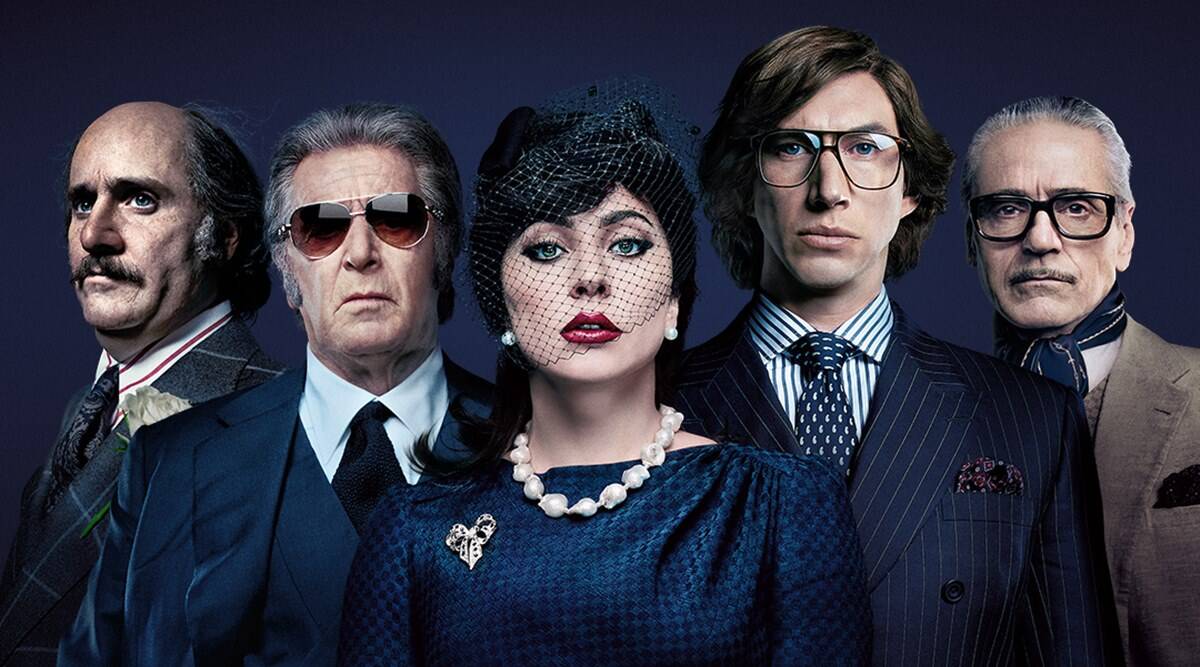
GOOD NEW MOVIE -- HOUSE OF GUCCI:

The cast of House of Gucci
HOUSE OF GUCCI (2021). Director: Ridley Scott.

Maurizio Gucci (Adam Driver) is smitten with the outgoing and ambitious Patrizia (Lady Gaga), and soon afterward they are married. Maurizio's father, Rodolfo (Jeremy Irons) isn't entirely taken with the union, but his brother, Aldo (Al Pacino) welcomes Patrizia and his nephew to New York. Then there's Aldo's son, Paolo (Jared Leto of Urban Legend), who is treated like a moron by his father, and who wants to design his own line. There are behind-the-scenes battles for control of the Gucci company, and then Maurizio has the temerity to have an affair and ask for a divorce. Patrizia is not going to take this lying down ... 

Lady Gaga was a determined Patrizia
House of Gucci
 is an entertaining and well-acted biopic and suspense story (even if you know the outcome) that holds the attention throughout its length. Lady Gaga is good, but I suspect there are other actresses who could have made more of the part. Driver and Leto (although he's initially over the top) are also quite good, but the pic is nearly stolen by a wonderful Pacino and especially Jeremy Irons as the father. If you're hoping to see some courtroom dynamics, be warned that the film ends rather abruptly with the arrest of certain parties -- you'll have to watch details of the murder trial on Dateline, which covered the story more than once.  

Verdict: Well, you may not rush out to buy a Gucci bag, but all the skullduggery in this is fascinating. ***1/4.  

Thursday, March 17, 2022

WHAT EVER HAPPENED TO ORSON WELLES? Joseph McBride

WHAT EVER HAPPENED TO ORSON WELLES? A Portrait of an Independent Career. Joseph McBride. University Press of Kentucky. 

What Ever Happened to Orson Welles? is not a biography of the famous actor and director, but rather a study of his career and an attempt to correct misconceptions about the man that have proliferated both before and after his death. McBride is often successful at this, and sometimes not, and the book -- while well-written and well-researched -- occasionally has a petulant "fan-boy" tone to it. Film buff McBride became acquainted with Welles and was even cast in The Other Side of the Wind as a nerdy film geek (a talented writer, the less said about his acting the better), and spoke and dealt with him on and off over the years. McBride argues against some of the assertions made against Welles, but at other times makes clear that these assertions are often true. Welles clearly was a narcissist, and clearly expected those under his spell to do what he wanted, come hell or highwater. However, McBride argues that Welles was not some corpulent figure of fun but an artist who not only made some successful and brilliant films, but, like a true artist, kept on working right up to the very last minute of his life. McBride dissects many of Welles's lesser-known film projects, and does make it clear that Welles's career did not begin and end with Citizen Kane. One suspects he's just too close to The Other Side of the Wind to see how really bad it is. To his credit, McBride doesn't shy away from examining Welles's flaws, and even goes into the man's ambivalent feelings about his sexuality. 

Verdict: Whatever you think of Welles, this is an interesting and thought-provoking read. ***.