Lively, entertaining reviews of, and essays on, old and newer films and everything relating to them, written by professional author William Schoell.
Showing posts with label Miklos Rozsa. Show all posts

Thursday, December 22, 2022

THE KILLERS

Virginia Christine, Burt Lancaster, Ava Gardner
THE KILLERS (1946). Director: Robert Siodmak.

Torpedoes Max (William Conrad) and Al (Charles McGraw) come to the town of Brentwood and (improbably) announce to people in the diner that they are going to kill a guy known as the Swede or Pete Lund (Burt Lancaster), which they do. The rest of the film presents assorted flashbacks from various points-of-view as insurance investigator Jim Reardon (Edmund O'Brien) tries to find out more about "Lund" and the reasons for his murder. Reardon hooks up with former cop Sam Lubinsky (Sam Levene) and discovers that the latter's old friend the Swede, actually Ole Anderson, a former boxer, was mixed up in a robbery plot as well as with a beautiful if duplicitous female named Kitty (Ava Gardner). But before Reardon's investigation is over, those two torpedoes just may have more work to do. 

Waiting for death: Burt Lancaster
The Killers is a fine and memorable piece of film noir. In his very first film, Lancaster gives a strong performance and he is backed up by an old pro in O'Brien. Conrad and McGraw certainly make in impression in their brief but chilling appearances. Levene and Virginia Christine (Anderson's old girlfriend and now Lubinsky's wife) are solid as well. And then there's Ava Gardner in her 27th film, but clearly still growing as an actress. She makes a good impression in the early scenes but doesn't quite cut it in her climactic moments. There are good turns from Phil Brown [Weird Woman] as Nick Adams, Vince Barnett as old Charleston, Albert Dekker as the architect of the robbery plot, Donald MacBride as Reardon's boss, Jack Lambert [The Unsuspected] as a member of the gang, Queenie Smith as Queenie, Anderson's sole beneficiary, and especially Jeff Corey as Blinky. (Charles Middleton plays a farmer but I didn't spot him.) Although Anderson is in some ways an unsympathetic character, you can't help but feel sorry for the miserable way in which he is played for a sucker. The Killers boasts an evocative score by Miklos Rozsa and fine photography by Elwood (Woody) Bredell. 

Verdict: Totally absorbing, very well-acted crime drama. ***1/4. 

Thursday, June 25, 2020

THE WORLD, THE FLESH AND THE DEVIL

Harry Belafonte
THE WORLD, THE FLESH AND THE DEVIL (1959). Director: Ranald MacDougall.

Ralph Burton (Harry Belafonte of Odds Against Tomorrow) is an engineer working underground when he is trapped for several days. When no one comes to rescue him he manages to make his way to the surface, and discovers that everyone has vanished. Newspapers report that millions fled the cities because of a radioactive dust that flooded the world after an apparent nuclear holocaust. Ralph makes his way to a deserted Manhattan where he moves into a luxurious apartment building, turns on a generator so he can have electricity, and sends out radio messages in the hopes of finding someone else alive. Then he meets Sarah (Inger Stevens), who was in a decompression chamber. As the two grow closer she claims that the difference in their races doesn't matter to her, but Ralph isn't sure he can believe her. Then new arrival, Benson (Mel Ferrer of Born to Be Bad), comes to town, and a melodramatic triangle situation develops.

Inger Stevens and Mel Ferrer
As contemporary critics noted, the first third of World, with Ralph discovering (more or less) what has happened and exploring his vacant surroundings, is the best part of the movie and suggests that something powerful might be in the offing. But unfortunately, the movie begins to fall apart with the arrival of Sarah, and pretty much collapses altogether with the introduction of Benson. Benson claims he has no problem with "negroes," but he's just a civilized racist, and his actions are ludicrous, occurring only because the filmmakers needed some suspect "drama." Although Belafonte -- who is top-billed -- and Stevens give good performances, neither they, Ferrer, or the film itself ever quite gets across the depth of their emotions as it pertains to this apocalyptic scenario -- there are times it's hard to believe this story is happening post WW3. Ferrer's performance is unbelievably poor and perfunctory -- when he talks about his missing wife and child he might as well be discussing a trip to the supermarket!

Abandoned cars on bridge -- where did all the people go?
Because World turns into a schlocky B Movie when it could have been so much more, the bored audience has time to ponder a variety of things that the script never addresses. How come there is not a single corpse anywhere? Did anyone besides Benson make it out of the cities? Why no mention whatsoever of radiation sickness?  What about people in nursing homes and hospitals? And so on. Why introduce a potential end-of-the-world scenario and then virtually ignore it completely? Even a Grade Z item wouldn't make that mistake, and this is an expensive MGM CinemaScope production (albeit in black and white).

Menage a trois? Belafonte, Ferrer, Stevens
There are some good things about the movie, however. Belafonte's character is a positive and sympathetic African-American, the hero -- not just the protagonist -- of a film made late in the fifties, which alone makes it of note. Harold J. Marzorati's cinematography is striking. Miklos Rozsa wrote the score for the film but there isn't enough of it. The title of the film is completely appropriate if pretentious. This being the fifties, Belafonte and Stevens aren't allowed to touch, let alone sleep together, and while the two should have kicked Ferrer out of New York altogether, in that time period the film couldn't end with an interracial couple going off together. However, the finale, which is meant to show hope for racial unity, instead unintentionally suggests something even more controversial: a menage-a-trois!

On the Beach was released the same year, and Five, which also included racial tensions in its storyline, came out eight years earlier. Ranald MacDougall also wrote and directed Queen Bee with Joan Crawford.

Verdict: A major missed opportunity but not without points of interest. **1/2. 

Thursday, May 28, 2020

A WOMAN'S VENGEANCE

Charles Boyer
A WOMAN'S VENGEANCE (1948). Director: Zoltan Korda. Screenplay by Aldous Huxley, based on his short story "The Gioconda Smile."

"I think of Henry all the time." -- Janet.

"No, you don't, you think of yourself in relation to Henry which is an entirely different proposition." -- Dr. Libbard.

Henry Maurier (Charles Boyer) has three women in his life: his bitter, ill and jealous wife Emily (Rachel Kempson); his dear long-time friend, Janet (Jessica Tandy of Butley); and his pretty young mistress, Doris (Ann Blyth). Henry is no angel, which causes him big problems when Emily is found dead. At first everyone assumes she died of heart failure, but the hateful nurse Caroline (Mildred Natwick) insists it was murder. An autopsy shows that there was arsenic in her system, so Henry's new marriage to Doris is interrupted by a trial. The results seem preordained, but Emily's doctor, James Libbard (Cedric Hardwicke of The Winslow Boy), engages in a battle of nerves with the person he believes is truly responsible.

Jessica Tandy
The performances in A Woman's Vengeance can not be faulted, with Boyer managing to make a sympathetic figure out of someone who may not deserve any sympathy. Mildred Natwick and Cedric Hardwicke are both excellent as doctor and nurse. Ann Blyth proves once again that her Veda in Mildred Pierce was no fluke, and Jessica Tandy nearly walks off with the movie in her fascinating portrait of a woman suffering from unrequited love. Called upon to display every possible kind of emotion she is on top of it all in every sequence. John Williams is also notable in a brief bit as the prosecutor, and there are other good supporting bits as well.

Boyer with Ann Blyth
One has to wonder exactly what screenwriter Huxley -- best-known as the author of "Brave New World" -- was trying to say in this little picture. One suspects it wasn't that circumstantial evidence can condemn an innocent man, and one hopes it was more than the old "Hell Hath No Fury" chestnut, but I'm not certain. The feelings of the scorned woman are explored, although her actions are not condoned. While A Woman's Vengeance is not and is not meant to be an Agatha Christie-type murder mystery, the pace does drag after the not-so-big reveal, and Huxley's screenplay is awfully talky at times. Russell Metty is the cinematography and there's a subdued score by Miklos Rozsa. Director Zoltan Korda was the brother of Alexander Korda. Rachel Kempson was the wife of Michael Redgrave.

Verdict: Great cast -- especially a superb Tandy -- giving their all but the film on a whole is unsatisfying. **1/2. 

Thursday, September 5, 2019

THE ASPHALT JUNGLE

Sam Jaffe and Sterling Hayden
THE ASPHALT JUNGLE (1950). Director: John Huston.

"Crime is only a left-handed form of human endeavor."

Fresh out of jail, Doc Reidenschneider (Sam Jaffe) immediately tries to get a team together for a big-time jewelry heist. Cobby, the bookie (Marc Lawrence), suggests that the wealthy lawyer Emmerich (Louis Calhern) can put up the front money so the operation can be carried out. He also enlists the aid of Dix (Sterling Hayden), a gunsel who only wants to go home to the country, safe cracker Louis (Anthony Caruso of Where Love Has Gone), and bartender Gus (James Whitmore). What none of the men know is that Emmerich is flat broke and planning on running off with the loot -- all of it.

The Adorable One with Louis Calhern
The Asphalt Jungle is a justifiably famous caper movie, although it isn't quite as good as The Killing, which also starred Sterling Hayden and came out five years later. Huston isn't a Hitchcock, and he doesn't play for maximum suspense, but the film is nevertheless absorbing and unpredictable. The robbery itself is, perhaps, less important than the aftermath. Sam Jaffe and Louis Calhern pretty much divide the movie up between them, as both of them are simply superb. But Caruso, Whitmore, and especially Marc Lawrence are also notable, as are Jean Hagen [Singin' in the Rain] as a woman who loves Dix, and the adorable one, Marilyn Monroe, as Calhern's sexy mistress, Angela, who is particularly good in her scenes with the police. John McIntire is also fine as Police Commissioner Hardy. Hayden, who was importuned by Huston to appear in the film, is not on the level of the others, and some times just seems to be merely reciting lines. He has given better performances elsewhere.

The film has a good look to it thanks to the cinematography of Harold Rosson, and although Miklos Rozsa's music is used sparingly, it is always effective.

Verdict: Another sharp, well-paced caper movie with a very interesting cast and characters, and brilliant work by Jaffe and Calhern.***. 

Thursday, July 11, 2019

THE LOST WEEKEND

Belly up to the bar, boys! Ray Milland
THE LOST WEEKEND (1945). Director: Billy Wilder.

Feeling himself a failure as a writer, and living off his brother, Wick (Phillip Terry of Hold That Kiss), Don Birnam (Ray Milland) has become, in his brother's words, a "hopeless drunk" His girlfriend of three years, Helen (Jane Wyman of Johnny Belinda), refuses to give up on Don, and does her best to help him. But even when he winds up in an alcoholic ward and later gets the DT's and has scary visions, he still won't stop drinking. Will Helen be able to get through to him, to get him to let his better self come through, or is he doomed?

The Lost Weekend is based on the autobiographical novel by Charles Jackson. Although Jackson married and had children, late in life he identified as bisexual and moved in with a male lover. This aspect of his life, and the fact that self-hatred over his homosexuality added to his distress and undoubtedly contributed to his drinking, is, of course, completely unexplored in this 1940's movie. The only thing that is mildly homoerotic in the picture is an obnoxious male nurse, Bim (well-played by Frank Faylen), in the alcoholic ward. Jackson wrote other works after Lost Weekend, but none were ever as successful as his first, and, although the movie intimates that Birnam will overcome his addictions, that was, sadly, not the case in real life. In 1968 he committed suicide.

Phillip Terry, Jane Wyman, Ray Milland
Still, The Lost Weekend is a memorable film with some first-class performances. Ray Milland, who is generally excellent, won the Best Actor Oscar. (The film also won for Best Picture, Best Director, Best Screenplay [Wilder and Charles Brackett] and Best Cinematography [John F. Seitz of the silent Four Horseman of the Apocalypse].) Phillip Terry, one of Joan Crawford's cast-off husbands, had a rare opportunity in a "A" picture and delivers a solid job in probably his most memorable role. Jane Wyman is as sympathetic and adept as ever. Howard Da Silva scores as the bartender, Nat, as do Doris Dowling as the barfly Gloria and Mary Young as Birnam's landlady, Mrs. Deveridge.

An interesting aspect of the picture is that, as played by Milland, Birnam often seems arrogant about his drinking and his life, as if the world owes him a living. In a sequence when Birnam steals a woman's purse in a restaurant, he seems to smirk as if he's gotten away with something, as opposed to his being ashamed and humiliated by his actions. This suggests that Birnam has character failings that have little to do with his drinking.

Jane Wyman
The film has some notable sequences, such as when Birnam sits at a performance of La Traviata, and the opera's famous brindisi (or drinking song) sequence only reminds him of the bottle of hootch he left in his jacket at the coat check and he has to leave to get a drink. Then there's his desperate run from pawn shop to pawn shop so he can get money for his typewriter only to learn that all the shops are closed for the Jewish holiday.

As good as the film is, it now has a kind of dated aspect to it. All you have to do is look at one of the episodes of Dr. Phil where he has desperate family members bringing an alcoholic and drug-addicted person on the show for a last chance at help, to realize that a person rarely just decides to stop drinking. The film is sanitized -- what seems horrifying about the debased, pathetic lives of drunks in this film is nothing compared to the reality. As good as Milland is, he rarely looks or acts like a really hard-core drunk despite the DT's and all the rest. As noted, the photography is first-class, as is Miklos Rosza's score, although the music the composer uses to denote, so to speak, "Demon Rum," is a little over the top and sounds like something out of a science fiction movie.

Verdict: The Lost Weekend must still be remembered as probably the first movie to depict alcoholics not as comical drunks but as tormented and addicted individuals. *** 

Thursday, July 13, 2017

TRIBUTE TO A BAD MAN

 Don Dubbins with his mentor, Cagney
TRIBUTE TO A BAD MAN (1956). Director: Robert Wise.

"You act like a man with a lot of ideas, all of them second-rate and none of them honorable." 

"A man doesn't die of a broken heart from his first love, only from his last."

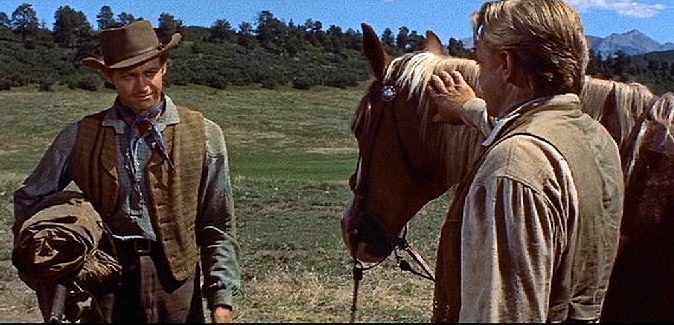
Young Steve Miller (Don Dubbins), who wants to be a cowboy or wrangler, winds up in the territory owned and run by Jeremy Rodock (James Cagney). Rodock has had to put up with people encroaching on his land and stealing horses and livestock for years, and he enacts his own rough justice, including hanging the perpetrators. The latest to earn his enmity is his old partner, L.A. Peterson (James Bell), and his son, Lars (Vic Morrow), but he may be wrong in his belief that either murdered one of his ranch hands. Rodock lives with Jocasta (Irene Papas, in her American debut), a woman with a past who is coveted by McNulty (Stephen McNally) and for whom Steve develops a growing infatuation. Finally tensions begin to boil over and Jocasta fears that Steve may develop the same hardness she sees in Jeremy, but is it possible that Rodock can mend his ways? Tribute to a Bad Man is an interesting western with some intriguing characters, and interactions among them, and the acting is uniformly good. Cagney is marvelous as the crusty autocrat with romantic leanings, and Papas gives a lovely performance as the woman he is devoted to. ("Introduced" in this film, Papas had already made several films overseas.) Don Dubbins was Cagney's protege, and the boyishly handsome actor always gives sensitive portrayals as he does here. McNally [The Lady Pays Off] and Morrow [Great White] make multi-dimensional villains, and James Bell and Jeannette Nolan [My Blood Runs Cold] score as Morrow's parents. Lee Van Cleef, Royal Dano, Peter Chong, and Onslow Stevens also make notable, if briefer, contributions. Cagney's patronage led to Dubbins appearing in this and These Wilder Years with Cagney, but the long career that followed consisted mostly of television work. This has nice widescreen Robert Surtees cinematography, adroit Robert Wise direction, a good Miklos Rozsa score, and a touching ending, although one could argue that the film certainly glosses over certain aspects of Rodock's character and actions.

Verdict: Romance and hangings in the wide open spaces. ***.

Thursday, September 15, 2016

QVO VADIS

The grandeur that was Rome courtesy of MGM
QVO VADIS (aka Quo Vadis/1951). Director: Mervyn LeRoy.

Marcus Vinicius (Robert Taylor) fights for the glory of Rome and its emperor, Nero (Peter Ustinov). He meets a woman named Lygia (Deborah Kerr) and the attraction is instant. Unfortunately, Lygia is a Christian and can't forget Vinicius' cruel soldier ways. Marcus then decides to enact an old Roman law that has Lygia forcibly taken away from her adoptive parents and brought to Nero's harem, where Marcus knows Nero has agreed to make a gift of her for him. But when Nero decides to blame the Christians for the burning of Rome, Marcus must decide on whose side he is really on, and if love will out. You can certainly quibble about certain aspects of Qvo Vadis, but as simple good story-telling and adept movie making, the picture is really a wonder to behold. Robert Surtees' cinematography is excellent, as are the scenic design, costuming, and matte paintings that make Rome seem even larger than it is. Miklos Rozsa also contributed an evocative score. As for the acting, Peter Ustinov gets the highest honors for his fascinating portrait of the petulant and often child-like, highly neurotic Nero. Kerr comes next, with her usual sensitive thesping, and even Robert Taylor, although certainly not on the level of those two, gives a good performance as Marcus. Leo Genn is fine as Marcus' uncle, although he is too perfunctory during his suicide scene. There are other notable performances from Patricia Laffan [Devil Girl from Mars] as Nero's nasty wife, Poppaea; Abraham Sofaer [Captain Sindbad] as Paul; Rosalie Crutchley [Blood from the Mummy's Tomb] as Acte, who loves Nero and runs his harem for him; Marina Berti as Eunice, a slave who adores her master, Marcus' uncle (the two have a moving death scene together); little Peter Miles [Roseanna McCoy] as young Nazarius, whose mother is killed when Rome burns to the ground; among others. Highlights of the well-directed film are the aforementioned burning of Rome; and the horrifying scenes of Christians being fed to the lions. There is a pre-Ben-Hur chariot battle, as well. Historians are still arguing over how accurate the assessments of Nero have been, so this picture must be taken with a grain of salt on that score.

Verdict: Almost as magnificent as Rome itself, and with its flaws as well, but this is splendid movie-making. ****.

Thursday, July 7, 2016

THE OTHER LOVE

Richard Conte and Barbara Stanwyck
THE OTHER LOVE (1947). Director: Andre De Toth.

"I'm not fooled, doctor. I know death is a guest here. Though he sent me his compliments."

Karen Duncan (Barbara Stanwyck) is a successful concert pianist who comes to a sanitarium for treatment of an unspecified illness. She and her doctor, Anthony Stanton (David Niven), find themselves falling for one another, and he suggests that Karen spend many months just resting. But Karen is restless for life, and goes off with race car driver Paul Clermont (Richard Conte) for a romantic and wearying time in Monte Carlo. Trying to evade her fate, Karen only gets sicker ... The Other Love is based on the story "Beyond" by Erich Maria Remarque. Fourteen years after The Other Love was released, Remarque wrote the novel "Heaven Plays No Favorites," which was filmed as the Al Pacino starrer Bobby Deerfield, which also deals with a dying woman and a race car driver. The Other Love proves no more convincing than Deerfield and Stanwyck's fine performance is wasted in a trite, superficial soap opera. Although Stanwyck is never that good at portraying vulnerability, she easily out-acts her two male co-stars. Gilbert Roland has a nice turn as a croupier who tries to take advantage of Karen, and Joan Lorring [The Corn is Green] is notable as another doomed patient in the sanitarium. Natalie Schafer briefly appears to sparkle in that certain sleazy way of hers as a guest at Monte Carlo. Miklos Rozsa' score doesn't help at all. Roland had a much more memorable appearance with Stanwyck in The Furies. NOTE: For more on Bobby Deerfield see Al Pacino In Films and On Stage.

Verdict: Dark Victory this isn't. **.

Thursday, December 3, 2015

LYDIA

Merle Oberon
LYDIA (1941). Director: Julien Duvivier.

"If I can't have all there is I don't want less."

An unmarried elderly woman named Lydia (Merle Oberon) invites a few old male friends to a gathering where she reviews her life and loves over the past few decades. Bob (George Reeves) runs off with Lydia after her grandmother Sarah's (Edna May Oliver) disapproval, but they never make it to the altar. Frank Andre (Hans Jaray) is a blind pianist whose love for Lydia remains unrequited. Michael (Joseph Cotten) is all set to marry Lydia but she doesn't feel the passion for him that she feels for Richard (Alan Marshal of House on Haunted Hill), a handsome sailor who tells her he must go off to settle some past romantic affairs and to wait for her. Well, it'll be a long wait ... Lydia is an unusual and unpredictable movie in that it defies romantic Hollywood conventions and doesn't offer up a traditional happy ending, meaning some viewers will find it unsatisfying, but it's just that difference that makes the movie interesting. The performances are excellent throughout, with a luminescent Oberon; George Reeves [The Adventures of Sir Galahad] proving that he was more than just Superman (whom he would essay a few years later); Joseph Cotten as good as ever; Alan Marshal charming as the mountebank; and Edna May Oliver nearly snatching away the movie from everyone else with her peppery portrayal of the hypochondriac grandmother. Sara Allgood is also on target, as usual, as the mother of a blind boy (Billy Ray) that Lydia befriends and Gertrude Hoffman is fine in a very small role. This has a nice score by Miklos Rozsa as well. The film is in some ways similar to Letter from an Unknown Woman, particularly in its conclusion.

Verdict: Romantic yet uncompromising. ***.

Thursday, May 15, 2014

DARK WATERS

Merle Oberon
DARK WATERS (1944). Director: Andre De Toth.

Leslie Calvin (Merle Oberon of These Three) is the only survivor of the shelling of a ship, and spent many miserable days in a life boat. With no family left, she goes to live with her Aunt Emily (Fay Bainter) and Uncle Norbert (John Qualen of Girls Dormitory), who live on an old sugar plantation near the bayou, and whom she has never met. Leslie is befriended by Dr. Grover (Franchot Tone), the maid Florella (Nina Mae McKinney), and another fired servant, Pearson (Rex Ingram), who has been warned to stay away from the estate. Among her relatives' associates are their lawyer, Mr. Sydney (Thomas Mitchell), and handyman Cleeve (Elisha Cook, Jr.). It isn't long before Leslie, now a wealthy heiress, suspects that there's something not quite right going on in the bayou, and that it embroils her aunt and uncle and perhaps others. Dark Waters is a modest, obvious and predictable suspense item with some good performances from Tone and Bainter, and especially Ingram [Fired Wife], Mitchell and Cook. Oberon has a strong scene in the hospital at the beginning, but her performance is uneven. It's all swathed in a nice score by Miklos Rozsa.

Verdict: Watchable but not much else. **1/2.

Thursday, April 10, 2014

KISS THE BLOOD OFF MY HANDS

KISS THE BLOOD OFF MY HANDS (1948). Director: Norman Foster.

In post-WW2 England Bill Saunders (Burt Lancaster) -- who thinks with his fists -- lashes out at a middle-aged bar owner simply because he says it's closing time and inadvertently kills the man. He runs off -- and hides out in the apartment of lady doctor Jane Wharton (Joan Fontaine). Jane tries to resist her attraction to Bill, but gets drawn deeper into his unsavory life, and winds up committing an act  of violence herself. Does this screwed-up couple have any hope? Frankly, it's hard to care about this romance of two unsympathetic people. Jane makes dumb excuses for Bill, and Bill never gives a thought to the man he killed or his family. Thrown into the mix is a creepy guy named Harry (Robert Newton of Obsession) who wants to get Bill involved in criminal activities, but whose chief purpose is to introduce someone Bill can feel morally superior to. It's as if the film is telling the audience: "See, Bill isn't so bad. Now this guy is a rotter." [But as far as we know Harry was never responsible for anyone's death.] Then there's the casting. Joan Fontaine can certainly play a woman who is obsessed with one man -- witness Letter from an Unknown Woman -- but she simply seems too intelligent to fall so hard for this loser, the vagaries of love notwithstanding. Lancaster also gives a good performance, by Hollywood standards at least, getting across the man's violence but not necessarily the aspects that make him a love object for Jane. Although only 80 minutes long the movie eventually becomes tedious, which is a shame because it has atmospheric photography by Russell Metty [The Omega Man], a nice score by Miklos Rozsa, adroit direction and editing -- but, sadly, a script that is lacking, to say the least. Norman Foster also directed the film noir Woman on the Run and many others.

Verdict: At least it has a good -- if kind of gross -- title. **. 

Thursday, August 29, 2013

MADAME BOVARY (1949)

Emma (Jones) wants a more exciting life and husband (Heflin)
MADAME BOVARY (1949). Director: Vincente Minelli.

"A man can change his life if he wants to ..."

Published in France in 1857, Gustave Flaubert's brilliant novel "Madame Bovary" was  accused of being an "outrage against public morals" and the author put on trial (and acquitted). This film version of the book begins with James Mason as Flaubert in the courtroom, explaining his creation, and then proceeding to [unnecessarily] narrate the early sequences of the movie. Farm girl Emma (Jennifer Jones) meets and falls in love -- or so she thinks -- with a simple, unambitious country doctor named Bovary (Van Heflin). But her day to day life is tedious and lacks color, and she realizes she is living with the wrong man, kind but dull. Her need for passion and excitement is even more energized when the couple are invited to a ball at the home of the Marquis D'Andervilliers (Paul Cavanagh) and she sees how wealthy people live and realizes how many men find her attractive. Guilt-wracked and initially resistant, she is drawn into affairs with Rodolphe Boulanger (Louis Jourdan), who shatters her, and later a young lawyer named Leon (Christopher Kent, who later became the director, Alf Kjellin). Meanwhile her taste for the finer things in life means that her debts are adding up alarmingly, but it may be her husband who has to pay the piper. Emma isn't evil, but her dissatisfaction with her life with Bovary makes her susceptible to, shall we say, outside stimuli. Madame Bovary is pretty faithful to the novel, despite a couple of changes. In the book Dr. Bovary is pressured to operate on the clubfooted Hippolyte (Harry Morgan, herein known as Henry) with almost tragic results, while in the film he wisely realizes that he hasn't the skill of a surgeon, making him somewhat more sympathetic. The more licentious scenes of the novel, such as Emma and Leon driving all around town in a carriage obviously having sex in the back behind lowered blinds, have been jettisoned. Although Madame Bovary could have been better cast -- Heflin never comes off as that dull or unattractive and Jones isn't the perfect Emma, although Jourdan is fine -- the actors are still quite good, including those of the large supporting cast, which includes George Zucco as Leon's boss; Gladys Cooper as his mother; Ellen Corby as the maid, Felicite; Mason as Flaubert; and especially Frank Allenby as the slimy salesman, Lhereux. The film is well directed by Minelli and has a nice score by Miklos Rozsa. Kjellin/Kent later appeared in Ice Station Zebra and directed the telefilm Deadly Dream.

Verdict: Certainly not the masterpiece that the novel is, but on it's own terms vivid and entertaining, with Jones in very good form. ***.