Lively, entertaining reviews of, and essays on, old and newer films and everything relating to them, written by professional author William Schoell.
Showing posts with label Tony Curtis. Show all posts

Thursday, March 16, 2023

THE PERFECT FURLOUGH

Janet Leigh and Tony Curtis

THE PERFECT FURLOUGH (1958). Director: Blake Edwards.

104 lonely men are stationed at an Arctic outpost and a notion is advanced to raise morale. One man will be chosen to go on a "perfect furlough," which is decided will be three weeks in Paris with the sexy movie queen Sandra Roca (Linda Cristal). Manipulating everyone behind the scenes, Corporal Paul Hodges (Tony Curtis) manages to become the winner. But when Colonel Leland (Les Tremayne) discovers that Hodges is an incurable skirt-chaser, he insists that his aide Major Collins (King Donovan) and Army psychologist Lt. Vicki Loren (Janet Leigh), who came up with the idea of the furlough, go along to keep Hodges out of trouble. But when Hodges gets a load of Sandra, this assignment may be more difficult than anyone imagines.

Elaine Stritch with Leigh
The Perfect Furlough could have been a smirking dirty joke but it's generally tasteful and consistently amusing. There are a lot of laughs in watching Hodges' efforts to escape from the MPs so he can hook up with Sandra -- who has a few surprises of her own -- as well as in the interplay between Hodges and a disapproving, yet attracted, Vicki. This is the perfect material for Curtis, who understandably has great chemistry with Leigh as the two were married at the time (1951 - 1962). While no comedian, Leigh is fine in the role, and there are excellent supporting performances from Elaine Stritch as Sandra's keeper; Tremayne and Donovan; Keenan Wynn as Sandra's manager; Alvy Moore as Private Brewer, who almost gets to go to Paris; and Gordon Jones as an MP. 

Argentinian actress Linda Cristal is cute, curvaceous and charming as Sandra, but she had her biggest success on television, starring in The High Chaparrral for several seasons. Troy Donahue [A Summer Place], playing a sergeant who accompanies Donovan and Leigh, is in the background in several scenes but has no dialogue. Another cast member who should be mentioned is the wonderful Jay Novello [The Mad Magician], who plays a French winemaker and lives with his father (Marcel Dalio), who hopes he'll get married. Lilyan Chauvin [Lost, Lonely and Vicious] shows up very briefly as a nurse. 

Verdict: Well-acted and funny fifties service comedy. ***. 

Thursday, November 10, 2022

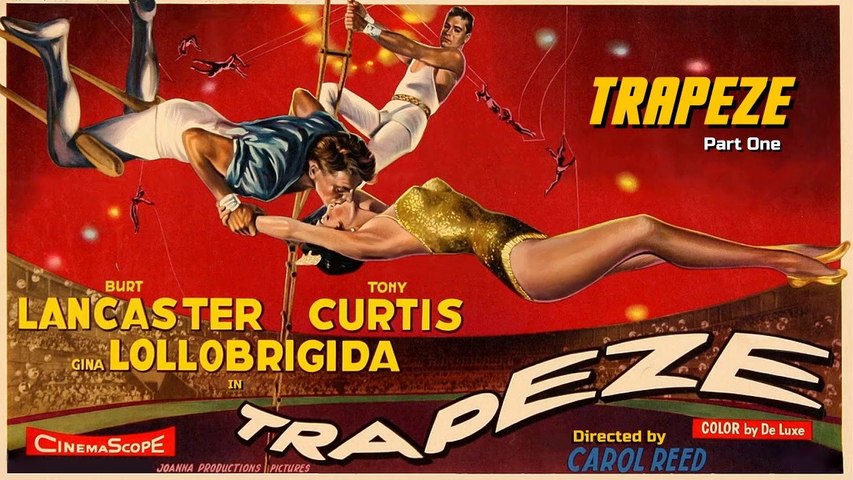
TRAPEZE

TRAPEZE (1956). Director: Carol Reed.

Bitter former acrobat Mike Ribble (Burt Lancaster) is working as a rigger for a Paris circus after falling and injuring himself while attempting a "triple" flip while performing high in the air. Tino Orsini (Tony Curtis) is an aspiring performer who talks Mike into teaming up with him for an act, hoping he can teach him to do the triple. Then there's the highly ambitious and beautiful Lola (Gina Lollobrigida of Woman of Straw) who manages to secure a position in their act while bouncing back and forth between both men. 

Lancaster, Lollobrigida and Curtis
While it's certainly understandable that both men would get the hots for Lola -- in my opinion Lollobrigida was always the sexiest and most beautiful of the Italian sex bombs -- falling in love with such a fickle and manipulative person is something else again. And one can't really see Lola falling for anyone but herself. But Trapeze is essentially a melodrama, and as such feelings are created in and discarded by the characters simply to serve the needs of the plot -- that's all there is to it. As a circus picture, Trapeze is only fair to middling. However, it comes alive during the aerial sequences, which are thrilling, skillfully intercutting the three main actors into the actions of real circus performers. Clearly they were each willing to be photographed doing some aerial work, although not high above the ground one supposes.

The performances are good. Curtis and Lancaster would reteam for Sweet Smell of Success the following year when Curtis would really come into his own. This is not Lollobrigida's first American film, but probably the biggest English role she'd had to that date. Her character is kind of impossible, and her transformation from opportunist to someone sincerely in love with one of the men isn't believable, but for that I'd blame the script. Others in the cast include Minor Watson (of Beyond the Forest) as a man from Ringling Brothers; Thomas Gomez as the fat and rather obnoxious boss of the Paris circus; Katy Jurado as Rosa, who is carrying a torch for Mike; and Gerard Landry as her husband. There are interesting and flavorful moments in the movie, but it's nothing very deep, although one senses everyone working on the film thought it would be. Malcolm Arnold's score is so overwrought at times that it approaches the comical.

All of the homoeroticism of the novel, The Killing Frost, upon which the film is based, was eliminated, although if you watch it carefully ... In the novel Tino is executed for murdering Lola, although she was actually killed by Mike, who was in love with -- you guessed it -- Tino! 

NOTE: It has been said that Lancaster, because of his background, did all of the trapeze stunts in the film except for the Triple. I think this has been very exaggerated. For one thing, Lancaster is clearly in front of a blue screen in some shots and if one freezes the film the aerialist playing Lancaster is clearly a different person in the long shots. 

Verdict: Stick with The Big Circus. **1/2. 

Thursday, March 4, 2021

SWEET SMELL OF SUCCESS

SWEET SMELL OF SUCCESS
(1957). Director: Alexander Mackendrick. 

"You're dead, son. Get yourself buried." 

Powerful newspaper columnist J. J. Hunsecker (Burt Lancaster), who seems to have an incestuous yen for his sister, Susan (Susan Harrison), is determined to keep her from marrying a musician (Martin Milner), and importunes press agent Sidney Falco (Tony Curtis) to help him break the couple up. This study of loathsome and immoral characters isn't really about show biz or newspapers or even columnists but it seems almost as hollow at its center as its protagonist. Part of the problem is that you never really believe Lancaster as Hunsecker, although by no means does he give a bad performance. Then the secondary love story isn't that convincing or moving. Susan Harrison and Barbara Nichols have some nice moments -- Milner is okay if a bit stiff -- but the picture is positively stolen by a ferocious, charismatic and altogether splendid performance by Tony Curtis. That's the main reason to watch the film. 

Verdict: Curtis' finest hour. **1/2.

Thursday, July 11, 2019

HOUDINI

Tony Curtis
HOUDINI (1953). Director: George Marshall.

Harry Houdini (Tony Curtis) is performing as the "wild man" in a carnival sideshow when he encounters the pretty Bess (Janet Leigh), who finds him a little headstrong. Nevertheless, he wins her over, the two are married, and the couple head for Europe where Harry is determined to become a great magician. Harry manages to escape from a strait-jacket, gets out of a Scotland yard jail cell, and nearly dies when he is caught beneath the ice in the Detroit River. Bess feels some trepidation as Harry prepares to extricate himself from the "Pagoda Torture Cell," which is filled with water and seems inescapable ...

Curtis and then-wife Janet Leigh
Houdini is loosely based on the life of the famous magician, although it does manage to get some of the facts straight. (The Pagoda Torture Cell was actually called the Chinese Water Torture Cell and Houdini escaped from it numerous times. not just once, and the ending to this film is pure fiction). Tony Curtis makes a perfect Houdini, combining brashness with slight nervousness, and giving an energetic performance, while his then-wife Leigh compliments him well as Bess. There are also notable turns by Torin Thatcher [Witness for the Prosecution] as the assistant to a late famous magician who comes to work for Houdini; Mabel Paige [Johnny Belinda] as a phony medium that Houdini exposes; Ian Wolfe [Foreign Correspondent] as the head of a magicians' society; and others. The film is also distinguished by good period atmosphere and the photography of Ernest Laszlo.

Verdict: Entertaining, colorful romp about a fascinating historical figure. ***. 

Thursday, June 13, 2019

AMERICAN PRINCE: A MEMOIR -- TONY CURTIS

AMERICAN PRINCE: A MEMOIR. Tony Curtis and Peter Golenbock. Harmony; 2008.

Apparently not being satisfied with the first book, this is the late Curtis' second autobiography. Never forgetting a slight, real or imagined, in this volume he settles scores. Since his first wife, Janet Leigh, had passed away by then, he feels free to dissect their marriage and highlight her alleged faults as a wife. (One can't imagine that this endeared him to his daughters by Leigh, including Jamie Lee Curtis.) One gets the impression that Curtis had no real interest in honest reflection nor in seeing things from other people's pov\s. He is the very personification of the self-absorbed movie star.

Curtis traces his early years and his bad relationship with his parents; the tragic deaths of his two brothers -- he never balances his basically successful life with the brother who was placed in a mental institution and eventually wound up homeless and beaten to death --  his determination to make it in Hollywood, and his cinematic triumphs in such as Sweet Smell of Success (arguably his greatest performance) and Some Like It Hot, among others.  Curtis doesn't shy away from detailing the years afterward, when he was forced to take virtually any role in any piece of crap just to pay the bills, including alimony and child support. He also writes about his cocaine addiction and his many marriages (at least one wife never gets mentioned at all).

Curtis never lost the chip on his shoulder. Part of this is due to the fact that he never felt he was really taken seriously. Part was also due to the fact that no matter what the role he generally came off as dead-common. This book didn't help him shake off that image.

Verdict: Not a bad read, but it leaves a sour taste. **1/2. 

Thursday, May 2, 2019

SEX AND THE SINGLE GIRL

Tony Curtis and Natalie Wood
SEX AND THE SINGLE GIRL (1964). Director: Richard Quine.

Bob Weston (Tony Curtis), who writes for a sleazy expose mag called Stop, has just come out with a story on psychologist Helen Brown (Natalie Wood). Dr. Brown wrote a bestseller entitled "Sex and the Single Girl," but the article claims she is a virgin with limited experience. Weston wants to dig up more dirt on Brown, so he poses as his next door neighbor, hosiery salesman Frank (Henry Fonda), whose wife, Sylvia (Lauren Bacall), is almost pathologically jealous, and pretends to be Helen's patient. When Bob and Helen start falling in love, it causes complications for everyone.

Lauren Bacall
When someone got the bright idea of turning Helen Gurley Brown's bestseller into a movie, they should have tried for something more sophisticated than this dumb "sex comedy" that has hardly any laughs. Even the basic premise of a man getting close to a woman who hates him by pretending to be someone else is nothing new. A sequence when not only Bacall but two other women show up at Brown's office claiming to be Sylvia should at least have been fun, but it's as clunky as everything else in the movie. The picture develops a slight degree of momentum toward the end, but it all winds up in a race to the airport with everyone chasing everybody else in their cars or taxis -- a bit with Bacall and a cab driver is kind of muffed -- and an attempt to emulate the kind of zaniness you used to find in Frank Tashlin movies never really comes off. The whole sequence goes on too long in any case.

Tony Curtis
Sex and the Single Girl might have worked if Carol Burnett had played Brown instead of Natalie Wood. She and Curtis give it the old college try, but they can do little to make any of the lines -- some of which are actually funny -- come alive. Henry Fonda is out of his element and even Bacall is mostly mediocre. Others in the cast include Mel Ferrer as a psychiatrist who is interested in Helen, Fran Jeffries as an amorous friend of Bob's, and Leslie Parrish as Bob's secretary. Two veterans who add a bit to the limited fun are Edward Everett Horton as Bob's boss and Otto Kruger as one of Helen's associates, and Larry Storch shows up as a motorcycle cop driven crazy by all the goings-on. There's an inside joke about Some Like It Hot but the references to Jack Lemmon are repeated once too often. The pic tries to come up with some interesting backdrops -- a dock where Bob threatens suicide, the ape cages in the zoo -- but ultimately the movie is just deadly. Fran Jeffries, who sings and dances in the movie, had previously been married to Dick Haymes, and then married Richard Quine, the film's director, the year after this was released. The marriage only lasted four years.

Verdict: And it's nearly two hours long as well! *1/2. 

Thursday, May 25, 2017

FORBIDDEN

FORBIDDEN (1953). Director: Rudolph Mate.

"There isn't one thing about you that I've ever forgotten."

In post-WW2 Macao, Eddie Darrow (Tony Curtis) comes looking for his lost lady love, Christine (Joanna Dru). A bitter Darrow is being paid money to bring Christine, who is the widow of a notorious gangster, back to the United States to help with a deal for one of her late husband's associates, but the truth is that she knows too much. Darrow comes to the aid of nightclub-casino owner Justin Keit (Lyle Bettger), who is assaulted in the street, and winds up staying in his home, ultimately learning that Christine is Keit's fiance. With Keit and his men on one side, and her husband's associates on the other, will Eddie and Christine live long enough to enjoy their rekindled romance? Forbidden takes all of the stock elements from much better pictures, tosses them around, and comes up with a brisk, entertaining, but forgettable romantic adventure. The performances are all good, with Curtis' dead-commonness not getting in the way of his characterization (such as it is); Dru attractive if a bit tame as the femme fatale; and Bettger [The Sea Chase] walking off with the movie as her dangerous fiance. Victor Sen Yung [Charlie Chan in Honolulu] gets to play two stereotypes: the inscrutable Oriental coming out with pithy sayings, and the philosophizing piano player. Arguably Curtis' best performance was in Sweet Smell of Success. Not to be confused with Macao.

Verdict: Call this Gilda once over lightly. **1/2.

Thursday, June 18, 2015

THE THIRD GIRL FROM THE LEFT

Kim Novak
THE THIRD GIRL FROM THE LEFT (1973 telefilm). Director: Peter Medak.

"If he cried for anyone, it was himself" -- Gloria

"Of course. Who else does anyone cry for?" -- Zimmy.

Gloria (Kim Novak) at 36 is known as the last of the New York City showgirls (Novak was actually forty). For thirteen years she has been involved with a frankly terrible but popular singer named Joey Jordan (Tony Curtis). Their marriage keeps being "postponed" for one reason or another. Even though Gloria is easily the most beautiful of the "girls," for the first time in her career she is told to stand in the back row instead of in front. She has an affair with a 24-year-old delivery boy named David (Michael Brandon of Four Flies on Grey Velvet), then Joey comes back from Las Vegas where he's been poking Melanie (Barbi Benton) ... The material was there for a decent picture, but The Third Girl from the Left doesn't quite work. Novak isn't terrible, but she's miscast in this, and while Curtis is more appropriate as a Las Vegas reptile, his character is also a cliche. Dory Previn, who wrote the script, was responsible for a number of sensitive songs with excellent music and lyrics on her albums -- although the theme song for this picture is not memorable --  but aside from some good dialogue now and then, this never really goes below the surface. The relationship between Gloria and David is never believable, with the latter coming off like some creepy witless stalker. The best impression is made by George Furth as Joey's manager, Zimmy. When Zimmy learns that the not-quite-bright Gloria was trying to commit suicide, he says "With an electric stove?" That old vulgarian Hugh Hefner was the executive producer of this, which is probably how his squeeze Barbi Benton wound up in the movie -- she's actually not bad although Kate Hepburn had nothing to worry about. Dory Previn was dumped by her husband Andre for the undernourished Mia Farrow, and wrote several songs about it. Judging from her lyrics, one would have hoped for a much better picture. Peter Medak also directed The Ruling Class and By the Pricking of My Thumbs.

Verdict: A nice idea that goes nowhere. **.

Thursday, December 25, 2014

THE GREAT RACE

Blink and you'll miss her: Vivian Vance
THE GREAT RACE (1965). Director: Blake Edwards.

Near the turn of the century, rival daredevils Professor Fate (Jack Lemmon) and the Great Leslie (Tony Curtis), among others, embark on a race from New York to Paris (they go way up north and head for Siberia to make their way into Europe). They are joined by Maggie Dubois (Natalie Wood), a suffragette and wannabee reporter. Along the way -- the very longgg way -- they have assorted misadventures ... Frankly, I only put on The Great Race because I heard Vivian Vance [The Blue Veil] was in it. Unfortunately, "Ethel" -- now playing the wife of newspaper editor Arthur O'Connell -- is a mere "guest star" and is on screen for at best a minute and a half. Boo hiss! Worse, the movie is nearly three hours long. No, it's not awful and there are enough entertaining moments and good acting to keep you watching, but there's no need for this picture to be so long. (The movie is, rather presumptuously, dedicated to Laurel and Hardy, who certainly never needed three hours to make a funny movie!) Probably inspired by the success of such mammoth productions as Around the World in 80 Days and It's a Mad, Mad, Mad, Mad World, The Great Race is bloated and episodic, with way too many digressions. There is a long and unnecessary detour involving a foppish (or stereotypically gay?) prince who happens to be a lookalike of Fate's, a sequence which could and should have been excised from the final cut, despite some good performances from Lemmon as the prince and George Macready as a conniving member of his court. A sequence for some reason situated in the old west has Dorothy Provine [Kiss the Girls and Make Them Die] -- looking sort of like a monkey with a bouffant hairpiece that threatens to topple off of her head any minute -- belting out a terrible number, but at least it leads into a fairly rousing bar fight. On the other hand, a pie fight that caps the prince sequence goes on too long (keeping in with the "theme" of the movie) and hasn't a single laugh. Oddly, the best scene in the movie is a well-cut and choreographed sword and saber fight between Curtis and Ross Martin that isn't played for laughs but plays. Jack Lemmon is in manic mode (as he was in Luv) throughout the movie but is effective on that sometimes irritating level. Curtis and Wood are Curtis and Wood, although they are well-coached in their line readings. Keenan Wynn, Larry Storch, Macready and Martin make a better impression.

Verdict: Not quite "Blake's Folly" -- but not for lack of trying. **1/2.

Thursday, July 26, 2012

THE LADY GAMBLES

THE LADY GAMBLES (1949). Director: Michael Gordon.

While her husband David (Robert Preston) works on a dam in Nevada, Joan Boothe (Barbara Stanwyck) wiles away her time in a gambling casino. There she meets Corrigan (Stephen McNally), the pit boss who is attracted to her, and uses her in certain schemes and high-stakes card games. But Joan's bigger problem is a growing addiction to gambling, which eventually jeopardizes her marriage and even her life. While today we would simply refer to Joan as a "gamblaholic" and be done with it, The Lady Gambles comes up with some dime store psychology involving Joan's neurotic sister Ruth (Edith Barrett) to explain her addiction. In spite of that, the movie is absorbing, in no large part due to Stanwyck's typically riveting performance. McNally is also excellent as Corrigan, adding some interesting dimension to an underwritten role. Barrett certainly delivers as the tormented, jealous sister. Preston is fine in the least interesting role of the husband. Dyspeptic John Hoyt (Attack of the Puppet People) is his usual acerbic self as a doctor. Tony Curtis has a bit part as a bellboy, and William Hudson also has a bit. At one point in the film Corrigan tells the two sisters that his first name is Horace, which is how McNally was originally known when he appeared in such films as Laurel and Hardy's Air Raid Wardens.

Verdict: Stanwyck is one hell of an actress and this is a very interesting story. ***1/2.

Thursday, April 12, 2012

THE MANITOU

Michael Ansara and Tony Curtis confront the Unknown
THE MANITOU (1978). Director: William Girdler.

Fake San Francisco spiritualist Harry Erskine (Tony Curtis) learns that an old girlfriend of his, Karen Tandy (Susan Strasberg), has a little bit of a problem. She has a tumor growing on her back, it's getting larger, and it appears to be a fetus! Erskine discovers that the fetus is the reborn spirit of a nasty Indian medicine man, and enlists the aid of a modern-day equivalent, John Singing Rock (Michael Ansara), to fight the medicine man and the evil gods it conjures. Their only allies are the spirits -- or "manitous" -- of the objects around them. Before long the hospital has become a battle zone as they fight for Karen Tandy's soul amidst corpses turned inside out, frozen, decapitated nurses, and other signs of murder and mayhem. The movie, based on a novel by Graham Masterton, has an interesting cast: Besides the aforementioned actors we've got Ann Sothern (a medium), Stella Stevens, Burgess Meredith (anthropologist Dr, Snow), Lurene Tuttle (a client of Erskine's who takes a tumble) and even Jeanette Nolan. Jon Cedar, who associate-produced and worked on the screenplay, plays Dr. Hughes. Curtis' pants are almost as tight as the ones worn by Robert Conrad in The Wild, Wild West! There are a lot of interesting elements to this movie, and it holds the attention, but somehow it doesn't completely jell. Cedar was also in Girdler's Day of the Animals.

Verdict: Not without interest, but somehow less than the sum of its parts. **1/2.

Thursday, March 3, 2011

SO THIS IS PARIS


SO THIS IS PARIS (1955). Director: Richard Quine.

In this "French" version of On the Town three American sailors wind up in Paree and have various, generally romantic, mis-adventures. Joe Maxwell (Tony Curtis) is the love 'em and leave 'em type; Al Howard (Gene Nelson) is shyer and more sensitive; and Davy Jones (Paul Gilbert) is the amiable cook and clown. Joe thinks he's got it made with an intriguing chanteuse, but he gets home early while Al and Davy show up later all smeared with lipstick. The women they meet include Jane (Gloria DeHaven), who pretends to be a French girl named Collette for her nightclub act; Suzanne (Corinne Calvet), a beautiful heiress who runs through men the way Joe runs through women; and Yvonne (Mara Corday), a pretty cashier in the nightclub who has a big family to support. It's interesting to see Corday, who starred in The Giant Claw, Tarantula, and The Black Scorpion, appear in a film where she isn't nearly eaten, but she isn't given nearly enough to do. She fares better than Allison [Attack of the 50 Foot Woman] Hayes, however, who seems to be in the background of a pool scene but whose dialogue scenes were apparently cut. On the Town [at least the original Broadway version] had songs composed by Leonard Bernstein; So This is Paris has the team of Moody and Sherrill, whose songs are hit or miss, mostly miss, although one number briefly crooned by DeHaven isn't bad. The performances are fine, with Paul Gilbert being especially noteworthy, and Gene Nelson's athletic dancing is a definite bonus. Curtis sings and dances and doesn't embarrass himself. The talented Gilbert didn't have too many TV or film credits but he may have been more at home in the theater; he later wound up in Women of the Prehistoric Planet.

Verdict: Surprisingly entertaining and not without its charms. ***.