Lively, entertaining reviews of, and essays on, old and newer films and everything relating to them, written by professional author William Schoell.
Showing posts with label 1956. Show all posts

Thursday, August 13, 2026

BACK FROM ETERNITY

BACK FROM ETERNITY (1956). Director: John Farrow.

In this widescreen if black and white remake of Five Came Back (which was also directed by John Farrow), a motley group of passengers survive a crash in the South American jungle, only to realize that only a few of them can fly away and there are headhunters right around the corner. Back from Eternity could have been a terrific, gut-wrenching movie if only all of the dumb "Hollywoodisms" had been excised from the script. True, I've watched plenty of silly if entertaining dumb Hollywood movies, but what makes Eternity worse is that it had so much potential. True, the final few minutes are suspenseful, the acting isn't bad, and the conclusion has a certain power, but otherwise it's not a very good movie. Anita Ekberg [Screaming Mimi] got the lion's share of the publicity, and aside from being beautiful and busty, she's not a bad actress, either (by Hollywood standards, at least), although her American career didn't last long. (She appeared in this before her famous role in Fellini's La Dolce Vita.) Robert Ryan as the possibly tippling pilot is perhaps less effective in this than in other films, but Rod Steiger offers the best performance as a condemned man being brought back for execution. Phyllis Kirk and Gene Barry are effective enough as an engaged couple who have problems, and Beulah Bondi and Cameron Prud'homme are fine as an elderly professor and his wife. Jesse White is Jesse White.

SPOILER ALERT: 
Now let's talk about those "Hollywoodisms:" Fred Clark is taking Steiger back for execution, but he uses no handcuffs on a supposedly dangerous felon. Kirk and Ekberg have a completely ridiculous "cat fight" over a man that serves only to show the latter in a wet, clinging outfit. Worse still is the whole business with the lovely stewardess, Maria (Adele Mara of Night Time in Nevada). First let's make it clear that Maria is a friend and co-worker of the pilot and his co-pilot (Keith Andes), and is an attractive and really nice person. Saving a little boy (Jon Prevost) from falling out of the plane when a tank smashes open the door, she herself falls to her death in a horrifying moment. There is no scene when Andes tells Ryan what happened. After the plane lands in the jungle, Ryan says to Andes "everyone all right?" to which Andes replies that the passengers were only a little bruised. There's absolutely no mention of brave Maria and her horrible death throughout the rest of the movie, and these are her co-workers!  (A somewhat similar sequence occurred in another plane crash drama The Crowded Sky.) Admittedly, the passengers are having their own problems, but even during a quiet, contemplative moment much later on, when the pious professor and his wife lead everyone in the Lord's Prayer, nobody offers up a prayer for Maria. It's unbelievable, cold-blooded and illogical scenes like this (or the lack of them) and others that make me classify Back From Eternity less as drama than as schlock. Farrow's direction, although the plane scenes are well-handled, also does little to disguise/detour around some moments of really bad acting.

Verdict: The final quarter has its moments but then there's the rest of it ... **.

Thursday, June 4, 2026

THE REVOLT OF MAMIE STOVER

Jane Russell and Richard Egan
THE REVOLT OF MAMIE STOVER (1956). Director: Raoul Walsh. 

"When you talk about money you're slumming. When I talk about it, I'm just plain scared." -- Mamie. 

Mamie Stover, originally from a small town in Nebraska, is put on a steamer to Honolulu by the authorities in San Francisco and told never to return. Although Mamie has never been convicted of anything (or so she says), she apparently has some kind of unsavory and criminal history. On the ship she meets up with handsome author Jim Blair (Richard Egan of A Summer Place), who doesn't waste much time before making passes which are happily received by the initially distrustful Mamie. When the boat docks Mamie learns that her new swain apparently has a steady girl in Annalee (Joan Leslie), a much more respectable female. Not at all bashful in any sense of the word, Mamie asks if she can move in to Jim's beautiful Hilltop estate, but he says no, loaning her one hundred bucks instead. Mamie goes to work at a somewhat sleazy establishment run by Bertha (Agnes Moorehead), who employs the sadistic Adkins (Michael Pate of Curse of the Undead) to keep the girls in line --  with his fists if necessary. Despite whatever reservations he might have -- and in spite of Annalee -- Jim can't help dropping into the nightclub where Mamie has become a top headliner. But she has been told not to fraternize with men outside the club, a rule she gleefully breaks to be with Jim. Surprisingly well-paid at the club, Mamie is saving her money and intends to have her own hilltop estate someday. Then the attack on Pearl Harbor occurs, and Mamie hits on a way to enrich her coffers ... 

Russell with Agnes Moorehead
The entertaining Revolt of Mamie Stover is typical of movies in the fifties that feature decided "bad girls" but make certain not to delineate their alleged misdeeds with too much scrutiny. Scenes that made it clear that Mamie was a hooker were cut from the film. Born into comparative poverty, Mamie -- like the heroine of Bedelia -- is determined to rise from the gutter by any means she can, although one senses that Miss Stover is not really evil, just mercenary and a little desperate. The hard-edged Russell is perfect for the role of Mamie, and she gives a snappy performance. Although he has a couple of wooden moments, Egan is basically fine as Jim. Pate and Moorehead score, as expected, in the two major supporting roles, but Joan Leslie has the thankless part -- and very little screen time -- as Annalee. Richard Coogan of Vice Raid is given the opportunity to make an impression and does so as Captain Eldon Sumac, a married officer who tries his best to score with Mamie. Marilyn Monroe and Lana Turner were both considered for the role of Mamie -- the former would have brought more vulnerability to the role -- but passed on it. A good score by Hugo Friedhofer and top-notch cinematography from Leo Tover certainly help. Leon Lontoc, who plays Jim's servant and supposed friend, Aki, later wound up on Burke's Law in a similar role. Jean Willes, Margia Dean and Hugh Beaumont also appear in smaller parts. 

Verdict: If you take this flick with a grain of salt -- it's watered down and is sometimes quite improbable -- it is absorbing and fun. ***

Thursday, May 7, 2026

BLITHE SPIRIT (1956).

Noel Coward and Claudette Colbert
BLITHE SPIRIT on Ford Star Jubilee Season One, episode five (1956). Director: Noel Coward. LIVE. 

Charles Condomine (Noel Coward of The Astonished Heart) and his second wife, Ruth (Claudette Colbert of Thunder on the Hill), invite the medium Madame Arcati (Mildred Natwick of A Woman's Vengeance) to their home for a seance. Unwittingly the somewhat vague Arcati summons up the ghost of Charles' first wife, Elvira (Lauren Bacall of Sex and the Single Girl), who can be seen by Charles but is invisible to Ruth. Eventually Ruth acknowledges that Elvira truly exists and is occupying their home, and schemes to send her back to the ether. Meanwhile Elvira is scheming to have Charles join her forever in the "hereafter," but her plans may go awry ... 

Coward with Lauren Bacall
This live TV adaptation of Noel Coward's famous very dark comedy is worth seeking out as it's quite funny and wonderfully acted by all. Coward, of course, knows just how to handle this material, and while she might seem like a lightweight in this company, Bacall is much better than expected as Elvira. Then we have Colbert, proving again what an acting powerhouse she is as Ruth -- she nearly walks off with the whole show. In one of her earliest roles Marion Ross of Happy Days and Lizzie is wonderful as the frenetic maid, Edith, and there are fine turns by Philip Tonge as Dr. Bradford and Brenda Forbes as his wife. Mildred Natwick is so good as Madame Arcati that she almost makes you forget Margaret Rutherford's superb portrayal of Arcati in the 1945 film version. Can one detect a definite if unintentional note of misogyny in this play -- possibly -- as at least one of these women certainly doesn't deserve her fate. One can imagine Condomine going off to the nearest gay beach when the play is over!

Verdict: Exciting, beautifully-acted live theater on TV! ***1/2. 

Thursday, January 15, 2026

DIE HALBSTARKEN

Horst Buchholz
DIE HALBSTARKEN (aka Teenage Wolfpack/1956). Director: Georg Tressler. Colorized

A youth gang (of sorts) in post-war Germany is led by Freddy (Horst Buchholz), the most attractive and charismatic of the bunch. He has acquired some of his nasty attitude from his father (Paul Wagner), who has been in a foul mood since his brother-in-law borrowed a significant amount of money and can't repay it. Freddy's younger brother, John (Christian Doermer), is dismayed that his father takes it all out on his mother (Viktoria von Ballasko) and hopes to raise the money to repay his father. Meanwhile Freddy has moved or been thrown out of the house, and has his own place, with his 15-going-on-16 girlfriend, Sissy (Karin Baal), just next door. Freddy concocts a robbery scheme that goes horribly wrong, and discovers that the female of the species may just be deadlier than the male. 

Doermer and Baal
If one is hoping for a serious and thoughtful look at life in post-WW2 Germany, Die Halbstarken is not it. Clearly inspired by Hollywood juvenile delinquency films (which were dubbed and shown in Germany), this picture resembles one of them even down to the jazz score. We've got the restless teenage boys, the sluttish females, the attitude and feeling of wasted lives going nowhere, and all the usual tropes. The acting is quite good, however, with Buchholz (billed as "Henry Bookholt" in the dubbed American version of the film, Teenage Wolfpack, which even played drive-ins in the states) taking top honors but getting competition from Doermer as his nicer and more sensitive brother and Baal as the girlfriend, a blonde Lolita who tries to play both ends against the middle. The supporting cast is also on top of things. Buchholz struts around in tight black leather pants through the whole movie, which is somewhat entertaining if minor. NOTE: After I wrote this review I discovered that I'd already seen and reviewed the darn thing some years ago. I hate when that happens! 

Verdict: Buchholz went on to better things. **3/4. 

Thursday, September 26, 2024

HE LAUGHED LAST

Frankie Laine and Lucy Marlow
HE LAUGHED LAST (1956). Director: Blake Edwards. 

When prohibition mobster Big Dan Hennessy (Alan Reed of I, the Jury) is wiped out by an ambitious underling, Max (Jesse White), the latter discovers that the dead man has left everything to an employee, singer-dancer Rosie (Lucy Marlow), including his stake in all of his rackets. This causes problems for Rosie because she is engaged to a cop, Jimmy Murphy (Richard Long). Surveying all this while having little impact on events is the late Dan's benign henchman, Gino Lupo (Frankie Laine), who also sings now and then. Max cooks up the idea of having handsome dancer Dominic Rodriguez (Anthony Dexter of Fire Maidens of Outer Space) become Rosie's partner and romance her, hoping to win her heart and hand and control of the rackets for Max. But Rosie may have other plans. 

Dick Long with Marlow
After the success of the film version of Guys and Dolls the previous year, there were all sorts of Damon Runyonesque-type stories featuring comical gangsters, of which He Laughed Last is one of the worst. Despite the title, the movie has virtually no laughs, and no one in the cast is remotely amusing. Frankie Laine, whose character doesn't really have much to do in the story, has no great comic skill, Jesse White is as annoying and unfunny as ever, Richard Long is certainly no comedian, and although Lucy Marlow plays it cute she's not a barrel of laughs, either. Blake Edwards script is, in a word, a stinker, an idea that should never have seen the light of day. 

Marlow with Anthony Dexter
He Laughed Last
 is not an actual musical, although Marlow is given two numbers and Laine sings a couple of times as well. The one and only highlight of the picture is when Rosie and that Latin Lover Boy Dominic dance a sexy tango together and the movie is (very) temporarily scintillating. Dexter had played Valentino five years earlier and uses the smooth assurance he displayed in that film to good affect in this, but he doesn't have enough screen time. Blake Edwards also directed Bring Your Smile Along, his first film, which also featured Marlow and Laine. It's a question why Laine even chose to appear in this picture. This might be the only time Richard Long was billed as "Dick Long."

Verdict: One tango does not a worthwhile movie make. *1/2. 

Thursday, March 28, 2024

PATTERNS

Face Off: Van Heflin and Everett Sloane
PATTERNS (1956). Director: Fielder Cook. Screenplay by Rod Serling. Colorized

Recruited by Walter Ramsey (Everett Sloane of The Big Knife), the head of the Ramsey Corporation, Fred Staples (Van Heflin) moves with his wife (Beatrice Straight) to New York for an important position. Fred will be working with veteran Bill Briggs (Ed Begley of Odds Against Tomorrow) but doesn't know that Ramsey intends for Fred to be Briggs' replacement. Ramsey is doing his best to get Briggs to quit, yelling at him and humiliating him, but Briggs is determined to stick it out. Ramsey gives all the credit for a joint report to Fred even though many of the ideas were Briggs', leading to a tense boardroom confrontation that may lead to tragedy. Will Fred stay working for Ramsey, a man he admits he hates ...

In the boardroom
With an excellent script by Rod Serling and a superb cast -- Elizabeth Wilson also gets high marks for her portrayal of secretary Marge, whose heart is breaking for Briggs -- Patterns emerges as a compelling and intelligent drama that hasn't lost any of its power. Heflin gives another strong performance as a man who has principles and doesn't wish to compromise them, and is perfectly willing to take on the more ruthless Sloane on a day by day basis. Although one could accuse Sloane of occasional over-acting, he also makes Ramsey much more than just a one-dimensional villain, as much of what he says is logical and impassioned and there are signs that he is not without a conscience. The picture is well-cast down to the smallest role, well-directed and paced. This film was undoubtedly influential on many other films and TV shows about corporate intrigue.

Verdict: The human factor vs. logistics. Good show! ***1/2. 

Thursday, February 15, 2024

FOREVER DARLING

Desi Arnaz, James Mason, Lucille Ball
FOREVER DARLING (1956). Director: Alexander Hall. 

Lorenzo or Larry Vega (Desi Arnaz), a chemist working on a new bug killer, is married to Susan (Lucille Ball), who is much influenced by her snobbish cousin, Millie (Natalie Schafer of Female on the Beach), whom Larry can't stand. Larry also feels that he and his wife are drifting apart after several years of marriage. He is hoping to rekindle things by taking her with him on a work-related trip, an idea that doesn't sit well with Susan. Then who should appear in her bedroom one night but James Mason (James Mason), who is actually Susan's guardian angel wearing the face of someone she admires. "James" gives Susan some sage advice, and convinces her to go off on a short trip with Larry so he can test his new insecticide, but things may not go exactly as planned ...  

Arnaz and Lucy
Made at the height of the popularity of I Love Lucy, the main strength of Forever Darling is its cast. Not exactly playing the Ricardos, Arnaz and Ball are as wonderful as ever, James Mason -- who probably wondered how he ever wound up in this film -- is classy and excellent, and the ever-adept Louis Calhern [The Asphalt Jungle] nearly steals the movie -- no easy feat -- as Susan's highly amusing father. Then we've also got Natalie Schafer, Nancy Kulp as the maid, John Hoyt and Willis Bouchey as Larry's associates, Mabel Albertson in a brief turn as a reporter, and John Emery in a very funny bit as a psychiatrist who tries to explain to Susan why she's seeing strange men in her bedroom. 

Forever Darling, alas, is not as good as the other film the Desi-Lucy combo did, the very funny The Long, Long Trailer, but it has its moments. What starts out almost as a somewhat sophisticated drawing room comedy turns into an episode of I Love Lucy as the couple have misadventures while camping, with their plastic boat springing a leak and so forth. It was probably decided that that was what the couple's fans wanted, but it makes the flick a bit lopsided. Nothing much really happens with the whole "guardian angel" idea, making the movie -- but for the delightful performances and a few laughs -- almost seem pointless. Still, it's Lucy! The theme song by composer Bronislau Kaper is pleasant, sung by the Ames brothers over the credits and by Desi late in the picture. He also sang the tune on an episode of Lucy. Marilyn Maxwell appears in a move-within-a-movie sequence with Mason. 

Verdict: Has a certain degree of charm and amusing performances, but the script -- an old one dusted off for Lucy and Desi -- could have used some work. **3/4. 

Thursday, November 10, 2022

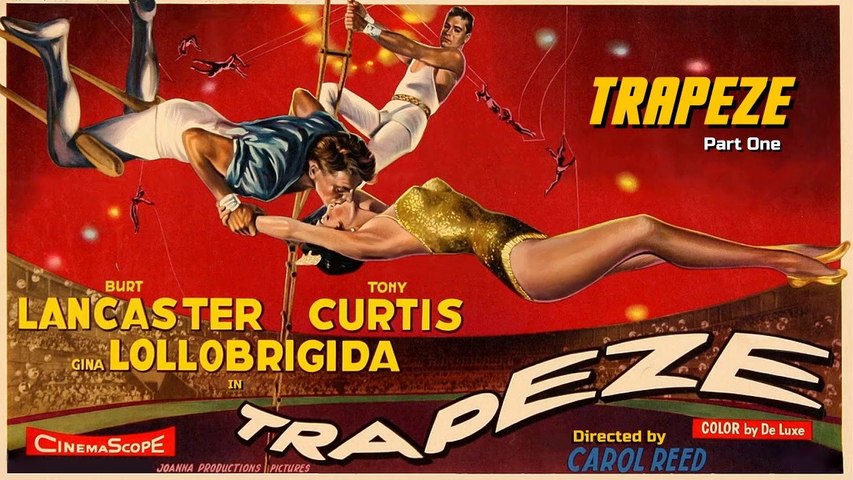
TRAPEZE

TRAPEZE (1956). Director: Carol Reed.

Bitter former acrobat Mike Ribble (Burt Lancaster) is working as a rigger for a Paris circus after falling and injuring himself while attempting a "triple" flip while performing high in the air. Tino Orsini (Tony Curtis) is an aspiring performer who talks Mike into teaming up with him for an act, hoping he can teach him to do the triple. Then there's the highly ambitious and beautiful Lola (Gina Lollobrigida of Woman of Straw) who manages to secure a position in their act while bouncing back and forth between both men. 

Lancaster, Lollobrigida and Curtis
While it's certainly understandable that both men would get the hots for Lola -- in my opinion Lollobrigida was always the sexiest and most beautiful of the Italian sex bombs -- falling in love with such a fickle and manipulative person is something else again. And one can't really see Lola falling for anyone but herself. But Trapeze is essentially a melodrama, and as such feelings are created in and discarded by the characters simply to serve the needs of the plot -- that's all there is to it. As a circus picture, Trapeze is only fair to middling. However, it comes alive during the aerial sequences, which are thrilling, skillfully intercutting the three main actors into the actions of real circus performers. Clearly they were each willing to be photographed doing some aerial work, although not high above the ground one supposes.

The performances are good. Curtis and Lancaster would reteam for Sweet Smell of Success the following year when Curtis would really come into his own. This is not Lollobrigida's first American film, but probably the biggest English role she'd had to that date. Her character is kind of impossible, and her transformation from opportunist to someone sincerely in love with one of the men isn't believable, but for that I'd blame the script. Others in the cast include Minor Watson (of Beyond the Forest) as a man from Ringling Brothers; Thomas Gomez as the fat and rather obnoxious boss of the Paris circus; Katy Jurado as Rosa, who is carrying a torch for Mike; and Gerard Landry as her husband. There are interesting and flavorful moments in the movie, but it's nothing very deep, although one senses everyone working on the film thought it would be. Malcolm Arnold's score is so overwrought at times that it approaches the comical.

All of the homoeroticism of the novel, The Killing Frost, upon which the film is based, was eliminated, although if you watch it carefully ... In the novel Tino is executed for murdering Lola, although she was actually killed by Mike, who was in love with -- you guessed it -- Tino! 

NOTE: It has been said that Lancaster, because of his background, did all of the trapeze stunts in the film except for the Triple. I think this has been very exaggerated. For one thing, Lancaster is clearly in front of a blue screen in some shots and if one freezes the film the aerialist playing Lancaster is clearly a different person in the long shots. 

Verdict: Stick with The Big Circus. **1/2. 

Thursday, February 3, 2022

HILDA CRANE

HILDA CRANE (1956). Director: Philip Dunne. 

After two disastrous marriages and what she considers "failure" in New York City, Hilda Crane (Jean Simmons) returns to her home town and her mother and ponders her future. Her unaffectionate mother, Stella (Judith Evelyn), thinks she should forget all about romantic notions of "love" and settle for appearances, a marriage that is settled and stabled (and, perhaps, without passion). Should Hilda marry small-town guy Russell Burns? (The fact that Burns is not only rich and nice, but is played by handsome Guy Madison, must have made Hilda's indecision over the matter seem a little comical to some ladies in the audience.) Or should she settle for a more passionate relationship with her former teacher Jacques (Jean-Pierre Aumont) whom she apparently finds more exciting? Evelyn Varden almost steals the picture as Russell's termagant of a mother, who thinks Hilda is nothing but a tramp and isn't afraid to say so. Peggy Knudsen adds some bite as Hilda's blunt friend, Nell, and Jeannette MacDonald's sister Blossom Rock (AKA Marie Blake) is cast as Mrs. Crane's housekeeper. (Years later she played Grandmama on The Addams Family TV show.) The usually reliable Judith Evelyn doesn't quite seem to get a handle on how she should play her character. Hilda Crane is watchable and generally well-acted, but despite the occasional crisp or intelligent line, it's just comes off as a forgettable soap opera. 

Verdict: Peyton Place Lite. **.

Thursday, October 28, 2021

MAN BEAST

Lloyd Nelson, Asa Maynor, Tom Maruzzi
MAN BEAST (1956). Director: Jerry Warren. 

Connie (Asa Maynor), has come to the Himalayas with her friend Hudson (Lloyd Nelson) in search of her brother, who is on an expedition with Dr. Erickson (George Wells Lewis). They hope to find a Yeti, or abominable snowman, in the higher altitudes. Connie and Hud, with the aid of Steve Cameron (Tom Maruzzi), manage to catch up with the expedition, but instead of her brother they find a man named Varga (George Skaff), who they deem suspicious. They are right to feel this way, as Varga turns out to be have a special relationship with the Yeti who turn up and threaten the others. And Varga has special -- and rather horrifying -- plans for Connie. 

One of the Yeti
Man Beast can't compare to the British Abominable Snowman that came out the following year, but while it's not a particularly good movie it does have its points of interest. The acting can best be described as adequate but George Skaff actually turns in a more than decent performance. Out of all of the performers he unsurprisingly racked up the most credits, although Maynor and Nelson also had more work after appearing in this picture. This was the sole film appearance for both Maruzzi and Lewis, and "Rock Madison" was just a made-up marquee name with producer/director Jerry Warren hoping audiences would think they were getting Rock Hudson or Guy Madison for their money -- there is no such actor. The picture's main strength, aside from its short length, is the atmospheric filming (with the slopes of California filling in for the Himalayas) of snowy vistas, deadly crevasses, avalanches, and the like, although undoubtedly stock footage was also employed. A scene when the Yeti come after the group inside a cave (there is no set, just surrounding blackness) is amateurishly staged and awkwardly shot, although I must say the first appearance of the Yeti is a mite startling. The soundtrack consists of very well-chosen stock musical cues. Jerry Warren also directed The Incredible Petrified World, which was similarly low-budget but a much better picture. 

Verdict: Not nearly as awful as its reputation, but not worth missing an episode of your favorite TV series. **. 

Thursday, May 27, 2021

FOREIGN INTRIGUE

Robert Mitchum and Genevieve Page
FOREIGN INTRIGUE (1956). Produced, written and directed by Sheldon Reynolds.  

"Did he say anything before he died?" -- numerous characters

Dave Bishop (Robert Mitchum) works for a millionaire philanthropist named Danemore (Jean Galland). When Danemore dies of a sudden heart attack, Bishop realizes that he knows very little of the past of his employer. A mysterious letter and a sealed package to be opened only if Danemore's death was suspicious ignites Bishop's interest. His curiosity brings him into contact with a bald little man named Spring (Frederic O'Brady), who may be much more sinister than he seems. Bishop is involved with two women: Danemore's widow (Genevieve Page), who discovers that her marriage of convenience may not have as big a pay-off as she'd hoped for; and Brita (Ingrid Thulin) -- the daughter of another widow, Mrs. Lindquist (Inga Tidblad) -- who quickly falls in love with Dave. Bishop is then contacted by various government agents who convince him to pretend to be a blackmailer so he can get the goods on several men who each betrayed their country. 

Ingrid Thulin with Mitchum
Foreign Intrigue is greatly bolstered by a solid and engaging performance by Robert Mitchum, who always seems interested in what's happening even when at least half the audience has stopped giving a damn. The movie has a fairly decent premise but few outstanding incidents nor indeed any sequences that stand out in the mind (except perhaps when a little boy gives Mitchum a playful kick in the leg); there is no style, suspense or tension and after while you just want it to be over. Both Genevieve Page and Ingrid Thulin (billed as Ingrid Tulean) were "introduced" in this film, and they are both attractive and more than competent, although neither -- in this film, at least -- is especially distinctive. Thulin [Return from the Ashes] had appeared in several Swedish films previously, and of course worked with Ingmar Bergman a few years later. Genevieve Page [Youngblood Hawke] had also appeared in numerous films previously and had a lengthy international career. Paul Durand's score is interesting if not always appropriate. In Eastmancolor.

Verdict: You can miss Mitchum speaking French! **.

GREAT DAY IN THE MORNING

GREAT DAY IN THE MORNING
(1956). Director: Jacques Tourneur. 

In the period just before the Civil War, Owen Pentecost (Robert Stack) comes to town and promptly becomes the new owner of the saloon after smitten "Boston"  Grant (Ruth Roman) fixes a card game in his favor. Then there's big "Jumbo" Means (Raymond Burr), who hates it when anybody calls him fat, especially if it's a female. Ann Alaine (Virginia Mayo) also takes a shine to Owen, although she pretends that she couldn't care less about him. Owen bonds with the young son of a man he killed in a gunfight. And so on. Great Day in the Morning is a sporadically interesting western with under-developed characters and a "storyline" that's all over the lot. It seems to build primarily to the scene where the two women confront each other over Owen. The actors all handle this stuff more than competently, although Stack, playing it stoic, seems a little wooden in most of his scenes. Regis Toomey is the town preacher. 

Verdict: Half-baked western with some interesting players. **1/2.

Thursday, April 29, 2021

THE SWORD AND THE DRAGON

Andreyev and Myshkova
THE SWORD AND THE DRAGON/aka Ilya Muromets/1956). Director: Aleksandr Ptushko. 

Ilya Muromet (Boris Andreyev) is a Russian peasant who is dismayed that due to injuries that prevent him from walking, he can not fight against the tyranny of the evil Tsar Kalin (Shukur Burkhanov). This changes when he is healed by a passing stranger and given a sword that used to belong to a great hero of old. Ilya meets his beloved, Vasilisa (Ninel Myshkova) and the two are married. In a misunderstanding with Prince Vanda (Andrei Abrikosov), Ilya winds up put in a dungeon even as his wife is spirited away by the Cossack-like Kalin. As years pass, Vasilia resists Kalin's advances but he does turn her and Ilya's little boy, Falcon, into his "son" and one of his best warriors. Freed from captivity, Ilya not only has to face his own son in combat, but also must face a gigantic, three-headed, fire-breathing dragon unleashed by Kalin.

son against father in mortal combat
While it may not be as much fun as American fantasy flicks of this nature, The Sword and the Dragon is a notable film from Russia with some outstanding widescreen cinematography (Yuli Kun; Fyodor Provorov), which helps provide sweeping vistas and elaborately staged battle scenes. It has an excellent story taken from Russian folklore and a fine score by Igor Morozov. The Sword and the Dragon is not really a kid's film -- there's a scene when four men are impaled on one spear -- although it has some fantastical elements. The dragon is a silly-looking full-scale prop that looks like something out of a funhouse. One amazing scene has Kalin ordering his followers to climb on top of one another in the hundreds to create a "mountain of men." And we mustn't forget the obese envoy who comes to town giving orders from Kalin and ultimately regrets it. 

Verdict: Quite interesting Russian fantasy film is definitely worth a look. ***. 
 

Thursday, March 4, 2021

SPIN A DARK WEB

Sister and brother: Domergue and Benson 
SPIN A DARK WEB (1956). Director: Vernon Sewell. 

Jim Bankley (Lee Patterson) hopes to get a start in the fight game, but is willing to take anything. His friend, Buddy (Robert Arden), arranges for Jim to meet his boss, Rico Francesi (Martin Benson), but he particularly ignites the interest of Rico's sexy sister, Bella (Faith Domergue of Where Danger Lives). One of Rico's flunkies, McLeod (Bernard Fox), is told to pay a relatively benign call on a boxer, Bill (Peter Hammond), who refused to take a dive, but violence ensues, and Bill is killed. Jim is also involved with Bill's sister, Betty (Rona Anderson), who is appalled that he is now working for Rico. Things begin spiraling downward from there, with Jim regretting that he ever got involved with this mob, and Bella determined to hold on to him -- at any cost. 

Lee Patterson and Rona Anderson 
Spin a Dark Web is the kind of British thriller I would normally review on my brother blog B Movie Nightmarebut this picture is a little bit different. The main difference is a highly interesting cast. Lee Patterson was a Canadian actor who had quite a list of credits in British "B"s before landing a gig in the American private eye show Surfside Six and doing US TV work and soap operas thereafter. He gives a solid performance in this as a man a bit on the shady side who still has some principles. Faith Domergue [Dah-mure], a Howard Hughes discovery (and more) in her teens, became a cult figure due to appearances in such films as It Came from Beneath the Sea and This Island Earth. She gives a good performance in this although one might have wished she came on a lot stronger in certain sequences, but Joan Crawford she wasn't. Martin Benson was in everything from The Cosmic Monsters to Gorgo to Goldfinger and always fit the bill. Robert Arden was the leading man in Orson Welle's Mr Arkadin/Confidential Agent, and he scores in this supporting part as well. Pleasant and pretty, Rona Anderson appeared in numerous UK movies. 

Spin a Dark Web has a good (if familiar) story and is generally well-paced, although with better and tighter editing and more use of close-ups the climax could have been a real nail-biter. Domergue and Patterson play well together.

Verdict: Domergue is not so "dah mure" in this! ***.

Thursday, January 21, 2021

STORM CENTER

STORM CENTER (1956). Director: Daniel Taradash. 

"The ball park isn't the only place someone can be a hero." 

Middle-aged librarian Alicia Hull (Bette Davis) is importuned by the town council to remove a book on Communism from the library. While not in any way a communist, Hull is against censorship and also feels that the book only illustrates the foolishness and stupidity of the communist tract -- she refuses to remove it. Before long many in the town are denouncing her, and her relationship with a book-loving boy named Freddie (Kevin Coughlin) is demolished. There is an interesting sub-plot wherein Kevin's father can't relate to his son's interest in reading over sports, and his wife can't relate to her husband's distrust of, and complete disinterest in, culture of any kind. (Unfortunately, the especially melodramatic developments with Freddie seem almost dragged in to add some drama and poignancy.) While Storm Center is intelligent (and a bit heroic considering the year it was made, although it might have been even more daring had Hull actually been a communist) and has some good dialogue and scenes, it's as if a good picture somehow got lost along the way. The main problem with the film is Bette Davis' positively dreadful performance, which has not one ounce of veracity or normalcy to it. She had entered her "grand lady of films" period and struts through the film so affectedly and unnaturally that she virtually stinks up almost every scene she's in. Davis has always been criticized for her performance in King Vidor's under-rated Beyond the Forest, but her acting in that is miles ahead of her work in Storm Center. (Another truth is that, despite her battered appearance, Davis was simply too sexual -- think of her in All About Eve -- to be convincing as some dried up -- if admirable-- old library hag.) Young Kevin Coughlin is better as Freddie, although he over-acts at times. Paul Kelly is excellent as a loyal friend of Hull's and Kim Hunter and Brian Keith are solid as Hull's assistant and her boyfriend, one of Hull's foremost accusers.

Verdict: Admirable failure with a woeful lead performance. **1/2.

Thursday, December 10, 2020

THREE BRAVE MEN

THREE BRAVE MEN
(1956). Director: Philip Dunne. 

Bernie Goldsmith (Ernest Borgnine) is horrified to discover that he's been summarily fired from his government job because he's been deemed a security risk due to an alleged "radical" (i.e. communist) past. He hires lawyer Joe DiMarco (Ray Milland) to defend him. Apparently Goldsmith angered some people because of his activism in minority housing (oddly, the subject of anti-Semitism is never broached). Even after a board presided over by Captain Wingfield (Frank Lovejoy) and Lt. McCoy (Nina Foch) clears Goldsmith, he still can't get his job back or get hired by anyone else. DiMarco takes the case to the Army man, Rogers (Dean Jagger), who had the board's decision reversed. Three Brave Men intelligently examines how gossip and innuendo, jumping to conclusions, and sheer sloppy investigating can ruin someone's life as it did many during the McCarthy anti-communist era. The film also has a nice subtext examining how the whole ordeal has revealed how strong Bernie's marriage to his wife (Virginia Christine) is. Still, it's all a bit matter of fact, with few nuances and shades of gray. Yet the fact that it was even made in 1956 -- years before our deplorable "cancel culture" -- speaks volumes. Dr. No's Joseph Wiseman has a notable cameo as a bigot. 

Verdict: Absorbing story of family's ruination and their struggle back. ***.

Thursday, October 1, 2020

PRODUCER'S SHOWCASE: BLOOMER GIRL

Barbara Cook
BLOOMER GIRL (Producer's Showcase/1956). Directed by Alex Segal. Presented Live

Bloomer Girl was a successful (if now essentially forgotten) Broadway musical that was adapted for television in an abbreviated version for the program Producer's Showcase. Celeste Holm, who had starred on Broadway, was replaced by Barbara Cook, a wise choice. The musical takes place just before the Civil War, and Evalina (Cook) is the only unmarried daughter of hoop (for skirts) manufacturer Horatio Applegate (Paul Ford). Her Aunt Dolly (Carmen Mathews) not only runs the newspaper but is an early feminist. Along comes Southern gentleman Jefferson Calhoun (Keith Andes), who is going to work for Horatio and begins courting an initially unimpressed Evalina. Unfortunately, Calhoun also brings along a slave, Pompey (Roy Spearman), who is hoping to stay North as a free man, something Evalina wants but which his owner may object to.  

Roy Spearman
Bloomer Girl
 dealt with women's rights and black rights in the 1950's, and frankly it's amazing that a live production was shown on television during the same period. Of course Pompey is a polite, somewhat subservient black character, yet he's also given the stirring song "The Eagle and Me," which is all about wanting and needing freedom. The performances in this TV version are all excellent, with Cook as delightful and in as good a voice as ever. Keith Andes adeptly plays the leading man, his charm working to overcome Calhoun's less likable traits, although he eventually triumphs over them. Carmen Mathews and Ford are typically on-target, and Spearman not only has a wonderful voice but imbues the role with a certain dignity.  

In this shortened version of the Broadway show, several of the lesser numbers have been cut. However, there's some gold in what remains: "When the Boys Come Home;" "Evalina;" "Sundays in Cicero Falls;" and the romantic duet "Right as the Rain" -- along with "The Eagle and Me" -- are the most memorable tunes. The lilting music is by Harold Arlen and the lyrics by E. Y. Harburg. Bloomer Girl isn't necessarily one of the all-time great musicals, but it is a worthwhile and interesting show which in some aspects was ahead of its time. 

Verdict: Tuneful, well-done, and sometimes moving. ***. 

Thursday, August 20, 2020

EMERGENCY HOSPITAL

John Archer and Margaret Lindsay
EMERGENCY HOSPITAL (1956). Director: Lee Sholem.

Dr. Janet Carey (Margaret Lindsay of Club Havana) is a very busy doctor at a state-run hospital during the night shift. Ben Caldwell (Byron Palmer of Ma and Pa Kettle at Waikiki) is a race car driver and playboy who wants Janet to give it all up and marry him, while Dr. Herb Ellis (John Archer) seems to be carrying a torch for Janet as well. Sgt. Paul Arnold (Walter Reed) is the police liaison with the hospital and he is on hand when his son, Jimmy (James Noah), is brought in after an accident and nearly winds up in a nasty incident between father and son. There are other assorted crises and patients during one long night.

James Noah and Walter Reed
Emergency Hospital looks like an especially gritty TV production, and in truth it's the kind of stuff that later wound up in many episodes of assorted medical shows -- life, death, accidents, diseases, assorted mini-dramas with some life lessons passed out by the staff. Lindsay is puffy-looking but gives a good performance, and Reed has some very good moments in the sequences with his son. Archer makes a positive impression as a decent guy who may just have to take a back seat to the flashier Caldwell, who is well-played by Palmer. Rita Johnson [Forty Little Mothers] scores as head nurse Norma Mullen.

The large cast also includes Rhodes Reason and William Boyett as traffic cops; Vera Francis as a lovely African-American nurse also named Vera; and Mary Carver, Maxine Gates, and Jan Englund as semi-hysterical patients.

Verdict: Too bad Ben Casey and Dr. Kildare don't put in an appearance. **3/4. 

Thursday, August 6, 2020

23 PACES TO BAKER STREET

Van Johnson as the disheartened playwright
23 PACES TO BAKER STREET (1956). Director: Henry Hathaway.

Phillip Hannon (Van Johnson) is a playwright who has temporarily relocated to London where the British production of his latest show is a hit. Phillip lost his eyesight in an unspecified accident a few years before and remains bitter and unsatisfied with life. His former fiancee, Jean (Vera Miles of Tarzan's Hidden Jungle), comes to see him -- it was not her idea to end the engagement -- but he still seems determined to keep distance between them. He has a likable butler named Bob (Cecil Parker of The Ladykillers) who looks after him. One evening Phillip overhears a conversation between two people -- a man named Evans and a woman named Murch who wears a distinctive perfume -- and realizes there is a strong possibility she is being forced into some kind of criminal mischief. With the help of Jean and Bob, Phillip goes about trying to find this Miss Murch so he can help her and prevent the possible child kidnapping or other skulduggery that might take place. But while he's looking for Murch, Evans is looking for him ...

Johnson with Vera Miles
23 Paces to Baker Street comes off like a combination of Rear Window and The Man Who Knew Too Much, although it lacks the Master's touch, Henry Hathaway not being in the same league as Hitchcock. In spite of that, 23 Paces is a memorable suspense-thriller, with a nifty scene when Phillip is caught on a crumbling roof in a diabolical trap, and an exciting climax when he squares off with the mastermind in his apartment. The performances can not be faulted: Johnson is square-on in his portrayal of the disheartened and embittered blind man who finally allows love in the door, Vera Miles is warm and sympathetic as the woman who adores him, Parker makes a likable helpmate, and Estelle Winwood is winning as a barkeep who also tries to help Phillip in his quest. There are also notable turns from Patricia Laffan as a nurse and Martin Benson [The Cosmic Monsters] as a man who runs an agency for same, among others.

Cinematography by Milton R.. Krasner
The movie greatly benefits from an evocative score by Leigh Harline and impressive CinemaScope photography by Milton R. Krasner; his sweeping shots of London are especially beautiful.  This was hardly the first depiction of a bitter blind man, nor is Phillip the first blind "detective." Edward Arnold played a blind private eye (much more accepting of his impairment) in two films. Years later James Franciscus starred as a blind insurance investigator on the TV series Longstreet, which lasted one season. An Italian giallo film named The Crimes of the Black Cat has a lot of plot similarities to 23 Paces, also featuring a blind man who overhears a plot in a bar, a rooftop trap, and the like. 23 Paces is far superior to Wait Until Dark, which had a blind heroine in a tough spot at the climax.

Verdict: Highly watchable suspense film with some excellent performances. ***. 

Thursday, April 30, 2020

SLIGHTLY SCARLET

Rhonda Fleming and John Payne
SLIGHTLY SCARLET (1956). Director: Allan Dawn.

June Lyons (Rhonda Fleeming), who is secretary and more to mayoral candidate Frank Jansen (Kent Taylor), brings her sister, Dorothy (Arlene Dahl) home after the latter gets out of prison. Both women get involved with Ben Grace (John Payne), who is the brains behind a criminal outfit run by Solly Caspar (Ted de Corsia), who has had to take it on the lam. Now Ben tries to take over and get all his ducks in a row, including Jansen, the police chief, and the two attractive ladies -- although things get a bit dicey when Solly suddenly returns from Mexico ...

Such devoted sisters? Dahl and Fleming
Slightly Scarlet is entertaining enough but it has a script that goes all over the place, and Allan Dwan's direction is not strong enough to make up for it. What we're left with is some vivid emoting from Payne, going through his bad guy (but not that bad) film noir phase, a solid Fleming, a vivacious and sluttish Dahl making the most of her scenes, and de Corsia also making an impression as the decidedly nasty and nearly psychopathic Solly. Although Payne does a good job in playing Ben, the screenplay never seems to get a true handle on the guy, so there doesn't really seem to be anyone to root for in this mess. Kent Taylor has a few scenes as the man who becomes mayor but he isn't developed enough to be much of a factor. June seems overly devoted to her sister, a trampy shoplifter and worse who doesn't even seem to care when Solly makes it clear that he's going to murder June.

Payne and Dahl at that beach house
Other players include Ellen Corby as June's very pleasant housekeeper, Roy Gordon [War of the Colossal Beast] as a crusader against Solly who meets a horrible fate, George Wallace [Radar Men from the Moon] as a sullen member of Solly's gang, and Myron Healey [Hot Rod] as another colleague who tries to ventilate Ben to his regret. Solly owns a beach house that can best be described as "fabulous." This is based on as novel by James M. Cain. An RKO-Radio production, it was filmed in "Superscope."

Verdict: Not as much fun as the plot might suggest, but fun enough if you're in an undemanding mood. **1/2.