Lively, entertaining reviews of, and essays on, old and newer films and everything relating to them, written by professional author William Schoell.
Showing posts with label Wendell Corey. Show all posts

Thursday, December 8, 2022

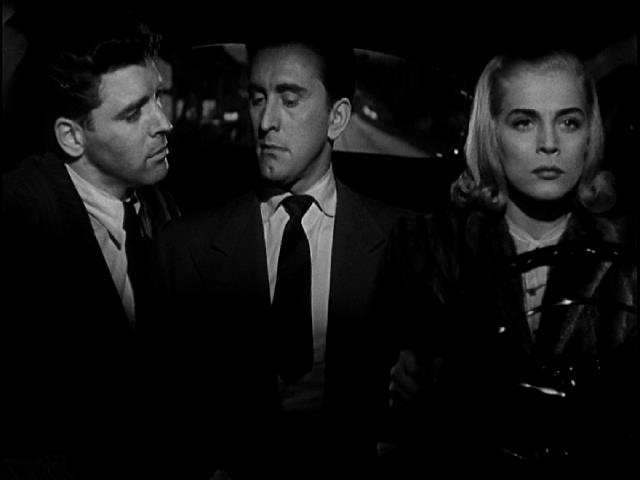
I WALK ALONE

Burt Lancaster, Kirk Douglas, Lizabeth Scott
I WALK ALONE (1947), Director: Byron Haskin.

Frankie Madison (Burt Lancaster) and Noll "Dink" Turner (Kirk Douglas) were partners in a bootlegging operation that went south. Frankie went to prison for fourteen years while Noll opened up his own successful nightclub, and got a girlfriend in singer Kay Lawrence (Lizabeth Scott). Despite his relationship with Kay, Noll plans to marry bitchy socialite Alexis Richardson (Kristine Miller) for business reasons. Frankie makes it clear that what he wants is not just 50% of what's coming to him, but something to make up for all of those years he spent in jail. But even as Frankie and Kay grow closer, Noll may have other, less admirable plans for his old friend ... 

Kirk Douglas in a dramatic moment
I Walk Alone is fair-to-middling film noir. Frankly, it just never becomes as interesting or as explosive as you might hope. The performances are on target,  however, with especially good and slick work from Kirk Douglas, although Lizabeth Scott is a little odd and her romance with Frankie is never quite convincing. Wendell Corey is fine as a friend of Frankie's and an associate of Noll's, and there is also good work from George Rigaud as Maurice, who also works for Noll but isn't quite so  subservient; Mickey Knox as gunsel Skinner; Mike Mazurki as doorman/bodyguard Dan; and Kristine Miller as the delightfully predatory Alexis. When she manages to get Noll to agree to take her to the altar, she suggests that Kay sing "I Lost My Man" to the nightclub patrons -- what a bitch! Corey's death scene on a city street is quite well-handled.

Verdict: Comes so close but somehow misses. **1/2. 

Thursday, October 15, 2020

NO SAD SONGS FOR ME

Margaret Sullavan
NO SAD SONGS FOR ME (1950). Director: Rudolph Mate.

A young wife and mother (Margaret Sullavan) discovers she has inoperable cancer and tries to arrange for another woman -- a co-worker of her husband's -- to take over when she's gone. This sounds like very depressing subject matter, but while the movie is very moving, it's also uplifting due to the artistry of Sullavan, whose performance is compelling, affecting and restrained yet believable. Although you of course know the outcome from the first, the story is still unpredictable. Howard Koch's fine screenplay transcends soap opera, and the supporting performers (Wendell Corey as the husband, Viveca Lindfors as the co-worker who falls in love with him) are also excellent. The raw graphic treatment that you would see in a film of this subject today is avoided, but at the same time, Sullavan does not get more glamorous as her health worsens. Some might find the final scene a bit pat, but it works for this movie, and avoids a morbid air. Very worthwhile. This is "adult" material in the best sense of the word.

Verdict: Great. ***1/2.

Thursday, February 22, 2018

PICTURE MOMMY DEAD

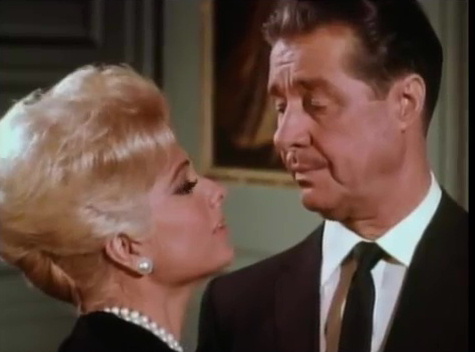
Martha Hyer and Don Ameche
PICTURE MOMMY DEAD (1966). Director: Bert I. Gordon.

Young Susan Shelley (Susan Gordon) gets out of a "convent" for the mentally disturbed three years after the death of her mother, Jessica (Zsa Zsa Gabor), in a fire in their mansion. Her father, Edward (Don Ameche), has been traveling the world with his new viper-like wife, the former governess, Francine (Martha Hyer), and now they are nearly broke. Another member of this highly dysfunctional household is Jessica's cousin, Anthony (Maxwell Reed), who was disfigured in the fire and will inherit money if both Edward and his daughter should happen to die, something which Francine is also happily aware of. But the murder victim may be more unexpected than you imagine. Picture Mommy Dead  -- one of a number of thrillers made by director Gordon, who had previously specialized in movies about giant people and monsters -- isn't that good, but it has a fairly interesting script that just misses the mark. A big problem with the picture is that Susan Gordon, the director's daughter, is too inexperienced (despite 25 previous credits!) to handle such a difficult and demanding role, although she gets an E for Effort. Zsa Zsa appears in a few flashbacks and isn't given anything too demanding to do, while Hyer plays her bitchy part with a little zest but little real skill. Ameche [Slightly French] comes off better, but Maxwell Reed of Daybreak is only somewhat effective. Wendell Corey delivers the goods in his one scene, playing a lawyer who is so tactlessly blunt with everyone that it's a wonder nobody murders him right then and there.

Verdict: Not terrible, but Gordon probably should not have cast his daughter. **1/2.

Thursday, May 12, 2016

LOVING YOU

Elvis!
LOVING YOU (1957). Director: Hal Kanter.

"He's the one -- the one with jumping beans in his jeans!"

Press agent Glenda Markle (Lizabeth Scott of Dark City) and her sort of boyfriend "Tex" Warner (Wendell Corey), hope to improve their situation and get lots of publicity by bringing young Deke Williams (Elvis Presley) into their band. Deke's hip-swinging antics incur the wrath of old biddies and the town council, but even the biddies are eventually won over by Deke's obvious likability and sex appeal. Jailhouse Rock, the next Presley film after Loving You, also juxtaposed an older has-been singer with an up and coming youngster but made a little more of the older man's angst, although Loving You has a slightly more serious script than Jailhouse. Elvis is fine, Scott and Corey are excellent, Delores Hart [Wild is the Wind] makes little impression as another band member and Presley's love interest. The title tune and "Teddy Bear" are the best numbers, and Presley betrays a not-terrible baritone when he warbles a ballad. One of the best scenes has Glenda reminding a disapproving council that years ago there was an outcry against jazz, and even against Debussy and Stravinsky decades before. Whatever you think of his acting and singing, Presley had presence in spades.

Verdict: Appealing performances help put this over. **1/2.

Thursday, March 3, 2016

HELL'S HALF ACRE

HELL'S HALF ACRE (1954). Director: John H. Auer.

Donna Williams (Evelyn Keyes) has always thought that her husband of a short time died during the war. But then she sees a story about a man named Chet Chester (Wendell Corey) who has been arrested for murder in Hawaii and who greatly resembles the dead man. Chester is a deserter, black marketeer, and shady criminal, and when Donna confronts him he insists that he is not her husband. Can Donna get the man she apparently still loves to tell the truth? Meanwhile her poking her nose into Chet's business is bringing her to the attention of assorted nefarious elements. "Hell's Half Acre" refers to a dangerous, crime-infested section of Honolulu where much of the action takes place. While the movie has an intriguing premise, Hell's Half Acre isn't very good. Knowing what she knows about "Chet," it seems incredible that she wouldn't just walk away from the creep, especially when she finds out he was a deserter. The scenes between Donna and Chet don't work because the two actors just walk through their roles, perhaps because even they weren't convinced by the script. Philip Ahn plays a gangster who slaps around Marie Windsor, and Elsa Lanchester [Les Miserables] is a spirited lady cab driver. Keye Luke is the police chief, and Jesse White, annoying and unimpressive as ever, plays another hood who comes to a bad end. Windsor [Swamp Women] probably comes off the best with her typically vital portrayal. John H. Auer also directed The Crime of Dr. Crespi and quite a few melodramas and musicals.

Verdict: Not half as interesting as it sounds. **.

Thursday, May 22, 2014

THE ACCUSED

Douglas Dick and Loretta Young
THE ACCUSED (1949). Director: William Dieterle.

"What do you think suicides are? Some little person thinks their little problems are all that matter in the world." -- Dr. Tuttle

College psychology professor Dr. Wilma Tuttle (Loretta Young) is concerned with a brilliant but brash and difficult student named Bill Perry (Douglas Dick). When Bill forces a smooch on her at an isolated spot, she reacts by hitting him repeatedly and killing him. Instead of coming clean, she covers up and hopes his death will be attributed to a bad dive off of a cliff into the water below; he was wearing swimming trunks. Perry's lawyer, Warren Ford (Robert Cummings), who didn't really know Perry that well nor especially like him, comes to town and begins a romance with Wilma even as homicide detective Lt. Ted Dorgan (Wendell Corey) begins to get suspicious ... The Accused features a good lead performance from Young [Because of You], fine support from an especially notable Douglas Dick and the wry, sardonic Corey [The Big Knife], but Bob Cummings is horribly miscast [as he always was in movies like this] and is terrible. Another  problem with the movie is that while Perry does kiss Wilma forcibly and without permission, it doesn't necessarily mean he would have sexually assaulted her, and her viciously hitting him over and over again seems like literal overkill. Sara Allgood and Ann Doran are also in the cast, and Sam Jaffe offers a flavorful performance as Dr. Romley, whom Wilma finds ghoulish. Victor Young's score is a plus, and Ketti Frings' screenplay has some interesting dialogue. Unfortunately The Accused runs out of gas long before it's over. Dieterle directed Dark City and many, many others.

Verdict: Physician, heal thyself. **.

Thursday, February 6, 2014

HARRIET CRAIG

Joan Crawford as Harriet Craig
HARRIET CRAIG (1950). Director: Vincent Sherman.

"I don't like trains. I don't like the feeling of being rushed along in the darkness. Having no control. Having my life completely in someone else's hands" -- Harriet Craig.

This remake of Craig's Wife is actually the third film version of George Kelly's play, which was first made as a silent. In this loose adaptation, Joan Crawford plays Harriet Craig, who likes order and neatness and everything in its place, including her husband, Walter (Wendell Corey of The Big Knife). She and her mother were abandoned by her father, and she needs to be in total control of her life and everyone else's, including her niece, Clare's (K. T. Stevens), who has lived with her and Walter for many years, and whose relationship with Wes (William Bishop of It's a Great Life) she tries to destroy. This version eliminates the character of Walter's aunt, and provides an even stronger motive for Walter's walking out on his wife. Crawford and Corey give very good performances, and the supporting cast, including Lucile Watson, Stevens, Ellen Corby, and Viola Roache, is notable.

Verdict: Crawford in dragon lady mode. ***.

Thursday, December 5, 2013

THE FILE ON THELMA JORDAN

Original title: Thelma Jordan."
THE FILE ON THELMA JORDAN (1950). Director: Robert Siodmak.

"Maybe I am just a dame and didn't know it. Maybe I like being picked up by a guy on a binge."

Concerned with possible burglars at her elderly aunt's estate, Thelma Jordan (Barbara Stanwyck) goes to see an assistant district attorney named Miles Scott (Paul Kelly) but winds up with another ADA, Cleve Marshall (Wendell Corey) who happens to be rather bored with his wife (Joan Tetzel) and children and their vacations and falls hard for Thelma while on a bender. The plot has various intriguing twists and turns as the two carry on a heated affair while Mrs. Marshall and the kids wait at the beach. Then, wouldn't you know it, someone gets murdered ... Stanwyck gives another fine performance in Thelma Jordan, and Corey is quite good as well; this is an actor who has hidden facets as well as versatility. Stanwyck plays one of her most unsympathetic characters but you're with her right from the start. Tetzel and Kelly are also fine, and Gertrude Hoffman is just right in her brief appearance as Thelma's aunt. No, this is no Double Indemnity, but it's absorbing and has a few tricks up its sleeve. To accept some of the more absurd plot turns takes a definite "suspension of disbelief," however. Some of Corey's best performances were in No Sad Songs for Me, The Big Knife, and his debut film Desert Fury, and he also somehow wound up in Women of the Prehistoric Planet.

Verdict: Stanwyck smoulders in grand style. ***.

Thursday, October 17, 2013

THE BIG KNIFE

Everett Sloane talks to Jack Palance
THE BIG KNIFE (1955). Producer/director: Robert Aldrich. Screenplay by James Poe from the play by Clifford Odets.

Movie star Charles Castle (Jack Palance) was involved in a hit and run that killed a child, but his p.r. man, Buddy (Paul Langton), took the rap for him. Charles' wife, Marion (Ida Lupino), who is separated from him, swears she'll divorce him if he re-signs with Stanley Hoff (Rod Steiger), who probably helped engineer the deception. Now there's a new complication: Castle had a woman with him in the car that night, Dixie Evans (Shelly Winters), and she's drunkenly shooting her mouth off everywhere she goes. Now Hoff and his associate Smiley (Wendell Corey), want to take care of Dixie -- permanently ... The Big Knife might have worked on the stage, and the Odets original was undoubtedly better than this half-baked adaptation, but the film sinks almost from the get-go. The chief problem is the epic miscasting of Jack Palance. Charlie might have evoked some sympathy in the viewer if he was played by a man who could get across his essential weakness and confusion, but Palance seems incapable of ever displaying the slightest trace of vulnerability. It gives the actor his presence and strength, but he's just all wrong for this picture. His scenes with Ida Lupino are stagey and over-rehearsed and just don't work at all -- both of them are busy "acting" instead of being. We're constantly being told of how wonderful Castle is and of his supposed integrity, but all we see is a corrupt, self-absorbed individual who allowed another man to take responsibility for his actions, slept with the man's wife, and acts like a dickhead throughout. When he protests at the idea of "silencing" Dixie, it's hard to believe that he would object -- he's the last one to take a high moral stance. It's up to the supporting cast to give the film whatever limited stature it has. Rod Steiger has some ferociously effective scenes as Stanley [some might think he's merely showing off]; Wendell Corey underplays beautifully as the slimy Smily; Everett Sloane is as solid as ever as Charles' agent; and Paul Langton has a beautifully and powerfully delivered speech to Castle at the end of the film that is one of the most memorable bits in the movie. As for the women, Ilka Chase offers a dead-on portrait of an oily, if stereotypical, gossip columnist, Shelley Winters is so-so as Dixie, and Jean Hagen fails to impress as Buddy's sluttish wife, Connie. Wesley Addy has a nice turn as the writer Hank Teagle. Oddly, a confrontation between Dixie and Hoff that might have been quite cinematic and dynamic is mentioned but not shown, but the film isn't "opened" up very much. It's hard to like or enjoy a movie in which virtually every character is either unpleasant or annoying. Robert Aldrich was the wrong director for this, as well. For a worthwhile Odets adaptation, see Clash By Night.

Verdict: A fairly embarrassing mess of Hollywood pseudo-profundity with horribly miscast leads. **.
Thursday, July 25, 2013

REAR WINDOW

Hitch does his cameo in Rear Window.
REAR WINDOW (1954). Director: Alfred Hitchcock.

Photojournalist "Jeff" Jefferies (James Stewart) is stuck in an apartment with a broken leg and a cast when he'd rather be out covering action in far-flung places with exotic names. Jeff has a beautiful girlfriend named Lisa (Grace Kelly), but he fears proposing to her because he doesn't think her patrician, elegant manner will go well with the places he has to travel to [although nowhere is it written that the wife must accompany her husband on such assignments]. Bored and needing distraction, Jeff begins observing his neighbors (on a marvelous, detailed set that shows many different kinds of apartments and tenants), such as the voluptuous dancer across the way, a pair of newlyweds who disappear behind the shade after moving in, a frustrated composer of romantic music, and a woman he calls "Miss Lonelyhearts" (Judith Evelyn) who talks to imaginary dates while she's having supper and gets drunk in bars. Eventually Jeff focuses on a man named Thorwald (Raymond Burr), whose nagging wife disappears one afternoon and never comes back. Jeff has reasons to believe Thorwald murdered the woman -- and eventually gets both Lisa and his nurse Stella (Thelma Ritter) on his side -- but his smug detective friend Doyle (Wendell Corey) assures him that he checked and the woman really is out of town. But is she? Jeff and the ladies begin an investigation of their own that leads them into some serious danger. Some viewers of this wonderful film don't like being put in Jeff's position all the time, peering through windows, and find the film claustrophobic, but I can't agree. The movie, while imperfect, is very cinematic and well-made. It does take a while for the basic mystery plot to begin unfolding, but the two main characters and their dilemma -- two very different people in love but uncertain of how it will work out -- are interesting enough to hold the attention, and Stewart and Kelly give fine performances, along with Ritter, Evelyn and others. [This is another film like The Tingler in which the talented Evelyn gets across a character without really saying a word.] The movie builds in suspense and has a creepy and exciting finale. One thing Rear Window is missing is a great score by, say, Bernard Herrmann, but you can't have everything. John Michael Hayes' screenplay is full of black humor, even relating to the dismemberment of the woman's corpse, which is a plus or a minus depending on how you look at it. Based on  a story by Cornell Woolrich.

Verdict: Smooth, unusual suspenser from the master. ***1/2.

Thursday, April 5, 2012

THE FURIES

Gilbert Roland and Barbara Stanwyck
THE FURIES (1950). Director: Anthony Mann.

Vance Jeffords (Barbara Stanwyck), daughter of rancher T.J. Jeffords (Walter Huston) on a ranch called the Furies in 1870, certainly has her problems. She's in love with swaggering banker Rip Darrow (Wendell Corey, not exactly the swaggering type, but not bad), who'd rather have her father's money. Her friend Juan Herrera (Gilbert Roland), one of a family of squatters, is in love with her but he doesn't quite make her engine rumble. Worst of all, daddy has brought home a strong, conniving lady named Flo (Judith Anderson), who threatens Vance's status on the ranch -- watch for those fireworks! Anderson, Huston and Stanwyck are splendid in this fascinating sex-western dealing with the [nearly incestuous] love and hatred between equally strong father and daughter. As Juan's sharp-shooting mother, Blanche Yurka is nearly as vengeful in this as she was in A Tale of Two Cities. Albert Dekker of Dr. Cyclops shows up briefly and Beulah Bondi has a small but effective bit late in the picture. John Bromfield has one of his more significant roles as Stanwyck's brother, Clay, although his character is never developed that much. Franz Waxman's excellent score, and Victor Milner and Lee Garmes' striking widescreen photography make this a pleasure to look at as well as to hear. Although some scenes, such as a hanging in which the victim goes meekly to the rope, don't quite come off, The Furies is consistently absorbing and -- best of all -- unpredictable. Written by Charles Schnee from a novel by Niven Busch.

Verdict: Highly satisfying western melodrama. ***1/2.

Thursday, March 24, 2011

WOMEN OF THE PREHISTORIC PLANET


WOMEN OF THE PREHISTORIC PLANET (1966 ) Writer/director: Arthur Pierce.

"My superior officer asked for volunteers for an important expedition -- I thought he said exhibition."

When Cosmos 3, the sister ship of Cosmos 1, crash lands on the planet Solarius, Admiral King (Wendell Corey) disobeys orders and lands on Solarius to search for survivors. Not to be confused with Voyage to the Planet of Prehistoric Women, Voyage to the Prehistoric Planet or Queen of Outer Space (not to mention Prehistoric Women and Untamed Women, for that matter, and other space movies with sexy long-legged aliens), there are no savage groups of space babes or cave gals in the movie. Instead some characters search the planet while encountering assorted dangers -- including a pitiful gecko that is supposed to be a monster [but is at least referred to as a "giant lizard" instead of a dinosaur], and a toy tarantula about the size of a dinner plate -- while in the meantime pretty Linda (Irene Tsu) encounters Tang (Robert Ito) and begins a romance that has a mild touch of charming lyricism to it (as well as a cute chimpanzee). You feel sorry for the actors because the entire cast gives the film a lot more than it deserves. Wendell Corey of Desert Fury certainly deserves a better fate, as does Paul Gilbert, who basically plays the same girl-crazy comedy relief that he did in So This is Paris. "I've been on a diet for seven days and so far all I've lost is a week," he says. John Agar is cast as Dr. Farrell and Glenn Langan of The Amazing Colossal Man appears briefly as the captain of the crashing ship. Keith Larsen is Commander Scott, who doesn't trust Centaurians such as Linda. The music is lifted from a variety of Universal's science fiction films and others. The ending employs the absolutely hoariest of science fiction cliches.

Verdict: Like a bad episode of sixties Star Trek. *1/2.

Thursday, February 3, 2011

DESERT FURY


DESERT FURY (1947). Director: Lewis Allen.

"I'd hate to be left alone on a desert road at night."

Fritzie Haller (Mary Astor) is the owner of the Purple Sage gambling den in Nevada. Home from yet another school is her 19-year-old daughter Paula (Lizabeth Scott). Mother and daughter's difficult relationship is further put to the test when Paula falls for bad boy Eddie Bendix (John Hodiak), but the one who's even more upset by this development is Eddie's right hand and major domo, Johnny Ryan (Wendell Corey, in his film debut). Years ago Eddie was essentially picked up by Johnny at an automat at two in the morning, but since then Eddie has been married once to a woman who died in a mysterious accident. This is a "small town with secrets" melodrama with some interesting characters and dialogue. Ryan could be taken merely as the stereotypical tough guy who thinks dames and business don't mix, but the movie seems determined to add a suppressed homoerotic subtext. At times Ryan seems in love with Bendix and at others merely determined to keep a girl away from a scumbag. The psychological underpinnings to the story are intriguing even if they generally don't jell. Burt Lancaster plays a cop that Astor tries to pair off with her daughter. The acting is quite good, especially from Corey and Astor, although Scott and Hodiak are no slouches, and Lancaster is swell. Good score by Miklos Rozsa and an exciting climax.

Verdict: Half-baked and perhaps hollow at the center, and yet ... **1/2.

Thursday, November 5, 2009

THE KILLER IS LOOSE

THE KILLER IS LOOSE (1956). Director: Budd Boetticher. 

When Detective Sam Wagner (Joseph Cotten) goes after Leon Poole (Wendell Corey), who held up a bank, he accidentally shoots the man's wife. When Poole breaks out of jail, he murders everyone in his way as he makes his way to Wagner-- so that he can kill Wagner's wife (Rhonda Fleming). This is a decidedly minor film for all concerned, but it does manage to work up a certain degree of suspense, in large part due to Lionel Newman's taut musical score. Filmed by Lucien Ballard. Alan Hale Jr. of Gilligan's Island is more subdued as another cop. Fleming is okay, but the female acting honors go to Virginia Christine as another cop's wife and friend, and Dee J. Thompson as the wife of Poole's old sergeant (John Larch). Some other familiar faces scattered throughout the movie in bit roles. Not always logical. Cotten is solid although this is not one of his more memorable credits. 

Verdict: a respectable if forgettable 73 minutes. **1/2.