Lively, entertaining reviews of, and essays on, old and newer films and everything relating to them, written by professional author William Schoell.
Showing posts with label Felix Aylmer. Show all posts

Thursday, January 2, 2025

THE CASE OF THE FRIGHTENED LADY (1940)

Dudley-Ward, Haye, Goring, Barr
THE CASE OF THE FRIGHTENED LADY (aka The Frightened Lady/1940). Director: George King. Colorized

In this British version of an Edgar Wallace story, Inspector Tanner (George Merritt) investigates when the chauffeur, Studd (John Warwick), of the redoubtable Lady Lebanon (Helen Haye) is found strangled on the grounds. Suspects include the shady Dr. Amersham (Felix Aylmer of The Chalk Garden), who knew Studd in India; Architect Ferraby (Patrick Barr), who has taken a shine to Lady Lebanon's secretary, Isla (Penelope Dudley-Ward); the grounds man Tilling (an unrecognizable Torin Thatcher); and Lady Lebanon's son Willie (Marius Goring of The Barefoot Contessa), whom she wants Isla to marry. Then there's another murder ... 

Haye and Dudley-Ward
The Case of the Frightened Lady 
was filmed many times both theatrically and for television. West Germany came out with a version called The Indian Scarf in the sixties, which made quite a few changes to the story. The performances in this version, especially from Haye and Goring, are quite good, and there's a degree of suspense as well. The screenplay has a subtext of keeping up appearances -- and bloodlines -- at all costs, no matter how reprehensible this may be. George Blake also directed Sexton Blake and the Hooded Terror.

Verdict: Edgar Wallace strikes again. ***. 

Thursday, January 19, 2023

SEPARATE TABLES

Rita Hayworth and Burt Lancaster

SEPARATE TABLES (1958). Director: Delbert Mann.

"I have no curiosity about the working classes." -- Mrs. Railton-Bell.

"Being alone in a crowd -- it's so painful ... frightening." -- Ann Shankland.

At the seaside Beauregard Hotel in Bournemouth, England -- where several people are permanent residents -- certain little dramas are unfolding. The highly snobbish Mrs. Railton-Bell (Gladys Cooper) has discovered the inappropriate behavior of Major Angus Pollock (David Niven), who has bored everyone with fictional stories of his allegedly heroic wartime exploits. Mrs. R-B gathers the other residents to vote on whether or not to insist that the man be thrown out of the hotel. Mrs. R-B's neurotically shy daughter, Sibyl (Deborah Kerr), who is exceptionally fond of the major, undergoes an emotional crisis when she learns of his illicit activities. Meanwhile, the proprietress, Pat Cooper (Wendy Hiller), who has become the lover of American resident John Malcolm (Burt Lancaster), discovers that his ex-wife, Ann (Rita Hayworth) is still in love with him and has taken a room in the hotel.   

David Niven and Deborah Kerr
Separate Tables
 was originally two plays by Terence Rattigan, sharing several supporting characters, that took place in the same location and were presented together on one evening in the theater, Although Rattigan was importuned to change this before the play debuted, the Major was originally a closeted homosexual and not a pervert who bothered women in a movie theater. (Although the movie is quite sympathetic to the major, it's a question how this would play in these post- MeToo days.) 

Separate tables indeed
The two plays have been intelligently put together and opened up (but not too much) and the film never appears stage bound or too talky, undoubtedly because Rattigan's dialogue is often excellent and perceptive. David Niven won a Best Actor Oscar for his portrayal and Deborah Kerr, who is outstanding, should have won but was only nominated. (Niven is quite good but a cut below Kerr. Hiller won Best Supporting Actress but was surprised by this, as she isn't onscreen very long and complained that her best scenes were cut.) Playing a comparatively superficial if vulnerable character, Rita Hayworth is effective as Ann, as is Burt Lancaster, although he really can't compare to some of these venerable British actors. Gladys Cooper and Cathleen Nesbitt as her friend are exemplary, as are Hiller, Felix Aylmer as Mr. Fowler, and Mary Hallatt as the brisk and self-sufficient Miss Meacham. Rod Taylor and Audrey Dalton have the thankless roles of a young couple temporarily staying in the hotel, their lines undoubtedly cut back to make room for the emoting of Hayworth and Lancaster.  Delbert Mann also directed the beautiful Middle of the Night and many others. 

Verdict: Superior British drama with some excellent performances. ***1/4. 

Thursday, July 21, 2022

THE CHALK GARDEN

Deborah Kerr and Hayley Mills
THE CHALK GARDEN (1964). Director: Ronald Neame. 

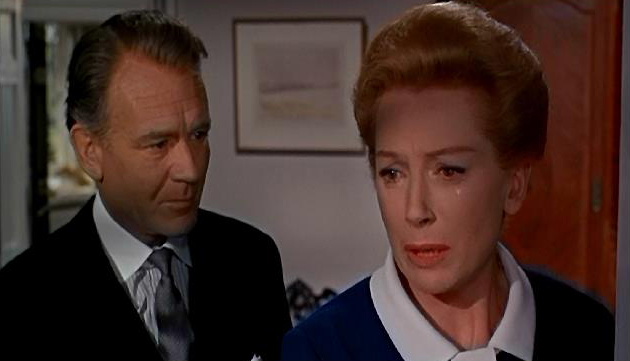
Miss Madrigal (Deborah Kerr) is the latest in a long line of governesses for young and incorrigible Laurel (Hayley Mills), whose mother went off with her new husband and left her in the care of her own mother, Mrs. St. Maugham (Edith Evans). Laurel, who hates her mother, Olivia (Elizabeth Sellars), for abandoning her, is determined to find out what if any secrets Miss Madrigal may have, and one of them is a doozy. Meanwhile the governess and Mrs. St. M disagree on who should raise Laurel, her mother or her grandmother. Madrigal believes she belongs with Olivia, while her employer vehemently denies this. Then Mrs. St. M's old friend, "Puppy," the retired Judge McWhirrey (Felix Aylmer) shows up, and eventually remembers where he has seen Miss Madrigal before ... 

John Mills with Kerr
The Chalk Garden is based on a play by Enid Bagnold, and in truth it is very stagey and often unconvincing. There were a great many changes made from theater to film. Deborah Kerr never quite seems to get a handle on her character (although in this she may not necessarily be blamed); Hayley Mills is fine but for one or two occurrences of over-acting; Edith Evans is on the money; and Sellars and Aylmer are perfectly solid. So too is John Mills, who plays the sympathetic butler. There is perhaps too much left unsaid in this version, and characters come to conclusions that seem without foundation.

Verdict: This Ross Hunter production has some merit but ultimately doesn't quite cut it. **3/4.

Thursday, April 7, 2016

THE WICKED LADY

Lock Up Your Valuables: Margaret Lockwood
THE WICKED LADY (1945). Director: Leslie Arliss.

"How can I fail to love a man as rich as he is?" --  Barbara Worth.

Sir Ralph Skelton (Griffith Jones) is engaged to lovely Caroline (Patricia Roc), when her cousin, Barbara (Margaret Lockwood), shows up and manages to steal Ralph away from her. After the marriage the somewhat masochistic Caroline stays on to help run the estate. Barbara becomes a little careless and in a card game loses an heirloom, a beautiful necklace that belonged to her mother, to the unctuous Henrietta (Enid Stamp-Taylor). Hearing of a notorious highwayman who robs coaches, Barbara decides to emulate him to get the heirloom back and for excitement continues her career as  a masked desperado. The Wicked Lady seems to take a weird turn at this point, but that's when things get really interesting, with Barbara falling in love with the highwayman, Captain Jerry Jackson (James Mason) even as her husband, Ralph, pursues the both of them without knowing her true identity. The performances from the entire cast, including Felix Aylmer [Never Take Candy from a Stranger] as the pious servant, Hogarth, are excellent; the movie has a fast pace; and the situations that develop are suspenseful and fascinating, Lockwood [Hungry Hill] and Mason [Child's Play] make a great team -- the two appeared together in the terrible A Place of One's Own -- and Michael Rennie delivers in a small but significant role as another man who falls in love with Barbara.

Verdict: Dark and twisted romantic melodrama with excellent performances. ***1/2,

Thursday, January 8, 2015

NEVER TAKE CANDY FROM A STRANGER

Patrick Allen, Budd Knapp, and Bill Nagy
NEVER TAKE CANDY FROM A STRANGER (aka Never Take Sweets from a Stranger/1960). Director: Cyril Frankel.

High school principal Peter Carter (Patrick Allen of Night Creatures) and his wife Sally (Gwen Watford) have moved to a new community with their young daughter, Jean (Janina Faye), and her grandmother, Martha (Alison Leggatt). One afternoon Jean tells her parents that she and her friend Lucille (Frances Green) were given candy by an elderly man in a house nearby who told them to take off their clothing. Peter wants to confront the old man, Sally wants to call the police, and the grandmother advises caution -- they aren't completely sure what if anything happened and the old man, Clarence Olderberry Sr. (Felix Aylmer) has a lot of clout in the town. Because of this the Carters find a lot of opposition when they have the man arrested and a trial ensues. Will the entire town turn against them and will Olderberry get away with his inappropriate behavior or get the help he clearly needs? Never Take Candy from a Stranger is a non-sensational look at a repellent subject, and is generally well-done and well-acted; Leggatt is especially good, as are Michael Gwynn [The Revenge of Frankenstein] as the prosecutor and Bill Nagy as Olderberry's son. This absorbing and distressing film leads up to a tragic and hard-hitting finale. One of the film's flaws, however, is that the "pervert" in question seems rather feeble and to be suffering from Alzheimer's, making some of his actions possibly unlikely, and his behavior perhaps more demented than criminal. A more menacing and younger antagonist, a more formidable and devious pedophile, might have given the film even more dramatic heft, although the ending is nevertheless uncompromising. Freddie Francis' cinematography gives the film a nice look, and there is a fine musical score by Elisabeth Lutyens [Paranoiac].

Verdict: Sobering look at a town's dirty secret. ***.