Lively, entertaining reviews of, and essays on, old and newer films and everything relating to them, written by professional author William Schoell.
Showing posts with label Lizabeth Scott. Show all posts

Thursday, September 26, 2024

PAID IN FULL

Bob Cummings and Lizabeth Scott

PAID IN FULL (1950). Director: William Dieterle.  

"Youth should be a blessing, not an apology." 

Jane Langley (Lizabeth Scott) makes continual sacrifices for her spoiled sister, Nancy (Diana Lynn), and even steps aside when both women fall in love with the same man, Bill Prentice (Robert Cummings). Bill and Nancy get married but he soon realizes that he got hitched to the wrong sister. Nancy is too selfish and immature to make a good wife or mother, but both Jane and Bill are too dumb to see it. When a tragedy involving a child occurs, no one seems to be held responsible for it. Meanwhile Dean Martin sings "You're Wonderful" on the soundtrack and Eve Arden, playing an arch gal named "Tommy," delivers her advice in her usual sardonic style. 

Cummings with Diana Lynn
Paid in Full is somewhat absorbing romantic schlock with generally credible performances. Others in the cast include Ray Collins of Perry Mason as a doctor, John Bromfield and Dorothy Adams, as well as Charles Bradstreet and Carol Channing in bits. Lizabeth Scott [I Walk Alone] delivers each and every line in a beatific style that makes her come off like the biggest sap on the planet. Shot by Leo Tover and with a score by Victor Young. William Dieterle also directed Dark City with Scott.

Verdict: Not one of the great classics of Hollywood. **1/4. 

Thursday, December 8, 2022

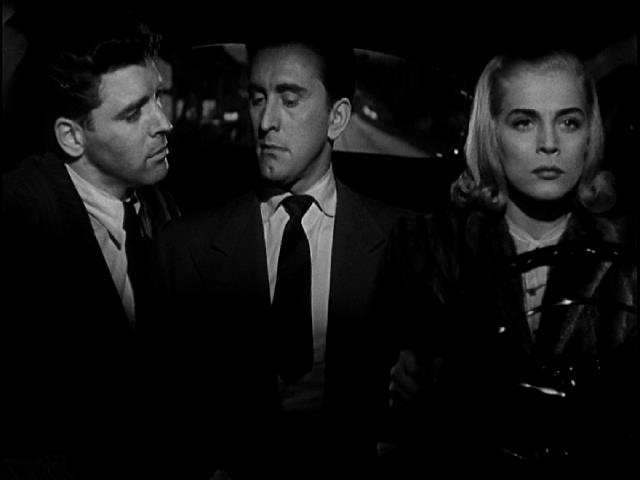
I WALK ALONE

Burt Lancaster, Kirk Douglas, Lizabeth Scott
I WALK ALONE (1947), Director: Byron Haskin.

Frankie Madison (Burt Lancaster) and Noll "Dink" Turner (Kirk Douglas) were partners in a bootlegging operation that went south. Frankie went to prison for fourteen years while Noll opened up his own successful nightclub, and got a girlfriend in singer Kay Lawrence (Lizabeth Scott). Despite his relationship with Kay, Noll plans to marry bitchy socialite Alexis Richardson (Kristine Miller) for business reasons. Frankie makes it clear that what he wants is not just 50% of what's coming to him, but something to make up for all of those years he spent in jail. But even as Frankie and Kay grow closer, Noll may have other, less admirable plans for his old friend ... 

Kirk Douglas in a dramatic moment
I Walk Alone is fair-to-middling film noir. Frankly, it just never becomes as interesting or as explosive as you might hope. The performances are on target,  however, with especially good and slick work from Kirk Douglas, although Lizabeth Scott is a little odd and her romance with Frankie is never quite convincing. Wendell Corey is fine as a friend of Frankie's and an associate of Noll's, and there is also good work from George Rigaud as Maurice, who also works for Noll but isn't quite so  subservient; Mickey Knox as gunsel Skinner; Mike Mazurki as doorman/bodyguard Dan; and Kristine Miller as the delightfully predatory Alexis. When she manages to get Noll to agree to take her to the altar, she suggests that Kay sing "I Lost My Man" to the nightclub patrons -- what a bitch! Corey's death scene on a city street is quite well-handled.

Verdict: Comes so close but somehow misses. **1/2. 

Thursday, May 12, 2016

LOVING YOU

Elvis!
LOVING YOU (1957). Director: Hal Kanter.

"He's the one -- the one with jumping beans in his jeans!"

Press agent Glenda Markle (Lizabeth Scott of Dark City) and her sort of boyfriend "Tex" Warner (Wendell Corey), hope to improve their situation and get lots of publicity by bringing young Deke Williams (Elvis Presley) into their band. Deke's hip-swinging antics incur the wrath of old biddies and the town council, but even the biddies are eventually won over by Deke's obvious likability and sex appeal. Jailhouse Rock, the next Presley film after Loving You, also juxtaposed an older has-been singer with an up and coming youngster but made a little more of the older man's angst, although Loving You has a slightly more serious script than Jailhouse. Elvis is fine, Scott and Corey are excellent, Delores Hart [Wild is the Wind] makes little impression as another band member and Presley's love interest. The title tune and "Teddy Bear" are the best numbers, and Presley betrays a not-terrible baritone when he warbles a ballad. One of the best scenes has Glenda reminding a disapproving council that years ago there was an outcry against jazz, and even against Debussy and Stravinsky decades before. Whatever you think of his acting and singing, Presley had presence in spades.

Verdict: Appealing performances help put this over. **1/2.

Thursday, March 27, 2014

THE COMPANY SHE KEEPS

Jane Greer and Lizabeth Scott
THE COMPANY SHE KEEPS (1951). Director: John Cronwell.

NOTE: Some plot points are revealed in this review. Diane (Jane Greer) is released from prison after passing bad checks and the like, and is assigned to parole officer Joan (Lizabeth Scott). Diane resents kindly Joan from the first, and makes a major play for Joan's boyfriend, Larry (Dennis O'Keefe of Hold That Kiss), which the big lug falls for. Before long Larry and Diane are in love, but they need Joan's approval to marry ... what a weird situation. The problem with The Company She Keeps is that the two lovers are pretty unsympathetic, with Diane returning Joan's friendship by stealing her boyfriend, and Larry betraying the faithful [if eternally busy] Joan, who is too sweet for words -- or reality. Fay Baker [The Star] plays another parolee who works with Diane as a nurse, and Gertrude Hoffman [My Little Margie] has a silent role as a woman on the parole board. Paul Frees is a judge's clerk and Great Old Movies' favorite Kathleen Freeman plays another parolee. Jeff Bridges and his brother Beau supposedly appear as an infant and a small boy. Given Diane's essential nature, it's unlikely that the "happy" ending for this couple is going to last. The acting is generally solid.

Verdict: These two lovers deserve each other. **.

Thursday, March 7, 2013

STOLEN FACE

Lizabeth Scott and Paul Henreid
STOLEN FACE (1952). Director: Terence Fisher.

While on vacation Dr. Philip Ritter (Paul Henreid). a renowned plastic surgeon,  meets and falls in love with concert pianist Alice Brent (Lizabeth Scott), but discovers that she is already betrothed to another. When Ritter is enlisted to give a disfigured female criminal, Lily (Mary Mackenzie) a new lease on life by giving her a new face, he uses Alice's countenance, and tries to turn her into Alice [sow's ear, silk purse, and all that]! Further complicating matters is Alice's decision to return to Philip, meaning the two women in his life now have the exact same face. This is certainly an intriguing idea [with some echoes of A Woman's Face, not to mention Vertigo, both of which are vastly superior]] but it is astonishing that no one ever calls Ritter out on his completely unethical and highly unprofessional behavior, making this a movie that seems to operate in its own weird little dimension. [The movie seems to find Ritter's bizarre obsessive actions to be reasonable!] On the other hand, Stolen Face is well-acted by the leads and Andre Morrell, has a nice score by Malcolm Arnold, and is completely absorbing.

Verdict: One of the best of the Hammer studio melodramas released in the U.S. by Lippert. ***.

Thursday, February 28, 2013

TWO OF A KIND

TWO OF A KIND (1951). Director: Henry Levin.

Brandy Kirby (Lizabeth Scott) hunts down bad boy "Lefty" Farrell (Edmond O'Brien) because she needs him for a certain project, but only if he'll agree to snip off the end of one of his fingers. Seems there's this long-lost missing heir whom Lefty resembles ... There's some minor suspense to Two of a Kind as you wonder if Lefty will get away with his impersonation, or if thieves will fall out and completely shatter their chances. Terry Moore plays a niece of the wealthy old man the conspirators are hoping to fleece, but while her performance is good her character is so improbably naive and stupid that the movie takes a real reality dive when she appears. With his homely mug O'Brien is miscast as a lover boy who supposedly gets all the ladies hot, but he's a good enough actor to get his character across convincingly in spite of it; Scott merely seems disinterested in the material [or in O'Brien] and it's not one of her more memorable performances.

Verdict: Film noir of a minor kind. **1/2.

Thursday, November 8, 2012

THE STRANGE LOVE OF MARTHA IVERS

Heflin, Scott and Stanwyck


THE STRANGE LOVE OF MARTHA IVERS (1946). Director: Lewis Milestone. Screenplay by Robert Rossen. 

"You still look like a scared little kid to me." -- Sam to Walter.

Martha (Barbara Stanwyck), Walter (Kirk Douglas) and Sam (Van Heflin) are childhood friends caught up in melodrama when -- early in the film -- Martha clubs her nasty aunt (Judith Anderson) and kills her right after said Aunt batters Martha's cat with her walking stick. Given Martha's age at the time, and her aunt's actions, probably nothing much would have happened to Martha, but in this movie she marries the witness, Walter, who grows up to become an alcoholic district attorney, and tries to pay off Sam [whom she thinks also witnessed the aunt's death] when he shows up back in town on a trip and chooses a very odd moment to kiss her. The trouble is, Martha and Walter framed an innocent man for the crime and he got the chair. Stanwyck and Heflin are excellent, and in his debut film, Douglas almost steals the film with his intense portrayal of Walter. His odd, clenched-teeth way of speaking takes a little getting used to, but it obviously didn't prevent him from becoming a major star. Lizabeth Scott, who plays an overaged urchin who's been told to get out of town but is befriended by Sam, gives a very odd performance, perhaps because she was trying to play younger than she really was [although she was hardly old at 24]. This was Scott's second film, but she was seen to better advantage in such films as Desert Fury and especially Too Late for Tears/Killer Bait. Well-directed by Milestone and with a nice score by Miklos Rozsa. Familiar faces include Olin Howlin and Ann Doran.

Verdict: Fascinating meller with intense performances from Heflin and Stanwyck and a star turn from Douglas. ***. 

Thursday, March 8, 2012

DARK CITY

Lizabeth Scott and Charlton Heston
DARK CITY (1950). Director: William Dieterle.

"We're a great pair. I haven't got a voice and you have no ear."

Danny Haley (Charlton Heston), who has a shady past, participates in a poker game which he thinks is honest but ultimately fleeces a former soldier, Arthur Winant (Don DeFore) of a five thousand dollar check that doesn't belong to him, causing Winant to commit suicide. As Haley dodges questions from Captain Garvey (Dean Jagger) and words of love from smitten songstress Fran (Lizabeth Scott), a mysterious figure with a big ring is murdering all the men who were in the card game. Trying to track down the killer, Haley even becomes involved with Winant's widow, Victoria (Viveca Lindfors) and her little boy, Billy (Mark Keuning). Heston was introduced in this picture and has a certain intensity and ability, even if one couldn't say he was exactly a brilliant performer. Scott and Lindfors are both more than adequate if not incredibly impressive; both have been better. DeFore, Jagger, Ed Begley, Harry Morgan and especially Jack Webb [in a role very different from what he played on Dragnet] give the most notable performances. The characters could all have used a little more dimension, but at least this holds the attention and has a nice ending.

Verdict: Not prime film noir but not without interest. ***.