Lively, entertaining reviews of, and essays on, old and newer films and everything relating to them, written by professional author William Schoell.
Showing posts with label 1953. Show all posts

Thursday, January 29, 2026

THE BIGAMIST

Ida Lupino and Edmond O'Brien
THE BIGAMIST
(1953). Director: Ida Lupino.

"How could a man like you, successful, respected, get into a situation as vile as this?"

When Harry Graham (Edmond O'Brien) and his wife Eve (Joan Fontaine) apply to adopt a child, Mr. Jordan (Edmund Gwenn), who's in charge of investigating the couple's background, discovers that Graham has another wife, Phyllis (Ida Lupino) in another city where he frequently travels for business. The rest of the film is a flashback as Graham tries to explain to the horrified Jordan exactly how he got into this situation. The Bigamist is completely absorbing, realistically and logically explaining how Graham fell in love with two women, and is beautifully acted by the entire cast. 

Joan Fontaine with O'Brien
Lupino's direction is on the mark, as is her acting, and O'Brien is excellent. The picture is nearly stolen by Joan Fontaine, who has a splendid moment as she reacts to the terrible news delivered to her over the phone by her lawyer. Jane Darwell and Kenneth Tobey have small roles, and there's a nice musical score by Leith Stevens. Very touching movie with an interestingly open-ended wind-up. On youtube there is a beautifully colorized version of the picture. Screenwriter-producer Collier Young was married to Fontaine but had previously been married to Lupino! 

Verdict: Outstanding adult drama with fine performances. ****.

Thursday, August 28, 2025

SPLIT SECOND

Alexis Smith, Paul Kelly, Stephen McNally 
SPLIT SECOND (1953). Director: Dick Powell. Colorized version

Sam Hurley (Stephen McNally) has broken out of prison with his buddies, Bart (Paul Kelly) and Dummy (Frank DeKova), and are hoping to retrieve some loot from an armored car robbery. Hurley commandeers a car driven by Ashton (Robert Paige) and his lover, Kay (Alexis Smith), and when that runs out of gas, takes over a vehicle driven by reporter Larry (Keith Andes) and hitchhiker Dottie (Jan Sterling). Sam takes the whole group to a ghost town in the desert, even though everyone knows that the following morning an atom bomb being tested will go off and decimate the place! Before they can get out of there, Hurley calls Kay's estranged husband, Dr. Garven (Richard Egan), and tells him to fly down and take a bullet out of Bart or else Kay will die. 

Richard Egan comforts Alexis Smith
Now right there you can see the problem. Even if Garven is still in love with the wife who is divorcing him, it seems ridiculous and unreasonable for him to take so much time getting to Bart instead of telling the police exactly where he is! Surely the cops would have a better chance of rescuing Kay and the others than Garven! Split Second  may be fast-paced, but it's not so fast that the audience won't be scratching their heads over this ludicrous plot hole. Garven has hours during which he can contact the authorities. Frankly, things get a little tiresome in that ghost town before things heat up for the climax. Another weird scene is when Ashton practically seems to be begging Sam to shoot him, and Bart's sudden character reversal is senseless as well, even though it's made clear early on that Bart is not the mad killer type like his friend Hurley..

Stephen McNally
Stephen McNally gives another sharp and dynamic performance as Sam, always convincing whether he's snarling at his captors, shouting orders, or romancing the ladies, one of whom goes along with his addressals for her own protection. The other performances are all good as well, with Smith having the showiest role. The climax is terrific, although the writers seem not to have considered the possible effects of radiation poisoning. Dick Powell directed this and generally keeps things moving, although Hitchcock had nothing to worry about. 

Verdict: Interesting idea that doesn't quite work. **1/2. 

Thursday, May 25, 2023

THE I DON'T CARE GIRL

Bob Graham and Mitzi Gaynor
THE I DON'T CARE GIRL (1953). Director: Lloyd Bacon.  Produced by George Jessel.

The real George Jessel is trying to produce a picture about old vaudeville star Eva Tanquay (Mitzi Gaynor of Anything Goes) and importunes his scriptwriters (Warren Stevens and Craig Hill) to locate people who knew the entertainer. These include Ed McCoy (David Wayne), supposedly the man who discovered her as well as her former partner; Charles Bennett (Oscar Levant of The Barkleys of Broadway), a composer; and Larry Woods (Bob Graham), another composer-performer who falls in love with Eva but is married. Larry is separated from his wife but a bigger problem is the seductive Stella Forest (Hazel Brooks of Sleep, My Love), who wants to star in Larry's operetta. Will true love win out over all?

David Wayne, Warren Stevens, Craig Hill
Hollywood is famous for coming out with biopics that have little to do with the real lives of their subjects, but The I Don't Care Girl takes the cake, as there's very little -- but the bare basics -- that have anything to do with Ms. Tanquay. The movie is really just an excuse to show off the admitted skills of Mitzi Gaynor, who gives a good performance, sings quite well, and is a sensational dancer with sensational gams. Ms. Gaynor is featured in some creative -- some might say overly creative -- big production numbers that have very little to do with anything ever seen on a vaudeville stage and everything to do with fifties fashion. 

Mitzi Gaynor and Oscar Levant
The title of the picture comes from Ms. Tanquay's most famous number, "I Don't Care." (Judy Garland, somewhat mimicking Tanquay,  arguably gives the best performance of this song in In the Good Old Summertime.) As for Tanquay, she was certainly a more interesting character than the sanitized version we see in this picture. Essentially forgotten today, she was once a tremendous international star, an early feminist, an absolutely relentless self-promoter, and had two or possibly three husbands as well as at least one affair. For a publicity stunt, she "married" a cross-dresser and wore a tuxedo while he wore the wedding dress. You can bet you won't see that in this movie! 

As for Bob Graham, the fellow is handsome, has a great baritone voice, and makes a smooth, likable leading man. But this was his last picture out of seven. What happened? Even the Internet Movie Data Base has very little information on him, including his date of birth and death. He is not to be confused with another actor named Robert Graham. 

Verdict: The story is just a mass of cliches but the cast is game and the dancing is great. ***.   

Thursday, July 7, 2022

SOUTH SEA WOMAN

Burt Lancaster and Virginia Mayo
SOUTH SEA WOMAN
(1953). Director: Arthur Lubin. 

Through a series of misadventures Sergeant James O'Hearn (Burt Lancaster), his buddy and rival Davey (Chuck Connors), and the woman, Ginger (Virginia Mayo), that Davey is in love with wind up on an isolated island that seems untouched by the war except that any soldiers there wind up in jail. O'Hearn only pretends that he's gone AWOL, but Davey wants no part of the war, with the result that O'Hearn, of all people, winds up court-martialed. The movie is a long flashback detailing how he wound up in such a situation with the story veering from Shanghai to the French island of Namou. Too much talk in the courtroom sequences slows the movie down but there's some good action near the end when a commandeered yacht helmed by O'Hearn takes on the Japanese fleet! The three leads all give very good performances, as does Viola Vonn as the Frenchwoman Lillie Duval, and Arthur Shields [Daughter of Dr. Jekyll] as another resident of the island. Paul Burke plays an ensign at the court martial. 

Verdict: Entertaining if unremarkable. **1/2.

Thursday, April 28, 2022

TREASURE OF THE GOLDEN CONDOR

Cornel Wilde and Anne Bancroft
TREASURE OF THE GOLDEN CONDOR (1953). Director: Delmer Daves. 

In 18th century France Jean Paul (Cornel Wilde) becomes the bonded servant of his hateful uncle the Marquis de St. Malo (George Macready). Jean also falls in love -- and vice versa -- with his cousin Marie (Anne Bancroft). Jean is the rightful heir to the estate and money but there is no proof that his parents, who died at sea, were ever married. Jean figures only money can get him out of his predicament, especially after he is arrested for assaulting his uncle and trying to flee, so he takes off on a treasure hunt in Guatemala with a man named MacDougal (Finlay Currie). 

Wilde with Finlay Currie
In Guatemala the two men set off with MacDougal's daughter Clara (Constance Smith) and look for a stone serpent to guide them to the treasure. Despite the fact that the movie made much of the fact that some of it was filmed in Guatemala, it doesn't especially add to the film's veracity, especially when the treasure seems to be found in a matter of minutes. There's a snake, a cave-in, and minimal excitement in the treasure scene. Then Jean returns to France, is put on trial, and has a rousing and satisfying final battle with his awful uncle, the best and most memorable sequence in the movie. Wilde gives a charismatic lead performance, with good support from a slimy Macready and a passionate if duplicitous Bancroft in one of her earliest roles. (When she eyes Wilde with his shirt off you can imagine she'd rather cozy up to him than Dustin Hoffman!) Irish actress Smith had about thirty credits but never hit the heights. Fay Wray has a supporting part as Macready's wife, and Leo G. Carroll is also in the cast, but I didn't recognize Robert Blake as a nasty stable boy.  The rich score by Sol Kaplan is beautifully orchestrated by Edward Powell. The main problem with this movie is that the viewer will expect it to be about a treasure hunt but that only takes up a small portion of the picture.

Verdict: Good cast can only do so much with comparatively weak and derivative material. **1/2.

Thursday, February 18, 2021

CITY BENEATH THE SEA (1953)

Robert Ryan and Mala Powers
CITY BENEATH THE SEA (1953). Director: Budd Boetticher. 

Brad Carlton (Robert Ryan) and Tony Barlett (Anthony Quinn) are salvage divers hired to look for a million dollars worth of gold on a ship that went down with all hands off the coast of Jamaica. Initially, they are told to call off the search as hopeless, but a variety of interested parties know the location of the ship -- right near the undersea ruins of Port Royal, destroyed by earthquake in 1692. When Tony throws in with some suspicious characters, Brad decides to mount his own above-board operation to keep his pal out of jail. But if the misunderstanding between them wasn't enough, they also have a new undersea quake to contend with ... 

Robert Ryan with Anthony Quinn
If City Beneath the Sea sounds exciting, be forewarned that it is nearly a complete stinker. It's hard to imagine that two major stars like Ryan and Quinn could have wound up in such a tacky, dull, below-routine affair that nearly talks itself to death and is even boring during the climax! The FX budget looks like it might have amounted to $1.99. Admittedly, Universal was no MGM, but the production values for this -- considering the players -- are shockingly poor. Ryan and Quinn give good performances, as do the ladies in their lives, Mala Powers [Unknown Terror] as the owner of a charter boat, and Suzan Ball as the sexy singer, Verita (who saucily delivers "Handle with Care") -- and there are some decent supporting players (including Woody Strode who gets very little to do) -- but the movie spends too much time on extraneous matters and not enough on the matter at hand. 

Can the excitement never end?
The surprising thing is that City Beneath the Sea isn't any better than a knock-off entitled Port Sinister that came out the same year. It's been years since I saw the latter -- and I remember that it was hardly a great movie -- but it had more atmosphere and more interesting elements than this dull picture does. In Port Sinister the city of Port Royal (actually a whole island) rises from the watery depths and there is not only a search for treasure and the usual complement of desperadoes, but even a couple of nasty dog-sized crabs that try to snack on people. In any case, it was more fun that this dog of a movie. Ryan and Quinn (admittedly his best work was ahead of him) must have read the script but perhaps they were hoping it could all be put together in the editing room. It wasn't.

Verdict: This could have used some giant crabs. **. 

Thursday, April 2, 2020

MA AND PA KETTLE AT WAIKIKI

Percy Kilbride and Marjorie Main
MA AND PA KETTLE AT WAIKIKI (1953). Director: Lee Sholem.

Pa Kettle's (Percy Kilbride) cousin, Rodney (Loring Smith of Shadow of the Thin Man), who once hoped to marry Ma (Marjorie Main) but instead stayed in Hawaii to run a pineapple business, has been told to take it easy by his doctor. Rodney and his associates decide to importune Pa -- whom they wrongly think is rich and successful -- to temporarily run the pineapple business in Honolulu until Rodney's health improves. They also think Pa's brilliance will put the company on the fast track again. Against all odds, the ever-lazy Pa seems to come up with schemes that enrich the firm's coffers. But then he's kidnapped and taken to an island where he thinks there's buried treasure.

Percy Kilbride as the lazy Pa Kettle
Ma and Pa Kettle at Waikiki starts out well with several amusing sequences revolving both around Pa's efforts at the pineapple plant and Ma's encounters with the snobby bank president's wife, Teresa Andrews (Mabel Albertson of The House That Would Not Die) and her condescending lady friends. Unfortunately, the flick falls apart in the second half with the introduction of the thoroughly uninteresting kidnappers (including Russell Johnson and Myron Healey) and the whole dull business with the treasure hunt. Even the insertion of a Hawaiian version of Ma and Pa and their huge brood doesn't help, but leads to even more tedious sequences when these characters attempt to rescue Pa with Ma's super-butch assistance and a lot of coconuts. Okay, there's a cute business with a crab but that's about it.

Lori Nelson returns as the Kettle's grown daughter, Rosie, and goes to Hawaii with them, and her new love interest is Bob Baxter (Byron Palmer), who works for Rodney Kettle. Birdie Hicks (Esther Dale) returns briefly and is back to hating Ma again, leading into a funny sequence involving an air-conditioner that doesn't work the way Pa intended. This script has Ma seeming much more stupid than usual.

Verdict: Some fun, but otherwise a disappointment. **1/4. 

Thursday, March 19, 2020

CODE TWO

Ralph Meeker, Jeff Richards, Robert Horton
CODE TWO (1953). Director: Fred M. Wilcox.

Three young men -- Chuck (Ralph Meeker), Russ (Robert Horton) and Harry (Jeff Richards of Born Reckless) -- join the police academy in Los Angeles and eventually ask to be assigned to the motor(cycle) squad. Chuck is a cocky if likable lug who goes after Russ' sister-in-law, Jane (Elaine Stewart of The Tattered Dress) but her focus is more on the shy-but-sexy Harry. Russ at first keeps the news about his assignment from his wife (Sally Forrest) because she fears for his safety, but tragedy is in store for one of the other men, with his two friends doing their best to avenge him. It all leads to an exciting climax in a warehouse with a boiling lime pit and a host of bad guys trying to make mincemeat of our heroes.

The three leads all give solid performances with fine support from the ladies and from Keenan Wynn as Police Sergeant "Jumbo" Culdane. William Campbell [The Young Racers] is also notable as a nasty, murderous trucker. Also on hand in smaller roles are Chuck Connors as a cop and James Craig as a police lieutenant. As for Meeker, he struts through the film with great charisma and authority.

Verdict: Well-done if minor cop melodrama. **1/2. 

Thursday, March 5, 2020

PARIS MODEL

Eva Gabor and Tom Conway 
PARIS MODEL (1953). Director: Alfred E.  Green.

Four women who pick out a fancy dress -- a "Paris model" or a cheaper copy of it -- want to wow their men but wind up getting their comeuppance, except in the last instance. Gogo (Eva Gabor) hopes to hook the wealthy Maharajah of Kim-Kepore (Tom Conway) but her billing the dress to another man may cause a problem -- not to mention the appearance of a gorgeous brunette (Laurette Luez). Betty Barnes (Paulette Goddard) is in love with her boss (Leif Erickson), but his wife, Cora (Gloria Christian), may out-do the grasping secretary in the fancy dress sweepstakes. Marion Parmalee (Marilyn Maxwell) pulls out all of the stops with her husband's flirty boss Sullivan (Cecil Kellaway) in the hopes of getting hubby (Robert Bice of Invasion U.S.A.) the new presidency when the boss retires, but she doesn't reckon with Sullivan's formidable wife (Florence Bates). Marta (Barbara Lawrence) hopes that boyfriend Charlie (Robert Hutton) will propose to her for her 21st birthday dinner at Romanoff's and she may get a little help from "prince" Michael Romanoff [Arch of Triumph] himself.

Secretary vs wife: Paulette Goddard and Gloria Christian
I confess I nearly dumped Paris Model in my latest collection of "Films I Just Couldn't Finish" because the first episode with Gabor and Conway is so lame -- aside from a modestly amusing wind-up -- that I couldn't see spending much more time on it. (One can't imagine either of the Gabor sisters being crazy about having their thunder stolen by another woman.) But once I understood the point of the film, that it dealt with the dress and the stymied manipulations of its wearers -- not to mention that the later segments were more entertaining -- I found this quite enjoyable. The performances are generally good (although Eva Gabor is just plain weird, like a dopey showgirl from another dimension), with Kellaway and Bates taking the acting honors. The film comes full circle with a very funny ending when Tom Conway shows up again as the horny Maharajah. Alfred E. Green directed everything from science fiction (the aforementioned Invasion U.S.A.) to old Bette Davis movies [Dangerous] to Copacabana and everything in-between. Tom Conway's brother, George Sanders, was married to both Zsa Zsa and Magda Gabor, but somehow he never got around to Eva.

Verdict: More fun than you first imagine it will be. ***.

Thursday, February 6, 2020

THE NAKED SPUR

Jimmy Stewart and Ralph Meeker
THE NAKED SPUR (1953). Director: Anthony Mann.

After the Civil War Howard Kemp (James Stewart) lost his farm to a faithless, greedy woman and is determined to buy it back with $5000 reward money for a murderer named Ben Vandergroat (Robert Ryan). Ben has been traveling with the daughter, Lina (Janet Leigh), of one of his deceased best friends, and he is equally determined to stay one step ahead of Kemp. Kemp enlists the aid of old prospector Jesse Tate (Millard Mitchell of Singin' in the Rain) and unsavory and dishonorable ex-soldier Roy Anderson (Ralph Meeker) to capture Ben, but now his two "partners" each want a third of the loot. The whole group begins a trek to Abilene where Ben is to be hung, but it's anybody's guess if they will all make it there in one piece, and if Ben will remain their captive ...

Robert Ryan and Janet Leigh. 
The Naked Spur sets up an interesting and harrowing situation -- the three captors are not just pitted against Ben and possibly Lina, but also each other -- and sustains suspense and tension all the way through. Admittedly, some scenes are not handled as dramatically as they might have been, and there's a disturbing sequence when a whole bunch of Indians are slaughtered when they are really just trying to get justice for a maiden who was apparently raped by Anderson. Stewart gives another impassioned and first-rate performance as Kemp, and Janet Leigh [Act of Violence] proves yet again that she was far more than just a pretty face. Ryan [Caught] plays in an unusual sardonic style considering what he's facing, but he pulls if off, and Meeker, as cocky as ever, makes the most of his turn as the rather sleazy Anderson. The ending seems tacked on to make Stewart's character more palatable, but it only makes him seem like an idiot. It's nice that character actor Millard Mitchell, who also gives a fine performance, is billed above the title with the four stars.

Verdict: Zesty if imperfect western with terrific cast. ***. 

Thursday, August 22, 2019

THOSE REDHEADS FROM SEATTLE

Gene Barry and Rhonda Fleming
THOSE REDHEADS FROM SEATTLE (1953). Director: Lewis R. Foster.

Mrs. Edmonds (Agnes Moorehead) brings her four daughters from Seattle to the Klondike to meet up with her husband, a reformer who is trying to clean up the town during the gold rush. Unfortunately, when they arrive they discover that the man has been murdered. The chief suspect is saloon owner Johnny Kisco (Gene Barry of Burke's Law), who does what he can for the ladies, including giving one daughter, Patricia (Teresa Brewer) a job as an entertainer in his club. Her sister Katherine (Rhonda Fleming of The Killer is Loose) falls for Johnny and vice versa, but she can't deal with the rumors about his part in her father's death. Patricia winds up on the outs with the rest of her family as Katherine, taking over her late father's newspaper, does her best to run Johnny out of town.

Teresa Brewer
With a storyline like that you wouldn't think that Those Redheads from Seattle would be a musical, but it is; unfortunately it was produced by Paramount and not MGM. The songs are by a variety of composers and lyricists, some of whom went on to better things. But the big problem is that you would think the movie would have employed some famous musical stars, but neither of the two leads really do any singing (Barry later wound up starring on Broadway in La cage aux folles, but he was no great shakes as a singer). Teresa Brewer can sing, more or less, but the less said about her overbearing style the better -- as actress she is more palatable, but this was her only movie. There's only one halfway memorable song anyway, "I Guess It Was You All the Time," very well sung by Guy Mitchell, who plays Johnny's buddy, Joe. This was Mitchell's first movie. Essentially a vocalist, he had only a few credits on TV and in pictures.

Moorehead with Fleming, Brewer and one Bell Sister
Barry and Fleming make a pretty good team, even if they barely talk to one another throughout most of the movie. Moorehead is as terrific as ever as the somewhat feisty widow. The other two daughters in the film are played by "The Bell Sisters," about which little is known -- this was their only movie. The last few minutes of the film are taken up with a shoot out between Johnny and the real murderer as he tries to bring him in to clear his name, an abrupt shift in tone that doesn't bring nearly enough excitement to the proceedings. On a whole, the movie is pleasant enough, but aside from some of the performances there's little to distinguish it from numerous mediocre musicals. NOTE: This was originally released in 3D, probably the first musical to do so. Not that it helped that much.

Verdict: If we must have western-melodrama-musicals, this one will do until something better comes along. **1/2. 

Thursday, August 8, 2019

THE AFFAIRS OF DOBIE GILLIS

Bobby Van and Debbie Reynolds
THE AFFAIRS OF DOBIE GILLIS (1953). Director: Don Weis.

Dobie Gillis (Bobby Van) has enrolled in college but he doesn't seem to have much on his mind academically. He is much more interested in girls, especially Pansy Hammer (Debbie Reynolds), who is initially resistant. Pansy's parents, especially her grumpy father (Hanley Stafford), rarely approve of her boyfriends and Dobie is no exception. Further complicating the matter is that Dobie's pal and roommate, Charlie (Bob Fosse), goes for Lorna (Barbara Ruick), who only has eyes for Dobie. Then Dobie manages to get into trouble over and over again, and it seems as if he and Pansy are to be separated forever.

Roomies: Bob Fosse and Bobby Van
The Affairs of Dobie Gillis is a trifle, but what a charming and entertaining trifle it is, with a great cast of talented performers giving their utmost. Bobby Van [The Navy vs the Night Monsters], while not traditionally handsome, proves an adept leading man with both singing and dancing skills, a pleasant, outgoing personality, and plenty of exuberance and charisma. The same could be said for Bob Fosse, who is both cute (if not on a Tab Hunter level) and appealing, but chose to work primarily behind the scenes as a top choreographer in later years. Debbie Reynolds [Singin' in the Rain] is also cute and perky and while this is mostly Van's show, gives him her best in support. Barbara Ruick, who was in the film version of Carousel as well as Rodgers and Hammerstein's Cinderella, scores as the love-sick gal who adores her disinterested Dobie and is given at least one snappy number. 

Reynolds, Van, Freeman
As for the supporting cast, Hans Conreid, as a stuffy professor, reminds one of Mr. Livermore on I Love Lucy. Kathleen Freeman certainly adds to the fun as the comical leader of an all-girl band. Percy Helton shows up as a shop owner, Charles Lane is well-cast as a -- what else? -- grouchy chemistry professor, and there are bits by Alvy Moore,  Almira Sessions, and John Smith. Lurene Tuttle is Debbie's mother, and is fine, but Hanley Stafford as her father is all bluster and no laughs. The songs include "All I Do is Dream of You," "I'm Through with Love;" and "Can't Do Wrong If It's Right," which features some fancy footwork from Van and Fosse. The somewhat episodic film reminds one a bit of a sitcom at times, and indeed it wasn't long before The Many Loves of Dobie Gillis was being telecast every week, although with a completely different cast.

Verdict: Lots of fun, good tunes, and fancy footwork. ***. 

Thursday, July 11, 2019

HOUDINI

Tony Curtis
HOUDINI (1953). Director: George Marshall.

Harry Houdini (Tony Curtis) is performing as the "wild man" in a carnival sideshow when he encounters the pretty Bess (Janet Leigh), who finds him a little headstrong. Nevertheless, he wins her over, the two are married, and the couple head for Europe where Harry is determined to become a great magician. Harry manages to escape from a strait-jacket, gets out of a Scotland yard jail cell, and nearly dies when he is caught beneath the ice in the Detroit River. Bess feels some trepidation as Harry prepares to extricate himself from the "Pagoda Torture Cell," which is filled with water and seems inescapable ...

Curtis and then-wife Janet Leigh
Houdini is loosely based on the life of the famous magician, although it does manage to get some of the facts straight. (The Pagoda Torture Cell was actually called the Chinese Water Torture Cell and Houdini escaped from it numerous times. not just once, and the ending to this film is pure fiction). Tony Curtis makes a perfect Houdini, combining brashness with slight nervousness, and giving an energetic performance, while his then-wife Leigh compliments him well as Bess. There are also notable turns by Torin Thatcher [Witness for the Prosecution] as the assistant to a late famous magician who comes to work for Houdini; Mabel Paige [Johnny Belinda] as a phony medium that Houdini exposes; Ian Wolfe [Foreign Correspondent] as the head of a magicians' society; and others. The film is also distinguished by good period atmosphere and the photography of Ernest Laszlo.

Verdict: Entertaining, colorful romp about a fascinating historical figure. ***. 

Thursday, May 30, 2019

SMALL TOWN GIRL

Farley Granger and Jane Powell
SMALL TOWN GIRL (1953). Director: Leslie (Laszlo) Kardos.

Rich and patronizing playboy Richard Livingstone III (Farley Granger) speeds through the small town of Duck Creek, sasses Judge Kimbell (Robert Keith), and winds up thrown in jail for thirty days. Richard importunes the judge's daughter, Cindy (Jane Powell), to let him out one night for his "mother's" birthday. Richard has a jealous if unfaithful fiancee in Broadway star Lisa Bellmount (Ann Miller), but during a night in New York he and Cindy start to fall in love. How will the judge react when he is apprised of this situation?

Jane Powell
Small Town Girl is the perfect example of a well-turned out MGM musical. The players are fine and enthusiastic (Granger is much better than you might imagine); the TechniColor is vivid and beautiful; there are a couple of more than pleasant tunes ("Small Towns;" "The Fellow I Follow"); some excellent production numbers; and an essentially amiable if lightweight veneer that puts over the slight but entertaining storyline. Jane Powell [Seven Brides for Seven Brothers] again proves an adept leading lady with a lovely voice and good delivery. And besides Granger, Powell has a host of excellent supporting players and character actors to back her up.

Bobby Van 
First among these is Bobby Van [Lost Horizon], who plays Ludwig Schlemmer, the boy next door who has Broadway aspirations. Van is by no means handsome in Hollywood terms, but he is so irrepressible and talented that it doesn't matter; he has a kind of Al Jolson delight in performing. The most famous highlight of Small Town Girl is when Van literally hops his way across town in sheer spirited excitement, a well-choreographed (Busby Berkeley) sequence that was filmed with only a few cuts. When Ludwig meets Ann Miller and tells her his name, she says "Well, keep it quiet and no one will notice." Ludwig's father is played by "Cuddles" Sakall, whose character in this seems more grumpy and unpleasant than lovable.

Miller struts her stuff
Then there's Ann Miller [Carolina Blues]. There may well have been better female dancers in Hollywood musicals, but in this Miller stars in a zesty production number, "Feel That Beat," wherein the members of the band are hidden behind walls and under the floor, with only their arms and instruments protruding. As for the rest of the players, Robert Keith is fine as the judge, as is an uncredited Chill Wills as the friendly sheriff, Happy. Fay Wray is the judge's wife; Billie Burke is her dithery self as Richard's society mother; William Campbell is a reporter; Marie Blake is a shop customer; and Beverly Wills, the daughter of Joan Davis, plays Ludwig's sister, Deidre. Nat King Cole also sings a number, "Burn Low." Photographed by Joseph Ruttenberg.

Verdict: Delightful MGM musical. ***.   

Thursday, September 13, 2018

CANADIAN MOUNTIES VS ATOMIC INVADERS

William Henry and Susan Morrow
CANADIAN MOUNTIES VS. ATOMIC INVADERS (12 chapter Republic serial/1953). Director: Franklin Adreon.

Sgt. Don Roberts (William Henry) of the Canadian Mounted Police and agent Kay Conway (Susan Morrow) team up to tackle a gang of spies who are planning to launch missiles against the U.S. from a remote base in Canada. First the spies do their best to get rid of people who want to settle in the very area where they want to build the rocket launchers, then shift their efforts in attempts to kill off Sgt. Roberts. To that end there are cliffhangers that employ avalanches, warehouse fires and explosions; and Roberts is both shot off the top of a cliff, and then knocked off another cliff when a car crashes into the spot where he's standing. The fight scenes in this serial are well-choreographed and exciting, especially a battle that occurs in the back of a careening pick-up truck. William Henry [The Thin Man] is solid as the Mountie, certainly essaying a different kind of role than he did in his earlier films. Susan Morrow [Macabre] is also good as Kay, who is handy with a gun when required and seems as diligent and brave as Roberts. Arthur Space [Panther Girl of the Kongo] is terrific as the villain, a foreign agent named Marlof who disguises himself as a simple-minded trapper named Ol' Smoky Joe -- he is particularly effective in this role. Hank Patterson, Harry Lauter (who appears so briefly I never noticed him), Tom Steele, Dale Van Sickel, and -- wouldn't you know it? -- Pierre Watkin appear in smaller roles.  One lively sequence has Roberts trying to stop a pack of wild dogs let loose by the bad guys from attacking a group of reindeer that are meant to be food for the settlers (those poor reindeer can't win either way!). William Henry began acting at a very young age and amassed 230 credits.

Verdict: Another fast-paced, utterly mindless, but very entertaining and action-packed Republic serial. ***. 
Thursday, July 26, 2018

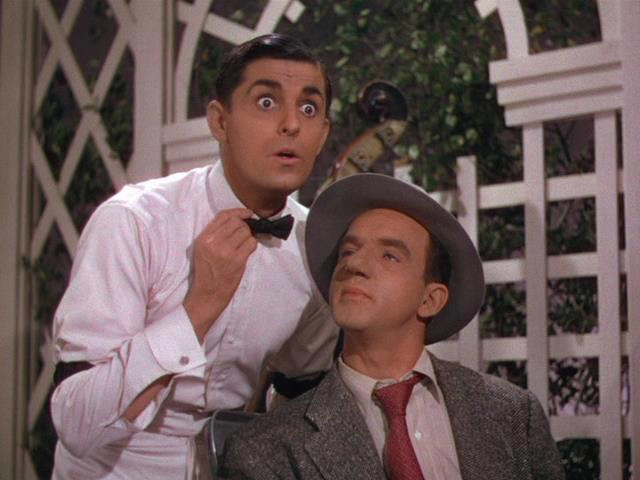
THE EDDIE CANTOR STORY

Keefe Brasselle (Cantor) and Jackie Barnett (Durante)
THE EDDIE CANTOR STORY (1953). Director: Alfred E. Green.

Even as a boy Eddie Cantor (Richard Monda) knew he wanted to be an entertainer. When a foolish do-gooder named Berk (David Alpert) wants to pack the kid off to an orphanage, claiming that his sturdy grandmother Esther (Aline MacMahon) can't take care of him, Eddie is fortunate to wind up with a theatrical couple who sponsor a children's revue instead. As Eddie (now played by Keefe Brasselle) falls in love with his childhood sweetheart, Ida (Susan Odin, and then Marilyn Erskine), he struggles to make a name for himself as an adult singing and dancing comedian. But the more famous Eddie gets, the more he neglects his wife, whose loneliness is palpable despite her having (eventually) five daughters to raise. Then serious health issues crop up and it looks like Cantor's career is over ... Eddie Cantor was still alive when this film came out, so the worst thing the movie says about the comic is that he was overly ambitious and addicted to applause and stardom, a fact that had a negative impact on his family life. The Eddie Cantor Story sticks to the basic facts about the man, even it it remains somewhat on a superficial level. However, Brasselle [Bannerline], outfitted with pop eyes and bigger teeth that generally disguise the actor's handsomeness. gives an excellent, well-studied impression of the famous performer. (One could argue that Brasselle, as is often the case in biopics, impersonates the man as he acts while performing as opposed to how he acts off-stage, but somehow this approach works.) Using the real Cantor's voice, Brasselle expertly recreates his routines from the Ziegfeld Follies as well as from such Broadway shows as Whoopee. The film boasts another excellent performance from Marilyn Erskine, who generally worked in television but should be much better known, as the grown-up Ida. Erskine explores every nuance of the character with her sensitive and splendid emoting. Aline MacMahon [The Young Doctors] is sterling as the loving, supportive grandmother, and there is very nice work from Arthur Franz [The Atomic Submarine] as a doctor who remains a loyal friend of the couple through thick and thin. Jackie Barnett does an amusing imitation of Jimmy Durante, and Will Rogers Jr. is cast as his father. Richard Monda is very winning and effective as Cantor as a child. Smaller roles are enacted by the likes of Chick Chandler (as a talent show host); Marie Windsor (as a jealous star); Gerald Mohr (as an old friend and bootlegger); Alix Talton (as a reporter;) as well as Ann Doran and Arthur Space. One is struck by the similarity between Cantor and friendly rival Al Jolson, who also performed in blackface. In his later years, Cantor did film and television work, and also became a spokesman for the March of Dimes. Cantor and his wife appear in the film's framing sequence, and he is given a classic closing line: "I've never looked  better in my life." Although two actors are credited with playing Cantor's parents (who died when he was an infant), they are either seen only in photographs, or their scenes were cut.

Verdict: Delightful biopic with top performances and snappy musical numbers. ***.  

Thursday, May 17, 2018

DANGEROUS WHEN WET

Fernando Lamas and Esther Williams
DANGEROUS WHEN WET (1953). Director: Charles Walters.

Katie Higgins (Esther Williams) belongs to a very healthy Arkansas family whose farm needs a lot of improvement. Along comes Windy Weebe (Jack Carson), who hawks a dubious product known as Liquipep. Katie is able to resist Windy's all-too-obvious advances, but she decides to let Liquipep sponsor her whole family in a race to swim the English Channel. While getting in training both in England and France, Katie meets a wealthy French playboy named Andre (Fernando Lamas of The Lost World), but his pursuit of her may endanger her chances of winning the race. Dangerous When Wet is a very entertaining and amiable pic with a funny script by Dorothy Kingsley and very good performances from Williams and the rest of the cast, which includes William Demarest and Charlotte Greenwood [Up in Mabel's Room] as Katie's parents; Denise Darcel as the very buxom French entry Gigi; and Barbara Whiting [Fresh from Paris] as Katie's younger sister, Suzie, who warbles "I Like Men." The bouncy, pleasant score is by Arthur Schwartz and Johnny Mercer, and also includes "I Got Outa Bed," "My Wildest Dreams;" and "Ain't Nature Great." Williams doesn't have a bad voice, and while Lamas can carry a tune, his tones are not exactly dulcet. The film has two major highlights: Charlotte Greenwood going into her dance with such obvious joy and kicking up her heels like she's double-jointed; and the suspenseful climax when Katie desperately tries to make it across the twenty miles of the channel, which is filmed in harrowing detail. Another bright moment is a sequence when Williams has a dream of being underwater with the cartoon characters Tom and Jerry, as well as a grabby octopus that is meant to represent Lamas. When the Higgins family first gets to England, the business with all of the fog is funny but causes eye strain after awhile.Williams married Lamas sixteen years after this film was made and they remained together until his death.

Verdict: Possibly Williams' best picture, and an unqualified delight. ***.

Thursday, March 8, 2018

DANCE HALL RACKET

Lenny Bruce
DANCE HALL RACKET (1953). Director: Phil Tucker. Screenplay by Lenny Bruce.

An undercover cop hangs out at a certain dance emporium whose owner he suspects of trafficking in shady deals and murder. The owner is Umberto Scalli (Timothy Farrell of Jail Bait) and his rather psychopathic right hand man is Vincent (Lenny Bruce), who stabs people right and left without hesitation. Scalli's secretary, Rose (Honey Bruce Friedman), is Vincent's chief girlfriend (Friedman was married to Lenny Bruce at the time). The two men are marking time until the arrival of fresh-out-of-the pen Victor Pappas, from whom they hope to learn the whereabouts of his stolen loot. This ultra low-budget, oddball movie, barely clocking in at an hour, was scripted by the controversial comic, and his performance as a sleazy if good-looking hood is personality-driven and competent. Farrell is a professional but uninteresting performer, and the rest of the cast veers from the broadly amateurish to the perfectly capable. The names of many of the cast members have been lost to history, but "Maxine" is noteworthy as Scalli's middle-aged former girlfriend, and she does a mean Charleston, too. The main plot, such as it is, is interrupted by supposedly comic intervals, and there's a terrible Swedish funny man (not!) portrayed by an annoying Bernie Jones. Phil Tucker also directed Robot Monster and Lenny Bruce also scripted Rocket Man.

Verdict: Now this is definitely a curiosity if nothing else. **.

Thursday, March 1, 2018

THE FLAMING URGE

Harold Lloyd Jr. 
THE FLAMING URGE (1953). Writer/director: Harold Ericson.

Tom Smith (Harold Lloyd Jr. of Frankenstein's Daughter) moves from town to town because he's always losing jobs by running off to watch fires. The latest town has less fires than usual, so Tom gets a job at a department store, where he is befriended by the owner, Chalmers (Jonathan Hale) --  who also likes to chase fires --and even gets a girlfriend, Charlotte (Cathy Downs of The Amazing Colossal Man). Just as life looks good, a firebug runs amok and the obvious suspect is Tom. The Flaming Urge is a very light-hearted look at the very serious subjects of arson and pyromania, but the cost in lives (although apparently no one ever dies!)  and property is completely glossed over by the superficial screenplay, and most of the movie plays like a comedy. An asset is the casting of Lloyd Jr., a talented and appealing actor with handsome and sensitive looks who makes the most of his rather bizarre role; this is one of the few if only times he was seen to advantage in the movies. Hale is fine but the picture is nearly stolen by Byron Foulger [The Master Key] as Mr. Pender, Tom's fussy supervisor at the store. Even Pierre Watkin shows up as Charlotte's father, and he is typically competent if unremarkable. The movie was filmed in Monroe, Michigan, and unlike a lot of movies made outside Hollywood, is perfectly professional if low-budget. Writer/director Ericson only made this one movie while Lloyd went on to make several more before dying tragically young of a stroke. The movie is seen by some as a "coded gay" film because of the title (reminding one of "flaming queen") and because Lloyd Jr. was gay in real life, but it might be reading too much into things to see his interest in fire as being a metaphor for homosexuality, yet. .. the movie is psychologically dubious in many ways. One of Harold Lloyd Sr.'s films was Fireman Save My Child.

Verdict: Offbeat with a fine lead performance. **1/2.

Thursday, February 8, 2018

MR. SCOUTMASTER

Scene-stealers: George "Foghorn" Winslow and Clifton Webb
MR. SCOUTMASTER (aka Mister Scoutmaster/1953). Director: Henry Levin.

Robert Jordan (Clifton Webb) has an intellectual TV show, but the ratings are dropping because it doesn't appeal to children. Jordan decides to correct this by getting to know the little darlings, and when the old scoutmaster flees, he takes over the man's position. At first the boy scouts are mightily unimpressed by Jordan, but he does manage to bond -- sort of -- with the littlest cub scout, Mike (George "Foghorn" Winslow), an adorable kid who doesn't quite have the propensity for telling the truth. As Jordan's lovely wife Helen (Frances Dee) begins falling in love with Mike, Jordan discovers the rather dismal reality of the youngster's home life, but can't get past the fact that he was lied to. Will his much, much wiser and warmer wife be able to break through her husband's stony reserve and get him to admit his feelings for the child? Mr. Scoutmaster boasts several fine performances, from the always-excellent Webb, the delightfully deadpan Winslow, the warm and winning Dee [So Ends Our Night], and Edmund Gwenn [Them] as Dr. Stone, as well as a host of talented youngsters. Veda Ann Borg also scores as little Mike's slattern of an aunt. This is a cute and funny picture, but I have to say. softie that I am, that it also gave me a lump in my throat. Webb and Gwenn also appeared together in For Heaven's Sake.

Verdict: Sentimental, moving, and amusing in equal measure. ***.