Lively, entertaining reviews of, and essays on, old and newer films and everything relating to them, written by professional author William Schoell.
Showing posts with label Deborah Kerr. Show all posts

Thursday, January 19, 2023

SEPARATE TABLES

Rita Hayworth and Burt Lancaster

SEPARATE TABLES (1958). Director: Delbert Mann.

"I have no curiosity about the working classes." -- Mrs. Railton-Bell.

"Being alone in a crowd -- it's so painful ... frightening." -- Ann Shankland.

At the seaside Beauregard Hotel in Bournemouth, England -- where several people are permanent residents -- certain little dramas are unfolding. The highly snobbish Mrs. Railton-Bell (Gladys Cooper) has discovered the inappropriate behavior of Major Angus Pollock (David Niven), who has bored everyone with fictional stories of his allegedly heroic wartime exploits. Mrs. R-B gathers the other residents to vote on whether or not to insist that the man be thrown out of the hotel. Mrs. R-B's neurotically shy daughter, Sibyl (Deborah Kerr), who is exceptionally fond of the major, undergoes an emotional crisis when she learns of his illicit activities. Meanwhile, the proprietress, Pat Cooper (Wendy Hiller), who has become the lover of American resident John Malcolm (Burt Lancaster), discovers that his ex-wife, Ann (Rita Hayworth) is still in love with him and has taken a room in the hotel.   

David Niven and Deborah Kerr
Separate Tables
 was originally two plays by Terence Rattigan, sharing several supporting characters, that took place in the same location and were presented together on one evening in the theater, Although Rattigan was importuned to change this before the play debuted, the Major was originally a closeted homosexual and not a pervert who bothered women in a movie theater. (Although the movie is quite sympathetic to the major, it's a question how this would play in these post- MeToo days.) 

Separate tables indeed
The two plays have been intelligently put together and opened up (but not too much) and the film never appears stage bound or too talky, undoubtedly because Rattigan's dialogue is often excellent and perceptive. David Niven won a Best Actor Oscar for his portrayal and Deborah Kerr, who is outstanding, should have won but was only nominated. (Niven is quite good but a cut below Kerr. Hiller won Best Supporting Actress but was surprised by this, as she isn't onscreen very long and complained that her best scenes were cut.) Playing a comparatively superficial if vulnerable character, Rita Hayworth is effective as Ann, as is Burt Lancaster, although he really can't compare to some of these venerable British actors. Gladys Cooper and Cathleen Nesbitt as her friend are exemplary, as are Hiller, Felix Aylmer as Mr. Fowler, and Mary Hallatt as the brisk and self-sufficient Miss Meacham. Rod Taylor and Audrey Dalton have the thankless roles of a young couple temporarily staying in the hotel, their lines undoubtedly cut back to make room for the emoting of Hayworth and Lancaster.  Delbert Mann also directed the beautiful Middle of the Night and many others. 

Verdict: Superior British drama with some excellent performances. ***1/4. 

Thursday, July 21, 2022

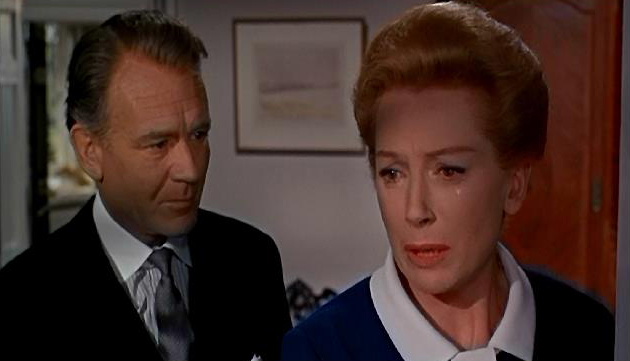
THE CHALK GARDEN

Deborah Kerr and Hayley Mills
THE CHALK GARDEN (1964). Director: Ronald Neame. 

Miss Madrigal (Deborah Kerr) is the latest in a long line of governesses for young and incorrigible Laurel (Hayley Mills), whose mother went off with her new husband and left her in the care of her own mother, Mrs. St. Maugham (Edith Evans). Laurel, who hates her mother, Olivia (Elizabeth Sellars), for abandoning her, is determined to find out what if any secrets Miss Madrigal may have, and one of them is a doozy. Meanwhile the governess and Mrs. St. M disagree on who should raise Laurel, her mother or her grandmother. Madrigal believes she belongs with Olivia, while her employer vehemently denies this. Then Mrs. St. M's old friend, "Puppy," the retired Judge McWhirrey (Felix Aylmer) shows up, and eventually remembers where he has seen Miss Madrigal before ... 

John Mills with Kerr
The Chalk Garden is based on a play by Enid Bagnold, and in truth it is very stagey and often unconvincing. There were a great many changes made from theater to film. Deborah Kerr never quite seems to get a handle on her character (although in this she may not necessarily be blamed); Hayley Mills is fine but for one or two occurrences of over-acting; Edith Evans is on the money; and Sellars and Aylmer are perfectly solid. So too is John Mills, who plays the sympathetic butler. There is perhaps too much left unsaid in this version, and characters come to conclusions that seem without foundation.

Verdict: This Ross Hunter production has some merit but ultimately doesn't quite cut it. **3/4.

Thursday, May 10, 2018

HATTER'S CASTLE

James Mason
HATTER'S CASTLE (aka A, J. Cronin's Hatter's Castle/1942). Director: Lance Comfort.

James Brodie (Robert Newton of Obsession) owns a hat shop in a small British township and not only has pretensions but an alleged connection to the peerage. The huge house he has built and can hardly afford to keep is called "Hatter's Castle" by the townspeople. Brodie takes out his anger on his dying wife (Beatrice Varley) and pretty daughter, Mary (Deborah Kerr of The Night of the Iguana), but reserves his only affection for his young son, Angus (Tony Bateman), on whom he pins his hopes. The hypocritical Brodie turns his daughter out when she becomes pregnant by his slimy clerk, Dennis (Emlyn Williams), but keeps a mistress, Nancy (Enid Stamp-Taylor), in town, whom he later hires as his housekeeper! This is Newton's picture -- James Mason [Caught] has a relatively small role as a doctor who ministers to Mrs. Brodie and falls in love with Mary despite everything that happens. Mason is excellent, as is everyone else in the cast, with Newton giving an especially strong and flavorful performance (although one could argue that at times Newton threatens to turn into a caricature of a palm-rubbing silent movie villain  -- and the movie certainly has elements of silent melodrama). Based on a novel by A. J. Cronin, Hatter's Castle is an absorbing film full of dramatic and moving incident; it moves fast and plays very well.

Verdict: Superior British melodrama with a gripping Newton, lovely Kerr and stalwart Mason. ***.

Thursday, October 26, 2017

EYE OF THE DEVIL

Deborah Kerr
EYE OF THE DEVIL (1966). Director: J. Lee Thompson.

Phillipe de Montfaucon (David Niven) lives in Paris with his wife, Catherine (Deborah Kerr), and their two beautiful children, Jacques (Robert Duncan) and Toni (Suky Appeby). Learning that there is a possibility that his vineyards back in his ancestral home of Bellenac may be failing, Phillipe returns there and tells Catherine to stay in Paris with the children. But Catherine misses her husband and brings the children to his side, where she discovers strange things are going on around the Castle Bellenac. Men in black robes gather in underground rooms and in the forest, and also hovering about are a strange brother and sister team, Christian (David Hemmings). who shoots doves with his bow and arrow, and Odile (Sharon Tate), who seems to have magical powers. Catherine eventually figures out exactly why her husband came back to Bellenac, but she may be too late to save him ... Eye of the Devil predates both The Wicker Man and Thomas Tryon's novel Harvest Home, both of which also deal with pagan sacrifice, but there's something a little off in this movie. Niven and Kerr, along with Edward Mulhare, Flora Robson, Donald Pleasence and little Robert Duncan all give good performances, but there doesn't seem to be much of an attempt to create real tension or a sense of encroaching dread until the admittedly effective climax. Two sequences when Jacques and then his mother nearly fall to their deaths from the castle roof are also taut. Sharon Tate [Valley of the Dolls] had appeared in one film and several TV shows before she was "introduced" in this movie, and she is perfectly cast and adept (if possibly dubbed) as the very strange and rather sinister Odile. Hemmings [Deep Red] has less to do but maintains the proper spooky attitude.

Verdict: Not entirely successful and slightly supernatural thriller. **1/2.

Thursday, September 15, 2016

QVO VADIS

The grandeur that was Rome courtesy of MGM
QVO VADIS (aka Quo Vadis/1951). Director: Mervyn LeRoy.

Marcus Vinicius (Robert Taylor) fights for the glory of Rome and its emperor, Nero (Peter Ustinov). He meets a woman named Lygia (Deborah Kerr) and the attraction is instant. Unfortunately, Lygia is a Christian and can't forget Vinicius' cruel soldier ways. Marcus then decides to enact an old Roman law that has Lygia forcibly taken away from her adoptive parents and brought to Nero's harem, where Marcus knows Nero has agreed to make a gift of her for him. But when Nero decides to blame the Christians for the burning of Rome, Marcus must decide on whose side he is really on, and if love will out. You can certainly quibble about certain aspects of Qvo Vadis, but as simple good story-telling and adept movie making, the picture is really a wonder to behold. Robert Surtees' cinematography is excellent, as are the scenic design, costuming, and matte paintings that make Rome seem even larger than it is. Miklos Rozsa also contributed an evocative score. As for the acting, Peter Ustinov gets the highest honors for his fascinating portrait of the petulant and often child-like, highly neurotic Nero. Kerr comes next, with her usual sensitive thesping, and even Robert Taylor, although certainly not on the level of those two, gives a good performance as Marcus. Leo Genn is fine as Marcus' uncle, although he is too perfunctory during his suicide scene. There are other notable performances from Patricia Laffan [Devil Girl from Mars] as Nero's nasty wife, Poppaea; Abraham Sofaer [Captain Sindbad] as Paul; Rosalie Crutchley [Blood from the Mummy's Tomb] as Acte, who loves Nero and runs his harem for him; Marina Berti as Eunice, a slave who adores her master, Marcus' uncle (the two have a moving death scene together); little Peter Miles [Roseanna McCoy] as young Nazarius, whose mother is killed when Rome burns to the ground; among others. Highlights of the well-directed film are the aforementioned burning of Rome; and the horrifying scenes of Christians being fed to the lions. There is a pre-Ben-Hur chariot battle, as well. Historians are still arguing over how accurate the assessments of Nero have been, so this picture must be taken with a grain of salt on that score.

Verdict: Almost as magnificent as Rome itself, and with its flaws as well, but this is splendid movie-making. ****.

Thursday, October 23, 2014

THE NIGHT OF THE IGUANA

Deborah Kerr and Richard Burton
THE NIGHT OF THE IGUANA (1964). Director: John Huston. Based on the play by Tennessee Williams.

"Don't make me take steps, Dr. Shannon ..." -- Judith Fellowes.

The former minister T. Lawrence Shannon (Richard Burton), who was locked out of his church, is now guiding ladies on a tour bus through Mexico. Young Charlotte Goodall (Sue Lyon) can't keep her hands off Shannon, inspiring the ire of her formidable guardian Judith Fellowes (Grayson Hall). Shannon takes the gals to a small hotel run by an old friend, Maxine Faulk (Ava Gardner), whose husband died a short while ago. While some of the tourist ladies put up a fuss, Maxine reluctantly admits the impoverished artist Hannah Jelkes (Deborah Kerr) and her aged poet father, Nonno (Cyril Delevanti) to her hostel. As these characters interact and Shannon faces dismissal from the tour business, will the man finally find himself  "at the end of his rope," like one of the iguanas tied to the stairs? Like many Williams' adaptations The Night of the Iguana is a mix of the poetic and the pretentious, but it does have some very tender moments. Burton, Lyon and Delevanti walk off with the acting honors. Grayson Hall [House of Dark Shadows] is a bit overwrought, almost ridiculous at times, as Judith, but the whole idea of the fire-breathing repressed lesbian is terribly dated. Deborah Kerr [Edward, My Son] is good, but she doesn't quite get across the weary defeatedness of someone who is a caregiver to a man in his nineties [walking him around Mexico in the heat with little money could almost be considered elder abuse], and is apparently homeless besides -- where is the sheer desperation she would be feeling? Gardner [Seven Days in May] is not bad at all and suitably earthy; Bette Davis played the role on the stage. The poem that Nonno completes, written by Williams, of course, is beautiful. Despite its flaws, the movie casts a certain exotic and haunting spell.

Verdict: Imperfect but entertaining and well-acted, with some interesting characters. ***.

Thursday, July 31, 2014

EDWARD, MY SON

Marital discord: Deborah Kerr and Spencer Tracy
EDWARD, MY SON (1949). Director: George Cukor.

"The trouble with drink is it makes it just a little bit uncouth."

Arnold Boult (Spencer Tracy) is determined to make sure that his son, Edward [who is never seen] has the greatest life possible, and commits all manner of crimes to insure this, his ruthlessness even driving people to suicide. His wife Evelyn (Deborah Kerr) watches in horror, tries to interfere, and turns to drink, only inspiring more contempt from her husband. Boult has an affair with his secretary, Miss Perrin (Leueen MacGrath), but finds her as disposable as most of the people in his life, including his partner Harry (Mervyn Johns). This absorbing, adult portrait of a supreme narcissist and his spoiled son packs a wallop, due to an excellent script by Donald Ogden Stewart [Keeper of the Flame]  and superb playing by Tracy [State of the Union] and Kerr [The End of the Affair]. MacGrath, Johns, Ian Hunter [Tower of London] as a doctor who is sympathetic to Evelyn, and Tilsa Page as Miss Foxley, are also excellent. 

Verdict: Powerful marital drama. ***1/2.

Thursday, January 31, 2013

THE END OF THE AFFAIR (1955)

Deborah Kerr and Van Johnson


THE END OF THE AFFAIR (1955). Director: Edward Dmytryk.

"It's quite simple really. One just does one's best."

"Are we to be children all our lives?"

In war-torn London, writer Maurice Bendrix (Van Johnson) has an affair with Sarah Miles (Deborah Kerr), the wife of a colleague, Harry (Peter Cushing). After Maurice is nearly killed in an explosion, he gets the paranoid impression that Sarah would have preferred he died so that the affair could end with ease, He becomes obsessed with finding out why she broke things off immediately afterward. He's unaware that Sarah, fearing he was killed, made a certain promise to a God she doesn't quite believe in ... The End of the Affair, based on a novel by Graham Greene, gets points for at least attempting to be adult fare and dealing with [semi] intellectual matters instead of merely blowing out the soap bubbles, but it is so talky and so smothered in awful religiosity that it's nearly a complete misfire. A supposedly atheistic character seems dragged in for balance, but he's really just an embittered, disfigured man who hates God, the movies' misconception of an atheist. The End of the Affair is the kind of picture that thinks talking about God and theology is somehow profound, giving it a pretentious and heavy air just when you should be getting caught up in the drama [what there is of it] and the characters. Speaking of which, both Maurice and Sarah are rather unsympathetic; neither ever gives a thought to husband Harry, who may be dull but seems a decent sort after all. Although The End of the Affair does illustrate the torments d'amour rather well at times, at other times it's almost comically awful, wasting some very good acting, a fine score by Benjamin Frankel, and moody cinematography by Wilkie Cooper. Deborah Kerr gives the best performance, better than the movie deserves, and Van Johnson, while not on her level, is quite good for the most part as well. Peter Cushing, in one of his rare non-horror parts, also acquits himself nicely as Harry, and John Mills has a good turn as a private detective hired by Bendrix. Greene's novel was again adapted as a film in 1999 with Julianne Moore and Ralph Fiennes in the Kerr-Johnson roles.

Verdict: A for effort, maybe, but this just doesn't work. **.