Lively, entertaining reviews of, and essays on, old and newer films and everything relating to them, written by professional author William Schoell.
Showing posts with label Edward G. Robinson. Show all posts

Thursday, July 30, 2026

TIGHT SPOT

Ginger Rogers
TIGHT SPOT (1955). Director: Phil Karlson. Colorized.

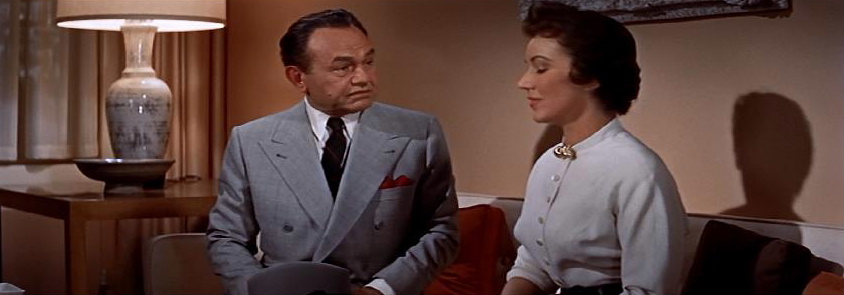
Prosecutor Lloyd Hallett (Edward G. Robinson of All My Sons) is out to deport murderous racketeer Ben Costain (Lorne Greene) but needs the help of inmate Sherry Conley (Ginger Rogers of We're Not Married). She is taken to a hotel in Manhattan, watched over by cops Vince Striker (Brian Keith) and Mrs. Willoughby (Katherine Anderson), while Hallett promises her that she won't go back to prison if she only testifies against Costain. Meanwhile, there are attempts on her life at the hotel, attempts which only convince her that it means certain death if she plays ball with the authorities. Can Hallett convince her to help them? 

Brian Keith with Lorne Greene
Although you can't quite say that she gives a bad performance, Rogers acts in a somewhat "cutesy" style that makes it seem as if she thought she were starring in a comedy! As Rogers has given perfectly good performances in dramatic roles, one wonders why she made this poor choice. The film itself is merely mediocre, with Keith and especially Greene, excellent and sinister in a malevolent role, coming off best. Robinson is fine, of course, but the material is very much beneath him, making you wonder why he took on the role in the first place. Lucy Marlow of Queen Bee appears very briefly in the opening scene in the women's prison, and Kathryn Grant has a bit as a frightened newlywed in the hotel. There is at least one surprise in the film and an okay climax. 

Verdict: So-so suspense film with an odd lead performance and a ho hum veneer. **.  

Thursday, October 12, 2023

ALL MY YESTERDAYS: EDWARD G. ROBINSON


ALL MY YESTERDAYS: An Autobiography
. Edward G. Robinson with Leonard Spigelgass. Hawthorne; 1973.

"For male actors it is possible, though not easy, to slip gradually from leading man into character roles. For me, it just came naturally, since I was never Tab Hunter ..."

In this posthumously published autobiography, the great actor, who became a star with Little Caesar, writes frankly of his life and career and relationships with friends, actors and other co-workers. He gives candid, honest -- but not mean-spirited -- assessments of such co-stars as Bette Davis and Kay Francis, and describes his love of art and how he set out amassing his great collection of masterpieces. He also writes about the brutal days when he was unfairly accused of being a communist. Robinson died before he could complete his recollections, so the book was finished by his collaborator Spigelgass, who provides some interesting footnotes and a compilation of Robinson's opinions on various subjects. He also writes of Robinson's divorce, how he lost most of his great art treasures, and his troubled relationship with his only son.

Verdict: Compelling reading from a great star and superb thespian. ****.

Thursday, February 16, 2023

HELL ON FRISCO BAY

Alan Ladd
HELL ON FRISCO BAY (1955). Director: Frank Tuttle. 

Ex-cop Steve Rollins (Alan Ladd) was framed for a murder he didn't commit and sent to prison for five years. When he gets out he is determined to find out who really murdered the victim and clear his name. He pretty much ignores his wife, Marcia (Joanne Dru), because he wants to protect her and also because she dared to dally with a gentleman out of loneliness when Steve wouldn't even let her come to see him. The San Francisco docks are controlled by a nasty man named Victor Amato (Edward G. Robinson), who has a good right hand, Joe (Paul Stewart), and a good-for-nothing nephew, Mario (Perry Lopez), who loves the ladies. Joe spends his nights with a former movie star named Kay (Fay Wray) while Victor is stuck with his pious wife, Anna (Renata Vanni), who treats Mario like a son and thinks he should be a priest. Steve talks to assorted individuals in the hopes they can give him information that might help him, but when Amato offers him a job, and Steve turns him down, he vows to make him pay -- painfully. 

Robinson and Fay Wray
Hell on Frisco Bay
 is a fast-paced and entertaining film noir thriller with many intriguing elements and a highly interesting cast. Ladd could probably play this kind of role in his sleep by now, but he manages to stay awake and acquits himself nicely. A deceptively cheery Robinson slowly unveils the layers of corruption and evil until he reveals the slimy lizard at his core, going so far as to order Joe to murder his own nephew. Stewart is excellent as the hired gun who's trying to get out from under Robinson's thumb. Fay Wray scores as Kay, and one of the best scenes is between Wray and Robinson as Amato makes a pass at her and gets angry when she turns him down, hitting her. "Get out, you filthy peasant!" she screams. Joanne Dru is acceptable as Marcia, giving solid line readings that don't always hit the emotional mark. 

William Demarest and Rod Taylor
The film is also full of flavorful performances by a wide variety of supporting players. William Demarest is a cop and friend of Steve's while Willis Bouchey is the police lieutenant who has to be convinced of Steve's innocence. Rod Taylor plays a hood who may have committed the murder Steve was sent away for with Tina Carver as his girlfriend. Peter Hansen [When Worlds Collide] is the corrupt cop, Connors, and Anthony Caruso [The Asphalt Jungle] is especially notable as a fisherman who is scared that if he talks to Steve his young son, George (Peter J. Votrian, who is also good) may come to harm. Renata Vanni probably made a career out of playing long-suffering wives or mothers. Nestor Paiva plays another dock worker who tries to work things out with Amato and only winds up dead. Perry Lopez [The Steel Jungle] plays the sexy but weak nephew to perfection. Jayne Mansfield plays his date.

Paul Stewart with Robinson
Ladd is manhandled by the chubby gunsel Hammy (Stanley Adams) in one scene and turns the tables on him, beating him up and telling Joe to "get your pig outa here!" The film has a boat chase at the end that is exciting although not quite on the level of similar scenes in those old cliffhangers. Although this might not be listed among Max Steiner's greatest scores, it is effective and thrilling when it needs to be. The screenplay is good, but one wishes the picture crackled with tension -- although it comes close at times -- but director Frank Tuttle doesn't make the film quite as explosive as it could have been. Still, it's quite well-played and snappy.

Verdict: Memorable crime drama with some outstanding performances. ***. 

Thursday, December 8, 2022

ALL MY SONS

Burt Lancaster and Edward G. Robinson
ALL MY SONS (1948). Director: Irving Reis. Based on the play by Arthur Miller.

Industrialist Joe Keller (Edward G. Robinson) was acquitted of deliberately selling defective plane parts to the army during WW2, but his partner, Herb Deever (Frank Conroy), wound up in jail.  21 planes crashed, killing the pilots and crews, because of the faulty parts. Now Deever's daughter, Ann (Louisa Horton), is engaged to Keller's son, Chris (Burt Lancaster). Adding to the awkwardness of the situation is the fact that Ann used to be engaged to Chris' late brother, who died fighting overseas, a fact which his mother, Kate (Mady Christians), refuses to acknowledge. Into this gathering comes Ann's angry brother, George (Howard Duff), who believes that Joe is the true guilty party and let his own father take the fall. With so much at stake Chris confronts first Herb and then Joe, but what he finds out may not be at all to his liking. And then there's a letter written to Ann from Chris' brother overseas just before his death ... 

Lancaster, Horton, Fraser, Morgan
All My Sons
 is a powerful, well-written and well-acted drama of the kind you rarely see these days. An outstanding Edward G. Robinson heads the cast and etches a strong portrait of a man who just doesn't get it until he finally does. The other cast members, including Lancaster, are all impressive as well. The supporting cast includes Arlene Francis and Lloyd Hough as one set of neighbors and Elisabeth Fraser and Harry Morgan as another; these are also interesting characters even if their appearances are brief. Howard Duff is a pleasant surprise as George, a sad figure who only felt truly at home when he was with the Kellers and now must cut himself off from them forever. Louisa Horton, who was married to George Roy Hill for twenty years, debuted in this film and years later appeared in Alice, Sweet, Alice. Helen Brown has a nice bit as an alcoholic woman whose husband died, and who confronts Joe in a restaurant and calls him a murderer. Despite being opened up in an intelligent fashion, the film is at times stagey, with some wrong choices in line readings and the like, but mostly this is a superior and memorable drama. 

Verdict: Fascinating situations explored in depth and with compassion. ***1/4. 

Thursday, August 4, 2022

THE MAN WITH TWO FACES

Edward G. Robinson and Mary Astor
THE MAN WITH TWO FACES
(1934), Director: Archie Mayo. 

"The second act is still a fine piece of Limburger." 

Actor Damon Welles (Edward G. Robinson)is appalled to learn that his brother-in-law Stanley Vance (Louis Calhern), isn't dead after all, but has come back into his sister Jessica's (Mary Astor) life and is exerting a seriously unhealthy influence over her. So he cooks up a scheme to disguise himself and ... This dull and predictable movie, based on a minor stage play, wastes the talents of its excellent cast, who give it more than it deserves. Ricardo Cortez plays a theatrical producer and John Eldredge is a playwright. Robinson has such a distinctive face, figure and aura that, fine actor that he is, it's difficult for him to successfully disguise himself. Crisp, well-composed photography is another bonus but nothing can overcome that creaky plot. 

Verdict: Robinson is always worth watching. **.

Thursday, April 28, 2022

TALES OF MANHATTAN

TALES OF MANHATTAN (1942). Director: Julien Duvuvier. 

This very entertaining film is a series of tales connected by a tailcoat that proves lucky or disastrous for whoever wears it, including an actor (Charles Boyer) who is in love with a married woman (Rita Hayworth); a man (Cesar Romero) who is about to get married and who has a jealous fiancee (Ginger Rogers) and a friend (Henry Fonda) who tries to help him; a musician (Charles Laughton) whose wife (Elsa Lanchester) gets him the tailcoat to wear on the night he conducts his symphony, to disastrous (and somewhat unlikely) results; and a down-on-his luck lawyer (Edward G. Robinson) who wears the coat to a reunion of his ivy league college buddies who have no idea of how far he's fallen. The final sequence stars Paul Robeson, Ethel Waters, and Eddie Anderson in a charming tale of poor folk (who are not exactly in Manhattan) who have to decide how to spend the money that falls out of the tailcoat. A brief but amusing sequence with W. C. Fields (appearing with Margaret Dumont!) lecturing society folk was cut out for the initial theatrical release, but has been wisely reinstated. The entire cast is good, with special honors going to Boyer, Robinson, and Fields. 

Verdict: Who knew a movie about a coat could be such fun? ***.

Thursday, March 18, 2021

LITTLE CAESAR

Edward G. Robinson
LITTLE CAESAR
(1931). Director: Mervyn Leroy. 

 "Mother of mercy -- is this the end of Rico?" 

 The great Edward G. Robinson became a star with this exciting and entertaining gangster flick. Rico (Robinson) wants to be somebody and have everything while his buddy Joey (Douglas Fairbanks, Jr., who comes off convincingly lower-class) just wants to be a dancer. The two should have just gone their separate ways, but Rico seems obsessed with his pal (any homoerotic aspects of this go unexplored). Rico rises in the rackets until he takes over an important gang, and forces his old pal Joey to help him rip off the establishment where he entertains with his girlfriend, Olga (Glenda Farrell). Rico gets bigger and bigger but there are forces conspiring against him ... Robinson is just terrific, and he has a solid supporting cast, including the aforementioned performers as well as Thomas Jackson as Sgt. Flaherty; William Collier Jr. as Tony; and Sidney Blackmer (who had an important role many years later in Rosemary's Baby) as "Big Boy." 

Verdict: Fun to watch Robinson rise and fall. ***1/2.

Thursday, September 13, 2018

THE OUTRAGE

Paul Newman
THE OUTRAGE (1964). Director: Martin Ritt.

In the late 19th century in the southwest, three men take refuge from a rain storm at a train depot: A priest (William Shatner), a prospector (Howard Da Silva) and a con man (Edward G. Robinson), with the first two telling the third the conflicting stories they heard at a murder trial. The trial centers on the notorious bandit Carrasco (Paul Newman), who is accused of raping a southern woman (Claire Bloom) and murdering her wealthy husband (Laurence Harvey). The bandit, the wife, the dead man (via an Indian medium) and then the prospector all tell their stories, but trying to figure out which is the correct one will drive you crazy. The Outrage is an interesting remake of the much more famous Japanese film Rashomon, and while it's generally a good picture (it helps if you're unfamiliar with the original), it's also a mixed bag. On the plus side is a charismatic and quite adept performance from Paul Newman, who's much better in what is essentially a character part than you might expect. Newman is on top of things in every scene. The next best performance is from Edward G. Robinson, whose expert acting skills are on marvelous display in his winning performance as the not very likable con artist. Although Claire Bloom [Three Into Two Won't Go] could be accused of being a little stagy and overly theatrical at times, she's playing many different interpretations of the same person and playing them well, with near-perfect line readings. Howard Da Silva scores as the prospector, and Laurence Harvey is fine in an underwritten part in which he is tied up and gagged for most of the running time. Shatner tends to overact a bit as he did as Captain Kirk -- he always seems to think he's doing Shakespeare -- but he's effective enough in the part.  James Wong Howe's cinematography is typically outstanding. While Alex North's score has some lovely things in it, it also seems inappropriate at times given the subject matter, but then again, The Outrage has several sequences that border on black comedy (which in of itself is inappropriate). Still, whatever its flaws, The Outrage is absorbing, good to look at, and features several excellent performances. Whether it has the kind of attitude towards rape that you might find today on, say, Law and Order:Special Victims Unit, is debatable. Martin Ritt directed Paul Newman in Hud the previous year.

NOTE: Apparently I had already reviewed this film on Great Old Movies eight years ago.  I liked it a little better this time around, and think it might even have more emotional impact than the original.

Verdict: Newman gives a striking performance in an unusual role for him. ***. 

Thursday, March 31, 2016

FLESH AND FANTASY

Who is that masked lady? 
FLESH AND FANTASY (1943). Director: Julien Duvivier.

This is a collection of three macabre stories with a framing device of one man relating the tales to another. The first story deals with a supposedly homely woman (Betty Field) who is given a mask (see photo) that makes her appear beautiful to everyone and that she must return by midnight. In the second story, Edward G. Robinson is given a prediction, which he initially scoffs at, that he will commit murder. The second story runs into the third, which has a high-wire acrobat (Charles Boyer) having premonitions of disaster when he meets a mysterious woman (Barbara Stanwyck) whom he has seen in a recurring dream in which he falls to his death; meanwhile the lady has secrets of her own. In a cast of talented actors, Thomas Mitchell [Theodora Goes Wild] and Dame May Whitty [The Sign of the Ram] almost walk off with the picture and it's quite interesting to see Boyer and Stanwyck together. Alexander Tasman contributed some quirky theme music. Duvivier also directed Lydia.

Verdict: Perhaps less here than meets the eye, but it's well-acted for the most part and entertaining. ***.

Thursday, April 24, 2014

A LADY TO LOVE

Robert Ames and Vilma Banky
A LADY TO LOVE (1930). Director: Victor Seastrom.

"Of all the lowdown, dirty tricks that was ever played on a girl!"

A vintner named Tony (Edward G. Robinson) is smitten with a pretty foreign-born waitress, Lena (Vilma Banky), and sends her a proposal of marriage through the mail. Unfortunately he also encloses the photograph and of his younger and better-looking hand, Buck (Robert Ames), leading to sensual complications when Lena finally arrives in the Napa Valley.  This is the second film version (and first sound picture) of Sidney Howard's They Knew What They Wanted and it has a slight edge over the 1940 film of that title, even though Robinson is not as good as Tony as Charles Laughton was. Robinson seems to play the character as if the film were a comedy, although he has some strong moments of poignant desperation at the end. Banky and Ames are fine, although Buck, who seems a decent enough sort, has a bit of a character reversal to bastard towards the end. The best version of this story might be Frank Loesser's The Most Happy Fella.

Verdict: Creditable adaptation with interesting cast. ***.

Thursday, March 20, 2014

HOUSE OF STRANGERS

Tense date: Richard Conte and Susan Hayward
HOUSE OF STRANGERS (1949). Director: Joseph L. Mankiewicz.

Gino Monetti (Edward G. Robinson) is the opera-loving head of a bank and has four sons, one of whom, the lawyer Max (Richard Conte of Thieves' Highway), he seems to love unconditionally. The oldest son, Joe (Luthor Adler) is bitter that Gino treats him with disdain and employs him only as a poorly-paid bank teller. Pietro (Paul Valentine of Love Happy) resents the fact that his father thinks he's stupid. Tony (Efrem Zimbalist Jr.) seems more interested in the ladies than in anything else. Although Max has a pretty fiancee named Maria (Debra Paget), he can't help but be attracted to a zesty, very self-confident lady named Irene (Susan Hayward), who comes to him for legal advice and with whom he enters into a sexy if exasperating love-hate affair. Then Gino discovers that his unorthodox approaches to lending have brought him under the scrutiny of bank officials and he may go to jail. Max has a scheme to get his father out of trouble, but he doesn't reckon with Joe's hatred ... House of Strangers is an absorbing, well-acted drama that just misses being really special, but is still quite worthwhile. Although Robinson is miscast as an Italian, he still gives his customary fine performance, and Conte and Hayward make an arresting couple. Luthor Adler almost walks off with the movie with his quietly ferocious portrayal of deceptively steel-hard Joe. Hope Emerson (Peter Gunn) is fun in a small role as Maria's termagant mother, trading verbal and nearly physical blows with Robinson, whom she towers over.

Verdict: Has quite a few memorable and powerful sequences. ***.

Thursday, April 25, 2013

BARBARY COAST

Robinson and Hopkins


BARBARY COAST (1935) Director: Howard Hawks.

Mary Rutledge (Miriam Hopkins), known as "Swan," arrives in San Francisco during the gold rush, fully expecting to find a fiancee and a million bucks waiting for her. Instead she winds up at a crooked roulette wheel in a casino-saloon owned by Luis Chamalis (Edward G. Robinson). Chamalis is a racketeer who runs the town with the aid of killer Knuckles (Brian Donlevy), who's fond of shooting people in the back. Swan becomes rather hardened by her life and Chamalis' persistent and unwelcome wooing of her, but she's softened a bit by an attractive and kindly young prospector, Jim (Joel McCrae), but their next encounter is quite unpleasant ... Hopkins and Robinson make an interesting team -- more interesting than Hopkins and McCrea -- but that's not enough to save this picture, whose basically light tone is at odds with the grim subject matter. Despite some good performances from the leads and the supporting cast -- Frank Craven (In This Our Life) as a colonel who starts a newspaper is especially noteworthy -- the movie is a mediocre mish mash, and not one of Robinson's better pictures. Walter Brennan offers another of his bizarre portraits as the cackling "Old Atrocity."

Verdict: Begins promisingly but goes in too many dull directions. **1/2.

Thursday, August 30, 2012

THE STRANGER

Powerhouse combo: Welles and Robinson
THE STRANGER (1946). Director: Orson Welles.

Wilson (Edward G. Robinson), who works for an Allied commission that brings war criminals to justice, is after the notorious Franz Kindler, who is hiding out in the small town of Harper as a teacher named Charles Rankin (Orson Welles). Rankin is just about to get married to judge's daughter Mary Longstreet (Loretta Young), when another Nazi from Kindler's past shows up, leading Wilson to his door. First Wilson must confirm his suspicions (the audience is clued in pretty early) and keep Kindler from removing any other obstacles in his path, including people  -- and even his wife. Considering the talent involved and the story line, one would think The Stranger would be a much stronger picture, but it certainly isn't bad. Of the three leads, Robinson comes off best, although Welles is a close second and Young has her moments. The excellent supporting cast includes Martha Wentworth as a housekeeper, and Billy House as a drug store owner. Philip Merivale doesn't seem to summon up the proper concern as Mary's father (the script doesn't help here), and Richard Long is a bit perfunctory as her brother, Noah; Red the Irish Setter, is on top of things, however. One of the best scenes has Wilson interrogating Mary even as he shows her footage (mostly unseen) of concentration camp atrocities. The movie has gaps in logic and Welles seems only sporadically interested in the material; the movie picks up as it goes along and has a fairly exciting climax in a clock tower.

Verdict: Some very good moments but lacks greatness. ***. 

Thursday, April 29, 2010

THE OUTRAGE


THE OUTRAGE (1964). Director: Martin Ritt.

Did outlaw Juan Carasco (Paul Newman) murder a man (Laurence Harvey) and rape his wife (Claire Bloom), or is the story more complicated than that? In this serio-comic American version of Roshomon, different characters tell their stories while the law tries to arrive at the truth. Although Newman received mostly criticism for his performance, he's actually quite lively and effective. Bloom, Howard Da Silva (as a prospector) and William Shatner (as a preacher) also give good performances, and Edward G. Robinson is a stand-out -- as usual -- as a con man. Superior black and white cinematography by James Wong Howe and a fine score by Alex North.

Verdict: Uneven but not without moments of interest. **1/2.

Thursday, February 18, 2010

DR. ERLICH'S MAGIC BULLET


DR ERLICH'S MAGIC BULLET (1940). Director: William Dieterle.

In Germany before the rise of the Nazis, Dr. Paul Erlich (Edward G. Robinson, pictured) experiments with controversial methods to cure different diseases, including tuberculosis. Short-sighted and mean-spirited colleagues at the hospital don't see that the compassionate Erlich has more to offer than the average doctor. In time he comes up with "magic bullets" or synthetic drugs that can combat disease, and eventually even gets into an early type of "chemotherapy" -- which causes a break between him and his closest friend, Emil (Otto Kruger). Attempting to cure syphilis, Erlich allows a new drug to be administered, but when some of the patients die he is accused of murder, resulting in him suing for slander. Although the film is a bit talky and slow in the first half, it eventually becomes quite intriguing and dramatic, bolstered enormously by the performances of Robinson and the other cast members. Although she isn't seen too often, Ruth Gordon is lovely as Erlich's wife, Hedy. Kruger, Donald Meek, Donald Crisp and the inimitable Maria Ouspenskaya are also wonderful. Ouspenskaya figures in an amusing and daring [for 1940!] dinner party scene in which Erlich discusses his work on syphilis! Max Steiner's touching score is another plus.

Verdict: "Syphilis" at the dinner table! ***.

Thursday, February 11, 2010

TWO SECONDS


TWO SECONDS (1932). Director: Mervyn LeRoy.

High rise worker John Allen (Edward G. Robinson) is about to be executed for murder, and the entire film is a flashback detailing the events that led up to this in the "two seconds" it takes him to die. Allen marries a dance hall girl, Shirley (Vivienne Osborne), while he's drunk, and she proves to be a shrew of the first rank. This brings John into conflict with his best friend and former roommate, Bud (Preston Foster), leading to a horrific tragedy. But things, if possible, get worse ... Robinson gives a ferociously superb performance in this [although it's quite odd that he appears almost drunk in the courtroom/sentencing scene]. J. Carroll Naish offers yet another of his excellent portrayals as Tony, and Osborne's performance certainly has bite. Guy Kibbee has a small role as well.

Verdict: Not exactly great drama but the acting is terrific. **1/2.

Thursday, January 28, 2010

THE HATCHET MAN

THE HATCHET MAN (1932). Director: William Wellman. Wong (Edward G. Robinson) is a "hatchet man" or enforcer [or hit man] for his local Chinese Tong in Chinatown. He is at first horrified to discover that his next assignment is to kill a man who is his best and oldest friend, Sun [a superb J. Carroll Naish, who is nearly unrecognizable under his excellent make up]. Wong inherits Sun's wealth, business -- and daughter Toya (Loretta Young), who years later becomes his wife. Unfortunately, Toya develops a yen for her bodyguard. Robinson basically eschews Oriental make up, while Young does look somewhat Chinese. "Ming the Merciless" Charles Middleton has a part in this film, but I confess I didn't spot him. This film is interesting and different, has a clever ending, but it's very morally ambiguous and we never learn how Toya would react if she learned exactly what happened when she was a child. Verdict: Well-acted but not exactly a Chinese Godfather. **.

Wednesday, January 21, 2009

DOUBLE INDEMNITY

DOUBLE INDEMNITY (1944). Director: Billy Wilder. Co-screenplay by Raymond Chandler. From a novel by James M. Cain.

Although the voice-over narration is overdone and annoying (as in Sunset Boulevard), you eventually get used to it, caught up in the mesmerizing spell of this great motion picture. Walter Neff (Fred MacMurray, in a very good performance) meets unhappy wife Phyllis Dietrichson (Barbara Stanwyck) and before long they're conspiring to murder her husband and make it look like an accident that will pay double from Neff's insurance company because of a "double indemnity" clause. Stanwyck, in the archetypal portrait of a sultry sociopathic siren, is simply magnificent. Edward G. Robinson is also superb as Barton Keyes, the older man who works with Neff, and who investigates the death of Dietrichson. But Wilder also made smart casting decisions with the supporting cast, such as Tom Powers as the victim, Jean Heather as his daughter, and Byron Barr as her unpleasant boyfriend, Nino.

The scene when Keyes nearly sees Phyllis hiding in the corridor outside of Neff''s apartment is marvelous, although Hitchcock probably would have done more with it. And frankly it makes little sense that Neff would go into Keyes' office instead of bolting away when he sees a man outside who could identify him and blow his whole scheme to smithereens. Of course, it does lead into a suspenseful scene in Keye's office later when you wonder if the witness will recognize Neff.

The ending to the film is strangely moving. Robinson/Keyes seems coldly disgusted with Neff's actions, not willing to give him any out. Then Neff suggests that Keyes couldn't see the solution because he was too close to the perpetrator, who was, as Neff says, right across the desk. "Closer than that," says Robinson. And you realize how much Robinson loved Neff in his own way and how utterly disappointed he is in him.

Although it may or may not have been an Oscar-worthy performance, one has to say that the casting of MacMurray goes a long, long way to enabling you to feel some slight sympathy for the character he plays (although he certainly showed no pity for Dietrichson).

Verdict: A classic in every sense of the word. ****.

Wednesday, August 27, 2008

NIGHTMARE

NIGHTMARE (1956). Director: Maxwell Shane.

Stan (Kevin McCarthy) is a jazz musician who has a vivid nightmare in which he murders a man in a room full of mirrors. When he wakes up he's convinced that the event actually happened and there's blood on his hands. He takes his story to his brother-in-law Rene (Edward G. Robinson), a homicide detective, but the cop thinks he's making too much of a particularly disturbing dream. Or is he? Although based on a novel by Cornell Woolrich, Nightmare meanders along without much suspense, and becomes increasingly ridiculous. McCarthy's okay performance occasionally lacks the proper intensity, considering the situation he finds himself in. Virginia Christine of “Mrs. Olsen” coffee fame and The Mummy's Curse plays McCarthy's sister. She also appeared with McCarthy in the classic Invasion of the Body Snatchers as Wilma. Oddly, the picture is at its most boring when it's supposed to be at its most exciting. You're always three steps ahead of the characters. Connie Russell gets to deliver an interesting number as Stan's singer girlfriend, Gina.

Verdict: This one may not put you to sleep, but almost. *1/2.

Thursday, May 1, 2008

ILLEGAL


ILLEGAL (1955). Director: Lewis Allen.


When District Attorney Victor Scott (Edward G. Robinson) discovers that he's sent an innocent man to the electric chair, he resigns, drinks, and winds up in a downward spiral that leads to him working with hoodlum Frank Garland (Albert Dekker). There comes a conflict of interest when he defends a former associate and close friend, Ellen Miles (Nina Foch), who is accused of murder and whose defense is tied in with Garland's activities. Hugh Marlowe has one of his more interesting roles as Foch's husband, and Jayne Mansfield, chest out-thrust, plays one of Garland's girlfriends (her performance is mediocre at best). DeForest Kelley of Star Trek fame plays the innocent man who goes to the chair, and Ellen Corby scores as Scott's no-nonsense secretary. Illegal is a snappy if pat movie with a great performance by Robinson -- his drunk scenes are masterful. Jan Merlin makes a striking and sinister gunsel and hit man, Andy Garth, and Nina Foch does a nice job as well.

Verdict: Minor but entertaining. **1/2.