Lively, entertaining reviews of, and essays on, old and newer films and everything relating to them, written by professional author William Schoell.
Showing posts with label 1966. Show all posts

Thursday, July 16, 2026

AFTER THE FOX

Peter Sellers
AFTER THE FOX (1966). Director: Vittorio De Sica.

Aldo Vanucci, a notorious criminal known as the Fox, escapes from jail to participate in the theft of a fortune in bullion known as the "Gold of Cairo." Working with a mysterious man named Okra (Akim Tamiroff), who only speaks through his beautiful companion, Aldo decides to make a movie about the theft and only pretend to be carrying off the gold. He inveigles aging American star Tony Powell (Victor Mature) to play the lead, and casts his aspiring actress sister, Gina (Britt Ekland) as his leading lady. The entire town turns out to participate in "Federico Fabrizi's" movie, but the best-laid plans ... 

Based on a play by Neil Simon (who also wrote the screenplay) this seems more like an attempt to cash in on the success of The Pink Panther and its sequels, but there's a reason why this never had any sequels. There are amusing and clever ideas and moments in the script, but they never quite jell, and the logistics of the crime are so hazy that the audience can't follow along, which is essential even in a comic caper treatment. De Sica may not have been the right director for this project -- he plays himself in a cameo -- but while star Sellers is good, he's simply not as farcical and as funny as he should have been; possibly he found the weak material uninspiring. Mature [Kiss of Death] is terrific as the vain actor whose dyed hair leaves streaks on Gina's face; Tamiroff [The Vulture] is as adept as ever; and Ekland [The Wicker Man], who was married to Sellers at the time, is also good and fetching. Martin Balsam has some funny moments as Tony's handler, and Lando Buzzanca makes an impression as a chief of police. This is one of those movies that probably looked hilarious on paper but just doesn't work out in actuality. The final gag is especially lame.

Verdict: Not one of Sellers' better movies nor performances. **.

Thursday, June 8, 2023

FRANKIE AND JOHNNY

Harry Morgan, Elvis, Nancy Kovacks

FRANKIE AND JOHNNY (1966). Director: Frederick De Cordova. 

Frankie (Donna Douglas) and Johnny (Elvis Presley) are entertainers on the riverboat-casino S. S. Mississippi Queen. Frankie's jealousy is ignited when a gypsy fortune teller tells Johnny that a redhead will bring him good fortune, so he zeroes in on Nellie Bly (Nancy Kovak of Jason and the Argonauts). All he wants from Nellie is for her to accompany him when he gambles, but both Frankie, and Nellie's boyfriend -- also Johnny's boss -- Braden (Anthony Eisley), get the wrong idea. Things come to a head when Frankie, Nellie, and showgirl Mitzi (Sue Ane Langdon) all dress up as Madame Pompadour for a masquerade ball, and Braden's associate Blackie (Robert Strauss) comes up with a criminal way of eliminating Johnny as a rival during a rendition of the title tune. 

Sue Ane Langdon and Donna Douglas
Frankie and Johnny could have been a really interesting look at the riverboat scene of the 19th century as well as a trenchant observation of what unruly passions can lead to, but instead it's just an Elvis Presley Picture, although on that level it's fun and entertaining. Elvis doesn't so much act as exude personality, and Donna Douglas -- who just can't eliminate that Elly Mae Beverly Hillbillies accent entirely -- while adequate, pretty much shows why she made no further theatrical movies after this one. On the other hand Nancy Kovack is classy and sexy as Nellie, Langdon is a lot of fun as Mitzi, who also loves Braden, and Harry Morgan [All My Sons] and Audrey Christie [Splendor in the Grass] score as Cully and Peg, a married couple who are friends and co-workers of the title duo. Anthony Eisley of Hawaiian Eye is also very good as boss Braden, and Joyce Jameson has an excellent turn as a drunken redhead whom Johnny thinks might temporarily substitute for Nellie. 

Douglas with Nancy Kovack
Frankie and Johnny comes pretty close to being a bona fide musical -- as opposed to just an Elvis Presley Musical -- because its score has quite a variety of music. The classic title tune is reinterpreted and there's a fine version of When the Saints Go Marching In. Elvis does a superlative job delivering such memorable ballads as Please Don't Stop Loving Me and Angel at My Side. He also has a charming number with a harmonica-playing shoeshine boy, Hard Luck, and a bouncy piece called Look Out, Broadway. (Jerome Cowan appears uncredited as a Broadway producer who likes F and J's act.) Except for Elvis, everyone's singing voice seems to be dubbed. Forget the gorgeous gowns of the ladies, Elvis himself wears one striking and beautiful ensemble after another! 

Verdict: The plot gets a bit bogged down and slightly tiresome, but it's hard to dislike the flick and even harder to dislike Elvis. ***. 

Thursday, March 31, 2022

A FUNNY THING HAPPENED ON THE WAY TO THE FORUM

Zero Mostel and Jack Gilford
A FUNNY THING HAPPENED ON THE WAY TO THE FORUM (1966). Director: Richard Lester. Music and lyrics by Stephen Sondheim. 

The slave Pseudolus (Zero Mostel) is hoping to acquire his freedom and comes up with a plan. His master's son, Hero (Michael Crawford), has fallen for a virginal courtesan, Philia (Annette Andre), just installed in Marcus Lycus' (Phil Silvers) brothel next door, and Hero will free Pseudolus if he arranges a relationship between the two. The problem is that Philia has already been bought by the egomaniacal Captain Milos Gloriosus (Leon Greene), who is on his way from Rome that very afternoon to claim his bride. Pseudolus schemes to get Philia away from Gloriosus even as his master Senex (Michael Hordern of Theater of Blood) schemes to get away from his termagant of a wife, Domina (Patricia Jessel).  


The first half hour or so of this adaptation of the Broadway musical A Funny Thing Happened on the Way to the Forum is delightful -- although it takes too long for someone to finally sing a song -- with Mostel fully in charge of his material along with Silvers, Jack Gilford as Hysterium, Hordern and Jessel, and especially Greene as the captain. But after awhile this farce just becomes a bit labored, and the film completely falls apart with a tasteless scene in the arena and especially a drawn-out slapstick sequence that falls completely flat. Others have noted that the film has a typically sixties attitude towards women: they are either young beauties lusted after by ugly old men or old hags unworthy of consideration. One could also argue that anything having to do with roman slavery is not exactly a great subject for the comedic treatment to begin with. I think the main problem is that this is the type of material that works much, much better on the stage. However, the producers wisely kept on Mostel and Gilford from the Broadway production. Unwisely, because they thought big movie musicals were on their way out, they cut most of Stephen Sondheim's tuneful score. What remains is the lovely "Lovely," sung by Philia; the captain's song as he comes into town and the dirge he sings later on; the spritely "Everybody Ought to Have a Maid;" and the infectious opening number "Comedy Tonight."

Leon Greene and Zero Mostel
As the young lovers Michael Crawford (who would find fame on Broadway as The Phantom of the Opera) and Annette Andre fail to make much of an impression. British actor Leon Greene, however, makes quite an impression and went on to have many more credits, mostly in the UK. Buster Keaton [Backstage], in his last role as a man looking for his kidnapped children, is, unfortunately, not good at all. 

Verdict: Some fun to be sure, but it just becomes too silly. **1/2. 

Thursday, November 11, 2021

THE OSCAR

THE OSCAR
(1966). Director: Russell Rouse.

Frankie Fane (Stephen Boyd) is a low-level garment worker who sort of falls into acting because he "impresses" a lady talent scout named Sophie (Eleanor Parker). Sophie gets him a top agent in "Kappy" Kapstetter (Milton Berle), who manages to convince studio head Kenneth Regan (Joseph Cotten) to sign him to a contract even though Regan senses something off about the guy. Fane becomes a star, but keeps biting the hand that feeds him -- even though some of his remarks to those who helped him have a point. When his career starts slipping badly, he has nightmares of going back to being nobody, and hitches upon a desperate plan to nab an Oscar and put himself back on top. The Oscar does show how undeserving louts can become movie stars simply because somebody has the hots for them -- which has happened more often than anyone imagines. The movie might have had more bite had Fane been someone desperately committed to the art of acting, but this can't be confused with the far superior Career -- it's basically entertaining trash with mostly one-dimensional characters and often hokey dialogue -- and not a few tedious moments. Once Fane begins to slide, however, the pic picks up. The fact is that the narcissistic, ambitious, self-absorbed Fane is all too typical of most Hollywood actors.

Elke Sommer and Boyd
Although miscast as some low-bred tough guy, Boyd is not at all bad as Fane, and has his best moment at the very end of the movie (you almost feel sorry for him). As his pal and procurer, Hymie, Tony Bennett seems amateurish until he has some powerful moments at the climax. Jill St. John gives it a good try, but she hasn't the real acting chops to make the most of her scenes as the girlfriend Fane stole from Hymie. Elke Sommer is okay as Kay Bergdahl, a designer Fane makes a play for and eventually marries, and Berle is at least flavorful as Kappy. Eleanor Parker gives the sauciest performance as Sophie, and makes St. John and Sommer look like a couple of kittens in comparison. But Edie Adams and Ernest Borgnine almost walk off with the movie as a husband and wife who are celebrating their divorce in Mexico when they encounter Fane and Kay and re-enter their lives in an unexpected fashion. Peter Lawford has a small but significant scene where he plays a once-famous actor who is now a headwaiter at a Hollywood restaurant; Lawford is excellent and this is probably the best scene in the movie. There are some celebrity cameos and Hedda Hopper as well. One of the screenwriters was Harlan Elison, who became better known as a science fiction writer.

Verdict: Not exactly Eugene O'Neill but fun. ***.

Thursday, May 13, 2021

AROUND THE WORLD UNDER THE SEA

Wynn, Eaton, Kelly, McCallum, Bridges and Thompson
AROUND THE WORLD UNDER THE SEA (1966). Produced and directed by Andrew Marton.  Produced by Ivan Tors. 

An increasing danger of undersea quakes that could endanger millions on land causes scientists to decide to implant special sensors in various places on the sea bottom, providing a sort of early warning system. To achieve this Doug Standish (Lloyd Bridges) and Craig Mosby (Brian Kelly) gather a team to occupy their sub, the Hydronaut, and voyage around the world. The team members consist of Hank Stahl (Keenan Wynn), Dr. Orin Hillyard (Marshall Thompson), Dr. Maggie Hanford (Shirley Eaton), and Philip Volker (David McCallum), who agrees to help only if they go on a salvage operation that could net millions once all the sensors are planted. But this operation is interrupted by an eruption, and the crew of the Hydronaut may find themselves in really hot water ... 

Shirley Eaton and Brian Kelly
Around the World Under the Sea may have been intended as producer Ivan Tors' answer to Irwin Allen's Voyage to the Bottom of the Sea, but it certainly falls short of providing the same entertainment value. Although there is much talk of the ever-present danger of quakes and the necessity of planting the sensors, there is no sense of urgency and no real suspense until, perhaps, the final sequence. The actors are competent enough for the most part, but not quite up to the challenge in their most intense scenes. 

Lloyd Bridges and Brian Kelly
Tors filled the movie with such TV stars as Bridges from Sea Hunt, Kelly from Flipper, Thompson from Daktari, McCallum from The Man from U.N.C.L.E., who affects the same accent he used as Ilya in that series, and then throws in the irascible Keenan Wynn and the sexy Shirley Eaton to cause some minor tension among the boys. Eaton and Thompson seem to be romantically involved at the beginning of the movie, but halfway through she shifts her attention to Kelly, but there's no major reaction from Thompson. Although one could argue that this avoids a cliche -- although there are plenty in this movie -- it also strips the movie of any melodrama, which it could have used. We do get a gigantic eel that shows up and sniffs around the sub, but the problem with this is that it doesn't really seem to be endangering it or the people aboard. (I thought I spotted a few moments of 3D animation during this sequence and stop-motion expert Jim Danson is listed in the credits.)

David McCallum appeals to Shirley Eaton
The science of the film is suspect as well. At the climax, the water around the sub should have been boiling from the heat, and other things don't make much sense. However, some viewers might enjoy that Shirley Eaton loses the top of her bathing suit at one point where it floats outside of a porthole (or whatever they call it on a sub), and Harry Sukman's score has its effective moments. The screenplay is not well-constructed and hardly takes advantage of a very workable premise. There is no real characterization to speak of. 

Verdict: By no means dreadful, but too blah to be memorable. **1/4. 

Thursday, October 1, 2020

THE FORTUNE COOKIE


THE FORTUNE COOKIE (1966). Produced and directed by Billy Wilder.   

When cameraman Harry Hinkle (Jack Lemmon) is knocked over by Cleveland Braves player Boom Boom Jackson (Ron Rich) during a football game, his brother-in-law, Whiplash Willie (Walter Matthau), importunes him to pretend his injuries are far worse than they really are for a huge cash payout. At first Harry is appalled by the very suggestion, but when Willie intimates that Harry's ex-wife, Sandy (Judi West), may come back to him out of sympathy, he agrees. Meanwhile a very guilty Boom Boom, who practically becomes Harry's servant, finds his own life spiraling out of control. Yet Harry's essential humanity may put paid to Willie's audacious and avaricious plan.

The Fortune Cookie is an excellent comedy-drama which begins as an amusing dark farce and midway turns a bit more serious. The performances are superb, with Matthau master of all he surveys, Lemmon on target throughout, Ron Rich sympathetic and appealing, and Judi West, introduced in this picture, scoring as Harry's ex, a singer who dreams of a shot at the big time in New York's Persian Room. Cliff Osmond also makes an impression as private eye, Purkey, although Lurene Tuttle overdoes it a bit as Harry's hysterical mother. There are other good character actors in the cast such as Les Tremayne. Although highly exaggerated, the characters come off more or less as real people, although many of the situations are not realistic and are not meant to be. I won't give anything away, but the ending strikes a blow for Civil Rights in a way that is unusual for a sixties movie (although one might wonder how anyone could be certain of Harry's reaction). Handsome and talented, this was the first big role for Rich, but he had only a few credits after this. Similarly, Judi West, who actually had a couple of TV credits before this film, had only a few subsequent credits as well. Joseph LaShelle's cinematography is first-rate.

Verdict: Imperfect at times, but a very entertaining black comedy with outstanding performances. ***1/2.                                                             

Thursday, July 9, 2020

PENELOPE

Natalie Wood
PENELOPE (1966). Director: Arthur Hiller.

Penelope (Natalie Wood) is the neglected wife of a bank president, James Elcott (Ian Bannen of Psyche 59). Apparently she has had a problem with stealing -- which gives her pleasure -- for some years, but her crowning achievement, some might say, is robbing her husband's bank on the very day it opens. Two cops -- Lt. Bixbee (Peter Falk) and Sergeant Rothschild (Bill Gunn) -- are called in to investigate, and are quickly on the trail of a blond woman with a French accent who disguised herself as an old lady and changed her clothing and wig in the ladies room. The two cops get closer and closer to Penelope, but ultimately arrest a streetwalker named Honeysuckle Rose (Arlene Golonka). Will Penelope come clean and keep this innocent woman out of jail?

Penelope in old lady drag
Penelope has its amusing moments, but as a major comedy it's a bust. Natalie Wood is cute in the picture, but her character calls more for a kookie Gracie Allen-type -- even Phyllis Diller would have been better in some ways -- and Wood doesn't really have sharp comedic skills. Ian Bannen isn't especially funny, either, but although he's initially rather off-putting, his performance is acceptable. At first Dick Shawn as Penelope's psychiatrist doesn't exactly act as if he's in a comedy, but he has his moments as well. Lila Kedrova and Lou Jacobi enliven the film a bit with their portrayal of a couple who run a dress shop. Jonathan Winters is completely wasted in a terrible flashback wherein he plays Penelope's college professor who literally tries to rape her -- even back in 1966 this sequence must have seemed utterly tasteless.

Peter Falk
Yet Penelope never quite made it onto my Films I Just Couldn't Finish list. That's because the movie is generally watchable, moves fairly quickly, and has some interesting twists to it that keep you  involved. As for the other actors, Peter Falk is fine, although one could argue that he's auditioning for his role on Columbo. Bill Gunn is a likable African-American actor who does what he can with a small if sympathetic part. Norma Crane [Night Gallery] is zesty as Elcott's ex-girlfriend, who just won't let go, and Arlene Golanka [Diary of a Bachelor] really runs with her brief portrayal of Honeysuckle. If you don't blink you'll also see adept bits by Jerome Cowan and Fritz Feld. Wood didn't make another movie for three years after this flick bombed at the box office.  

Verdict:  If the biggest laugh comes from a character's burping, you know a comedy is in trouble. **1/2.                                                                                                                                                    

Thursday, February 20, 2020

THE IDOL

Michael Parks as The Idol
THE IDOL (1966). Director: Daniel Petrie.

"To be idolized, a man must offer the unusual." -- ad copy.

Marco (Michael Parks) is an American studying art in London. He has a sort of girlfriend in Sarah (Jennifer Hilary) and a kind of best buddy in Timothy (John Leyton), and the three pal around a lot together. Marco is less impressed when he meets Timothy's mother, Carol (Jennifer Jones), also an American, who is divorcing her husband and about to remarry. Carol also seems to be slightly overbearing with Timothy. Marco seems to have a problem with parents and authority in general. When Marco is embarrassed by Carol at a house-warming party, he is furious, but Carol warms up to Marco when he comes to her son's rescue after two slobs try to beat him up. One New Year's Eve Marco goes to Carol's home to find Timothy, but he has already gone to a party with Sarah. At midnight Marco gives Carol a kiss and one thing leads to another -- with highly unfortunate repercussions ...

Jennifer Jones
There were many great British films made in the 1960's, but The Idol isn't one of them. Its screenplay is half-baked and its characters poorly developed   -- especially Marco, who has little reason for doing anything he does except that he's an asshole -- and the overlong film is also tedious. Made by an American studio, The Idol would still have been a poor movie, but at least it might have been more entertaining with the right trashy cast. Parks is better in this film than he is in Bus Riley's Back in Town, but Laurence Olivier might have had trouble with this character. Jennifer Jones has the good sense to look embarrassed through most of the movie, and her performance is one of her weakest. John Leyton, although he's way too old to convincingly play someone who's just nineteen, probably comes off best. Jennifer Hilary is adequate but she lacks the raw sex appeal of, say, an Ann-Margret -- or a Michael Parks -- so her love scenes with Parks aren't very exciting.

Parks, Leyton and Hilary
Some viewers claim that Carol has incestuous feelings for her son and/or vice versa, but if this was intended, it is not handled very well. Timothy seems to have a crush on Sarah, whom he pursues when he thinks Marco has broken off his relationship with her, but it may be just as likely that Marco is the true object of his sensual attentions. In the long run, none of this makes a difference, because it's impossible to care about any of these characters. One member of the large supporting cast who deserves kudos, however, is Rita Webb as the landlady at Marco's nifty apartment who repeatedly remarks about her tenants that "they're all a bit mental." One wonders what she would think of this motley crew?

Verdict: Lame attempts at pseudo-profundity don't help and neither does an ad campaign that promises more than it delivers. **.

Thursday, February 21, 2019

WHO'S AFRAID OF VIRGINIA WOOLF?

Liz Taylor and Richard Burton
WHO'S AFRAID OF VIRGINIA WOOLF? (1966). Director: Mike Nichols.

"I'd divorce you if you existed." --Martha regarding George.

George (Richard Burton of Becket) is an Associate Professor of History at New Carthage University. His wife Martha (Elizabeth Taylor of Giant) is the daughter of the university president. Married for some years, they are enmeshed in bitter disappointment and alcohol. They were not able to have children, and George had hoped to be head of his department by now. The contempt they feel for themselves and for one another bursts out in lacerating games and accusations.

George Segal and Sandy Dennis
After a party one night they invite a younger couple, new to the university, to their home at two in the morning. Nick (George Segal) is a new biology teacher, and Honey (Sandy Dennis of That Cold Day in the Park) is his wife. The two were only married because of an hysterical pregnancy, and Honey's family is wealthy. Copious amounts of alcohol keep the "games" coming, with Martha pretending that she and George have a son. Before long all four people are lashing out at each other, and George decides it's time to put one rumor to rest.

George notices that Martha has plans for Nick
Who's Afraid of Virginia Woolf? intelligently opens up Edward Albee's play with scenes at a roadhouse and on the lawn, and the film is very well directed by Nichols, who gets excellent performances from the entire cast, and an especially strong one from Oscar-winning Elizabeth Taylor. Alex North's music is used very sparingly but it adds to the grim atmosphere of this black comedy, as does Haskell Wexler's top-notch black and white cinematography.

George fences with Nick
Since the play is much longer than the movie, cuts were obviously made, but I suspect that the movie is better than the play. It is debatable if Virginia Woolf is a great work of theater or more along the lines of kitsch, and in truth it probably lies somewhere in the middle. Although seen as a dissection of typical married life back when it premiered in the sixties,  it was obviously not the first play to deal with dysfunctional marriages. There was a typically sixties frankness and crudity to the language that was different, however, and Albee's dialogue is often very good and very funny.

George and Martha 
The whole business with the "son" doesn't really make much sense, but one's left with a vague air of tragedy because these people seem so pathetic, despite the fact that they are not that likable nor sympathetic. As played (beautifully) by Sandy Dennis, who also garnered an Oscar, even Honey is simply too freaky to engage our sympathies. Although we obliquely learn certain things about the characters -- the whole business with George's book, his parents' (?) deaths and so on is admittedly intriguing if obscure -- it might be said that we don't quite come to know them that well (nor do we want to).

Still, Who's Afraid of Virginia Woolf holds the attention and has its fascinating aspects. Underneath the laughs and bitchy interplay there is genuine pain and loneliness, but other plays have perhaps gone into the same themes with more brilliance and compassion. (Admittedly, there are undoubtedly big differences between the play, which I have not seen in some years, and the film.) Albee based George and Martha on a straight couple he knew -- they were never intended to be a gay couple, which is probably why he nixed an all-male version that Burton and Henry Fonda wanted to do with Jon Voight and Warren Beatty in 1970. True!

NOTE: The film Martha is referring to when she imitates Bette Davis saying "What a dump!" is Beyond the Forest.

Verdict: Who's Afraid of Alcohol Poisoning? ***. 

Thursday, November 8, 2018

THE VENGEANCE OF FU MANCHU

Chris Lee as Fu
THE VENGEANCE OF FU MANCHU (1967). Director: Jeremy Summers.

Fu Manchu (Christopher Fee) has not only decided to bring together all sorts of international criminals, including American gangsters, to form a group that he will lead, but has also concocted a diabolical scheme for revenge against his British nemesis, Nayland Smith (Douglas Wilmer of Unman, Wittering and Zigo) of Scotland Yard. Smith has concluded that a group to be called Interpol should be formed to unite law officers from various countries and combat the criminal scourge. But he is unaware that Fu Manchu has created a double of Smith whose actions will destroy his reputation even as Smith himself is taken captive by his enemy. Dealing with the zombie-like double are FBI agent Mark Weston (Noel Trevarthen of Escort for Hire) and Smith's long-time friend and colleague, Dr. Petrie (Howard Marion-Crawford).


Horst Frank, Christopher Lee, Lin Tang
The Vengeance of Fu Manchu is the third of five films starring Lee as the notorious Chinese doctor, but he already seems a trifle bored with the role. A bigger problem is a script that never takes advantage of the pulp horror atmosphere of Sax Rohmer's novels. While the Fu Manchu books were never out and out horror novels, they generally had very macabre elements that the film adaptations unwisely omit. Vengeance is simply a prosaic thriller, not too well put together, that could have had any antagonist. Because of the popularity of spy films we also get a Shanghai cop, Inspector Ramos (Tony Ferrer), who employs judo and karate. (Ferrer also starred in several Filipino spy movies.) Lin Tang is back as Fu's nasty daughter, and Horst Frank [Cat O' Nine Tails] plays a gangster who is sent from America as an emissary of mob interests. The script is full of implausibilities, even for this kind of thriller, such as an Asian man's face being turned into a duplicate of Nayland Smith's in 48 hours (!), and the Smith double being sentenced to death when he is clearly mentally disturbed. Followed by The Blood of Fu Manchu. The first film in this series was The Face of Fu Manchu.

Verdict: Disappointing Fu movie you might want to say "foo!" to. **. 

Thursday, June 28, 2018

AROUND THE WORLD WITH THE HONEYMOONERS IN BLACK AND WHITE AND COLOR

Jackie Gleason and Art Carney
AROUND THE WORLD WITH THE HONEYMOONERS. IN BLACK AND WHITE AND COLOR. The Jackie Gleason Show. The Color Honeymooners. Collection 1. Directed by Frank Bunetta. 1966. Also The Jackie Gleason Show 1956.

"The Honeymooners" began as a series of sketches on Cavalcade of Stars, then on Jackie Gleason's own program. In 1955 the sketches metamorphosed into a half hour series, The Honeymooners, that lasted one season and 39 episodes. Gleason decided to go back to a variety format, The Jackie Gleason Show, and returned again to the Honeymooners. Several of the episodes were turned into a musical story in which Ralph, Alice, Ed and Trixie win a trip around the world. In these Audrey Meadows revealed that she had a lovely singing voice, and Joyce Randolph could carry a tune as well.

About a decade later Gleason revived The Jackie Gleason Show complete with all of his old characters and the June Taylor Dancers, and also decided to do color remakes of the musical trip around the world. While Art Carney came back as Norton, Alice and Trixie were now played by Sheila MacRae and Jane Kean. These remakes essentially used the same scripts and the same songs. When these episodes proved successful, Gleason took a variety of old non-musical scripts (from the "Lost Honeymooners" episodes) and added new tunes to make additional episodes.

This story line has Ralph (Jackie Gleason), Ed (Art Carney), and their wives (Sheila MacRae and Jane Kean) going on an around-the-world tour after the boys win a slogan contest for the Flakey Wakey cereal company. As usual, the boys treat their much smarter wives abominably (you have to wonder why either woman would stay with them, but that's show biz!) Gleason and Carney could do no wrong for the Miami Beach audience, who ate up every double-take, fat joke, and put-down with delight, and much of the material was genuinely funny, although much was also routine. Gleason and Carney make an unbeatable team, and there's good support from the gals, although one misses Audrey Meadows' acerbic delivery in her performance as Alice in the original series. The first episode, as well as the second -- which has the group traveling on a cruise ship when the boys fall overboard -- are excellent, and the rest are hit or miss. There's a very funny segment with Robert Coote [Theater of Blood] in London where the gang do a television commercial (shades of the "Happy Housewife's Handy Helper," or whatever it was called) and the Jackie Gleason show is itself spoofed; and amusing moments when they encounter counterfeiters in France; blackmailers in Spain; a huge gorilla in Africa; a conniving "ghost" in an Irish castle (an especially silly episode); and when Ralph thinks Alice has an Italian lover who turns out to be a little boy (Jomar Cidoni). The songs are by Lyn Dudddy and Jerry Bresler, and they are at least serviceable, and often much better than that. (MacCrae and little Cidoni have a very charming and pretty number in the Italian episode, a new version of the same song from the black and white episode with Audrey Meadows and another talented young boy.) One could easily quibble about some of the things in these shows, but they are undeniably charming and well-acted and often very, very amusing.

All of the black and white musical shows were redone in color except for the episode in Berlin, where Ralph and Ed wander into Russian-controlled territory and wind up in prison. This is not one of the better episodes, but as usual it does have some pleasant tunes and funny material, such as when Ralph does a Russian dance for the assemblage. Overall, the color versions are somewhat better than the black and white originals; all are available on DVD.

Verdict: The Great One, his equally great sidekick, and lots of funny stuff. ***.

Thursday, June 7, 2018

ARABESQUE

Sophia Loren and Gregory Peck 
ARABESQUE (1966). Produced and directed by Stanley Donen.

"I'm sorry to have to tell you this, my dear, but Mr. Pollock is as poor as a church mouse." -- Beshraavi

"He was rather strange, even for an American."

Professor David Pollock (Gregory Peck) is drafted by an Arab Prime Minister, Hasson Jena (Carl Duering) to enter the home of the sinister Beshraavi (Alan Badel of Salome) and decode a cipher on a piece of paper with a Hittite inscription that my reveal the man's plans. The house is apparently owned by Yasmin Azir (Sophia Loren), Beshraavi's mistress, and to Pollock's befuddlement her role keeps changing even as she seems to switch sides with the drop of a hat. Before long he and Yasmin are on the run, dodging bullets and trying to get back the cipher so they can figure out what is happening. But David is never sure if he can fully trust Yasmin. Arabesque was Stanley Donen's follow-up to the more successful Charade, but the film's first big problem is the miscasting of the two leads. Peck tries to approximate but fails to deliver the light touch of a Cary Grant, and Loren is also a bit too heavy-handed, although she tries. Arabesque has a solid plot but the script has too many silly, indeed stupid, detours, and some of the action scenes are completely muffed by Donen, who is no Hitchcock. On the other hand, there is some exciting business near the end, including an attack on the principals at a construction site, an attempt to stop an assassination, and a race across a bridge while a helicopter is firing live ammunition at the couple. Another problem is that Alan Badel looks too much like Peter Sellers impersonating an Indian (which he did more than once in his career, such as in The Millionairess, which he did with Loren) and you keep expecting -- or hoping -- he will suddenly indulge in some hilarious shtick. No such luck. Henry Mancini's score does little to help. A much better thriller for Peck was Mirage.

Verdict: So so comedy-thriller with a few good sequences, but not nearly enough. **1/2.

Thursday, May 17, 2018

THE GLASS BOTTOM BOAT

Doris Day
THE GLASS BOTTOM BOAT (1966). Director: Frank Tashlin.

Widow Jennifer Nelson (Doris Day) works as a tour guide at a space research center, where she runs into scientist Bruce Templeton (Rod Taylor) only days after he hooks her mermaid suit with a fishing rod. Attracted to Jennifer, Bruce gives her an assignment to get close to her, and pretends he's working on something called Project: Venus. In truth, he has developed a device called Gizmo. Some of Bruce's associates, such as his partner, Zach (Dick Martin) and General Bleecker (Edward Andrews), are convinced Jennifer is a Russian spy who's after the secret plans for Gizmo. This leads into all sorts of complications, some of which are quite funny, and others not so much. Instead of doing The Graduate, which might have led into more mature and serious roles for Day, she did stuff like The Glass Bottom Boat, which made use of her talents as a comic actress (although not on a Lucille Ball level) but little else. Still, she's good in the picture, as is her co-star Rod Taylor, who handles the silliness with aplomb after already appearing with Day in Do Not Disturb. The movie tries to tie into the spy trends of the period with gadgets and the like, and Robert Vaughn of The Man from U.N.C.L.E even shows up for literally a second. Martin, Andrews, and Dom DeLuise [Fail-Safe] adeptly add some fun to the proceedings, although Paul Lynde [Bye Bye Birdie] is given the single funniest moment, which is the priceless expression on his face when he observes Martin and Andrews inadvertently in bed with one another. He also does a comical drag routine, especially when he's interacting with Day in a ladies room. Alice Pearce [The Belle of New York] and George Tobias play Day's neighbors, and essentially essay the same roles as the ones they play on TV's Bewitched, which debuted two years earlier. Arthur Godfrey is cast as Day's father, who owns the titular boat and has his daughter playing mermaid now and then to justify the title; he adds nothing to the picture. The movie is about half an hour too long, and hasn't enough of director Tashlin's trademark cartoon-like humor, although there are some amusing scenes such as a comical encounter between Day, DeLuise, a cake, and a trash can. It's amazing that nobody noticed that the song sung over the opening credits, "The Deep Blue Sea," is basically a knock-off of "Mockingbird." This was the last of Day's films to make money, after which she fled to television.

Verdict: Punctuated with enough laughs to keep you watching, but never a real riot. **1/2.

Sunday, April 1, 2018

HATCHET (1966)


HATCHET (1966). Director: William Castle.

This was Castle and Joan Crawford's unreleased follow-up to Strait-Jacket. That film made so much money that Castle immediately made plans for Crawford to do a sequel, but Hush...Hush, Sweet Charlotte and Crawford's alleged illness got in the way. By the time Crawford got around to doing the film, there was a brand new script and she was a new character named -- ironically -- Mrs. Vorhees (although spelled with one "o.") Jackie Vorhees owns cabins for rent in Maine. Who should show up one day but the man who jilted her years ago and the woman he married. The two are killed in a gruesome sequence, but their bodies disappear. Eventually there are more murders-by-hatchet and Jackie is the prime -- although certainly not the only -- suspect. Gloria Blondell isn't bad as the manager of the cabins, who has some odd secrets of her own. Cameron Mitchell is a horny handyman, and Christine Jorgenson has a great guest appearance as a traveling saleslady. Gregor Tanese is fine as an overly ambitious reporter. The film was never completed, however, because Joan walked off the set, although the ending was shot and a DVD is expected to surface in early 2019.

Verdict: Compelling hatchet job with a zesty Joan. ***.

Thursday, March 15, 2018

BRIGADOON (1966)

Peter Falk, Robert Goulet and Sally Ann Howes
BRIGADOON (1966 ABC television special). Produced and directed by Fielder Cook. Music and lyrics by Alan Jay Lerner and Frederic Loewe.

In this television adaptation of the famous Broadway musical, American friends Tommy Albright (Robert Goulet) and Jeff Douglas (Peter Falk) stumble upon an 18th century Scottish village that only appears every hundred years (the logistics of this are impossible to really figure out so don't even try). Jean (Linda Howe) has decided to marry Charlie (Thomas Carlisle) over Harry (Edward Villella), putting him in a funk that leads to tragedy. While milkmaid Meg (Marlyn Mason) pitches woo at Jeff, the also unmarried Fiona (Sally Ann Howes) develops feelings for Tommy and vice versa. But is Tommy willing to make what might seem to any reasonable person an insane sacrifice for love that can never be rescinded? Even this shortened and adapted version of Lerner's libretto gets across the intense romance (in every sense of the word) of the story, as well as both the poetic and nightmarish aspects of Brigadoon and the curse that hangs over it. Peter Falk [Luv] is terrific in this, but thank goodness he doesn't have to do any singing. That's left to Howes [Dead of Night], who has a beautiful voice, and Carlisle, who is also a splendid singer. Goulet has a fine voice as well, but although he appeared in Broadway shows (such as Lerner and Loewe's Camelot), he sings in a typically sixties pop style that doesn't quite ruin such superb numbers as "Almost Like Being in Love" and "There But for You Go I" but doesn't compliment them, either. (The original Broadway cast album has the best versions of these songs.) Marlyn Mason [That Certain Summer] is excellent as Meg, and does a fine rendition of "My Mother's Wedding Day." Interestingly the last two lines of the song -- "It was a mess beyond compare/I ought to know 'cause I was there" -- which were cut from the original cast album were reinstated for this TV special. Ballet dancer Edward Villella does a very nice job as the jilted Harry and dances a sword dance as well. The Lerner and Loewe score is one of their finest, and can almost be described as American opera. The 1957 feature film was a big disappointment.

Verdict: Interesting adaptation of this enduring and beautiful musical. ***.

Thursday, February 22, 2018

PICTURE MOMMY DEAD

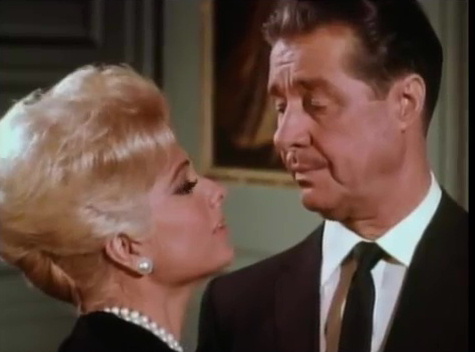
Martha Hyer and Don Ameche
PICTURE MOMMY DEAD (1966). Director: Bert I. Gordon.

Young Susan Shelley (Susan Gordon) gets out of a "convent" for the mentally disturbed three years after the death of her mother, Jessica (Zsa Zsa Gabor), in a fire in their mansion. Her father, Edward (Don Ameche), has been traveling the world with his new viper-like wife, the former governess, Francine (Martha Hyer), and now they are nearly broke. Another member of this highly dysfunctional household is Jessica's cousin, Anthony (Maxwell Reed), who was disfigured in the fire and will inherit money if both Edward and his daughter should happen to die, something which Francine is also happily aware of. But the murder victim may be more unexpected than you imagine. Picture Mommy Dead  -- one of a number of thrillers made by director Gordon, who had previously specialized in movies about giant people and monsters -- isn't that good, but it has a fairly interesting script that just misses the mark. A big problem with the picture is that Susan Gordon, the director's daughter, is too inexperienced (despite 25 previous credits!) to handle such a difficult and demanding role, although she gets an E for Effort. Zsa Zsa appears in a few flashbacks and isn't given anything too demanding to do, while Hyer plays her bitchy part with a little zest but little real skill. Ameche [Slightly French] comes off better, but Maxwell Reed of Daybreak is only somewhat effective. Wendell Corey delivers the goods in his one scene, playing a lawyer who is so tactlessly blunt with everyone that it's a wonder nobody murders him right then and there.

Verdict: Not terrible, but Gordon probably should not have cast his daughter. **1/2.

Thursday, October 26, 2017

EYE OF THE DEVIL

Deborah Kerr
EYE OF THE DEVIL (1966). Director: J. Lee Thompson.

Phillipe de Montfaucon (David Niven) lives in Paris with his wife, Catherine (Deborah Kerr), and their two beautiful children, Jacques (Robert Duncan) and Toni (Suky Appeby). Learning that there is a possibility that his vineyards back in his ancestral home of Bellenac may be failing, Phillipe returns there and tells Catherine to stay in Paris with the children. But Catherine misses her husband and brings the children to his side, where she discovers strange things are going on around the Castle Bellenac. Men in black robes gather in underground rooms and in the forest, and also hovering about are a strange brother and sister team, Christian (David Hemmings). who shoots doves with his bow and arrow, and Odile (Sharon Tate), who seems to have magical powers. Catherine eventually figures out exactly why her husband came back to Bellenac, but she may be too late to save him ... Eye of the Devil predates both The Wicker Man and Thomas Tryon's novel Harvest Home, both of which also deal with pagan sacrifice, but there's something a little off in this movie. Niven and Kerr, along with Edward Mulhare, Flora Robson, Donald Pleasence and little Robert Duncan all give good performances, but there doesn't seem to be much of an attempt to create real tension or a sense of encroaching dread until the admittedly effective climax. Two sequences when Jacques and then his mother nearly fall to their deaths from the castle roof are also taut. Sharon Tate [Valley of the Dolls] had appeared in one film and several TV shows before she was "introduced" in this movie, and she is perfectly cast and adept (if possibly dubbed) as the very strange and rather sinister Odile. Hemmings [Deep Red] has less to do but maintains the proper spooky attitude.

Verdict: Not entirely successful and slightly supernatural thriller. **1/2.

Thursday, September 14, 2017

JESSE JAMES MEETS FRANKENSTEIN'S DAUGHTER

Narda Onyx, John Lupton and Cal Bolder
JESSE JAMES MEETS FRANKENSTEIN'S DAUGHTER (1966). Director: William Beaudine.

"My, you're a humanitarian. You should have stayed in Europe and given pink pills to sweet old ladies." -- Maria to Rudolph.

Dr, Maria Frankenstein (Narda Onyx), daughter of Victor, and her befuddled brother, Rudolph (Steven Geray of Gilda), transplanted from Vienna, are experimenting on men in the old west, inexplicably trying to create a strong monster to do their bidding. Her latest victim is Hank Tracy (Cal Bolder), who is a friend of the infamous Jesse James (John Lupton). Juanita (Estrelita Rodriguez), a villager, believes that Maria murdered her brother, and in the process of helping Jesse and Hank, falls in love with the former. Meanwhile Marshall MacPhee (Jim Davis of Monster from Green Hell) is on the look-out for Jesse with the help of James' former associate, Lonny (Rayford Barnes). The surprising thing about this absurd but entertaining movie is how creditable the acting is, with Onyx doing her best to make her ridiculous character come alive, the talented Geray making an impression despite the fact that at times he appears to have wandered into the wrong movie, and baby-faced Lupton [The Man in the Net], outfitted with a mustache, coming off more like the title outlaw that one would have imagined. Rayford Barnes makes his mark as Lonny as well, but it's Estrelita who really makes an impression as Juanita, playing the whole bizarre scenario with conviction. William Fawcett and Nestor Paiva also have good supporting roles. Onyx mostly did television work; this was her last credit. This was also the last credit for "Estralita," who had appeared in Rio Bravo. Bolder frequently appeared as a heavy on The Man from U.N.C.L.E., and Barnes had nearly 300 credits. As "The Wild Bunch" is mentioned in this movie it's interesting that Barnes was later cast in Sam Peckinpah's movie The Wild Bunch. Veteran director Beaudine keeps things moving.

Verdict: Strangely absorbing if not terribly wonderful. **1/2.

Thursday, February 16, 2017

DAYS OF DARK SHADOWS

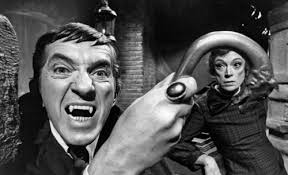
Jonathan Frid and Grayson Hakk
DAYS OF DARK SHADOWS.

This week we look at that venerable old Gothic,/horror soap opera, Dark Shadows (1966 - 1971), which kept many kids glued to their TV screens each weekday afternoon to watch the adventures of vampire Barnabas Collins (Jonathan Frid), the witch Angelique (Lara Parker), the weird Dr. Hoffman (Grayson Hall), those good gals Maggie Evans (Kathryn Leigh Scott) and Victoria Winters (Alexandra Moltke), the nice guys Joe Haskell (Joel Crothers) and Jeff Clark(Roger Davis), the ever-emotional Willie Loomis (John  Karlen), Professor Stokes (Thayer David), the Frankenstein-like Adam (Robert Rodan), werewolf Quentin (David Selby), and a host of others.

Dark Shadows, to be charitable, was pretty low-brow, and even schlocky at times. The series borrowed from everything from Jane Eyre to Wuthering Heights to Mary Shelley's Frankenstein to all the old Universal horror films starring Franky, Dracula, and the Wolfman. Not that there's anything wrong with that, for Dark Shadows often came up with intriguing variations on a theme, such as having a handsome Frankenstein monster instead of an ugly one. The 1790 storyline which told how Barnabas became a vampire certainly had fascinating elements, and there were other gripping adventures during the series' run.

And then there's the acting. With little rehearsal time, and difficultly memorizing lines, some actors relied too much on the TelePrompTer, with the result that all they could do was "indicate" a performance -- when you're too involved in just getting the right lines out, it's difficult to create convincing emotion in a character. Only when the cast really knew their lines was the acting more than adequate. Grayson Hall had her good moments, but she was more often awful on the show, splitting up her sentences ["there must -- be something -- we can do"] in ways that made little sense, or suggesting that she either was stalling to remember her lines or had breathing issues. Frid was quite effective when he clearly knew what the scene was about and what he was saying.

Joel Crothers
Humbert Allen Astredo, who played Nicholas and other characters, was one of the best and most professional actors on the show. Robert Rodan scored as Adam. And there were many others equally memorable. Kathryn Leigh Scott was always professional, as was Louis Edmonds. Alexandra Moltke did have the innocent quality that producer Dan Curtis was looking for, even if she wasn't necessarily a great actress. Handsome Don Briscoe was quite good in the roles of twin brothers, and was especially effective as the bad boy who turns into a werewolf. John Karlen handled everything the writers and Barnabas Collins threw at Willie and he always rose to the occasion. Joel Crothers was solid as stalwart Joe Haskell, who was Maggie's boyfriend until Angelique got her hooks -- and fangs -- into him.

This week we look at one of the most interesting story arcs on the show, "The Creation of Adam and Eve;" as well as the 1990 revival of the show; the film Night of Dark Shadows; a book on the series; and some special extras, Last, but not least, we look at season two of the Showtime series Penny Dreadful, because if it wasn't at least partially influenced by Dark Shadows, I'll eat my hat.

You can also click here to read about House of Dark Shadows and Tim Burton's dreadful big-screen adaptation of Dark Shadows.

Thursday, February 2, 2017

THE QUEENS

Raquel Welch and Jean Sorel
THE QUEENS (aka Le fate/1966.) Various directors.

This Italian anthology film dealing with comedic relationships between men and women has a large cast and different directors and features such weak screenplays it's a wonder it was even made. The first story is a silly concoction in which a man saves a strange woman (Monica Vitti of Modesty Blaise) from assault. The second is a weird, confusing trifle with a police officer dealing with an even stranger woman (Claudia Cardinale), who has an adorable baby, and lives in a very odd apartment overhanging a gallery thronging with people -- only there doesn't appear to be any wall, just a big open space over the gallery. The third story stars Jean Sorel [A View from the Bridge] and Raquel Welch [One Million Years B.C.] as neighbors who are married to others. Sorel wonders if his wife is carrying on with another man the way he is carrying on with Welch. This segment is the shortest and leads to nowhere, completely wasting the two sexy leads. The fourth story, which had possibilities, deals with a waiter, Giovanni (Alberto Sordi), who is importuned to sleep with a guest, a countess (Capucine), during a party. When he is hired as a chauffeur, his new employer's wife turns out to be ... the countess. She only recognizes and lusts after him when she's drunk. This segment has an especially flat ending. Vitti and Sordi give the most memorable performances.

Verdict: An intriguing idea betrayed by very poor and ill-conceived screenplays. *1/2.