Lively, entertaining reviews of, and essays on, old and newer films and everything relating to them, written by professional author William Schoell.
Showing posts with label Stanley Donen. Show all posts

Thursday, July 31, 2025

THE PAJAMA GAME

John Raitt and Doris Day
THE PAJAMA GAME (1957). Directed by George Abbott and Stanley Donen. 

Sid Sorokin (John  Raitt) gets a job in management at a pajama factory and almost immediately comes into romantic conflict with worker and union member Babe Williams (Doris Day). Although the two are clearly attracted to one another, Babe is sure that there will eventually be problems over their taking opposite sides in a struggle over a raise of seven and a half cents. Meanwhile Gladys (Carol Haney), who keeps the books, is exasperated by her boyfriend Vernon's (Eddie Foy Jr. of The Case of the Black Parrot) almost pathological jealousy. When the workers decide to have a slow-down on the job, things come to a head.  

Picture This: Foy and Shaw trip the Light Fantastic
The Pajama Game is based on the Broadway show with songs by Adler and Ross and choreography by Bob Fosse, which is transplanted to the screen along with much of the cast, such as Raitt. Doris Day replaced Janis Paige, but she is quite good, and handsome Raitt is so good -- and has such an outstanding voice -- that it's a wonder he didn't have more film assignments. Haney and Foy are also excellent, as is Reta Shaw, who does a delightful light-on-her-feet number with Foy ("Picture This"). Other musical highlights include Raitt singing the show's most memorable number, "Hey There;" the big production number at the picnic ("Once a Year Day"); and the smoky, insinuating "Hernando's Hideaway." Another well-known number from the show is "Steam Heat," which I confess I've never much cared for. 

John Raitt 
Thelma Pelish makes an impression as Mae, the economy-sized factory worker and wit who certainly stands out in (very) widescreen. Barbara Nichols [Woman Obsessed] as dumb Poopsie is her typical whiny self and even attempts to sing at times. The worst performance is from Ralph Dunn (of The Golden Eye) as boss Myron Hasler, who instead of  being amusing is merely loud and obnoxious, ruining virtually every scene that he's in. It also has to be noted that the secondary love story between Gladys and Vernon has its tiresome moments, especially the nonsense with the latter throwing knives at everyone in the office. Otherwise, Pajama Game is a likable, entertaining, if relatively slight musical comedy with several good scenes and songs. 

Verdict: Fun and tuneful musical with a spirited Day and a rather sexy Raitt. ***. 

Thursday, August 3, 2023

SATURN 3

Harvey Keitel, Kirk Douglas, Farrah Fawcett
SATURN 3 (1980). Director: Stanley Donen. 

Adam (Kirk Douglas) and his assistant and lover, Alex (Farrah Fawcett), work on Titan, a moon of Saturn, in an experimental food research station. One day along comes "Captain Benson "(Harvey Keitel), who has apparently murdered and taken the place of the real Captain Benson for unknown reasons. Benson also brings along with him a robot, Hector, that is linked to his own brain, follows his orders, and seems to lust for Alex just as he does. Obviously things are going to go wrong. Benson seems to think he has a right to sleep with Alex, suggests that Adam is over the hill, and sets about making trouble and being obnoxious. Then the robot begins to go berserk ... 

Hector goes after Alex
Saturn 3
 may or may not have been influenced by Alien, which came out the year before, but S3 suffers in comparison because the mechanical villain of the piece is nowhere nears as interesting as the monster in Alien. The film shows signs of much post-production tampering as well. The original director left and was replaced by Stanley Donen, of all people, hardly a Sci Fi specialist. Kirk Douglas is as charismatic as ever -- even showing off his naked butt (yet again!) -- while Fawcett Of All The Hair is acceptable but no more. It's impossible to judge Keitel's performance. He seems to be the best thing in the movie until you learn that producer Lew Grade didn't care for Keitel's Brooklyn accent and wanted the actor to redub his lines -- instead the lines were dubbed by Roy Dotrice, whose readings are excellent. 

Verdict: Some exciting scenes and interesting sets but relatively minor sci fi. **3/4. 

Thursday, June 28, 2018

SEVEN BRIDES FOR SEVEN BROTHERS

Jane Powell rules the roost: 7 brothers instead of dwarves
SEVEN BRIDES FOR SEVEN BROTHERS (1954). Director: Stanley Donen.

In the Oregon territory of 1850 rugged farmer Adam (Howard Keel) comes to town and is instantly smitten with a busy waitress named Milly (Jane Powell), and vice versa. The two get hitched and Milly discovers that she now has six brothers-in-law that she has to attend to. The crude brothers, who are taught manners by Milly, go a-courtin', but when things don't proceed as fast as they want, they resort to kidnapping potential brides upon the advice of Adam. Milly is outraged and orders the men into the barn while Adam goes off to a cabin to wait out the winter, unaware that Milly is pregnant ... Seven Brides has been denounced as misogynous in some quarters, but while some of the characters may be misogynous, I don't really think the film is. Sure, it's handy that the brothers all turn out to be gentlemen who never molest the ladies, and even handier that all of the women fall in love with the boys (it might have added some dramatic conflict if one or two of the gals had preferred their old boyfriends or just found none of the brothers appealing), but I don't believe any of this is meant to be taken seriously. In any case, the main thing about the vastly entertaining Seven Brides is not the plot but its sheer enthusiasm, its embrace of life, its excellent performances, and the wonderful singing and dancing throughout. Powell and Keel are perfection and they're nearly matched by the other players, including Ian Wolfe [Dressed to Kill] as Reverend Elcott; and Russ Tamblyn, Jeff Richards [Born Reckless] and the other brothers as well. (Ruta Lee -- billed as Ruta Kilmonis -- and Julie Newmar -- billed as Julie Newmeyer -- are two of the wives.) Seven Brides is also distinguished by the fact that it has one of the best scores for a movie musical that is not based on a Broadway show (although decades later Seven Brides was turned into a musical for the London stage). Johnny Mercer and Gene de Paul provided genuinely memorable tunes such as"Lonesome Polecat" "Sobbin' Women;" "Bless Your Beautiful Hide;" "When You're in Love;" and especially the beautiful "Wonderful Day" and infectious "Spring, Spring, Spring."  Wonderfully photographed in CinemaScope and Technicolor by George Folsey. The choreography is by Michael Kidd, who was also an actor [It's Always Fair Weather].

Verdict: Whatever its peculiarities, this is a top-flight musical. ***1/2. 

Thursday, June 7, 2018

FUNNY FACE

Sexless glamour: Audrey Hepburn (with Fred Astaire)
FUNNY FACE (1957). Director: Stanley Donen.

Fashion magazine editor Maggie Prescott (Kay Thompson of Manhattan Merry-Go-Round) and photographer Dick Avery (Fred Astaire) invade a Greenwich Village bookstore with a dumb model (hoping all the books will make her look intellectual) and a camera crew, overwhelming the bright if pretentious clerk, Jo Stockton (Audrey Hepburn). Later they get the idea of turning Jo into a high-fashion model where she will be the cornerstone of a campaign in Paris and help introduce designer Paul Duval's (Robert Flemying of The Horrible Dr. Hichcock) new line. Jo has always wanted to see Paris and meet her idol, Professor Emile Flostre (Michel Auclair), the founder of "empathacolism," who preaches empathy but would rather make time with Jo. Almost grudgingly, Dick and Jo fall in love while the others hope that she and the new collection will be a hit. Hepburn, who exudes her famous "sexless glamour" throughout the movie (even before she's made over), had starred in several films by this time, and she gives a superior performance, radiating charm, but her singing is for the birds and she was wisely dubbed by the time My Fair Lady came around. Astaire is Astaire, making everything seem effortless. One can only assume that Eve Arden wasn't available to essay the role of Maggie, because the casting of Kay Thompson -- even though the woman could sing and dance -- is perplexing. Thompson is by no means terrible, but she completely lacks the light tough, and hasn't an ounce of charm; indeed she's rather off-putting. Admittedly, you won't find many close ups in most wide screen productions of the era, but the camera wisely stays as far away from Thompson's face as it can. The songs consist of some Ira and George Gershwin classics and new tunes by producer Roger Edens and collaborators."Bonjour Paris" has Astaire, Hepburn and Thompson extolling the virtues of the great city. Hepburn and Thompson clown around for "How to Be Lovely;" and Astaire warbles the title tune, "He Loves and She Loves" and "S'Wonderful." Ray June's cinematography is first-rate and makes the most of Parisian locations, especially a pastoral forest where Hepburn and Astaire have a dance -- the film's highlight. Funny Face is good to look at and generally well-performed, but for some reason it just doesn't emerge as a real classic, and the script is trite and dated. The score is very jazzy, and at one point Astaire and Thompson (who reportedly did not enjoy working with Astaire) team up for a beatnik number that frankly, doesn't add much to the picture.

Verdict: Attractive fluff. **3/4.

ARABESQUE

Sophia Loren and Gregory Peck 
ARABESQUE (1966). Produced and directed by Stanley Donen.

"I'm sorry to have to tell you this, my dear, but Mr. Pollock is as poor as a church mouse." -- Beshraavi

"He was rather strange, even for an American."

Professor David Pollock (Gregory Peck) is drafted by an Arab Prime Minister, Hasson Jena (Carl Duering) to enter the home of the sinister Beshraavi (Alan Badel of Salome) and decode a cipher on a piece of paper with a Hittite inscription that my reveal the man's plans. The house is apparently owned by Yasmin Azir (Sophia Loren), Beshraavi's mistress, and to Pollock's befuddlement her role keeps changing even as she seems to switch sides with the drop of a hat. Before long he and Yasmin are on the run, dodging bullets and trying to get back the cipher so they can figure out what is happening. But David is never sure if he can fully trust Yasmin. Arabesque was Stanley Donen's follow-up to the more successful Charade, but the film's first big problem is the miscasting of the two leads. Peck tries to approximate but fails to deliver the light touch of a Cary Grant, and Loren is also a bit too heavy-handed, although she tries. Arabesque has a solid plot but the script has too many silly, indeed stupid, detours, and some of the action scenes are completely muffed by Donen, who is no Hitchcock. On the other hand, there is some exciting business near the end, including an attack on the principals at a construction site, an attempt to stop an assassination, and a race across a bridge while a helicopter is firing live ammunition at the couple. Another problem is that Alan Badel looks too much like Peter Sellers impersonating an Indian (which he did more than once in his career, such as in The Millionairess, which he did with Loren) and you keep expecting -- or hoping -- he will suddenly indulge in some hilarious shtick. No such luck. Henry Mancini's score does little to help. A much better thriller for Peck was Mirage.

Verdict: So so comedy-thriller with a few good sequences, but not nearly enough. **1/2.

Thursday, May 17, 2018

DANCING ON THE CEILING: STANLEY DONEN AND HIS MOVIES

DANCING ON THE CEILING: STANLEY DONEN AND HIS MOVIES. Stephen M. Silverman. Knopf; 1996.

From Broadway chorus boy to choreographer to director of several famous movies, Dancing on the Ceiling charts the course of Stanley Donen's Hollywood career with insight and admiration. Whether Silverman succeeds in making his case that Donen was one of the great directors, I'll leave to the individual viewer. Donen's romantic life follows an all-too-familiar course, with several failed marriages, including one to a woman nearly forty years his junior. Silverman briefly goes into these marriages but dispatches with them quickly, as he seems much more interested in Donen's career than his personal life, and as good as the book is, one might come away from the tome without ever really getting that much of a sense of Donen the person. However, the book certainly gives Donen his due as an important figure, detailing his triumphs and not skirting over his failures. Donen began co-directing with Gene Kelly on such films as On the Town, It's Always Fair Weather and Singin' in the Rainthen went strictly solo with such films as Royal Wedding, Funny Face and the excellent Damn Yankees. Later he became known as the "sophisticated" director of such films as Charade and Indiscreet. His misfires included the gay farce Staircase, Saturn 3, which he disavowed, and two movies with Yul Brynner, but he got some positive reaction to Two for the Road with Audrey Hepburn (with whom he worked several times) and Albert Finney. Written with Donen's cooperation, Dancing on the Ceiling is bolstered by many interviews with people who knew and worked with Donen, (although the device of quoting Betty Comden and Adolph Green as they affectionately discuss and disagree on several points eventually becomes tiresome).

Verdict: If this doesn't give you a new appreciation of Donen's work, nothing will. ***.

Thursday, April 26, 2018

SINGIN' IN THE RAIN

Gene Kelly and Debbie Reynolds
SINGIN' IN THE RAIN (1952). Directed by Stanley Donen and Gene Kelly.

Silent movie star Don Lockwood (Gene Kelly) has been teamed with Lina Lamont (Jean Hagen of Alexander: The Other Side of Dawn) in movie after movie. Don doesn't particularly like Lina, but she has not only convinced herself that they are in love but engaged. This comes to a head when Gene falls for Kathy (Debbie Reynolds of The Gazebo), who has "theatuh" aspirations but for now spends her time jumping out of cakes. When the first talkie, The Jazz Singer, becomes a tremendous hit, Don's studio insists his latest film with Lamont be turned into a sound picture. The only trouble is -- what to do about Lina's fish-wife screech, which is hardly suitable for sound? Paging Kathy ... but Lina isn't going to take the dubbing lying down, while Kathy is interested in her own career. Singin' in the Rain deservedly has a reputation as one of Hollywood's most memorable musicals with wonderful performances, nice tunes by Freed and Brown, a funny storyline, and a hilarious ending that gives the witchy Lina her full comeuppance. The highlights include Kelly and Donald O'Connor tap dancing to "Fit as a Fiddle;" Kelly, Reynolds and O'Connor performing "Good Mornin';".the "Broadway Melody" production number ("Gotta Dance") with Kelly and Cyd Charisse; and other numbers, such as "You Were Meant for Me," and "You Are My Lucky Star." Then there's Kelly's famous and iconic dance to the title tune. O'Connor's "Make 'Em Laugh" is cute if less successful, and others have noted that the song is very much like "Be a Clown," but I'm not certain which came first. Kathleen Freeman has a brief funny bit as a vocal coach who tries to help Lina talk like a human being, and Millard Mitchell [Thieves Highway] is solid as the studio head, R. F. Simpson.

Verdict: Really a delightful movie. ***1/2.

Thursday, March 8, 2018

IT'S ALWAYS FAIR WEATHER

Michael Kidd, Dan Dailey and Gene Kelly
IT'S ALWAYS FAIR WEATHER (1955). Directors: Stanley Donen; Gene Kelly.

Three men who were buddies in the army have many drinks at the end of the war and vow to meet in ten years' time at their favorite bar in Manhattan. Now, you might wonder, if they were such good friends, they would certainly have stayed in touch for the past decade, but apparently they haven't, so when they each keep the appointment they discover that they have little in common and don't even like each other very much (surely they could have talked about wartime experiences, at least?). Angie (Michael Kidd), who planned on becoming a great chef, is married, has several kids, and runs a hamburger joint in Schenectady. Doug (Dan Dailey of There's No Business Like Show Business), who'd wanted to become a famous artist, does work on TV shows that sell detergent, and is on the verge of divorce. Ted (Gene Kelly), who figured on a legal career, is now an unmarried manager for a boxer who is planning to take a dive. The ladies in the story include Jackie, (the gorgeous, leggy Cyd Charisse), who works on one of Ted's TV shows; and Madeline (Delores Gray), the star of said show. The gals hope to get the former soldiers on the program as a surprise, unaware that they now actively dislike each other. And some hoods who fixed the fight are out to get even with Ted.

Filmed in startling CinemaScope and color and photographed by Robert Bronner, It's Always Fair Weather presents a striking sound stage Manhattan that is prominently featured in two sequences: when the boys dance under the elevated subway, each wearing a garbage can lid on one foot; and when Kelly does an absolutely smashing dance on roller skates, and even winds up tap dancing while still wearing them ("I Like Myself"). Cyd Charisse [The Unfinished Dance] is featured in a production number in which she dances with flat-faced pugilists in a gym, and Delores Gray gets a chance to shine when she sings and dances to "Thanks, But No Thanks" with a dozen chorus boys. The songs were composed by Andre Previn [The Kissing Bandit] -- the lyrics were provided by Comden and Green -- and are pleasant enough, with "Friends Forever" emerging the prettiest number. The performances by the entire cast are excellent. Michael Kidd appeared in a few films, such as Smile, but was primarily a well-regarded choreographer [Seven Brides for Seven Brothers.]

Verdict: A small degree of pathos counteracts the silliness and Kelly's dancing is simply sensational. ***.

Thursday, April 6, 2017

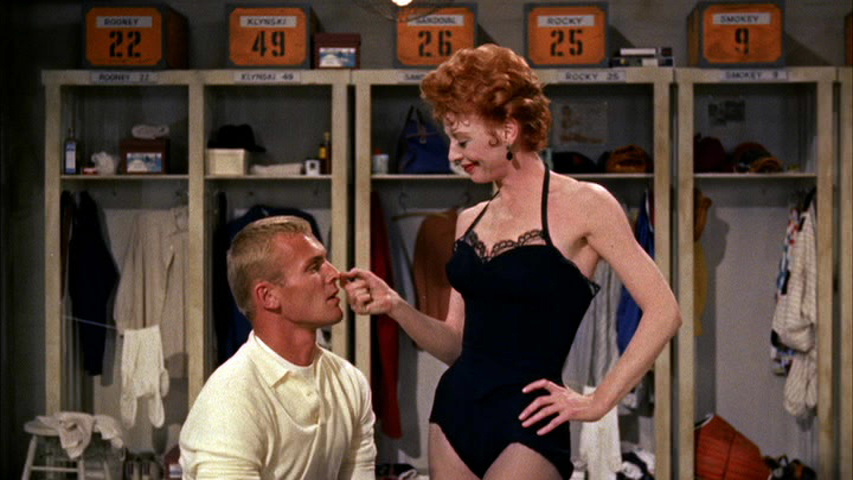
DAMN YANKEES

Whatever Lola Wants: Tab Hunter and Gwen Verdon
DAMN YANKEES (1958). Produced and directed by George Abbott and Stanley Donen.

"I was the ugliest woman in Providence, Rhode Island." -- Lola, remarking upon her origins

Joe Boyd (Robert Shafer) is a manic fan of the Washington Senators baseball team. The Devil -- in the form of a man named Applegate (Ray Walston) offers him a chance to become young and play for his favorite team against the "damned Yankees," even offering him an out. As "Joe Hardy" (Tab Hunter), Boyd becomes a star player with many fans, but he can't quite forget the wife, Meg (Shannon Bolin), he left behind. But will 172-year-old vamp Lola (Gwen Verdon) be able to keep Hardy in line? With its highly theatrical premise, this Broadway hit should not have worked as a movie but it does, mostly due to its performances and its recreation of some excellent production numbers. With the exception of Tab Hunter, most of the Broadway cast was transplanted to the big screen, a wise decision, especially in the case of Verdon. Although Verdon may not have been seen as a truly formidable sexpot, she is a highly talented performer with great dancing and acting skills and a really killer figure. Walston is as delightful as ever, and Hunter [Island of Desire] -- while not in the same class as the others -- does an okay job as the rather shy Hardy who wants to stay faithful to his wife. He briefly attempts some dancing as well and manages to pull it off. Rae Allen and Jean Stapleton [Dead Man's Folly], both of whom also appeared in the Broadway show, are snappy as, respectively, the inquiring reporter, Gloria Thorpe, and the likable neighbor, Sister Miller. Shafer and Bolin were primarily stage performers, and the former appeared in just this one picture. The score by Adler and Ross boasts some tunes that have become standards: "Whatever Lola Wants:" and the spirited "You Gotta Have Heart," but there's also Joe's nice farewell to his sleeping wife ("Goodbye Old Girl"); a snappy Mambo number; and the knock-out production number for Verdon and Hunter's "Two Lost Souls." Bob Fosse [Cabaret] did the choreography for both show and film; he and Verdon were married two years later. There's lots of dark humor and a poignant conclusion.

Verdict: One of the very best of the hit Broadway show film adaptations. ***1/2.

Thursday, June 30, 2016

ROYAL WEDDING

Fred Astaire and Jane Powell
ROYAL WEDDING (1951). Director: Stanley Donen.

"She's quiet, but deep. At least I hope she's deep or she's wasting a lot of her time being quiet." -- James Ashmond on his daughter, Anne.

Tom and Ellen Bowen (Fred Astaire and Jane Powell) are a brother and sister team of entertainers who take their latest show, "Every Night at Seven," to London just in time for the Royal Wedding. Although Ellen has been a bit of a playgirl, and Tom isn't marriage-minded, they both find themselves falling in love: Ellen with Lord Brindale (Peter Lawford); and Tom with pub owner's daughter and dancer, Anne (Sarah Churchill). But will respective marriages break up the act? Royal Wedding is a bit of MGM fluff but well turned out, with very good performances, some nice singing and dancing, and several highlights. For me it's Jane singing the beautiful romantic ballad "Too Late Now," although Astaire's dancing on his room's walls and ceiling is a close second. Then there's Astaire and Powell's rendition of the comical "How Could You Believe Me (When I Said I Love You)?" The songs are by Alan Jay Lerner and Burton Lane, and another memorable tune is "My Love," warbled beautifully by Powell. Sarah Churchill [He Found a Star] received a lot of bashing for her acting in this, but I think she's charmingly effective, and despite the somewhat mannish features that I've noted, quite lovely -- she was the daughter of Winston Churchill. Albert Sharpe scores in the role of Anne's father, James Ashmond, and Keenan Wynn is fine in dual roles of twin brothers, one for each side of the Atlantic. "I Left My Hat in Haiti" is a snappy production number.

NOTE: Beware which DVD firm you buy, rent or borrow this movie from. Westlake Entertainment offers one of the worst video transfers I've ever seen, with washed-out colors, whole scenes that seem cast in shadows, and so on. You expect this for cheap old B movies and TV shows, but a glossy MGM musical? Fortunately, there are other DVDs of this movie.

Verdict: Dancing on the ceiling indeed! *** out of 4.