Lively, entertaining reviews of, and essays on, old and newer films and everything relating to them, written by professional author William Schoell.
Showing posts with label Jennifer Jones. Show all posts

Thursday, February 20, 2020

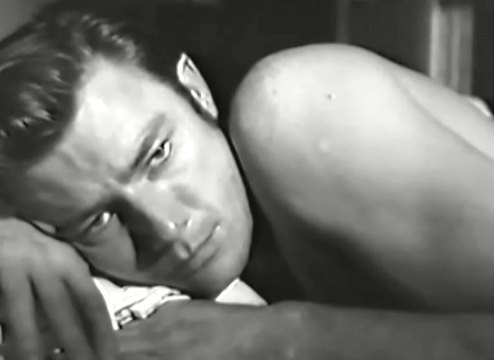
THE IDOL

Michael Parks as The Idol
THE IDOL (1966). Director: Daniel Petrie.

"To be idolized, a man must offer the unusual." -- ad copy.

Marco (Michael Parks) is an American studying art in London. He has a sort of girlfriend in Sarah (Jennifer Hilary) and a kind of best buddy in Timothy (John Leyton), and the three pal around a lot together. Marco is less impressed when he meets Timothy's mother, Carol (Jennifer Jones), also an American, who is divorcing her husband and about to remarry. Carol also seems to be slightly overbearing with Timothy. Marco seems to have a problem with parents and authority in general. When Marco is embarrassed by Carol at a house-warming party, he is furious, but Carol warms up to Marco when he comes to her son's rescue after two slobs try to beat him up. One New Year's Eve Marco goes to Carol's home to find Timothy, but he has already gone to a party with Sarah. At midnight Marco gives Carol a kiss and one thing leads to another -- with highly unfortunate repercussions ...

Jennifer Jones
There were many great British films made in the 1960's, but The Idol isn't one of them. Its screenplay is half-baked and its characters poorly developed   -- especially Marco, who has little reason for doing anything he does except that he's an asshole -- and the overlong film is also tedious. Made by an American studio, The Idol would still have been a poor movie, but at least it might have been more entertaining with the right trashy cast. Parks is better in this film than he is in Bus Riley's Back in Town, but Laurence Olivier might have had trouble with this character. Jennifer Jones has the good sense to look embarrassed through most of the movie, and her performance is one of her weakest. John Leyton, although he's way too old to convincingly play someone who's just nineteen, probably comes off best. Jennifer Hilary is adequate but she lacks the raw sex appeal of, say, an Ann-Margret -- or a Michael Parks -- so her love scenes with Parks aren't very exciting.

Parks, Leyton and Hilary
Some viewers claim that Carol has incestuous feelings for her son and/or vice versa, but if this was intended, it is not handled very well. Timothy seems to have a crush on Sarah, whom he pursues when he thinks Marco has broken off his relationship with her, but it may be just as likely that Marco is the true object of his sensual attentions. In the long run, none of this makes a difference, because it's impossible to care about any of these characters. One member of the large supporting cast who deserves kudos, however, is Rita Webb as the landlady at Marco's nifty apartment who repeatedly remarks about her tenants that "they're all a bit mental." One wonders what she would think of this motley crew?

Verdict: Lame attempts at pseudo-profundity don't help and neither does an ad campaign that promises more than it delivers. **.

Thursday, April 11, 2019

GOOD MORNING, MISS DOVE

Prune-face: Jennifer Jones as Miss Dove
GOOD-MORNING, MISS DOVE (1955). Director: Henry Koster.

55-year-old geography teacher Miss Dove (Jennifer Jones) has to go into the hospital for tests, and uses the time to reflect upon her life and her influence upon her students. Known as "the terrible Miss Dove" by certain townspeople, she is a rather grim and completely humorless, outwardly unemotional old maid, but despite her demeanor she can be kind to her pupils, especially a young boy named William who grows up to become a cop (Chuck Connors). Both her nurse (Peggy Knudsen) and doctor (Robert Stack) and his wife (Kipp Hamilton of War of the Gargantuas), as well as the town priest (Biff Elliot) are also former students.

Chuck Connors with Jones
There are several moving sequences in Good Morning, Miss Dove, but while I generally admire sentiment in old movies, this picture becomes a bit too unrealistic. With her unpleasant personality it's hard to believe that that many townspeople would care that much about this persnickety, disapproving and prune-faced spinster, giving this an ending that is pure Hollywood. Jones, who realistically ages from about twenty to middle-age, gives a very good performance, but there are huge gaps that fail to explain exactly why she's become the way she is. An early sequence shows her regretfully turning down a suitor's (Marshall Thompson) proposal as she has a family obligation that forces her to work and repay a debt, but we never learn why there were apparently no other suitors during her youth. There is also some bad sitcom-like nonsense about a student who grows up to become a petty crook and escapes from jail.

Priest and doctor: Biff Elliot and Robert Stack

In addition to Jones, most of the cast members (including some marvelous child actors) acquit themselves nicely, with Thompson notable in his one sequence with Jones, and there's also good work from Connors [South Sea Woman] , Stack, etc. and especially Peggy Knudsen [Hilda Crane] as the nurse Billie Jean, who had a child out of wedlock. Leigh Harline has contributed a pleasant and soapy score that is effective for the picture. Good Morning, Miss Dove is quite similar to the 1941 movie Cheers for Miss Bishop, which also examines a small town and the life of a teacher, but is a much, much better movie.

Verdict: Good night, Miss Dove. **1/2. 

Thursday, March 27, 2014

DUEL IN THE SUN

Jennifer Jones watches as horse gives Gregory Peck a kiss
DUEL IN THE SUN (1946). Director: King Vidor.

In post-Civil War Texas, the tempestuous "half-breed" Pearl (Jennifer Jones) comes to live with her aunt Laura (Lillian Gish) after the death of her father (Herbert Marshall), who was convicted of murdering her mother. Laura's husband, Senator McCanles (Lionel Barrymore) is an anti-Indian bigot who refuses to accept Pearl, and whose main occupation is keeping the railroad off of his property [leading to a tense confrontation between cowboys and train men halfway through the movie]. McCanles has two sons, the decent Jesse (Joseph Cotten) and the more unsavory Lewt (Gregory Peck). While Pearl falls in love with the kind Jesse, she can't fight her attraction to the sexy "bad boy," Lewt, creating a lot of problems, not to mention a highly perverse climax. Producer David Selznick was hoping for another Gone With the Wind when he made Duel in the Sun, but the film is almost forgotten. The acting in this entertaining "epic" is generally of the second-rate "Hollywood" variety across the board, but on that level it isn't bad. Jones [Love Letters] gives a good performance, although she looks almost ugly in some shots, and a miscast Peck [Mirage] does his best with a role he's really not suited for; neither Peck nor Jones are that good with transitions of mood, which occur frequently in their exchanges. Barrymore, Butterfly McQueen (who is great despite the patronizing attitude held toward her by both the other characters and the filmmakers), Charles Bickford (as one of Pearl's suitors), Otto Kruger, Charles Dingle as a sheriff, and Scott McKay as nasty Syd all make a favorable impression. Some beautiful cinematography from Lee Garmes and others. King Vidor also directed Beyond the Forest and the silent masterpiece The Crowd. Possibly the first of the "sex-westerns," as lust has a lot more to do with it than cow-punching.

Verdict: This could have been a lot better, but it certainly has its moments. ***.

Thursday, October 3, 2013

THE TOWERING INFERNO

THE TOWERING INFERNO (1974). Director: John Guillermin. Action scenes directed by producer Irwin Allen.

Warner Brothers and 20th Century Fox each had rights to two separate novels with the same theme: "The Tower" and "The Glass Inferno" both had to do with massive fires in high-rise buildings. The two studios cooperated on one film combining aspects of both stories, thus The Towering Inferno. During an inaugural party in the penthouse of the world's tallest building in San Francisco, a fire breaks out and gets worse and worse as firemen try to cope with the disaster. People are trapped in the Promenade room as other horrible incidents occur on the floors below. As some individuals try to make their way down to the ground far below, the others at the party enact a desperate scheme to save themselves and put out the fire at the same time. Everything is hampered and things made worse by the fact that against the architect's orders a man named Simmons (Richard Chamberlain), the builder's son-in-law, saved money by ignoring the fire codes and safety procedures.

Watching Inferno today with memories of 9/11 in your head makes for a distinctly uncomfortable experience. That being said, Allen has put together a suspenseful and often terrifying movie that grips you for its full length and never lets go. Among the more gut-wrenching scenes are the one where a group tries to get past a shattered, swinging metal staircase, and the horrifying business in the scenic elevator, during which Jennifer Jones' character plunges to a grotesque death. There are a very few moments of pathos in the movie, but most of it is tension and terror. Paul Newman is fine as the architect, an ordinary man, who watches his dream project collapsing and tries to save lives, although Steve McQueen is unemotional throughout as the fire chief. William Holden is the builder, Faye Dunaway is Newman's lover, Fred Astaire is an aging con man, Robert Vaughn is a senator, and Susan Blakely is Holden's daughter, and all are fine. John Williams' score helps sustain the tension. O. J. Simpson is also in the movie,, but that's a disaster of a different kind. Guillermin also directed The Whole Truth and the first terrible remake of King Kong.

Verdict: Not exactly a pleasant experience but certainly well done. ***1/2.

Thursday, August 29, 2013

MADAME BOVARY (1949)

Emma (Jones) wants a more exciting life and husband (Heflin)
MADAME BOVARY (1949). Director: Vincente Minelli.

"A man can change his life if he wants to ..."

Published in France in 1857, Gustave Flaubert's brilliant novel "Madame Bovary" was  accused of being an "outrage against public morals" and the author put on trial (and acquitted). This film version of the book begins with James Mason as Flaubert in the courtroom, explaining his creation, and then proceeding to [unnecessarily] narrate the early sequences of the movie. Farm girl Emma (Jennifer Jones) meets and falls in love -- or so she thinks -- with a simple, unambitious country doctor named Bovary (Van Heflin). But her day to day life is tedious and lacks color, and she realizes she is living with the wrong man, kind but dull. Her need for passion and excitement is even more energized when the couple are invited to a ball at the home of the Marquis D'Andervilliers (Paul Cavanagh) and she sees how wealthy people live and realizes how many men find her attractive. Guilt-wracked and initially resistant, she is drawn into affairs with Rodolphe Boulanger (Louis Jourdan), who shatters her, and later a young lawyer named Leon (Christopher Kent, who later became the director, Alf Kjellin). Meanwhile her taste for the finer things in life means that her debts are adding up alarmingly, but it may be her husband who has to pay the piper. Emma isn't evil, but her dissatisfaction with her life with Bovary makes her susceptible to, shall we say, outside stimuli. Madame Bovary is pretty faithful to the novel, despite a couple of changes. In the book Dr. Bovary is pressured to operate on the clubfooted Hippolyte (Harry Morgan, herein known as Henry) with almost tragic results, while in the film he wisely realizes that he hasn't the skill of a surgeon, making him somewhat more sympathetic. The more licentious scenes of the novel, such as Emma and Leon driving all around town in a carriage obviously having sex in the back behind lowered blinds, have been jettisoned. Although Madame Bovary could have been better cast -- Heflin never comes off as that dull or unattractive and Jones isn't the perfect Emma, although Jourdan is fine -- the actors are still quite good, including those of the large supporting cast, which includes George Zucco as Leon's boss; Gladys Cooper as his mother; Ellen Corby as the maid, Felicite; Mason as Flaubert; and especially Frank Allenby as the slimy salesman, Lhereux. The film is well directed by Minelli and has a nice score by Miklos Rozsa. Kjellin/Kent later appeared in Ice Station Zebra and directed the telefilm Deadly Dream.

Verdict: Certainly not the masterpiece that the novel is, but on it's own terms vivid and entertaining, with Jones in very good form. ***.
Thursday, January 17, 2013

LOVE LETTERS

Jennifer Jones, Joseph Cotten and Cecil Kellaway
LOVE LETTERS (1945). Director: William Dieterle.

"Most people aren't happy. They wait all their lives for something to happen to them."

"Women must understand that the returned soldier is not the man she knew and loved before he went away."

Allen Quinton (Joseph Cotten) does a favor for a callow Army buddy, Roger (Robert Sully), by writing love letters to the latter's girl back home, a woman named Victoria. Allen is disturbed because he fears when Victoria marries Roger, she'll be thinking he's an entirely different sort of man because of the letters. Years later Allen hears that Roger was killed by his wife during an argument, and is told that she, too, is dead. But is she? Allen meets a mysterious woman who goes by the one-word name "Singleton" (Jennifer Jones) at a party and at first barely notices her. But who is she really? And will the truth of her identity drive her to a nervous breakdown? Love Letters may sound intriguing, but be warned that it's a deadly bore, very slowly paced as if everyone concerned thought they were summoning up something deeply profound here. There were certainly possibilities in the premise, but Ayn Rand's un-cinematic screenplay fritters them all away with much talk and some truly suspect developments that make little sense -- it's almost as if she was writing a parody of a romantic film! Cotten is excellent, as usual; Jones has to deal with playing a very irritating character [but she received an undeserved Oscar nomination  anyway]; and Cecil Kellaway and Gladys Cooper (in a truly thankless part) are as wonderful as ever. But this is a misfire that even a pleasant score and some good dialogue can't save. File this under "Bad Hollywood Amnesia Movies."

Verdict: Leave "Singleton" to herself! **.

Thursday, November 3, 2011

DICK TRACY'S G-MEN

Phyllis Isley [Jennifer Jones] and Ralph Byrd
DICK TRACY'S G-MEN (15 chapter Republic serial/1939). Directors: John English; William Witney.

Criminal genius Zarnoff (Irving Pichel) manages to escape execution, and for 15 chapters matches wits, guns and devious plots with his nemesis, Dick Tracy (Ralph Byrd). Tracy gets out of many of his predicaments in a clever and realistic fashion. The more memorable of these predicaments include a death trap in chapter two; a crane dropping tons of lumber on Dick in chapter seven; a horrifying dirigible fire in chapter nine; and a room with a fiery dynamo in chapter ten. The climax with Tracy and Zarnoff squaring off in the desert is also memorable. Plenty of fisticuffs and a good use of pre-existing locations. Zarnoff tries to sell plans to a foreign power as well as steal a new explosive formula. If there is any problem with the serial it's that Pichel is rather colorless as the villain. Phyllis Isley plays Tracey's secretary and has little to do. There is absolutely nothing about her that would suggest she'd become a major star under the name Jennifer Jones. Not quite as good as Dick Tracy vs Crime Inc.

Verdict: More fun from Republic studios. ***.

Thursday, August 27, 2009

CARRIE (1952)


CARRIE (1952). Director: William Wyler.

"When you're poor it gets all mixed up; you like the people who are good to you."

Carrie Meeber (Jennifer Jones) says goodbye to her family and takes the train to Chicago, where she hopes to find a better life. What she finds is one man, Charles (Eddie Albert), who takes care of her but is slow to offer marriage, and another man, George (Laurence Olivier), a restaurant manager, who wants to marry her but already has a wife (Miriam Hopkins). Still, he takes steps to have Carrie for his own, leading inexorably to bitter disillusionment and tragedy. This is not a mere soap opera but a fascinating, mesmerizing drama with superb performances from all. Olivier's portrait of the manager who gives up everything for passion is brilliant and haunting. Jones gives one of her all-time best performances, right up there with Olivier from start to finish. David Raksin offers an interesting score, while Wyler's direction is as assured and compelling as ever. From the chilling early scenes showing Carrie at work in a dehumanizing sweatbox to the final devastating, deeply affecting moments, this is pure gold.

Verdict: Powerful adaptation of Drieser's Sister Carrie. ****.