Lively, entertaining reviews of, and essays on, old and newer films and everything relating to them, written by professional author William Schoell.
Showing posts with label Eleanor Parker. Show all posts

Thursday, March 26, 2026

RETURN TO PEYTON PLACE

RETURN TO PEYTON PLACE
(1961). Director: Jose Ferrer.

In this sequel to Peyton Place, Allison MacKenzie (now played by Carol Lynley) goes to New York with her roman a clef manuscript about the town she grew up in, and falls for her handsome married publisher (Jeff Chandler). Her mother Constance is now married to Mike Rossi (these two are now played by Eleanor Parker and Robert Sterling of Topper TV series fame), and while mama is appalled, Mike wants to place the book in the school library. Selena (now played by Tuesday Weld) is mortified that Allison chose to write about her rape and subsequent trial in her novel, and Roberta Carter (Mary Astor) is outraged that the principal wants to put his step-daughter's filthy book in the library where anyone could read it. 

Mary Astor, Brett Halsey, Luciana Paluzzi
Brett Halsey is Roberta's son Ted, who shows up with a new wife (Luciana Paluzzi, who later did Thunderball) in tow. Meanwhile Selena meets a guy named Nils (Gunnar Hellstrom). (They ignore the fact that Selena and Ted were not just friends but were once engaged). The acting is good and there are a few surprises. Although few would argue that Eleanor Parker was a more talented actress than Lana Turner (despite the latter's fine stint in A Life of Her Own), Turner was actually more suitable for the role of Constance Mackenzie (and it doesn't help that Parker is doing one of her "actressy" turns). Brett Halsey comes off better than usual. It's absolutely no surprise, however, that the whole movie is positively stolen by the superb performance of Mary Astor, who gives the entire cast and everyone who sees the film a lesson in sharp and superlative thesping.

Verdict: A pleasant return to old Sin City. ***.

Thursday, November 11, 2021

THE OSCAR

THE OSCAR
(1966). Director: Russell Rouse.

Frankie Fane (Stephen Boyd) is a low-level garment worker who sort of falls into acting because he "impresses" a lady talent scout named Sophie (Eleanor Parker). Sophie gets him a top agent in "Kappy" Kapstetter (Milton Berle), who manages to convince studio head Kenneth Regan (Joseph Cotten) to sign him to a contract even though Regan senses something off about the guy. Fane becomes a star, but keeps biting the hand that feeds him -- even though some of his remarks to those who helped him have a point. When his career starts slipping badly, he has nightmares of going back to being nobody, and hitches upon a desperate plan to nab an Oscar and put himself back on top. The Oscar does show how undeserving louts can become movie stars simply because somebody has the hots for them -- which has happened more often than anyone imagines. The movie might have had more bite had Fane been someone desperately committed to the art of acting, but this can't be confused with the far superior Career -- it's basically entertaining trash with mostly one-dimensional characters and often hokey dialogue -- and not a few tedious moments. Once Fane begins to slide, however, the pic picks up. The fact is that the narcissistic, ambitious, self-absorbed Fane is all too typical of most Hollywood actors.

Elke Sommer and Boyd
Although miscast as some low-bred tough guy, Boyd is not at all bad as Fane, and has his best moment at the very end of the movie (you almost feel sorry for him). As his pal and procurer, Hymie, Tony Bennett seems amateurish until he has some powerful moments at the climax. Jill St. John gives it a good try, but she hasn't the real acting chops to make the most of her scenes as the girlfriend Fane stole from Hymie. Elke Sommer is okay as Kay Bergdahl, a designer Fane makes a play for and eventually marries, and Berle is at least flavorful as Kappy. Eleanor Parker gives the sauciest performance as Sophie, and makes St. John and Sommer look like a couple of kittens in comparison. But Edie Adams and Ernest Borgnine almost walk off with the movie as a husband and wife who are celebrating their divorce in Mexico when they encounter Fane and Kay and re-enter their lives in an unexpected fashion. Peter Lawford has a small but significant scene where he plays a once-famous actor who is now a headwaiter at a Hollywood restaurant; Lawford is excellent and this is probably the best scene in the movie. There are some celebrity cameos and Hedda Hopper as well. One of the screenwriters was Harlan Elison, who became better known as a science fiction writer.

Verdict: Not exactly Eugene O'Neill but fun. ***.

Thursday, April 20, 2017

THREE SECRETS

Eleanor Parker and Patricia Neal
THREE SECRETS (1950). Director: Robert Wise.

"Is he going to be surprised! You know what his grounds [for divorce] were? He said I wasn't a woman!" -- Phyllis, on learning that she's pregnant.

A plane crashes on a mountain and the only survivor is a little boy. As rescue workers prepare for the dangerous two mile ascent, three women arrive on the scene, all of them wondering if the child is the one they gave up for adoption. The little boy was born on the same day as their child, and came from the same orphanage. Susan (Eleanor Parker) is afraid her marriage may not survive if her husband (Leif Ericson) learns she had a child out of wedlock. Phyllis (Patricia Neal) was a war correspondent whose husband (Frank Lovejoy) left her because she was never home and wouldn't conform to being a traditional wife; she learns she is pregnant after he remarries. Ann (Ruth Roman) gave birth to a boy fathered by a conscienceless wealthy man who paid the ultimate price for his callousness. Three Secrets concentrates on the emotional turmoil of the women's lives and not on the harrowing details of the rescue of the boy, which would have been a completely different picture. The three leading ladies all give fine performances, with Parker and Neal being especially notable. Katherine Warren is also good as Susan's mother, and Kenneth Tobey appears briefly as an army officer who catches Susan with her soldier boyfriend (Arthur Franz). The film's premise is contrived but irresistible, but some of it has to be taken with a grain of salt. An orphanage might acquire three baby boys on the same day in a big city, but all three women basically arrive there at the same time, and how likely is it that Phyllis will remember Susan, who she barely speaks to, five years later, reporter or no. But these are minor concerns: the picture plays beautifully, is very well-acted and well-directed, and has a very moving conclusion. David Buttolph's score disconcertingly reworks the melody of "I Get a Kick Out of You." Although it's been unfairly compared to it, this is completely different from A Letter to Three Wives. This was remade for television in 1999.

Verdict: Oh a higher plateau than the usual soap opera. ***1/2.

Thursday, August 11, 2016

CAGED

Formidable Hope Emerson towers over the tough Betty Garde
CAGED (1950). Director: John Cromwell.

'If it weren't for men, we wouldn't be in here."

"If you stay in here too long, you don't think of guys at all -- you just get out of the habit."

A 19-year-old named Marie (Eleanor Parker), who may or may not have participated in an armed robbery with her now-dead husband, is sent up the river for one to fifteen. While having her baby, Marie is introduced to a motley crew of pretty tough career criminals of the female gender: Kitty Stark (Betty Garde), who wants to get Marie into the rackets; Elvira Powell (Lee Patrick), the super-hard queen of vice; June (Olive Deering), who is desperate to get paroled; Georgia (Gertrude Michael), who thinks she comes from society and is losing her mind; elderly Millie (Gertrude Hoffman) a lifer who'll think nothing of taking out a hated matron if she has to; spacey Emma (Ellen Corby) who finally murdered her husband after four previous attempts;  and others. Speaking of matrons, we have the relatively kindly head of the isolation ward, played by Jane Darwell, and the fat, sadistic and highly formidable Harper, played by Hope Emerson. Harper and Kitty are, in particular, major antagonists and sooner or later something will blow ... Caged has been dismissed in some quarters as camp (sometimes because of the not very subtle lesbian inferences), which is completely unfair, as the movie is a powerful, completely absorbing drama with excellent performances and one compelling scene after another: a disappointed inmates' suicide; the jailhouse riot over a kitten; the physical and psychological battles between Harper and Stark; and the compassionate warden, Ruth Benton (Agnes Moorehead), having to deal with the infuriatingly disinterested and misogynous parole board and other dumb-headed politicians. Caged doesn't say that most of these women don't belong where they are, only that their imprisonment is punishment enough and abusive behavior among the matrons should be prohibited. Parker, who was nominated for a Best Actress Oscar and should have won, is superb, as are Hope Emerson (nominated for Best Supporting Actress) and Betty Garde; and there is notable work from Moorehead and hard-boiled Patrick, as well as Taylor Holmes as clueless Senator Donnelly. John Cromwell's direction helps give the film a major dramatic punch after 66 years, and Max Steiner's score is subdued but effective. Caged engendered several inferior imitations -- Women's Prison, Blonde Bait, House of Women, a nominal remake with absurd situations not in the original, Betrayed Women -- and practically created a new sub-genre still going today. However realistic Caged may or may not be regarding conditions in women's prisons then or now, the story still packs a wallop.

Verdict: Perhaps Parker's finest hour -- as well as Emerson's and Garde's. ****.

Thursday, August 13, 2015

THE MAN FROM U.N.C.L.E. Season 4

The Fiery Angel: Madylyn Rhue
THE MAN FROM U.N.C.L.E. Season Four. 1967.

  
Seventh Wonder: Eleanor Parker
Toning down some of the more absurd situations and comedy of season three episodes, Uncle's truncated fourth and final season was a big improvement. Virtually every episode was well-worth watching and a few were outstanding. "J for Judas" featured Broderick Crawford and Chad Everett in a tale of THRUSH wanting to take over a business run by a combative father and son. The episode was serious, well-acted and well-done. "Test Tube Killer" starred Christopher Jones as a top THRUSH specimen sent to wipe out an entire Greek village. Jack Lord and Nehemiah Persoff try to outwit one another in a THRUSH battle of power in "Master's Touch." Michael Rennie tries to brainwash and/or murder people in his exclusive, private casino in the "THRUSH Roulette Affair." In "The Fiery Angel" an excellent Madlyn Rhue plays a besieged but feisty and independent Democratic lady president of Querida. A THRUSH double agent causes mayhem at the UNCLE "Survival School" with Richard Beymer and Charles McGraw. Will Kuluva and George Macready guest-star in a story in which THRUSH wants to work with two old Nazis. THRUSH wants a deadly molecular gun invented by scientist William Marshall in the clever "Maze Affair." In the two-part "Seven Wonders of the World" -- the series' final episode -- Barry  Sullivan plays a scientist who hopes to create peace with a docility gas, but doesn't realize that his faithless wife (Eleanor Parker) is working with THRUSH.

    The Man from U.N.C.L.E.  again became a very worthwhile show in its forth year, but alas, the damage had been done and it was canceled halfway through the season. It was followed by the telefilm The Return of the Man from U.N.C.L.E.and the new theatrical film many years later.

Verdict: Highly entertaining spy series. ***.

Thursday, July 23, 2015

DETECTIVE STORY

Kirk Douglas and Eleanor Parker
DETECTIVE STORY (1951). Director: William Wyler.

24 hours in a police precinct focusing on Detective James McLeod (Kirk Douglas) and his efforts to bring down Karl Schneider (George Macready), who helps bring unwanted babies into the world so he can sell them [in the play, Schneider was a simple abortionist]. McLeod seems so crazy to get this guy that his superior, Lt. Monaghan (Horace McMahon), wonders if there's some personal connection to the case, and in an ironic development, discovers that there is -- and it concerns McLeod's wife, Mary (Eleanor Parker). Will these revelations bring about the too-rigid McLeod's ruination? Detective Story is an absorbing and often powerful movie and features some fine performances from Douglas, Macready, McMahon [Quick Millions], and especially the wonderful William Bendix as McLeod's colleague, Brody. Lee Grant [Damian: Omen 2], in her first film, is fine as a likable if bewildered shoplifter; Craig Hill scores as an embezzler in love with the wrong woman; and Cathy O'Donnell offers a sensitive portrayal of another woman who's in love with Hill. There are also some flavorful short appearances by Gladys George [Flamingo Road] and Gerald Mohr; Joseph Wiseman, only in his second film, is perhaps less effective. Eleanor Parker, possibly miscast to begin with, is a bit too showy and mannered at times, although she has her moments. In general, Wyler's assured direction gets the most out of the story and characters and the film holds the attention throughout. O'Donnell and Mohr appeared together in Terror in the Haunted House.

Verdict: Another very fine Wyler feature. ***1/2.

Thursday, February 26, 2015

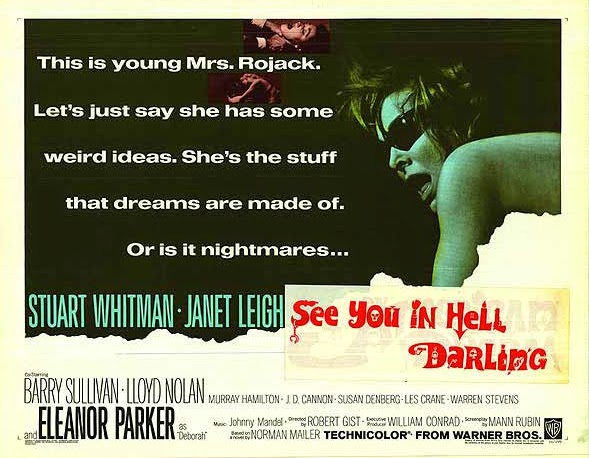
AN AMERICAN DREAM aka SEE YOU IN HELL DARLING

AN AMERICAN DREAM (aka See You In Hell Darling/1966). Director: Robert Gist.

When TV host Stephen Rojack (Stuart Whitman) pays a call on estranged wife, Deborah (Eleanor Parker), the vicious, drunken woman winds up falling off her balcony to her death. Rojack, grilled by police, does the sensible thing after his wife has just died and shacks up with old gal pal, Cherry (Janet Leigh). Rojack's father-in-law (Lloyd Nolan) contemplates pushing Stephen off of a balcony, and detectives Barry Sullivan and J. D. Cannon act like they'd like to tear his throat out. And we mustn't forget the whole host of mafia boys headed by Eddie Ganucci (Joe De Santis) and Johnny Dell (Warren Stevens) who have their own beef with Rojack. Whitman isn't bad, Parker [Lizzie] is vivid, Leigh plays it all in the key of bitter, Nolan is, frankly, terrible, Cannon over-acts in stock TV fashion, and Sullivan [Suspense] isn't much better. There are some interesting elements to An American Dream -- which is very loosely based on a novel by Norman Mailer -- but the movie is pretty much a melodramatic and at times even laughable mess. Acrophobes in the audience may have a few tense moments. Richard Derr has a bit as a producer while Murray Hamilton has a little more to do as an associate of Stephen's. Harold Gould and George Takei also have bits as lawyers. Whitman and Leigh appeared together in the monster bunny movie Night of the Lepus, which was actually a lot more entertaining than this.

Verdict: Everyone seems to be yelling -- or simmering -- to little effect. **.

Thursday, July 17, 2014

A MILLIONAIRE FOR CHRISTY

Fred MacMurray
A MILLIONAIRE FOR CHRISTY (1951). Director: George Marshall.

Lawyer J. C. Thompson (Douglass Dumbrille) dispatches his secretary, Christy (Eleanor Parker) to tell radio personality Peter Lockwood (Fred MacMurray) that he's inherited two million dollars, but not before she's importuned by Patsy (Una Merkle) to go after the guy and get herself a wealthy husband. The trouble is that Peter is just about to get married to fiancee June (Kay Buckley), and neither he nor anyone else believes Christy about the money. Peter's rival, Dr. Roland Cook (Richard Carlson of All I Desire) thinks Christy is a mental case who needs his help -- and so on. A Millionaire for Christy is frenetic but absolutely and completely laughless -- you sit there and watch this, utterly stupefied, helplessly observing McMurray and Parker [Lizzie] struggling to bring life to an utterly hopeless script. Dumbrille [Alimony] is completely wasted. Nestor Paiva has a small role.

Verdict: Not even Fred can save this one. Atrocious. *.

Thursday, February 27, 2014

LIZZIE

Eleanor Parker and Richard Boone
LIZZIE (1957). Director: Hugo Haas.

Elizabeth (Eleanor Parker of Home for the Holidays) is a timid soul who works in a museum and receives threatening notes from someone named "Lizzie." Then Elizabeth begins hitting the bars at night, wearing sexy clothing and make-up, and affecting a lascivious attitude. A helpful neighbor, Walter (Haas), who is friends with Elizabeth's slatternly Aunt Morgan (Jane Blondell of Advance to the Rear), with whom she lives, suggests she see a psychiatrist named Neal (Richard Boone). Neal is able to determine that Elizabeth has three distinct personalities, but which one will emerge as the dominant one? I'm not certain how Eleanor Parker wound up in this B movie knock-off of The Three Faces of Eve (also released in 1957), but she gives a good performance, and the rest of the cast are all solid. Lizzie equates sexuality with "evil" in some ways, and Parker's least convincing moments are when she turns into a nostril-flaring decadent "Lizzie," eschewing a less subtle way of making each personality distinct. But it works for this movie, which is professionally done but kind of cheap and depressing. Marion Ross and John Reach each make an impression as, respectively, Elizabeth's co-worker and a man she dates as Lizzie. Johnny Mathis also makes an impression playing a pianist/singer in a saloon; he has no dialogue. As an actor, Haas also appeared in Summer Storm and others.

Verdict: Entertaining enough but lurid and unpleasant. **1/2.

Thursday, June 13, 2013

HOME FOR THE HOLIDAYS

Haworth, Walter and Parker camp it up


HOME FOR THE HOLIDAYS (1972 telefilm). Director: John Llewellyn Moxey.

Okay, get this. An old man lives alone in a mansion with his second wife, who was once accused of poisoning her first husband. Now the old man is convinced his wife is trying to poison him, and he's asked his four daughters to come home for Christmas to help him. However, he has been estranged from his daughters for years because most of them think he is responsible for their mother's suicide due to his affair with wife # 2. Then the murders begin ... Now add to that great premise the fact that the old man is Walter Brennan, his second wife is Julie Harris, and the daughters are played by Eleanor Parker (old faithful), Sally Field (li'l adorable), Jill Haworth (sharp-tongued sophisticate) and Jessica Walter (pill-popping dipsomaniac) -- and that the script is by Joseph Stefano, who wrote the screenplay for Hitchcock's Psycho -- and you've got an ABC "Movie of the Week" to reckon with! Frankly, with all that talent one would have hoped that Home for the Holidays would have been a lot more memorable, but it is an engaging and well-acted [by all] bit of grotesquerie that holds the attention and has a certain degree of atmosphere [of the "it was a dark and stormy night" variety]. George Tipton contributed an interesting score. One of the actors, however talented, sort of gives the game away with an overly, shall we say,  dynamic performance, but the ending will still be a surprise to some. John Fink plays the cute doctor who lives in town and knows all the women.

Verdict: And you think your family holidays are bad ...! **1/2.

Saturday, March 29, 2008

VALENTINO (1951)


VALENTINO (1951). Director: Lewis Allen.

Mostly fictionalized biography of the great silent star Rudolph Valentino, played here by Anthony Dexter, who looks quite a bit like Rudy and gives an excellent performance as well. Valentino meets famous actress Joan Carlisle (Eleanor Parker) and through her and her director Bill King (Richard Carlson) finds himself in the movies. [Carlisle and King are supposed to be director Rex Ingram and his actress wife Alice Terry, who appeared on-screen with Valentino.] Valentino romances several ladies, including Joan, who's reluctant to get involved with the Latin lover boy because he has serious commitment problems. Instead Joan marries King, and finds herself in an uncomfortable position when she's teamed with Rudy, whom she's still attracted to, in a movie. By focusing on this triangle, the movie completely avoids all the true drama of the essentially homosexual Valentino's life and career and becomes a little tedious. The production isn't first-rate, either. The capable supporting cast includes Lloyd Gough as a nosy reporter Eddie, Otto Kruger as a producer, Patricia Medina as an actress Valentino nearly marries, and Dona Drake in another fiery role as Valentino's dance partner, boss, and lover early in the picture. [Drake was memorable as Bette Davis' slovenly maid in Beyond the Forest.]
Because Valentino wasn't successful despite his fine performance, Anthony Dexter later wound up in such films as Fire Maidens of Outer Space.

Verdict: A bit colorful but not enough. **.
For the real story of Valentino's life, click here to read an article by Lawrence J. Quirk and to see many photos of Valentino and his films.

Sunday, January 13, 2008

BETWEEN TWO WORLDS

Paul Henreid
BETWEEN TWO WORLDS (1944). Director Edward A. Blatt.

Long and rather tedious remake of Outward Bound has a couple who committed suicide (Eleanor Parker; Paul Henreid) finding themselves aboard a passenger ship heading toward eternity – only the other passengers don't realize that they themselves are also dead. Thought-provoking premise is given half-baked, overly literal and preachy treatment, and the many stilted performances don't help. Aside from an excellent speech at the very end of the film, John Garfield is in no way showcased to advantage in the film, playing it all in one note and revealing little of his character's inner torment. His girlfriend in the film, Faye Emerson, doesn't even appear to be an actress (although she plays one); she has some nice moments, again at the conclusion, but is otherwise astonishingly inept. However, Edmund Gwenn is splendid as the chief steward, and Sara Allgood scores, as usual, as a kindly older lady. Henreid gives one of his more memorable performances, and Parker is superb. By the time Sydney Greenstreet shows up as the “examiner” to determine exactly which place the passengers go -- Heaven or Hell – the movie just implodes.

Verdict: Have a nice nap instead. *1/2.

Monday, January 7, 2008

VALLEY OF THE KINGS


VALLEY OF THE KINGS (1954). Director: Robert Pirosh.

In Cairo in 1900 archaeologist Robert Taylor teams up with Eleanor Parker to find the tomb of Rahotep so that Parker can prove her late father's theories. Kurt Kaznar, as the sinister, knife-wielding Ahmed, is in league with Parker's slick husband, “Philip Mercedes,” a tomb-robber. In addition to some beautiful scenic vistas and good photography, the picture features scuttling scorpions under the bedsheets, a spectacular sand storm that seems to wipe away half of the cast, and a fist fight between Taylor and Parker's husband high on top of a majestic sphinx that ends, naturally enough, with a fatal fall. This last sequence is completely silent – except for grunts and punches – and could have used some musical background. There's also a growling, bad-tempered camel for good measure. The picture is by no means a classic, but it holds the attention and has some very good sequences. Taylor handles the derring-do nicely enough, and Parker is generally fine, although a bit wasted in this kind of material.
Verdict: Not bad timepasser. **12.