Lively, entertaining reviews of, and essays on, old and newer films and everything relating to them, written by professional author William Schoell.
Showing posts with label Walter Matthau. Show all posts

Thursday, October 1, 2020

THE FORTUNE COOKIE


THE FORTUNE COOKIE (1966). Produced and directed by Billy Wilder.   

When cameraman Harry Hinkle (Jack Lemmon) is knocked over by Cleveland Braves player Boom Boom Jackson (Ron Rich) during a football game, his brother-in-law, Whiplash Willie (Walter Matthau), importunes him to pretend his injuries are far worse than they really are for a huge cash payout. At first Harry is appalled by the very suggestion, but when Willie intimates that Harry's ex-wife, Sandy (Judi West), may come back to him out of sympathy, he agrees. Meanwhile a very guilty Boom Boom, who practically becomes Harry's servant, finds his own life spiraling out of control. Yet Harry's essential humanity may put paid to Willie's audacious and avaricious plan.

The Fortune Cookie is an excellent comedy-drama which begins as an amusing dark farce and midway turns a bit more serious. The performances are superb, with Matthau master of all he surveys, Lemmon on target throughout, Ron Rich sympathetic and appealing, and Judi West, introduced in this picture, scoring as Harry's ex, a singer who dreams of a shot at the big time in New York's Persian Room. Cliff Osmond also makes an impression as private eye, Purkey, although Lurene Tuttle overdoes it a bit as Harry's hysterical mother. There are other good character actors in the cast such as Les Tremayne. Although highly exaggerated, the characters come off more or less as real people, although many of the situations are not realistic and are not meant to be. I won't give anything away, but the ending strikes a blow for Civil Rights in a way that is unusual for a sixties movie (although one might wonder how anyone could be certain of Harry's reaction). Handsome and talented, this was the first big role for Rich, but he had only a few credits after this. Similarly, Judi West, who actually had a couple of TV credits before this film, had only a few subsequent credits as well. Joseph LaShelle's cinematography is first-rate.

Verdict: Imperfect at times, but a very entertaining black comedy with outstanding performances. ***1/2.                                                             

Thursday, July 9, 2020

STRANGERS WHEN WE MEET

Kim Novak and Kirk Douglas
STRANGERS WHEN WE MEET (1960.) Director: Richard Quine. Screenplay by Evan Hunter, based on his novel of the same name.

"Outraged innocence is always a good gambit, but the amateur always overplays it." -- Felix.

Larry Coe (Kirk Douglas) is an award-winning architect who is always hoping he'll be given the opportunity to fulfill his potential as an artist. Although he is happily married to Eve (Barbara Rush), and has two little boys, he is galvanized by the sight of a beautiful neighbor, Maggie (Kim Novak), who also has a husband (John Bryant) and young son, and is instantly attracted. Initially resistant, Maggie is eventually won over by the persistent and narcissistic -- and presumptuous -- Larry and the two begin an affair even as Larry designs a house for author Roger Altar (Ernie Kovacs). Maggie seems to be content with the way things are, but Larry isn't so certain, especially when he's offered a job that will take him and his family to Hawaii for five years.

On the beach: Kim Novak and Kirk Douglas
Although the plot goes in a very different direction, you're immediately reminded of Fatal Attraction, because in this movie Douglas basically plays a self-serving pig just as his son does in the later film. Larry seems to give absolutely no thought to his wife and children and is only concerned with his own gratification. Maggie at least has some excuse -- her husband is under-sexed, possibly even asexual, and she is neglected in the bedroom. That this is a sexual affair is made very clear, but that this is supposedly a romantic relationship is not as certain -- sexual obsession maybe -- despite the film's attempt to turn this into some kind of Brief Encounter, which it certainly isn't.

Larry (Douglas) is confronted by Felix (Matthau)
The acting and direction helps a lot. Aside from some moments when she is overly affected, Kim Novak gives a solid performance, proving that she had become quite accomplished in the right role and with a sympathetic director. However, she is so beautiful, such an obvious sex object (which may not have been the case in the novel) that it unbalances the story -- Larry just seems like a horny jerk after a hot babe. Douglas is excellent, but one senses he doesn't plumb Larry's guilt or vulnerability because he doesn't see Larry as doing anything wrong! Barbara Rush puts the viewer on Eve's side, and it's a little sickening when Eve starts blaming herself for her husband's affair. Another actor who really scores is Walter Matthau, playing Felix, a jealous neighbor and alleged friend of Larry's who confronts him about the affair and then makes a repellent play for Eve in a very tense and disquieting sequence. In her last screen role Virginia Bruce makes an impression as Maggie's mother; an interesting character whose back story is only hinted at. Ernie Kovacs is okay as the author who wants Larry to design his dream house, but his part is pretty unnecessary to the story. John Bryant does the best he can do with a thankless role. Betsy Jones-Moreland [Last Woman on Earth] and Paul Picerni play party guests.

Kirk Douglas and Barbara Rush
Then there's the subject of rape. Maggie tells Larry about how she flirted with a man who insisted on coming over to the house when her husband was out, and forced himself upon her after she had taken a sleeping pill. Larry accuses Maggie of wanting to sleep with the man, which is why she supposedly didn't lock the door before retiring. Whatever the case, the whole business of sexual assault is glossed over as if she were talking about somebody making a mere pass.

Verdict: Rather depressing look at martial infidelity with a rather unlikable protagonist. **1/4. 

Thursday, February 21, 2019

JACK LEMMON

JACK LEMMON. Michael Freedland. St. Martin's; 1985.

This overview of Lemmon's life and career is a fast read which gives most of the facts and highlights without digging too deeply, but it does manage to get across Lemmon's character, his devotion to acting, and his approach to certain challenging roles, such as in Some Like It Hot and Days of Wine and Roses. The book briefly discusses his first marriage, then his relationship with actress Felecia Farr, which led into his second, long-lasting marriage which was not without its problems, although this book downplays them considerably. His film work is certainly not ignored, and the book explores his working and friendly relationships with director Billy Wilder and actor Walter Matthau, with whom he collaborated numerous times. Along the way Lemmon did television and stage work, but his most frequent appearances were in films. He appeared in such early works as Betty Grable's penultimate film Three for the Showthe dreadful It Should Happen to You, and the vastly over-rated The Apartment. Frankly Lemmon was guilty of shameless mugging in some of his films, such as Luv, but he developed into a fine dramatic actor in such movies as The China SyndromeMissing and Save the Tiger, for which he won a Best Actor Oscar (he had won a supporting Oscar for Mr. Roberts). Published in 1985, this book doesn't go into his later major triumphs in Glengarry Glen Ross and in the stage and TV adaptations of Long Day's Journey Into Night.

Verdict: A nice book on Jack Lemmon, but hardly the last word. ***.  

Thursday, August 10, 2017

FAIL-SAFE

Frank Overton
FAIL-SAFE (1964). Director: Sidney Lumet.

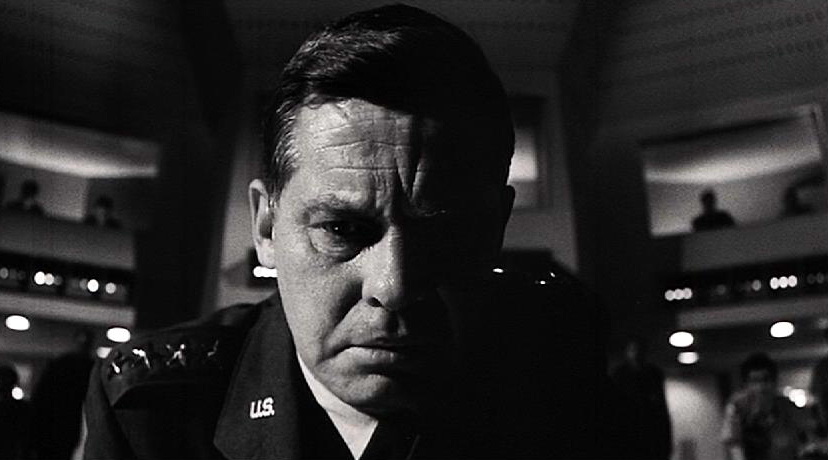
The American president (Henry Fonda) discovers that the U.S. air force accidentally launched a bomber squadron against Moscow. Now his job is two-fold: to convince his Russian counterpart that this strike was indeed accidental and prevent retaliation; and to stop or even shoot down the U.S. planes before they can drop the bombs and start WW3. The tension is thick as various characters react to what is an untenable and horrifying situation. The acting from the entire cast is first-class: Dan O Herlihy  [King of the Roaring 20's] as General Black, who must discharge the most distasteful duty of his career, to put it mildly; Fritz Weaver (who was introduced in this film) as Colonel Cascio, who is nearly driven mad by the situation and has a violent breakdown; Walter Matthau (in one of his early dramatic roles) as Groeteschele, who is coldly pragmatic when it comes to the numbers of projected casualties and the like; and especially Frank Overton [Desire Under the Elms], in the performance of his career, as the conflicted but duty-bound General Bogan. Janet Ward certainly scores in a small but pivotal role as Mrs. Grady, who desperately tries to tell her husband, the lead pilot, to turn back before it's too late. Nancy Berg, Dom DeLuise [Diary of a Bachelor]  and Larry Hagman (as a translator), among others, also do well in some flavorful supporting roles. One of the best scenes has Bogan reacting after the men in the war room cheer the downing of one of the planes -- "this isn't a football game!" I don't know if I find the controversial ending to this to be especially believable, but it certainly packs a wallop. I have no doubt that when this was released people left the theater shivering in shocked silence. This was released the same year as the satirical Dr. Strangelove, which has more or less the same plot, but the more somber Fail-Safe has the edge on it. The movie could have been cut by ten or so minutes and tightened a bit, however.

Verdict: Disturbing, high-impact, and infinitely depressing. ***1/2.

Thursday, March 30, 2017

VOICE IN THE MIRROR

Bar mates: Richard Egan and Arthur O'Connell
VOICE IN THE MIRROR (1958). Director: Harry Keller.

"We're all in the same boat, none of us more than one drink away from the gutter for the rest of our lives."

"I spilled more whiskey than you ever drank."

Commercial artist Jim Burton (Richard Egan) claims to have started drinking since the death of his little girl, but his doctor, Leon (Walter Matthau), reminds him that he was drinking before that and would probably have used any excuse. Jim's patient wife, Ellen (Julie London of The Helicopter Spies), is forced to put up with broken promises and wondering if and when he'll come home and what condition he'll be in. Now Leon tells him that his alcoholism may have created serious nerve damage. A fellow drunk named Harry (Harry Bartell) tells him that he thinks the solution to their problem may be through spiritualism, but Jim discovers that the secret may be to help other drunks --  alcoholics can help other alcoholics stay sober. Although set twenty years later, Voice in the Mirror basically appears to be the story of the formation of Alcoholics Anonymous (although the term is never used and there's not as much emphasis on religiosity; AA's famous slogan is used at the end, however.) In any case, the picture is absorbing and generally well-acted, with a moving conclusion. Egan and London are not exactly perfect casting for this film (stolid Egan never quite seems desperate enough for one thing), but both of them have their moments; oddly, London is better in her more emotional and difficult scenes than in her quieter ones. Harry Bartell and Doris Singleton, who plays Jim's sympathetic co-worker, have nice bits; both of them appeared several times on I Love Lucy. Arthur O'Connell nearly steals the picture as one of Jim's sad friends, and Matthau, in an unexpected role as the no-nonsense doctor, is also excellent. Ann Doran and Peggy Converse make their marks, respectively, as a landlady and the mother of a suicidal young drunk played by Troy Donahue. Eleanor Audley [Sleeping Beauty] is fine as a woman at a soup kitchen, and I believe that's Mae Clarke [Frankenstein] playing the first woman member of Jim's group. One of the best scenes depicts Jim's frightening nightmare in which he is caught in a train tunnel as a rushing train threatens to run him down.

Verdict: Imperfect but interesting and affecting drama. ***.

Thursday, October 11, 2012

MIRAGE

MIRAGE (1965). Director:Edward Dmytryk.

"If we can lie, cheat, steal and kill in broad daylight, but have to wait until it's dark to make love ... what does that have to say about us as a society!"

"If you're not committed to anything, you're just taking up space."

In 1951 Howard Fast published the novel "Fallen Angel" (which was reissued years later in paperback under the title "Mirage") under the pen name Walter Ericson. The book was well-written, but typical of post-WW2 fiction, in that it was grim and fatalistic and occasionally pretentious. "Fallen Angel" was the basis of two films, Mirage and Jigsaw. Mirage is by far the better of the two.

Although there are some changes made, Mirage is pretty faithful to the novel. David Stillwell (Gregory Peck) discovers that he has amnesia on the same day that a man plummets to his death in the same office building in which Stillwell works. Or so he thinks. The office has disappeared; a pretty young woman  named Shela (Diane Baker) claims to know him although to him she's a complete stranger; and worse, people are trying to kill him and demanding he turn over something -- but he has no idea what it is or what they're talking about. Stillwell hires a first-time private eye named Ted Caselle (Walter Matthau) to help him, but the man uncovers more questions than answers.

Mirage is a first-rate suspense film (although it can be argued that it succeeds due to the acting and plot more than to Dmytryck's standard if more-than-competent direction). Peck gives a very good performance, and although Baker isn't quite the femme fatale type the attractive actress nevertheless acquits herself nicely. Matthau, in his pretty much comic turn as the private eye, doesn't really seem to fit into the movie. Of the supporting cast, Robert H. Harris makes the best impression as Dr. Broden, but there are also notable turns by Jack Weston, George Kennedy, Walter Abel, Leif Ericson, Kevin McCarthy, and Anne Seymour. There's an excellent use of New York City locations, and an exciting chase sequence in Central Park. Ann Doran has a bit part as the neighbor of a murdered man who wants to keep her nose clean. Peter Stone's screenplay intelligently adapts the novel, makes things a little clearer than they are in the sometimes murky book, and has some excellent dialogue as well (see above).

Verdict: Classy suspense film with a convoluted but fascinating storyline and very good performances. ***1/2.

Wednesday, January 14, 2009

BIGGER THAN LIFE


BIGGER THAN LIFE (1956). Director: Nicholas Ray.

Ed Avery (James Mason) is a family man who finally goes to the doctor to see about his painful spells, and learns he will be dead in months unless he takes the new wonder drug, cortisone. Unfortunately the side effect of the drug (which he apparently abuses) is to make him egomaniacal, irrational, paranoid, and eventually homicidal and psychotic. The ending of the film is only moderately hopeful.

Frankly Bigger Than Life is a pretty depressing and completely unpleasant film that is virtually devoid of entertainment value. Mason gives a good enough performance, it's just that this stylish, elegant actor seems completely wasted in a role that could probably have been played just as well by Fred MacMurray (and it might have had more shock value)! Barbara Rush gives a lovely performance as his wife, however. Walter Matthau turns up as Ed's buddy in a more or less dramatic turn and he's fine. The movie is too tedious to be a thriller, it that's what was intended, and not strong enough to be much of a drama, either.

Verdict: Who wants to see James Mason in the suburbs? **.