Lively, entertaining reviews of, and essays on, old and newer films and everything relating to them, written by professional author William Schoell.
Showing posts with label Elizabeth Taylor. Show all posts

Thursday, January 16, 2025

RHAPSODY

Ericson, Taylor and Gassman
RHAPSODY (1954). Director: Charles Vidor.

"You have an almost neurotic need to be needed. And that man needs no one."

Hollywood always liked to hedge its bets when it came to movies with a classical music milieu, so they made sure in such pictures to include beautiful women, handsome men, and a dollop of sex -- or at least lots of romance. In Rhapsody the beautiful woman is Elizabeth Taylor, who never looked more luscious except perhaps in Elephant Walk, and she has two handsome co-stars, Vittorio Gassman and John Ericson. If that weren't enough, the movie is drenched in the music of Tchaikovsky, Rachmaninoff, and others. Louise Durant (Taylor) is in love with an up and coming violinist, Paul Bronte (Gassman) and she follows him to Zurich where he needs to finish his studies. Louise is sensitive but a bit too superficial to be able to develop an interest in classical music, so she has no real joy in her lover's eventual success. 

Meanwhile, James Guest (Ericson) an upstairs neighbor studying piano at the same conservatory, is falling for Louise and is there for her when things temporarily fall apart between her and Paul. A love triangle develops, with Louise torn between the man she thinks she loves and the other man who desperately needs her ... La Liz gives one of her best performances in Rhapsody, a spoiled but loving minx who needs the affection withheld by her father (an excellent Louis Calhern) and will do just about anything to get it from the man she loves. Gassman is wonderful as an artistic devil-may-care, for whom Louise will always take second place, and Ericson, who later appeared on TV's Honey West, has probably the best role of his career and runs with it. Other notable cast members include Michael Chekhov as Professor Cahill, Celia Lovsky as a landlady, and Stuart Whitman as another student, among others.

Verdict: Feed your inner romantic! ***.

Thursday, September 14, 2023

SUDDENLY, LAST SUMMER (1959)

"And this you won't believe:" Albert Dekker and Liz Taylor 
SUDDENLY LAST SUMMER (1959). Director: Joseph L. Mankiewicz. Screenplay by Gore Vidal from the play by Tennessee Williams. NOTE: This review includes important plot details. 

Violet Venable (Katharine Hepburn) is utterly appalled at the tale being told about her son Sebastian's demise by her niece Catherine (Elizabeth Taylor) and "wants that hideous story cut out of her brain." To that end she has called in a neurosurgeon, Dr. Cukrowicz (Montgomery Clift of Lonelyhearts), and promises financial aid to a possible clinic named after her son if the doctor performs a lobotomy on Catherine. Dr. Cukrowicz meets with the distraught woman -- the two are attracted to each other -- and he can clearly see that she is not the kind of hopeless case who would need a lobotomy. Instead he brings Catherine to her aunt's house -- accompanied by her mother (Mercedes McCambridge of All the King's Men) and brother (Gary Raymond of Jason and the Argonauts), who hunger for Sebastian's money -- and administers a truth serum. Catherine then tells the horrifying truth about what happened to Sebastian in the village of Cabeza del Lobo in Spain.

Katharine Hepburn and Montgomery Clift
The problem with Suddenly Last Summer is the same as it is with all plays and films written and produced before Stonewall. The viciously negative stereotypes about homosexuals abound, and it makes no difference that Williams and Gore Vidal were contributors to the picture. Although we never meet or see Sebastian, he hits all the stereotype buttons: vein, superficial, pretentiously "artistic," a bitchy momma's boy, and worst of all, a sexual predator. (One senses that when Taylor refers to boys in relation to her cousin she doesn't mean boys as in "boys and girls," but underage boys.) The production code had a lot of problems with Suddenly Last Summer but ultimately the film was released because, after all, homosexual Sebastian does die, which just proves the "negativity" of the gay lifestyle. (Of course gay men have always had a problem with being cannibalized, LOL!) While a modern interpretation might suggest that Sebastian is gay-bashed, it is much worse than that.  

a tormented Liz Taylor
The laughable notion of the play and movie is that Sebastian, who is supposedly shy, uses good-looking women like his mother (until her stroke) and then cousin to attract men and then presumably pounces on them be these men gay or straight (or offers them money -- or food). Most gay men really don't need this subterfuge to meet other men, even back in the thirties when this takes place -- and the idea of gay men using women to attract hopefully gay men is ludicrous -- although it's also stated that his mother has social connections so I guess Sebastian can meet the "best," well, meat. Of course, there have been self-hating homos who insist only on having sex with "straight" men -- you can see the problem there -- or who buy hustlers who may or may not be gay but are probably at least bi. 

McCambridge, Taylor and Raymond
In any case, playwright Williams was not necessarily being literal when Catherine tells of her snobbish cousin being chased by starving homeless boys who use their musical instruments, made mostly of tin cans, to cut away and eat pieces of their victim after they chase and surround him. The movie however, intimates that this is what actually happened. Could Williams, who had become quite a success by this time, have been thinking about the handsome young actors who wanted to use him so they could get cast in one of his plays? Were they figuratively "devouring" him? Or did he have some guilt over his own behavior? Williams at this time was not exactly what today we would call "out and proud." This was also true of Montgomery Clift, so one can only imagine what the hell he thought of the picture! 

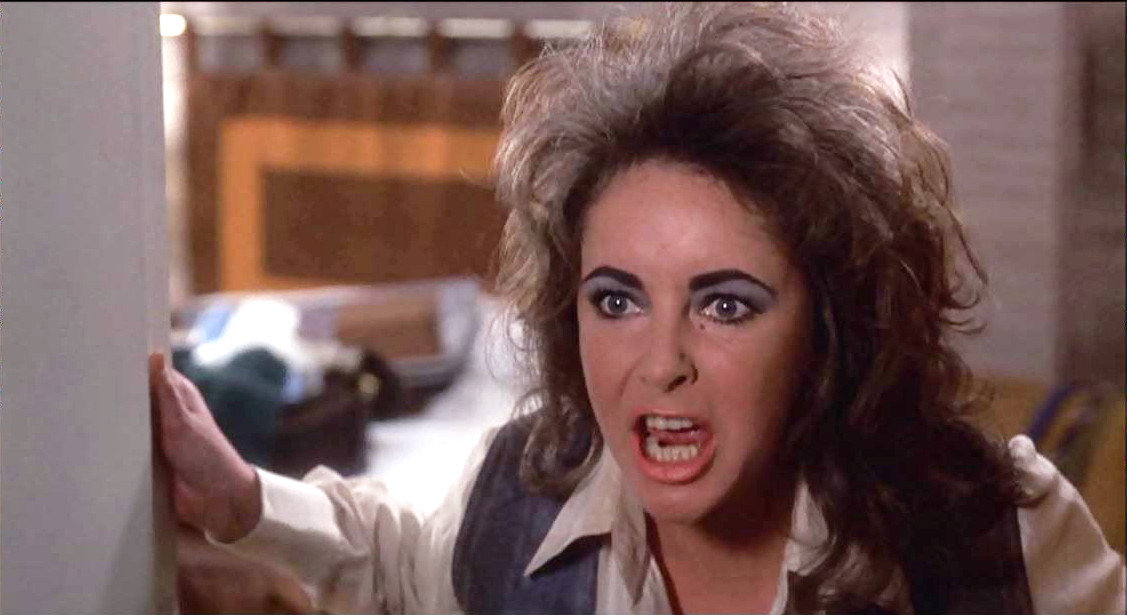
Angry Liz 
Playing in "dragon lady" mode, Katharine Hepburn gives a strong, if imperfect, but very showy performance. Mankiewicz clearly worked with Taylor to help her give as strong a performance as she does. The role is basically beyond the actress' limited range, but she gives excellent line readings, and really delivers during her horrifying climactic speech, giving her readings a frightening urgency and intensity. Clift is basically fine in a not-terribly-interesting part, and McCambridge and Raymond are just about perfect. Albert Dekker, okay as an associate of the doctor's. plays a role that was not in the play. The romantic sub-plot, if that's what you can call it, is expanded, and there are added scenes showing Catherine in a nun's retreat and the state asylum. (A continuity flaw shows a crazy old lady in a rocker in both the nunnery and the asylum.) The film has zero period atmosphere and just comes off as if it takes place in the fifties when it was made. 

Verdict: Yes, this has fascinating aspects but it's terribly dated, quite homophobic, and emerges more as a sick and dirty joke than anything else. **1/2. 

Thursday, August 3, 2023

ASH WEDNESDAY

Lovely Liz
ASH WEDNESDAY (1973). Produced by Dominick Dunne. Directed by Larry Peerce. 

Sixtyish Barbara Sawyer (Elizabeth Taylor) fearing that her husband, Mark (Henry Fonda), will leave her for a younger playmate, goes to Switzerland and has cosmetic surgery (graphically depicted) to make her look like -- gorgeous, 41-year-old Liz Taylor! After the bandages come off, Barbara goes to the resort of Cortina, Italy, staying in a fabulous hotel and wearing expensive fashions. She also turns the head of a playboy named Erich (Helmut Berger, again miscast as a heterosexual). Should Barbara succumb to her romantic feelings for Erich, and what will Mark think of her new look when he finally arrives in Cortina. She may learn that her marriage had more problems than her aged appearance ... 

Helmut Berger
With its superficial and one-dimensional characters, one really has to wonder why anyone thought making this movie was a good idea. Sure, lots of people might have loved looking at glamorous Liz (although probably not at distasteful surgery), but an actual  story might have helped. Half of the movie is taken up by scenes at the clinic, and the surgery sequence seems to last as long as the actual operation. When Barbara/Liz puts on her sweeping ultra-chic winter coat/robe that looks like it must have cost a thousand dollars, the film just suddenly seems to turn into a comical parody. Taylor's performance is generally on target, although it's not one of her best. Helmut Berger is Helmut Berger and doesn't really have to act just look enigmatic. Fonda is actually good in this -- his assorted reactions are perfect -- and Margaret Blye [The Entity] is fine as their daughter, Katie. Keith Baxter adds some zest as David, a (possibly gay?) fashion photographer who is also getting work done and befriends Barbara at the clinic and elsewhere. Monique van Vooren [What Makes Sammy Run?] plays a German celebrity who briefly chats with David at the clinic. 

Verdict: Another entry in the "Oh, how the rich suffer!" sweepstakes! **1/4. 

Thursday, January 5, 2023

X, Y AND ZEE

X, Y AND ZEE (aka Zee and Co./1972). Director: Brian G. Hutton. 

"I got expelled at school because I fell in love with one of the nuns." -- Stella. 

Zee (Elizabeth Taylor) and Robert (Michael Caine of Dressed to Kill) have a toxic marriage that seems to run on ennui and liquor. At a party Robert meets the widow Stella (Susannah York), and while he hopes for just another cheap affair winds up supposedly falling in love with her. Zee seems to have a casual and world-weary reaction to this, but then comes to see Stella and her two small boys -- she and Robert can't have children -- as a threat. Robert makes up his mind to move out and have a life with Stella. What's a wife to do?  Wondering exactly how old Stella might have been when she kissed a nun and got expelled at school, Zee pays a call on her when Robert is out ... 

Frankly X,Y and Zee is over just when it starts to get interesting. For most of its length, it is a fairly dreary marital drama -- wife vs. mistress with a cad caught in the middle -- that has good performances and some good dialogue along with two-dimensional characters. Unlike the "bisexual" comedy Score, which came out the following year, X, Y and Zee turns coy and basically cops out at the end. Made only three years after Stonewall X, Y and Zee has a fairly negative attitude towards homosexuality, with stereotypical gay characters being referred to as "fags" (even right in front of them), so it's hard to think of it as ahead of its time (now if the trio had turned into a "thrupple!"). One also has to remember that Susannah York had already starred in The Killing of Sister George, which was much more explicit on lesbian matters and was released four years earlier.

Liz on the rampage!
Another problem with the movie is that none of the characters are likable. While we can imagine how she became that way, Zee is overbearing and superficial. Stella is, in a word, stupid to even begin a relationship with a man like Robert, who is -- in another word -- a pig. The movie doesn't so much as explore sexual options as exploit them, although many might find the ending amusing. Margaret Leighton (of The Winslow Boy) provides a little bit of fun as an intoxicated party host. Taylor and director Hutton also worked together on Night Watch

Verdict: Who's Afraid of Virginia Mayo? Heads in an interesting direction, and then completely muffs it. **. 

Thursday, May 30, 2019

UNSINKABLE

UNSINKABLE: A MEMOIR. Debbie Reynolds and Dorian Hannaway. William Morrow; 2013.

In Debbie Reynolds' first autobiography, she went into her divorce from Eddie Fisher -- who ran off with Liz Taylor -- and how her second husband completely drained her bank account and left her broke. In this sequel, Reynolds writes affectingly of two major incidents since that period. The first is her marriage and divorce to her third husband who, at least as portrayed in the book, was a monstrous hustler who took his wife for everything she was worth, all the while using her money to support his long- time mistress. During one confrontation, he kept asking Debbie to step out on the 12th story balcony, which might well have been her finish. Coinciding with this is her narrative of the Debbie Reynolds Hotel and Casino, which her husband apparently managed to run into the ground.

Once she was extricated from that mess, Reynolds now had to find a home for all the items of Hollywood memorabilia that she had amassed over the decades. This section of the book also has real suspense as the lady discovers that people in Hollywood don't especially care that much about its history. With one plan after another for the museum crumbling despite her and others' best efforts, all of the items (including the dress Marilyn Monroe wore in The Seven Year Itch) finally were sold in a huge auction that netted Reynolds millions.

This is about enough for two thirds of a book, so Reynolds has a final section in which she recounts some familiar stories about her coming to Hollywood, losing Eddie Fisher to La Liz, and so on, then has an annotated list of all of her movies, what she thought of them, and interesting behind-the-scenes details. Reynolds tells of the time she had to get a drunken Donald O'Connor off the stage when he tried to join in when Fred and Adele Astaire started dancing, and reveals that David Janssen [Man-Trap] was convinced he was the son of Clark Gable and drank himself to death over it! Who knows?

For much of its length, Unsinkable is a real page-turner, and for that we can thank Reynolds' co-auhor, (Ms.) Dorian Hannaway, who does a splendid job of telling the movie star's story.

Verdict: Very readable, well-done, and entertaining memoir. ***1/2. 

Thursday, February 21, 2019

WHO'S AFRAID OF VIRGINIA WOOLF?

Liz Taylor and Richard Burton
WHO'S AFRAID OF VIRGINIA WOOLF? (1966). Director: Mike Nichols.

"I'd divorce you if you existed." --Martha regarding George.

George (Richard Burton of Becket) is an Associate Professor of History at New Carthage University. His wife Martha (Elizabeth Taylor of Giant) is the daughter of the university president. Married for some years, they are enmeshed in bitter disappointment and alcohol. They were not able to have children, and George had hoped to be head of his department by now. The contempt they feel for themselves and for one another bursts out in lacerating games and accusations.

George Segal and Sandy Dennis
After a party one night they invite a younger couple, new to the university, to their home at two in the morning. Nick (George Segal) is a new biology teacher, and Honey (Sandy Dennis of That Cold Day in the Park) is his wife. The two were only married because of an hysterical pregnancy, and Honey's family is wealthy. Copious amounts of alcohol keep the "games" coming, with Martha pretending that she and George have a son. Before long all four people are lashing out at each other, and George decides it's time to put one rumor to rest.

George notices that Martha has plans for Nick
Who's Afraid of Virginia Woolf? intelligently opens up Edward Albee's play with scenes at a roadhouse and on the lawn, and the film is very well directed by Nichols, who gets excellent performances from the entire cast, and an especially strong one from Oscar-winning Elizabeth Taylor. Alex North's music is used very sparingly but it adds to the grim atmosphere of this black comedy, as does Haskell Wexler's top-notch black and white cinematography.

George fences with Nick
Since the play is much longer than the movie, cuts were obviously made, but I suspect that the movie is better than the play. It is debatable if Virginia Woolf is a great work of theater or more along the lines of kitsch, and in truth it probably lies somewhere in the middle. Although seen as a dissection of typical married life back when it premiered in the sixties,  it was obviously not the first play to deal with dysfunctional marriages. There was a typically sixties frankness and crudity to the language that was different, however, and Albee's dialogue is often very good and very funny.

George and Martha 
The whole business with the "son" doesn't really make much sense, but one's left with a vague air of tragedy because these people seem so pathetic, despite the fact that they are not that likable nor sympathetic. As played (beautifully) by Sandy Dennis, who also garnered an Oscar, even Honey is simply too freaky to engage our sympathies. Although we obliquely learn certain things about the characters -- the whole business with George's book, his parents' (?) deaths and so on is admittedly intriguing if obscure -- it might be said that we don't quite come to know them that well (nor do we want to).

Still, Who's Afraid of Virginia Woolf holds the attention and has its fascinating aspects. Underneath the laughs and bitchy interplay there is genuine pain and loneliness, but other plays have perhaps gone into the same themes with more brilliance and compassion. (Admittedly, there are undoubtedly big differences between the play, which I have not seen in some years, and the film.) Albee based George and Martha on a straight couple he knew -- they were never intended to be a gay couple, which is probably why he nixed an all-male version that Burton and Henry Fonda wanted to do with Jon Voight and Warren Beatty in 1970. True!

NOTE: The film Martha is referring to when she imitates Bette Davis saying "What a dump!" is Beyond the Forest.

Verdict: Who's Afraid of Alcohol Poisoning? ***. 

BUTTERFIELD 8

Liz Taylor and Laurence Harvey
BUTTERFIELD 8 (1960). Director: Daniel Mann.

"Every awful moment of it, I Loved!" -- Gloria.

Gloria Wandrous (Elizabeth Taylor) is a model and good-time girl who has a male best friend, Steve (Eddie Fisher), who may be in love with her, to the consternation of his girlfriend, Norma (Susan Oliver). Gloria begins an affair with an unhappily married man named Weston Liggett (Laurence Harvey of Summer and Smoke) and is convinced that her sordid liquor-and-sex past is over, that she has found true love at last. But there is still the wife, Emily (Dina Merrill) to deal with, and more than one ugly misunderstanding ...

Eddie Fisher and La Liz
Butterfield 8 is undoubtedly a sanitized, cliff notes version of John O'Hara's 1935 novel, and has apparently been updated to the late 1950's. Gloria is not an especially sympathetic character (nor Weston) until she reveals to Steve what happened to her in her childhood in a powerful sequence. Like something out of Harvey's film Room at the Top, Weston has apparently married for a good job and social position, although his wife seems to blame her own family for making things too easy for him. Taylor gives a very good performance, and won an Oscar for her portrayal. Harvey is also excellent, and there's good work from Merrill, Oliver, Kay Medford as a motel proprietor, Carmen Mathews as Emily's mother, and especially Mildred Dunnock as Gloria's mother and Betty Field as her very blunt best friend, Frances. Eddie Fisher, who was married to Taylor at the time (after leaving Debbie Reynolds for her), gives a respectable performance.

Verdict: Good performances and some good dialogue lift this a notch above the soap opera level. ***. 

Thursday, September 6, 2018

THE BIG HANGOVER

Van Johnson and Liz Taylor
THE BIG HANGOVER (1950). Written, produced and directed by Norman Krasna.

David Muldon (Van Johnson) had a strange experience in the war that left him so "allergic" to alcohol that he can get tipsy just with a sip of it. The sensible thing to do would be to tell everyone of the situation without going into details, so that he wouldn't feel required to drink a toast, for instance, and act silly. Instead his boss's daughter, Mary (Elizabeth Taylor), decides to try to help him overcome the problem. You would think from its title that The Big Hangover is a riotous tale with frequent scenes of an "inebriated" David making a comical fool of himself, and while there are such scenes in the movie, that's not really what the picture is about. David has gotten a job with a prestigious law firm because he is an honor student and valedictorian. In a touching and well-played sequence, he demonstrates the speech he'll give on graduation day to Mary, telling of his best buddy, who dreamt of being a lawyer, but who died in his arms overseas during combat. He is determined to follow in his footsteps. When a Chinese-American doctor (Philip Ahn) is locked out of his apartment with his pregnant wife by a racist manager, David assumes his law firm will side with the doctor, who is not a "Chinaman" but an American born in the U.S. But David learns that the law isn't always on the side of what's right. While one can't necessarily say that this ranks with the best of Frank Capra as a thoughtful comedy-drama, it is still an entertaining and worthwhile picture that has more on its mind than at first glance. Van Johnson gives another excellent performance, maintaining the perfect balance between humor and seriousness, handling every sequence with aplomb. Elizabeth Taylor, who is no comedienne, at first seems miscast, but once you settle into the true tone of the picture, she is very warm, winning, and adept. As for the supporting cast, we've got Percy Waram and Fay Holden as Mary's parents; Leon Ames [The Velvet Touch] as a public attorney who is outmaneuvered by high-priced lawyers and Rosemary DeCamp as his wife; Edgar Buchanan and Selena Royle [The Damned Don't Cry] as Davis's amusing aunt and uncle; and Gene Lockhart [A Scandal in Paris] as a senior partner in the firm who does his best to get David drunk at a swanky gathering (a scene that will make you want to reach into the TV set and give Lockhart a major bitch slap!). The supporting performances are all wonderful, with Leon Ames having a fine, underplayed moment when he admits to his mediocrity during the aforementioned dinner, and Philip Ahn is as dignified and effective as ever as Dr. Lee. If I have one quibble I wish that they film hadn't tacked on an unconvincing happy ending to the love story. One simply can not see La Liz happy with a husband who isn't wealthy and successful, and who tells him she admires him but doesn't want someone who's so noble. Still, it hardly ruins the movie. If Percy Waram is unfamiliar to most viewers, it's because he was primarily a British stage actor and had very few credits in pictures.

Verdict: A lost gem of a movie. ***1/2. 

Thursday, August 2, 2018

THE LAST TIME I SAW PARIS

Van Johnson and Elizabeth Taylor
THE LAST TIME I SAW PARIS (1954). Director: Richard Brooks. Very loosely based on a story by F. Scott Fitzgerald.

In post-WW2 Paris, war correspondent Charles Wills (Van Johnson) meets beautiful Helen Ellswirth (Elizabeth Taylor). Initially attracted to Helen's sister, Marion (Donna Reed), he makes a date with her that is intercepted by Helen, leading to a major romance and marriage. Although the couple discover oil on property they own and have plenty of money, the marriage is threatened by Charles' inability to sell his novels to any publisher, the drinking and carousing that results from it, and Helen's reaction to this as well as his flirtatious relationship with the much-married divorcee, Lorraine (Eva Gabor). It all leads up to an unexpected tragedy ... The main strength of The Last Time I Saw Paris are the lead performances, which are better than the movie deserves. Taylor  plays the somewhat spoiled woman-child very well, but Johnson is especially outstanding, doing some of the very best work of his career. The trouble with the movie is not so much the basic plot but the screenplay by Julius and Philip Epstein, which indulges in one cliche after another and rarely delves into the situations with any depth. The final quarter of the film is the most memorable, as it finally deals with Charles' apparent rejection of Marion, as well as with his relationship with his young daughter,  Vicky (a charming Sandy Descher of Them!); these sequences are moving and very well-played. (Cast as Marion, Donna Reed truly has a thankless part.) Four years earlier Johnson and Taylor were teamed for a comedy entitled The Big Hangover, and there are times when the light soap opera tone of Paris threatens to just collapse into giggles; you get the sense the tragedy that occurs is meant to add some sobering substance to the proceedings, even if it doesn't quite work. Eva Gabor [The Mad Magician], who was always more talented than her sister Zsa Zsa (although hardly an acting genius) is fun as Lorraine; as Helen and Marion's rather irresponsible father, Walter Pidgeon is Walter Pidgeon. Roger Moore [A View to a Kill] shows up and is as smooth as ever as a playboy who dallies with Helen. Of all people, the corpulent Bruno VeSota [Attack of the Giant Leeches] shows up in a party scene clad in a tuxedo!

Verdict: Some tender and amusing moments, but Paris -- and Fitzgerald -- deserve better. **1/2. 

Thursday, March 9, 2017

JOAN ON THE BBC

JOAN CRAWFORD ON THE BBC.

Crawford did a late sixties interview for the BBC which covered her entire career and her thoughts on current movies and performers. At first Joan seemed a bit guarded and not relaxed, and complained how the British seemed obsessed with age (apparently some reporters came right out and bluntly asked her how old she was). "I know some people think there are very few things before my time," she said. She relaxed a bit more as the interview with the young admiring host continued, although when she answered a question she didn't always really answer the question, but said -- as stars are wont to do -- what she wanted to say. She talked admiringly of Bette Davis and said she enjoyed working with her on Baby Jane, calling Davis a "fascinating actress" but saying they really hadn't had time to become friends. She was, however, close friends with Barbara Stanwyck, whom the interviewer compared to her, pleasing Joan. Joan apologized in a way for making negative comments about Liz Taylor's personal life, but praised her acting skills, and said, next to Gable, John Garfield was her most dynamic co-star. Joan said that "I never had a sense of humor about myself until I worked with George Cukor." During the interview she is friendly, smiles, makes amusing comments and reacts to same, but it still comes off, understandably considering her years in front of the camera, as if it's another performance. and while it may not be fair to say she is humorless, she is,as mentioned, holding herself in warily. She expresses the wish that pictures had more romance and glamor, and suggests that Warren Beatty is ornery, while admiring Natalie Wood, whom she feels hasn't reached her potential, that there was no longer any help or guidance for actors as in the studio days. Joan talks affectionately of Lionel Barrymore, but while admiring his genius, admits that John Barrymore could be difficult while making Grand Hotel. Basically Joan is ever the professional, and the interview, while not that probing, is a good one. It probably didn't hurt that Joan seems to like the kind of cute interviewer.

Verdict: Joan talks! ***.

Thursday, May 2, 2013

THE MIRROR CRACK'D

Novak, Hudson and Taylor
THE MIRROR CRACK'D (1980).  Director: Guy Hamilton.  Based on "The Mirror Crack'd From Side to Side" by Agatha Christie.

"Chin up, darling -- both of them!"

Move star Marina Gregg (Elizabeth Taylor) and her director husband Jason Rudd (Rock Hudson) have taken over a British country estate while in England to film Marina's comeback film when during a party a young fan (Maureen Bennett) talking to Marina is given a poisoned drink and dies. It isn't long before it is determined that Marina was the true target of the poison -- or was she?  Miss Marple (Angela Lansbury) asks questions while her nephew, an Inspector (Edward Fox), investigates, but it's sure bet who'll solve the case first. Agatha Christie got the germ of her idea from an actual tragic incident that happened to actress Gene Tierney, although Marina does not seem otherwise based on that particular movie star. Taylor is perfect casting as the difficult, whiny, needy fading actress going to fat, but that is not to say her performance is any more than passable. Kim Novak is better and much more fun as a movie rival of Marina's who trades bitchy remarks with her. Hudson is okay, if a bit dour and superficial, and Tony Curtis is fun enough as a vulgar producer.  Geraldine Chaplin is Rudd's suspicious secretary, and Charles Gray is his butler. This is better than another adaptation done on Masterpiece Mystery in 2010. Lansbury looks more like Miss Marple than Margaret Rutherford did, but she's not as funny nor meant to be.

Verdict: At least it has an interesting cast and Novak looks sensational. ***.

Thursday, August 23, 2012

DROPPED NAMES: FAMOUS MEN AND WOMEN AS I KNEW THEM

DROPPED NAMES: FAMOUS MEN AND WOMEN AS I KNEW THEM. Frank Langella. HarperCollins; 2012.

In this unconventional memoir, actor Frank Langella (Diary of a Mad Housewife; Dracula; Frost/Nixon) spares the reader the need to look up famous names in the index. Langella is smart enough to know that most people read autobiogs by second and third tier celebrities [well-known, but not superstars or household names] to see what they have to say about the mega-stars they worked with, so the book is divided into many chapters bearing the names of the famous and pretty famous. [Of course, it is also true that in a "memoir" of this nature you can avoid answering the hard questions about yourself.] In concise, well-written sections we read Langella's impressions of everyone from Bunny Mellon to Jackie Onassis to Paul Newman to Marilyn Monroe. Some of these chapters are especially well-done, such as the section on the lonely middle-aged Elizabeth Taylor [although Langella never really makes it clear why he didn't want to go on seeing her except that she "would eat him alive," which sounds like a cop out. If he no longer found her attractive, why not just say so?] You sometimes get the impression Langella only exists when he's in the company of celebrities [the wealthier, the better]; that the rest of the time he's folded up, maybe in one of those vinyl bags you put clothes in and hang in closets, in a state of suspended animation, waiting for the next party or the next invitation to the Mellon estate. While, as I've stated, this is an unconventional memoir, it's still a bit startling that Langella says virtually nothing of substance about his wife [wives? who can tell?] and children, and reading between the lines you also sense he's possibly being coy about his own sexuality [giving a supposedly "sophisticated" book a somewhat dated quality]. In the meantime, he "outs"  late author Dominick Dunne, among others. So while the book has its entertaining stretches and drops many, many names, it has the usual limitations of a work by a tiresomely self-absorbed "celebrity." Langella gives the last word, more or less, to super-rich Bunny Mellon: "Don't think so much about famous people," she told him. "They already think too much about themselves."

Verdict: Readable and generally well-written, but hardly essential. **1/2.


Thursday, August 16, 2012

BUTTERFIELD 8

BUTTERFIELD 8 (1960). Director: Daniel Mann.

"Let's face it -- I was the slut of all time!"

Gloria (Elizabeth Taylor) is a beautiful "model" who is chased by men and considered a complete slut by the prudish. Her best friend is Steve (Eddie Fisher), whose girlfriend Norma (Susan Oliver), is jealous of Gloria. Gloria's latest conquest -- or is it the other way around? -- is Weston Liggett (Laurence Harvey), who is married to the very wise Emily (Dina Merrill). Things threaten to come to a boil when Emily finds her mink coat missing, unaware that hubby loaned it to Gloria ... Mildred Dunnock is Gloria's concerned mother and Betty Field the mother's friend, Fanny. Kay Medford is an ex-vaudevillian motel owner who sadly remembers the glory days and Carmen Mathews has a good turn as Emily's mother. Harvey is excellent, Taylor is quite good [although perhaps not quite deserving of the Oscar she won], and Fisher -- who was then married to Taylor -- does a nice job as well, although he always tends to get knocked by critics and biographers. Taylor has an especially good scene telling Fisher about her childhood sexual abuse. The movie has the odd distinction of being somewhat "modern" and yet dated at one and the same time. The impression one gets is that the film is trying to paint Gloria as an emotionally wounded "sexaholic" yet there's also that old double-standard that men who sleep around are studs but women who do the same are whores -- and that ending!

Verdict: At least you've got Liz sauntering sexily. ***.

Thursday, August 9, 2012

HOW TO BE A MOVIE STAR: ELIZABETH TAYLOR IN HOLLYWOOD

HOW TO BE A MOVIE STAR: ELIZABETH TAYLOR IN HOLLYWOOD. William J. Mann. Houghton Mifflin Harcourt; 2009.

Mann has decided not to write a straight-forward bio of Taylor but focus on certain highlights of her life, the result being that the book actually has as much depth and knowledge of the woman as bios that cover every facet of her life and career. [To all intents and purposes this is  a full biography.] You can read about Taylor's early career and aggressive mother, who'd been an actress herself; her affairs with, and marriages to, Eddie Fisher and Richard Burton; the making of the mammoth Cleopatra; the death of husband Mike Todd in a plane crash; her feud with Hedda Hopper, who was sued for claiming another Liz-husband, Michael Wilding, was gay; the filming of career highlights such as Giant and Who's Afraid of Virginia Woolf, in which Liz was supposed to look slatternly; and so on. Of course, some things get lost -- Rhapsody, in which Taylor is terrific, is again glossed over [as it was in Taraborrelli's book] and there's no mention of Toscanini [I would have loved to have gone behind-the-scenes with Taylor and co-star C. Thomas Howell!], but you can't have everything. Naturally, when a star has been written about as often as Taylor, lots of stuff gets rehashed, but Mann is a good enough writer to make it all very interesting and readable nevertheless. Taylor's trials and tribulations may no longer be terribly important in the great scheme of things, if they ever were, but they do make good reading and Mann adroitly explores how Liz's romantic carryings-on and choice in movies helped open liberal sexual doors in Hollywood for better or worse. Mann is also the author of Behind the Screen, Kate, and Edge of Midnight on director John Schlesinger; all are recommended.

Verdict: Very readable and entertaining book that is as much about Hollywood as it is about Taylor. ***1/2.

THE SANDPIPER

Burton and Taylor get the bird [atop Taylor's head]
                                                                              

THE SANDPIPER (1965). Director: Vincente Minelli.

"I won't seduce him. I wouldn't give him the satisfaction of blaming me afterwards."

Free-spirited artist Laura Reynolds (Elizabeth Taylor), who has a young son Danny (Morgan Mason) -- who is always getting into trouble -- but no husband, is angered when Judge Thompson (Torin Thatcher) tells her the boy either goes to the Episcopal San Simeon school run by Dr. Edward Hewitt (Richard Burton) or reform school. Hewitt is married to Claire (Eve Marie Saint), but that doesn't stop him from succumbing to his sexual and romantic feelings for Laura, and she makes little effort to stop him. On one hand The Sandpiper flirts with modern ideas and liberal attitudes -- Laura's atheism, her no-guilt approach to the affair -- but the screenplay is muddled, morally confusing, and talky, talky, talky. Taylor is miscast, but she and Burton were put into the film only to capitalize on the headlines they were garnering from their well-publicized affair at the time. Patrons expecting something steamy must have been disappointed, because [despite their off-screen relationship] these two generate little real passion and the movie isn't terribly erotic. There's much talk about Hewitt's hypocrisy, but none about Laura's, who easily gets indignant yet allowed a married man to pay her way through art school -- what, this "independent" woman couldn't get a job? An unintentionally hilarious scene has Taylor referring to the isolation of one trysting spot and saying "I feel as alone as Robinson Caruso." [And yet there's no opera in the background, only the pop tune introduced in the film, "The Shadow of Your Smile."] An injured bird that Laura mends hops around on her head during one love scene [see photo], probably as bored with the pretentious dialogue and alleged symbolism as the audience. Burton has his moments, and Eva Marie Saint and young Mason are excellent; Taylor comes off like an older version of her character in Rhapsody, still petulant, now living in luxurious poverty on the coast of Big Sur. The movie is beautiful to look at, however, with sweeping scenic views throughout. Robert Webber is fine in a thankless role as a cast-off lover of Laura's, and Thatcher offers a little bit of class as the judge. Tom Drake is also good in the very small role of a teacher at the school. Young Mason was later executive producer on Sex, Lifes and Videotape.

Verdict: For real romance and a better Taylor performance, watch Rhapsody instead. **.

Thursday, July 26, 2012

[YOUNG] TOSCANINI

C. Thomas Howell as the great conductor
TOSCANINI (aka Young Toscanini and Il giovane Toscanini/1988). Director: Franco Zeffirelli.

NOTE: As I have only seen the Italian-language version of this film, this post is more of a report on the movie than a review.

It sounds like something that could only happen in a movie, but it really did happen: When he was 19- years-old, musician (and chorus master) Arturo Toscanini was working on a production of Verdi's "Aida" in Rio de Janeiro when the conductor proved so inept that the singers threatened to go on strike if the general manager didn't replace him. When two successive conductors couldn't handle the score, Toscanini, who knew the whole opera, was importuned to take over at the podium despite the fact he'd never conducted before. Toscanini did an excellent job, and became one of the world's most famous conductors of operas and classical music.

Okay, you know how the movie ends, but that's history. Toscanini shows the young artist (C. Thomas Howell) being rejected as a cellist at La scala due to his temperament, then follows him as he joins a South American tour and winds up in Brazil. There he romances a young lady, Margherita (Sophie Ward, who has a great face), who ministers to the poor in Rio, and also meets an idol of his, the (probably fictional) soprano Nadina Bulichoff (Elizabeth Taylor), who is coming out of retirement to appear in "Aida." During the opera she enrages the powers-that-be by denouncing the slavery [part of the plot of the opera] that is still being practiced in Brazil.

Toscanini is a handsome picture with beautiful settings and musical backgrounds. Tenor Carlo Bergonzi appears in the film -- and sings! -- and the production of "Aida" looks quite magnificent. An especially charming scene has Arturo playing for the sweet-faced children of Rio; a more somber moment has him discovering that some of these children have died.

As an English-language or sub-titled version of the film is unavailable, it is hard to judge the dramatic viability of the film unless you understand Italian. Howell and Taylor have been dubbed by Italian actors. (The DVD release of the film says that it has both English and Korean sub-titles, but it only has Korean.) The film is certainly good to look at, and appears to have several tense and dramatic sequences.

Some may feel that the non-Italian casting of the leads is rather odd. If Zeffirelli were hoping Howell and Taylor would improve the film's chances of American success he was mistaken. Taylor was no longer box office in 1988, and while Howell had appeared in such successful "teen" films as The Outsiders, his fans probably didn't know who Toscanini was. He seems quite intense and romantic in the part. (Toscanini was a good-looking man, although probably not as Hollywood handsome as Howell)] So in the long run, sadly, the two actors, good as they are, didn't do the picture much good and vice versa.

Definitely worth a look. And let's hope one with English captions or titles comes out one of these days.

Thursday, July 19, 2012

GIANT

Elizabeth Taylor and James Dean
GIANT (1956). Director: George Stevens.

Texas rancher Jordan "Bick" Benedict (Rock Hudson) marries the feisty, independent-minded Leslie (Elizabeth Taylor) and comes to realize that meek compliance is not in her nature. Meanwhile, the arrogant, slouching ranch hand Jett Rink (James Dean) discovers oil on the property left to him by Benedict's sister, Luz (Mercedes McCambridge) and is soon even wealthier than Jordan, leading to various complications and a couple of fight scenes. This long, sprawling saga is entertaining for the most part, and features one of Taylor's best performances. Hudson isn't the best casting, but he isn't bad, and the odd Dean makes a minor impression as well. Giant is not really a masterpiece, but it does have some good scenes: the Benedict children discovering that their Thanksgiving dinner is their pet turkey; Leslie telling off the men who think women have no place in politics; Angel (Sal Mineo) "coming home" from WW2. The other cast members include Carolyn Craig (House on Haunted Hill) as Leslie's younger sister; Rod[ney] Taylor as her cast-off suitor, who later on marries said sister; Carroll Baker as Leslie's daughter [in her second film and first big role]; Chill Wills as Uncle Bawley; Dennis Hopper as the Benedict son, Jordy, who, like his mother, has a mind of his own; Elsa Cardenas as Jordy's Mexican wife; and Earl Holliman as Bob, the husband of the youngest Benedict daughter, Judy (Fran Bennett). Of the supporting players, Hopper and McCambridge provide the most vivid performances. Giant has an admirable sub-text on the evils of racism -- both Benedict and Rink are prejudiced against the "wetbacks" -- but this might have had more impact if the Mexican characters, such as Angel, were developed a lot more.

Verdict: Long, but generally sustains interest, and -- surprisingly -- Taylor is the glue holding it all together. ***.

REFLECTIONS IN A GOLDEN EYE

Private Williams goes "bare-backing"
REFLECTIONS IN A GOLDEN EYE (1967). Director: John Huston.

"Any fulfillment at the expense of normality should not be allowed to bring happiness."

On an Army barracks in the South, twisted passions and adulterous affairs are playing havoc with people's lives and emotions. Major Weldon Penderton (Marlon Brando) is married to the beautiful Leonora (Elizabeth Taylor) but he's much more interested in handsome Private Williams (Robert Forster), who rides a black horse through the woods both bare-backed and bare-assed. Penderton is so obsessed with Williams that he doesn't even turn to look at a car accident behind him so that he can continue to stare at the object of his affection, and he lovingly collects the private's discarded candy wrappers. Meanwhile Leonora is sleeping with next door neighbor Lt. Col. Morris Langdon (Brian Keith), whose depressed wife Alison (Julie Harris) cut off her nipples with garden shears and has much more of a connection with her Filipino houseboy Anacleto (Zorro David). Worse news for Penderton is that Private Williams has a crush on Leonora, and sneaks into her room at night to watch her sleep and play with her things, leading to a major [no pun intended] and infuriating climactic disappointment for the Army man. Leonora seems most of all to care about her horse, Firebird. Based on a novel by Carson McCullers, Reflections in a Golden Eye is fascinating and absorbing but at the same time hard to take entirely seriously, as it tends to be over-baked and soap opera-lurid at times. Brando gives a fairly good performance, but like many of his performances, it comes dangerously close to caricature. Harris and Taylor are fine as very different housewives, light years apart in intelligence and sensitivity; Keith is excellent, as is Zorro David, a painter and beautician who appeared in no other films. Forster makes a definite impression in his first film. Repressed, unhappy Major Penderton shows signs of  wanting to break out of his closet, but he also destroys the career of a man who is suspected of being gay [because of his love of poetry and classical music!] but possibly isn't. The film received some criticism  because it doesn't have any 1940's period atmosphere, but I saw nothing in the movie to indicate that it takes place in any other time period than when it was shot, the late sixties. Handsomely produced and photographed, and quite well-directed by Huston. NOTE: The DVD restores the original muted colors favored by Huston but replaced by the studios with regular color prints one week after the film's release.

Verdict: Kind of silly all told, but more than watchable and with an interesting plot. ***.

Thursday, November 3, 2011

NIGHT WATCH

NIGHT WATCH (1973). Director: Brian G. Hutton.

Wealthy Ellen Wheeler  (Elizabeth Taylor) is strangely obsessed with thoughts of the death of her philandering first husband, causing concern in her second husband, John (Laurence Harvey) and her best friend, Sarah (Billie Whitelaw), who's there for a visit. Worse, Ellen is convinced that during a storm she saw a corpse in the window in the abandoned house across the way. But nobody seems to believe her, and the police think she's dotty. Night Watch is based on a novel by Lucille Fletcher, who also wrote the original play upon which Sorry, Wrong Number was based. While Night Watch may not be in  that league [and Liz Taylor is no Barbara Stanwyck] and the plot may or may not hold up under close scrutiny, it's still an entertaining picture with a darkly amusing final twist. Taylor (Rhapsody) is okay, but Harvey (Room at the Top) and especially Whitelaw (The Omen) are a lot better. NOTE: This is now available in a remastered edition from Warner Archives.

Verdict: Like an extended episode of The Alfred Hitchcock Hour. ***

Thursday, February 26, 2009

RAINTREE COUNTY


RAINTREE COUNTY (1957). Director: Edward Dmytryk.

John Shawnessy (Montgomery Clift) lives in a Northern county which has the legend of a mysterious, magical raintree in the swamps, which he tries to find but fails. He is loved by Nell (Eva Marie Saint) but winds up married to a neurotic Southern gal named Susanna (Elizabeth Taylor), who fears that her true mother was a Cuban black woman with whom her father supposedly had an affair. What's worse -- for essentially racist Susanna -- John is an abolitionist ... and then the Civil War breaks out. If this all sounds interesting be warned that it's stretched out to a tedious 2 hours and 48 minutes and the movie never really jells. Part of the problem is a meandering script without any major focus, but director Dmytryk isn't much help, either. Clift gives a good performance, but it was clearly affected by the shattering car accident he was in that occurred during filming. Elizabeth Taylor deserves an A for effort but she's not really up to playing a character that has so many different facets and psychological problems. Rod Taylor is good as a swaggering rival of John's, and Lee Marvin certainly scores as the charismatic Flash, with whom John has a race and who winds up in the Army with him. But the best performance is from Eva Marie Saint, who stands by John through thick and thin, and who is better than the picture deserves. DeForest Kelley shows up briefly as a rebel soldier. Fine cinematography by Robert Surtees and a good score by Johnny Green, but this is mostly a bore.

Verdict: Three hours of your life you can never get back. **.