Lively, entertaining reviews of, and essays on, old and newer films and everything relating to them, written by professional author William Schoell.
Showing posts with label Zsa Zsa Gabor. Show all posts

Thursday, October 12, 2023

THE GIRL IN THE KREMLIN

Michael Fox and Lex Barker
THE GIRL IN THE KREMLIN (1957). Director: Russell Birdwell.

Joseph Stalin (Maurice Manson) has faked his death with a lookalike corpse, changed his face via plastic surgery, and is hiding out in Greece with associate and assassin Igor Smetka (Michael Fox of The Lost Planet) and his nurse Miss Gresenko (Zsa Zsa Gabor). This woman is the twin of Lily Gresenko (also Gabor) -- the two women were separated and one was taken to Moscow some years before. Lily desperately wants to find her sister, and hires callous private eye Steve Anderson (Lex Barker of Tarzan's Savage Fury) for the job until he deems it too impossible to finish. Importuned by Lily to continue, he teams up with an old friend, a one-armed agent named Mischa (Jeffrey Stone of Money, Women, and Guns). Learning that the monster Stalin may be alive, and that Lily's sister may be with him, the hunt is on. But others are aware of this search, and are going to do their best to stop it, by murder and kidnapping if necessary. 

Zsa Zsa gives two mediocre performances
The Girl in a Kremlin
 is a lurid melodrama that is caught somewhere between being a serious, if far-fetched, spy thriller and a wild, rather absurd Man from UNCLE episode. Zsa Zsa Gabor, never much of an actress although they kept giving her parts, is slightly better as the Stalin associate than she is as the concerned Lily, but that's not saying much. Lex Barker doesn't put himself out too much, playing the role in a flippant style that makes you wonder why his character bothers doing anything. Jeffrey Stone, the model for Disney's Prince Charming, is much better as the attractive and very appealing Mischa. Perennial supporting player Michael Fox has a good role as an assassin who carries a bullet-firing umbrella, and Maurice Manson is effective as Stalin, and even more so in his new identity, which I won't reveal here. 

Jeffrey Stone and Lex Barker
William Schallert also gives a good performance as Stalin's son, Yakov, who somehow survived his death in a German concentration camp after his father sent him to the front and refused a prisoner exchange that would have brought him home! Norbert Schiller (of The Return of Dracula) scores as Brubov, who is told he must kill Steve if he wants to see his wife and boys again, and dresses up as a nun to carry out his assignment. Elena Da Vinci makes a sinister, whip-wielding Olga, Smetka's wife, and Phillipa Fallon sneers competently as her associate, Nina. At one point Steve is whipped by Olga. Meanwhile Zsa Zsa has a cat fight with herself. 

Natalie Daryll gets her head shaved
One cast member you can only feel pity for is Natalie Daryll, who plays Russian prisoner, Dasha. In an early, protracted sequence, she has her locks shorn and head shaved in almost pornographic detail, right down to the use of a straight razor and shaving cream. This whole business is not faked and one can only hope the poor woman was well paid for this disturbing exhibition. This was her first and last movie; and she had only two TV credits afterwards. The whole sequence is rather pointless aside from illustrating Stalin's weird tastes and cruelty. As for the movie, it is strangely compelling and entertaining if impossible to take entirely seriously. DeWitt Bodeen was one of the screenwriters. No composer is credited, but the score, presumably stock music, really helps put the movie over.

Verdict: Here's a strange one! ***.  

Thursday, August 4, 2022

WE'RE NOT MARRIED

Wedded bliss? Fred Allen and Ginger Rogers
WE'RE NOT MARRIED (1952). Director: Edmund Goulding.

"I'll say one thing about our marriage. If there's such a thing as an unjackpot, I've hit it!" -- Ramona

Five couples who were married by a dithering Justice of the Peace (Victor Moore) discover that the man's license only went into affect after the new year, so that their marriages are invalid. Those affected include radio show hosts Ramona and Steven Gladwyn (Ginger Rogers and Fred Allen), who hate each other and only speak during the show; Katie and Hector Woodruff (Eve Arden and Paul Douglas), who have gotten into a rut; Annabel and Jeff Norris (Marilyn Monroe and David Wayne), who have an adorable baby boy; Patsy and Wilson Fisher (Mitzi Gaynor and Eddie Bracken), who are expecting a child; and Eve and Fred Melrose (Zsa Zsa Gabor and Louis Calhern), who are facing an expensive divorce -- for Fred. 

Gabor, Louis Calhern, Paul Stewart
Although there are a few laugh-out-loud moments, We're Not Married has a very insufficient screenplay. Some of the stories have such flat endings that you wondered why anyone even bothered. It also makes no sense to team the adorable Marilyn Monroe -- whose appearances virtually amount to a cameo! -- with the bland and utterly sexless David Wayne; they hardly set the screen on fire. The best episode has lawyer Paul Stewart dictating divorce terms to Louis Calhern, then a certain letter arrives in the mail, but even this segment is completely predictable. For me it doesn't help that Eddie Bracken happens to be one of my least favorite actors ever, although his typically whiny performance is adequate. Calhern, Rogers and others are wasted in this piffle, which could have been a really strong picture with a much, much better screenplay. Fred Allen was once a very popular comedian, although he's virtually forgotten today. Movies like this didn't help.

Verdict: A lot of good actors with generally disappointing material. **1/2.

Thursday, February 22, 2018

PICTURE MOMMY DEAD

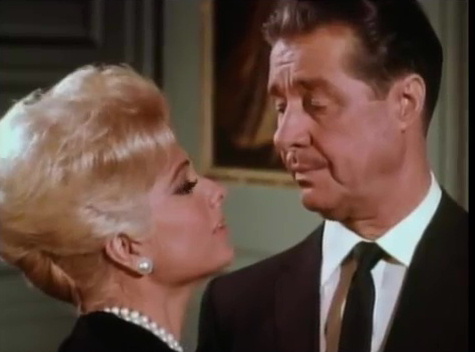
Martha Hyer and Don Ameche
PICTURE MOMMY DEAD (1966). Director: Bert I. Gordon.

Young Susan Shelley (Susan Gordon) gets out of a "convent" for the mentally disturbed three years after the death of her mother, Jessica (Zsa Zsa Gabor), in a fire in their mansion. Her father, Edward (Don Ameche), has been traveling the world with his new viper-like wife, the former governess, Francine (Martha Hyer), and now they are nearly broke. Another member of this highly dysfunctional household is Jessica's cousin, Anthony (Maxwell Reed), who was disfigured in the fire and will inherit money if both Edward and his daughter should happen to die, something which Francine is also happily aware of. But the murder victim may be more unexpected than you imagine. Picture Mommy Dead  -- one of a number of thrillers made by director Gordon, who had previously specialized in movies about giant people and monsters -- isn't that good, but it has a fairly interesting script that just misses the mark. A big problem with the picture is that Susan Gordon, the director's daughter, is too inexperienced (despite 25 previous credits!) to handle such a difficult and demanding role, although she gets an E for Effort. Zsa Zsa appears in a few flashbacks and isn't given anything too demanding to do, while Hyer plays her bitchy part with a little zest but little real skill. Ameche [Slightly French] comes off better, but Maxwell Reed of Daybreak is only somewhat effective. Wendell Corey delivers the goods in his one scene, playing a lawyer who is so tactlessly blunt with everyone that it's a wonder nobody murders him right then and there.

Verdict: Not terrible, but Gordon probably should not have cast his daughter. **1/2.

Thursday, March 14, 2013

NIGHT GALLERY Season 2 [POST # 2000!]

Laurence Harvey has a painful problem with an earwig
NIGHT GALLERY Season 2 (1971). Hosted by Rod Serling.

"I have read thousands -- tens of thousands -- of books, and never have I read about a spider the size of a dog -- not even in Kafka."

This second full season of Night Gallery continued the format of presenting at least two or more segments per episode, with Rod Serling introducing most segments using paintings mounted in a "night" gallery. Out of nearly fifty segments [in twenty-two episodes] only seven are memorable, with many not only on a "C" level but even descending to "D" or "F." In other words, most of the stories are pretty bad. Earlier episodes include quick gags or black humor black-outs, most of which are mercilessly unfunny. Among the more notable stories are: "The Boy Who Predicted Earthquakes," in which a small child is exploited for his psychic ability; "The Devil is Not Mocked" in which Count Dracula (an excellent Francis Lederer) takes on the Nazis; an adaptation of H. P. Lovecraft's "Cool Air," in which the addition of a romantic element doesn't hurt at all [Lovecraft's "Pickman"s Model," which also adds romantic-love aspects, doesn't work as well]; and the genuinely original "Sins of the Fathers" with Richard Thomas as a starving young man who must "eat" the sins [represented by food surrounding a corpse] of Barbara Steele's late husband. Arguably the two best episodes are "The Dark Boy" [from August Derleth], a poignant mood piece in which the ghost of a dead boy unites his lonely father with an equally lonely school teacher (Elizabeth Hartman) and "The Caterpillar," in which Laurence Harvey gets a fatal surprise when he tries to kill off a rival by employing an insect, the earwig, that enters through the ear and eats its way through the brain; probably the only really classic episode of the season, and the one most people remember [with excellent performances as well]. Some of the less memorable episodes have their entertaining moments, such as slatternly Zsa Zsa Gabor running from a dinosaur that wants to eat her in the amusing "Painted Mirror." Unfortunately, far too many episodes are flat, poorly conceived and developed, and have little real entertainment value. Among the more memorable guest stars are Vincent Price, Gale Sondergaard, Joanna Pettet, Virginia Mayo, and Louise Sorel. Producer Jack Laird also wrote and directed several episodes, but the generally mediocre quality of the show can't be laid only at his feet, as Serling himself contributed many execrable episodes.

Verdict: At least the earwig sticks in your mind [literally]. **1/2.

SPECIAL NOTE: This is the 2000th post of Great Old Movies, still going strong!

Wednesday, July 16, 2008

QUEEN OF OUTER SPACE

QUEEN OF OUTER SPACE (1958). Director: Edward Bernds.

Now classified as a "camp classic," Queen of Outer Space is simply a really awful movie. Being decked out in CinemaScope and Technicolor only makes its flaws more apparent. A spaceship in 1985 is hurled off course and lands on Venus, which is nothing like the way it's been described by scientists (no explanation is offered for this). Queen Yllana (Laurie Mitchell) has taken over the planet and banished the men whose war-mongering caused so much trouble, but she's just as bad. Zsa Zsa Gabor plays a scientist (yeah -- sure!) who is part of an underground conspiracy against the evil queen, and she and others help the earthmen to save their planet from a destructive blast from the queen's beta disintegrator. With costumes from Forbidden Planet (what an insult!), a plastic spider-prop from World Without End, and almost zero entertainment value, Queen of Outer Space isn't "so bad it's good"-- it's just bad. Slow pacing, a dumb script, and mediocre direction don't help. Some of the actors do the best they can -- Laurie Mitchell isn't bad -- but Zsa Zsa gives one of the worst performances by an actress in a professional (more or less) motion picture. Even Missile to the Moon (1959) and Fire Maidens of Outer Space (1955) were better than this! The bit with a deadly beam destroying a space station has some suspense to it even though the beam seems to come from a dozen different directions. A hilarious sequence has Gabor trying to imitate the queen as if none of the queen's guards would notice her accent!

Verdict: Not even the cheesecake and beefcake can save it. *.

Friday, January 11, 2008

GEORGE SANDERS: AN EXHAUSTED LIFE


GEORGE SANDERS: An Exhausted Life. Richard VanDerBeets. Madison Books; 1990.

An excellent, thorough look at the fascinating life of the fascinating man and actor George Sanders, his four marriages (each of which is a story in itself), his affairs, his attitude toward acting and toward life in general, his films, friends, and troubled final years. Sanders got bored early on with the kind of treacle that Hollywood gave him, and after awhile, took just about any film assignment strictly for the money. He was an excellent actor (an asset to most films) who probably would have done well to take on more challenging work, but had a fear of performing live and appeared to have no interest in being a Shakespearean actor a la Olivier. He didn't die out of boredom, but for more specific reasons which are detailed in the biography. The book is bolstered by major interviews with family members and ex-wife Zsa Zsa Gabor, who remained good friends with Sanders even after their ill-advised marriage was over. You'll also learn about Sander's rather cynical (or realistic) attempts to get his brother Tom Conway started in pictures in London; Conway eventually made it to Hollywood where – with his brother's help -- he achieved much less success than Sanders. The book is peppered by Sander's sardonic comments, quotes, and interviews. A very entertaining and informative read.

Verdict: A fine biography of a fine actor.***1/2.