Lively, entertaining reviews of, and essays on, old and newer films and everything relating to them, written by professional author William Schoell.
Showing posts with label Janet Leigh. Show all posts

Thursday, March 16, 2023

THE PERFECT FURLOUGH

Janet Leigh and Tony Curtis

THE PERFECT FURLOUGH (1958). Director: Blake Edwards.

104 lonely men are stationed at an Arctic outpost and a notion is advanced to raise morale. One man will be chosen to go on a "perfect furlough," which is decided will be three weeks in Paris with the sexy movie queen Sandra Roca (Linda Cristal). Manipulating everyone behind the scenes, Corporal Paul Hodges (Tony Curtis) manages to become the winner. But when Colonel Leland (Les Tremayne) discovers that Hodges is an incurable skirt-chaser, he insists that his aide Major Collins (King Donovan) and Army psychologist Lt. Vicki Loren (Janet Leigh), who came up with the idea of the furlough, go along to keep Hodges out of trouble. But when Hodges gets a load of Sandra, this assignment may be more difficult than anyone imagines.

Elaine Stritch with Leigh
The Perfect Furlough could have been a smirking dirty joke but it's generally tasteful and consistently amusing. There are a lot of laughs in watching Hodges' efforts to escape from the MPs so he can hook up with Sandra -- who has a few surprises of her own -- as well as in the interplay between Hodges and a disapproving, yet attracted, Vicki. This is the perfect material for Curtis, who understandably has great chemistry with Leigh as the two were married at the time (1951 - 1962). While no comedian, Leigh is fine in the role, and there are excellent supporting performances from Elaine Stritch as Sandra's keeper; Tremayne and Donovan; Keenan Wynn as Sandra's manager; Alvy Moore as Private Brewer, who almost gets to go to Paris; and Gordon Jones as an MP. 

Argentinian actress Linda Cristal is cute, curvaceous and charming as Sandra, but she had her biggest success on television, starring in The High Chaparrral for several seasons. Troy Donahue [A Summer Place], playing a sergeant who accompanies Donovan and Leigh, is in the background in several scenes but has no dialogue. Another cast member who should be mentioned is the wonderful Jay Novello [The Mad Magician], who plays a French winemaker and lives with his father (Marcel Dalio), who hopes he'll get married. Lilyan Chauvin [Lost, Lonely and Vicious] shows up very briefly as a nurse. 

Verdict: Well-acted and funny fifties service comedy. ***. 

Thursday, February 6, 2020

THE NAKED SPUR

Jimmy Stewart and Ralph Meeker
THE NAKED SPUR (1953). Director: Anthony Mann.

After the Civil War Howard Kemp (James Stewart) lost his farm to a faithless, greedy woman and is determined to buy it back with $5000 reward money for a murderer named Ben Vandergroat (Robert Ryan). Ben has been traveling with the daughter, Lina (Janet Leigh), of one of his deceased best friends, and he is equally determined to stay one step ahead of Kemp. Kemp enlists the aid of old prospector Jesse Tate (Millard Mitchell of Singin' in the Rain) and unsavory and dishonorable ex-soldier Roy Anderson (Ralph Meeker) to capture Ben, but now his two "partners" each want a third of the loot. The whole group begins a trek to Abilene where Ben is to be hung, but it's anybody's guess if they will all make it there in one piece, and if Ben will remain their captive ...

Robert Ryan and Janet Leigh. 
The Naked Spur sets up an interesting and harrowing situation -- the three captors are not just pitted against Ben and possibly Lina, but also each other -- and sustains suspense and tension all the way through. Admittedly, some scenes are not handled as dramatically as they might have been, and there's a disturbing sequence when a whole bunch of Indians are slaughtered when they are really just trying to get justice for a maiden who was apparently raped by Anderson. Stewart gives another impassioned and first-rate performance as Kemp, and Janet Leigh [Act of Violence] proves yet again that she was far more than just a pretty face. Ryan [Caught] plays in an unusual sardonic style considering what he's facing, but he pulls if off, and Meeker, as cocky as ever, makes the most of his turn as the rather sleazy Anderson. The ending seems tacked on to make Stewart's character more palatable, but it only makes him seem like an idiot. It's nice that character actor Millard Mitchell, who also gives a fine performance, is billed above the title with the four stars.

Verdict: Zesty if imperfect western with terrific cast. ***. 

Thursday, October 17, 2019

ACT OF VIOLENCE

Robert Ryan
ACT OF VIOLENCE (1949). Director: Fred Zinnemann.

Frank Enley (Van Heflin) is a respected man with a wife, Edith (Janet Leigh), and an infant son. Into their lives comes Joe Parkson (Robert Ryan), a friend and associate of Frank's during the war. Trying to save the lives of his men in a German POW camp, Frank made a terrible mistake, and these same men died torturous deaths. Joe is one of the survivors and has come to kill Frank, whose guilt and shame is at times overpowering. A woman Frank encounters named Pat (Mary Astor), puts him in touch with someone who can help, but then he learns that the plan is to murder Parkson ...

Van Heflin, Mary Astor, Berry Kroeger
Very well directed by Fred Zinnemann, Act of Violence is a superior crime film with some excellent characterizations and performances. The film doesn't offer easy answers, as even Frank himself wonders how noble or base his motives may have been during the war. Heflin turns in another sharp turn as Frank, and I don't think I've ever seen Janet Leigh better. Ryan has less to do than the others but he is effective and is given some fine moments. Phyllis Thaxter also makes an impression as Ann, a woman who is in love with Joe and tries to talk him out of murdering Frank. Strangely, the only performance that doesn't work at all is Mary Astor's, herein miscast as a middle-aged barfly, one of the few if only times I haven't been impressed with her work. (Her introduction into the story is rather contrived as well). Berry (sic) Kroeger [Atlantis the Lost Continent] certainly scores as the sinister Johnny, who plans to kill Joe for money.

Van Heflin and Janet Leigh
There are some comparatively minor problems with Act of Violence. It makes little sense that Edith wouldn't have had Joe arrested when he forces his way into the house, at gunpoint no less. That would certainly have gotten him off the streets for quite a while. The ending of the film is ill-conceived as well, although it gives Frank a chance at redemption. Unusual for a film made in the forties, there are no opening credits except for the title, with the rest of the credits coming at the very end. An interesting question: by refusing his superior officer, Frank's orders, was Joe more responsible for the men's deaths than Frank was?

Verdict: Worthwhile forties melodrama with more depth than usual. ***. 

Thursday, July 25, 2019

MY SISTER EILEEN (1955)

Janet Leigh and Bob Fosse
MY SISTER EILEEN (1955). Director: Richard Quine.

Ruth Sherwood (Betty Garrett) and her younger and prettier sister Eileen (Janet Leigh of The Spy in the Green Hat) come from Ohio to Greenwich Village to pursue careers as, respectively, a writer and an actress. Eileen becomes entangled with lunch counter waiter Frank (Bob Fosse) and on-the-make reporter Chick (Tommy Rail), while Ruth is involved with prominent magazine editor, Bob Baker (Jack Lemmon). Will the sisters find success and romance?

Bob Fosse and Betty Garrett
My Sister Eileen was originally filmed in 1942 with Rosalind Russell playing Ruth. Russell then reprised the role in a Broadway musical version entitled Wonderful Town with music by Leonard Bernstein. Columbia Pictures, which owned the rights to the original film, wanted to do a film adaptation of Wonderful Town with Judy Holliday stepping into the lead, but the show's producers wanted too much money. Therefore they decided to remake Eileen and add a completely new and different score by Leo Robin and Jule Styne. Meanwhile, Judy Holliday became unavailable and Betty Garrett, oddly, was signed to the part.

Jack Lemmon
Garrett, who was married to the blacklisted Larry Parks, is pleasant and competent enough as Ruth, but she can't hold a candle to Rosalind Russell. My Sister Eileen did not lead to major stardom for Garrett, who had bigger successes on television (All in the Family; Laverne and Shirley). Aside from a film noir feature some years later, Eileen was, in fact, Garrett's last starring role. Everyone in this remake is a step downward from the cast in the earlier film with the exception of Bob Fosse, who is very appealing, and Tommy Rail, who is handsome and adept, although, like Fosse, better known for his dancing (and in Fosse's case, choreography and direction). Ironically, Fosse's role in the original picture was played by Richard Quine, who co-wrote (with Blake Edwards) and directed this remake. Jack Lemmon is also quite nice as the editor, Bob Barker. Lemmon and Quine reunited for How to Murder Your Wife ten years later.

Kasznar, Leigh, Garrett, York
Other roles are filled by Kurt Kasznar as the landlord and Dick York as the off-season football player (which the skinny York scarcely resembles) who lives upstairs. The roles of the sisters' father and grandmother have been eliminated, along with the fortune teller Effie. This remake is not only in Technicolor and CinemaScope but it's been opened up with scenes in Frank's drug store, the El Morocco nightclub, and even the Brooklyn Navy Yard, although the apartment and Village scenes are clearly filmed on a sound stage. The Portuguese merchant marines have become Brazilian sailors. Expanding this sequence just creates a ridiculous scene in which these guys all chase after the not-very-sexy Garrett, something not handled quite so blatantly in the original. The conga scene from the original movie becomes a big production number but loses most of its charm. Another change has Ruth pretending that her stories about Eileen are really about her, an unnecessary development that goes nowhere.

Garrett, Fosse, Leigh, and Rail
Then there are the songs. Jule Styne, the composer of Funny Girl, Gypsy and Darling of the Day can be counted on for some nice numbers and he delivers such good tunes as "I'm Great But No One Knows It," "There's Nothin' Like Love" and "Give Me a Band and My Baby." One of the best scenes in the movie has Fosse and Rail doing a dancing dual as Eileen goes off for an audition.

Verdict: On its own terms, this can be entertaining, and the musical interludes are generally nice, but on a whole it's a cut below the original. **1/4.

Thursday, July 11, 2019

HOUDINI

Tony Curtis
HOUDINI (1953). Director: George Marshall.

Harry Houdini (Tony Curtis) is performing as the "wild man" in a carnival sideshow when he encounters the pretty Bess (Janet Leigh), who finds him a little headstrong. Nevertheless, he wins her over, the two are married, and the couple head for Europe where Harry is determined to become a great magician. Harry manages to escape from a strait-jacket, gets out of a Scotland yard jail cell, and nearly dies when he is caught beneath the ice in the Detroit River. Bess feels some trepidation as Harry prepares to extricate himself from the "Pagoda Torture Cell," which is filled with water and seems inescapable ...

Curtis and then-wife Janet Leigh
Houdini is loosely based on the life of the famous magician, although it does manage to get some of the facts straight. (The Pagoda Torture Cell was actually called the Chinese Water Torture Cell and Houdini escaped from it numerous times. not just once, and the ending to this film is pure fiction). Tony Curtis makes a perfect Houdini, combining brashness with slight nervousness, and giving an energetic performance, while his then-wife Leigh compliments him well as Bess. There are also notable turns by Torin Thatcher [Witness for the Prosecution] as the assistant to a late famous magician who comes to work for Houdini; Mabel Paige [Johnny Belinda] as a phony medium that Houdini exposes; Ian Wolfe [Foreign Correspondent] as the head of a magicians' society; and others. The film is also distinguished by good period atmosphere and the photography of Ernest Laszlo.

Verdict: Entertaining, colorful romp about a fascinating historical figure. ***. 

Thursday, June 13, 2019

AMERICAN PRINCE: A MEMOIR -- TONY CURTIS

AMERICAN PRINCE: A MEMOIR. Tony Curtis and Peter Golenbock. Harmony; 2008.

Apparently not being satisfied with the first book, this is the late Curtis' second autobiography. Never forgetting a slight, real or imagined, in this volume he settles scores. Since his first wife, Janet Leigh, had passed away by then, he feels free to dissect their marriage and highlight her alleged faults as a wife. (One can't imagine that this endeared him to his daughters by Leigh, including Jamie Lee Curtis.) One gets the impression that Curtis had no real interest in honest reflection nor in seeing things from other people's pov\s. He is the very personification of the self-absorbed movie star.

Curtis traces his early years and his bad relationship with his parents; the tragic deaths of his two brothers -- he never balances his basically successful life with the brother who was placed in a mental institution and eventually wound up homeless and beaten to death --  his determination to make it in Hollywood, and his cinematic triumphs in such as Sweet Smell of Success (arguably his greatest performance) and Some Like It Hot, among others.  Curtis doesn't shy away from detailing the years afterward, when he was forced to take virtually any role in any piece of crap just to pay the bills, including alimony and child support. He also writes about his cocaine addiction and his many marriages (at least one wife never gets mentioned at all).

Curtis never lost the chip on his shoulder. Part of this is due to the fact that he never felt he was really taken seriously. Part was also due to the fact that no matter what the role he generally came off as dead-common. This book didn't help him shake off that image.

Verdict: Not a bad read, but it leaves a sour taste. **1/2. 

Tuesday, October 30, 2018

THE FOG (1980)

THE FOG (1980). Director: John Carpenter.

As the California coastal town of Antonia Bay prepares for its centennial, most of the town's citizens are unaware of its truly tragic origin. The town's founders, learning that a wealthy man was planning to build a leper colony near the town, deliberately sank the schooner that the lepers were sailing on and took the wealthy man's gold for themselves. Now it's one hundred years later and the ghosts of the lepers want revenge. Noticing the glowing fog at sea, along with some other strange occurrences, are several townspeople, including: Stevie (Adrienne Barbeau), who runs the local radio station out of a lighthouse; hitchhiker Elizabeth (Jamie Lee Curtis) and the fisherman, Nick (Tom Atkins), who gives her a lift; the tippling Father Malone (Hal Holbook), whose grandfather was one of the town's founders; and Mrs. Williams (Janet Leigh), who tries to stay in charge of the ceremonies even as she deals with the fact that her husband is missing.


Adrienne Barbeau
This was the second theatrical film after Halloween for both director Carpenter and Jamie Lee Curtis, who has a supporting part in this. I was not all that impressed with The Fog when it was released, and it hasn't grown on me, although it is by no means a terrible picture, especially when compared to some of the horror schlock released at the same time. The main problem with the film is its too-deliberate pacing, which should at least give the movie time to develop its characters but doesn't. The main premise is quite good, but Carpenter, who co-scripted, just doesn't do enough with it, and viewers often get the impression that the movie is over just when it starts to get really interesting -- although to be fair there are some eerie sequences and a couple of startling moments. It also has some mood and atmosphere, and Dean Cundey's cinematography is notable. The picture cries out for a much better score than the one that composer Carpenter has provided, however. Janet Leigh gives a very obvious performance, but Barbeau [Two Evil Eyes] is better, along with most of the other cast members. Barbeau and John Carpenter were married at the time; their marriage lasted five years. I found it hard to believe that Barbeau's character would stay at the radio station instead of going to her little boy's rescue. Remade in 2005.

Verdict: If you like movies with creepy things in the fog, watch The Crawling Eye instead. **1/2.

Thursday, July 12, 2018

PRINCE VALIANT

Robert Wagner
PRINCE VALIANT (1954). Director: Henry Hathaway.

Hal Foster's newspaper comic strip Prince Valiant  -- which debuted in the late 1930's and is still published today -- was given lavish treatment by 20th Century-Fox with Technicolor and CinemaScope. Valiant (Robert Wagner of Titanic) is the Viking son of the exiled King Aguar (Donald Crisp). Hoping to restore his father to his throne, Val travels to the court of King Arthur, where he hopes to become a knight. Arthur (Brian Aherne) tells him that he must be a squire first, and he is   assigned to Sir Gawain (Sterling Hayden of The Star). Valiant falls in love at first sight with the beautiful Princess Aleta (Janet Leigh of Psycho), but, alas, Gawain falls instantly in love with her himself even as her sister, Ilene  (Debra Paget) pines for him. An added complication is a sinister and mysterious Black Knight, who has men who are loyal to him and wishes Arthur's throne for himself. Prince Valiant is a beautifully-produced movie which boasts one of Franz Waxman's richest and most  elaborate scores, as well as exquisite cinematography from Lucien Ballard. The performances are fine, and James Mason -- although this is arguably not one of his more memorable roles -- adds a nice touch as Sir Brack, who may have a few secrets (none of which will be surprising to the audience). In its early years the Prince Valiant strip had fantastic elements such as sorcery and monstrous giant beasts, but by the fifties the strip was more realistic and the film adaptation follows suit. There is, however, a well-choreographed and fiery battle scene, and a splendid and protracted sword fight between Val and Sir Brack. Ultimately, how much you enjoy the movie depends on how much you like the time period and the comic strip. Prince Valiant was never my cup of java, but the movie is still impressive in many ways.

Verdict:  Beautiful production values and not a bad story. ***.

Thursday, January 19, 2017

WORDS AND MUSIC

Mickey as Lorenz Hart and Judy as herself
WORDS AND MUSIC (1948). Director: Norman Taurog.

"... strange places with strange people ..."

Richard Rodgers (Tom Drake) and Lorenz Hart (Mickey Rooney) become a highly popular song-writing duo and a theatrical force to be reckoned with. This is a heavily fictionalized biography that completely suppresses Hart's homosexuality and alcoholism, and instead makes the man unlucky in love. The highlights of the film are the musical interludes: Judy Garland, playing herself, singing "I Wish I Were In Love Again" with Mickey; and doing a solo on "Johnny One-Note." Lena Horne scores with "Where or When? " and "The Lady is a Tramp,"  and Mel Torme does "Blue Moon." Then there's the excellent "Slaughter on Tenth Avenue" from On Your Toes with Gene Kelly at the top of his game. Rooney is as superb as ever, Drake [Betrayed Women] is fine as Rodgers, and Marshall Thompson plays associate Herbert Fields. Perry Como plays a fictional character in the film, and while his acting isn't bad, his singing style (at that time) apes Bing Crosby shamelessly. Janet Leigh has a nice turn as Rodgers' wife, as does Ann Sothern as Joyce, but the best one can say about Betty Garrett is that she's utterly unexciting. The picture is very handsomely produced, but the narration is unnecessary. To cap it all off we've got "With a Song in My Heart," one of Rodgers most beautiful melodies.

Verdict: Not the real story but colorful and entertaining. ***.

Thursday, February 26, 2015

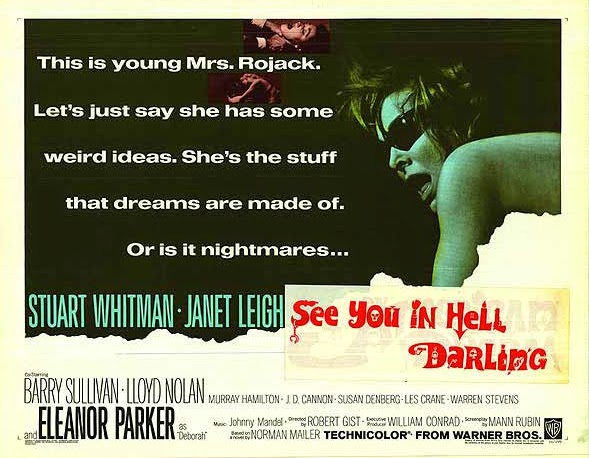
AN AMERICAN DREAM aka SEE YOU IN HELL DARLING

AN AMERICAN DREAM (aka See You In Hell Darling/1966). Director: Robert Gist.

When TV host Stephen Rojack (Stuart Whitman) pays a call on estranged wife, Deborah (Eleanor Parker), the vicious, drunken woman winds up falling off her balcony to her death. Rojack, grilled by police, does the sensible thing after his wife has just died and shacks up with old gal pal, Cherry (Janet Leigh). Rojack's father-in-law (Lloyd Nolan) contemplates pushing Stephen off of a balcony, and detectives Barry Sullivan and J. D. Cannon act like they'd like to tear his throat out. And we mustn't forget the whole host of mafia boys headed by Eddie Ganucci (Joe De Santis) and Johnny Dell (Warren Stevens) who have their own beef with Rojack. Whitman isn't bad, Parker [Lizzie] is vivid, Leigh plays it all in the key of bitter, Nolan is, frankly, terrible, Cannon over-acts in stock TV fashion, and Sullivan [Suspense] isn't much better. There are some interesting elements to An American Dream -- which is very loosely based on a novel by Norman Mailer -- but the movie is pretty much a melodramatic and at times even laughable mess. Acrophobes in the audience may have a few tense moments. Richard Derr has a bit as a producer while Murray Hamilton has a little more to do as an associate of Stephen's. Harold Gould and George Takei also have bits as lawyers. Whitman and Leigh appeared together in the monster bunny movie Night of the Lepus, which was actually a lot more entertaining than this.

Verdict: Everyone seems to be yelling -- or simmering -- to little effect. **.

Thursday, March 6, 2014

HONEYMOON WITH A STRANGER

Eric Braeden and Rossano Brazzi
HONEYMOON WITH A STRANGER (1969 telefilm). Director: John Peyser.

Sandra (Janet Leigh of Night of the Lepus) has just traveled to Spain with her new husband, Ernesto (Joseph Lenzi), where they move into a huge castle that he owns. Unfortunately, the next morning Sandra discovers that her husband has disappeared. Worse, when he finally shows up again, it's a completely different man (Cesare Danova), who insists he was the man that Sandra married, confounding both her and a sympathetic police captain (Rossano Brazzi of Summertime). Ah, but Ernesto has a lawyer, Frederico (Eric Braeden of The Young and the Restless) and a sister, Carla (Barbara Steele of Black Sunday), and when they arrive they'll settle the matter once and for all -- or will they only make matters more confusing? Honeymoon with a Stranger is an intriguing suspense film with a couple of good twists and good acting from all, with Leigh, Braeden, and especially a striking Steele especially notable. As she adds class to this production as she did to many others, one can only muse on the criminal under-utilization of Steele in cinema. The direction of this just covers the action, but the script and performers keep you entertained.

Verdict: A not bad Honeymoon. ***.

Friday, September 20, 2013

HITCHCOCK (2012)

Hitchcock (Hopkins) and Leigh (Johansson) share a ride and a laugh
HITCHCOCK (2012). Director: Sacha Gervasi.

"I was filming all day with John Gavin. Plywood is more expressive!" -- Hitchcock supposedly talking about actor John Gavin

If you take it with a grain of salt, this is an interesting and entertaining look at Alfred Hitchcock during the days when he was making Psycho, detailing the skepticism with which the project was greeted by the studio and others, showing how he cast the film and got along with the people he made it with. Did Hitch really peep at Vera Miles (Jessica Biel) while she was undressing? Probably not, but Hitchcock takes certain, shall we say, dramatic liberties. Anthony Hopkins is really nothing like Hitch, but his performance is still good, and Helen Mirren is excellent as his wife and collaborator, Alma, who seems very drawn to a novelist (Danny Huston) who is working on a screenplay with her. The best scene has Alma telling off Hitchcock in blunt if loving fashion late in the movie. Scarlet Johansson makes an effective and personable Janet Leigh. James D'Arcy gets little to do as Anthony Perkins, but the private lives of the actors in Psycho generally go unexplored and some -- such as Martin Balsam and John Gavin -- barely appear at all. The relationship between Alfred and Alma is depicted primarily as a loving and professional friendship. Hitchcock barely touches on the outrage and disgust that the film engendered in many quarters when it was released. The film is good-looking and well-paced.

Verdict: If you don't take it seriously as biography, this is a nice picture all told. ***.

Thursday, June 20, 2013

DEADLY DREAM

Lloyd Bridges
DEADLY DREAM (1971 telefilm). Director: Alf Kjellin.

Dr. Jim Hanley (Lloyd Bridges) is working on certain revolutionary DNA experiments that have the powers-that-be at his university nervous. He begins to have recurring dreams in which he is chased by menacing members of a group calling themselves the Tribunal. The spooky thing is that when he wakes up he has the minor injuries that he received running from the group in his nightmares. Then he starts seeing some of these men in his waking hours, also bearing scars from the dreams. A colleague (Carl Betz) tries to help him in one of his nightmares, but he is later killed in real life. Before long, Hanley is totally paranoid, suspecting anyone and everyone of plotting against him, including his own wife (Janet Leigh). He begins to wonder if his "real" life is just a dream, and the world of his nightmare is his true reality. Deadly Dream, an intriguing ABC "Movie of the Week," was probably inspired by the success of the previous year's Brotherhood of the Bell, which it resembles to a certain extent, although it goes off in its own direction and is not as good. The notion of unraveling DNA was ahead of its time, but not much is done with it. The movie is quite suspenseful and very well-acted by Bridges, Leigh and the rest of the cast, but some might groan a bit at the ending. Bridges really gives one of his best performances in this.

Verdict: Bizarre little telefilm with fine performances. ***.

Thursday, November 3, 2011

NIGHT OF THE LEPUS


NIGHT OF THE LEPUS (1972). Director: William F. Claxton.

"Attention! Attention! There is a herd of killer rabbits heading this way!"

Roy (Stuart Whitman) and Gerry Bennett (Janet Leigh) are scientists who come to Arizona to deal with an explosion in the rabbit population and the dangers this represents to the ecosystem. Trying to curb the rabbits', ahem, appetites, their experiments only result in rabbits that are much larger and astonishingly ferocious. Supposedly remaining vegetarians, they nonetheless go around attacking people, leaving mutilated corpses in their wake. Now, it would have been one thing if the special effects department had come up with some fearsomely mutated rodents with large fangs and grotesque appearances, but all they did was use real cute bunny rabbits stuffed into miniature sets and interacting with people via process shots. Some of these sequences aren't badly done, but the sound effects are what make the cuddly bunnies seem so horrible. The best scene is the climax when Leigh tries to keep the surrounding rabbits away from her and her little daughter after their camper gets a flat tire at night. Rory Calhoun plays a rancher and DeForest Kelley, almost fresh from Star Trek, is a friend of the Bennetts. Played completely straight, the movie is completely absurd but somehow amusing and entertaining, if strictly for monster movie devotees.

Verdict: Stupid, but a lot of fun in spite of it. **1/2.

Thursday, October 13, 2011

BYE BYE BIRDIE

Ann-Margret belts out title tune in Bye Bye Birdie
BYE BYE BIRDIE (1963). Director: George Sidney.

When Elvis-type rock singer Conrad Birdie (Jesse Pearson) is drafted, a plan is developed whereupon he will kiss a lucky girl, Kim (Ann-Margret), goodbye on the Ed Sullivan show. Songwriter Albert Peterson (Dick Van Dyke), whose song Birdie will sing, hopes this will lead to lasting success as a composer, while his secretary, Rosie (Janet Leigh), hopes it will lead to their marriage. Kim's father (Paul Lynde) hopes that his daughter's Sullivan appearance will lead to more business, while her boyfriend, (Bobby Rydell), just wants to belt Conrad in the nose. Albert's mother (Maureen Stapleton) seems only to want to take pot shots at Rosie ... and so on. But will a substitute ballet selection mean that Birdie and Kim will have to be bounced from the show, dashing everyone's hopes? Based on the Broadway stage musical, this adaptation is good-natured and pleasant but overall not that memorable. Ann-Margret at 22 seems way too sophisticated for a small town high school girl, and is in fact borderline grotesque at times. Maureen Stapleton, who doesn't seem to know how to kvetch, gives one of her rare bad performances. Van Dyke, Leigh, Sullivan (playing himself) and Rydell come off the best, with Lynde not far behind. Pearson isn't bad as the ersatz Elvis, but he's generally a bit too much, overdoing everything -- less would have been a lot more. Some of the songs make an impression: "Ed Sullivan;" "Put on a Happy Face" (which has become a standard); "Kids;" and the whole splashy production number "Got a Lot of Livin' to Do." The finale has the principles sabotaging a sequence from a Tchaikovsky ballet just so Conrad can sing Albert's forgettable number "One Last Kiss." Oy vey!

Verdict: Pleasant but not much more. **1/2.

Thursday, May 6, 2010

THE GIRL IN ALFRED HITCHCOCK'S SHOWER


THE GIRL IN ALFRED HITCHCOCK'S SHOWER. Robert Graysmith. Berkley Books; 2010.

Because of carelessness and the fact that she wasn't aware of what people were saying about her, Marli Renfro, the body double for Janet Leigh in the shower scene in Psycho, was reported murdered -- there was even a book about it. However it turns out the real victim was Myra Davis, a supposed stand-in for Leigh who did not take her clothes off and therefore did not "stand-in" in the shower. [People thought that "Marli Renfro" was Davis' stage name.] It was irresistible, of course: the body double in the shower in Psycho winds up being murdered by a psycho herself. Only it didn't really happen.

The Girl in Alfred Hitchcock's Shower purports to be a biography of the very-much-alive Marli Renfro, but author Graysmith doesn't seem to know if he wants to write a bio about a pin-up queen [with a great body but not a great beauty] that he idolized in college [time to grow up, maybe?]; a book about the making of Psycho; or a true-crime tome about "Sonny" Busch, who was strangling women around the time that Psycho was being made. And boy does this book suffer because of it!

Just as the story of Sonny Busch reaches fever pitch and you're anxious to know what happens next, Graysmith suddenly switches to a chapter about Renfro and her negligible "career" in men's magazines and in sex comedies. This happens again and again. You're anxious to find out how Sonny is going to get caught, and Graysmith expects you to give a shit about some old movie with Marli because Francis Ford Coppola was supposedly involved with it. Marli Renfro's life and career might have been worth an article, but a book? It's almost as if all the stuff about Hitchcock and Psycho and Sonny Busch on his murdering spree is padding for the life story of Marli Renfro! Who cares? The real story is Sonny Busch and his murder spree, but Graysmith keeps pulling away from it to concentrate on the tedious adventures of Marli, even dragging in Hugh Hefner and others for some added name-dropping. I suspect Graysmith was trying to create a book that was a big tapestry containing several elements, but it doesn't work -- the separate elements simply don't jell.

Worse, there seems to be only a couple of paragraphs about the actual murdered woman. We learn virtually nothing about her! The other victims are pretty much given short shrift as well.

While some parts of The Girl in Alfred Hitchcock's Shower are readable, the fact remains that this is a disjointed and ill-conceived project cobbled together for the 50th anniversary of Hitchcock's film. If Graysmith had wanted to write about Renfro and the world of men's magazines and cheap sex films of the sixties, he should have stuck to that. It seems to me that a book about Sonny Busch -- a psycho on the loose who even murdered two victims after seeing the film -- would have not only included the Psycho connection but made a far more interesting tome.

Verdict: Half of this book should have been left on the cutting room floor. **.

Thursday, July 2, 2009

THE SPY IN THE GREEN HAT

THE SPY IN THE GREEN HAT (1966). Director: Joseph Sargent. 

The Spy in the Green Hat was the European theatrical version of the two part Man from U.N.C.L.E. episode "The Concrete Overcoat Affair." Thrush has decided upon a crazy plan to turn Greenland into "Thrushland" and is planning to use deadly missiles in their scheme. Louis Strago (Jack Palance) is the person Thrush has assigned to this plan and he is assisted by a sadistic secretary/assassin played by Janet Leigh. While investigating the operation, UNCLE agent Napoleon Solo (Robert Vaughn) is caught in the bedroom of a pretty young Italian girl , Pia (Leticia Roman). Her relatives, prohibition mobsters who are now elderly men (Eduardo Ciannelli; Allen Jenkins), go after Solo to force him to marry her, but wind up teaming up with him when they learn that Pia has been taken captive by Strago. Jack Palance's performance is just a little over the top even for this kind of material, but Janet Leigh strikes just the right note as the psychotic hit woman and she has a nifty (if too brief) cat-fight with Letitia Roman. Ludwig Donath is the ex-Nazi who is working with Thrush and even Elisha Cook shows up as another petty, aging mobster. This is an entertaining UNCLE movie, with the usual quota of excitement and humor. "The Spy in the Green Hat" turns out to be Mr. Thaler, an emissary from Thrush Central, who comes to see Strago carry out the operation successfully. Thaler is well played by Will Kuluva, the actor who was first chosen to play the head of UNCLE [Mr. Allison] before it was decided to go with the better known Leo G. Carroll. [Kuluva also appears in the first UNCLE film To Trap a Spy.] Vaughn and David MaCallum are in good form as Solo and his fellow agent Illya Kuryakin. 

Verdict: As theatrical telefilms go, this isn't bad -- if you're an UNCLE fan. ***.

Thursday, March 12, 2009

PSYCHO

PSYCHO (1960). Director: Alfred Hitchcock. 

 "I think that we're all in our private traps, clamped in them. And none of us can ever get out. We scratch and claw, but only at the air, only at each other. And for all of it, we never budge an inch." -- Norman Bates. "If you love someone, you don't do that to them even if you hate them" -- Norman Bates. 

You can quibble about Psycho's flaws, but let's talk about the virtues of this incredibly influential motion picture. Anthony Perkins gives an outstanding performance, and his scene when he's questioned by an equally wonderful Martin Balsam as the investigator Arbogast is practically a textbook example of great two-party acting. Janet Leigh has gone up in my estimation. Yes, she delivers some lines that are meant to be ironic in too matter-of-fact a style, but she's quite good in her nervous scenes with the cop and the used car salesman, not to mention Norman. Simon Oakland as the psychiatrist in the epilogue plays the guy as if he's a bit nutty and insensitive, but he makes what could have been a dull scene a lot more interesting. Vera Miles displays an effective intensity and even John Gavin is better than usual. Frank Albertson is great as the wealthy guy with the forty thousand who starts the whole horrific ball rolling. Even the very small roles are well cast. Joseph Stefano's screenplay is full of wonderful -- and occasionally wicked -- dialogue. [For instance when Janet Leigh's much plainer co-worker Caroline (Pat Hitchcock) says to her : "He was flirting with you -- I guess he must have noticed my wedding ring."] Bernard Herrmann's score is one of the finest ever composed for a motion picture, from the stabbing violins to the German romanticism (heard softly behind the opening hotel room scene) that underscores the doomed love affair between Marion and Sam. His music embellishes every scene, such as the long sequence when Norman cleans up after "mother's" murder and drives Marion's car into the swamp. John L. Russell's crisp black and white photography is of a very high order, as are the sets and art direction. The basic set of the old house and the motel is a wonderful juxtaposition of the Gothic and the modern. There's no sense in saying Psycho isn't Shakespeare; its brilliance is on a cinematic level. In general Hitchcock's direction is assured and masterful. Even when you already know every plot twist, the picture holds your attention. And then we have the fascinating Norman Bates, inspired by the real-life Ed Gein but with his own unique and formidable facets. 

Verdict: Still an absolute masterpiece. ****.