Lively, entertaining reviews of, and essays on, old and newer films and everything relating to them, written by professional author William Schoell.
Showing posts with label Warren Stevens. Show all posts

Thursday, September 14, 2023

THE BAREFOOT CONTESSA

Humphrey Bogart and Ava Gardner
THE BAREFOOT CONTESSA (1954). Written, produced, and directed by Joseph L. Mankiewicz. 

Spanish dancer Maria Vargas is turned into a movie star by spoiled wealthy producer Kirk Edwards (Warren Stevens of The Price of Fear), famous director Harry Dawes (Humphrey Bogart), who has been on the wagon for several months, and ass-licking public relations man Oscar Muldoon (Edmond O'Brien). The beautiful Maria is desired by a great many men, including the South American millionaire Alberto Bravano (Marius Goring), and Italian Count Torlato-Favrini (Rossano Brazzi), but she has other dalliances with men not quite as rich. One of these dalliances will lead to tragedy ... 

The Barefoot Contessa opens with Maria's funeral, so you know her fate from the first, and the movie's flashbacks show how she got there. There isn't much about the picture-making process, and Maria -- although she stars in three films in a row -- is never shown on a set, nor do we see Dawes working his magic on his star. One of the most interesting sequences purports to show Maria dancing in a nightclub, although we never actually see Maria, only the varying reactions from the people in the audience, an audacious touch. (Later on Maria is shown dancing with a gypsy in the forest.) A lot about Maria's character is given away in drips and drabs. Gardner is really required only to be beautiful and sensual and a bit enigmatic, and she carries this off quite well, although it could not be called great acting. On the other hand, Bogart gives one of his best performances in this. O'Brien won an Oscar for his supporting performance, although it's well within his rather wide range. Stevens and especially Goring are both fine as dueling millionaires, and their sallies at one another at a party makes for one of the most arresting sequences in the movie. Edwards seems to derive no joy from his money, while Bravano enjoys life to the fullest. Rossano Brazzi is certainly a very handsome fellow, but in this film his performance lacks passion, although one could argue that he is playing a highly depressed character who probably has trouble getting excited about anything, except perhaps Maria, from whom he keeps a terrible secret.

Warren Stevens and Ava Gardner
There are some solid supporting performances in the picture: Mari Aldon as Myrna, who is badly mistreated by Edwards; Diana Decker [Is Your Honeymoon Really Necessary?] as a drunken blonde at a party who gets into it with Maria; Elizabeth Sellars [The Chalk Garden] as Jerry, a script girl who is Dawes' girlfriend; Valentina Cortese as Brazzi's sister; young Enzo Staiola [The Bicycle Thief] as a busboy with an eye for the ladies; Franco Interlenghi as Maria's brother, Pedro; Carlo Dale in a sexy, insinuating silent performance as Brazzi's chauffeur and Maria's lover; and former silent star Bessie Love as a patron at what is probably meant to be the casino at Monte Carlo. 

The Barefoot Contessa is an entertaining and absorbing picture, but there may be less here than meets the eye. Mankiewicz' targets are pretty familiar: wealthy movie producers who never worked a day in their lives and have no real taste; glamorous movie stars who seem to have no appreciation of their careers and what it's given them: oily publicists; the idle rich and the European jet set; and so on. Still, there are some amusing and trenchant observations scattered throughout the picture, along with some great dialogue. The situation with Maria and the count is a pathetic and intriguing one as well. The ending, in which Bogart is saddened by Maria's death but displays no anger at her killer is odd, but may be indicative of the production code's edict that adulterers must be punished. It's a major weakness in the movie. Marlon Brando was originally sought for the part played by Bogart, but I can't imagine Brando in the role. 

Verdict: Colorful picture that is not exactly about the picture business. ***.

Thursday, May 25, 2023

THE I DON'T CARE GIRL

Bob Graham and Mitzi Gaynor
THE I DON'T CARE GIRL (1953). Director: Lloyd Bacon.  Produced by George Jessel.

The real George Jessel is trying to produce a picture about old vaudeville star Eva Tanquay (Mitzi Gaynor of Anything Goes) and importunes his scriptwriters (Warren Stevens and Craig Hill) to locate people who knew the entertainer. These include Ed McCoy (David Wayne), supposedly the man who discovered her as well as her former partner; Charles Bennett (Oscar Levant of The Barkleys of Broadway), a composer; and Larry Woods (Bob Graham), another composer-performer who falls in love with Eva but is married. Larry is separated from his wife but a bigger problem is the seductive Stella Forest (Hazel Brooks of Sleep, My Love), who wants to star in Larry's operetta. Will true love win out over all?

David Wayne, Warren Stevens, Craig Hill
Hollywood is famous for coming out with biopics that have little to do with the real lives of their subjects, but The I Don't Care Girl takes the cake, as there's very little -- but the bare basics -- that have anything to do with Ms. Tanquay. The movie is really just an excuse to show off the admitted skills of Mitzi Gaynor, who gives a good performance, sings quite well, and is a sensational dancer with sensational gams. Ms. Gaynor is featured in some creative -- some might say overly creative -- big production numbers that have very little to do with anything ever seen on a vaudeville stage and everything to do with fifties fashion. 

Mitzi Gaynor and Oscar Levant
The title of the picture comes from Ms. Tanquay's most famous number, "I Don't Care." (Judy Garland, somewhat mimicking Tanquay,  arguably gives the best performance of this song in In the Good Old Summertime.) As for Tanquay, she was certainly a more interesting character than the sanitized version we see in this picture. Essentially forgotten today, she was once a tremendous international star, an early feminist, an absolutely relentless self-promoter, and had two or possibly three husbands as well as at least one affair. For a publicity stunt, she "married" a cross-dresser and wore a tuxedo while he wore the wedding dress. You can bet you won't see that in this movie! 

As for Bob Graham, the fellow is handsome, has a great baritone voice, and makes a smooth, likable leading man. But this was his last picture out of seven. What happened? Even the Internet Movie Data Base has very little information on him, including his date of birth and death. He is not to be confused with another actor named Robert Graham. 

Verdict: The story is just a mass of cliches but the cast is game and the dancing is great. ***.   

Thursday, February 20, 2020

THE PRICE OF FEAR

Merle Oberon and Lex Barker
THE PRICE OF FEAR (1956). Director: Abner Biberman.

Jessica Warren (Merle Oberon) is driving carefree and a little drunk when she runs over an elderly man. Does she call for an ambulance? No, she keeps driving. Her temporary crisis of conscience fades when she sees dog track owner Dave Barrett (Lex Barker) "borrow" her car and figures if she reports the vehicle as stolen he will be accused of the hit and run, not she. Complicating matters for Dave -- who took Jessica's car because he was being followed by hoods who want a piece of his track -- is the fact that the same time the elderly man was run over, an enemy of Dave's was shot to death. Barrett is going to be convicted of one crime or the other, but he gets close to Jessica to find out what he can. But is she really falling in love with him or does she have her own agenda?

Warren Stevens and Merle Oberon
The Price of Fear has more than one interesting situation and the relationship between Jessica and Dave with their conflicting goals but obvious attraction to one another adds to the film's compelling quality. This was one of Oberon's last starring roles -- it's a bit surprising to see her in this kind of film noir -- and she gives an excellent performance that keeps the audience guessing as to exactly what's on Jessica's mind and what she is ultimately planning to do. Barker gives it the old college try, and his line readings are certainly not terrible, but next to Oberon he's a bit of a wooden Indian. Warren Stevens gives one of his all-time best performances as the shady character Frankie Edare, who's responsible for a lot of Dave's problems; he and Oberon play especially well together.

Lex Barker
There are also good performances from Gia Scala [The Garment Jungle] as the heartbroken daughter of the elderly man; Charles Drake [It Came from Outer Space] as the police sergeant assigned to the case; and Stafford Repp [Batman: The Black Widow Strikes Again] and Mary Field as a tippling cab driver and his unloving wife. With a little added depth and characterization, The Price of Fear would have made an even more memorable picture, but it's quite absorbing as it is. It has a tense climax and an uncompromising wind-up. Abner Biberman was primarily a television director.

Verdict: Another one of those movies that is so good you wish it were just a bit better. ***. 

Thursday, September 14, 2017

HOT SPELL

Shirley MacLaine and Shirley Booth
HOT SPELL (1958). Director: Daniel Mann.

Housewife Alma Duval (Shirley Booth) is hoping that the 45th birthday celebration for her beloved husband, John (Anthony Quinn), will be a memorable occasion, but things are brewing that may make that impossible. John is very unhappy with his life and has taken on a lover who is decades younger than he is. Oldest son Buddy (Earl Holliman) feels that his dad doesn't take him seriously and is always putting him down. Daughter Virginia (Shirley MacLaine) is in love with aspiring doctor, Wyatt (Warren Stevens), but is only headed for heartbreak. And youngest son Billy (Clint Kimbrough) is uncertain about himself and unable to understand his father's unhappiness. Based on a play, Hot Spell is a thoughtful and beautifully-acted drama that looks at the ins and outs of marriage and family life with compassion and perception. Heading a terrific cast is a splendid Booth [About Mrs. Leslie], who must contend with her children's problems even as her own marriage, and her dreams of a happier future (tied to a home they lived in many years before), begin to crumble. Quinn is also superb, adding dimension and sympathy to what could have been an odious character in some ways, with fine work from Holliman [The Big Combo] and MacLaine (especially the latter). Kimbrough was an attractive and sensitive young actor who should have had many more credits than the twenty he amassed. Eileen Heckart [The Bad Seed] also appears as Alma's friend, Fran, and is also very good, as expected. One could argue that the movie is resolved a little too neatly, but it is generally quite effective and at times very poignant.

Verdict: A lost gem. ***1/2.

Thursday, February 26, 2015

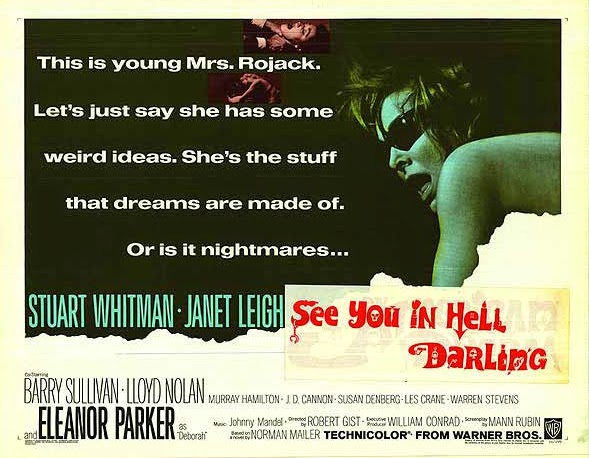
AN AMERICAN DREAM aka SEE YOU IN HELL DARLING

AN AMERICAN DREAM (aka See You In Hell Darling/1966). Director: Robert Gist.

When TV host Stephen Rojack (Stuart Whitman) pays a call on estranged wife, Deborah (Eleanor Parker), the vicious, drunken woman winds up falling off her balcony to her death. Rojack, grilled by police, does the sensible thing after his wife has just died and shacks up with old gal pal, Cherry (Janet Leigh). Rojack's father-in-law (Lloyd Nolan) contemplates pushing Stephen off of a balcony, and detectives Barry Sullivan and J. D. Cannon act like they'd like to tear his throat out. And we mustn't forget the whole host of mafia boys headed by Eddie Ganucci (Joe De Santis) and Johnny Dell (Warren Stevens) who have their own beef with Rojack. Whitman isn't bad, Parker [Lizzie] is vivid, Leigh plays it all in the key of bitter, Nolan is, frankly, terrible, Cannon over-acts in stock TV fashion, and Sullivan [Suspense] isn't much better. There are some interesting elements to An American Dream -- which is very loosely based on a novel by Norman Mailer -- but the movie is pretty much a melodramatic and at times even laughable mess. Acrophobes in the audience may have a few tense moments. Richard Derr has a bit as a producer while Murray Hamilton has a little more to do as an associate of Stephen's. Harold Gould and George Takei also have bits as lawyers. Whitman and Leigh appeared together in the monster bunny movie Night of the Lepus, which was actually a lot more entertaining than this.

Verdict: Everyone seems to be yelling -- or simmering -- to little effect. **.

Thursday, February 7, 2013

WOMEN'S PRISON

WOMEN'S PRISON (1955). Director: Lewis Seiler.

"They never get things right in prison pictures."

Convicted of vehicular manslaughter after accidentally killing a child, neurotic Helene (Phyllis Thaxter of The Sign of the Ram) is sent to a women's prison adjacent to a men's penitentiary. Her fellow inmates include Joan (Audrey Totter of The Saxon Charm), whose husband manages to cross over to see [and impregnate] her, returnee Brenda (Jan Sterling of Johnny Belinda), Mae (Cleo Moore of One Girl's Confession), and Dottie (Vivian Marshall) who does pretty bad impressions of Bette Davis and others but does a fairly good job of imitating Ida Lupino, who just happens to play the neurotic and slightly evil Amelia van Zandt, a prison official who lords it over the women's compound. All hell breaks loose when van Zandt is told she better find out how Joan's husband, Glen (Warren Stevens) managed to get in to see her [we never find out] and she begins slapping around the pregnant woman, raising the inmates' ire and leading to a fairly exciting climax. Women's Prison is the kind of junk movie that pretends to have some kind of social conscience while parading superficial platitudes and one-dimensional characters who have little basis in reality. Ida Lupino, with her mostly arch overplaying, does the best she can with terrible material; her real-life husband, Howard Duff (Dante), comes off much better and is quite good as the compassionate prison psychiatrist who thinks van Zandt is a psychopath. Thaxter is fine, but except for scenes when she's victimized gets little chance to etch a real character, and Ross Elliott is also good in his brief turn as her husband. Sterling and Totter aren't bad and Cleo Moore is Cleo Moore. The big trouble with this picture is that it isn't even very entertaining.

Verdict: A pretty bad "Bad Girls" picture. **.

Thursday, November 17, 2011

GORILLA AT LARGE


GORILLA AT LARGE (1954) Director: Harmon Jones.

When people start getting murdered at a carnival, the police wonder if the culprit is the star attraction, Goliath the gorilla, or someone in an ape suit. Suspects for the latter include the owner Cy Miller (Raymond Burr); his wife, Laverne (Anne Bancroft), who is a trapeze artist who works with Goliath; Joey Matthews (Cameron Mitchell), who has a crush on Laverne; Kovaks (Peter Whitney), Laverne's ex-husband; and a few others. The cops on the case include Lee J. Cobb (The Exorcist), Lee Marvin (Raintree County), and Warren Stevens (Phone Call from a Stranger). [Clearly this is one low-budget movie that has a very interesting cast.] This is a modestly entertaining, generally well-acted thriller that holds the attention if nothing else. Director Hrmon Jones did mostly television work, including a few episodes of Perry Mason. NOTE: Midnite [sic] Movies' remastered DVD looks great in high definition.

Verdict: Fun, even if most of the cast went on to much better things. **1/2.