Lively, entertaining reviews of, and essays on, old and newer films and everything relating to them, written by professional author William Schoell.
Showing posts with label Bob Fosse. Show all posts

Thursday, August 8, 2019

THE AFFAIRS OF DOBIE GILLIS

Bobby Van and Debbie Reynolds
THE AFFAIRS OF DOBIE GILLIS (1953). Director: Don Weis.

Dobie Gillis (Bobby Van) has enrolled in college but he doesn't seem to have much on his mind academically. He is much more interested in girls, especially Pansy Hammer (Debbie Reynolds), who is initially resistant. Pansy's parents, especially her grumpy father (Hanley Stafford), rarely approve of her boyfriends and Dobie is no exception. Further complicating the matter is that Dobie's pal and roommate, Charlie (Bob Fosse), goes for Lorna (Barbara Ruick), who only has eyes for Dobie. Then Dobie manages to get into trouble over and over again, and it seems as if he and Pansy are to be separated forever.

Roomies: Bob Fosse and Bobby Van
The Affairs of Dobie Gillis is a trifle, but what a charming and entertaining trifle it is, with a great cast of talented performers giving their utmost. Bobby Van [The Navy vs the Night Monsters], while not traditionally handsome, proves an adept leading man with both singing and dancing skills, a pleasant, outgoing personality, and plenty of exuberance and charisma. The same could be said for Bob Fosse, who is both cute (if not on a Tab Hunter level) and appealing, but chose to work primarily behind the scenes as a top choreographer in later years. Debbie Reynolds [Singin' in the Rain] is also cute and perky and while this is mostly Van's show, gives him her best in support. Barbara Ruick, who was in the film version of Carousel as well as Rodgers and Hammerstein's Cinderella, scores as the love-sick gal who adores her disinterested Dobie and is given at least one snappy number. 

Reynolds, Van, Freeman
As for the supporting cast, Hans Conreid, as a stuffy professor, reminds one of Mr. Livermore on I Love Lucy. Kathleen Freeman certainly adds to the fun as the comical leader of an all-girl band. Percy Helton shows up as a shop owner, Charles Lane is well-cast as a -- what else? -- grouchy chemistry professor, and there are bits by Alvy Moore,  Almira Sessions, and John Smith. Lurene Tuttle is Debbie's mother, and is fine, but Hanley Stafford as her father is all bluster and no laughs. The songs include "All I Do is Dream of You," "I'm Through with Love;" and "Can't Do Wrong If It's Right," which features some fancy footwork from Van and Fosse. The somewhat episodic film reminds one a bit of a sitcom at times, and indeed it wasn't long before The Many Loves of Dobie Gillis was being telecast every week, although with a completely different cast.

Verdict: Lots of fun, good tunes, and fancy footwork. ***. 

Thursday, July 25, 2019

MY SISTER EILEEN (1955)

Janet Leigh and Bob Fosse
MY SISTER EILEEN (1955). Director: Richard Quine.

Ruth Sherwood (Betty Garrett) and her younger and prettier sister Eileen (Janet Leigh of The Spy in the Green Hat) come from Ohio to Greenwich Village to pursue careers as, respectively, a writer and an actress. Eileen becomes entangled with lunch counter waiter Frank (Bob Fosse) and on-the-make reporter Chick (Tommy Rail), while Ruth is involved with prominent magazine editor, Bob Baker (Jack Lemmon). Will the sisters find success and romance?

Bob Fosse and Betty Garrett
My Sister Eileen was originally filmed in 1942 with Rosalind Russell playing Ruth. Russell then reprised the role in a Broadway musical version entitled Wonderful Town with music by Leonard Bernstein. Columbia Pictures, which owned the rights to the original film, wanted to do a film adaptation of Wonderful Town with Judy Holliday stepping into the lead, but the show's producers wanted too much money. Therefore they decided to remake Eileen and add a completely new and different score by Leo Robin and Jule Styne. Meanwhile, Judy Holliday became unavailable and Betty Garrett, oddly, was signed to the part.

Jack Lemmon
Garrett, who was married to the blacklisted Larry Parks, is pleasant and competent enough as Ruth, but she can't hold a candle to Rosalind Russell. My Sister Eileen did not lead to major stardom for Garrett, who had bigger successes on television (All in the Family; Laverne and Shirley). Aside from a film noir feature some years later, Eileen was, in fact, Garrett's last starring role. Everyone in this remake is a step downward from the cast in the earlier film with the exception of Bob Fosse, who is very appealing, and Tommy Rail, who is handsome and adept, although, like Fosse, better known for his dancing (and in Fosse's case, choreography and direction). Ironically, Fosse's role in the original picture was played by Richard Quine, who co-wrote (with Blake Edwards) and directed this remake. Jack Lemmon is also quite nice as the editor, Bob Barker. Lemmon and Quine reunited for How to Murder Your Wife ten years later.

Kasznar, Leigh, Garrett, York
Other roles are filled by Kurt Kasznar as the landlord and Dick York as the off-season football player (which the skinny York scarcely resembles) who lives upstairs. The roles of the sisters' father and grandmother have been eliminated, along with the fortune teller Effie. This remake is not only in Technicolor and CinemaScope but it's been opened up with scenes in Frank's drug store, the El Morocco nightclub, and even the Brooklyn Navy Yard, although the apartment and Village scenes are clearly filmed on a sound stage. The Portuguese merchant marines have become Brazilian sailors. Expanding this sequence just creates a ridiculous scene in which these guys all chase after the not-very-sexy Garrett, something not handled quite so blatantly in the original. The conga scene from the original movie becomes a big production number but loses most of its charm. Another change has Ruth pretending that her stories about Eileen are really about her, an unnecessary development that goes nowhere.

Garrett, Fosse, Leigh, and Rail
Then there are the songs. Jule Styne, the composer of Funny Girl, Gypsy and Darling of the Day can be counted on for some nice numbers and he delivers such good tunes as "I'm Great But No One Knows It," "There's Nothin' Like Love" and "Give Me a Band and My Baby." One of the best scenes in the movie has Fosse and Rail doing a dancing dual as Eileen goes off for an audition.

Verdict: On its own terms, this can be entertaining, and the musical interludes are generally nice, but on a whole it's a cut below the original. **1/4.

Thursday, April 6, 2017

DAMN YANKEES

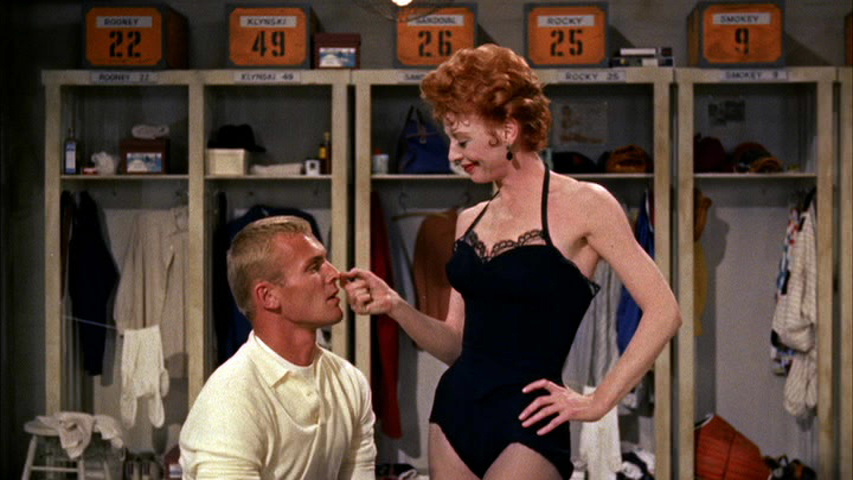
Whatever Lola Wants: Tab Hunter and Gwen Verdon
DAMN YANKEES (1958). Produced and directed by George Abbott and Stanley Donen.

"I was the ugliest woman in Providence, Rhode Island." -- Lola, remarking upon her origins

Joe Boyd (Robert Shafer) is a manic fan of the Washington Senators baseball team. The Devil -- in the form of a man named Applegate (Ray Walston) offers him a chance to become young and play for his favorite team against the "damned Yankees," even offering him an out. As "Joe Hardy" (Tab Hunter), Boyd becomes a star player with many fans, but he can't quite forget the wife, Meg (Shannon Bolin), he left behind. But will 172-year-old vamp Lola (Gwen Verdon) be able to keep Hardy in line? With its highly theatrical premise, this Broadway hit should not have worked as a movie but it does, mostly due to its performances and its recreation of some excellent production numbers. With the exception of Tab Hunter, most of the Broadway cast was transplanted to the big screen, a wise decision, especially in the case of Verdon. Although Verdon may not have been seen as a truly formidable sexpot, she is a highly talented performer with great dancing and acting skills and a really killer figure. Walston is as delightful as ever, and Hunter [Island of Desire] -- while not in the same class as the others -- does an okay job as the rather shy Hardy who wants to stay faithful to his wife. He briefly attempts some dancing as well and manages to pull it off. Rae Allen and Jean Stapleton [Dead Man's Folly], both of whom also appeared in the Broadway show, are snappy as, respectively, the inquiring reporter, Gloria Thorpe, and the likable neighbor, Sister Miller. Shafer and Bolin were primarily stage performers, and the former appeared in just this one picture. The score by Adler and Ross boasts some tunes that have become standards: "Whatever Lola Wants:" and the spirited "You Gotta Have Heart," but there's also Joe's nice farewell to his sleeping wife ("Goodbye Old Girl"); a snappy Mambo number; and the knock-out production number for Verdon and Hunter's "Two Lost Souls." Bob Fosse [Cabaret] did the choreography for both show and film; he and Verdon were married two years later. There's lots of dark humor and a poignant conclusion.

Verdict: One of the very best of the hit Broadway show film adaptations. ***1/2.

Thursday, April 16, 2015

CABARET

Threesome: Minelli, Griem,York
CABARET (1972). Director: Bob Fosse.

"I feel just like Kay Francis!" --Sally.

Brian: "Screw Maximilian!" Sally: "I do!" Brian: "So do I!"

In 1931 Berlin a language teacher named Brian (Michael York) becomes best chums with the free-spirited entertainer Sally Bowles (Liza Minelli) as Germany begins taking a Nazi turn for the worse. As two pupils -- Fritz (Fritz Wepper) and Natalia (Marisa Berenson) -- fall in love, Brian begins a romance with Sally that is complicated by the addition of handsome millionaire Maximilian Van Heune (Helmut Griem). Odd that this musical version of I Am a Camera is franker than the original in some respects, and tiresomely regressive in others. Michael York is appealing as the conflicted Brian, as is Marisa Berenson as the wealthy Jewish Natalia. Liza Minelli is less irritating in some ways than Julie Harris was playing the same part, although Harris is the better actress; that said, Minelli is not bad at all, although hardly deserving of the Best Actress Oscar she was awarded. Helmut Griem has little to do but look kind of sexy, but that he does perfectly well. I have to confess I found two things in this movie rather repellent: a made-up, simpering Joel Grey, although he's effective enough as the emcee; and Liza Minelli when she tries to act all sexy. The most unconvincing thing in the movie is the "romance" between Brian and Sally.

In I am a Camera, the "Brian" character was actually Camera writer Christopher Isherwood (Laurence Harvey), and he was so named. Herein Isherwood has been turned into an alternate Chris Isherwood but it never quite works -- his gayness is going to burst out no matter what. [Of course, one is tempted to say this isn't the first time Liza Minelli had a gay boyfriend!] Early in the film Brian explains that he tried sex with women three times and it was always a disaster. When he successfully has sex with Sally, she remarks they must have been the wrong three girls, that godawful creaky business about how you're only gay until you meet the right woman! This is somewhat redeemed by the revelation that Brian has been intimate with Max, but any sequences, erotic or otherwise, relating to this, are completely unexplored. All we know is that Brian and Max have had an argument, there's tension in the air, and Max seems very angry. But whether it's because Brian won't remain his "fuck buddy" [out of concern for Sally or the fact that Max is married] or because he prefers to stay with Sally (highly unlikely) is never revealed. The scene quoted above, in which Sally learns the two men are screwing behind her back, was considered quite controversial in its day and York's second line was always cut on network television. Michael York also played a character who slept with both men and women in Something for Everyone.

When Cabaret came out I liked the movie very much, but it's gone downhill in my estimation. Most of the characters are not well-developed, the film is coy and dated about sexuality, and aside from the snappy title number and "Tomorrow Belongs to Me," I didn't much care for the Kander and Ebb song numbers [they wrote the German youth's song in that style]. It also doesn't have enough period atmosphere despite the location filming. While Cabaret  deals more with the encroaching Nazis than I Am a Camera did, it doesn't really get across that sense of doom until the final chilling image. And at least I Am a Camera didn't invent a phony romance. NOTE: I have only seen the film versions of John Van Druten's "I am a Camera" and of the Broadway musical "Cabaret," so I can't comment on the stage originals.

Verdict: Some nice things in this, but overall I'd rather watch Something for Everyone. **1/2.