Lively, entertaining reviews of, and essays on, old and newer films and everything relating to them, written by professional author William Schoell.
Showing posts with label Richard Derr. Show all posts

Thursday, August 4, 2022

LUXURY LINER

George Brent and Jane Powell
LUXURY LINER (1948). Director: Richard Whorf. 

Widower Jeremy Bradford (George Brent) is the captain of a luxury liner. His precocious daughter, Polly (Jane Powell), wants to go with him on a cruise to Rio, but he insists that she finish her studies first. The determined young lady decides to become a stowaway, first to spend time with her dad, and second to audition for famous tenor Olaf Eriksen (Lauritz Melchior), who is also voyaging to South America. Instead she winds up peeling potatoes and scrubbing the corridors! Others on the boat include the man-hungry soprano Zita Romanka (Marina Koshetz); Laura Dean (Frances Gifford), who is trying to get away from her ex-fiance; and said fiance Charles Worton (Richard Derr), who is determined to win her back. Although Polly tries to get the lovers back together, a complication is that her father is falling for Laura himself. 

Brent with Frances Gifford
Luxury Liner
 is a gorgeous MGM technicolor bauble with no pretentions to great art, but it is an entertaining trifle that is good to look at and listen to. There is no score as such, just some older tunes that work well with this material. Melchior gets to sing Wintersturm, there's a dandy production number with Polly leading the kitchen staff in Alouetta, Polly sings a bit of Massenet's Manon, and even Xavier Cugat and his band get into the act with a zesty Latin number. Powell, who has a beautiful voice, even looks attractive when she does a trouser role in her school play at the film's opening. The Pied Pipers singing group get a number and Met soprano Koshetz also gets a chance to shine. Amiable and amusing as a man-chaser, she appeared in several other films as well. Brent does well with this unchallenging material, as does Powell, and Gifford was in everything from the great serial Jungle Girl to Henry Aldrich Gets Glamour, acquitting herself nicely in all. Melchior not only has a fine voice but a winning personality; he also did other movie musicals. Thomas E. Breen makes an impression as the sailor, Mulvey, as does John Ridgely, 

Verdict: The captain has a grand piano in his cabin! ***. 

Thursday, January 5, 2017

JOAN OF ARC

A captive Joan prays: Ingrid Bergman
JOAN OF ARC (1948). Director: Victor Fleming.

"We can win only if we become God's army."

Joan (Ingrid Bergman), a young farm girl in France, claims to hear voices from God, telling her to speak to the Dauphin (Jose Ferrer) -- who would become King of France -- and to rally the French troops to force the British interlopers out of the country. She is on a mission from God to save France. Initially people are skeptical --  she is eventually seen as a witch by some, and a saint by others, and she marches into battle as a kind of unarmed mascot. But Joan's admirers are growing in number, and the French powers-that-be are disturbed ... Joan of Arc was excoriated when it was first released, primarily because it cost more than Gone with the Wind but was a financial bust. It's hard to understand why contemporary critics found the film boring and almost worthless. I am not at all religious, but I was impressed by the film's performances --virtually every well-known character actor working in pictures at the time -- the score (Hugo Friedhofer), and the beautiful color cinematography (Joseph Valentine) which often makes each shot look like a painting. The movie moves quite quickly as well. Bergman gives an Oscar-winning performance, and is wonderful. The only quibble I might have is that in scenes when she is supposed to be utterly exhausted due to no sleep she merely seems mildly fatigued -- even make up would have helped, but one supposes no one wanted to mar her features. Bergman was 33 at the time of filming (Joan was put to the stake at 19) and always wanted to play the role; a younger actress might have lacked the ability and strength the part required. Jose Ferrer, who was introduced in this picture,  also won a Best Actor Oscar, and while he's not on Bergman's level, he is quite good as the rather foppish Dauphin. Of the huge supporting cast there is notable work from Richard Derr as a knight and Joan's first follower; John Emery [Kronos] as the sympathetic Duke d'Alencon; and Jeff Corey [Seconds] as a jailer intent on Joan's rape. There are also appearances by Jimmy Lydon (!) as Joan's brother; Alan Napier (Batman's butler) as the Earl of Warwick; Hurd Hatfield as Father Pasquerel; and brief bits with Henry Brandon, Thomas Brown Henry, George Coulouris, and many others. The worst performance is by Francis L. Sullivan [Hell's Island], who plays Pierre Cauchon, Joan's chief accuser, almost as if he were a villain in a cliffhanger serial. The movie employs a lot of dramatic license, as a great deal is not known about Joan, and the picture simply takes her at face value, with no indication (from the movie's point of view) that she may be either demented, opportunistic or both. Her horrible death is depicted but rather glossed over -- she doesn't even break out into a sweat as the flames supposedly consume her.

Verdict: At times the movie seems to exist in a vacuum, but it is beautiful to look at, well-paced, and features some marvelous performances. ***.

Thursday, April 23, 2015

CHARLIE CHAN IN RIO

Victor Sen Yung, Harold Huber, and Sidney Toler
CHARLIE CHAN IN RIO (1941). Director: Harry Lachman.

Charlie Chan (Sidney Toler) and his irrepressible son, Jimmy (Victor Sen Yung), have come to Rio where Charlie plans to arrest a woman from Honolulu who is wanted for murder; meanwhile Jimmy hopes to learn the mambo either from singer Lola Dean (Jacqueline Dalya) or her cute maid, Lili (Iris Wong). Alas, Lola is the woman wanted for murder, but she herself is killed before Charlie can put the cuffs on her. Suspects include Lola's baffled fiance, Clark (uncredited); Morana, the Indian mystic (Victor Jory of Cat-Women of the Moon); Ken Reynolds (a strangely unrecognizable Richard Derr of The Invisible Avenger); his wife, Joan (Mary Beth Hughes of Rockin' in the Rockies); friend Bill Kellogg (Hamilton MacFadden); the bitter Grace (Cobina Wright Jr.); Lola's efficient secretary, Helen (Kay Linaker); and even the butler, Rice (Leslie Denison). This is an entertaining mystery, but it lacks the tension and suspense of superior entries in the series. The acting is generally good, however, with Toler and Sen Yung in fine form. Harold Huber once again plays a police inspector, but is more relaxed and appealing than usual. Kay Linaker and Iris Wong were also in previous Chan pictures. Truman Bradley, who was in the last entry Dead Men Tell, is listed in the cast but I couldn't spot him in this and can't even remember the character!

Verdict: Acceptable Chan vehicle. **1/2.

CASTLE IN THE DESERT

CASTLE IN THE DESERT (1942). Director: Harry Lachman.

Charlie Chan (Sidney Toler) receives a note from a woman named Lucy Manderley (Lenita Lane of The Bat) that asks him to come immediately to her castle located in the Mojave Desert in California. Once he arrives, Charlie learns that Lucy never sent the note, but there has apparently already been one murder. Lucy is a descendant of the notorious Lucrezia Borgia, and when a victim or two winds up poisoned, naturally suspicion falls upon her. But there are other suspects: Carl Detheridge (Richard Derr of When Worlds Collide), who worked with Charlie on a previous case; Lucy's husband (Douglass Dumbrille of Alimony), half of whose face is hidden due to a scar; sculptor Watson King (Henry Daniell), who wants to do a bust of Lucy; cadaverous Arthur Fletcher (Milton Parsons), who has a few secrets; the weird fortune teller Madame Saturnia (Ethel Griffies); and others. As the deaths occur, Charlie and the others, including son Jimmy (Victor Sen Yung), are trapped in the castle without a car or a telephone. There's an apothecary in the basement that contains numerous poisons as well as a torture chamber. Castle in the Desert gets a little silly at times, but it has a good story and is well acted by the principals. Derr and Griffies appeared in previous Chan films but played different characters. This was the last Charlie Chan film produced by Twentieth Century-Fox.

Verdict: Good fun in a creepy castle. ***.

Thursday, February 26, 2015

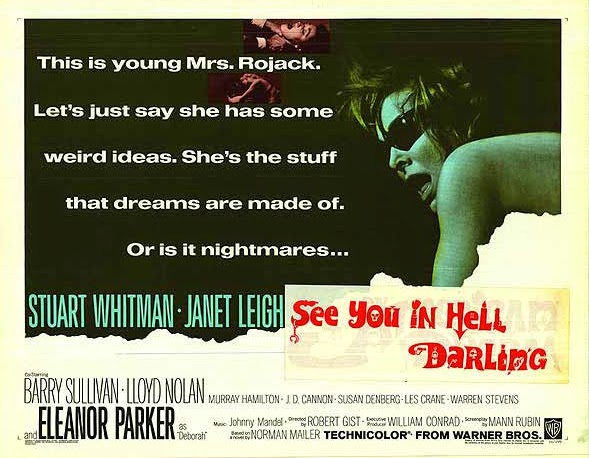
AN AMERICAN DREAM aka SEE YOU IN HELL DARLING

AN AMERICAN DREAM (aka See You In Hell Darling/1966). Director: Robert Gist.

When TV host Stephen Rojack (Stuart Whitman) pays a call on estranged wife, Deborah (Eleanor Parker), the vicious, drunken woman winds up falling off her balcony to her death. Rojack, grilled by police, does the sensible thing after his wife has just died and shacks up with old gal pal, Cherry (Janet Leigh). Rojack's father-in-law (Lloyd Nolan) contemplates pushing Stephen off of a balcony, and detectives Barry Sullivan and J. D. Cannon act like they'd like to tear his throat out. And we mustn't forget the whole host of mafia boys headed by Eddie Ganucci (Joe De Santis) and Johnny Dell (Warren Stevens) who have their own beef with Rojack. Whitman isn't bad, Parker [Lizzie] is vivid, Leigh plays it all in the key of bitter, Nolan is, frankly, terrible, Cannon over-acts in stock TV fashion, and Sullivan [Suspense] isn't much better. There are some interesting elements to An American Dream -- which is very loosely based on a novel by Norman Mailer -- but the movie is pretty much a melodramatic and at times even laughable mess. Acrophobes in the audience may have a few tense moments. Richard Derr has a bit as a producer while Murray Hamilton has a little more to do as an associate of Stephen's. Harold Gould and George Takei also have bits as lawyers. Whitman and Leigh appeared together in the monster bunny movie Night of the Lepus, which was actually a lot more entertaining than this.

Verdict: Everyone seems to be yelling -- or simmering -- to little effect. **.

Thursday, May 22, 2014

THE SECRET HEART

Claudette Colbert
THE SECRET HEART (1946). Director: Robert Z. Leonard.

On shipboard, Lee (Claudette Colbert) is romanced by Chris (Walter Pidgeon), who urges her to marry him instead of his "friend," Larry Addams (Richard Derr), to whom she is engaged. But Lee does marry Larry and finds herself trapped in a relationship with a neurotic, paranoid composer -- basically an asshole -- who takes a long time to finally dispose of himself. Chris comes back into Lee's life, but she resists him out of guilt. Another complication is that her step-daughter, Penny (June Allyson), thinks she's fallen in love with the much older Chris -- when she learns the truth of whom he really loves will she go the way of her father? The Secret Heart is an absorbing enough romantic melodrama, bolstered by some very good performances, especially from Colbert, Derr [Terror is a Man], Robert Sterling [Bunco Squad] as Lee's stepson and Patricia Medina as his fiancee. Lionel Barrymore is in Wise Old Owl mode as Penny's shrink, and Marshall Thompson is charming as a young man who is attracted to a dismissive Penny. June Allyson is not bad as Penny, although, as usual, she's a trifle cloying, and Pidgeon manages to hold his own with Colbert without being on her level. Elizabeth Patterson and Dwayne Hickman are also in the cast. Leonard also directed the far superior In the Good Old Summertime.

Verdict: Some people you can live without. **1/2.

Thursday, May 1, 2014

SOMETHING TO LIVE FOR

Ray Milland and Joan Fontaine
SOMETHING TO LIVE FOR (1952). Director/producer: George Stevens.

Alan Miller (Ray Milland) is a recovering alcoholic with a wife, Edna (Teresa Wright), and son. An elevator boy (Harry Bellaver) he knows calls him in to council a drunken hotel guest whom Alan assumes is male, but turns out to be a woman; Alan nevertheless decides to speak to her. Jenny (Joan Fontaine) is an actress who is letting alcohol strip her of her career and her dignity. Almost against their own wishes the two discover a mutual attraction, but there is the problem of Alan's marriage -- and his torment over his conflicted feelings ... Some contemporary critics saw Something to Live For as pure schmaltz, but for the more romantic-minded, it's an interesting picture with very good [if not necessarily great] performances from the leads. Teresa Wright with her expressive face offers a sensitive portrait of the wife who knows more than Alan realizes, and there's nice work from Richard Derr [When Worlds Collide] as an obnoxious, self-centered director with whom Jenny was once involved. Paul Valentine and Douglas Dick are also in the cast in smaller roles. One could argue about which classical composer influenced Victor Young the most, but his lovely score for the film is a decided asset. The ending may seem a little abrupt and simplistic, but it works beautifully. Stevens also directed Giant and many, many other notable films.

Verdict: While this is certainly not on the level of Brief Encounter, which it resembles in some ways, it is a worthwhile romantic picture. ***.

Thursday, May 17, 2012

WHEN WORLDS COLLIDE

WHEN WORLDS COLLIDE (1951). Director: Rudolph Mate. Produced by George Pal.

Earth has a real problem. A star called Bellus is entering our solar system and bringing with it a planet named Zyra. Unfortunately as these planetary bodies approach earth, they will tear the planet apart in only eight months. At first scientists are unable to convince skeptical, frightened authorities of the sad truth of the matter, but eventually they find a wealthy benefactor, Stanton (John Hoyt), to fund the building of a rocket that can take forty or so people to Zyra to start human life anew. Although as handsome as a peacock, Richard Derr makes a human and appealing hero as pilot David Randell, with scientist's daughter Joyce (Barbara Rush) as his love interest. [There is a triangle with Dr. Tony Drake (Peter Hansen) but this never overwhelms the story, although it adds another dimension to it at times.] The movie never makes it clear whether or not Earth will be completely destroyed or if there's any remote chance of some people surviving the cataclysm [why bother to evacuate 8 million people out of New York if they're all going to die anyway and where exactly do you put them?] and the final throes of the planet are never shown, except for the tidal wave that engulfs Manhattan [there's a great shot of the island under water with overturned ocean liners in the harbor]. A sequel might have dealt with the fact that Zyra appears to have "man-made" structures on it at the finale. There are some moments of pathos but at only 80 minutes the film concentrates primarily on action. Derr also appeared in Terror is a Man and The Invisible Avenger as the Shadow. Hansen has had a long, long list of credits. Rush also appeared in Bigger Than Life with James Mason and many other movies. A miscast Larry Keating plays Rush's father, and while he has his moments, sometimes his delivery carries all the urgency of a man ordering liverwurst in a deli. Mate also directed such fine pictures as D.O.A. and No Sad Songs for Me.

Verdict: Fast-paced and satisfying if imperfect. ***.

Thursday, July 30, 2009

TERROR IS A MAN

TERROR IS A MAN (1959). Director: Gerry De Leon. 

In what is essentially an uncredited version of H. G. Wells The Island of Dr. Moreau, William Fitzgerald (Richard Derr) survives a shipwreck and winds up on an isolated island where Dr. Girard (Francis Lederer) and his wife Frances (Greta Thyssen) are experimenting on animals. They have created a panther-man (an effective Flory Carlos) who breaks loose periodically and causes death and havoc. Meanwhile William and Frances find themselves drawn to one another. Filmed in the Philippines, this is actually a fairly decent horror flick with not-bad performances, and a brooding atmosphere, although perhaps not enough is made of the terrible presence in their midst. Competently scored and directed as well. Danish Greta Thyssen had very few credits. Richard Derr had a much longer list of credits, including playing The Shadow in The Invisible Avenger and starring in the Broadway musical Plain and Fancy [about the Amish] with Barbara Cook. Peyton Keesee is charming as the little native boy, Tiago, and Oscar Keesee (presumably a relative) is vivid as the leering Walter, who also has a lech for Frances. 

Verdict: Holds the attention. ***.

Monday, August 18, 2008

THE INVISIBLE AVENGER

THE INVISIBLE AVENGER (1958). Directed by James Wong Howe and John Sledge.

Richard Derr plays the famous Shadow, aka Lamont Cranston, in this pretty much lost curiosity which was one of the few films (co-) directed by famous cinematographer James Wong Howe. The story line has The Shadow getting involved with South American revolutionaries, an exiled King, and his evil lookalike brother, as well as various hoodlums. Reportedly this was originally the pilot for a possible Shadow TV series which received a theatrical release instead, and on the production level it does resemble a TV show. Throughout much of the movie Cranston is accompanied by a man named Jogendra (Mark Daniels), who is his teacher (even though Daniels doesn't seem much older than Derr). The Shadow is able to hypnotize people into thinking he's disappeared, effectively making himself an "invisible" avenger. There's some eerie music and a fair amount of atmosphere, but this is largely forgettable. It's unlikely that the resultant TV series would have amounted to much.

Verdict: Make like a shadow and disappear. *1/2.