Lively, entertaining reviews of, and essays on, old and newer films and everything relating to them, written by professional author William Schoell.
Showing posts with label Arthur Franz. Show all posts

Thursday, February 2, 2023

WOMAN OBSESSED

Stephen Boyd and Susan Hayward
WOMAN OBSESSED (1959). Director: Henry Hathaway.

When her husband (Arthur Franz) is killed during a forest fire, Mary Sharron (Susan Hayward) hires a man named Fred Carter (Stephen Boyd) to help her on the farm. Mary has a little boy named Robbie (Dennis Holmes), who is a little wary of Fred at first. Eventually Mary and Fred decide to marry, but the latter's parenting skills are noticeably lacking. This causes decided problems between husband and wife which are hardly helped by his backslapping her and then forcing her to have sex with him. Sexual assault anyone? 

Mary and Fred fall for each other: Boyd; Hayward
From the title and the star you might hope that Woman Obsessed is a trash wallow with Hayward chewing the scenery as she deals with man troubles and other women, but nothing much like that ever happens. The sluttish and homely Barbara Nichols shows up now and then as Fred's ex-girlfriend (he definitely stepped up in class when he married Hayward), but there are no cat fights -- although Fred and Nichols' new boyfriend do have a lively fistfight late in the picture. Instead we are offered some dubious dime store psychology from Hayward's doctor (Theodore Bikel) in regards to Fred's attitudes towards alleged cowardice and other things. Some of the occurrences in the film are predictable; others are not. Both the doctor, Hayward, and the film itself gloss over the rape that clearly occurs (offscreen) halfway through the movie. 

Dennis Holmes with Hayward
Modern-day audiences will have a problem getting past the rape, although there is an attempt to redeem Fred with his heroic efforts to save Mary's life after she has a miscarriage, and his change in attitude towards the boy once he realizes that he, too, can feel fear. Hayward gives a more subdued performance as fits her character and Boyd is actually quite good. Affecting a kind of Canadian accent -- this takes place in Saskatchewan -- it disguises and offsets the somewhat nasal quality of his voice. 9-year-old Dennis Holmes (playing 7, not too big a stretch) is wonderful as little Robbie; he was best-known for a role on the western TV series Laramie with Robert Fuller. Everything is wrapped up in the end like a fifties sitcom. 

Verdict: A nice score (Hugo Friedhofer) and some good acting aren't enough to make this memorable. **. 

Thursday, July 26, 2018

THE EDDIE CANTOR STORY

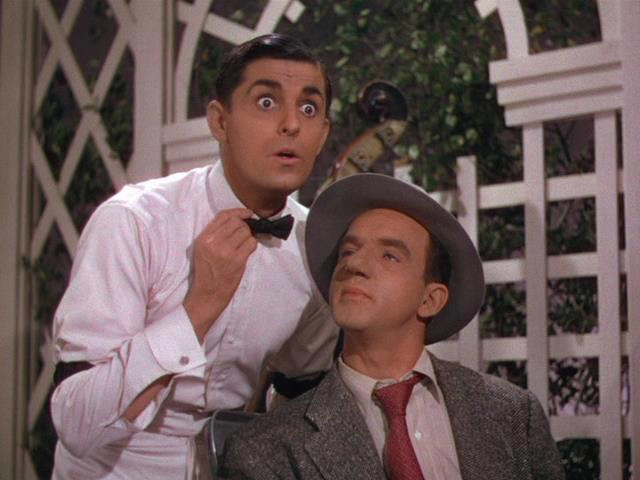
Keefe Brasselle (Cantor) and Jackie Barnett (Durante)
THE EDDIE CANTOR STORY (1953). Director: Alfred E. Green.

Even as a boy Eddie Cantor (Richard Monda) knew he wanted to be an entertainer. When a foolish do-gooder named Berk (David Alpert) wants to pack the kid off to an orphanage, claiming that his sturdy grandmother Esther (Aline MacMahon) can't take care of him, Eddie is fortunate to wind up with a theatrical couple who sponsor a children's revue instead. As Eddie (now played by Keefe Brasselle) falls in love with his childhood sweetheart, Ida (Susan Odin, and then Marilyn Erskine), he struggles to make a name for himself as an adult singing and dancing comedian. But the more famous Eddie gets, the more he neglects his wife, whose loneliness is palpable despite her having (eventually) five daughters to raise. Then serious health issues crop up and it looks like Cantor's career is over ... Eddie Cantor was still alive when this film came out, so the worst thing the movie says about the comic is that he was overly ambitious and addicted to applause and stardom, a fact that had a negative impact on his family life. The Eddie Cantor Story sticks to the basic facts about the man, even it it remains somewhat on a superficial level. However, Brasselle [Bannerline], outfitted with pop eyes and bigger teeth that generally disguise the actor's handsomeness. gives an excellent, well-studied impression of the famous performer. (One could argue that Brasselle, as is often the case in biopics, impersonates the man as he acts while performing as opposed to how he acts off-stage, but somehow this approach works.) Using the real Cantor's voice, Brasselle expertly recreates his routines from the Ziegfeld Follies as well as from such Broadway shows as Whoopee. The film boasts another excellent performance from Marilyn Erskine, who generally worked in television but should be much better known, as the grown-up Ida. Erskine explores every nuance of the character with her sensitive and splendid emoting. Aline MacMahon [The Young Doctors] is sterling as the loving, supportive grandmother, and there is very nice work from Arthur Franz [The Atomic Submarine] as a doctor who remains a loyal friend of the couple through thick and thin. Jackie Barnett does an amusing imitation of Jimmy Durante, and Will Rogers Jr. is cast as his father. Richard Monda is very winning and effective as Cantor as a child. Smaller roles are enacted by the likes of Chick Chandler (as a talent show host); Marie Windsor (as a jealous star); Gerald Mohr (as an old friend and bootlegger); Alix Talton (as a reporter;) as well as Ann Doran and Arthur Space. One is struck by the similarity between Cantor and friendly rival Al Jolson, who also performed in blackface. In his later years, Cantor did film and television work, and also became a spokesman for the March of Dimes. Cantor and his wife appear in the film's framing sequence, and he is given a classic closing line: "I've never looked  better in my life." Although two actors are credited with playing Cantor's parents (who died when he was an infant), they are either seen only in photographs, or their scenes were cut.

Verdict: Delightful biopic with top performances and snappy musical numbers. ***.  

Thursday, April 20, 2017

THREE SECRETS

Eleanor Parker and Patricia Neal
THREE SECRETS (1950). Director: Robert Wise.

"Is he going to be surprised! You know what his grounds [for divorce] were? He said I wasn't a woman!" -- Phyllis, on learning that she's pregnant.

A plane crashes on a mountain and the only survivor is a little boy. As rescue workers prepare for the dangerous two mile ascent, three women arrive on the scene, all of them wondering if the child is the one they gave up for adoption. The little boy was born on the same day as their child, and came from the same orphanage. Susan (Eleanor Parker) is afraid her marriage may not survive if her husband (Leif Ericson) learns she had a child out of wedlock. Phyllis (Patricia Neal) was a war correspondent whose husband (Frank Lovejoy) left her because she was never home and wouldn't conform to being a traditional wife; she learns she is pregnant after he remarries. Ann (Ruth Roman) gave birth to a boy fathered by a conscienceless wealthy man who paid the ultimate price for his callousness. Three Secrets concentrates on the emotional turmoil of the women's lives and not on the harrowing details of the rescue of the boy, which would have been a completely different picture. The three leading ladies all give fine performances, with Parker and Neal being especially notable. Katherine Warren is also good as Susan's mother, and Kenneth Tobey appears briefly as an army officer who catches Susan with her soldier boyfriend (Arthur Franz). The film's premise is contrived but irresistible, but some of it has to be taken with a grain of salt. An orphanage might acquire three baby boys on the same day in a big city, but all three women basically arrive there at the same time, and how likely is it that Phyllis will remember Susan, who she barely speaks to, five years later, reporter or no. But these are minor concerns: the picture plays beautifully, is very well-acted and well-directed, and has a very moving conclusion. David Buttolph's score disconcertingly reworks the melody of "I Get a Kick Out of You." Although it's been unfairly compared to it, this is completely different from A Letter to Three Wives. This was remade for television in 1999.

Verdict: Oh a higher plateau than the usual soap opera. ***1/2.

Thursday, May 7, 2015

BACK FROM THE DEAD

Otto Reichow and Peggie Castle
BACK FROM THE DEAD (1957). Director: Charles Marquis Warren.

Dick Anthony (Arthur Franz of Monster on the Campus) stupidly decides to bring his new wife, Mandy (Peggie Castle of I, the Jury), to the home he once shared with his first wife, although he claims he was "compelled" to do so. Maybe that's the case, because it isn't long before both Arthur and his sister-in-law Kate (Marsha Hunt) are baffled by Mandy's insistence that she is really Arthur's drowned wife, Felicia. Has Mandy's mind and body been taken over by the consciousness of the dead Felicia, or is something else going on? Almost from the very first it seems clear that this is a genuine case of demonic possession, with Arthur and Kate hoping to free Mandy, and others -- such as Felicia's batty mother, Ada (Helen Wallace) and sinister spiritualist Renault (Otto Reichow) -- trying to keep Felicia on the more or less mortal plane. All of this sounds interesting, and the acting isn't bad, but Back From the Dead is only sporadically entertaining and has very little suspense. James Bell is especially good as Felicia's horrified father. The music by Raoul Kraushaar is (deliberately one hopes) atrocious. Warren also directed Unknown Terror, which was better than this.

Verdict: This one should have stayed dead. **.

Thursday, January 10, 2013

BEYOND A REASONABLE DOUBT (1956)

BEYOND A REASONABLE DOUBT (1956). Director: Fritz Lang.

After viewing an  execution in a prison, writer Tom Garrett (Dana Andrews) and newspaper publisher Austin Spencer (Sidney Blackmer) have a discussion in which the latter wonders if the dead man, convicted on purely circumstantial evidence, could have been innocent. While Spencer is very much opposed to the death penalty, Garrett is thinking more of what a great book it would make if the two of them conspired to make it look as if the latter were responsible for the unsolved murder of a show girl. The idea is to get the innocent Garrett convicted and then whip out photographs Spencer has taken of Garrett planting phony evidence. (It doesn't occur to either of them that by tampering with evidence and obstructing justice they would both be committing serious crimes.) The biggest problem is that the two men don't include Spencer's daughter Susan (Joan Fontaine), who is engaged to Garrett, in the loop. While the whole movie has to be taken with a grain of salt, Beyond a Reasonable Doubt moves at a brisk pace and is quite entertaining, offering a neat twist that most viewers won't see coming. Andrews' stoicism serves him well as Garrett, Blackmer is as good as usual, and Fontaine is simply outstanding in her strongly emotional scenes as Joan. Arthur Franz, Shepperd Strudwick, Barbara Nichols and Philip Bourneuf are also solid in supporting roles. Remade -- quite well -- in 2009.

 Verdict: Invigorating suspense film with neat finale. ***.

Thursday, May 26, 2011

INVADERS FROM MARS


INVADERS FROM MARS (1953). Director: William Cameron Menzies.

"The little man has had a big day."

A young boy, David (Jimmy Hunt), sees a spaceship land in the desert outside his house and soon discovers that aliens are taking over the minds of his parents and other townspeople. Dr. Kelston (Arthur Franz) and Dr. Blake (Helena Carter) believe the boy even though others think it's just his imagination. Although this was made before Invasion of the Body Snatchers -- which is a much better movie -- it shares some similarities with the later picture (which improved upon these ideas). There are many people who have very fond feelings for Invaders from Mars, but to me it's far from being a classic. Menzies' stylish sets, especially the path to the desert or moors, are good, and the viewer can get caught up in David's emotional concern for the welfare of his parents, but the movie is unintentionally comical and the dragged-out climax makes it seem like it's three hours long. Little Hunt is good, as is Hillary Brooke as his mother, and Morris Ankrum offers another stalwart portrait as the general in charge.The martians, unfortunately, look like duck-footed dorks in scratchy woolens, and I've never known what to make of that ugly head in the jar that leads them. [Although this "martian intelligence" is supposed to be male, it's played by diminutive actress Luce Potter.] The version of the film released in the U.K. has a better ending than the hokey one used for American prints.

Verdict: Watch It Conquered the World instead. **. 

Thursday, January 14, 2010

THE UNHOLY WIFE

THE UNHOLY WIFE (1957). Director: John Farrow. 

Paul (Rod Steiger) is a vintner who marries a woman, Phyllis (Diana Dors), who admits from the first that she's not very good. It's not just that she has no maternal instinct, she doesn't even have any particular love for her little boy, Mike (Gary Hunley), and as he's a charmer that puts her in an especially bad light. We learn from the first that Phyllis has fallen for hunky rodeo man San Sanders (Tom Tryon, who later became a novelist), and wants to murder Paul. But will she succeed in her plans? There are ironic and compelling aspects to this sultry melodrama, which features an interesting cast and good performances. Steiger is excellent, as usual, and Dors is pretty good, although one could say that she plays it a little too cool and unemotional for the most part. [Even sociopaths can at least act emotional when they have to.] Tom Tryon, little Gary Hunley, and Arthur Franz as Paul's priest brother are notable, as is Beulah Bondi as Paul's mother. [It's hard to imagine Diana Dors and Beulah Bondi in the same movie, but there they are, sometimes in the same frame.] Marie Windsor is her usual sardonic self in a brief bit as an associate of Phyllis' in a nightclub. Dors appears very deglamorized in certain sequences. 

Verdict: May not seem promising at first but stick with it. ***.

Thursday, October 22, 2009

THE WILD PARTY (1956)


THE WILD PARTY (1956). Director: Harry Horner.

Anthony Quinn, Carol Ohmart (Vincent Price's bitchy wife in House on Haunted Hill), Arthur Franz of Atomic Submarine and The Sniper, Nestor Paiva of Tarantula, Kathryn Grant of The 7th Voyage of Sinbad, Paul Stewart and Nehemiah Persoff all in the same movie -- too bad it's a nearly unwatchable stinker. It's even more of a shame that virtually everyone in the cast gives a good performance, especially Carol Ohmart, who mostly did TV work. She plays Erica, who is seeing boyfriend Franz on his last night before going overseas, and is kidnapped by a crazy, desperate Quinn. Jay Robinson plays an even crazier pal of Quinn's, Gage. Persoff's hippie character, "Kicks," is incredibly annoying, although Persoff plays him well (too well). A lot of bad dialogue and under-developed characters.

Verdict: Fairly pitiful, with a cast that deserves better. *.

Thursday, June 11, 2009

MONSTER ON THE CAMPUS

MONSTER ON THE CAMPUS (1958). Director: Jack Arnold. 

Professor: "Don't open the door! It might escape!" Girl student: "Who cares!?" 

The trouble all starts for Professor Donald Blake (Arthur Franz) when he orders a dead coelcanth for his college science lab. The blood of the prehistoric fish has properties that inexplicably turn back the clock on any species that comes into contact with it. A dog becomes an ancient wolf, a dragonfly grows to giant size, and Professor Blake ... ? Well, somebody has to be the monster on the campus and it might as well be him. Franz gives a good -- not great -- performance in the film, but he's certainly better than the wooden Troy Donahue, who's one of his students. Joanna Moore plays Blake's fiancee Madeline, and Helen Westcott is a colleague and his first pitiful victim. Although the pace drags a bit at the end, the film is generally fast-moving and entertaining. Ross Elliot, who appeared in many genre films, is a police sergeant; Whit Bissell plays a doctor. The make-up and the dragonfly are creditable. Some creepy and suspenseful scenes; ably directed by Arnold. It doesn't hurt that the film seems to use the same score as Arnold's Tarantula. Westcott was also in The Invisible Avenger and Abbott and Costello Meet Dr. Jekyll and Mr. Hyde. Franz's best performance was in The Sniper

Verdict: Could have been called The Astounding Fish-Monster! ***

Friday, November 7, 2008

ROSEANNA MCCOY


ROSEANNA MCCOY (1949). Director: Irving Reis.

"Don't talk with your knife in your mouth!"

Hollywood's look at the famous feud between the Hatfields and the McCoys of Kentucky has Roseanna McCoy (Joan Evans) falling in love with Johnse (sic) Hatfield (Farley Granger) while the relatives fuss, fight, sass, and shoot. The main problem with the film, besides a script that's half-baked, is the miscasting of the leads. Granger is no Kentucky mountain man by a long shot, and Evans [pictured with her godmother Joan Crawford], although not totally awful, is too inexperienced and passionless -- not to mention comparatively plain and pudgy-faced -- to amount to much of a heroine. The much more talented supporting cast is certainly interesting, however. Raymond Massey and Aline MacMahon, are Roseanna's parents, while Charles Bickford and Hope Emerson of Caged fame are the Hatfield folk. Arthur Franz, Marshall Thompson and Richard Basehart also have roles, and do fine with them, Basehart in particular. Gertrude Hoffman of My Little Margie and Mabel Paige of I Love Lucy and The Sniper also have small roles. But perhaps the best and most impassioned performance in the film is given by little Peter Miles, who plays "Little Randall" McCoy, and is the brother of Gigi Perreau (who was his sister in real life and in the film). Years later Miles wrote the novel upon which Robert Altman based his film That Cold Day in the Park. While there's some fairly exciting gun play at the climax, the entire project is mostly forgettable.

Verdict: Watch the Beverly Hillbillies instead. **.

Tuesday, October 14, 2008

THE SNIPER

THE SNIPER (1952). Director: Edward Dmytryk.

Eddie Miller (Arthur Franz) is a delivery man for a cleaning service and has a problem with women. When one of his customers, a singer named Jean (Marie Windsor) innocently excites him but sends him away when her boyfriend shows up, he begins a spree of shooting women, with Jean the first victim. Franz, who is excellent, is the perfect choice for the title role, with his clean cut features and appealing presence in stark contrast to the terrible crimes he's committing. The movie certainly has an interesting cast. Adolphe Menjou is the head cop on the case, Lt. Frank Kafka, and Richard Kiley, that Man of La Mancha himself, is a police psychologist. He gives disturbing statistics about sexual predators (the situation has obviously gotten much worse since 1952). Frank Faylen and Gerald Mohr are also cast as policemen. Miller's landlady is played by Mabel Paige, who sold Lucy and Ethel her dress shop in a classic I Love Lucy episode. Jay Novello, who also appeared on I Love Lucy, turns up in another amazing characterization as Pete, the owner of the bar where Jean sings for her supper. The movie is well made and completely absorbing, but it does give rather short shrift to the victims.

Verdict: Probably Franz' finest hour. ***.

Friday, September 5, 2008

BAD FOR EACH OTHER


BAD FOR EACH OTHER (1953). Director: Irving Rapper.

A young medical man is torn between helping the poor miners in his home town or joining a practice in which most of his patients would be bored, wealthy women. No, it's not The Citadel, it's a modern-day rip-off called Bad for Each Other. Charlton Heston is actually a military man with a medical degree who comes home to Pittsburgh after his brother's death. Lizabeth Scott is the rich gal he falls for, and Mildred Dunnock is his mother (both are very good). Arthur Franz is fine as an ex-serviceman who asks Heston for a job and Marjorie Rambeau scores as Scott's aunt. Heston saunters through the movie with his usual star charisma and gives a good performance, but this mediocre soaper with its one-dimensional characters and familiar plot is no substitute for the real thing.

Verdict: Watch The Citadel instead. **.

Monday, August 4, 2008

ABBOTT AND COSTELLO MEET THE INVISIBLE MAN

ABBOTT AND COSTELLO MEET THE INVISIBLE MAN (1951). Director: Charles Lamont.

Recent graduates from detective school, Bud and Lou run into an escaped con, Tommy Nelson (Arthur Franz), who is wanted for murder but claims he was framed. A scientist acquaintance of his girlfriend Helen (Nancy Guild) has John Griffin's formula for invisibility, but warns Nelson that it's too dangerous to take. Naturally, Nelson ignores the warning as the cops close in. Eventually Lou winds up becoming a boxer (with Nelson's invisible fists helping him out) known as Louie the Looper. Adele Jergens adds some spice, as usual, as fight promoter Sheldon Leonard's moll, doing her best to seduce a little-boyish Costello. Leonard is the same as ever, but William Frawley is fun as the detective who's after Nelson. Nancy Guild makes little impression as the "good gal." The special effects by David S. Horsley are as good as John P. Fulton's in Universal's previous "invisible" pictures.

Verdict: Cute, if minor A & C comedy. **1/2.

Sunday, May 11, 2008

THE ATOMIC SUBMARINE

THE ATOMIC SUBMARINE (1959). Director Spencer G. Bennet

Something in the Arctic circle is destroying ships and submarines, so the atomic sub Tiger Shark is sent to investigate. Dick Foran is the captain of the ship, upon which we also find Commander "Reef" Holloway (Arthur Franz) and Dr. Carl Neilson (Brett Halsey), who operates a new "depth explorer" that figures in the action. Reef can't stand Carl, whom he sees as a peacenik whose attitudes caused strain for his father, Reef's friend. The film makes the point that one doesn't have to be militaristic or a war-mongerer to be brave. However, the real point of the film is the underwater flying saucer they dub "cyclops" -- it turns out the spaceship is a living being, in fact -- that contains a huge, one-eyed monstrous alien with telepathic powers and several wriggling tentacles. The sets are sparse, economical, and clever, and the music (possibly Alexander Laszlo) suitably weird and eerie. Joi Lansing plays Reef's sexy date and Tom Conway is a scientist. Jack Mulhall, who plays the Secretary of Defense, was in serials The Clutching Hand and The Three Musketeers. 

Verdict: Cheap and irresistible. **1/2.