Lively, entertaining reviews of, and essays on, old and newer films and everything relating to them, written by professional author William Schoell.
Showing posts with label 1967. Show all posts

Thursday, July 16, 2026

THE HONEY POT

Cliff Robertson and Rex Harrison
THE HONEY POT (1967). Writer/director: Joseph L. Mankiewicz.  

At his palazzo in Venice, wealthy Cecil Fox (Rex Harrison) has concocted a scheme inspired by Ben Johnson's classic play "Volpone." He has hired out-of-work actor William McFly (Cliff Robertson) to help him "stage manage" the situation when he pretends to be dying and invites two ex-wives and a long-time lover to Venice, where he will tease them about which will inherit his money. The ex-wives include actress Merle McGill (Edie Adams of The Oscar) and Princess Dominique (Capucine of The Queens), and the lover is Mrs. Sheridan (Susan Hayward of I Thank a Fool), who brings along her nurse, Sarah (Maggie Smith). Complications ensue when Mrs. Sheridan reveals that she is Cecil's common law wife. Then one of the women is murdered, and Cecil's own life seems to be in danger ... 

Capucine, Susan Hayward, Maggie Smith
For much of its length, it isn't certain exactly where The Honey Pot is going nor what the audience is supposed to think of it. It eventually emerges as a light-hearted murder mystery with some clever (if suspect) touches. As with most of these tricky pictures, the plot may not hold up under intensive scrutiny, but while the movie seems oddly disjointed at times, it can't quite be called boring. Because it's necessary to hold secrets from the audience, the characters aren't that well-developed, although the actors give it the old college try. Harrison is as marvelous as ever, Robertson better than expected, and of the ladies Hayward probably makes the best impression, although the others are also good. The ending may seem cute but it ignores some niceties of law. It's interesting that Cecil's dream was to be a ballet dancer, and he and a double dance to the strains of the ballet music from Ponchielli's La gioconda at one point (Allan Sherman used the melody for his "Camp Granada" novelty song.) 

Verdict: An interesting oddity that doesn't quite work but entertains in spite of it. ***. 

Thursday, November 21, 2024

THE MURDERERS' CLUB OF BROOKLYN

George Nader as Jerry Cotton
THE MURDERERS' CLUB OF BROOKLYN (aka Der Morderclub von Brooklyn/1967). Director: Werner Jacobs.

FBI agent Jerry Cotton (George Nader) and his partner Phil Decker (Heinz Weiss) take on a sinister group operating out of Brooklyn that extorts money from wealthy businessmen by threatening to murder their children. Some of these victims are indeed kidnapped and found dead. The businessmen -- Dyers (Karel Stepanek), Johnson (Helmuth Rudolph) and Cormick (Rudi Schmitt), as well as their sons Bryan Dyers (Helmut Fornbacher) and Burnie Johnson (Helmut Kircher) -- come under suspicion as well. The trail seems to lead to a Salvation Army outpost run by one Nash (Horst Michael Neutze). But the true mastermind behind it all might surprise even Jerry. 

Heinz Weiss with Nader
Murderers' Club is one of the most entertaining and well-made Jerry Cotton thrillers. At one point Phil is kidnapped and left to die in the back of a refrigerated truck, and at another point Jerry fakes his own death in an elevator to draw out the criminals. There's a splendid fight scene atop a speeding freight train. Peter Thomas' score is very effective and employs the annoying Jerry Cotton theme sparingly. Phil is given more to do in this installment than in others. Franziska Bronnen makes an impression as Jerry's efficient secretary, Susan, who even gets involved in the action during a car chase. 

Murderers' Club is the fifth in a series of eight West German films starring Nader as Cotton. The movies were based on a whole slew of German-language thrillers by various authors starring the NYC-based FBI agent. A more recent German movie entitled Jerry Cotton came out in 2010.

Verdict: Exciting and fast-paced West German thriller. ***. 

Thursday, October 27, 2022

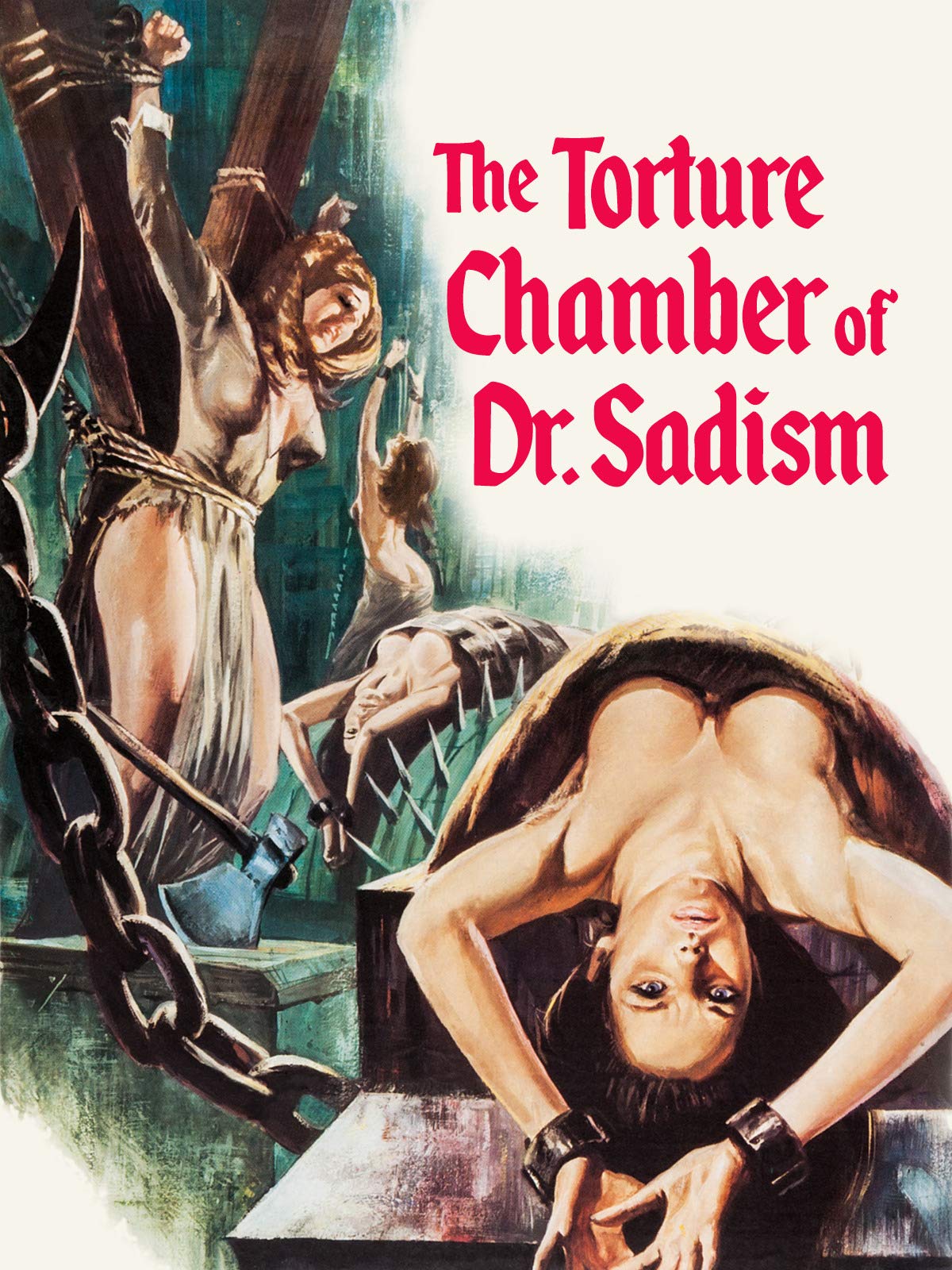
THE TORTURE CHAMBER OF DR. SADISM

THE TORTURE CHAMBER OF DR. SADISM (aka Die Schlagengruber und das Pendel/1967). Director: Harald Reinl. 

35 years ago Count Regula (Christopher Lee) murdered 12 virgins in an attempt to gain immortality. For his trouble, he was drawn and quartered as his two chief accusers stood watching. Now the descendants of these people, Roger Mont Elise (Lex Barker) and Baroness Lillian (Karin Dor), have received an invitation to the crumbling old Castle Regula, both unaware of what transpired in the past. Accompanying them by coach are Lillian's maid Babette (Christiane Rucker) and the rather shady Father Fabian (Vladimir Medar). 

The first half of the film is a protracted journey through a creepy forest in which trees have limbs growing out of them and skeletons are hanging from nooses. At the castle the group run into the long-dead Anatol (Carl Lange), the count's major domo, who plans to bring the count back to life. Wanting his revenge, the revived count places Roger under a slowly descending pendulum even as Lillian is nearly thrown into a pit full of writhing snakes. Yes, this is a very loose adaptation of Poe's classic The Pit and the Pendulum

Pitiful victim of "Dr. Sadism"
Although one could certainly quibble with some aspects of the screenplay, Torture Chamber not only holds the attention but has some classy and macabre art direction and is colorful in every sense of the word. Lex Barker appeared in several West German films and eurospy movies after he wrapped up his run as Tarzan. Karin Dor was a German actress who appeared with Barker more than once and was also in You Only Live Twice. Christopher Lee only appears in the prologue and at the very end and probably did all of his scenes in a couple of days  -- he appears to be the only actor who isn't dubbed. Carl Lange certainly makes an impression as Anatol.

Verdict: Fun horror film from West Germany that has some of the qualities of Italian horror features. ***. 

Thursday, April 28, 2022

BONNIE AND CLYDE

Warren Beatty and Faye Dunaway
BONNIE AND CLYDE (1967). Director: Arthur Penn. 

Bonnie and Clyde go on a crime spree robbing banks in the 1930's and become folk heroes to part of the population, but their days are numbered. This film was quite polarizing when it first came out, with some finding it slick and cinematic; others repellent and empty -- both viewpoints have validity. Warren Beatty [Splendor in the Grass] isn't bad as Clyde Barrow, the leader of a group of depression-era bank robbers, but he's never quite believable, either. The same could be said of Faye Dunaway [Mommie Dearest]  as Bonnie Parker, although she certainly demonstrates star-making vitality. The trouble with both of the leads is that they never seem quite as stupid as the people they're playing. Gene Hackman, Estelle Parsons and Michael J. Pollard as relatives and fellow gang members are perhaps more on the mark. 

Estelle Parsons and Gene Hackman
Today Bonnie and Clyde seems almost benign next to Goodfellas and similar movies. The picture doesn't really glorify these murdering robbers so much as it shows how pathetic and desperate they and their self-absorbed lives really are. But the movie can't really be considered a serious examination of these people because the characters lack dimension and the film can't seem to make up its mind whether or not to take them -- or itself, in fact -- seriously. In any case, the picture is generally entertaining and well-done, but it goes on about half an hour too long and is very Hollywood-ized to say the least. One could make a strong case that William Witney's The Bonnie Parker Story, made ten years earlier, is the better picture. 

Verdict: Okay, but maybe watch Little Caesar instead. **1/2.

Thursday, October 1, 2020

HOTEL

Catherine Spaak and Rod Taylor
HOTEL (1967). Director: Richard Quine. Based on the novel by Arthur Hailey.

The beautiful and stately St. Gregory's hotel in New Orleans is in danger of shutting its doors forever. The owner, Warren Trent (Melvyn Douglas), is fielding two offers, the most aggressive of which comes from Curtis O'Keefe (Kevin McCarthy) who isn't above playing a few dirty tricks, such as using his girlfriend, Jeanne (Catherine Spaak), to get information from the hotel manager, Peter McDermott (Rod Taylor of The Liquidator). While this is going on there is a thief (Karl Malden) loose in the hotel, and a Count (Michael Rennie) and Countess (Merle Oberon) are being blackmailed by the house dick (Richard Conte) because they ran over a child in their expensive car. 

Kevin McCarthy and Taylor
Hotel is basically sixties schlock, devoid of deep characterization or any meaning whatsoever. At one point, when a dignified black couple is turned away at the desk of the St. Gregory according to the hotel's long-standing racist policy and their unproven fear that it will cost them clientele, it looks as if there might be something of substance to say. But everyone seems much more upset at what bad publicity will do to their coffers than their unfair and dated policy toward "Negroes." It's a case of "this is bad for the hotel" as opposed to "this is just plain bad." Peter may not be a racist but his employer definitely is.

Michael Rennie and Merle Oberon
In spite of all this, the film is smooth and mildly entertaining, with good performances. Taylor is commanding and pleasant, McCarthy and Douglas are solid pros, and Rennie and Oberon, especially the latter, nearly walk off with the movie. We never learn anything about the boy who was killed, nor do either of these privileged people ever express the slightest feeling about the child's death! Although we're supposed to believe that McDermott is a great manager, he doesn't shut down an elevator that is acting funny (resulting in the liveliest scene in the movie and undoubtedly a major lawsuit for the hotel) and seems to spend more of his time imbibing cocktails in the bar than anything else. Spaak and Malden both appeared in Cat O' Nine Tails.

Verdict: Watch Grand Hotel instead. **1/2.                                                                                                 

Thursday, January 9, 2020

THE CHAMPAGNE MURDERS

Yvonne Furrneaux and Anthony Perkins
THE CHAMPAGNE MURDERS (aka Le scandale/1967). Director: Claude Chabrol.

Christine Belling (Yvonne Furneaux of The Death Ray Mirror of Dr. Mabuse) has not only acquired the majority of shares in the Wagner champagne business -- probably due to her late father's business tactics -- but a gigolo husband named Christopher (Anthony Perkins). Christopher's buddy, Paul Wagner (Maurice Ronet), who introduced him to his wife, still controls the name of the champagne company, a name that Christine desperately wants to own. Things take a strange turn when a drunk Paul wakes up more than once to find a woman's corpse nearby. Has he gone mad or is somebody framing him?

Maurice Ronet
The Champagne Murders is an arresting enough but very odd movie that holds the attention despite the leisurely pacing and almost episodic nature of the first three quarters of the film. Although this is a post-Psycho movie and Chabrol was a great Hitchcock admirer, the murders in this all happen off-screen -- there are no grisly details or cinematic pyrotechnics. Then the whole thing is topped off with a twist that some viewers may have seen coming while others may be merely confused. The final sequence of the film is lifted a bit from The Big Knife but is undeniably effective.

Christine and her maid
As to the performers -- which include Furneaux and Ronet as well as Stephane Audran, Henry Jones [Deathtrap], and Suzanne Lloyd -- everyone is on target with the exception of Perkins, who is badly miscast as the gigolo and doesn't seem to have any real idea how to play the part. Chabrol probably figured that having a well-known American actor in the role would increase box office in the U.S., but it also compromised his movie. Still, there's something about the picture that keeps you hooked, and while there are things about it that may not seem to make sense, if you think about it a bit it works -- well, except for at least one sequence that makes absolutely no sense once you know the big reveal at the end --  although one could easily argue that (considering the thin characterizations) the movie would have worked even better as a gorier and more violent type of French-style giallo movie.

Verdict: You may be scratching your head at the conclusion, but it's still entertaining and Ronet is compelling. ***. 

Thursday, October 13, 2016

DANGER!! DEATH RAY

Delfi Mauro and Gordon Scott
DANGER!! DEATH RAY (aka Il raggio infernale/1967). Director: Gianfranco Baldanello.

When Professor Carmichael (Tullio Altamura) is kidnapped along with his death ray -- more powerful than a laser beam -- American agent Bart Fargo (Gordon Scott) is sent into action. En route to Barcelona, Fargo first encounters a pretty plane passenger (Silvia Solar), who turns up again in dramatic circumstances, and then meets the painter, Lucille (Delfi Mauro). In addition to flirting with the ladies, Fargo has to fight off several assassins, including one, Al (Massimo Righi), who becomes Bart's helpmate when his companions turn on him. The hired guns in this are especially inept, particularly in one comical sequence when an assassin tries to push Bart out a window and goes flying into space himself! The high-tech effects include an obviously toy helicopter and submarine, and the "death ray" certainly doesn't do much until a few seconds at the end. (Any notions that the movie presents attacks on cities or buildings by giant death rays because of the title are quickly forgotten.) One clever bit has jackhammers being turned into machine guns. Gordon Scott, best known for playing Tarzan in such films as Tarzan's Greatest Adventure, makes a perfectly acceptable super-spy, the ladies are adept enough, and Alberto Dalbes is effective as Carver, the slimy villain of the piece. The movie's score is terrible.

Verdict: Sub-standard Eurospy trash in widescreen Eastmancolor. **.

Thursday, July 21, 2016

DIABOLICALLY YOURS

Senta Berger and Alain Delon
DIABOLICALLY YOURS  (ala Diaboliquement votre/1967). Director: Julien Duvivier.

An accident victim (Alain Delon) wakes up in the hospital with amnesia and is told he is "Georges Campo." He is confused, but has few complaints as his wife, Christiane (Senta Berger), is beautiful, and they live in a magnificent home on a large estate. His old friend, Freddie (Sergio Fantoni), a doctor, tells him he needs bed rest and shouldn't even make love to his wife until he remembers her. But his dog doesn't recognize him and there are several more accidents that nearly kill him ... Diabolically Yours, a French-Italian-West German co-production. comes off like a poor Movie-of-the-Week, with an unoriginal plot and mostly uninspired performances. Considering the things that have happened to him, Delon [L'eclisse] can only muster up a mildly perturbed air instead of the outrage he would be feeling. Berger [The Spy with My Face] is very pretty but she is only adequate, while Peter Mosbacher steals the show as her odd, devoted servant, Kim. Made ten years earlier with a zestier cast and better direction, this might have come off like a lively if minor film noir such as Strange Awakening, which actually has a similar plot. This was the last film directed by Julien Duvivier, who did both French and American films, such as Flesh and Fantasy and Lydia, both of which were much better than this clap-trap. Duvivier, of course, needed a much better script, but he does very little with what he's been offered.

Verdict: Even Delon's fans will find this a bore. *1/2.

Thursday, June 9, 2016

BATTLE BENEATH THE EARTH

Martin Benson as General Chan Lu
BATTLE BENEATH THE EARTH (1967). Director: Montgomery Tully.

Commander Jonathan Shaw (Kerwin Mathews), and his old Korean War buddy, scientist Arnold Kramer (Peter Arne), discover that the Chinese have come up with a horrendously diabolical plot. Using laser drills on tank-like vehicles, they have burrowed tunnels under U. S. space centers, military bases, and large population areas, and plan on using atomic bombs to wipe out the whole country. A geologist, Tila Yung (Vivienne Ventura), helps the others discover the tunnel under the sea where the Chinese forces have made their way to America. Can they stop their plan in time? Battle Beneath the Earth somewhat reminds one of Crack in the World in that its interesting (if absurd) situation is undermined by a very low-budget, although there is one marvelous shot showing the sea pouring into the Chinese tunnel. Another highlight is a suspenseful business involving the disarming of a bomb. Mathews has little opportunity to display the derring do of, say, The 7th Voyage of Sinbad, but Peter Arne offers a flavorful performance as Kramer, Ventura is very pretty, and Martin Benson [The Cosmic Monsters] steals the show as General Chan Lu, the leader of the assault. Robert Ayres [Black Widow] makes a very intense Admiral Hillebrand. This is like a TV production, and might have been enlivened by the appearance of some underground man-eating monsters, but no such luck. Montgomery Tully directed several thrillers, such as Strange Awakening; this was his last credit.

Verdict: In some ways it's like a poor man's James Bond. ** out of 4.

Thursday, March 10, 2016

CAMELOT

Richard Harris as King Arthur
CAMELOT (1967). Director: Joshua Logan.

"Perhaps one day I will see forgiveness in your eyes. But I won't be there. I won't see it." -- a tearful Guenevere

Noble King Arthur (Richard Harris) of Camelot is trying to bring civilization and order to a barbaric society. Despite some opposition, things are going swimmingly until two major factors interfere. One is Arthur's reptile of a son, Modred (David Hemmings of Deep Red), who conspires against his father behind the scenes. The other is the triangle that develops between Arthur,  Queen Guenevere (Vanessa Redgrave), and the proud, handsome knight, Lancelot (Franco Nero), which causes tremendous complications. The sad thing about this film adaptation of the hit Broadway Lerner and Loewe musical is that much of it is excellent. In fact, one might think that it's a pity that the movie didn't end at the intermission. The first half, showing the meeting and growing love of Arthur and Guenevere, as well as the creation of the Round Table, and ending with Arthur's sad realization of the feelings between his queen and Lancelot, plays very well for the most part. Things go awry in the second half however, with too many scenes that would have played perfectly well in the theater but don't go over at all on the big screen. Like most of the roadshow musicals of the period, Camelot goes on too long, with unnecessary sequences that add nothing to the movie.

The performances are problematic as well. Harris [Mutiny on the Bounty] has some excellent moments, but seems to be playing Arthur as a kind of "camp" through much of the movie. It is possible he was inspired by Richard Burton's performance in the stage play, but whereas Burton can get away with being "cute," the more serious Harris can not. While Arthur is an admirable character in many ways, one does get annoyed that, despite his internal anguish, he never displays some simple rage over being cuckolded by the two people he cares for the most, making him seem rather weak. One doesn't expect Arthur to chop off their heads as other kings might have done, but some expression of anger might have been appropriate. Vanessa Redgrave [Mary Queen of Scots] is simply lovely and excellent as Guenevere while Franco Nero manages to get by without being much of an actor, at least in this. although he does have one very fine moment. Harris did his own singing, which isn't any better than Burton's, Redgrave's own voice is just passable, and Nero is dubbed.

Whatever its flaws, Camelot boasts a fascinating and moving story -- one man's dream destroyed by others' passions -- and music and lyrics by Lerner and Loewe, including "Camelot" [the orchestrations for the chorus of this song are especially wonderful]; "If Ever I Would Leave You;" and others. And there are some splendidly touching moments, such as Lancelot sobbing over the corpse of Sir Dinadan (Anthony Rogers); Arthur's soliloquy about the love between the queen and Lancelot; and the final good-bye between Arthur and Guenevere, one of the best scenes in the movie.

Lionel Jeffries is his usual bumbling self as Arthur's adviser, Pellinore, and Laurence Naismith is fine as the magician Merlyn. Estelle Winwood shows up briefly as Lady Clarinda, who accompanies Guenevere to Camelot. (The latter wonders "Was there ever a more inconvenient marriage of convenience?") Gary Marsh has a nice turn as the young Tom of Warwick, who gives Arthur hope at the end.

Verdict: Half a good movie. ***.

Thursday, February 4, 2016

THE MONEY JUNGLE

John Ericson and Leslie Parrish
THE MONEY JUNGLE (1967). Director: Francis D. Lyon.

Four geologists are killed in suspicious "accidents" and it all seems tied in to whether or not a certain field contains oil. The board of directors of the Jumbo Oil Co. hire private investigator Blake Heller (John Ericson) to look into the murders and other matters. As he proceeds with his investigation the murders continue, until an unexpected assailant is revealed. The Money Jungle pulls you along without ever developing into a good movie. On the production level it resembles a failed TV pilot, but apparently that is not the case, and there's not a trace of style or panache to be found. Luke Heller is not your typical private eye with a seedy office, many bills, and hordes of panting women (although there are a couple). Heller lives in a large, expensive house, obviously makes big bucks dealing with corporate espionage and the like, and generally kisses women on the cheek or forehead. Frankly, this might have actually made a good series, it it had been well-handled. Ericson [Honey West] is okay as Heller, and the interesting cast includes Nehemiah Persoff [The Wild Party], Don Rickles, Lola Albright [Peter Gunn] and Leslie Parrish. Persoff and Rickles are fine, while Parrish offers an oddly subdued and relatively ineffective performance. Lola Albright is a lousy singer, but she's quite vivid in her turn as one of Heller's acquaintances. Charles Drake, Kent Smith and Michael Forest have smaller roles and are all good.

Verdict: Done with a bit of flair this might have amounted to something. **.

Thursday, October 1, 2015

CAXAMBU!

CAXAMBU! (1967). Director: W. Lee Wilder.

"Back, Peggy!"

Vince Neff (John Ireland) and his cronies have stolen a bunch of diamonds but need Emil Garrett (Keith Larsen), a diamond cutter from Antwerp, to make them salable. The honest Garrett is appalled by their criminal intentions and tries to take over the plane they're on with the help of his wife, a trained nurse named Peggy (Carol Ohmart). Unfortunately, the result is that they all crash-land in the jungle in an area near Caxambu where headhunters prowl, and where it soon becomes obvious that there is little honor among thieves. The first thing you notice about Caxambu! is that it has a very low budget even for a W. Lee Wilder film. The "sky" in which the plane flies is just a back drop, and when the aircraft crashes it is not a miniature but a literal toy. There are several other unintentionally comical scenes, such as when Peggy gets hysterical when she sees a crocodile that is just minding its own business and Emil needs to club it to death as if it were just about to clamp its jaws on his wife, who is many feet away. But the shame of Caxambu! is that it has a good script, interesting situations, and with a little more effort and directorial finesse this might have really amounted to something. Ireland [Queen Bee] and Larsen are okay, Ohmart [House on Haunted Hill] is excellent (in a role much less sensual than what she usually plays), and Gordon Blackman is rather effective as nasty Simon, who is willing to sacrifice virtually anyone for the diamonds -- the actor never appeared in another film, however. Wilder directed movies of variable entertainment value, but he really socked one out of the ballpark with his excellent Bluebeard's Ten Honeymoons.

Verdict: After a bad start this develops into a fairly entertaining movie with a good story. **1/2.

ISLAND OF THE LOST

ISLAND OF THE LOST (1967). Director: John Florea.

Anthropologist Josh MacRae (Richard Greene of The Hound of the Baskervilles) sets sail with his daughters, Sharon (Sheila Welles) and Lizzie (Robin Mattson), son Stu (Luke Halpin), the Polynesian Judy (Irene Tsu), and a young adventurer named Gabe (Mart Hulswit) -- not to mention a cute, friendly seal named Drip. Unfortunately MacRae gets all of them lost on a strange island in the south seas. There's a tribe of unfriendly natives who are out to get them (all except a friendly native named Tupuna [Jose De Vega]), and worse, a whole horde of carnivorous ostrich-lizards -- yes, ostrich-lizards -- with sharp teeth. However, this is not a horror film but a family-friendly adventure story from Ivan Tors, who had a cottage industry going with Flipper and other watery adventures. The best scenes in the movie have to do with sharks who prove excellent performers as they swim around and dangerously near to some of the actors/stunt men in some amazing footage. The acting is professional, especially Greene, and some of the scenery is lovely. Florea also directed The Astral Factor.

Verdict: Not totally terrible, but not that memorable, either. **1/2.

Thursday, September 17, 2015

VALLEY OF THE DOLLS

VALLEY OF THE DOLLS (1967). Director: Mark Robson.

Three young women either in, or on the fringes of, show business endure heartbreak of varying kinds and turn to pills for comfort. Anne Welles (Barbara Parkins) has a complicated relationship with her boss, Lyon Burke (Paul Burke). Neely O'Hara (Patty Duke) gains success but turns into a drug-addicted monster. Jennifer North (Sharon Tate) falls in love with a singer, Tony (Tony Scotti), who must be institutionalized due to a rare illness; then she develops breast cancer. I remember that Jacqueline Susann's novel was a very entertaining potboiler, but the film version is not so successful. There is certainly enough drama and tragedy in the story to make an effective movie, but the direction and editing, and some of the third-rate acting, really sink the production. The sense of time passing is never clearly delineated, and it seems apparent that a lot has been left on the cutting room floor. Barbara Parkins' [Asylum] blandness seems to work for the role of the "good girl;" ill-fated Sharon Tate is not much of an actress; and as for Patty Duke ...? Let's say that the character Duke is playing is horrible, and that she is miscast to begin with, but even with that in mind Duke's performance is pretty much an embarrassment. Duke self-consciously "acts" all through the movie, and acts badly for the most part; she simply can't do a convincing drunk and when she sings with a dubbed voice she looks spastic. Paul Burke [The Disembodied] is not bad but Martin Milner sinks to Duke's level as O'Hara's husband. Charles Drake doesn't appear long enough to make much of an impression, but he's fine. The cast members who come off best are Susan Hayward as a Broadway star; Lee Grant as the afflicted Tony's sister; and Robert H. Harris as Burke's business partner. Tony Scotti is barely acceptable as Jennifer's husband -- this was his only film appearance -- and Richard Dreyfuss of Jaws appears briefly as a stagehand. A scene when Neely O'Hara, who is drying out in the same sanitarium where Tony must live, encounters him in the lounge and they sing together, comes off more treacly than moving. The scene most people remember is a bitchy encounter between Duke and Hayward in the ladies room. The screenplay betrays decidedly sixties attitudes towards homosexuality, and the whole business of referring to pills as "dolls" is ridiculous. The theme song by Andre and Dory Previn isn't memorable, and there are other really lousy numbers as well. This was remade as a mini-series in 1981 -- I recall it being better than this film -- and to my surprise it was also a TV series with 65 episodes in 1994. Robson also directed the film version of Peyton Place, which is superior to this.

Verdict: Not very many redeeming qualities. **.

Thursday, September 10, 2015

GUNN

GUNN (1967). Director: Blake Edwards. Screenplay by Edwards and William Peter Blatty.

"My theory is that the human race is just a temporary experiment on the earth, and the experiment is failing" -- Lt. Jacoby

The TV series Peter Gunn had been off the air for seven years -- it ran three seasons from 1958 - 1960 -- when this big-screen adaptation played in theaters. Craig Stevens [Where the Sidewalk Ends] was forty-nine when he reprised the character in spite of the fact that private eyes in the movies were quickly being replaced by super-spies like James Bond. [The poster art for the movie tried to make it seem like an 007-type adventure, which it isn't.] The supporting players on the TV show were replaced in the movie, with Laura Devon filling in for Lola Albright as singer/sometime girlfriend, Edie; Ed Asner substituting for Herschel Bernardi as Lt. Jacoby; and -- of all people -- Wagnerian opera diva Helen Traubel taking over from Hope Emerson and Minerva Urekal as Mother, who owns the nightclub where Edie sings and Peter kibitzes. Gunn, despite being in color with slightly more elaborate production values, plays like an extra-long episode of the series. When a mobster named Scarlatti is murdered, the chief suspect is another criminal character named Fusco (Albert Paulsen). A shady lady named Daisy Jane (Marion Marshall) hires Peter to prove that Fusco was the killer. Along the way there are a couple more dead bodies for Gunn to trip over. To make the whole thing more contemporary, Mother's nightspot is turned into a rock club (after it is, once again, blown up, as it was at least once in the series), and one of the characters turns out to be a transvestite/transsexual a la Mickey Spillane [see the Mike Hammer novel, Vengeance is Mine.] There are a couple of twists and a fairly vicious final fight scene. Stevens plays Gunn in the same [one] note as before, and the other actors are fine, with Jean Carson making an impression as a flippant waitress in a diner.

Verdict: Perhaps this "gunn" was fired once too often. **.

Thursday, August 13, 2015

THE MAN FROM U.N.C.L.E. Season 4

The Fiery Angel: Madylyn Rhue
THE MAN FROM U.N.C.L.E. Season Four. 1967.

  
Seventh Wonder: Eleanor Parker
Toning down some of the more absurd situations and comedy of season three episodes, Uncle's truncated fourth and final season was a big improvement. Virtually every episode was well-worth watching and a few were outstanding. "J for Judas" featured Broderick Crawford and Chad Everett in a tale of THRUSH wanting to take over a business run by a combative father and son. The episode was serious, well-acted and well-done. "Test Tube Killer" starred Christopher Jones as a top THRUSH specimen sent to wipe out an entire Greek village. Jack Lord and Nehemiah Persoff try to outwit one another in a THRUSH battle of power in "Master's Touch." Michael Rennie tries to brainwash and/or murder people in his exclusive, private casino in the "THRUSH Roulette Affair." In "The Fiery Angel" an excellent Madlyn Rhue plays a besieged but feisty and independent Democratic lady president of Querida. A THRUSH double agent causes mayhem at the UNCLE "Survival School" with Richard Beymer and Charles McGraw. Will Kuluva and George Macready guest-star in a story in which THRUSH wants to work with two old Nazis. THRUSH wants a deadly molecular gun invented by scientist William Marshall in the clever "Maze Affair." In the two-part "Seven Wonders of the World" -- the series' final episode -- Barry  Sullivan plays a scientist who hopes to create peace with a docility gas, but doesn't realize that his faithless wife (Eleanor Parker) is working with THRUSH.

    The Man from U.N.C.L.E.  again became a very worthwhile show in its forth year, but alas, the damage had been done and it was canceled halfway through the season. It was followed by the telefilm The Return of the Man from U.N.C.L.E.and the new theatrical film many years later.

Verdict: Highly entertaining spy series. ***.

THE VISCOUNT

Kerwin Mathews roughs up a bad guy
THE VISCOUNT aka Les viscomte regle ses comptes aka The Viscount Settles a Score/1967.) Director: Maurice Cloche.

A bank hold-up which employs special equipment such as a vaporizer begins this adventure in which agent Clint de la Roche, known popularly as the Viscount (Kerwin Mathews of Maniac), gets caught in a war between two hoodlums, Barone (Falco Lulli) and Demoygne (Fernando Rey of The French Connection). Clint meets a sexy stripper named Lili (Sylvia Sorrente) after the latter's roommate is blown up by Barone in her car; and also encounters an agent with the Bureau of Narcotics named Steve Heller (Luis Davila). Mathews does this spy stuff as well as anyone, but it's a shame that his very nice voice has been dubbed. There are the usual gun battles, scenes of capture and torture, but none of it amounts to very much.[NOTE: On imdb.com Edmund O'Brien is listed as playing "Ricco Barone" but this distinctive actor does not appear to be in the film; he may have been slated to play the part, then dropped out.] A France-Italy-Spain co-production.

Verdict: Standard Eurospy saga. **.

Thursday, July 30, 2015

OPERATION KID BROTHER

Neil Connery as Neil Connery
OPERATION KID BROTHER (aka O.K. Connery/1967). Director: Alberto De Martino.

"I want to be generous. In return for your services, I will give you your life." -- Beta

Wanting to cash in on the James Bond craze like a dozen other producers, somebody got the bright idea of casting Sean Connery's younger brother, Neil, as the hero in this dubbed Italian spy movie. They also cast Lois Maxwell and Bernard Lee (Miss Moneypenny and M) in what are basically the same roles they play in the 007 films. Then they enlisted Adolfo Celi, the villain from Thunderball, and Daniela Bianchi, the heroine from From Russia With Love and concocted a stew that mixes elements from Thunderball (the sinister organization Thanatos instead of Spectre; the evil Rosa Klebb-like lesbian), Goldfinger (Thanatos wants to control the world's gold reserves), and the climactic battle from both films in which the forces of good try to stop the forces of Thanatos from employing a magnetic wave device that will make machinery, planes, arms, etc. inoperable. The basic plot is workable, but there are too many digressions in this, and while it begins well, Operation Kid Brother quickly degenerates into something that is very busy but not very entertaining. Maxwell and Lee actually have more to do in this film than in any of the Bond movies (the producers of the 007 flicks could not have been thrilled with their participation, even if this film was no competition), and they do it well, as does Celi as Mr. Thai or "Beta." Anthony Dawson, who appeared in three Bond films in smaller roles (playing a barely seen Blofeld in two of them) does a beautiful job as the highly dangerous and menacing "Alpha;" it's too bad his performance couldn't have been captured in a better movie. (Dawson most famously appeared as the would-be murderer in Hitchcock's Dial M. for Murder.) As for Neil Connery, few people would make the connection between him and his brother. Now and then you can catch the resemblance from a certain angle, but otherwise he doesn't much look like Sean and he has none of his presence or panache, although he is not unattractive in his own right. In this he is sort of cast as himself, "Dr. Neil Connery," a plastic surgeon who is also an expert archer and has amazing hypnotic powers. M and Miss Moneypenny -- I mean, "Commander Cunningham" and his female assistant "Max" -- refer to Neil's "older brother," who is a master spy, throughout the movie. The biggest problem with the film isn't the script or acting but the direction of master hack Alberto De Martino [The Chosen], who seems overwhelmed by everything and can't craft engaging action sequences to save his life.

Verdict: Ultimately this is pretty bad. *1/2.

Thursday, July 9, 2015

THE MILLION EYES OF SUMURU

Shirley Eaton as the evil Sumuru
 THE MILLION EYES OF SUMURU (1967).  Director: Lindsay Shonteff.

 Back in the 1950s Sax Rohmer, the creator of Fu   Manchu, decided to start another series about a  mysterious master villainess named Sumuru.  There were five books in this series. I've only  read two of the five books so far, and they are  fun, if below the fiendish and suspenseful level  of the Fu Manchu novels. But they are all  masterpieces compared to this woeful film  adaptation. In this Sumuru (Shirley Eaton), like  in the books, wants to create a new golden world  via her female helpmates and doesn't care who  she has to kill to get it. Tommy Carter (Frankie  Avalon) and Nick West (George Nader) are  some kind of agents out to stop Sumuru from various plots and assassinations. Million Eyes is cheap and cheap-looking, but the worst problem is the approach, which is meant to be light, even tongue-in-cheek, like a sixties spy film, but instead comes off as stupid. The shame of it is that Eaton [Your Past is Showing] not only looks beautiful in her dark wig but gives an excellent performance, perfectly embodying Sumuru in a way that would probably have pleased Sax Rohmer. The less said about Frankie Avalon, who wandered in from a beach party movie, and  George Nader [Shannon] the better. Nader was capable of some excellent performances, such as in a sixth season episode of Alfred Hitchcock Presents, but he doesn't seem to have a clue as to how to play his role in a mish mosh like this. As in the novels, Sumuru has a habit of turning her enemies into stone. Wilfred Hyde-White adds a touch of class as Colonel Baisbrook and Klaus Kinski [Circus of Fear] is sort of fun as President Boong and his double. That same year James Coburn starred in In Like Flint, which was also about an all-female organization trying to take over the world. Maybe the screenwriter was a Sumuru fan.

Verdict: Both Sumuru and Sax Rohmer deserve better. Hell, even Frankie Avalon does! *1/2.

IN LIKE FLINT

James Coburn, Thomas Hasson, Lee J. Cobb
IN LIKE FLINT (1967). Director: Gordon Douglas.

"By this time tomorrow, women will be ruling the world."

"Brain and hair-washing at the same time!"

"An actor as President?"

In this sequel to Our Man Flint, super-adventurer Derek Flint (James Coburn) is contacted by Lloyd Cramden (Lee J. Cobb) of Z.O.W.I. E. when he realizes that he was blanked out for three minutes during a golf game with President Trent (Andrew Duggan). During that time Trent was replaced by a double, a plot engineered by a group of women who plan to sabotage missiles -- Project Damocles -- to gain their ends. The main representative of this women's group is Lisa Norton (Jean Hale), who runs a cosmetic outfit called Fabulous Face that has its headquarters in the Virgin Islands, adjacent to the missile base. Unfortunately for the ladies, General Carter (Steve Ihnat), is only pretending to be an ally and turns on them, forcing the women to engage in Operation Smooch ... In Like Flint is sillier than the worst episode of The Man from U.N.C.L.E., slow-paced, unfunny for the most part, and with a climax that seems to go on for four hours. Coburn isn't bad in the part, although both Duggan and Cobb make more of an impression. Anna Lee is fine as Elisabeth, one of the older women in the group, but Jean Hale, while very pretty, isn't much of an actress. Searching for two missing lady cosmonauts, Flint winds up in Moscow, where he gets a standing ovation after dancing in a ballet! Yvonne Craig of Batman fame plays a Russian gal who offers Flint a doped cigarette. That same year saw the release of The Thousand Eyes of Sumuru, which was also about a group of women plotters and which was even worse than In Like Flint. The ladies in Flint never seem very menacing, probably due to typical sixties sexism.

Verdict: This could have killed the parody spy genre altogether. **.