Lively, entertaining reviews of, and essays on, old and newer films and everything relating to them, written by professional author William Schoell.
Showing posts with label George Macready. Show all posts

Thursday, April 28, 2022

TREASURE OF THE GOLDEN CONDOR

Cornel Wilde and Anne Bancroft
TREASURE OF THE GOLDEN CONDOR (1953). Director: Delmer Daves. 

In 18th century France Jean Paul (Cornel Wilde) becomes the bonded servant of his hateful uncle the Marquis de St. Malo (George Macready). Jean also falls in love -- and vice versa -- with his cousin Marie (Anne Bancroft). Jean is the rightful heir to the estate and money but there is no proof that his parents, who died at sea, were ever married. Jean figures only money can get him out of his predicament, especially after he is arrested for assaulting his uncle and trying to flee, so he takes off on a treasure hunt in Guatemala with a man named MacDougal (Finlay Currie). 

Wilde with Finlay Currie
In Guatemala the two men set off with MacDougal's daughter Clara (Constance Smith) and look for a stone serpent to guide them to the treasure. Despite the fact that the movie made much of the fact that some of it was filmed in Guatemala, it doesn't especially add to the film's veracity, especially when the treasure seems to be found in a matter of minutes. There's a snake, a cave-in, and minimal excitement in the treasure scene. Then Jean returns to France, is put on trial, and has a rousing and satisfying final battle with his awful uncle, the best and most memorable sequence in the movie. Wilde gives a charismatic lead performance, with good support from a slimy Macready and a passionate if duplicitous Bancroft in one of her earliest roles. (When she eyes Wilde with his shirt off you can imagine she'd rather cozy up to him than Dustin Hoffman!) Irish actress Smith had about thirty credits but never hit the heights. Fay Wray has a supporting part as Macready's wife, and Leo G. Carroll is also in the cast, but I didn't recognize Robert Blake as a nasty stable boy.  The rich score by Sol Kaplan is beautifully orchestrated by Edward Powell. The main problem with this movie is that the viewer will expect it to be about a treasure hunt but that only takes up a small portion of the picture.

Verdict: Good cast can only do so much with comparatively weak and derivative material. **1/2.

Thursday, March 19, 2020

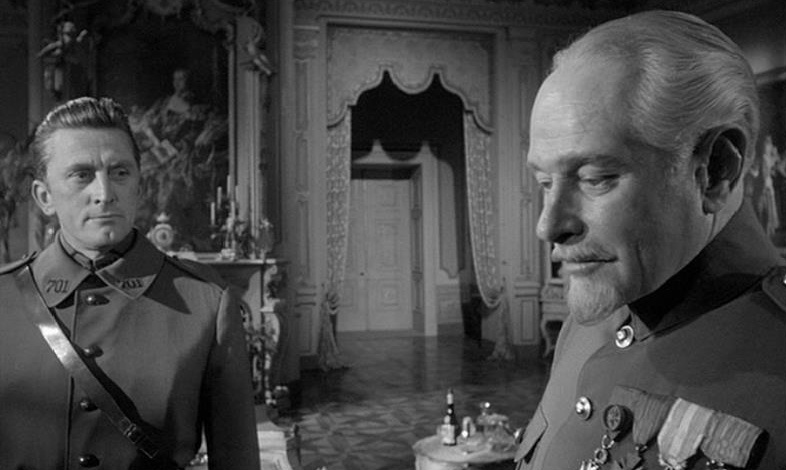
PATHS OF GLORY

Kirk Douglas and George Macready
PATHS OF GLORY (1957). Director: Stanley Kubrick.

"There is no such thing as shell shock." -- General Mireau

French WW 1 General Paul Mireau (George Macready) initially makes it clear to General Brouard (Adolphe Menjou) that there is no way his battalion can possibly take a strategic position known as the "anthill." But Mireau changes his tune when Brousard talks about a promotion, even though they expect at least 60% casualties among their men.

Wayne Morris and Ralph Meeker
Now Mireau's second-in-command Colonel Dax (Kirk Douglas) is told in no uncertain terms that the men -- already exhausted and demoralized -- must take the hill the next day or else. Although the soldiers try their damnedest, it is an impossible and indeed suicidal task, and Mireau accuses them of cowardice. (Mireau even wants to fire on his own men because they aren't moving fast enough!) Mireau is talked out of shooting a hundred soldiers, but three are to be court-marshaled as an example. These three men are Private Arnaud (Joe Turkel of The Glass Wall); Private Ferol (Timothy Carey of The World's Greatest Sinner and Kubrick's The Killing); and Corporal Paris (Ralph Meeker), who is picked because he knows that his superior officer, Lt. Roget (Wayne Morris), essentially murdered one of his soldiers. Dax represents the men in what is basically a kangaroo court with an outcome that is clearly pre-ordained.

Old pros: Macready and Menjou
Paths of Glory is a powerful and maddening film, examining the outrageous miscarriages of justice and heartlessness that can take place during war time even among men fighting on the same side. The performances are excellent: a borderline slimy Menjou; an upright and morally-repulsed Douglas; Meeker, whose trademark cockiness eventually vanishes when he faces his own mortality; and Wayne Morris giving an unexpectedly strong performance as the morally-bankrupt Roget. Turkel and Carey are also notable -- as is Richard Anderson as the prosecutor --  but the one actor who positively walks away with the film is George Macready, who gives an absolutely ferocious and mesmerizing portrayal of the utterly loathsome and infuriating Mireau -- forget Gilda (in which I didn't think Macready was even all that great), this is the performance he should be remembered for.

Kubrick beautifully -- or rather horrifically -- recreates the WW 1 battlefield, and scenes of the men in the trenches as bombs explode unnervingly all around them are compelling, The film almost goes a bit off-course in the second half when it has aspects that remind one of the later Dr. Strangelove, but for the most part this is one of Kubrick's most successful and effective movies. Several years later the film King and Country had a similar theme but was not as good.

Verdict: George Macready's finest hour and a half and a highly memorable if imperfect picture for Kubrick. ***1/2. 

Thursday, January 17, 2019

A LADY WITHOUT PASSPORT

Hedy Lamarr
A LADY WITHOUT PASSPORT (1950). Director: Joseph H. Lewis.

Peter Karczag (John Hodiak of Lifeboat) is an immigration officer assigned to Havana, where he pretends to be a man named Josef Gombush. Peter is hoping to get the goods on Palinov (George Macready), who illegally gets people out of Cuba. One of the hopefuls is Marianne Loress (Hedy Lamarr), who is desperate to get back to the United States. Things are complicated when Peter and Marianne meet and fall for one another. Palinov takes Marianne and others on a flight to Florida and Peter follows ...

John Hodiak and Hedy Lamarr
A Lady Without Passport cobbles together elements from other and better movies and comes up with ... nothing. The movie proceeds without ever engaging our sympathies or even much interest for the cardboard characters on display. Although the actors do the best they can, none of them -- not even the formidable George Macready of Gilda -- can bring them to life. There is little if any action until the final minute or so, and it isn't worth waiting for. The movie is short, but not short enough. James Craig is a colleague of Peter's and Steven Hill of Mission: Impossible fame plays another fed.

Verdict: You can hardly wait until it's over. *.

Thursday, June 1, 2017

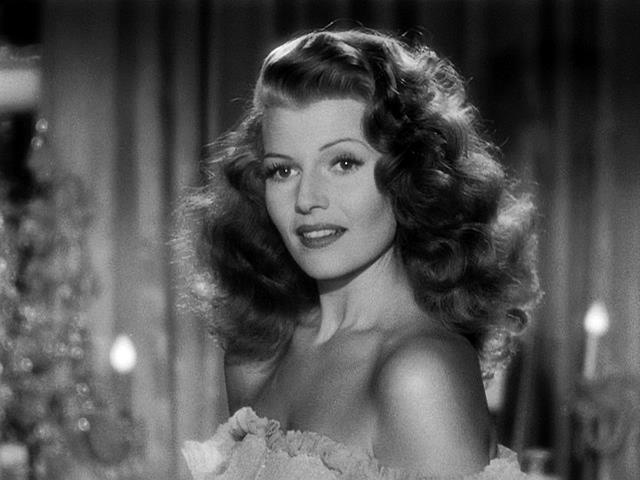
GILDA

Rita Hayworth
GILDA (1946). Director: Charles Vidor.

"Hate can be an exciting emotion. Very exciting. Hate is the only thing that can ever warm me." -- Ballin Mundson.

"If I'd been a ranch, they'd have named me the bar nothing." -- Gilda.

Down Argentine way just at the end of WW2, a hustler and crooked gambler named Johnny Farrell (Glenn Ford) is nearly robbed when a stranger on the docks with a spear in his cane comes to his rescue. The stranger is casino owner Ballin Mundson (George Macready), who hires Johnny to look after his interests. Some time later Ballin introduces Johnny to his beautiful wife, Gilda (Rita Hayworth), and both feign ignorance of the fact that they were once involved. Johnny and Gilda have a real love-hate relationship to add to the stew, and Ballin has a consortium with a bunch of Germans to add to the confusion. After a man is murdered in the casino, Ballin seems to commit suicide in his plane ... What to make of the modestly entertaining and often silly Gilda? Artificial and Hollywoodish as all get-out, with one-dimensional characters and one of the shortest climaxes in the history of the movies, Gilda has a few interesting twists and turns and is distinguished by the sex appeal and fine, constantly insinuating performance of Rita Hayworth, who makes the most of a standard role of the good-bad girl who is kept by wealthy men while loving the poor fellow she truly adores. Ford is not bad, if miscast, as the grubby borderline lowlife who winds up a kind of bodyguard/ersatz gunsel to Ballin (the narration he's given is unnecessary). Macready gives a good performance -- probably the longest and most famous of his career -- although some of his line readings are a little too matter-of-fact; one can think of other actors who might have played it in a somewhat more colorful and poetically sinister fashion. Steven Geray, Gerald Mohr, and Joseph Calleia all score as, respectively, a lowly casino employee who knows where the bodies are buried; a slimy guy with a hankering for Rita; and the police inspector who is concerned with the doings of the German consortium (even if no one in the audience is).

Some people* have had a different reading on Gilda, claiming that Johnny Farrell is a literal hustler on the bisexual side, Ballin's boyfriend, in fact, and that Johnny's self-hatred forced him to walk away from Hayworth before the story begins. This theory has it that Ballin needs to have power over attractive people of both sexes (one is reminded of Clifton Webb's character in Laura). Unfortunately, this take on the film makes it seem like a bad, regressive gay novel of the forties -- the tormented "queer" pulls away from the guy he's with and walks off into the sunset with a woman -- and while some advocates of this theory can point out certain lines and situations in scene after scene (and they may even have a point), they forget that many, many movies featured bad (and good) guys with live-in bodyguards and buddies, and this was never necessarily considered homoerotic. The proponents of this theory would have a lot to make of the Gilda imitation, Forbidden and many others as well.

Rudolph Mate has contributed some fine cinematography, but you would never know that the story takes place in Buenos Aires, as it has little Argentinian atmosphere. Gilda might be considered film noir except for the fact that its crime aspects are comparatively minimal. The pseudo-clever dialogue is often amusing.

* such as film noir specialist Eddie Muller on the Gilda DVD.

Verdict: Anyway, it's fun watching Hayworth do her "Put the Blame On Mame" number. **1/2.

Thursday, May 4, 2017

TARZAN'S PERIL

Dorothy Dandrige
TARZAN'S PERIL (1951). Director: Byron Haskin.

Radjeck (George Macready), a bad guy who escaped from jail, is up to no good with his less bloodthirsty companions, Trask (Douglas Fowley) and Andrews (Glenn Anders). One of Radjeck's victims is Commissioner Peters (Alan Napier). Before realizing what a crumb he was, Jane (Virginia Huston) had befriended Radject, but now Tarzan (Lex Barker) is out to snare him. Radjeck wants to sell weapons to a nasty native tribe; Queen Melmendi (Dorothy Dandridge) represents a tribe of friendlier natives. Tarzan's Peril is a poor Tarzan entry, badly directed by Haskin, who fails to give the film any kind of pacing or suspense. (This is strange, as Haskin also directed The War of the Worlds and Too Late for Tears, among others, both excellent movies.) Dandridge [Change of Heart] is as criminally wasted as she usually was, even after her Oscar nomination some years later for Carmen Jones. Macready is strangely subdued (for him) as the villain throughout most of the running time. There's a mechanical snake that nearly eats Cheetah (who has little to do in the pic), and man-eating plants that ensnare both Tarzan and a baby elephant with their vines. Jane looks like she'd be more at home on Park Avenue than in the jungle!

Verdict: Not Tarzan's finest hour. **.

Thursday, March 2, 2017

ADVENTURES IN PARADISE

Glib disdain: Gardner McKay
ADVENTURES IN PARADISE (1959 television series).

Adventures in Paradise, a series which lasted three seasons, cataloged the adventures of one Adam Troy (Gardner McKay), a Korean war veteran who hoped to raise money for a ranch in Texas. Somehow he wound up in Tahiti, where he is captain of the Tiki, a ship which takes on both passengers and cargo. Troy's assistants include Clay Baker (James Holden), who always calls the captain "Pappy," (and later becomes a bar owner); and Chris Parker (Guy Stockwell), who was in about a third of the episodes; among others.

Gardner McKay [The Pleasure Seekers] was perfect for the role of Adam Troy, not only for his incredible good looks, but that almost mesmerizing stare of what can only be called "glib disdain." McKay wasn't necessarily an actor of great range or emotion, but his strong and commanding presence worked in his favor. Holden compliments McKay; he had only a few credits aside from this series and did nothing else after the show was over. Stockwell [Blindfold], who was almost as handsome as McKay, amassed over 90 credits. McKay only had ten other credits besides this series, but he reinvented himself as a playwright whose work was often produced.

Bolstered by the beautiful and romantic theme music composed, I believe, by Lionel Newman, the series -- while not essential viewing -- had a certain sweep and style to it, and featured some good stories (everything from adventure to comedy to mysteries) and fine performances by a variety of well-known guest-stars. No doubt there were many viewers who dreamed of setting sail with Adam (who seemed to have a woman in every port) through the warm waters of Tahiti (although I imagine even that could get tiresome after awhile). Occasionally the soundtrack featured music cues from the scores of Bernard Herrmann, such as Journey to the Center of the Earth. I've managed to see about 67 of the 91 episodes, and of these the most memorable are:

"Safari at Sea" with Diana Lynn and John Ericson in a tale of a bickering couple who want to capture a dangerous eel. The wife is a castrating monster who wants a macho man like Adam.

"The Raft," a harrowing lifeboat drama -- after a boat hits a mine -- with an especially notable performance from Ed Anders.

"Walk Through the Night" stars Mara Corday in a memorable performance of a woman who hunts for the man she loves amidst danger and cannibals with the help of Adam Troy.

"The Black Pearl." Skulduggery over the title gem with appearances by Lon Chaney Jr and Patricia Medina.

"Man-Eater." Did a shark devour an amorous, wealthy married lady? With notable turns from Bethel Leslie and John Fielder.

"Please Believe Me." A woman (an excellent Jacqueline Scott) is accused of murdering her new but rather larcenous husband.

"Violent Journey." An especially flavorful episode with Jeff Richards and Jerome Cowan in a tale of a runaway heiress and sharks.

"Feather Clock." Pippa Scott and George Macready are fine in a story of some cleverly stolen artwork.

"Judith." Gloria Vanderbilt, of all people, proves herself a gifted actress indeed in this tale of a hurricane that also unveils terrific human passions.

"Flamin' Lady" stars Catherine Nesbitt, Harvey Korman, and Patricia Cutts in a suspense story.

"Command at Sea." Raymond Massey gives an outstanding performance in a tale of a captain who blames a younger officer for his own deadly mistake. Michael David is also memorable.

"Daughter of Illusion" offers Alan Napier and Barbara Steele in notable turns as a magician and his daughter in a scheme to use a dress to pilfer diamonds.

"Build My Gallows Low" has Adam accused of murder and on the run, but aided by the victim's daughter, Peggy Ann Garner, giving a fine performance.

Of the episodes I've seen, the two best are easily "The Good Killing," a moving story in which a young man commits murder for what he thinks is a good reason; and "Amazon," about a yacht race with a man's life at stake, with very good performances from Lizabeth Scott and Tom Drake.

Verdict: Too many mediocre episodes, but not a half-bad series. **1/2.

Thursday, August 13, 2015

THE MAN FROM U.N.C.L.E. Season 4

The Fiery Angel: Madylyn Rhue
THE MAN FROM U.N.C.L.E. Season Four. 1967.

  
Seventh Wonder: Eleanor Parker
Toning down some of the more absurd situations and comedy of season three episodes, Uncle's truncated fourth and final season was a big improvement. Virtually every episode was well-worth watching and a few were outstanding. "J for Judas" featured Broderick Crawford and Chad Everett in a tale of THRUSH wanting to take over a business run by a combative father and son. The episode was serious, well-acted and well-done. "Test Tube Killer" starred Christopher Jones as a top THRUSH specimen sent to wipe out an entire Greek village. Jack Lord and Nehemiah Persoff try to outwit one another in a THRUSH battle of power in "Master's Touch." Michael Rennie tries to brainwash and/or murder people in his exclusive, private casino in the "THRUSH Roulette Affair." In "The Fiery Angel" an excellent Madlyn Rhue plays a besieged but feisty and independent Democratic lady president of Querida. A THRUSH double agent causes mayhem at the UNCLE "Survival School" with Richard Beymer and Charles McGraw. Will Kuluva and George Macready guest-star in a story in which THRUSH wants to work with two old Nazis. THRUSH wants a deadly molecular gun invented by scientist William Marshall in the clever "Maze Affair." In the two-part "Seven Wonders of the World" -- the series' final episode -- Barry  Sullivan plays a scientist who hopes to create peace with a docility gas, but doesn't realize that his faithless wife (Eleanor Parker) is working with THRUSH.

    The Man from U.N.C.L.E.  again became a very worthwhile show in its forth year, but alas, the damage had been done and it was canceled halfway through the season. It was followed by the telefilm The Return of the Man from U.N.C.L.E.and the new theatrical film many years later.

Verdict: Highly entertaining spy series. ***.

Thursday, July 23, 2015

DETECTIVE STORY

Kirk Douglas and Eleanor Parker
DETECTIVE STORY (1951). Director: William Wyler.

24 hours in a police precinct focusing on Detective James McLeod (Kirk Douglas) and his efforts to bring down Karl Schneider (George Macready), who helps bring unwanted babies into the world so he can sell them [in the play, Schneider was a simple abortionist]. McLeod seems so crazy to get this guy that his superior, Lt. Monaghan (Horace McMahon), wonders if there's some personal connection to the case, and in an ironic development, discovers that there is -- and it concerns McLeod's wife, Mary (Eleanor Parker). Will these revelations bring about the too-rigid McLeod's ruination? Detective Story is an absorbing and often powerful movie and features some fine performances from Douglas, Macready, McMahon [Quick Millions], and especially the wonderful William Bendix as McLeod's colleague, Brody. Lee Grant [Damian: Omen 2], in her first film, is fine as a likable if bewildered shoplifter; Craig Hill scores as an embezzler in love with the wrong woman; and Cathy O'Donnell offers a sensitive portrayal of another woman who's in love with Hill. There are also some flavorful short appearances by Gladys George [Flamingo Road] and Gerald Mohr; Joseph Wiseman, only in his second film, is perhaps less effective. Eleanor Parker, possibly miscast to begin with, is a bit too showy and mannered at times, although she has her moments. In general, Wyler's assured direction gets the most out of the story and characters and the film holds the attention throughout. O'Donnell and Mohr appeared together in Terror in the Haunted House.

Verdict: Another very fine Wyler feature. ***1/2.

Thursday, December 25, 2014

THE GREAT RACE

Blink and you'll miss her: Vivian Vance
THE GREAT RACE (1965). Director: Blake Edwards.

Near the turn of the century, rival daredevils Professor Fate (Jack Lemmon) and the Great Leslie (Tony Curtis), among others, embark on a race from New York to Paris (they go way up north and head for Siberia to make their way into Europe). They are joined by Maggie Dubois (Natalie Wood), a suffragette and wannabee reporter. Along the way -- the very longgg way -- they have assorted misadventures ... Frankly, I only put on The Great Race because I heard Vivian Vance [The Blue Veil] was in it. Unfortunately, "Ethel" -- now playing the wife of newspaper editor Arthur O'Connell -- is a mere "guest star" and is on screen for at best a minute and a half. Boo hiss! Worse, the movie is nearly three hours long. No, it's not awful and there are enough entertaining moments and good acting to keep you watching, but there's no need for this picture to be so long. (The movie is, rather presumptuously, dedicated to Laurel and Hardy, who certainly never needed three hours to make a funny movie!) Probably inspired by the success of such mammoth productions as Around the World in 80 Days and It's a Mad, Mad, Mad, Mad World, The Great Race is bloated and episodic, with way too many digressions. There is a long and unnecessary detour involving a foppish (or stereotypically gay?) prince who happens to be a lookalike of Fate's, a sequence which could and should have been excised from the final cut, despite some good performances from Lemmon as the prince and George Macready as a conniving member of his court. A sequence for some reason situated in the old west has Dorothy Provine [Kiss the Girls and Make Them Die] -- looking sort of like a monkey with a bouffant hairpiece that threatens to topple off of her head any minute -- belting out a terrible number, but at least it leads into a fairly rousing bar fight. On the other hand, a pie fight that caps the prince sequence goes on too long (keeping in with the "theme" of the movie) and hasn't a single laugh. Oddly, the best scene in the movie is a well-cut and choreographed sword and saber fight between Curtis and Ross Martin that isn't played for laughs but plays. Jack Lemmon is in manic mode (as he was in Luv) throughout the movie but is effective on that sometimes irritating level. Curtis and Wood are Curtis and Wood, although they are well-coached in their line readings. Keenan Wynn, Larry Storch, Macready and Martin make a better impression.

Verdict: Not quite "Blake's Folly" -- but not for lack of trying. **1/2.

Thursday, February 21, 2013

NIGHT GALLERY (1969)

Joan Crawford in a dramatic moment
NIGHT GALLERY (1969 telefilm). Hosted and scripted by Rod Serling. Directors: Boris Sagal; Steven Spielberg; Barry Shear.

Rod Serling's follow-up to The Twilight Zone was a new fantasy-horror series in which Serling introduced each episode from a gallery of paintings, each painting tied in to one of the night's stories. This telefilm was the pilot for the show, and featured three tales of the bizarre. In the first, "The Cemetery," Roddy McDowall murders his decrepit wealthy uncle (George Macready), then freaks out as he sees the old man apparently breaking out of his grave in stages in a painting that hangs on the wall -- is the corpse coming after him with murder on its mind? The manservant, Portifoy (Ossie Davis), figures in an amusing climax. In the second story, "Eyes," filthy rich Miss Menlo (Joan Crawford), who has been blind since birth, pays a poor fool (Tom Bosley) to give her his eyes for money even as her doctor (Barry Sullivan) tells her she'll only have sight for about eleven hours. The story is deliciously ironic if quite improbable. [This was one of Steven Spielberg's earliest assignments; Crawford thought he was the coffee boy!] The third tale, "The Escape Route," is a highly satisfying tale in which a Nazi war criminal (Richard Kiley) in South America dreams of finding peace from "persecution" [!] in a pastoral painting hanging in the local museum, but winds up in a much more fitting scenario. Serling has scripted some fine dialogue for the stories, and gotten some top-flight actors to give their all for the all-important pilot. Roddy McDowall and Ossie Davis both deliver the goods in the first segment; Crawford and Sullivan are terrific in the second [with solid support from Bosley]; and Kiley, in an unusual turn for him, is splendid as the Nazi Strobe, with Norma Crane making quite a positive impression as the contemptuous prostitute, Gretchen. Serling is as adept a host as ever and the three directors are on top of things.

Verdict: Easy to see why this went to series. ***.

Thursday, September 9, 2010

FOLLOW THE BOYS


FOLLOW THE BOYS (1944). Director/co-writer: A. Edward Sutherland.

"Little things that one man may not even notice can be irresistibly alluring to another."

Ex-vaudevillian Tony West (George Raft) hooks up with a movie star Gloria Vance (Vera Zorina) and becomes her partner in movies and life, but trouble ensues when he's judged 4-F when war breaks out and decides to do his bit by organizing camp shows full of celebrities entertaining "the boys." He can't understand why Gloria won't join him on his travels and the two nearly break up, all of which could have been avoided had Gloria only told the fellow she was pregnant. Obviously the framing story for this variety propaganda film is piss poor, but there are some entertaining moments in its nearly two hour running time: an amazing canine trapeze act; Orson Welles and Marlene Dietrich doing a comical magic act; the Andrews Sisters; Louis Jordan and his band; the all-black Delta Rhythm Boys singing "The House I Live In." When Jeanette MacDonald does "Beyond the Blue Horizon" the line "my life has only begun" has a certain irony when many of the very young soldiers she's singing to won't make it back from the war. The film's low-point is Peggy Ryan and Donald O'Connor doing a lousy hep cat number. As usual, star George Raft makes little impression, although he does do a creditable dance number to "Sweet Georgia Brown" in a rainstorm. Vera Zorina means so little today -- she also makes little impression in the film -- that it's Marlene Dietrich who's featured on the VHS cover and not Zorina. It's significant -- and admirable -- that the film includes black entertainers, although these sequences were probably deleted in prints sent to southern theaters. What doesn't make sense is why a film that's meant to boost wartime morale should have such a downbeat ending. Other cast members/entertainers include W. C. Fields, Dinah Shore, Ted Lewis of Hold That Ghost, George MacReady of Gilda, and Elizabeth Patterson, Mrs. Trimble of I Love Lucy.
Verdict: Hit or miss, but well-meaning one supposes. **1/2.

Thursday, March 18, 2010

WHERE LOVE HAS GONE


 WHERE LOVE HAS GONE (1964). Director: Edward Dmytryk.

"What's a honeymoon? Two weeks of people telling each other lies ... they'll never live up to."

"When you're dying of thirst you'll drink from a mudhole!"

War hero Luke Miller (Michael Connors) marries wealthy sculptress Valerie Hayden (Susan Hayward), and things fall apart pretty quickly -- with help from Miller's mother-in-law, Mrs. Hayden (Bette Davis). After their divorce, the Miller's troubled daughter, Danny (Joey Heatherton), is accused of stabbing her mother's lover to death. This roman a clef regarding the Lana Turner-Johnny Stompanato case, based on Harold Robbin's best-selling novel, is well-acted, absorbing, and very entertaining. Davis and Hayward have at least one sizzling confrontation, and Joey Heatherton is simply terrific -- she should have had a much bigger career. Jane Greer and Anne Seymour are fine as, respectively, a social worker and psychiatrist, and Anthony Caruso scores in a brief bit as a horny blackmailer. In bit parts are Ann Doran (It, the Terror from Beyond Space; The Man Who Turned to Stone) and Walter Woolf King (Swiss Miss; A Night at the Opera). DeForest Kelley of Star Trek fame is very memorable as Valerie's agent, and George Macready as adept as ever as her mother's lawyer. As for Davis, good, bad or indifferent, Bette Davis is always Bette Davis. In this film she's already starting to split up her sentences in a way that indicates her constant smoking gave her such breathing problems that she could rarely complete a line without taking a breath somewhere. [Eventually she would have to take two breaths per sentence.] Jack Jones sings the pants off the title tune. John Michael Hayes' script was undoubtedly superior to the book.

Verdict: Definitely a guilty pleasure. ***1/2.

Thursday, October 22, 2009

THE MISSING JUROR

THE MISSING JUROR (1944). Director: Budd Boetticher. 

"A man named 'Apple?' Funny name, Apple. Bet he's a peach!" 

Reporter Joe Keats (Jim Bannon) gets on the trail of a mad killer when he discovers that several jurors on a notorious murder trial have been killed in mysterious "accidents." Harry Wharton (George Macready) was convicted of murdering a woman he loved, but it was discovered that he'd been framed. Although the truth came out before Wharton could be executed, the experience unhinges him and he commits suicide in a sanitarium. Now someone is executing all the jurors. Keats tries to protect the other jurists, and especially bonds with a pretty gal named Alice (Janis Carter). Jean Stevens is Alice's sexy gal pal, Tex Tuttle; Mike Mazurki is Cullie, the masseur; and Trevor Bardette certainly scores as Pierson, who confesses to the murders at one point. The Missing Juror is a snappy, well-acted, and entertaining programmer, but the main problem is that the solution is apparent almost from the first. Macready gives a terrific performance as the haunted Wharton in flashbacks. Joseph Crehan is Willard Apple, editor of the Record-Herald that Keats works for. Macready had one of the most distinctive voices in Hollywood. Jim Bannon was also in Unknown World. Trevor Bardette appeared in about a thousand movies. 

Verdict: Another reason to get out of jury duty. **1/2.

Thursday, August 13, 2009

THE MONSTER AND THE APE

THE MONSTER AND THE APE (1945). 15-chapter Columbia serial. Director: Howard Bretherton. 

Professor Franklin Arnold (Ralph Morgan) has made a robot from the material of a meteor which he calls "metaligan." Unfortunately, the evil Ernst (George Macready), who pretends to be a good guy, wants the robot and the meteor and everything else he can get for himself. Fighting against the evil Ernst are Kent Morgan (Robert Lowery of Batman serial fame) and Arnold's decorative daughter, Baba (Carole Mathews). Ernst not only has a passel of gunsels to help him, but a big ape named Thor (played winningly by Roy Corrigan) as well. We learn very early on that Ernst is a bad guy and it's just as well, as Macready's very distinctive voice would have given it away anyway. Caught in the middle of everything is Arnold's lab assistant, Flash (Willie Best of My Little Margie). [While Best is forced by the script to play the stereotypical "nervous negro," at least his gifted comic acting shines through in spite of it.] There are some good cliffhangers, such as a pit with closing walls in chapter eight, and an electro-death in chapter ten. This is not a bad serial, but by no means one of the best. Lee Zahler's score certainly helps. Morgan also appeared in the serial Gangbusters

Verdict: Perfectly entertaining if unspectacular. **1/2.

Thursday, July 23, 2009

THE ALLIGATOR PEOPLE

THE ALLIGATOR PEOPLE (1959). Director: Roy Del Ruth. 

Joyce Webster (Beverly Garland) is happily beginning her honeymoon with her handsome new husband Paul (Richard Crane), when he opens and reads a letter, tells her good-bye, and runs off the train to disappear. Joyce's search for the man leads her to a mansion in the swamps which is occupied by the imperious Mrs. Hawthorne (Freida Inescort, at her most imperious), a couple of cowered servants, and a weird man who sneaks in at night and plays the piano. George Macready plays a doctor who is experimenting with reptile hormones to heal mortal wounds in humans -- but the best laid plans .... Lon Chaney Jr. is a crazy guy who lives in a shack and goes on and on about how an alligator bit off his hand. The Alligator People actually has an interesting premise, a certain amount of suspense, a genuinely tragic air, and is very well acted by the entire cast, although Inescort's Southern-British accent is kind of odd. Even Richard Crane gives a much better performance than usual as a very tortured man. The make up in the film isn't bad, but a certain mask late in the picture creates unfortunate giggles. You''ll find yourself rooting for the characters to find happiness. 

Verdict: Unusual monster flick with pathos. ***.

Thursday, July 16, 2009

MY NAME IS JULIA ROSS

MY NAME IS JULIA ROSS (1945). Director: Joseph H. Lewis. 

Julia Ross (Nina Foch), who is three weeks behind on her rent, takes a job as a secretary to old Mrs. Hughes (Dame May Whitty) and her son Ralph (George Macready) at a house in London, then wakes up in a manor by the sea in Cornwall and is told that her name is Marian and she is supposedly married to Ralph! Maddeningly, everyone in the household and indeed the town either goes along with -- or actually believes -- the deception. The more Julia protests, the more people think she's crazy. While the plot may not stand up to too close scrutiny, this is a well-made and well-acted suspenser. Whitty gives a fine portrait of understated evil. Joy Harington is vivid in the role of Bertha, the bitter maid in the boarding house where Julia owes rent. Roland Varno makes an acceptable romantic lead, although he has little to do in the film. Very well photographed by Burnett Guffey. Remade as Dead of Winter

Verdict: Nifty B thriller with a very satisfying conclusion and a sheen that belies its budget. ***.

Wednesday, January 14, 2009

KNOCK ON ANY DOOR

KNOCK ON ANY DOOR (1949). Director: Nicholas Ray. 

"Live fast, die young, have a good-looking corpse." 

Against his better judgment lawyer Andrew Morton (Humphrey Bogart) takes the case of "Pretty Boy"Nick Romano (John Derek), who's been accused of killing a cop. Morton believes that Romano is innocent, but during the trial, he tries to convince the jury that it was society that made Romano -- who is guilty of other crimes -- the angry young man he is. The point is never made, even by the prosecutor, that many others came from the same environment as Romano and were able to rise above it. Knock on Any Door is an entertaining film with two excellent lead performances, but the movie is staggeringly simplistic and one-sided. The dead cop is completely forgotten and his family is never shown. An alternate point of view is never presented. Even when the truth about the murder is revealed at the end of the film, the bleeding heart approach still continues. Absurd. Prosecutor George Macready is given a disfiguring scar as if to imply that he hates the defendant because of his good looks, but the film makes clear that Romano is pretty much a stinker of a human being any way you slice it. 

Verdict: Fast-paced but foolish. **1/2.

Sunday, May 25, 2008

COUNT YORGA, VAMPIRE

COUNT YORGA, VAMPIRE (1970/aka The Loves of Count Iorga, Vampire.) 

Director/writer: Bob Kelljan. A handsome Bulgarian vampire (Robert Quarry) posing as a psychic insinuates himself into a young group of sunny Californians, turns the women into vampires, and kills the men. The picture isn't terrible, just a bit bland and completely devoid of atmosphere. It doesn't compare favorably to the old Universal classic horror films that, whatever their flaws, were much more entertaining and better made. Quarry isn't bad as the count, and there's one good scare scene at a van parked on his property. Besides Quarry, Michael Murphy is the only recognizable name in the cast. Roger Perry is the doctor who helps track down Count Yorga. NOTE: George Macready is briefly heard as a narrator on the soundtrack. His son, Michael Macready plays Mike in the film. Robert Quarry had an interesting role in the original A Kiss Before Dying

Verdict: If you want to see a vampire gal munching on her kitty ... **.

Wednesday, January 23, 2008

A KISS BEFORE DYING

A KISS BEFORE DYING (1956). Director: Gerd Oswald. NOTE: Some plot details are discussed in this review.

Okay adaptation of Ira Levin's suspense novel features Robert Wagner as a charming sociopathic killer who shoves his pregnant girlfriend (Joanne Woodward) off of a roof and then zeros in on her equally wealthy sister (Virginia Leith). Mary Astor is pretty much wasted as Wagner's mother; Jeffrey Hunter offers an odd performance as a pipe-smoking junior detective; and George Macready is positively weird – like Igor in one of the Frankenstein movies – as Leith and Woodward's cold-hearted father. The CinemaScope photography is very good, although Oswald often employs very, very long takes [often the fashion in wide-screen movies of the period] which aren't very cinematic. However, the movie is entertaining and suspenseful, and Wagner's performance is smooth if not outstanding. [The bad remake starring Matt Dillon makes little sense, as Dillon already seems like a hoodlum before he commits a single murder.] It's hard to tell which murder is more disturbing: Woodward's high-story plunge, or the shooting death of the disk jockey that Wagner frames for the murder even as the frightened young man (Robert Quarry) pleads for his life. Woodward is as good as ever and Leith is more than adequate.

Verdict: Intriguing, if imperfect, thriller. ***.