Lively, entertaining reviews of, and essays on, old and newer films and everything relating to them, written by professional author William Schoell.
Showing posts with label Alfred E. Green. Show all posts

Thursday, May 7, 2026

MEET THE STEWARTS

Frances Dee and William Holden
MEET THE STEWARTS (1942). Director: Alfred E. Green. 

Candy (Frances Dee of Mr. Scoutmaster) practically blackmails Michael (William Holden of Picnic) into proposing, an idea he resists because he wants to be able to support her on his own. This works out fine, because Candy's wealthy father, Mr. Goodwin (Grant Mitchell of It Happened on Fifth Avenue) has no intention of supporting his daughter once she's married. The newlyweds struggle to make ends meet, live in a house they can't quite afford, wind up in debt to a country club to which Candy thought she still belonged, and argue endlessly about finances. Will these two be able to settle their differences, or are they headed for divorce court?

Money, money, money
Meet the Stewarts is a perfectly pleasant if forgettable trifle that examines the usual problems young couples face such as finances, jealousy, meddling in-laws and the like. The film is mildly amusing, but it could have been very funny with different leads. While Dee and Holden are more-than-competent players they are not skilled comic actors -- Jack Lemmon, Cary Grant and others could have gotten more out of the frequently funny lines. A better impression is made by Grant Mitchell as the father and Anne Revere as Michael's blunt, no-nonsense sister, Geraldine. Margaret Hamilton has a few amusing moments as the maid, Willametta (as if struggling couples could afford a maid!). The film shows its age when one fellow proudly says "all wives have to be smacked around now and then." Alfred E. Green was a busy director who helmed a wide variety of pictures, including several Bette Davis films such as Dangerous

Verdict: Just nothing special in this mild comedy which at least boasts one rousing fist-fight that would not have been out of place in a cliffhanger serial. **1/2. 

Thursday, March 5, 2020

PARIS MODEL

Eva Gabor and Tom Conway 
PARIS MODEL (1953). Director: Alfred E.  Green.

Four women who pick out a fancy dress -- a "Paris model" or a cheaper copy of it -- want to wow their men but wind up getting their comeuppance, except in the last instance. Gogo (Eva Gabor) hopes to hook the wealthy Maharajah of Kim-Kepore (Tom Conway) but her billing the dress to another man may cause a problem -- not to mention the appearance of a gorgeous brunette (Laurette Luez). Betty Barnes (Paulette Goddard) is in love with her boss (Leif Erickson), but his wife, Cora (Gloria Christian), may out-do the grasping secretary in the fancy dress sweepstakes. Marion Parmalee (Marilyn Maxwell) pulls out all of the stops with her husband's flirty boss Sullivan (Cecil Kellaway) in the hopes of getting hubby (Robert Bice of Invasion U.S.A.) the new presidency when the boss retires, but she doesn't reckon with Sullivan's formidable wife (Florence Bates). Marta (Barbara Lawrence) hopes that boyfriend Charlie (Robert Hutton) will propose to her for her 21st birthday dinner at Romanoff's and she may get a little help from "prince" Michael Romanoff [Arch of Triumph] himself.

Secretary vs wife: Paulette Goddard and Gloria Christian
I confess I nearly dumped Paris Model in my latest collection of "Films I Just Couldn't Finish" because the first episode with Gabor and Conway is so lame -- aside from a modestly amusing wind-up -- that I couldn't see spending much more time on it. (One can't imagine either of the Gabor sisters being crazy about having their thunder stolen by another woman.) But once I understood the point of the film, that it dealt with the dress and the stymied manipulations of its wearers -- not to mention that the later segments were more entertaining -- I found this quite enjoyable. The performances are generally good (although Eva Gabor is just plain weird, like a dopey showgirl from another dimension), with Kellaway and Bates taking the acting honors. The film comes full circle with a very funny ending when Tom Conway shows up again as the horny Maharajah. Alfred E. Green directed everything from science fiction (the aforementioned Invasion U.S.A.) to old Bette Davis movies [Dangerous] to Copacabana and everything in-between. Tom Conway's brother, George Sanders, was married to both Zsa Zsa and Magda Gabor, but somehow he never got around to Eva.

Verdict: More fun than you first imagine it will be. ***.

Thursday, July 26, 2018

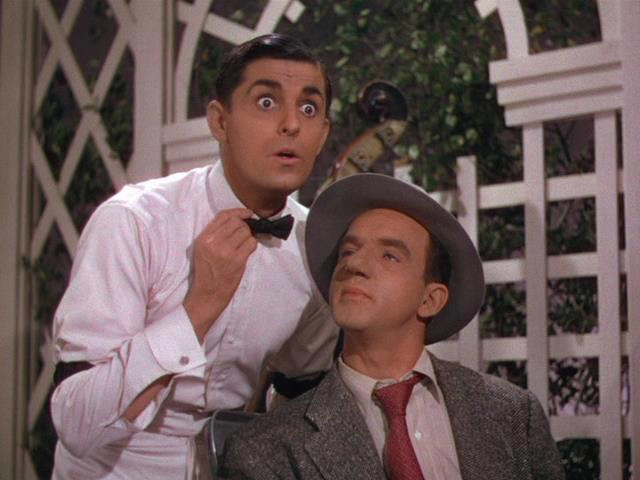
THE EDDIE CANTOR STORY

Keefe Brasselle (Cantor) and Jackie Barnett (Durante)
THE EDDIE CANTOR STORY (1953). Director: Alfred E. Green.

Even as a boy Eddie Cantor (Richard Monda) knew he wanted to be an entertainer. When a foolish do-gooder named Berk (David Alpert) wants to pack the kid off to an orphanage, claiming that his sturdy grandmother Esther (Aline MacMahon) can't take care of him, Eddie is fortunate to wind up with a theatrical couple who sponsor a children's revue instead. As Eddie (now played by Keefe Brasselle) falls in love with his childhood sweetheart, Ida (Susan Odin, and then Marilyn Erskine), he struggles to make a name for himself as an adult singing and dancing comedian. But the more famous Eddie gets, the more he neglects his wife, whose loneliness is palpable despite her having (eventually) five daughters to raise. Then serious health issues crop up and it looks like Cantor's career is over ... Eddie Cantor was still alive when this film came out, so the worst thing the movie says about the comic is that he was overly ambitious and addicted to applause and stardom, a fact that had a negative impact on his family life. The Eddie Cantor Story sticks to the basic facts about the man, even it it remains somewhat on a superficial level. However, Brasselle [Bannerline], outfitted with pop eyes and bigger teeth that generally disguise the actor's handsomeness. gives an excellent, well-studied impression of the famous performer. (One could argue that Brasselle, as is often the case in biopics, impersonates the man as he acts while performing as opposed to how he acts off-stage, but somehow this approach works.) Using the real Cantor's voice, Brasselle expertly recreates his routines from the Ziegfeld Follies as well as from such Broadway shows as Whoopee. The film boasts another excellent performance from Marilyn Erskine, who generally worked in television but should be much better known, as the grown-up Ida. Erskine explores every nuance of the character with her sensitive and splendid emoting. Aline MacMahon [The Young Doctors] is sterling as the loving, supportive grandmother, and there is very nice work from Arthur Franz [The Atomic Submarine] as a doctor who remains a loyal friend of the couple through thick and thin. Jackie Barnett does an amusing imitation of Jimmy Durante, and Will Rogers Jr. is cast as his father. Richard Monda is very winning and effective as Cantor as a child. Smaller roles are enacted by the likes of Chick Chandler (as a talent show host); Marie Windsor (as a jealous star); Gerald Mohr (as an old friend and bootlegger); Alix Talton (as a reporter;) as well as Ann Doran and Arthur Space. One is struck by the similarity between Cantor and friendly rival Al Jolson, who also performed in blackface. In his later years, Cantor did film and television work, and also became a spokesman for the March of Dimes. Cantor and his wife appear in the film's framing sequence, and he is given a classic closing line: "I've never looked  better in my life." Although two actors are credited with playing Cantor's parents (who died when he was an infant), they are either seen only in photographs, or their scenes were cut.

Verdict: Delightful biopic with top performances and snappy musical numbers. ***.  

Thursday, September 22, 2016

THOROUGHBREDS DON'T CRY

Ronald Sinclair, Mickey Rooney and Judy Garland
THOROUGHBREDS DON'T CRY (1937). Director: Alfred E. Green.

Young Roger Calverton (Ronald Sinclair) travels to America in the company of his beloved grandfather (C. Aubrey Smith); the old man's employee, Wilkins (Forrester Harvey); and their horse, which they hope to enter in a race. They induce a  brash jockey, Timmie Donovan (Mickey Rooney) to ride the horse, but fate intervenes in the form of Timmie's miserable father (Charles D. Brown), who claims he desperately needs an iron lung or else he'll die. Timmie is importuned to throw the race, leading to tragedy ... Thoroughbreds Don't Cry was an early hit for Rooney, but he's also got Judy Garland (their very first teaming) -- who for once isn't in love with Rooney's character -- and the inestimable Ronald Sinclair, who proves more than a match for Rooney's thespian skill. Sophie Tucker makes her mark as the woman who runs the boarding house where many jockeys, and Garland, live. Garland does a great rendition of "Goin' to Town." Frankie Darro appears briefly as another nasty jockey. Darro and especially Sinclair were extremely talented child actors, but the former was often relegated to bit parts as he got older, and Sinclair retired from acting only five years later, becoming an editor and producer of several Roger Corman flicks and working on everything from The Amazing Colossal Man to Dr. Goldfoot and the Bikimi Machine to Island Claws. Despite some charming moments and the uniformly excellent acting from the cast, Thoroughbreds can't quite seem to overcome its dated quality, and the whole movie at times seems a little unreal.

Verdict: Not Mickey's best. **1/2.

Thursday, January 14, 2016

THE GOLDEN ARROW

Bette Davis and George Brent
THE GOLDEN ARROW (1936). Director: Alfred E. Green.

When reporter Johnny Jones (George Brent) shows up on a yacht belonging to wealthy heiress Daisy Appleby (Bette Davis) hoping for a story, she mistakes him for a member of Society and begins to fall for him. But it turns out that Johnny isn't the only one who's playing a role. Daisy wants to keep unwanted suitors and fortune hunters away from her, so she importunes Johnny to wed her for a marriage of sheerest convenience. But when he learns that truth about Daisy, will everything blow up in her face? The Golden Arrow begins with possibilities but never recovers from its contrivances or the fact that it is never very funny. Davis and Brent give very good performances, as expected, and there is wonderful support from Catherine Doucet [These Three] as Miss Pommesby, who looks after Daisy, and Eugene Pallette [First Love] as Mr. Meyers. Dick Foran and Carol Hughes are also in the cast and are fine.

Verdict: One of those lousy movies Davis was always railing against early in her career. **.

Thursday, December 31, 2015

THE GIRL FROM 10TH AVENUE

Bette Davis and Ian Hunter
THE GIRL FROM 10TH AVENUE (1935). Director: Alfred E. Green.

Geoff Sherwood (Ian Hunter) has been tossed over by his fiancee Valentine (Katharine Alexander) for a wealthier man, John (Colin Clive of Bride of Frankenstein). On her wedding day Geoff gets good and drunk and encounters the sympathetic Miriam (Bette Davis), who eventually imbibes with him and winds up getting married to him that very night. Miriam agrees that he can end the marriage whenever he wants to, but she sticks to him as the weeks go by. Then Valentine, dissatisfied with her marriage to John, comes a'calling ... The young Bette Davis appeared in many forgettable movies but The Girl from 10th Avenue is actually not a bad picture. Davis is terrific and luminescent as Miriam, and she not only has credible support from Hunter [Call It a Day] and an excellent Colin Clive, but a very good playmate in Alison Skipworth [The Devil is a Woman] as her landlady, Mrs. Martin. The best and funniest scene in the movie has Miriam telling off the rather horse-faced Valentine in the dining room of the Waldorf-Astoria. John Eldredge and Phillip Reed also have small roles as Geoff's friends, and Mary Treen shows up briefly as well.

Verdict: Not bad early Bette. ***.

Thursday, November 12, 2015

DANGEROUS

DANGEROUS (1935). Director: Alfred E. Green.

Don Bellows (Franchot Tone) is a successful architect engaged to Gail Armitage (Margaret Lindsay). One day Don spots the dissipated actress, Joyce Heath (Bette Davis), who has gone on a long bender after her once-promising career disintegrated. Joyce, and anyone who could hire her, are convinced she is a jinx. Admiring her talent and feeling that she once inspired him, Don takes it upon himself to bring Joyce back into the light -- and the limelight. But can Joyce overcome her own fears and insecurities, or will she sink back into the morass of doubt and depression? Dangerous is a good and entertaining picture, but one senses there's an even better movie lost in there somewhere. The sudden introduction of Joyce's husband, Gordon (John Eldredge), adds an almost weird plot turn to the movie, as well as an ending that may be strange to many (although I thought it worked). Davis [Dark Victory] won a Best Actress Oscar for Dangerous, although she's certainly given better performances elsewhere. Both she and Lindsay [Baby Face] ruin some dramatic scenes by rushing through their lines as if there's an explosive fire on the sound stage just out of camera range, and there's an unintentionally comical moment when a producer says of Joyce: "even in rehearsal it's the greatest performance I've ever seen." Unfortunately, Davis' on-stage emoting in this scene is laughably mediocre. There's some very good dialogue in the movie, but a little too much of "Mildred" from Davis' Of Human Bondage. Both Joyce and Gail are convinced  they will wind up with Don when neither lady has a good reason for thinking so. Franchot Tone [I Love Trouble] gives a fine performance; Eldredge is also good in a very under-written role; and Alison Skipworth is terrific as Bellows' housekeeper, Mrs. Williams. Dick Foran and Mary Treen have smaller roles and are swell.

Verdict: Snappy if suspect melodrama with some good lines and acting. ***.

Thursday, September 17, 2015

INVASION U.S.A.

INVASION U.S.A. (1952). Director: Alfred E. Green.

A group of people in a bar, including Vince Potter (Gerald Mohr of Redhead from Manhattan), Carla Sanford (Peggie Castle), and George Sylvester (Robert Bice of The Big Bluff), are horrified to learn on television that a foreign power has invaded the United States. There's talk of an A bomb hurtling towards Manhattan! Via hypnotism, a mysterious man named "Mr. Ohman" (Daniel O'Herlihy)-- get it? -- offers the patrons a cautionary tale of what might happen if the U.S. should succumb ... Red-Baiter Hedda Hopper loved this film (see poster) because it was anti-communist, but that's about all anybody could love about this very minor and routine picture. O'Herlihy offers the best performance, although Castle isn't bad, and Mohr is his usual lounge-lizard self. Interesting cast members in small roles include both "Lois Lanes" -- Phyllis Coates and Noel Neill -- and Edward G. Robinson, Jr. Green also directed Housewife with Bette Davis, among others.

Verdict: Worth sleeping through. *1/2.

Thursday, September 6, 2012

BABY FACE

BABY FACE (1933). Director: Alfred E. Green.

"Where would I go -- Paris? I got four bucks!"

"Are you really thinking or just pretending to?"

Lily Powers (Barbara Stanwyck) works in her unpleasant father's speakeasy, but an old customer named Adolph (Alphonse Ethier), suggests she take a cue from Nietzsche, of all people, and use men the way they all want to use her. So Lily takes off with her maid Chico (Theresa Harris), goes to the big city, and makes her way onward and upward through a bank by basically sleeping with one man after another [ not exactly what feminists today would consider female empowerment]. After casting aside both Ned Stevens (Donald Cook), who is engaged to Ann (Margaret Lindsay), as well as Ann's father (Henry Kolker), the now-notorious Lily has to deal with new president Courtland Trenholm (George Brent) -- and deal with him she does. Stanwyck is fine in a role that seems more tailored for Joan Crawford, Brent is satisfactory, and even John Wayne has a small role as another of Lily's early conquests. The main problem with the movie is that the characters are one-dimensional, and despite this being a "pre-code" movie, it's all rather dated; the ending may be unconvincing for many viewers as well. Still, it holds the attention.

Verdict: Stanwyck in man-eating mode. **1/2.

Wednesday, April 16, 2008

HOUSEWIFE


HOUSEWIFE (1934). Director: Alfred E. Green.

Nan Reynolds (Ann Dvorak) helps to push her husband Bill (George Brent) to success, then has to deal with it when he falls in love with a man-hungry co-worker, Patricia Berkeley (Bette Davis, pictured) and says he wants to marry her. You can argue that the film is fairly predictable and formulaic, but it's also well-acted by the principals and surprisingly entertaining. Dvorak is very lovely and capable, Brent proves again that he could give many a winning performance, and Davis is saucy and likable despite her "bad girl" role. John Halliday and Ruth Donnelly also score as, respectively, one of Bill's clients (in his advertising business), who falls for Nan, and Nan's amused and amusing sister-in-law, Dora.

Verdict: Nothing special, but easy to take. ***.