Lively, entertaining reviews of, and essays on, old and newer films and everything relating to them, written by professional author William Schoell.
Showing posts with label Henry Levin. Show all posts

Thursday, March 30, 2023

APRIL LOVE

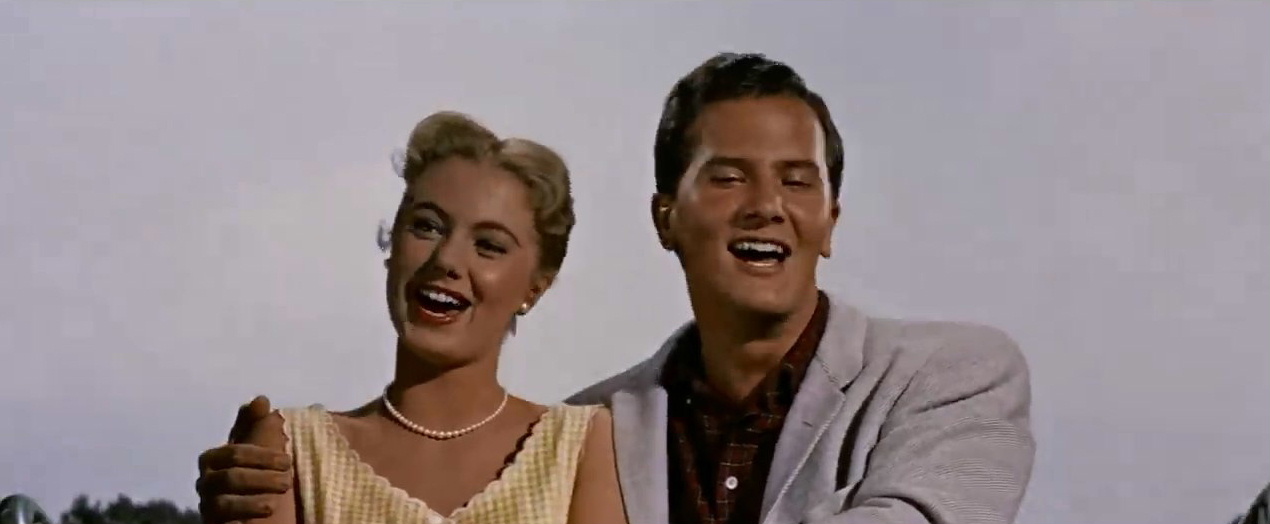
Sing out: Shirley Jones and Patty Boone
APRIL LOVE (1957). Director: Henry Levin. 

Nick Conover (Pat Boone of State Fair) is supposedly a "bad boy" who was sent from Chicago to Kentucky by his mother after his being arrested for taking a joy ride. Living with his Aunt Henrietta (Jeanette Nolan) and grumpy Uncle Jed (Arthur O'Connell of Anatomy of a Murder) on their farm, he fixes the old man's tractor and develops a crush on the neighbor gal, Fran (Delores Michaels). This doesn't sit well with Fran's sister, Liz (Shirley Jones), who develops a yen for Nick herself. And besides, Fran already has a boyfriend in Dan (Matt Crowley). Before a major triangle can develop, however, Nick bonds with a beautiful horse named Tugfire, who used to belong to Jed's son (who was killed in the war), and before you know it he's off to the races! But will his bad behavior back in Chicago catch up with him? 

Off to the races!
Hardly a classic, April Love succeeds on sheer amiability and the likability of its players. With a credible Boone in the lead the film becomes a musical, with him and others warbling several numbers. A couple of these are instantly forgettable but "A Gentle Girl" and the title tune are pleasant numbers, very well-sung by Boone, who now and then reminds one of Crosby. Delores Michaels [The Wayward Bus] was an attractive and talented actress who had a limited number of credits. Second lead Matt Crowley mostly had television credits. Henry Levin was a very busy director who worked with Boone on three films. 

NOTE:  April Love is a remake of Home in Indiana, which has a bit more pathos and sentiment but is not as smooth and entertaining as this. This version turns the two rivals for the hero's affections into sisters, and also gives the uncle a son who died in the war. It eliminates the likable if stereotypical black characters. There are no musical numbers in the original film.  

Verdict: The horse nearly steals the show! ***. 

Thursday, November 14, 2019

BERNARDINE

Pat Boone and Dick Sargent
BERNARDINE (1957). Director: Henry Levin.

Some high school pals in a club imagine the perfect woman and for unaccountable reasons call her "Bernardine." One afternoon Sanford Wilson (Dick Sargent) meets a beautiful young lady named Jean (Terry Moore of Mighty Joe Young), and he is instantly smitten -- she is his Bernardine. The other guys in the club also think Jean is special, but her relationship with Sanford hits the rocks when she meets Langley (James Drury), the handsome older brother of Sanford's friend, Beau (Pat Boone). With a little help from his friends, Sanford tries to win the hand of fair lady.

Terry Moore and Dick Sargent
Although Pat Boone and Terry Moore are top-billed in Bernardine, the main character and the one who gets the most running time, is Dick Sargent's Sanford. Pat Boone, playing a very unlikable person (although most of the boys in the film are unlikable) does have some screen time and gets to warble three numbers, the okay title tune, the highly sexist "Technique," and the more memorable "Love Letters in the Sand," which I believe was a big hit for Boone, who kind of imitates Der Bingle a bit. Terry Moore actually has very little to do in the film considering she is the leading lady. Bernardine asks us to accept Sargent, Boone, Ronnie Burns, and others as high school students when they have clearly left their teenage years far behind them. This makes their behavior at times seem borderline grotesque. They are particularly obnoxious to a nerd named Kinswood (Hooper Dunbar), although eventually he's somewhat accepted by the others.

Janet Gaynor
Natalie Schafer plays Boone's mother in a couple of brief scenes, but the stand-out in this is Janet Gaynor [Sunrise], who plays Sargent's mom and is given a couple of strong moments. "It's crazy, it's wild, it's improbable -- but don't tell me you passed!" she says to Sanford, who is not a great student. Sargent has some good moments, too, but again he's too old, his character isn't very appealing, and the more serious moments when he's dealing with heartbreak are almost worse than the comedy sequences. Although Sargent subsequently appeared with Boone in Mardi Gras, his film career never really developed and he mostly did television. Walter Abel and Dean Jagger are also in the film. This was Pat Boone's first movie and Janet Gaynor's last; she had two television credits after that.

Verdict: In spite of "Love Letters in the Sand," this is so bad it's depressing. *1/2. 

Thursday, February 8, 2018

MR. SCOUTMASTER

Scene-stealers: George "Foghorn" Winslow and Clifton Webb
MR. SCOUTMASTER (aka Mister Scoutmaster/1953). Director: Henry Levin.

Robert Jordan (Clifton Webb) has an intellectual TV show, but the ratings are dropping because it doesn't appeal to children. Jordan decides to correct this by getting to know the little darlings, and when the old scoutmaster flees, he takes over the man's position. At first the boy scouts are mightily unimpressed by Jordan, but he does manage to bond -- sort of -- with the littlest cub scout, Mike (George "Foghorn" Winslow), an adorable kid who doesn't quite have the propensity for telling the truth. As Jordan's lovely wife Helen (Frances Dee) begins falling in love with Mike, Jordan discovers the rather dismal reality of the youngster's home life, but can't get past the fact that he was lied to. Will his much, much wiser and warmer wife be able to break through her husband's stony reserve and get him to admit his feelings for the child? Mr. Scoutmaster boasts several fine performances, from the always-excellent Webb, the delightfully deadpan Winslow, the warm and winning Dee [So Ends Our Night], and Edmund Gwenn [Them] as Dr. Stone, as well as a host of talented youngsters. Veda Ann Borg also scores as little Mike's slattern of an aunt. This is a cute and funny picture, but I have to say. softie that I am, that it also gave me a lump in my throat. Webb and Gwenn also appeared together in For Heaven's Sake.

Verdict: Sentimental, moving, and amusing in equal measure. ***.

Thursday, June 11, 2015

THE DEVIL'S MASK

Jim Bannon and Anita Louise
THE DEVIL'S MASK (1946). Director: Henry Levin. Based on a I Love a Mystery radio script.

A plane crashes on its way to South America, and among its cargo is a shrunken head. Meanwhile Janet Mitchell (Anita Louise of The Firebird) is convinced that her father was murdered on a trip into the jungle, and goes to her Uncle Leon (Paul E. Burns) for succor. Her chief suspects are her stepmother Louise (Mona Barrie) and Professor Logan (Frank Wilcox), who are supposedly having an affair. Private eyes Jack Packard (Jim Bannon of Unknown World) and Doc Long (Barton Yarborough) are hired by Louise, who is suspicious of Rex Kennedy (Michael Duane), an alleged gadabout who is keeping company with Janet. Then someone is killed with a Jivaro blow gun ... The Devil's Mask is minor in all departments but it has its intriguing aspects and the acting is okay, with insouciant Duane [The Return of the Whistler] the stand-out. There's some interesting business with the shrunken head as well.

Verdict: Okay, but a better movie with shrunken heads is The Four Skulls of Jonathan Drake. **1/2.


Thursday, December 18, 2014

THE REMARKABLE MR. PENNYPACKER

THE REMARKABLE MR. PENNYPACKER (1959). Director: Henry Levin.

"Morality is a matter of geography."

The progressive Horace Pennypacker (Clifton Webb) has one wife and many children in one town in Pennsylvania, and a whole different family in another town in the state -- sooner or later each family will learn of the other's existence and then what? Mr. Pennypacker answers that question and manages to milk much humor out of a decidedly serious situation. It also manages to be surprisingly frank at times, if a trifle unreal. Webb is, as ever, excellent, and there are fine performances from Dorothy McGuire [Invitation] as unwitting wife, Emily; Dorothy Stickney [Murder at the Vanities] as Aunt Jane; Doro Merande [The Gazebo] as the secretary, Miss Haskins; and Charles Coburn as Grandfather Pennypacker; and there's nice support from Jill St. John as Kate. Ray Stricklyn and David Nelson are two other children, and Ron Ely is a young minister who's fallen for Kate. However entertaining the film may be, there is no denying that Horace's reasons for entering into a second bigamous marriage are rather spurious and self-centered. Still, it's hard not to like the movie on its own terms, and it even has some suspense.

Verdict: Another winning Webb performance. ***.

Thursday, November 27, 2014

THE CORPSE CAME C.O.D.

George Brent
THE CORPSE CAME C.O.D. (1947). Director: Henry Levin.

Beautiful actress Mona Harrison (Adele Jergens) gets a big crate delivered to her, postage due, and discovers that there's a dead body inside it! The corpse belongs to Hector Rose (Cosmo Sardo), a fashion designer for the studio. As handsome Lt. Wilson (Jim Bannon of Unknown World) tries to solve the case, he is helped and hampered by two rival reporters -- Joe (George Brent) and Rosemary (Joan Blondell) -- who are fighting their attraction to one another. Then there's another murder, and a mysterious cache of diamonds. You want to like The Corpse Came C.O.D., because of its premise and its cast -- Adele Jergens [The Fuller Brush Man] in particular is a Great Old Movies favorite -- but this sinks into tiresome mediocrity almost from the first, although the identity of the killer is a mild surprise. The leads do their best to enliven the somewhat leaden proceedings. Adele looks great -- she puts poor Blondell [We're in the Money] in the shade -- but this is not one of her more memorable performances. Such reliable actors as Una O'Connor and Grant Mitchell do their bit and there are quite a few familiar faces, including famous columnists such as Hedda and Louella, who are featured in a prologue about Hollywood. The producers obviously wanted to hedge their bets by using the columnists/critics in the movie, but it doesn't make the picture any better.

Verdict: Dead nearly on arrival. **.

Thursday, July 3, 2014

THE GUILT OF JANET AMES

Rosalind Russell lost in a fantasy
THE GUILT OF JANET AMES (1947). Director: Henry Levin.

Janet Ames (Rosalind Russell) is a war widow whose husband died throwing himself on a grenade, thereby saving the lives of five men. A bitter Janet decides to find out if these five men were worthier of life than her husband, but the problem is the method the film employs to help her do so. Instead of actually meeting these men (aside from one of them) Janet encounters an alcoholic reporter named "Smitty" (Melvyn Douglas) who helps her fantasize about these men in tiresome dream sequences, supposedly inspired by a character in Peter Ibbetson. [One of these men is comic Sid Caesar of Curse of the Black Widow playing, well, a comic.] Smitty has his own dark secret, relating to Janet's husband, and Janet also has to face some harsh truths about her marriage. The premise is excellent, and this is -- or could have been -- strong, adult material, but the screenplay and approach are silly and pull the viewer out of the story despite some interesting developments. Russell and Douglas both give excellent performances, however. Arthur Space [Target Earth], Hugh Beaumont [Murder is My Business], and Harry von Zell are also in the cast.

Verdict: Perhaps well-intentioned, but it just doesn't work. **.

Thursday, December 19, 2013

MR. SOFT TOUCH

Glenn Ford and Evelyn Keyes
MR. SOFT TOUCH (1949). Directors: Gordon Douglas; Henry Levin.

A man with the unlikely moniker of Joe Miracle (Glenn Ford) returns from service and discovers that hoods have taken over his nightclub and murdered his partner. We never actually see Miracle learning about this -- we're introduced to him after he steals money (his money rightfully, he feels) from the nightclub safe and is on the run from the police. He eventually winds up befriended by a do-gooder named Jenny Jones (Evelyn Keyes), who works for a settlement house where there are numerous cute youngsters and the comparatively stern but warm-hearted Mrs. Hangale (Beulah Bondi), not to mention a handyman played by Percy Kilbride (The Egg and I). John Ireland (Raw Deal) is cast against type as a bespectacled reporter who wants to get info from Miracle. The trouble with Mr. Soft Touch is that it tries for equal amounts of sentiment, comedy, and action, but these elements simply never jell. Ford's character is so unlikable for the most part that the actor gives one of his few charmless performances. Keyes and Bondi come off better, but the movie just doesn't work, and you find yourself not only not caring for anyone but even for what happens. It seems to take forever to just end.

Verdict: A misfire on virtually all levels, deservedly forgotten. **.

Thursday, February 28, 2013

TWO OF A KIND

TWO OF A KIND (1951). Director: Henry Levin.

Brandy Kirby (Lizabeth Scott) hunts down bad boy "Lefty" Farrell (Edmond O'Brien) because she needs him for a certain project, but only if he'll agree to snip off the end of one of his fingers. Seems there's this long-lost missing heir whom Lefty resembles ... There's some minor suspense to Two of a Kind as you wonder if Lefty will get away with his impersonation, or if thieves will fall out and completely shatter their chances. Terry Moore plays a niece of the wealthy old man the conspirators are hoping to fleece, but while her performance is good her character is so improbably naive and stupid that the movie takes a real reality dive when she appears. With his homely mug O'Brien is miscast as a lover boy who supposedly gets all the ladies hot, but he's a good enough actor to get his character across convincingly in spite of it; Scott merely seems disinterested in the material [or in O'Brien] and it's not one of her more memorable performances.

Verdict: Film noir of a minor kind. **1/2.

Thursday, February 21, 2013

NIGHT EDITOR

William Gargan [second from left] confronts a suspect
NIGHT EDITOR (1946). Director: Henry Levin.

"You're like me -- there's a meanness inside you that has to hurt or be hurt!"

A veteran editor of the New York Star tells a cautionary tale to a troubled young reporter (Coulter Irwin) which is illustrated in the long flashback scenes that comprise most of the movie. During prohibition days, married cop Tony Cochrane (William Gargan) is having an affair with a cold-hearted, married blonde named Jill (Janis Carter). While the two are parked on the outskirts of town, they witness a woman being brutally murdered. Afraid of losing his wife and son, Cochrane doesn't report the murder, leading to the expected complications. While Hitchcock might have done a lot with this very workable premise, Night Editor does little more than hold the attention, although Gargan's performance is quite good. The oddly-named Jeff Donnell is also good as his wife, Martha, while the supporting cast is at the very least competent. This was based on a radio series that later became a television program. Gargan also played a cop in Who Done It? and many other movies. Janis Carter also played a nasty lady in Framed when her leading man was Glenn Ford.

Verdict: Standard crime drama probably churned out in two days. **1/2.

Thursday, January 3, 2013

BELLES ON THEIR TOES

BELLES ON THEIR TOES (1952). Director: Henry Levin.

Cheaper by the Dozen was so successful that a sequel was inevitable, despite the fact that the main character played by Clifton Webb died at the end of that movie. In Belles Myrna Loy and Jeanne Crain take center stage as the wife and oldest daughter. Loy's Mrs. Gilbreth, who we learn was also a doctor and engineer like her late husband, is sort of reinvented as an early feminist; Loy seems a little more at home playing the woman than she did in the first picture. Much of the movie details the romantic adventures of daughters Ann (Crain). Martha (Debra Paget), and Ernestine (Barbara Bates). The illegally good-looking Jeffrey Hunter plays a doctor who falls for Ann, and Martin Milner [13 Ghosts] has a smaller role as Al Lynch. The weird butler, Tom (Hoagy Carmichael), seems to have wandered in from a different movie! Verna Felton and Edward Arnold also have roles, the latter as a man who reluctantly goes into business with Loy and has romantic aspirations toward her. Little Jimmy Hunt, who was charming in the first movie, is given no dialogue in the sequel.  At one point the movie threatens to turn into a musical when the whole gang sings a forgettable song about, of all things, beans!

Verdict: Where is Clifton Webb when you need him? **1/2.


Thursday, June 9, 2011

KISS THE GIRLS AND MAKE THEM DIE

KISS THE GIRLS AND MAKE THEM DIE (1966). Director: Henry Levin.

A CIA operative known only as Kelly (Mike Connors) is in Rio tracking down the activities of a man named Ardonian (Raf Vallone), who has many girlfriends -- and kills any of them who dare to take on other lovers. But this ultimate Male Chauvinist Pig has another nefarious plan in mind. Working with the Red Chinese, Ardonian has developed a formula which will remove the sex drive from all human beings, eventually wiping out the U.S. population in a generation or so without bloodshed. [Ardonian doesn't seem to reckon with the ingenuity of human beings.] With the help of Susan, a British spy (Dorothy Provine), and her gifted chauffeur (Terry-Thomas), Kelly sets out to stop Ardonian and his allies. With attractive Brazil locations and some exciting scenes, and good performances from the leads (especially Vallone, who strikes just the right note), Kiss the Girls is basically good-natured but a little bit too silly for its own good. Poor Provine is clothed in one hideous fashion "creation" after another. But the movie is fun for the most part.

Verdict: One of the better James Bond imitations if not without its flaws. **1/2.

Thursday, June 25, 2009

CRY OF THE WEREWOLF

CRY OF THE WEREWOLF (1944). Director: Henry Levin. 

This starts out as a promising horror film, but it never works up enough atmosphere, despite the fact that the settings include a museum of the supernatural with hidden tunnels, corridors beneath a mortuary, and a gypsy camp. Nina Foch plays Celeste, the High Priestess of a gypsy cult, who inherited the curse -- or gift? -- of lycanthropy from her mother, who was named Marie Latour. When she learns that Dr, Morris (Fritz Lieber) is planning to write a book about her mother's disappearance and all it entails, she takes decisive and aggressive action. An interesting aspect of the cult is that it is a matriarchal society, with power passing from mother to daughter. Osa Massen works in the aforementioned museum, and is romantically involved with the son (Stephen Crane) of the late doctor. Blanche Yurka is an old gypsy woman and confidante of Marie's. A big problem with the film is that the sinister werewolf just looks like a cute and cuddly Siberian husky. Barton MacLane seems a bit out of place as the police lieutenant assigned to the case. Cry of the Werewolf holds the attention and has some decent acting -- Crane is pleasant but a bit of a stiff -- but it's strictly a minor werewolf movie. Milton Parsons, the actor who most resembled a living cadaver, is cast as undertaker Adamson, of course. Levin directed a number of Pat Boone movies, including Journey to the Center of the Earth

Verdict: Where is the Wolfman when you need him? **1/2.

Thursday, June 5, 2008

THE FAMILY SECRET

THE FAMILY SECRET (1951). Director: Henry Levin.

David Clark (John Derek, pictured) kills his drunken, knife-wielding best friend in self-defense but he and his father Howard (Lee J. Cobb) decide to keep quiet about it. Unfortunately, an innocent man (Whit Bissell) is arrested for the crime and Howard winds up defending him. The Clarks' silence ultimately proves tragic. Interesting, but irritating, drama has some good performances and situations, but never quite comes to grips with the moral questions and dilemmas it poses. Erin O'Brien-Moore is David's concerned, over-protective mother, and Dorothy Tree is the wife of the man put on trial for David's crime. This could have used a few more plot twists. For one thing, we have only David's word that it was self-defense. Jody Lawrance is appealing as Lee, Howard' secretary and a romantic interest for David.

Verdict: Unsatisfactory but holds the attention. **1/2.

Tuesday, January 15, 2008

WONDERFUL WORLD OF THE BROTHERS GRIMM

WONDERFUL WORLD OF THE BROTHERS GRIMM (1962). Directed by Henry Levin. Fairy tale sequences directed by George Pal. 

Over-length and the occasional cloying moment are the only deficits to this otherwise excellent fantasy film inspired by the lives of the Brothers Grimm. The biographical sections – which probably have to be taken with a grain of salt – are interrupted by the telling of three classic fairy tales. In the first, Russ Tamblyn is a woodsman who tries to find out why a princess (Yvette Mimieux) wears out her shoes every night, and discovers that she runs out a secret door to dance all night long with a bunch of gypsies. A cloak of invisibility helps him in this task. In the second a weary cobbler's figurines come to life to help him finish up his work in time for Christmas [he spent too much time making toys for the poor children of the neighborhood]. The last story has to do with a knight (Terry-Thomas) and his put-upon servant (Buddy Hackett) who set out to destroy a dragon that has been terrorizing Otto Kruger's kingdom. When Hackett manages to slay the dragon, his master kills him and takes the credit, but the servant manages to have the last laugh. As Wilhelm Grimm attempts to collect fairy tales to preserve for future generations, he and his brother Jacob struggle to finish a family history that they have been hired to write.

You wouldn't think Laurence Harvey would be the right actor for this kind of stuff but he's excellent as Wilhelm Grimm, and also scores as the elderly cobbler in the second tale. Karl (Peeping Tom) Boehm also strikes the right note as Jacob. The many actors in the assorted supporting roles – everyone from Beulah Bondi as an old gypsy woman to Jim Backus as the father of the dancing princess – are all in top form. The settings and cinematography are of a very high order [the film was originally released in Cinerama and MUST be seen in letterbox format.]. The “puppetoon” animation in the second story is charming, expressive and fluid. The dragon with the bejeweled body in the third story is deliberately dopey-looking for comedic effect and the stop-motion animation used to bring it to life isn't bad at all, if not quite on the Ray Harryhausen level. [At one point Hackett interacts with a full-size mock-up of the monster's feet and stomach as the creature tries to crush him.] The dream sequence near the end when Wilhelm is ill and sees visions of Cinderella, the Frog Prince etc. may have been required to remind viewers of all the tales the Grimms made famous, but it becomes tiresome very quickly. Still, this is a very worthwhile picture with many memorable sequences. 

Verdict: Lots of fun. ***. NOTE: This is about a thousand times better than the recent godawful Brothers Grimm with Matt Damon and Heath Ledger, which actually has little to do with the brothers or their stories and is a big, tedious, mess with rubbery special effects and little coherency. Skip it!

Saturday, January 12, 2008

JOURNEY TO THE CENTER OF THE EARTH

JOURNEY TO THE CENTER OF THE EARTH (1959). Director: Henry Levin.

"Oh, goose, goose, goose!" Professor Lindenbrook when his daughter impatiently tells him to come to supper.

One could easily quibble and say that Journey is sometimes too silly for its own good, goes on too long, and that we still haven't gotten the ultimate film version of Jules Verne's fascinating novel, and while all this is true, it is also true that Journey is a very entertaining picture. Professor Lindenbrook (James Mason) is accompanied on the title journey by a student Alec (Pat Boone), a big Icelander named Hans (Peter Ronson), and the widow of a rival professor, Carla (Arlene Dahl). The bickering between Mason and Dahl is amusing (courtesy of screenwriters Walter Reisch and Charles Brackett), and the film works up suspense as our team tries to stay ahead of yet another rival scientist, Count Saknussem (Thayer David) who thinks of himself as the King of the Underworld. One of the most exciting scenes has the expedition encountering gigantic and hungry prehistoric dimetrodons (essentially big lizards) that nearly snack on Dahl. They also come across a section of the lost city of Atlantis [there were monsters in Verne's novel, but no Atlantis.] There are some wonderful sets and art direction; the special effects work is uneven but much of it is quite well done. Mason is excellent; Dahl, snappy; Boone, boyish and perky; and David marvelous as the villain of the piece. Leo Tover's cinematography is first-rate and Bernard Herrmann's beautiful and expressive score is nigh onto perfection. Diane Baker is lovely in a small role as Mason's daughter, Jenny. Verne's basic premise is one of the most compelling in fiction. Very handsome production and even a couple of pleasant tunes sung by Boone.

Verdict: Flawed but fascinating fantasy. ***.