Lively, entertaining reviews of, and essays on, old and newer films and everything relating to them, written by professional author William Schoell.
Showing posts with label Richard Egan. Show all posts

Thursday, August 28, 2025

SPLIT SECOND

Alexis Smith, Paul Kelly, Stephen McNally 
SPLIT SECOND (1953). Director: Dick Powell. Colorized version

Sam Hurley (Stephen McNally) has broken out of prison with his buddies, Bart (Paul Kelly) and Dummy (Frank DeKova), and are hoping to retrieve some loot from an armored car robbery. Hurley commandeers a car driven by Ashton (Robert Paige) and his lover, Kay (Alexis Smith), and when that runs out of gas, takes over a vehicle driven by reporter Larry (Keith Andes) and hitchhiker Dottie (Jan Sterling). Sam takes the whole group to a ghost town in the desert, even though everyone knows that the following morning an atom bomb being tested will go off and decimate the place! Before they can get out of there, Hurley calls Kay's estranged husband, Dr. Garven (Richard Egan), and tells him to fly down and take a bullet out of Bart or else Kay will die. 

Richard Egan comforts Alexis Smith
Now right there you can see the problem. Even if Garven is still in love with the wife who is divorcing him, it seems ridiculous and unreasonable for him to take so much time getting to Bart instead of telling the police exactly where he is! Surely the cops would have a better chance of rescuing Kay and the others than Garven! Split Second  may be fast-paced, but it's not so fast that the audience won't be scratching their heads over this ludicrous plot hole. Garven has hours during which he can contact the authorities. Frankly, things get a little tiresome in that ghost town before things heat up for the climax. Another weird scene is when Ashton practically seems to be begging Sam to shoot him, and Bart's sudden character reversal is senseless as well, even though it's made clear early on that Bart is not the mad killer type like his friend Hurley..

Stephen McNally
Stephen McNally gives another sharp and dynamic performance as Sam, always convincing whether he's snarling at his captors, shouting orders, or romancing the ladies, one of whom goes along with his addressals for her own protection. The other performances are all good as well, with Smith having the showiest role. The climax is terrific, although the writers seem not to have considered the possible effects of radiation poisoning. Dick Powell directed this and generally keeps things moving, although Hitchcock had nothing to worry about. 

Verdict: Interesting idea that doesn't quite work. **1/2. 

Thursday, January 5, 2023

ESTHER AND THE KING

ESTHER AND THE KING (1960). Director: Raoul Walsh.  

King Ahasuerus (Richard Egan of Wicked Woman) of Persia returns home from battle and rewards Simon (Rik Battaglia of Raw Wind in Eden), who saved his life, with a symbolic sword. Simon is engaged to Esther (Joan Collins of Land of the Pharaohs), the beautiful niece of adviser Mordecai (Denis O'Day). The faithless Queen Vashti (Daniela Rocca), the lover of the evil Prince Haman (Sergio Fantoni of Diabolically Yours), is kicked out on her keester while the search is on for a new queen. Wouldn't you know that Esther would be one of the women rounded up by barbaric soldiers, and that the king would find her most comely? Although still in love with Simon, Esther does feel great admiration for the king, and goes along with it when Mordecai tells her what good she can do for her people, the Jews, if she becomes the new queen. But Haman and his ally, the brutal Klydrathes (Renato Baldini), won't take this lying down.  

Richard Egan and Joan Collins
Loosely based on the biblical story (which itself is not really based on historical facts)
Esther presents a compelling situation and tangled love story but the execution is only fair-to-middling. Essentially an Italian production filmed in Rome and with an all-Italian cast (aside from the two leads), it has that low-budget look despite some impressive crowd sequences and advancing armies. Although not the best casting in either case, Egan and Collins give good enough performances, although Sergio Fantoni steals the movie with his skillful and sinister turn as the ever-plotting Haman. Handsome Rik Battaglia as Esther's original lover also causes one to wonder which man our sweet Esther will ultimately wind up with. 

Caught between two loves: Collins with Rik Battaglia
Daniela Rocca sizzles a bit as the disloyal queen who tries to win over her husband's favor with a sexy court dance (supposedly done not by Rocca but a dancer), and Rosalba Neri also scores as another one of Haman's lovers, Keresh, who steals a golden cape given to Esther by the eunuch Hegai (Walter Williams) and winds up strangled in Esther's place. Mario Bava, later best-known as a horror filmmaker, did the cinematography, and there is an interesting score by Angelo Francesco Lavagnino and Roberto Nicolosi. 

Verdict: By no means a terrible movie, but you may wish a Ray Harryhausen monster would show up now and then. **1/2. 

Thursday, July 7, 2022

POLLYANNA

Hayley Mills
POLLYANNA  (1960). Director: David Swift. 

Now that she has become an orphan, young Pollyana (Hayley Mills) is shipped off to a small midwestern city where she is to live in a mansion with her stern and uncompromising Aunt Polly (Jane Wyman). So as not to disturb her sleep, Polly gives her niece the smallest room up in the attic. Despite her travails, Pollyana has the most upbeat nature in the world, and refuses to see defeat in anything or anybody. Mayor Warren (Donald Crisp) wants the town to build a new orphanage while Polly -- the wealthiest citizen, who happens to own the building -- thinks all it needs is new plumbing. When everyone decides to hold a fair to raise money for the new orphanage, Polly forbids her to go, but she sneaks out anyway, nearly leading to tragedy. 

Mills with Richard Egan
A very popular movie in its day -- and the first film Mills did for Walt Disney -- Pollyana is undeniably entertaining and generally well-acted, especially by young Ms. Mills. A sub-plot has to do with the romance between Polly's assistant Nancy (Nancy Olson) and George Dodds (James Drury), not to mention Polly's interactions with old flame Dr. Chilton (Richard Egan). Pollyana also interacts with the hypochondriacal Mrs. Snow (Agnes Moorehead, badly over-acting); the weird recluse Pendergast (Adolphe Menjou); orphan boy Jimmy (Kevin Corcoran); grumpy maid Angelica (Mary Grace Canfield); the termagant Mrs. Tarvell (Anne Seymour); peppery cook Tillie (Reta Shaw); and the amazingly wishy washy and weak Reverend Ford (Karl Malden). Pollyana offers a surprisingly negative portrait of the minister, although he does eventually grow a spine. 

Egan with Jane Wyman
Pollyana is a little too long - surely the little ones in the audience grew impatient, not to mention needed bathroom breaks? -- and the whole business with Pendergast and his prisms that create rainbows gets tiresome very quickly. How faithful the film is to its turn of the century period I can't tell. Despite the open-endedness of the finale, the movie is extremely pat in virtually solving all of the problems of the characters with what seems like the snap of a finger -- this is almost funnier than anything else in the movie. Still, if you can take all that with a grain of salt, the movie may work for you. It is fun. 

Verdict: Classic Disney film with a fine lead performance. ***. 

Thursday, March 30, 2017

VOICE IN THE MIRROR

Bar mates: Richard Egan and Arthur O'Connell
VOICE IN THE MIRROR (1958). Director: Harry Keller.

"We're all in the same boat, none of us more than one drink away from the gutter for the rest of our lives."

"I spilled more whiskey than you ever drank."

Commercial artist Jim Burton (Richard Egan) claims to have started drinking since the death of his little girl, but his doctor, Leon (Walter Matthau), reminds him that he was drinking before that and would probably have used any excuse. Jim's patient wife, Ellen (Julie London of The Helicopter Spies), is forced to put up with broken promises and wondering if and when he'll come home and what condition he'll be in. Now Leon tells him that his alcoholism may have created serious nerve damage. A fellow drunk named Harry (Harry Bartell) tells him that he thinks the solution to their problem may be through spiritualism, but Jim discovers that the secret may be to help other drunks --  alcoholics can help other alcoholics stay sober. Although set twenty years later, Voice in the Mirror basically appears to be the story of the formation of Alcoholics Anonymous (although the term is never used and there's not as much emphasis on religiosity; AA's famous slogan is used at the end, however.) In any case, the picture is absorbing and generally well-acted, with a moving conclusion. Egan and London are not exactly perfect casting for this film (stolid Egan never quite seems desperate enough for one thing), but both of them have their moments; oddly, London is better in her more emotional and difficult scenes than in her quieter ones. Harry Bartell and Doris Singleton, who plays Jim's sympathetic co-worker, have nice bits; both of them appeared several times on I Love Lucy. Arthur O'Connell nearly steals the picture as one of Jim's sad friends, and Matthau, in an unexpected role as the no-nonsense doctor, is also excellent. Ann Doran and Peggy Converse make their marks, respectively, as a landlady and the mother of a suicidal young drunk played by Troy Donahue. Eleanor Audley [Sleeping Beauty] is fine as a woman at a soup kitchen, and I believe that's Mae Clarke [Frankenstein] playing the first woman member of Jim's group. One of the best scenes depicts Jim's frightening nightmare in which he is caught in a train tunnel as a rushing train threatens to run him down.

Verdict: Imperfect but interesting and affecting drama. ***.

Thursday, October 22, 2015

FANFARE FOR A DEATH SCENE

Richard Egan and Al Hirt with his trumpet
FANFARE FOR A DEATH SCENE (1964). Director: Leslie Stevens.

"An intelligent enemy is better than a foolish friend." -- Lord Kahn

This telefilm certainly has an intriguing title, but it's actually just the unsold pilot for a series called Stryker. Richard Egan [Wicked Woman] plays an agent in an ersatz spy movie (somewhat reminiscent of The Man from U.N.C.L.E.) who is up against a mysterious evil figure named Lord Kahn (Telly Savalas). The opening scene is a macabre one in which dozens of poisoned corpses are found in a sanitarium after a harried Professor Bannermann (Burgess Meredith) has made his escape. Both the good guys and the bad guys want Bannermann's formula. The interesting cast includes trumpeter Al Hirt (playing a trumpeter); a pre- Mary Tyler Moore show Ed Asner; Tina Louise from Gilligan's Island; J. D. Cannon [An American Dream]; Joseph Ruskin: and Viveca Lindfors [Silent Madness], who nearly walks off with the whole movie as a kind of femme fatale, along with Savalas.

Verdict: It's just as well this didn't become a series. **.

Thursday, May 28, 2015

A SUMMER PLACE

Troy Donahue
 A SUMMER PLACE (1959).  Writer/producer/director: Delmer Daves.

 "You insist on de-sexing her, as if sex were  synonymous with dirt." -- Ken

Lifeguard Ken Jorgenson (Richard Egan) went off to make his fortune and got married to Helen (Constance Ford) after his true love, Sylvia (Dorothy McGuire), married a man of her class. Her husband Bart (Arthur Kennedy) has fallen on hard times and he and Sylvia now run an inn with their son, Johnny (Troy Donahue), on Pine Island, off the coast of Maine, where Ken and Sylvia first fell in love. Ken returns to the island with his family; feelings between him and Sylvia are rekindled even as Johnny begins an intense romance with Ken's daughter, Molly (Sandra Dee). Then Helen finds out about the affair between her husband and Sylvia ... A Summer Place is distinguished by some very good acting, a frank and positive look at sex, and Max Steiner's lushly romantic score. (This includes the main theme and the younger couple's love theme, which became a hit record; other music is recycled from Steiner's A Stolen Life.) Richard Egan [Wicked Woman] and Dorothy McGuire are excellent, and Arthur Kennedy has an outstanding scene where a drunken Bart confronts his son and Molly when they ask his permission to marry. Egan is especially good in a well-written scene when he's telling off his wife and listing her assorted prejudices. One flaw (among a few) in the film is the characterization of Helen, who is presented strictly as a one-dimension villainess. As such, Constance Ford is fine, but the script and direction (both from Delmer Daves) limit her. Sandra Dee is quite effective as young Molly, and Troy Donahue -- who obviously did his more memorable work with the coaching and encouragement of Delmer Daves -- gives one of his best performances. (Daves used Donahue in four movies, and the actor was always better than he was in such later films as My Blood Runs Cold, in which he was back to being as stiff as a board.) Beulah Bondi has a good role as Sylvia's wise old Aunt, who lives in the inn and tries to give Sylvia sage advice about the affair. A Summer Place borders on the edge of soap opera, and never becomes a great movie -- it's overlong and talky at times --  but it's full of interesting scenes, such as a certain moment between Ken and Sylvia. Sylvia tells Ken that she's sorry she's not as pretty as she used to be. You would expect Ken to immediately tell Sylvia that she's wrong, but instead there's a long pause and he says, "I love you too much to speak." The closeness between the two is so intense that there's no need to tell pretty lies or even to say anything to each other. It's hard to realize that A Summer Place was once extremely controversial, but now it serves as a time capsule detailing the difficulty of sexual and romantic relationships in a less enlightened era. This is another movie that could be filed in the category: How The Rich Suffer!

Verdict: For romantic souls and Troy Donahue fans. ***.

Thursday, July 31, 2014

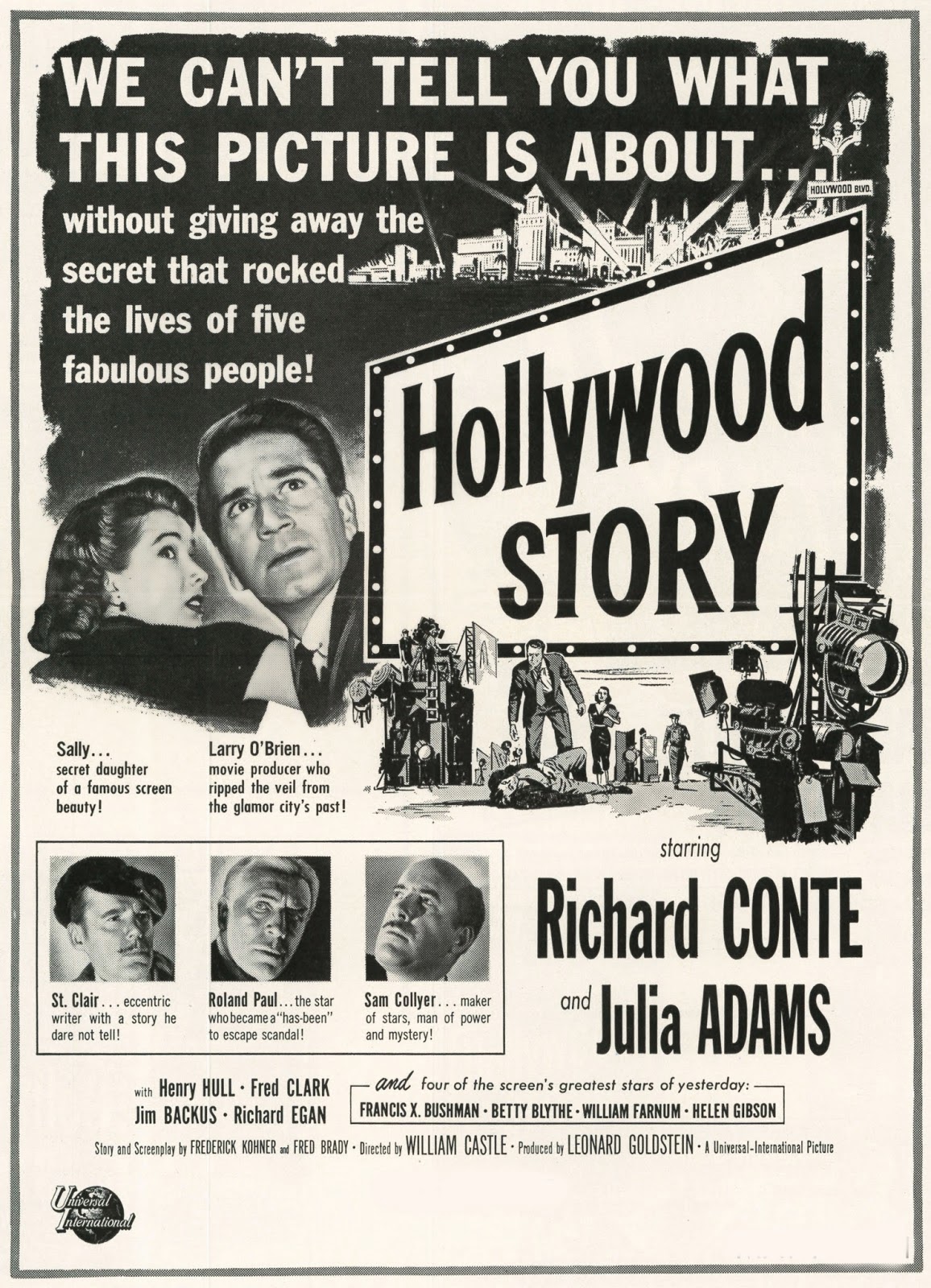
HOLLYWOOD STORY

HOLLYWOOD STORY (1951). Director: William Castle.

Larry O'Brien (Richard Conte) is a producer who becomes fascinated by an old Hollywood mystery, the still-unsolved 1929 murder of silent film director Franklin Farrara. Larry decides to make a film about the murder, and hires an old screenwriter named Vincent St. Clair (Henry Hull of Werewolf of London), who once worked with the victim.  When someone takes a shot at Larry, he realizes the killer is still alive and doesn't want even a chance of the truth coming out. Richard Egan is cast as a police lieutenant, and Jim Backus is Larry's agent, Mitch. An uncredited Paul Cavanaugh [he's not even listed in the cast on imdb.com] plays aging actor Roland Paul, who was always one of the suspects, along with Sam Collyer (Fred Clark). William Farnum, Francis X. Bushman [The Phantom Planet], and Joel McCrea play themselves in cameos. The best performance is given by Julia/Julie Adams, who apparently knows more than she's saying and may have some unknown connection to the crime. This movie is of interest primarily because it was directed by William Castle [Strait-Jacket], but even with that distinction it has still been forgotten. The trouble is that it has very little suspense, a dull mystery, and plays like nothing so much as a TV pilot. However, the cast may hold your attention.

Verdict: One mystery that doesn't need solving. **.

Thursday, May 2, 2013

THE HOUSE THAT WOULD NOT DIE

Anderson, Stanwyck, and Wynn
THE HOUSE THAT WOULD NOT DIE (1970 telefilm). Director:John Llewellyn Moxey.

Ruth Bennett (Barbara Stanwyck) and her niece Sara (Katherine or Kitty Winn) move into a country house built in the 1700's and willed to Ruth by her cousin. Ruth bonds with her neighbor, Pat (Richard Egan), while Sara makes good friends with Pat's student, Stan (Michael Anderson, Jr.). During a seance, restless spirits in the house make their presence known, and eventually begin to take over the minds of the inhabitants, especially Sara. Is she going mental, or is something supernatural going on? The viewer will be far ahead of the characters in this mediocre flick which was presented as an ABC "Movie of the Week" back in the day. At least there's an interesting cast. Stanwyck, who always gives a solid performance no matter what drivel she's in, is above the material, as expected. Winn later appeared with Al Pacino in The Panic in Needle Park and The Exorcist and its sequel; she was a very good actress and does the best she can with this material. Richard Egan was in everything from The View from Pompey's Head to Wicked Woman, and Michael Anderson Jr. was with Hayley Mills and Maurice Chevalier in In Search of the Castaways when he was a boy. The medium is played by Doreen Lang, the hysterical woman who slaps Tippi Hedren in Hitchcock's The Birds; she's only mildly hysterical in this. Mabel Albertson shows up briefly as another neighbor and a friend of Lang's. This was produced by Aaron Spelling from a screenplay by Henry Farrell [Hush ... Hush, Sweet Charlotte].

Verdict: Stanwyck maintains her dignity in a forgettable and obvious ghost story. **.

Thursday, April 11, 2013

THE KILLER THAT STALKED NEW YORK

THE KILLER THAT STALKED NEW YORK (1950). Director Earl McAvoy.

Sheila Bennett (Evelyn Keyes) is not having a good day. Her faithless boyfriend Matt (Charles Korvin) plans to dump her as soon as she delivers gems that she stole, and is in fact carrying on with her younger sister, Francie (Lola Albright). Even worse is that Sheila has smallpox, is deathly ill, and is infecting nearly everyone she comes into contact with. Sheila's need to get even with Matt overrides everything else in this absorbing and well-acted suspense film. Keyes is excellent, and she's well supported by those already named and others in an interesting cast, which includes everyone from Richard Egan (treasury agent) and William Bishop (doctor)  to Dorothy Malone (nurse), Arthur Space (another doctor) and even Jim Backus as a bartender. Keyes also made a positive impression in a very different role with Peter Lorre in The Face Behind the Mask. Well-directed by McAvoy, who only helmed two other pictures.

Verdict: Zesty film noir with a sterling lead performance. ***.