Lively, entertaining reviews of, and essays on, old and newer films and everything relating to them, written by professional author William Schoell.

Thursday, December 30, 2010

DEADLY MANTIS

DEADLY MANTIS (1957). Director: Nathan Juran. 

A gargantuan prehistoric preying mantis thaws out from its icy prison and makes it way down from the Arctic and toward Washington D.C. and then Manhattan, where it lodges inside a tunnel after popping quite a few people into its mouth. This is one of the few credible mechanical monsters to appear in a creature feature -- its skin is slick, it drips saliva, it's "altogether icky" and its utter lack of personality only makes it creepier. Craig Stevens is the stoic, nearly wooden Colonel Parkman, assigned to destroy the big bug; William Hopper is a helpful paleontologist; and Alix Talton is the nature mag photographer and nominal love interest. The best scenes, aside from the tunnel climax, have the insect climbing the Washington Memorial and flipping over a bus -- not to mention when it creeps up on an Army base and scares the bejeezus out of Talton. 

Verdict: A fun creature feature. ***. NOTE: To read more about this film and others like it, see Creature Features: Nature Turned Nasty in the Movies.

CONGO BILL

CONGO BILL 15-chapter Columbia serial (1948). Directors: Spencer Bennet; Thomas Carr. 

The heiress to the Culver circus may be a blond queen of a lost tribe in Africa known as Lureen (Cleo Moore). Congo Bill (Don McGuire), who works for the circus, is determined to find out, but he's unaware that the new managers of the circus would prefer that the heir to their business never be found. Congo Bill was actually a strip that appeared in Action Comics along with Superman and other heroes; he later metamorphosed into "Congorilla," who could exchange minds with a big ape. Congo Bill has a somewhat similar plot line to the far superior Tiger Woman, but that's where the resemblance ends. Unlike the Tiger Woman, Lureen basically does nothing for 15 chapters [she doesn't even show up until chapter six], and she's played inadequately by the busty but talentless Moore. McGuire could make an impression as a second lead or supporting player in such films as The Fuller Brush Man, but in this he displays little star charisma. There are some acceptable cliffhangers -- Bill caught in a turning mill stone; descending spikes etc. -- but this is one of Columbia's dullest serials. "Janu the Jungle Boy" from the comic book stories has been replaced with the older "Kohla. " 

Verdict: Watch Tiger Woman instead. **

SEX AND THE CITY 2


SEX AND THE CITY 2 (2010). Writer/director: Michael Patrick King.

While the first Sex and the City movie was pretty good, this disappointing sequel is more problematic. For one thing, at over two and half hours long it seems to go on forever. Second, there's no real plot to speak of, except that each of the women seem to be undergoing a kind of minor crisis. Carrie (Sarah Jessica Parker) is afraid her marriage with "Big" is going stale; Charlotte (Kristin Davis) has trouble dealing with the stress of motherhood; Miranda (Cynthia Nixon) is under-valued by her male boss; and Samantha (Kim Cattrall) is on a steady hormone diet to keep her body as youthful as possible. Then the movie throws in a long sequence in which the gals travel on a junket to the mid-eastern city of Abu Dhabi, and Sex and the City 2 almost turns into a travelogue or tourism short. However, there are some good scenes, including the ladies singing "I am Woman" during karaoke night at an Abu Dhabi night club, and the whole business with Samantha taking on the sexual oppressiveness and sexism of the middle east has some punch to it. Alas, with its gay wedding full of "fag" stereotypes -- and even Liza Minelli! -- the movie seems backward even as it's trying to be hip; in Sex and the City gay men are always depicted as swishy throw backs who exist solely to hold their girlfriends hands and do their hair! Sex in the City 2 is very well-acted by all, but it's only sporadically entertaining and often tedious.

Verdict: Maybe these gals should just retire.

THE MOTHERS-IN-LAW


THE MOTHERS-IN-LAW 1967 - 1969.

It must have looked good on paper. Get the wonderful Eve Arden and the talented Kaye Ballard together to play women whose children are married to one another. On top of that, the two families live next door to each other. And there are all sorts of problems, complications and feuding and fussing. If didn't really matter who played the husbands or the married children [in truth these actors were all competent if forgettable] as long as Arden and Ballard could successfully pull off a new team of Lucy and Ethel. Unfortunately, they don't. Even Lucille Ball and Vivian Vance as they got older and began to repeat themselves became much less fun as the comical couple after I Love Lucy -- a truly memorable sitcom -- went off the air and they dipped in the well once too often on The Lucy Show. [Let's not even talk about Here's Lucy or Life with Lucy.] It was a style of comedy that had its day and is still fun to watch in I Love Lucy reruns, but on The Mothers-in-Law it mostly didn't work. Much was made of the fact that many episodes of this series were written by people who'd done scripts for I Love Lucy, but a.) it was another era and b.) they were not writing for Ball, Vance, Arnaz and Frawley, and c.) even I Love Lucy had the occasional stinker episode. The Mothers-in-Law has the occasional laugh [Ballard does a dead-on impression of Bette Davis at her most affected], but mostly this show is made up of stinker episodes. Yes, Lucille Ball's lovably childish "Lucy" character was brilliantly brought to life by Ball, but in general it's not much fun watching grown-ups acting like eight-year-olds.

Verdict: Watch I Love Lucy instead where they did most of this shtick for the first time. **.

Thursday, December 23, 2010

CULT OF THE COBRA

CULT OF THE COBRA (1955). Director: Francis D. Lyon. 

In 1945 Asia a group of servicemen observe a secret ceremony of a cult whose women can turn into snakes, and are targeted for death when they return to the states. The architect of their demise is a beautiful woman, Lisa (Faith Domergue, who's not exactly Asian), who seems uncertain if she's doing the right thing -- but does it anyway. The victims are played by such familiar genre actors as Marshall Thompson (Fiend without a Face), Richard Long (House on Haunted Hill), William Reynolds (The Thing that Couldn't Die), as well as David Janssen. Domergue gets across the conflicted feelings of her character even if she's a little too cool at times. Ed Platt of Get Smart appears briefly as one of the cult members. Kathleen Hughes plays Long's love interest, Julia. Cult of the Cobra holds the attention, and while not a horror classic by any means [and not especially horrific in any case], it does have its moments. 

Verdict: More entertaining than it has any right to be. ***.

THE SILVER AGE OF COMICS by William Schoell


Ye humble blog owner's latest book is entitled THE SILVER AGE OF COMICS and has just been published by BearManor Media. The book is available at amazon.com, barnesandnoble.com and BearManor's web site as well.

Today the silver screen [not to mention the Broadway stage] is full of the exploits of numerous super-heroes but most of these characters have been around for decades. Superman and Batman date back to the 1930's of course, but even Spider-Man, Iron Man and Green Lantern have been around for over forty years. Characters such as the very popular X-Men [four films so far] and Fantastic Four [two movies] were first introduced in the sixties. THE SILVER AGE OF COMICS looks back with affection at those early comic books during the period which became known as the "silver age," when super-heroes -- who had fallen out of favor but for a few -- once again came back into prominence [where they remain to this day].

In this book you can read how DC Comics reinvented golden age heroes Flash and Green Lantern and others for the silver age and found they had gold on their hands, putting many of their heroes together into the super-popular Justice League of America [still going strong today]. Meanwhile Stan Lee, Jack Kirby, Steve Ditko and others tried a new, somewhat more "mature" take on "long-underwear" characters and turned also-ran Marvel Comics into a mighty comic book powerhouse. While DC had Superman, Batman and Wonder Woman, Marvel had Spider-Man, the Hulk, Iron Man, X-Men, and many, many others.

THE SILVER AGE OF COMICS is an entertaining, informative, critical and historical look back at the days when our favorite heroes were either invented or reinvented to thrill readers as they have been doing ever since. You can read about the most memorable stories, influential artists and writers, and how silver age comics began to show the social changes that were even then reverberating across the nation.

ON SALE NOW! More info here.

RODAN

RODAN (1956). Director: Inoshiro [Ishiro] Honda. 

"The strongest, swiftest creatures that ever lived." 

A shaft inside a mine has gone deeper than ever before, and men working below soon turn up dead and mutilated. The culprits are creepy [if unconvincing] giant worms with big bug-like metallic eyes. But they're nothing compared to what's uncovered by an earthquake inside a gigantic cavern near the mine: two huge flying, carnivorous reptiles of the species rodan that are related to the pternadon. These creatures have 500 foot wingspans and can fly at super-sonic speeds -- in other words, the earth does not need them. Shigeru (Kenji Schora), a young man who first discovered the monsters in the cavern, leads the military to their hiding place but they escape, using huge flapping wings to create cyclonic, city-destroying winds. Rodan is probably the best of the many Japanese giant monster movies, which for most people isn't saying very much. However, the film is well-directed, has suspenseful early scenes in the mines, and while the two Rodan aren't very scary-looking, they are nevertheless formidable giant monsters. Aside from the rubber beasties, Rodan has some very good effects work and good music for the finale. This American version of the movie has a prologue about atomic testing [which really has nothing to do with the movie or its monsters] and has some poetic narration at the end about how one of the monsters willingly dies because it can't save its mate. 

Verdict: Probably the best monster movie to come out of Japan. ***.

MADE-FOR-TV MOVIES


Satellitedish.org has published an interesting article on the “Top 10 Made for TV Movies of All Time.” See if any of the ones that made their list are on yours as well.

Here's the link.

Years ago there used to be "Movies of the Week" and now cable shows a steady diet of telefilms. A lot of made-for-TV movies were just rip-offs, imitations and derivations of theatrical movies, but there have also been many telefilms of genuine quality. Recommendations anyone?

ALFRED HITCHCOCK PRESENTS SEASON FIVE

ALFRED HITCHCOCK PRESENTS Season 5. 

38 more episodes of this endearing series hosted by the great Alfred Hitchcock. The best: "The Crystal Trench," a somewhat incredible but darkly amusing tale of romantic obsession; "No Pain," in which a man wants his wife murdered quickly and neatly and without her suffering; the bizarre "Specialty of the House" in which the blue plate special at an exclusive club's restaurant is quite unspeakable; "Day of the Bullet," in which a little boy [a wonderful Barry Gordon] feels so betrayed by his father that it influences his entire future life; "Madame Mystery," about a publicity man who wants to take advantage of an actress's death [the ending for this really packs a wallop]; "The Little Man Who was There," in which AHP producer Norman Lloyd seems to play the devil in the wild west; and "Graduating Class,": a very downbeat tale in which teacher Wendy Hiller tries to help a promising student to her ultimate regret. And there are many more memorable episodes as well. 

Verdict: One of the series' best seasons. ***1/2.

Wednesday, December 8, 2010

HAPPY HOLIDAYS!


Taking a week off to prepare for the holidays.

Great Old Movies will be back in the New Year, if not before!

HAPPY HOLIDAYS EVERYONE -- and thanks for reading!

William Schoell

Thursday, December 2, 2010

THE SEVENTH VEIL


THE SEVENTH VEIL (1945). Director: Compton Bennett.

Francesca (Ann Todd) is a deeply troubled and suicidal concert pianist whose guardian, her older cousin Nicolas (James Mason), a lame woman-hater, dominates her life and has kept her apart from the man she loves, a musician named Peter (Hugh McDermott). Dr. Larsen (Herbert Lom), a psychiatrist, treats Francesca and tries to determine what earlier events led her to want to take her own life. The performances in this are excellent, and there's a good use of classical music [and Ben Frankel contributed a memorable theme], although some may feel the "happy" ending is a little suspect. Todd and Mason became involved in real life. Beethoven's "Pathetique" figures in an important sequence.

Verdict: Twisted romance. ***.

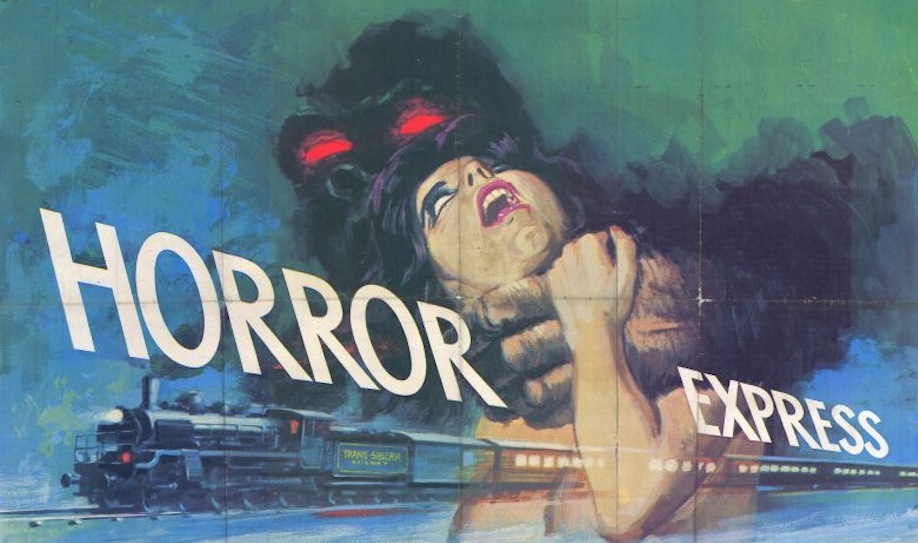
HORROR EXPRESS

HORROR EXPRESS (1972). Director: Eugenio Martin. 

Professor Alexander Saxton (Christopher Lee) arranges for an ancient fossil he has discovered to be shipped aboard a train upon which he is traveling, along with a colleague named Dr. Wells (Peter Cushing). However, this "fossil" turns out to be alive, able to emit reddish rays from its eyes that parboil a person's brains and turn their own eyes solid white. [It turns out that the creature's memories are stored not in its brain but in its eyes]. The monster is also able to transfer its consciousness into other people's bodies, as well as revivify its victims for more "fun." This period piece teaming horror great Lee with Cushing is not as memorable as one might have hoped for, but it does have some interesting sequences and concepts. Telly Savalas adds some spice as Captain Kazan who comes aboard the express late in the picture to try to figure out why so many are dying. Made in Spain. 

Verdict: An express you might like to take, but not to worry if you miss it. **1/2.

ALFRED HITCHCOCK PRESENTS: SEASON FOUR

ALFRED HITCHCOCK PRESENTS Season 4. 

A whole bunch of ironic, amusing, and suspenseful stories served up by the ever-droll Hitch. "Poison" features Wendell Corey in a tale of a snake in a bed. "Man with a Problem" finds Gary Merrill out on a ledge threatening suicide. "Tea Time" teams Margaret Leighton and Marsha Hunt in a tale of wife vs. mistress. "Mrs. Herman and Mrs. Fenimore" is a delightful tale of a miserly uncle and the two women in his life, Dora Merande and Mary Astor, both of whom are wonderful. Then there's the creepy "Waxwork," and Franchot Tone and Mary Astor again in "The Impossible Dream" about an aging actor. Bette Davis stars in "Out There, Darkness," about a woman who pays the price for her jealous actions, and there's nice work from Fay Wray in "The Morning After." Other notable episodes include "Murder Me Twice" with Phyllis Thaxter in a tale of reincarnation; "The Desert Shall Blossom," with two cowboys and a gangster; "Kind Waitress," with Olive Deering; "The Diamond Necklace" with the great Claude Rains; Dennis Day in "Cheap is Cheap;" and Robert Morse and Paul Douglas in "Touche." 

Verdict: More fun with Hitchcock. ***.

FRANCESCA DA RIMINI


FRANCESCA DA RIMINI. Opera by Riccardo Zandonai. The Metropolitan Opera 1985. Presented on Live from the Met. Stage Director: Piero Faggioni. TV director: Brian Large. Conducted by James Levine.

Francesca's (Renata Scotto) brother knows that she'll never marry Giancetto Malatesta (Cornell MacNeil) if she sees what he looks like, so he arranges a cruel trick. He has Giancetto's handsomer and younger brother Paolo (Placido Domingo) show up on the da Rimini estate, where it becomes love at first sight for the two [in a very passionate moment in which the two principals never sing, only the chorus in the background, and Francesca presents Paolo with a rose). Unfortunately, the scene in which Francesca discovers the truth is not depicted in this version of Gabrielle D'annunzio's play, but there's plenty of fireworks to come in spite of it. Try as they might, Francesca and Paolo can't quell their rising passion for one another, leading to sex and disaster, and a deeply moving, beautifully staged finale. With superior production design by Ezio Frigerio and beautiful costumes by Franca Squarciapino, this presentation by the famed Metropolitan opera is first-class virtually all the way through. Scott is perhaps not in the best voice, although no fault can be found with her acting. Domingo sings the pants off his third-act aria in which he explains how tormented he is by his separation from Francesca, and the two singers vividly display the proper amount of sexual and romantic excitation. Despite a tendency toward shrillness at times, Domingo is excellent, as is Cornell MacNeil as his frightening brother and William Lewis as the nasty Malatestina, a third brother who loses an eye in combat. Among the supporting cast, pretty Isola Jones makes a strong vocal impression as Francesca's devoted servant, Smaragdi.
Zandonai's music is attractive and powerful, intense with passion throughout, and full of forecasting of the terrible events that will transpire. A masterpiece.

Verdict: Perhaps the only time you'll see a severed head batted around the stage of the Met. ****.

SHE'S OUT OF MY LEAGUE


SHE'S OUT OF MY LEAGUE (2010). Director: Jim Field Smith.

Kirk (Jay Baruchel) works for airport security and Molly (Alice Eve) is a pretty event planner. The more average-looking Kirk thinks he hasn't got a chance with Molly, but to his delight, confusion, and severe apprehension, she seems to go for him. [Actually this is not such a big stretch as Eve is pretty but not "drop dead' gorgeous and Kirk isn't ugly by any means and has an appealing personality to boot]. Kirk's insecurity threatens to unravel everything, but Molly has her own secrets. Poor Kirk is saddled with a family made up of complete morons. The premise of this film isn't bad, the acting is good, and there are a few funny moments [such an an "accident" Kirk has just when he's about to meet Molly's parents] but just not enough to make this memorable. Geoff Stults plays Cam, a straight pilot who thinks Kirk is gay and rates his buddies as to how "hot" they are in a weird but funny sequence.

Verdict: Almost ... but not quite. **.

Thursday, November 25, 2010

HAPPY THANKSGIVING!


HAPPY THANKSGIVING!


Give thanks for all the great movies out there and watch out for those turkeys!

PIT AND THE PENDULUM

PIT AND THE PENDULUM (1961). Producer/director: Roger Corman. 

Francis Barnard (John Kerr) arrives at the castle of his brother-in-law Don Medina (Vincent Price) and his sister, Catherine (Luana Anders), after hearing of the supposed death of his own sister, Elizabeth (Barbara Steele). Medina is the son of a notorious torturer of the inquisition, and the cellar is full of the sinister implements that he used in his work. As Kerr struggles to find the truth from Don Medina and Catherine, there are disturbing indications that Elizabeth may still be alive. Richard Matheson's screenplay doesn't really have much to do with Edgar Allan Poe's excellent short story upon which this is very loosely based, instead being a tale of marital and familial discord and mental illness with a dollop of "The Fall of the House of Usher' [which Corman had previously filmed] thrown in. (Corman apparently liked the basic plot of this film so much that he used it again for Premature Burial.) This is a handsomely appointed production with superior art direction and scenic design by Daniel Haller and an effective score by Les Baxter. Price is also effective as Medina, borderline hammy but dramatic and fun. For some reason Barbara Steele is dubbed. Kerr is fine, as is Anthony Carbone as Dr. Leon, and Luana Anders scores in a very different role from the one she played in Dementia 13. Not much is done with the "pit," but the sequence with the deadly pendulum is very well done and the best thing in the movie. Great ending! 

Verdict: Don't expect much Poe, but on its own terms this is quite vivid and entertaining. ***1/2.

THE COSMIC MONSTERS

THE COSMIC MONSTERS (1958/aka The Strange World of Planet X and The Cosmic Monster.) Director: Gilbert Gunn. 

"Insects! Oh mon dieu -- No!" 

 Gil Graham (Forrest Tucker) and sexy French computer expert Michele Dupont (Gaby Andre) suspect that something is going wrong with an experiment by a colleague who is altering the molecular stability of metals with a field that is expanding far beyond the confines of the laboratory. Boy, are they right! -- which is confirmed by a visitor from outer space (Martin Benson) who warns them of their potential destruction. The field not only drives men mad, but has mutated all manner of yucky insects into slavering, hungry giants! The best scene has Ms. Dupont caught in a giant spider web even as pretty new teacher Miss Forsythe (Patricia Sinclair) is trapped in the school house by crunching, aggressive creepy-crawlies. The Cosmic Monsters is talky at times and very low-budget, but it has a certain unsavory zest in its insect scenes and is generally well-acted. Based on a novel by Rene Ray. 

Verdict: You can't beat those bugs! ***.

HONEY WEST


HONEY WEST (1965) ABC-TV series.

This series about a female private eye only lasted one season and thirty episodes, but it could be very snappy stuff. The TV incarnation of Honey was introduced on an episode of Burke's Law. The show was based on a series of exploitation novels by G. G. Fickling (a husband and wife writing team) with the emphasis on sex. Things are toned down a bit for the TV show, although the emphasis remains on Honey's shapely charms, as personified by actress Anne Francis. Although occasionally on the "cutesy" side, Francis is pretty much perfect as Honey, and John Ericson is similarly excellent as her partner, Sam Bolt. Honey inherited the detective agency from her father, and Sam -- who used to work for the old man -- now works for her, although in general they function as a team that now and then has a prickly relationship (this was in the days before "sexual tension" was coined). Most of the episodes were fun and well-acted, with plenty of action in a compact half hour minus commercials. There were only a couple of clunkers and even these episodes aren't really awful. The best episodes include "The Swinging Mrs. Jones" (a blackmail ring preying on wealthy married women); "Whatever Lola Wants" (a sinister society hostess); "Little Green Robin Hood" (Edd Kookie Byrnes as a crazy thief, with Allen Jenkins and Eleanor Audley -- who was the voice of Malificent in Disney's Sleeping Beauty -- also in the cast); and "An Eerie, Airy Thing" (a man out on a ledge wants to talk his wife, unaware that she's been murdered). Irene Hervey shows up now and then as Honey's likable and helpful Aunt Meg.

Verdict: Honey with some spice and humor to it. ***.

IRON MAN 2


IRON MAN 2 (2010). Director: Jon Favreau.

Antony Stark (Robert Downey Jr.) returns as the armored hero in this sequel to Iron Man. The plot doesn't really matter, but Stark mixes it up with the Black Widow (Scarlett Johansson), Whiplash (Mickey Rourke), and Justin Hammer (Sam Rockwell), all of whom first appeared in the Iron Man comic books. The Widow pretends to be an employee of Stark Industries, Hammer has a sinister plot afoot involving dozens of Iron Man clones, and Whiplash is really Ivan Vanko, a Russian scientist who uses electronic whips to slash automobiles in half. However, the best sequence has a drunken Iron Man [Stark is a reformed alcoholic in the comics] battling his pal Rhody (Don Cheadle) as the latter is dressed in his own armor as War Machine. Iron Man 2 is colorful and has some exciting sequences, although it's too long and drags at times. Downey is fine as Stark; ditto for Gywneth Paltrow as his assistant Pepper Potts [whom he makes head of Stark Industries] and the rest of the supporting cast. Mickey Rourke looks fairly grotesque but he nearly steals the picture with his intense portrayal of Ivan Vanko. Nice theme music by John Debney.

Verdict: Noisy and splashy and at times entertaining. ***

GEORGE HAMILTON: DON'T MIND IF I DO


DON'T MIND IF I DO. George Hamilton and William Stadiem. Touchstone; 2008.

George Hamillton has always come across as a vaguely likable if decidedly superficial personality and he's pretty much true to form in this entertaining memoir. You read about his trips to this country and that and his friendships and dalliances with famous people, but you won't read much about culture or anything of real substance. Hamilton started out as a highly promising actor with a strong and sensitive performance in Home from the Hill, but he didn't build on that promise, more interested in being the suave if old-fashioned playboy than a serious actor. [Yet I have never once heard anyone say they thought Hamilton was "hot." But nobody says that about Hugh Hefner either.] Hamilton writes a lot about his colorful mother and gay brother, Bill, both of whom seem more interesting in some ways than Hamilton. Hamilton does get points for honesty, as he doesn't gloss over some of the bad movies he's made as most other actors do, but has fun writing about them. [Oddly, he doesn't mention such creditable film projects as The Power.] Don't Mind if I Do can also be very witty, and is well-written by Stadiem. All in all, this is a bit of fluff like the actor himself but not without its charms.

Verdict: Not a bad read if you're so minded. ***.

Thursday, November 18, 2010

TEENAGE DOLL


TEENAGE DOLL (1957). Producer/director: Roger Corman.

A young lady is thrown off of a roof and killed, precipitating a series of events among some tough and not-so-tough slum gals. Female gang leader Helen (Fay Spain) is convinced that the killer is a vague young woman named Barbara Bonney (June Kenney) and is out to wring a confession from her come hell or highwater. Barbara has an upright father and a bizarre mother (Dorothy Neumann) who wears pigtails and looks demented. Another of Roger Corman's "bad girl/juvenile delinquent"films, similar to Sorority Girl, with its own twists, but, if anything, much duller. June Kenney was introduced in this film; she later wound up in Earth vs the Spider and similar low-budget films in addition to other Corman productions; she's not bad at all. In general the actors are much better than the material. John Brinkley [as bad boy Eddie] and Barboura Morris [as Janet, who hopes for a better life] display genuine acting ability and charisma, as do most the actors, in fact. But the script is entirely forgettable. Screenwriter Charles Griffith generally did much better with Corman's horror items.

Verdict: Watch Corman's Attack of the Crab Monsters -- also written by Griffith --instead. *1/2.

ARCH JOHNSON OR GENE EVANS


Arch Johnson [on the right] or Gene Evans [on the left]?

It happens all the time. I'll be watching an old TV show or movie and I'm convinced that the actor I'm looking at is Gene Evans, who starred in The Giant Behemoth, Samuel Fuller's Park Row, Devil Times Five, Steel Helmet, Fixed Bayonets, and many others and when I look at the cast list it will turn out that "Evans" is really an actor named Arch Johnson, who could be his brother. [Keep in mind that in these two pictures Evans is much younger than Johnson. When they were the same age they looked even more alike.]

Evans and Johnson not only resembled one another, but they were born on the same year, 1922. Johnson lived until 1997 and Evans died just a year later. Evans, who won a purple heart as well as the Bronze star in WW2, arguably had the higher-profile career, appearing in many more movies than Johnson, including Donovan's Brain and Walking Tall, but Johnson was no slouch. In the sixties and afterward, both actors appeared primarily in television productions, and both had long, busy careers appearing on one TV show after another. Evans appeared in the film Operation Petticoat and Johnson appeared in the TV show based on the movie.

So remember, the next time you're watching an old movie or show, if you think it's Evans it's probably Johnson -- and vice versa!

CLORIS: MY AUTOBIOGRAPHY CLORIS LEACHMAN


CLORIS: MY AUTOBIOGRAPHY. Cloris Leachman with George Englund. Kensington; 2009.

Ms. Leachman -- with the help of ex-husband Englund -- writes pleasantly of her life and career in this memoir done in the style of Bette Davis' This 'n' That: instead of proceeding chronologically, Leachman jumps around from subject to subject on her whim, but she manages to cover most of the bases. One senses, however, that she could have had a lot more to say about her life with, and divorce from, Englund, the father of her children, as well as about some of her co-workers. Leachman writes of how -- despite having perhaps [in my opinion] one of the worst names in show business -- she became successful on Broadway, in films and on television, garnering a host of Emmys, Tonys and an Oscar along the way. She also describes her devastation at the death of one of her sons to drugs. Then there are amusing stories of awkward things that happened on live television. At times Leachman comes off as dithery as her character "Phyllis," especially when she relates how Ed Asner basically stopped speaking to her because of her public references to his weight -- but she repeats the anecdote he hated in the book! When she writes of ex-husband Englund -- "I'm number one with him. He has a girlfriend now .. [who] takes wonderful care of him, and he loves her. But I'm still the one" -- you have to wonder if this is enduring friendship of ex-spouses or the words of a woman who just won't let go. In any case, the book is entertaining, and Leachman remains a very gifted actress.

Verdict: Easy to take. ***.

ALFRED HITCHCOCK PRESENTS SEASON THREE

ALFRED HITCHCOCK PRESENTS Season 3. 

The delightfully droll Hitch introduces 39 more half hour episodes of mayhem, mischief, murder, and macabre comedy. The two best episodes are "Reward to Finder" in which a husband and wife [Jo Van Fleet and Oscar Homolka, both of whom are superb] battle over the cash that was found in a lost wallet; and "Return of the Hero," an ironic item about a soldier (Jacques Bergerac) who apparently wants to bring home a disabled friend who saved his life, and is surprised at his family's negative (and ultimately heart-breaking) reaction. Other memorable episodes include: "Heart of Gold" [an ex-con "adopted" by his cell mate's family]; "Together," with Joseph Cotten locked in an office with his dead mistress; the famous "Lamb to the Slaughter," with Barbara Bel Geddes using an unusual weapon on her unfaithful husband; "Post Mortem" [sweepstakes ticket on a corpse]; "The Canary Sedan" [Jessica Tandy in a tale of a psychic]; "The Impromptu Murder" [a very ironic tale in which Hume Cronyn murders an old lady]; and "Little White Frock," in which an actor (Herbert Marshall) "auditions" by telling a very tall tale. 

Verdict: One of the most entertaining TV series ever. ***.

CELL [SOON TO BE A MOVIE]


CELL Stephen King. 2006; Pocket.

King has come up with a creepy thriller in which cell phones are used to mount a massive attack against the human race. One afternoon a signal goes out that drives everyone on a cell phone mad in an instant, turning them into homicidal maniacs and mindless drones to some cyber-intelligence. People unaffected immediately pick up their cell phones to call for help and also get zapped by the pulse. The only ones unaffected are those who don't have cell phones at all, including graphic artist Clayton Riddell, who hopes to be reunited with his wife and son; a gay man named Tom; and a teenage girl named Alice; the three team up to try to survive and find out what happened. Cell is one of King's best books, with an irresistible [and chilling] premise, and lots of suspense, harrowing action, and pretty good characterization. A page-turner to be sure. Cell is being made into a TV film that will probably debut in late 2010 or 2011. It should make a gripping film if it's directed well and handled with some intelligence and sensitivity.

Verdict: Stay off the friggin' cell phone!

Thursday, November 11, 2010

AGAINST TYPE: THE BIOGRAPHY OF BURT LANCASTER


AGAINST TYPE: THE BIOGRAPHY OF BURT LANCASTER. Gary Fishgall. 1995; Scribner.

A solid bio of Lancaster, who had a long and interesting career [more interesting than you might imagine, as this book reveals] and made many movies, including Trapeze, Sweet Smell of Success, Elmer Gantry, Birdman of Alcatraz, and many others. Fishgall describes how Lancaster got his start as a kind of acrobat, and used this early training for flamboyant performances in certain pictures. There may not seem to be enough personal detail in the book, but that's probably because Lancaster was, unlike some actors, rather private, and that, like many other stars, his career was essentially his life. Fishgall goes a bit into allegations of physical brutality against women and bisexuality [not to compare the two] -- more out of inclusiveness than sensationalism, one suspects -- but the evidence is too scanty to arrive at any conclusion, especially in the latter case. Against Type is well-written, well-researched and rather absorbing, not only a good bet for Lancaster's fans but for movie fans in general.

Verdict: Substantial bio of a star of long-standing. ***1/2.

X2


X2 (aka X-Men 2; X2: X-Men United/2003). Director: Bryan Singer.

This sequel to X-Men is another winner. Seems a bad guy named Willam Stryker (Brian Cox) had a mutant son named Jason, and his experiences with him so embittered him that he now wants to wipe out all mutants. To do this he intends to use Professor Xavier (Patrick Stewart) and the professor's Cerebro machine (which detects mutants and connects Xavier to everyone's minds). Professor X is given God-like power in this, but his opposite number, Magneto (Ian McKellan) is along for the ride and then some. X2 has some terrific sequences: Magneto using the iron in a guard's bloodstream to make his escape from prison; Pyro's (Aaron Stanford) fiery assault; the X-Men's plane being pursued by missiles. Jean Gray (Famke Janssen), Roque (Anna Paquin), and Wolverine (Hugh Jackman) all get plenty of screen time, as does Alan Cummings, who is as good as the others as Nightcrawler/Kurt Wagner. The entire cast, including Shawn Ashmore as Iceman, play with conviction, and the direction, photography [Newton Thomas Sigel] and musical score [John Ottman] are of a high order.

Verdict: Exciting, amusing, and moving. ***1/2.