Lively, entertaining reviews of, and essays on, old and newer films and everything relating to them, written by professional author William Schoell.
Showing posts with label Ross Hunter. Show all posts

Thursday, July 21, 2022

THE CHALK GARDEN

Deborah Kerr and Hayley Mills
THE CHALK GARDEN (1964). Director: Ronald Neame. 

Miss Madrigal (Deborah Kerr) is the latest in a long line of governesses for young and incorrigible Laurel (Hayley Mills), whose mother went off with her new husband and left her in the care of her own mother, Mrs. St. Maugham (Edith Evans). Laurel, who hates her mother, Olivia (Elizabeth Sellars), for abandoning her, is determined to find out what if any secrets Miss Madrigal may have, and one of them is a doozy. Meanwhile the governess and Mrs. St. M disagree on who should raise Laurel, her mother or her grandmother. Madrigal believes she belongs with Olivia, while her employer vehemently denies this. Then Mrs. St. M's old friend, "Puppy," the retired Judge McWhirrey (Felix Aylmer) shows up, and eventually remembers where he has seen Miss Madrigal before ... 

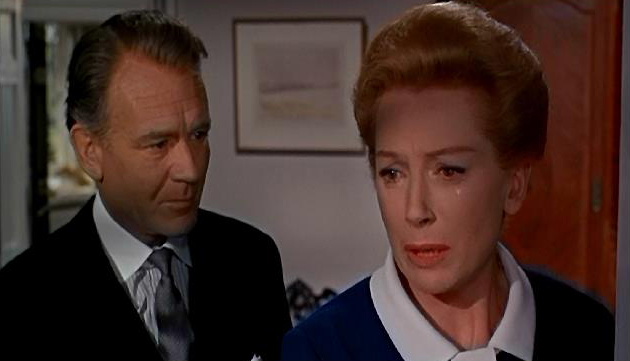
John Mills with Kerr
The Chalk Garden is based on a play by Enid Bagnold, and in truth it is very stagey and often unconvincing. There were a great many changes made from theater to film. Deborah Kerr never quite seems to get a handle on her character (although in this she may not necessarily be blamed); Hayley Mills is fine but for one or two occurrences of over-acting; Edith Evans is on the money; and Sellars and Aylmer are perfectly solid. So too is John Mills, who plays the sympathetic butler. There is perhaps too much left unsaid in this version, and characters come to conclusions that seem without foundation.

Verdict: This Ross Hunter production has some merit but ultimately doesn't quite cut it. **3/4.

Thursday, August 18, 2016

PORTRAIT IN BLACK

PORTRAIT IN BLACK (1960). Director: Michael Gordon. Produced by Ross Hunter.

Sheila Cabot (Lana Turner) is a beautiful woman married to a sick and seemingly hateful old man named Matthew (Lloyd Nolan). One day Sheila's lover, David (Anthony Quinn), who happens to be her husband's doctor, tells her how easy it would be to get rid of him. When Matthew conveniently kicks off, Sheila and David think they are above suspicion. But then a certain insinuating letter arrives ... Portrait in Black is an exhilarating suspense film whose chief strength is a superb performance from Quinn and an excellent score by Frank Skinner [Back Street] that helps keep viewers on the edge of their seats as all the various twists and turns of the plot -- and there are many -- skillfully unfold in a screenplay by Ivan Goff and Ben Roberts (based on their stage play). Michael Gordon's direction at least keeps things moving at a brisk pace, and there is some fine photography of San Francisco settings by Russell Metty [Miracle in the Rain]. While Turner and Quinn [Wild is the Wind] may not seem to have that much chemistry, Quinn's passion simply enfolds Turner and helps empower her more than competent performance. As for the rest of the cast: Lloyd Nolan; Sandra Dee as Turner's step-daughter; John Saxon as Dee's boyfriend; Richard Basehart as a scheming associate; Dennis Kohler as young Peter, Dee's step-brother; Virginia Grey as a secretary; and Ray Walston as a chauffeur who may know too much are all quite good, and for extra added measure we get Anna May Wong, of all people, playing the maid. Paul Birch shows up very briefly as a detective. This picture, now forgotten by most, was quite famous in its day, and is certainly worth a look. Producer Ross Hunter insures that the film has that certain Hunter gloss. The ad campaign for the pic seems to summon up images of Lana Turner, her daughter, and Johnny Stompanato which was turned into Where Love Has Gone with Susan Hayward in the Turner part.

Verdict: Very entertaining melodrama that isn't boring for an instant. ***.

Thursday, July 28, 2016

LOST HORIZON (1973)

Peter Finch seems to be asking: how did I get in this movie?
LOST HORIZON (1973). Director: Charles Jarrott. Produced by Ross Hunter.

A plane carrying several passengers, including peace envoy Richard Conway (Peter Finch) and his brother, George (Michael York), wind up kidnapped to a lamasery called Shangri-La in this musicalized remake of the 1937 Lost Horizon. Larry Kramer [The Normal Heart] seems to have ignored (or never read) the source novel and simply turned in a very slightly modified version of the original screenplay. For instance, in both film versions the two main male characters are brothers, which is not true in the novel. In the book the sole woman on the plane is a prissy missionary, while in both films she's a world-weary gal who's either dying or tired of living; in the color version she tries to commit suicide. This version eliminates a scene when Catherine (Liv Ullmann), who lives in Shangri-La, tells Richard how she wanted him brought to Shangri-La; in fact Ullmann gets few dramatic scenes. Olivia Hussy [Black Christmas] essays Maria (played by Margo in the first version) and is slightly more dimensional than in the original film. George Kennedy's character is very similar to Thomas Mitchell's, but Edward Everett Horton's comedy relief paleontologist has been replaced by an entertainer played by Bobby Van. James Shigeta has a very small role, while John Gielgud and Charles Boyer, of all people, are even better than the actors who played Chang and the High Lama, respectively, in the original film. All of the actors are quite good, in fact. And then there's the music.

Actually aside from a couple of numbers about to be mentioned, Burt Bacharach's score is not bad. His frequently dissonant dramatic music adds much to the picture, and the songs, which might be described as more like lyrical minor arias than show tunes, are generally lilting if on the downbeat side (which may be why so few liked them). Although Liv Ullmann [Cries and Whispers] sang on Broadway in Richard Rodgers I Remember Mama, her songs in this --  "The Circle" and a duet with Finch -- appear dubbed, and so is Finch. Sally Kellerman [Reflection of Fear] seems to be doing her own singing, but I'm not sure about Olivia Hussey when they do a creditable duet, "List of Things I Will Not Miss," in which the former tells of how glad she is to be away from civilization and the latter pines for all the places she's never been (if only more had been made of this aspect of the film). "Peaceful Joys" is a nice enough number, but the decided low-lights of the score include Kellerman's forgettable song, "Reflection," sung to George Kennedy, and Bobby Van's terrible "Question Me An Answer," which is not Van's fault but Bacharach's; this is one number that should have stayed inside his piano bench. Hal David contributed the awful lyrics. [One doesn't expect another "Getting to Know You," but this is just too much!]

The snow/adventure scenes in this are actually inferior to the ones in the original movie, although the trip to Shangri-La seems a bit more realistic. Essentially Lost Horizon in any form comes off like a paean to small-town mentalities, and the High Lama, who has people kidnapped to repopulate his dying city, is not much better than Fu Manchu. The biggest trouble with the movie isn't "Question Me an Answer" but the fact that in both movies -- and I daresay Hilton's novel -- none of the often interesting ideas are explored with any depth.

Verdict: The same length as the original film, although both seem twice as long. **.

Thursday, February 12, 2015

THE GROOM WORE SPURS

Joan Davis and Ginger Rogers
THE GROOM WORE SPURS (1951). Director: Richard Whorf.

Cowboy star Ben Castle (Jack Carson) owes 60,000 dollars to a gambler named Harry (Stanley Ridges of Black Friday), so attorney Abigail (Ginger Rogers) tries his best to make a settlement. Ben winds up getting married to Abigail, but he fears it's all just part of the deal. Later there's a murder and an unfunny business with a plane going out of control on the runway. In the meantime, most of the minimal laughs have to do with Alice (Joan Davis), who wears a short chic hairstyle and thinks Abby is a little nuts. Carson and Rogers are adept, Davis is as lively as ever, but the script is pretty bad. James Brown is a pilot named Steve who would probably make a better match than lunkhead Carson, and Ross Hunter [All I Desire] is Austin Tindale, a banker who seems to have a hankering for Alice. Mira McKinney [Young Fugitives] is fun as a termagant cook, as is Victor Sen Young as Carson's butler, although he's unfortunately asked to speak fractured Chinese.

Verdict: Davis deserves much better, which is usually the case. **.

Thursday, August 23, 2012

THERE'S ALWAYS TOMORROW

Fred MacMurray and Barbara Stanwyck
THERE'S ALWAYS TOMORROW (1956). Director: Douglas Sirk. Produced by Ross Hunter.

Clifford Groves (Fred MacMurray) is a toymaker with a wife (Joan Bennett) and children, but he also has a nagging sense of a lack of fulfillment. He runs into an old employee, Norma (Barbara Stanwyck) and the old feelings they used to have for one another begin to rekindle. Clifford's son Vinnie (William Reynolds) is convinced his dad is up to no good, while his girlfriend, Ann (Pat Crowley) reminds him that men and women can be friends and have innocent encounters. But are Clifford's feelings for Norma quite so innocent ... ? There have been lots of movies about [supposedly] "neglected" wives, but few about neglected husbands. Clifford seems a little unfair and unrealistic in getting jealous of his wife's understandable and necessary attention to the children. Still, MacMurray etches a poignant portrait of a man suffering a mid-life crisis and crying out for passion and romance. In the meantime, Norma gives a rather simplistic speech to the concerned children. The three leads all give fine performances, and Reynolds, Crowley and Gigi Perreau as the young daughter are all notable as well. The ending is not exactly a happy one although audiences were probably expected to be pleased with the resolution.

Verdict: Not exactly Brief Encounter, but not without merit. ***.

Thursday, August 16, 2012

PILLOW TALK

Hudson and Day
PILLOW TALK (1959). Director: Michael Gordon.

"It's like being around a pot belly stove on a frosty morning."

Interior decorator Jan Morrow (Doris Day) shares a party line with playboy and composer Brad Allen (Rock Hudson) and has conniptions trying to get him off the line -- he's usually giving the same old palaver to one woman or another -- when she needs to use the phone. Brad finally meets Jan and likes what he sees, but pretends to be a shy Texan so she won't know who he really is, leading to amusing complications. The two leads are very good and have fine support from the likes of Tony Randall (a friend of Brad's who loves Jan) and Thelma Ritter (Pam's tippling maid). Hayden Rourke, Nick Adams, Lee Patrick and Allen Jenkins also have smaller roles. At one point Brad, in his own identity, suggests that the out-of-town Texan Jan is dating [himself, of course] is a "mama's boy" [read gay], which must have made Hudson a little uncomfortable [besides being decidedly dated]. Generally, however, this is a good-natured, funny movie and the first of several films made by the odd but effective pairing of Day and Hudson. Produced by Ross Hunter, who first brought Hudson to the big time in Magnificent Obsession, this is full of suggestive scenes and lines that must have made it seem daring in its day.

Verdict: You wouldn't think this would work, but it does. ***.

Thursday, August 9, 2012

ALL I DESIRE

Stanwyck, Henderson [above] and Carlson
ALL I DESIRE (1953). Director: Douglas Sirk. Produced by Ross Hunter.

Naomi Murdoch (Barbara Stanwyck) left her husband and family years ago --there was dissatisfaction in her life, and a budding scandal involving another man -- and took to the stage. The ones she left behind, including her youngest daughter, Lily (Lori Nelson), who invites her mother to see her star in the high school play, think Noami is the toast of two continents but she's actually a lower case vaudeville performer. But when Naomi arrives in Riverdale, Wisconsin, she discovers that the household is divided over her presence. Lily and her young son Ted (Billy Gray) are delighted to see Naomi, as is the housekeeper Lena (Lotte Stein), but her oldest daughter Joyce (Marcia Henderson) wants nothing to do with her, and her husband, Henry (Richard Carlson), isn't entirely sure how he feels. This is an interesting drama and period piece [taking place in the early years of the 20th century] with another top-notch Stanwyck performance and an excellent supporting cast. Maureen O'Sullivan is a teacher and romantic interest for Henry; Lyle Bettger is an old fling of Naomi's, and Richard Long is Joyce's boyfriend. Dale Robertson, Brett Halsey, and Stuart Whitman turn up in small roles as members of the high school drama club. Although I've rarely been impressed with Lori Nelson in other films, in this she is quite good and charming as the daughter with theatrical aspirations.[It's almost as if she got worse with each role instead of better!] I guess playing with a talent like Stanwyck never hurts!

Verdict: Another absorbing Stanwyck picture and performance. ***

Thursday, July 26, 2012

MAGNIFICENT OBSESSION (1954)

MAGNIFICENT OBSESSION (1954). Director: Douglas Sirk. Produced by Ross Hunter.

This Technicolor remake of the 1935 Magnificent Obsession  casts Rock Hudson and Jane Wyman in the roles originally played by Robert Taylor and Irene Dunne, and they give equally good performances. This picture turned Hudson into a major star and he was later re-teamed with Wyman in the more interesting All That Heaven Allows the following year. This has the exact same story as the 1935 film -- wealthy irresponsible playboy Bob Merrick (Hudson) turns over a new leaf after he is, in part, responsible for a beloved doctor's death, and then the accidental blinding [not Merrick's fault] of the doctor's widow (Wyman). The trouble is that this version, while very nice to look at and with fine supporting performances from Barbara Rush, Agnes Moorehead and others, is just as contrived. Although the age difference between the two leads was addressed in All That Heaven Allows, it is ignored in this picture. In smaller roles you'll find Mae Clarke, Paul Cavanaugh, and Richard Cutting of Attack of the Crab Monsters.

Verdict: Glossy and well-intentioned, but there's nothing really there. **1/2.

Thursday, July 5, 2012

ALL THAT HEAVEN ALLOWS

Rock Hudson and Jane Wyman
ALL THAT HEAVEN ALLOWS (1955). Director: Douglas Sirk.

"As Freud says, when we reach a certain age sex becomes incongruous."

""You were ready for a love affair, but not for love."

Cary Scott (Jane Wyman), a small-town widow approaching middle age, finds a second chance for happiness with a somewhat younger gardener named Ron Kirby (Rock Hudson). Even though Ron has his own successful business, he is seen as a poor choice for Cary, whose first husband was an affluent businessman. While the town busybodies gossip, even wrongly suggesting that something was going on between Cary and Ron even before Mr. Scott's death, Cary's son, Ned (William Reynolds), and daughter, Kay (Gloria Talbott), have strenuous objections to their mother's relationship with Ron. Concerned about her children's feelings, Cary makes a fateful decision, only to discover her children haven't time to give much thought to their mother's feelings. [A great scene has the children giving Cary a television set for Christmas, and the camera pulls in toward her sad reflection in the screen as she realizes this TV is meant to be her "companionship" for the future.] Jane Wyman gives an excellent and sensitive performance that holds up through all of the plot contrivances, and Hudson, if not on his co-star's level, is good and romantic and at the height of his male beauty. This is a typically handsome Ross Hunter production with picture postcard Technicolor cinematography. The screenplay tries [and fails] for added depth by making Kirby a Thoreau addict who tries, along with his friends Mick and Alida (Charles Drake and Virginia Grey), to turn aside from mindless ambition and enjoy life's simpler pleasures. [Only in a Hollywood movie can people who eschew the rat race and Keeping Up With The Jones' live in such utterly sumptuous surroundings. Anyone who lives in a reconverted, refurbished mill house has to have bucks.] That being said, there is some good dialogue and supporting performances from such as Gloria Talbott [as the constantly psychoanalyzing daughter], William Reynolds, Donald Curtis as a lecherous suitor, and Agnes Moorehead as Cary's good friend, Sarah. Jacqueline DeWit is the bitchy Mona, who dishes dirt on everyone, Nestor Paiva is one of Ron's circle of friends, and David Janssen is Kay's boyfriend. Although the film makes some attempt at dealing with ageism, it's also guilty of it in its treatment of Harvey (Conrad Nagel), who is Cary's steady date. Harvey may be twenty years older than Cary, but it's still a bit ludicrous to suggest that a man in his late fifties [as Nagel was] would settle for a sexless marriage with a younger woman, as Harvey more or less suggests. Setting aside these and other quibbles, All That Heaven Allows is not without appeal, although it is nowhere near as good as a similar vehicle with Barbara Stanwyck, My Reputation. Nice Frank Skinner score with classical themes.

Verdict:  Attractive soap opera with compelling leads [if for different reasons]. ***.