Lively, entertaining reviews of, and essays on, old and newer films and everything relating to them, written by professional author William Schoell.
Showing posts with label John Mills. Show all posts

Thursday, July 21, 2022

THE CHALK GARDEN

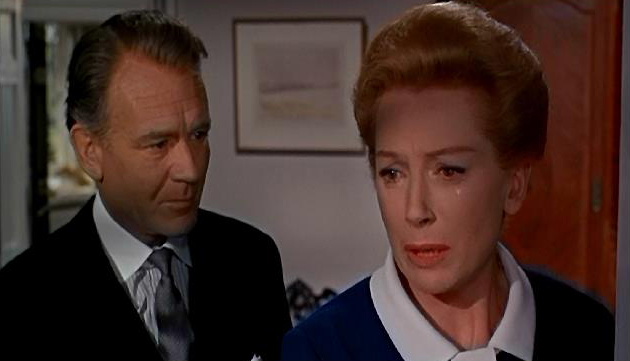
Deborah Kerr and Hayley Mills
THE CHALK GARDEN (1964). Director: Ronald Neame. 

Miss Madrigal (Deborah Kerr) is the latest in a long line of governesses for young and incorrigible Laurel (Hayley Mills), whose mother went off with her new husband and left her in the care of her own mother, Mrs. St. Maugham (Edith Evans). Laurel, who hates her mother, Olivia (Elizabeth Sellars), for abandoning her, is determined to find out what if any secrets Miss Madrigal may have, and one of them is a doozy. Meanwhile the governess and Mrs. St. M disagree on who should raise Laurel, her mother or her grandmother. Madrigal believes she belongs with Olivia, while her employer vehemently denies this. Then Mrs. St. M's old friend, "Puppy," the retired Judge McWhirrey (Felix Aylmer) shows up, and eventually remembers where he has seen Miss Madrigal before ... 

John Mills with Kerr
The Chalk Garden is based on a play by Enid Bagnold, and in truth it is very stagey and often unconvincing. There were a great many changes made from theater to film. Deborah Kerr never quite seems to get a handle on her character (although in this she may not necessarily be blamed); Hayley Mills is fine but for one or two occurrences of over-acting; Edith Evans is on the money; and Sellars and Aylmer are perfectly solid. So too is John Mills, who plays the sympathetic butler. There is perhaps too much left unsaid in this version, and characters come to conclusions that seem without foundation.

Verdict: This Ross Hunter production has some merit but ultimately doesn't quite cut it. **3/4.

Thursday, July 7, 2022

FOREVER YOUNG: A MEMOIR Hayley Mills

FOREVER YOUNG: A MEMOIR. Hayley Mills. Grand Central; 2021.

In this very well-written and completely absorbing memoir, Hayley Mills begins by telling us that not only wasn't she at the ceremony, but she wasn't even aware of it when she was given a special Oscar for her first Disney film, Pollyanna.  She then writes of her early years, her family -- including father John Mills and sister Juliet Mills and her possibly alcoholic mother, who was also an actress -- and her first film, the British independent Tiger Bay, in which she co-starred with Horst Buchholz and developed a major crush on him. She signed a contract with Walt Disney, a man she greatly admired (she says nothing whatsoever negative about him) and appeared in such films as The Parent Trap, In Search of the Castaways, Summer Magic, That Darn Cat and others. Her first adult role was in The Family Way, which was directed by the much older Roy Boulting, whom she married. Boulting put her in unmemorable and inappropriate vehicles such as Twisted Nerve and their marriage was ultimately unsuccessful. Mills doesn't neglect her films or acting career, but the strength of the book is how well she delineates the feelings she was going through as she became famous at a very early age and other life-and-career-changing events that occurred afterward. 

Verdict: One of the best show biz memoirs ever written. ****. 

Thursday, July 28, 2016

GOODBYE, MR. CHIPS (1939)

Mr. Chipping (Robert Donat) and one of his charges
GOODBYE, MR. CHIPS (1939). Director: Sam Wood.

Mr. Chipping (Robert Donat), affectionately known as "Chips," becomes teacher at a boys' school and after a few missteps with the unruly youngsters wins them over and becomes a beloved figure. At 83 and retired, he looks back over his life: his first awkward days at the school; meeting his beautiful wife, Katherine (Greer Garson), while on holiday; being turned down for headmaster; his own family tragedy; and his anguish at the deaths of so many of his students during WW1. Although Donat [The Winslow Boy] is a bit too caricatured as an man in his eighties, he gives a very good and sensitive performance, and is matched in quality by Garson [Madame Curie] as his loving and intelligent wife who helps guide him in his choices. There is such a talented bunch of young actors in this -- Terry Kilburn plays various generations of a boy named Colley (with John Mills as Colley as a young man) -- each of whom is a thorough professional. Billed as "Paul Von Hernried," Paul Henreid [Between Two Worlds] is also fine as the German teacher who befriends Chips and helps bring him out of his shell. This is also based on a novel by James Hilton, but I find it vastly superior to Lost Horizon. Although some aspects of the story may be a bit improbable (since when do little boys have such respect for elderly men?), this is a warmly sentimental and absorbing, well-made drama. One of the most moving scenes has Chips reading the names of many of the boys who have been killed in action. Goodbye, Mr. Chips won four academy awards for Best Actor, Best Actress, Best Direction, and Best Picture.

Verdict: Lovely old movie. ***1/2.

Thursday, June 25, 2015

THE FAMILY WAY

Wife and son comfort Ezra
THE FAMILY WAY (1966). Producer/Directors: John and Roy Boulting. Note: This review reveals plot elements.

"I can cry if I want, can't I? It's life, lad, life. It might make you laugh at your age, but one day it'll make you bloody cry." -- Ezra Fitton

Arthur Fitton (Hywel Bennett) has married his sweetheart Jenny (Hayley Mills), but the two are ripped off by a travel agency and can't afford a honeymoon. Worse, Arthur and Jenny must stay in his father's house and the lack of privacy and the resulting tension leads to the marriage not being consummated. When father Ezra (John Mills, playing his daughter's father-in-law) says that he thinks there's something "queer" about it, his wife, Lucy (Marjorie Rhodes), reminds him that Ezra actually took his beloved buddy Billy with them on their honeymoon! Situations aren't always what they seem -- or are they? The Family Way is a charming, beautifully-acted movie that has sparked a debate about its true sub-text, not only because of the honeymoon business but because of the ending, when Ezra breaks down in front of his wife and his other son. People either believe that Ezra was in love with Billy, who vanished, or that Billy is actually Arthur's father, but the solution may be even more complex than that.

The Family Way was based on a 1964 play entitled "All in Good Time" by Bill Naughton, who also wrote the screenplay for the film adaptation. I went back to the original source for some clues to the true meaning of the movie and while probably only the late Irish playwright knows for sure, one can make some surmises. Some reviewers have argued that men can form very close friendships without being gay (in truth, there are heterosexual men who much more enjoy the company of other heterosexual men than their own wives), but the whole business with the honeymoon, plus the rhapsodic expression on Ezra's face whenever he talks about the vanished Billy, says volumes. As for Arthur being Billy's son, there are certain unconfirmed hints at this, although this aspect doesn't really come across in the actors' performances. Then there's the question, would both Ezra and Lucy have been unaware of the boy's parentage for all these years when, let's face it, children tend to look like their parents long before they hit twenty-five? Still, "All in Good Time" is called "a comedy," and that alone can make the absurd seem -- no pun intended -- conceivable (including the honeymoon business). Still there's no getting around a certain romantic despair in Ezra at the end and Naughton writes that "he is a more complex person than he would have anyone know."

So what's the answer? There's a good chance it's both. Imagine how Ezra would feel if the boy he raised was actually the son of the man he'd been in love with (although it's unlikely this relationship was ever consummated). Hence the tears at the end. Some have argued that the whole Ezra-Billy business was dragged in just to make a point -- that just because Arthur is impotent with his wife doesn't make him -- nor Ezra or Billy -- gay (and the film doesn't suggest Arthur is), which Lucy basically says at one point -- but it's dwelt upon quite a bit. One bit of lovely dialogue has Lucy saying "It's a father's duty to help an' protect a lad like that -- not turn on him like the mob would, an' tear his self-respect to ribbons, all over somethin' he had no say in." The play has dialogue in which Lucy explains that having a child took Ezra's mind off of Billy, which could be taken as a man (unsuccessfully) shedding his homosexual past and making the best of a married, heterosexual future. In any case, John Mills [The Wrong Box] gives one of the best performances of his career, Marjorie Rhodes [Hands of the Ripper] is sheer perfection, Bennett and Hayley Mills are wonderful, and there's nice work from Murray Head, who later appeared in Sunday, Bloody, Sunday, as Arthur's younger brother, and Barry Foster [Frenzy] as a co-worker who rides Arthur a bit too much.

The Family Way is more of a comedy-drama than an out and out comedy, and that's probably due to the strong performances, as much as the not-always comical situations. Hywell Benett and Hayley Mills also appeared together in Boulting's Twisted Nerve. NOTE: Naughton's play was filmed in 2012 under the original title. Like Family Way, it is an English film but with an East Indian cast, and appears to be an out and out comedy or farce.

Verdict: The vagaries and heartbreak of love indeed. ***.

Thursday, January 31, 2013

THE END OF THE AFFAIR (1955)

Deborah Kerr and Van Johnson


THE END OF THE AFFAIR (1955). Director: Edward Dmytryk.

"It's quite simple really. One just does one's best."

"Are we to be children all our lives?"

In war-torn London, writer Maurice Bendrix (Van Johnson) has an affair with Sarah Miles (Deborah Kerr), the wife of a colleague, Harry (Peter Cushing). After Maurice is nearly killed in an explosion, he gets the paranoid impression that Sarah would have preferred he died so that the affair could end with ease, He becomes obsessed with finding out why she broke things off immediately afterward. He's unaware that Sarah, fearing he was killed, made a certain promise to a God she doesn't quite believe in ... The End of the Affair, based on a novel by Graham Greene, gets points for at least attempting to be adult fare and dealing with [semi] intellectual matters instead of merely blowing out the soap bubbles, but it is so talky and so smothered in awful religiosity that it's nearly a complete misfire. A supposedly atheistic character seems dragged in for balance, but he's really just an embittered, disfigured man who hates God, the movies' misconception of an atheist. The End of the Affair is the kind of picture that thinks talking about God and theology is somehow profound, giving it a pretentious and heavy air just when you should be getting caught up in the drama [what there is of it] and the characters. Speaking of which, both Maurice and Sarah are rather unsympathetic; neither ever gives a thought to husband Harry, who may be dull but seems a decent sort after all. Although The End of the Affair does illustrate the torments d'amour rather well at times, at other times it's almost comically awful, wasting some very good acting, a fine score by Benjamin Frankel, and moody cinematography by Wilkie Cooper. Deborah Kerr gives the best performance, better than the movie deserves, and Van Johnson, while not on her level, is quite good for the most part as well. Peter Cushing, in one of his rare non-horror parts, also acquits himself nicely as Harry, and John Mills has a good turn as a private detective hired by Bendrix. Greene's novel was again adapted as a film in 1999 with Julianne Moore and Ralph Fiennes in the Kerr-Johnson roles.

Verdict: A for effort, maybe, but this just doesn't work. **. 

Thursday, June 21, 2012

THE WRONG BOX

Peter Sellers as Dr. Pratt
THE WRONG BOX (1966). Director: Bryan Forbes.

"My father was a missionary. He was eaten by his bible class." 

In this highly amusing black comedy, two elderly brothers are all that remain of a bunch of boys who were involved with a financial "tontine:" the surviving member of the group will receive all the money and the interest accrued. The film begins with a scene of these young boys, who seem to have no idea of what it's all about, gathered in a room with their guardians and being told about the tontine. Next follows a sequence showing how these now-grown boys meet their often untimely demises in generally comic and unusual ways. The main story follows the misadventures of Masterman Finsbury (John Mills), who has been in bed dying for decades, and his hated brother Joseph (Sir Ralph Richardson) -- a "boring pedantic old poop" -- as Masterman tries to murder Joseph [in a very funny sequence] and their assorted relatives conspire against each other or wonder what the hell is going on. Michael Caine is Masterman's nephew, and Dudley Moore and Peter Cook are the nephews of Joseph, with Nanette Newman playing Joseph's adopted daughter, who adores Caine and vice versa. There's a mix up with a dead body on a train and a corpse in a box, and while after a bit you may not quite follow everything going on, there are plenty of laughs in both the dialogue and performances. While his part is relatively small, Peter Sellers almost steals the picture in his hilarious, brilliant turn as drunken felonious old quack Dr. Pratt. The entire cast is marvelous, including Wilfrid Lawson, who died that year at sixty-six, as the butler Peacock. [Lawson plays a much older character and is very convincing]. The climax goes on too long, but this is a clever and very funny movie with a top-notch cast. Mills so loses himself in his character that you might not realize that it's him. And Sellers! Sublime!

Verdict: All this and Sellers, too! ***.