Lively, entertaining reviews of, and essays on, old and newer films and everything relating to them, written by professional author William Schoell.
Showing posts with label Frank Skinner. Show all posts

Thursday, January 30, 2025

BACK STREET (1941)

Charles Boyer and Margaret Sullavan
BACK STREET
(1941). Director: Robert Stevenson.

"There's one half of Walter Saxel's life -- and here comes the other half." 

In old Cincinnati Ray Smith (Margaret Sullavan) meets a visitor named Walter Saxel (Charles Boyer), and the two fall madly in love. Unfortunately it turns out Walter already has a fiancee. In spite of this he determines to marry Ray, only fate conspires to keep them apart at the fateful moment. Years later the two meet in New York, and begin a life-long affair ... The best screen version of Fannie Hurst's famous novel transcends soap opera via its superior script, direction, and acting from the leads and indeed the entire cast. Ray Smith's tragedy is that she is clearly an independent-minded woman of strength and character who is undone by her love for a man who needs to keep up appearances and is somewhat selfish in his all-consuming need for her. Boyer doesn't always play up the vulnerability in his character -- Ray fell in love with more than a businessman, after all -- but he is still quite good, and Sullavan is, as ever, simply marvelous for the most part. Richard Carlson [White Cargo, Creature from the Black Lagoon], Frank McHugh, Esther Dale, and young Tim Holt all score in supporting roles. There is an excellent score by Frank Skinner. The book was filmed earlier in 1932, and much later in 1961.

Fannie Hurst's novel has a different, much grimmer ending than any of its film versions. In the 1932 and 1941 versions Ray simply expires a few days after the death of her lover. (The 1961 version has Susan Hayward bravely moving forward in relative splendor.) In both of these versions, as in the novel, Walter's oldest son Richard offers to take care of Ray with monthly stipends. In the novel, Richard is killed, and the stipends cut off. An aging Ray descends into poverty, and takes to gambling (and occasional prostitution) to survive. At the end of the novel she ironically and accidentally has a five hundred franc note thrown into her grasping hands by Walter's surviving younger son. She sees this, in a sense, as Walter still looking after her. When she's found dead of starvation in her room, she's still -- to the amazement of the landlord -- clutching the note ... 

Verdict: A romantic gem if ever there were one. ****.

Thursday, August 4, 2022

ARABIAN NIGHTS

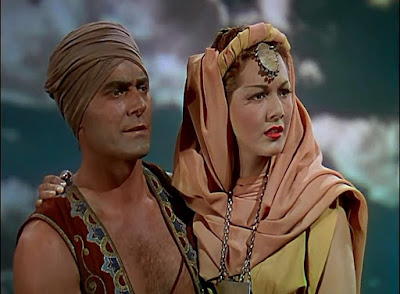
Jon Hall and Maria Montez
ARABIAN NIGHTS (1942). Director: John Rawlins. 
 

Sentenced to a slow death for trying to usurp the throne from his brother, Kamar (Leif Erickson) escapes and holds court in the palace while the true king, Haroun (Jon Hall of The Invisible Man's Revenge), goes on the run until he can regain his rightful position. Kamar is in love with the dancer Sherazade (Maria Montez) -- a different version of the Sheherazade of legend -- but before he can find her she is sold into slavery. As Sherazade and Haroun fall in love, they escape from slave traders and other nefarious characters until Kamar at last reclaims his chosen bride. But will true love win out in the end or is Haroun doomed to die? Young Ali (Sabu) will certainly do all he can to unite the lovers. 

Hall gets some wise counsel from Sabu
Universal may not have been in the same league as MGM when it came to gloss and pageantry, but they certainly gave it the old college try with Arabian Nights. The film is often beautifully photographed (Milton R. Krasner) in positively gorgeous -- and very expensive -- technicolor with striking desert vistas and impressive matte paintings. Frank Skinner's exciting score is flavored with the occasional "Arabian" touch. Jon Hall and Leif Erickson make a fine pair of literally dueling brothers, Sabu is as appealing as ever as the young Ali, and Edgar Barrier [Phantom of the Opera] is properly loathsome as Kamar's plotting associate, Nadan. 
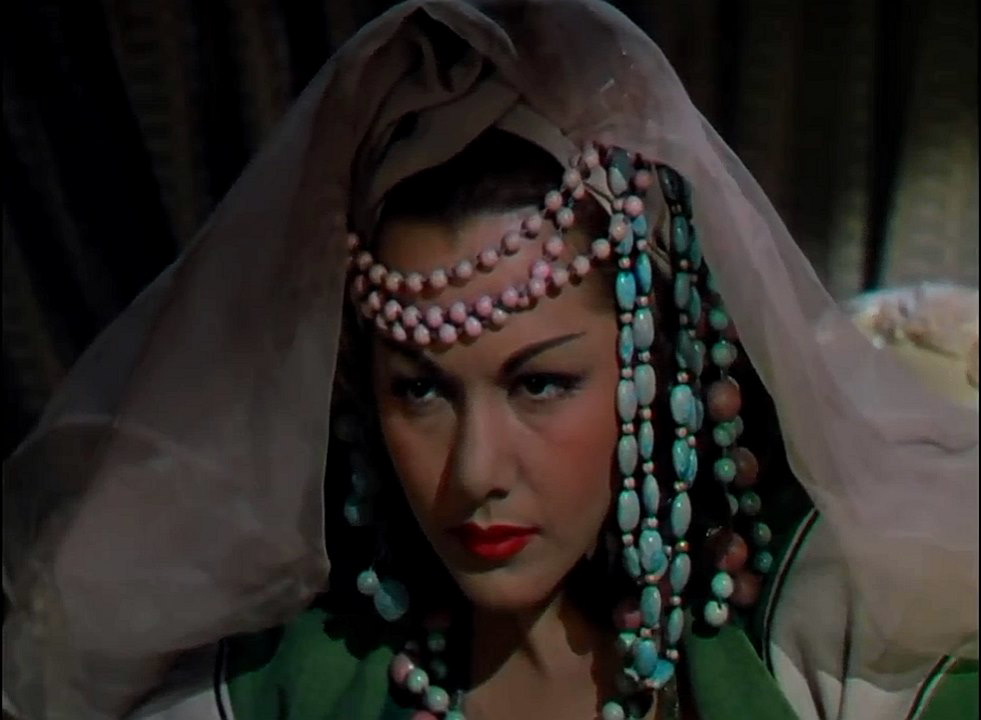
The Montez gives a smoldering look
As for Maria Montez? The movie is populated by starlets just as attractive if not more so than Montez, although she is certainly very decorative, as they say. One thing you must say about the woman is that she has a haughty, imperious authority -- possibly the way she was off-screen as well -- that works very well for her in parts like these. Her arrogance and self-confidence come through with her every line reading, which are generally on target. No, she's no Kate Hepburn, but one could hardly see Hepburn in this role (although she might have been better than one might imagine)! In other words, while no Oscar would have been in the offing for Ms. Montez, she is more than acceptable as Sherazade. 
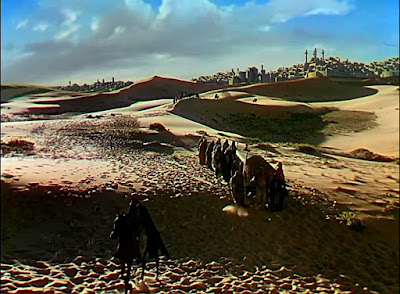
A striking sequence from Arabian Nights
There are other characters, some from the Arabian Nights, sprinkled throughout the movie. Sinbad, presented as a lazy lout instead of as a hero, is played by Shemp Howard, one of the Three Stooges! Aladdin (John Qualen) spends the movie trying to find his famous lamp and failing. Turhan Bey is cast as a captain in the King's army who comes to a bitter fate. As Ahmed, who runs a shop, Billy Gilbert overacts atrociously. Gilbert's scenes sometimes resemble something out of Abbott and Costello. Sherazade does a very expressive and sensual dance late in the movie, but apparently that was not Montez, who could neither sing nor dance. 

Verdict: A Maria Montez movie that is actually good! ***. 

Thursday, September 13, 2018

BLACK ANGEL

Dan Duryea and June Vincent
BLACK ANGEL (1946). Director: Roy William Neill. Based on a novel by Cornell Woolrich.

When sexy singer Mavis Marlowe (Constance Dowling) is murdered, the chief suspect is her lover, Kirk Bennett (John Phillips), who was being blackmailed by her. In spite of his affair, his wife, Catherine (June Vincent), remains loyal, as well as convinced that he is innocent. When he winds up convicted and on death row, with time running out, she makes up her mind to uncover the real murderer, and winds up working with the victim's ex-husband, Martin Blair (Dan Duryea of Terror Street), who was investigated by police and cleared. Catherine and Martin get a job as a singer and accompanist at a night spot owned by Mr. Marko (Peter Lorre of The Verdict), whom Martin swears he saw at Mavis' apartment house the night she was killed. Can the couple uncover the truth before they become more of his victims ,..? Black Angel is an absorbing, nominal film noir with some fine performances and a degree of suspense. Although June Vincent [Shed No Tears] is better cast as a bad girl and at first seems out of place in the movie, she has her typically sharp and unusual delivery to set her apart from the standard heroine. Duryea is, as ever, first-rate for the most part, and Lorre, in another in a long line of supporting roles that wasted his talent, is effortlessly excellent. Broderick Crawford plays the investigator on the case and is about as usual. There's a good score by Frank Skinner, and a snappy number called "I Wanna be Talked About" warbled by a dubbed Vincent. The ending is strangely moving, but you may be scratching your head at a couple of loose ends that make the denouement a bit suspect.

Verdict: Credible mystery with interesting cast. ***. 

Thursday, April 13, 2017

MIDNIGHT LACE (1960)

Natasha Parry and Doris Day
MIDNIGHT LACE (1960). Director: David Miller.

Wealthy Kit Preston (Doris Day) lives in a beautiful London townhouse with her husband, businessman Anthony Preston (Rex Harrison). She hears creepy voices in the pea-soup fog threatening to kill her, and gets obscene phone calls that Inspector Byrnes (John Williams) thinks may be imaginary. Is Kit overly anxious for her busy husband's attention, or is somebody actually out to get her? If so, there are numerous suspects: Malcolm (Roddy McDowall), the maid's son, who is shiftless and threatening; Brian (John Gavin), who supervises the construction site next to the townhouse and may be overly solicitous; a weird stranger who follows Kit about (Anthony Dawson); and Tony's business associates, Charles (Herbert Marshall) and Daniel (Richard Ney). Doris Day gives one of her best performances in Midnight Lace, convincingly getting across her character's terror and nervousness throughout the movie. Okay, there are times Day rather rabidly masticates the scenery a bit -- especially when she has a meltdown on a staircase -- but her hysteria fits the character, who is so wimpy and helpless at times that you want to slap some sense into her. The other performers are all excellent as well, including Natasha Parry as Kit's friend, Peggy, and Myrna Loy, who adds some class as Kit's Aunt Bea. John Gavin, incredibly handsome in this picture, uses a British accent and is better than usual. Russell Metty's cinematography is first-rate and Frank Skinner's score certainly adds immeasurably to the tension of certain sequences. When Kit asks for bus directions to a London neighborhood, leading to her near-death, you have to wonder why such a fabulously wealthy woman would bother taking a bus in the first place! Williams and Dawson both appeared in Hitchcock's Dial M for Murder. David Miller directed Joan Crawford in an even better woman-in-jeopardy film, Sudden Fear.

Verdict: Smooth, solid, well-acted suspense film. ***.

Thursday, August 18, 2016

PORTRAIT IN BLACK

PORTRAIT IN BLACK (1960). Director: Michael Gordon. Produced by Ross Hunter.

Sheila Cabot (Lana Turner) is a beautiful woman married to a sick and seemingly hateful old man named Matthew (Lloyd Nolan). One day Sheila's lover, David (Anthony Quinn), who happens to be her husband's doctor, tells her how easy it would be to get rid of him. When Matthew conveniently kicks off, Sheila and David think they are above suspicion. But then a certain insinuating letter arrives ... Portrait in Black is an exhilarating suspense film whose chief strength is a superb performance from Quinn and an excellent score by Frank Skinner [Back Street] that helps keep viewers on the edge of their seats as all the various twists and turns of the plot -- and there are many -- skillfully unfold in a screenplay by Ivan Goff and Ben Roberts (based on their stage play). Michael Gordon's direction at least keeps things moving at a brisk pace, and there is some fine photography of San Francisco settings by Russell Metty [Miracle in the Rain]. While Turner and Quinn [Wild is the Wind] may not seem to have that much chemistry, Quinn's passion simply enfolds Turner and helps empower her more than competent performance. As for the rest of the cast: Lloyd Nolan; Sandra Dee as Turner's step-daughter; John Saxon as Dee's boyfriend; Richard Basehart as a scheming associate; Dennis Kohler as young Peter, Dee's step-brother; Virginia Grey as a secretary; and Ray Walston as a chauffeur who may know too much are all quite good, and for extra added measure we get Anna May Wong, of all people, playing the maid. Paul Birch shows up very briefly as a detective. This picture, now forgotten by most, was quite famous in its day, and is certainly worth a look. Producer Ross Hunter insures that the film has that certain Hunter gloss. The ad campaign for the pic seems to summon up images of Lana Turner, her daughter, and Johnny Stompanato which was turned into Where Love Has Gone with Susan Hayward in the Turner part.

Verdict: Very entertaining melodrama that isn't boring for an instant. ***.

Thursday, August 15, 2013

FOXFIRE

Jane Russell, Dan Duryea and Jeff Chandler
FOXFIRE (1955). Director: Joseph Pevney.

A wealthy young woman named Amanda (Jane Russell) gets a lift from a handsome half-Apache mining engineer [who seems to have mixed emotions about his heritage], Jonathan "Dart" Dartland (Jeff Chandler), and the two rapidly fall in love and get married. Amanda must deal with the culture shock of moving out of luxury to a comparative shack in a mining town, and Dart has to deal with jealousy and a certain void in his emotions, as well as some self-esteem issues. The movie doesn't bang you on the head with the characters' problems, which is all the better, and the leads give good performances. Chandler has a limited bag of tricks but he makes them work within the role, and Jane gives a vital, warm and appealingly feminine performance instead of playing it hooker-hard as she often does in other movies. She and Chandler work up a lot of chemistry, which the latter didn't have with all of his leading ladies [such as the unfortunate June Allyson]. Frieda Inescort [The Alligator People] is fine as Russell's high society mother, but Austrian Celia Lovksy is ludicrously miscast as Dart's Native American mother, especially with that thick Viennese accent! Dan Duryea scores as the alcoholic doctor in the mining camp as does Mara Corday as his nurse, Maria, even if it makes no sense that the doc is smitten with Amanda but can't see the even more gorgeous and buxom Maria for dust. "Foxfire" refers to an abandoned Indian mine that Dart suspects has hidden gold in it, and wants to work. When all is said and done, however, Foxfire can't quite rise above its minor melodrama-romance status, despite some unusual and interesting elements. Whether Foxfire is accurate as regards to Native American affairs and attitudes in the fifties is debatable. NOTE: Jeff Chander wrote the lyrics for the title tune (with music by Henry Mancini) and also did the vocal, quite creditably. Nice score by Frank Skinner.

Verdict: Nice technicolor and a solid cast never hurt. **1/2. 

Wednesday, June 25, 2008

THE MUMMY'S GHOST

THE MUMMY'S GHOST (1944). Director: Reginald LeBorg.

In this sequel to The Mummy's Tomb, the town of Mapleton is having more problems with Kharis, the Living Mummy, who is still alive and up to trouble. Even High Priest Andoheb (George Zucco) is somehow still alive, and this time sends Yousef Bey (John Carradine) to take up where his last emissary left off. Inexplicably, the town's museum is displaying the mummy of Kharis' beloved, Ananka (although Steve Denning never actually found her in The Mummy's Hand) and Bey and Kharis are out for vengeance on those who committed this desecration -- or something like that. What really matters are the still creepy scenes of Kharis (Lon Chaney Jr.) shuffling around and strangling infidels. Barton MacLane is Inspector Walgreen, who does his best to stop Kharis, and Robert Lowery is the boyfriend of Amina (Ramsay Ames), the woman who -- very conveniently -- turns out to be the reincarnation of Ananka. Lowery later played the Caped Crusader in the Batman and Robin serial. The decorative Ames doesn't have to do too much acting, but even the little she's required to do is somewhat beyond her. The music (by Frank Skinner, with some themes probably by Hans Salter) does a lot of the work. This has a surprisingly downbeat ending. Followed by The Mummy's Curse.

Verdict: There's life in the old mummy yet! **1/2.

Sunday, January 13, 2008

MAN OF A THOUSAND FACES


MAN OF A THOUSAND FACES (1957). Director: Joseph Pevney.

The life of the great silent actor Lon Chaney, with a focus on his first failed marriage and his love for, and competition with, his son Creighton [later known as Lon Chaney Jr, a talented actor in his own right.] This is one of the best backstage biopics to come out of Hollywood, with a superb performance by James Cagney in the title role. In recreations of scenes from Chaney's hits, Cagney even gets across the style of acting employed by Chaney in the silent days. Jane Greer offers one of her loveliest performances as Chaney's second wife, Dorothy Malone is vivid and pathetic as wife number one, and even Robert Evans is fine as Irving Thalberg. In addition, Marjorie Rambeau has a nice scene as an extra called the “Duchess” who shows new-in-Hollywood Chaney the ropes. If there is a problem with the film it's that there seems to be too much of an effort made to turn wife number one into a villainess. At first Malone seems to be overacting as her character overreacts to the fact that Chaney's parents are deaf mutes, but it becomes evident later on that the picture wants to paint her as being a mite disturbed. The movie works up some sympathy for Malone in the final quarter. According to the film, wife number one was bored being left home alone with a baby, desired a career for herself as a singer, and when she went out and got one was basically told to stay home where she belongs by her disapproving, chauvinistic husband. Her reunion with her son brings about an estrangement between Lon and Creighton that is movingly resolved before the former's death. Whatever its flaws and dramatic licenses, this is an excellent film that features a dead-on Cagney performance. The CinemaScope photography is not really necessary for a more intimate type of story as this, but Frank Skinner's score for the film is one of his finest.
Verdict: Great biopic. ***1/2.

Friday, January 4, 2008

SABOTEUR


SABOTEUR (1942). Director: Alfred Hitchcock.

It's just possible that this wonderful movie might have become a classic if Hitchcock had gotten the two leads he really wanted – Gary Cooper and Barbara Stanwyck – instead of Robert Cummings and Priscilla Lane. While some might feel the dynamic Stanwyck would have been wasted in this movie, she would have added far more bite and intensity than the competent but mediocre Lane. Bob Cummings was certainly a skilled comedic actor (some think Cummings could also turn in fine dramatic performances in such films as Kings Row), but he's all wrong for Saboteur. Michael Curtiz once said “some men squeeze a line to death” and Cummings not only does that but rushes mush-mouthed through his readings to such a degree that the effect is not stirring or powerful as he might have intended but ludicrous. Apparently Hitch just threw up his hands and bristled at having to use these two utter lightweights in a movie that deserved so much better. Cummings is falsely accused of sabotage at a defense plant and also of incinerating his best friend by putting gasoline inside a fire extinguisher. [Cummings carries little of the resonance of this throughout the rest of the movie.] The real culprit is Norman Lloyd (who is excellent), whom Cummings – with an initially unwilling Lane in tow – pursues across the country. There are scenes which give one pause – how can a man in handcuffs manage to swim, for instance – but also some fine moments and interesting settings, such as the dusty, deserted Soda City where they encounter some of the nest of spies in an eerie moment or two. Hitch works up a lot of suspense for the scene in which Cummings gets rid of said handcuffs with a car's fan belt, and the Statue of Liberty finale is superb. Giant close ups of Norman Lloyd's jacket sleeve – held by Cummings, who wants to save the man so that he can clear him -- beginning to tear are contrasted with stunning long shots of the two men clinging horrifically to the outside of the statue. Hitchcock always said that it should have been Cummings dangling (or falling?) from the statue, not the villain, but the sequence is breath-taking all the same. An inspired touch is having the saboteurs operating in the midst of a respectable charity ball, and they are presented as being for the most part quite ordinary and mundane, with the exception of the flamboyant Mrs. Sutton and the sinister fifth columnist leader, very well-played by, respectively, Alma Kruger and Otto Kruger (no relation). Frank Skinner's opening credits music is very effective and right on the money. The strangest moment: Priscilla Lane actually pays for a milkshake brought to her by one of her captors. Talk about adding insult to injury!
Verdict: Not what it could have been but still some knock-out sequences. ***.