Lively, entertaining reviews of, and essays on, old and newer films and everything relating to them, written by professional author William Schoell.
Showing posts with label Hayley Mills. Show all posts

Thursday, July 21, 2022

SUMMER MAGIC

Mills, Mathers, McGuire, Hodges, Pollard

SUMMER MAGIC (1963). Director: James Neilson.

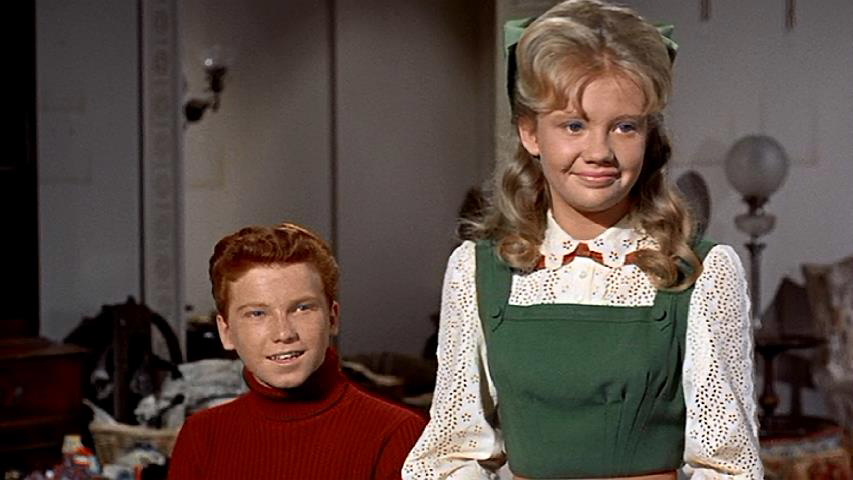
Widow Margaret Carey (Dorothy McGuire of Susan Slade) has to move her brood from Boston to a rented house in the country for financial reasons. The agent for the house, Osh Popham (Burl Ives of The Big Country), assures her that the owner is anxious for her to move in, but is he keeping secrets as his wife, Mariah (Una Merkel), suggests? Neither daughter Nancy (Hayley Mills) or older son Gilly (Eddie Hodges) are thrilled when they learn that stuck-up, pretentious cousin Julia (Deborah Walley), is moving in, but both young ladies are thrilled to meet the handsome young schoolmaster, Charles (James Stacy). Nancy is deflated when Charles seems to prefer Julia, but she may get the consolation prize when the house's real owner (Peter Brown of Violent Road) finally shows up. 

Eddie Hodges and Hayley Mills
Although there are a couple of moments when Summer Magic threatens to become dangerously sitcom-like and overly cutesy, I have to admit the darn thing has a lot of charm, not to mention several excellent performances. The gifted Hayley Mills always seems to be wonderful, and the same can be said of Dorothy McGuire. Ives and Merkel make an interesting couple, with the ever-quirky Michael J. Pollard (was there ever an actor anything like him?) playing their son with his customary shit-eatin' benevolence. Eddie Hodges is fine as Gilly, who would have preferred to stay in Boston, and little James Mathers (younger brother of Leave It to Beaver's Jerry Mathers) nearly steals the pic as the youngest member of the family. (It's somewhat annoying that when he's bullied because he has long hair and is wearing a Buster Brown outfit said bullies don't get any comeuppance.) 

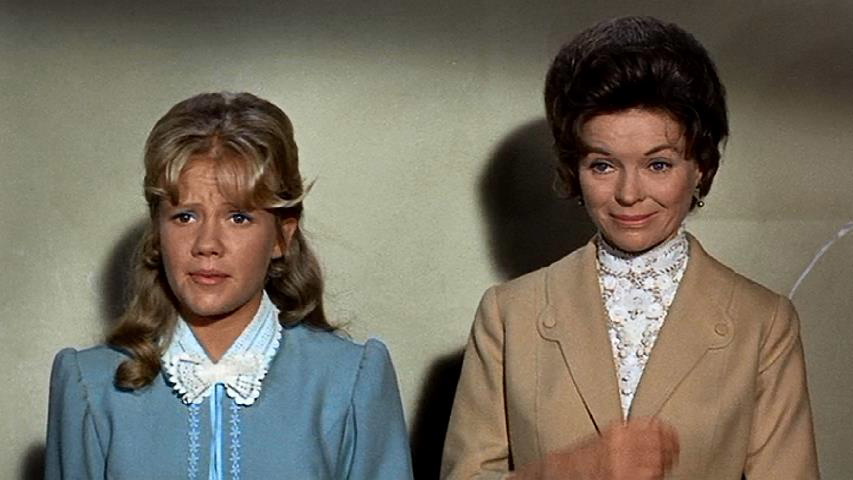
Hayley with Dorothy McGuire
Summer Magic is a musical, and while the songwriting team of the Sherman Brothers is not exactly Rodgers and Hammerstein, they have contributed some more-than-pleasant tunes, including "On the Front Porch with You," "The Ugly Bug Ball," "Beulah" and others. Hayley, Eddie and Burl do their own singing while I believe the others are dubbed. The rather abrupt character reversal of Julia is unconvincing, although Deborah Walley manages to handle it all with aplomb. A song in which the girls sing about "Femininity" and hiding your true self to snare a beau is the most dated thing about the picture, even if it takes place in the twenties. Although Dorothy McGuire was not that old and still attractive, the film doesn't give her a romantic partner, another dated aspect.

Verdict: Take it with a grain of salt and this is amusing and entertaining in equal measure. ***. 

THE CHALK GARDEN

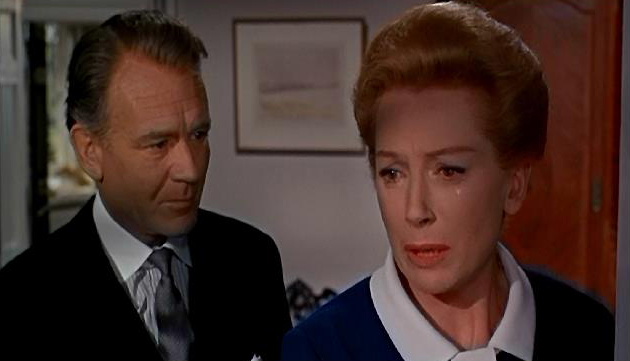
Deborah Kerr and Hayley Mills
THE CHALK GARDEN (1964). Director: Ronald Neame. 

Miss Madrigal (Deborah Kerr) is the latest in a long line of governesses for young and incorrigible Laurel (Hayley Mills), whose mother went off with her new husband and left her in the care of her own mother, Mrs. St. Maugham (Edith Evans). Laurel, who hates her mother, Olivia (Elizabeth Sellars), for abandoning her, is determined to find out what if any secrets Miss Madrigal may have, and one of them is a doozy. Meanwhile the governess and Mrs. St. M disagree on who should raise Laurel, her mother or her grandmother. Madrigal believes she belongs with Olivia, while her employer vehemently denies this. Then Mrs. St. M's old friend, "Puppy," the retired Judge McWhirrey (Felix Aylmer) shows up, and eventually remembers where he has seen Miss Madrigal before ... 

John Mills with Kerr
The Chalk Garden is based on a play by Enid Bagnold, and in truth it is very stagey and often unconvincing. There were a great many changes made from theater to film. Deborah Kerr never quite seems to get a handle on her character (although in this she may not necessarily be blamed); Hayley Mills is fine but for one or two occurrences of over-acting; Edith Evans is on the money; and Sellars and Aylmer are perfectly solid. So too is John Mills, who plays the sympathetic butler. There is perhaps too much left unsaid in this version, and characters come to conclusions that seem without foundation.

Verdict: This Ross Hunter production has some merit but ultimately doesn't quite cut it. **3/4.

Thursday, July 7, 2022

POLLYANNA

Hayley Mills
POLLYANNA  (1960). Director: David Swift. 

Now that she has become an orphan, young Pollyana (Hayley Mills) is shipped off to a small midwestern city where she is to live in a mansion with her stern and uncompromising Aunt Polly (Jane Wyman). So as not to disturb her sleep, Polly gives her niece the smallest room up in the attic. Despite her travails, Pollyana has the most upbeat nature in the world, and refuses to see defeat in anything or anybody. Mayor Warren (Donald Crisp) wants the town to build a new orphanage while Polly -- the wealthiest citizen, who happens to own the building -- thinks all it needs is new plumbing. When everyone decides to hold a fair to raise money for the new orphanage, Polly forbids her to go, but she sneaks out anyway, nearly leading to tragedy. 

Mills with Richard Egan
A very popular movie in its day -- and the first film Mills did for Walt Disney -- Pollyana is undeniably entertaining and generally well-acted, especially by young Ms. Mills. A sub-plot has to do with the romance between Polly's assistant Nancy (Nancy Olson) and George Dodds (James Drury), not to mention Polly's interactions with old flame Dr. Chilton (Richard Egan). Pollyana also interacts with the hypochondriacal Mrs. Snow (Agnes Moorehead, badly over-acting); the weird recluse Pendergast (Adolphe Menjou); orphan boy Jimmy (Kevin Corcoran); grumpy maid Angelica (Mary Grace Canfield); the termagant Mrs. Tarvell (Anne Seymour); peppery cook Tillie (Reta Shaw); and the amazingly wishy washy and weak Reverend Ford (Karl Malden). Pollyana offers a surprisingly negative portrait of the minister, although he does eventually grow a spine. 

Egan with Jane Wyman
Pollyana is a little too long - surely the little ones in the audience grew impatient, not to mention needed bathroom breaks? -- and the whole business with Pendergast and his prisms that create rainbows gets tiresome very quickly. How faithful the film is to its turn of the century period I can't tell. Despite the open-endedness of the finale, the movie is extremely pat in virtually solving all of the problems of the characters with what seems like the snap of a finger -- this is almost funnier than anything else in the movie. Still, if you can take all that with a grain of salt, the movie may work for you. It is fun. 

Verdict: Classic Disney film with a fine lead performance. ***. 

FOREVER YOUNG: A MEMOIR Hayley Mills

FOREVER YOUNG: A MEMOIR. Hayley Mills. Grand Central; 2021.

In this very well-written and completely absorbing memoir, Hayley Mills begins by telling us that not only wasn't she at the ceremony, but she wasn't even aware of it when she was given a special Oscar for her first Disney film, Pollyanna.  She then writes of her early years, her family -- including father John Mills and sister Juliet Mills and her possibly alcoholic mother, who was also an actress -- and her first film, the British independent Tiger Bay, in which she co-starred with Horst Buchholz and developed a major crush on him. She signed a contract with Walt Disney, a man she greatly admired (she says nothing whatsoever negative about him) and appeared in such films as The Parent Trap, In Search of the Castaways, Summer Magic, That Darn Cat and others. Her first adult role was in The Family Way, which was directed by the much older Roy Boulting, whom she married. Boulting put her in unmemorable and inappropriate vehicles such as Twisted Nerve and their marriage was ultimately unsuccessful. Mills doesn't neglect her films or acting career, but the strength of the book is how well she delineates the feelings she was going through as she became famous at a very early age and other life-and-career-changing events that occurred afterward. 

Verdict: One of the best show biz memoirs ever written. ****. 

Thursday, May 12, 2022

ENDLESS NIGHT

Hywel Bennett and Hayley Mills
ENDLESS NIGHT (1972). Director: Sidney Gilliat. 

Michael Rogers (Hywel Bennett) drives wealthy people across Europe but wants a better life for himself. He greatly admires a piece of property called Gypsy's Acre in a small English village, and dreams of having his dying architect friend, Santonix (Per Oscarsson), design a house for him there. Dreams do come true after Michael meets and falls for Ellie Thomson (Hayley Mills), a lovely young woman who turns out to be an American heiress. Michael is disturbed by the discrepancy in their incomes, but Ellie is determined to marry him, despite her family's and advisors' objections. She is helped in her goal by her friend, Greta (Britt Ekland), who becomes an unwelcome presence in the couple's lives after they tie the knot. Santonix does design a magnificent house for them on the desired property, but events occur which make them feel ill at ease. Then there's a death ... 

Bennett with George Sanders
Endless Night is based on the novel by Agatha Christie, one of the author's personal favorites, and it is a suspenseful and especially well-written book which is told, as in the film version, from the point of view of Michael. Endless Night is quite well-acted by all the participants -- George Sanders adds a touch of class as a deceptively friendly lawyer -- the house is something to see (particularly the inside of it), and the viewer may or may not catch on to the twist that occurs at the finale. 

Britt Ekland with Mills
The trouble is that Endless Night is just blah. There's only one possible twist, not a lot of serious suspects, and the whole production just comes off as second-rate. Even Bernard Herrmann's score seems to consist of snatches from other and better movies. Bennett and Mills first worked together in The Family Way, then reunited for Twisted Nerve and then this film. Hayley Mills married Roy Boulting, who was 33 years older than her, and it is said that his choices for her all but ruined her career. Mills is still acting although her profile is comparatively low today. Bennett passed away in 2017. Britt Ekland's [The Wicker Man] last credit was in 2006. 

Verdict: Read the novel instead. **1/2.

Thursday, March 29, 2018

APPOINTMENT WITH DEATH

Carrie Fisher and Nicholas Guest
APPOINTMENT WITH DEATH (1988). Producer/director: Michael Winner

In 1937 Emily Boynton (Piper Laurie), a former prison wardress, rules over her family after her husband's death with an iron fist. The American family consists of two attractive stepdaughters, Carol (Valerie Richards) and Ginevra (Amber Bezer), and two strikingly good-looking stepsons, Raymond (John Terlesky), who is single, and Lennox (Nicholas Guest), who is married to Nadine (Carrie Fisher). Vacationing in the Holy Land with the rest of his family, Raymond finds himself attracted to Dr. Sarah King (Jenny Seagrove), who is appalled by the domineering behavior of his stepmother. Then there's a murder, and Hercule Poirot (Peter Ustinov) is conveniently on the scene to  ferret out the killer  ... Appointment with Death is a mediocre adaptation of one of Agatha Christie's best murder mysteries, though the film does boast some interesting settings and decent performances. Piper Laurie [Dario Argento's Trauma] is probably the cast standout, and we've also got Lauren Bacall in a superficial turn as Lady Westholme; Sir John Gielgud wasted as an elderly colonel; Michael Craig barely putting in an appearance as Lord Peel; Hayley Mills [The Family Way] fine as a traveling companion of Lady Westholme's; and David Soul [The Disappearance of Flight 412] effective enough as Jefferson Cope, the family lawyer with a shady past. More or less faithful to the novel, the screenwriters invent some stuff but director Winner fails to give the film very much suspense. Ustinov's performance is too fussy by far.

Verdict: Okay, but stick with the book if you love Christie. **1/2.

Thursday, June 25, 2015

THE FAMILY WAY

Wife and son comfort Ezra
THE FAMILY WAY (1966). Producer/Directors: John and Roy Boulting. Note: This review reveals plot elements.

"I can cry if I want, can't I? It's life, lad, life. It might make you laugh at your age, but one day it'll make you bloody cry." -- Ezra Fitton

Arthur Fitton (Hywel Bennett) has married his sweetheart Jenny (Hayley Mills), but the two are ripped off by a travel agency and can't afford a honeymoon. Worse, Arthur and Jenny must stay in his father's house and the lack of privacy and the resulting tension leads to the marriage not being consummated. When father Ezra (John Mills, playing his daughter's father-in-law) says that he thinks there's something "queer" about it, his wife, Lucy (Marjorie Rhodes), reminds him that Ezra actually took his beloved buddy Billy with them on their honeymoon! Situations aren't always what they seem -- or are they? The Family Way is a charming, beautifully-acted movie that has sparked a debate about its true sub-text, not only because of the honeymoon business but because of the ending, when Ezra breaks down in front of his wife and his other son. People either believe that Ezra was in love with Billy, who vanished, or that Billy is actually Arthur's father, but the solution may be even more complex than that.

The Family Way was based on a 1964 play entitled "All in Good Time" by Bill Naughton, who also wrote the screenplay for the film adaptation. I went back to the original source for some clues to the true meaning of the movie and while probably only the late Irish playwright knows for sure, one can make some surmises. Some reviewers have argued that men can form very close friendships without being gay (in truth, there are heterosexual men who much more enjoy the company of other heterosexual men than their own wives), but the whole business with the honeymoon, plus the rhapsodic expression on Ezra's face whenever he talks about the vanished Billy, says volumes. As for Arthur being Billy's son, there are certain unconfirmed hints at this, although this aspect doesn't really come across in the actors' performances. Then there's the question, would both Ezra and Lucy have been unaware of the boy's parentage for all these years when, let's face it, children tend to look like their parents long before they hit twenty-five? Still, "All in Good Time" is called "a comedy," and that alone can make the absurd seem -- no pun intended -- conceivable (including the honeymoon business). Still there's no getting around a certain romantic despair in Ezra at the end and Naughton writes that "he is a more complex person than he would have anyone know."

So what's the answer? There's a good chance it's both. Imagine how Ezra would feel if the boy he raised was actually the son of the man he'd been in love with (although it's unlikely this relationship was ever consummated). Hence the tears at the end. Some have argued that the whole Ezra-Billy business was dragged in just to make a point -- that just because Arthur is impotent with his wife doesn't make him -- nor Ezra or Billy -- gay (and the film doesn't suggest Arthur is), which Lucy basically says at one point -- but it's dwelt upon quite a bit. One bit of lovely dialogue has Lucy saying "It's a father's duty to help an' protect a lad like that -- not turn on him like the mob would, an' tear his self-respect to ribbons, all over somethin' he had no say in." The play has dialogue in which Lucy explains that having a child took Ezra's mind off of Billy, which could be taken as a man (unsuccessfully) shedding his homosexual past and making the best of a married, heterosexual future. In any case, John Mills [The Wrong Box] gives one of the best performances of his career, Marjorie Rhodes [Hands of the Ripper] is sheer perfection, Bennett and Hayley Mills are wonderful, and there's nice work from Murray Head, who later appeared in Sunday, Bloody, Sunday, as Arthur's younger brother, and Barry Foster [Frenzy] as a co-worker who rides Arthur a bit too much.

The Family Way is more of a comedy-drama than an out and out comedy, and that's probably due to the strong performances, as much as the not-always comical situations. Hywell Benett and Hayley Mills also appeared together in Boulting's Twisted Nerve. NOTE: Naughton's play was filmed in 2012 under the original title. Like Family Way, it is an English film but with an East Indian cast, and appears to be an out and out comedy or farce.

Verdict: The vagaries and heartbreak of love indeed. ***.

Thursday, September 6, 2012

IN SEARCH OF THE CASTAWAYS / THE CHILDREN OF CAPTAIN GRANT

Maurice Chevalier and Hayley Mills
THE CHILDREN OF CAPTAIN GRANT/aka Les Enfants du capitaine Grant, 1867. Jules Verne.

 IN SEARCH OF THE CASTAWAYS (1962). Director: Robert Stevenson.

"No matter where you are in the world, it is always different but it is always the same."

The Novel:

Jules Verne wrote Les Enfants du capitaine Grant [The Children of Captain Grant aka In Search of the Castaways], a three part novel, just before writing 20,000 Leagues Under the Sea. Although it never became as well known as other works by the French author, it is a masterpiece, beautifully written, continuously suspenseful, and full of colorful adventures and thrills. The two young children of the missing Captain Grant are convinced that he is still alive due to a message in a bottle, and set off on the Duncan with Lord and Lady Glenarvan, who are touched by their story, to find Grant. The French geographer Paganel guides them, first to South America, and then to Australia and New Zealand. Despite all the changes in setting and solid research, the novel never becomes a dull travelogue and pulls one along from start to finish. Although two of the main characters are children, this is not juvenile fiction; in fact scenes when the group are captured by cannibalistic Maoris are not only gruesome but quite revolting. Verne not only throws multiple twists and turns at the reader, but sometimes piles danger upon danger -- the group take refuge in a tree during a flood, which catches fire, but when they try to escape into the water, a group of hungry gators come by etc. All in all, an excellent read.

The Film:

Having had a great success with an adaptation of Verne's 20,000 Leagues Under the Sea, the Walter Disney studios decided to try for another hit with Verne. 20th-Century Fox came out with Journey to the Center of the Earth and Columbia beat them to the punch with Mysterious Island (both a dreadful serial version in 1951 and an excellent feature film ten years later), so Disney turned to The Children of Captain Grant, probably attracted to its youthful protagonists and colorful storyline. Unfortunately, Disney also turned a rather brilliant adult novel (even if the emphasis is on harrowing action) into an unremarkable kiddie feature that hasn't stood the test of time at all well. The basic plot remains the same, but everything has sort of been dumbed down and anything remotely offensive to children or their parents excised, giving the whole thing a sanitized air. In the novel the characters often go through Hell but in the film it all seems like a jolly good time, even when they're careening down an icy mountain slope on a piece of cliff that has broken off during an earthquake (this scene is therefore deprived of true thrills). There is one marvelous bit of business in the movie, and that is when the flood overtakes them and they must seek refuge in an enormous tree in the middle of a formerly dry stretch of land (this, too, is taken from Verne). Although the FX in the film are variable and often outdated, in this sequence they are quite impressive. Once the story moves from South America to New Zealand, the film loses its tension (the only reference to cannibalism is a quick remark about a "stew pot").

Still, the movie is at least well-acted by Hayley Mills; little Keith Hamshere as her brother; Michael Anderson Jr,. as Glenarvan's son (not in the novel, if I recall correctly) and Mills' love interest; the ever charming Maurice Chevalier as Paganel; George Sanders as the villain of the piece (who was much more complicated and interesting in the book); Wilfrid Hyde-White as Glenarvan (his wife has been eliminated); and Wilfrid Brambell as the rather loony Bill Gaye (don't remember if he is in the book or not). Chevalier and Mills sing a couple of pleasant enough songs, including "Let's Climb." (At least the studio resisted bringing in, say, Fabian or Frankie Avalon to play a role and warble a ditty or two.)

A remake is in pre-production for 2014, so let's hope that this time they get it right. Verne and the novel deserve better. 

Verdict: The Children of Captain Grant. ****
             In Search of the Castaways **1/2.

Thursday, April 12, 2012

THE PARENT TRAP (1961)

Hayley Mills meets Hayley Mills
THE PARENT TRAP (1961). Director: David Swift. Walt Disney Studios.

"You must bring mother to California. Boston is no place to rekindle a romance."

Two girls at a summer camp named Sharon and Suzie (Hayley Mills) look exactly alike. Initially hating each other, they eventually become friends, compare notes, and discover they are sisters raised on separate coasts. The two decide to switch places so they can each get to know the parent the other one lives with. When it develops that their father Mitch (Brian Keith) is about to get remarried, they contrive to rekindle a romance between him and their mother, Margaret (Maureen O'Hara). The film starts badly with a horrible title tune sung not at all well by Tommy Sands and Annette Funicello, but the opening scenes in camp are very funny. Hayley Mills reminds everyone that she was one of the most talented child stars ever. Brian Keith and Maureen O'Hara make a good team, even if Keith is a more natural actor; O'Hara looks stunning. Joanna Barnes and Linda Watkins are the scheming fiancee, Vicky, and her overbearing mother, Edna; Cathleen Nesbitt and Charlie Ruggles, the maternal grandparents -- all are fine. Ruth McDevitt is fun as the dithery head of the summer camp, Miss Inch, and Nancy Kulp appears briefly as a counselor. Una Merkle plays Mitch's housekeeper, Verbena, and Leo G. Carroll, a few years before The Man from U.N.C.L.E., has a very amusing turn as the reverend Dr. Mosby. The most hilarious scene occurs when Margaret meets Vicky and her mother for the first time and mischievously confuses the two of them. At over two hours, this is a little overlong, but entertaining for the most part. However, the plot and its holes will not hold up to much scrutiny [why not tell the girls they have a sister, for instance?] The girls perform the snappy "Let's Get Together." Mills starred in the very different Twisted Nerve seven years later.

Verdict: Amiable Disney comedy with some good performances. ***.