Lively, entertaining reviews of, and essays on, old and newer films and everything relating to them, written by professional author William Schoell.
Showing posts with label 2021. Show all posts

Thursday, April 13, 2023

BOULEVARD! A HOLLYWOOD STORY (2021)

BOULEVARD! A HOLLYWOOD STORY (2021). Director: Jeffrey Schwarz. 

Finding herself without too many opportunities despite her (Oscar-less) triumph in Sunset Boulevard, Gloria Swanson decided she would turn the movie into a Broadway musical. To that end she hired two young songwriters, pianist and composer Dickson Hughes and lyricist Richard Stapley, who were a romantic couple at the time, to work with her on the project. The fact that she apparently knew the two men were lovers didn't prevent Swanson from developing romantic and sexual feelings for the very handsome Stapley, but these feelings were not reciprocated. (Although Swanson was not unattractive, she had never been a great beauty, what with those teeth and chin, and probably even much younger hetero men might not have wanted to share the sheets with her!) Director Jeffrey Schwarz examines this triangle situation via archive footage (including Swanson doing a number from the show on Steve Allen), a video interview of Stapley taped by a friend, and Schwarz's audio interview with Hughes, as well as commentary from people who knew the two men (now deceased). Interspersed with these is some attractive animated footage illustrating some of the scenarios. 

Richard Stapley
Richard Stapley was an English actor who went to Hollywood in the hopes of becoming a major star. He had a good role in The Strange Door with Boris Karloff and Charles Laughton but wound up in stuff like Jungle Man-Eaters from the Jungle Jim B movie series. The documentary doesn't quite make it clear why he and Hughes broke up, but Stapley went back to England, changed his name to Richard Wyler, got married (his second wife, who seemed to have really been just a beard), became a macho motorcycle racer, and starred in several Eurospy movies as super-spy and super-stud Dick Smart. Swanson was never able to secure the rights to Sunset Boulevard -- in 1974 she starred in the amusing telefilm Killer Bees -- but Andrew Lloyd Webber had no such problem. Once Webber's show debuted in London, Hughes got to work. He couldn't do a show based on the movie, but he could do a show that depicted the attempts to make a show based on the movie. Using the songs that had already been written, and using himself, Stapley and the now-deceased Swanson as the main characters, he mounted "Swanson on Sunset" at a small venue in LA. What happened next is revealed in the documentary.

Hughes, Swanson, Stapley
The most interesting aspect of Boulevard may not be the whole business with Swanson and Sunset Boulevard, but the relationship between the two men, the cruelty of the vagaries of Hollywood, the terrible price often paid by people who relentlessly pursue stardom and deny their own true selves as they do so. Stapley did not age well, but he returned to Hollywood and kept plugging away practically until the day of his death. Hughes didn't get the major Broadway show -- and we don't learn if he had any long-term relationships after Stapley -- but he seems to have been happy enough in his life. One commentator seemed to feel that Stapley's letters to his boyfriend reveal a deep love, but we don't know how Hughes felt, possibly because he didn't want to talk about it. Was he heartbroken when Stapley walked out of his life, or did he feel "goodbye to bad rubbish." There is an implication that Stapley, like a lot of good-looking Hollywood types, could be an opportunist who thought of his career -- what there was of it -- above all else. What we hear of the songs written for the aborted show indicate that they were pleasant and adept show tunes if not quite on the level of, say, Richard Rodgers. Jeffrey Schwarz also directed the superb Vito, and many others. 

Verdict: With Swanson as a springboard, this is an interesting look at Hollywood dreams turned to dust. ***. 

Thursday, February 16, 2023

DISAPPOINTING NEWER MOVIE: THE POWER OF THE DOG

Benedict Cumberbatch
THE POWER OF THE DOG (2021). Director: Jane Campion. NOTE: This review gives away important plot points.

In 1925 Montana two brothers, Phil (Benedict Cumberbatch) and George (Jesse Plemons), live together in a big house and work a ranch. Phil is a charismatic macho type who often belittles his shyer, nicer brother as "Fatso." Phil is furious when George marries a widow named Rose (Kirsten Dunst), moving her in, and even more furious when her "sissy" 16-year-old son Peter (Kodi Smit-McPhee) comes home from school. As Rose becomes drunk every day due to the tension, Phil hopes that George will throw her out. Phil tries to bond with Peter, ostensibly to turn him against his mother. Pretending to befriend Phil, Peter manages to get Phil to let down his guard and become aware of his true feelings towards the boy. But Peter has his own plans that may be even more sinister ... 

The Power of the Dog is based on a novel by Thomas Savage, a closet queen who married a woman, had three children, and came out to his daughter as gay very late in life. Let me make it clear from the first that studies of pathetic closet cases written by pathetic closet cases are among my least favorite sub-genres. I also get mighty tired of people thinking there's something profound in exploring that not-so-new stereotype of repressed homosexual men who overcompensate with hyper-masculinity. Right off the top of my head I can think of several movies with this theme, with American Beauty and The Other Side of the Wind coming immediately to mind and there are a great many others. In 1967 when the novel was published this may have been unique (but probably wasn't) but today it's nothing but a cliche. Why Jane Campion (or anyone else) felt compelled to make a movie out of this old and old-fashioned novel is beyond me. It's another modern-day movie like Tar and others that presents distinctly negative homosexual characters. And am I wrong in suggesting that movies about gay men should perhaps be made by gay men, and gay studies made by people who are actually gay? 

Jesse Plemons and Kirstin Dunst
But let's get to the film itself. The performances from the entire cast are quite good, and the movie boasts often stunning cinematography by Ari Wegner. (Johnny Greenwood's score, which has been charitably described as "minimalist," is terrible.) While Jane Campion may have won an undeserved Oscar for directing the film, I can't believe that a more gifted or at least a different director couldn't have made a film that was more compelling and entertaining. I don't think the film is well-directed at all and it eventually becomes so tedious that it nearly made it onto my list of "Films I Couldn't Quite Finish." (I have friends who never did finish it.)  I've often said that (supposed) subtlety can be awfully over-rated, but much of this movie is about as subtle as a sledgehammer: Phil whipping a horse's head in lieu of Rose; Phil practically having an orgasm over a hanky once handled by his youthful hero, crush and possible sex partner with the silly name of "Bronco Henry." 

Kodi Smith-McPhee
Frankly I think many viewers will be left with a feeling of "is that all there is?" Even if they have read the novel and understand the ending -- the "sissy" boy cleverly murders the butch closet case and would-be molester -- they may still feel cheated by the film's mediocrity and its essentially reactionary tone. I mean, are these the kind of gay protagonists we need in films in the 21st century? Yes, the allegedly progressive will say that Phil's problem isn't his homosexuality but his repression of and attitude towards same, but you've still got a portrait of a nasty faggot, a bitchy boy-lover, an utter stereotype despite his machismo, who gets murdered. How "progressive" is that? It's as if Savage and Campion were saying that even masculine gay men are nothing but big bitches who go after boys and apparently despise women. Why has the so-called liberal establishment in Hollywood embraced this film? (Do I have to ask? Being homosexual is still considered a negative.) 

One final note: my dear friend Larry Quirk was in Thomas Savage's writing class at Suffolk university. Larry told me that he handed in a story of a boy with an unrequited crush on another boy who hopes that they can consummate their relationship. Savage read the story and told Larry he would have preferred to see the protagonist triumphing over his "affliction" -- his homosexuality. Trying to do just that in real life, Savage got married and stayed in the closet, seeing men in secret, for decades. Writers like Savage can only see gay men through their very limited and self-hating perspective, which means that I don't find their work very relevant in this day and age. And I wish no one else did either. People can read and study books like this for their historical value, of course, but making major Hollywood movies out of them is another matter. 

Verdict: Impressive cinematography, some good acting, little else. **. 

Thursday, July 7, 2022

FOREVER YOUNG: A MEMOIR Hayley Mills

FOREVER YOUNG: A MEMOIR. Hayley Mills. Grand Central; 2021.

In this very well-written and completely absorbing memoir, Hayley Mills begins by telling us that not only wasn't she at the ceremony, but she wasn't even aware of it when she was given a special Oscar for her first Disney film, Pollyanna.  She then writes of her early years, her family -- including father John Mills and sister Juliet Mills and her possibly alcoholic mother, who was also an actress -- and her first film, the British independent Tiger Bay, in which she co-starred with Horst Buchholz and developed a major crush on him. She signed a contract with Walt Disney, a man she greatly admired (she says nothing whatsoever negative about him) and appeared in such films as The Parent Trap, In Search of the Castaways, Summer Magic, That Darn Cat and others. Her first adult role was in The Family Way, which was directed by the much older Roy Boulting, whom she married. Boulting put her in unmemorable and inappropriate vehicles such as Twisted Nerve and their marriage was ultimately unsuccessful. Mills doesn't neglect her films or acting career, but the strength of the book is how well she delineates the feelings she was going through as she became famous at a very early age and other life-and-career-changing events that occurred afterward. 

Verdict: One of the best show biz memoirs ever written. ****. 

Thursday, April 28, 2022

GOOD NEW MOVIE -- HOUSE OF GUCCI:

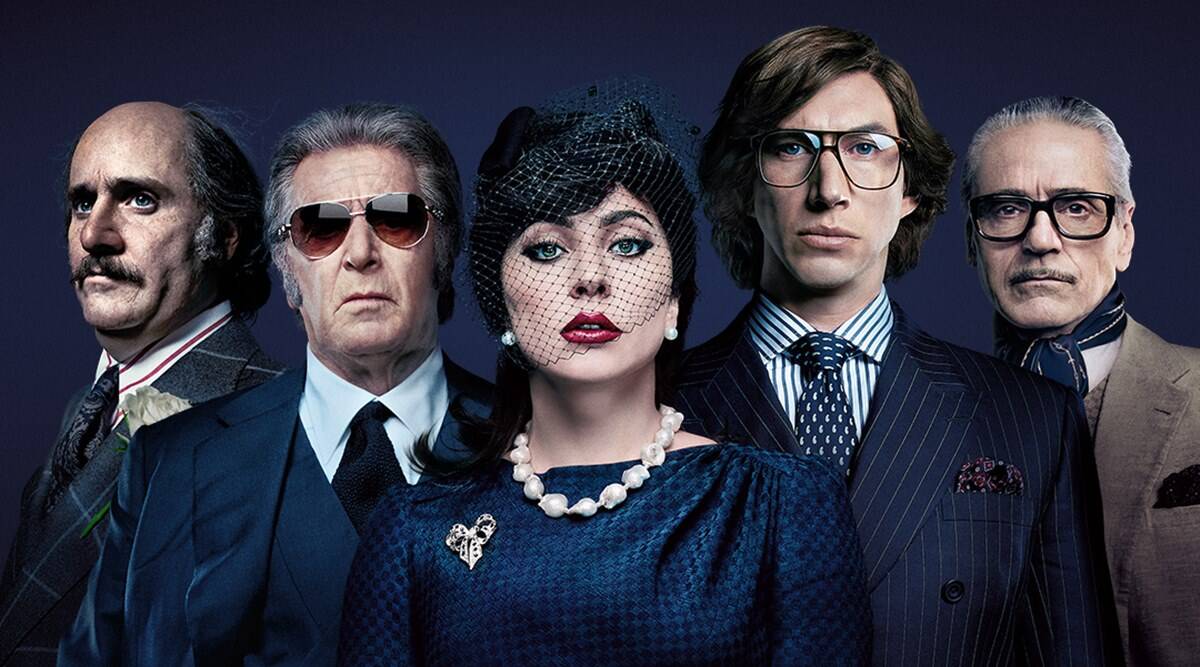
The cast of House of Gucci
HOUSE OF GUCCI (2021). Director: Ridley Scott.

Maurizio Gucci (Adam Driver) is smitten with the outgoing and ambitious Patrizia (Lady Gaga), and soon afterward they are married. Maurizio's father, Rodolfo (Jeremy Irons) isn't entirely taken with the union, but his brother, Aldo (Al Pacino) welcomes Patrizia and his nephew to New York. Then there's Aldo's son, Paolo (Jared Leto of Urban Legend), who is treated like a moron by his father, and who wants to design his own line. There are behind-the-scenes battles for control of the Gucci company, and then Maurizio has the temerity to have an affair and ask for a divorce. Patrizia is not going to take this lying down ... 

Lady Gaga was a determined Patrizia
House of Gucci
 is an entertaining and well-acted biopic and suspense story (even if you know the outcome) that holds the attention throughout its length. Lady Gaga is good, but I suspect there are other actresses who could have made more of the part. Driver and Leto (although he's initially over the top) are also quite good, but the pic is nearly stolen by a wonderful Pacino and especially Jeremy Irons as the father. If you're hoping to see some courtroom dynamics, be warned that the film ends rather abruptly with the arrest of certain parties -- you'll have to watch details of the murder trial on Dateline, which covered the story more than once.  

Verdict: Well, you may not rush out to buy a Gucci bag, but all the skullduggery in this is fascinating. ***1/4.  

Thursday, January 20, 2022

CHARLES BOYER: THE FRENCH LOVER John Baxter

CHARLES BOYER: THE FRENCH LOVER
. John Baxter. University Press of Kentucky; 2021. 

This is an absorbing study of the life and career of Charles Boyer, a balding and stocky man, married to one woman for many years, who nevertheless became a Great Lover on the screen. Boyer's career in Hollywood began with him doing foreign versions of American productions, and he maneuvered as much as he could to become tied to a Hollywood studio. Eventually Boyer starred and gave wonderful performances in such films as Algiers, A Woman's Vengeance, History is Made at NightGaslight, and many, many others. Boyer wasn't always at the top of his game, as shown in Arch of Triumph, but generally he graced every production he was in. Baxter writes that Boyer outwardly accepted but inwardly resented being given supporting parts as he grew older, but his career was kept alive thanks to these roles and to TV appearances, but no matter how small the role he was always a star (witness The Happy Time, for instance). His final years were troubled by the death of his son, his wife's terminal illness, and his own health problems. Also recommended: Charles Boyer: The Reluctant Lover by Larry Swindell. 

Verdict: Absorbing read on the great star and actor. ***. 

Thursday, January 6, 2022

MIKE NICHOLS: A LIFE

MIKE NICHOLS: A LIFE. Mark Harris. Penguin Press/Random House; 2021. 

In this first-class biography of the actor-director, who worked in the theater even more than he did in films, we learn how Igor Peschkowsky came from Berlin to America in 1939 as an eight-year-old. Nichols entered show business as a kind of intellectual comedian, eventually partnering with Elaine May, then began directing for the stage. He made the switch to films by helming the cinema adaptation of Who's Afraid of Virginia Woolf? -- he followed this with The Graduate, Carnal Knowledge and others -- but continued directing for the theater, occasionally "fixing" shows behind the scenes. Nichols could be distinctly neurotic and unpleasant, and never quite made it to the front rank of movie directors, although he became a significant figure in the arts. With many interviews to bolster Nichols' story, biographer Harris explores Nichols' marriages, relationships, and career in compelling fashion. Harris also had access to Nichols and others when Nichols directed the cable adaptation of Angels in America, which was written by Harris' husband. While Harris doesn't necessarily shy away from detailing Nichols faults both as director and human being, others have noted that he does on occasion come off like a "fan-boy." 

Verdict: Even if you're not a major Nichols admirer, this bio has a whole cast of interesting supporting characters as well as the background stories of important filmic and theatrical productions. ***1/2. 

OKAY NEW MOVIE: BEING THE RICARDOS

On the set of I Love Lucy
BEING THE RICARDOS (2021 Amazon streaming video). Written and directed by Aaron Sorkin. 

While preparing an episode of their show I Love Lucy, Lucille Ball (Nicole Kidman of To Die For) and her husband Desi Arnaz (Javier Bardem of Skyfall) learn that powerful columnist Walter Winchell is calling Lucy a communist. In addition to that upsetment, Lucille is convinced that Desi is having affairs with other women, even if a photo published in Confidential proves to be several months old. Lucy, a perfectionist, clashes with her director, writers, husband and fellow cast members as to how certain sequences should be handled, while Vivian Vance (Nina Arianda) suffers angst over how Ethel is continually seen as unattractive when she is married to her "grandfather," Fred, played by William Frawley (J. K. Simmons of Whiplash). The sole female scriptwriter doesn't want Lucy to be depicted as being stupid, but Ball counters that "Lucy" is clever and almost always gets her way -- true! 

Essentially all of this material, none of which is new to the I Love Lucy fanatic (among which I count myself) has already been covered in the 1991 telefilm Lucy and Desi: Before the Laughter. However, Being the Ricardos is still an entertaining, if unnecessary, picture, although if it has people pulling out or buying their complete sets of I love Lucy I'm all for it. Nicole Kidman is better as Lucy than I would have imagined, and while Bardem is not as handsome as Desi was, he is also effective in his portrayal. I wouldn't have necessarily chosen Simmons or Arianda to play Fred and Ethel, but they are also good, especially grumpy Simmons, and the people who play the writers and director are also well-chosen. (Linda Lavin and others play the older versions of these people in mock interviews.) Lucy's children, Lucie and Desi Jr., served as producers. 

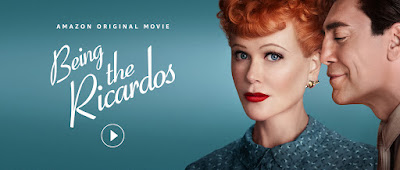
Nicole Kidman as Lucille Ball
Just as happened with Judy, the recent film about Judy Garland, some viewers won't be satisfied with any actor portrayal of a beloved figure unless the person themselves gets up out of the grave and, impossibly, plays the part. Nicole Kidman has gotten some serious hatred, and she certainly isn't a brilliant comedienne like Lucy, but she doesn't try to be -- she is rarely shown attempting the physical comedy Ball was famous for. But nevertheless she does a very good job approximating Ball. As for the film itself, there is some attempt to flesh out the characters, although the ultimate result is a tad superficial. Apparently Aaron Sorkin is not a fan of I Love Lucy -- while not every episode was a winner, quite a few were classics that are as funny today as when they first aired. 

Verdict: Whether you like this movie or not, get out your box of I Love Lucy and enjoy Ball and the others dealing with operettas, candy factories, William Holden in the Brown Derby, Lucy stomping grapes to soak up local color, selling salad dressing, attending a country club dance, going to charm school, and dozens of other episodes that will bring a great big smile to your face. And these days we sure need one! ***. 

LITTLE SISTER: MY INVESTIGATION INTO THE MYSTERIOUS DEATH OF NATALIE WOOD

LITTLE SISTER: My Investigation into the Mysterious Death of NATALIE WOOD. Lana Wood (with Lindsay Harrison). HarperCollins; 2021. 

I admit I didn't expect much from this book, but it is so skillfully put together by co-author Lindsay Harrison, so well-paced and constructed, that it actually makes for a very compelling read. Of course the animosity between Natalie Wood's younger sister and her widower, Robert Wagner, is no secret, so one has to take some of this with a grain of salt.  Lana Wood also doesn't seem to realize how people's behavior can be affected by copious amounts of alcohol. Still there's never been any proof that Natalie, say, surprised her husband and shipmate Christopher Walken having sex and took off in a dinghy in distress -- one of the theories -- and indeed the evidence seems to clearly point in another direction. If we are to believe reports and comments made by the two detectives (as filtered through Lana) who were assigned to Natalie Wood's death after the case was finally reopened, the original investigation was severely botched, either by incompetence or a star-struck attitude toward Robert Wagner, still a TV fixture at the time; and pathologist-to-the-stars Thomas Noguchi made serious errors as well. Clearly something bad happened on that ship and Wagner knows a lot more than he's telling. His account of that evening [Pieces of My Heart] simply doesn't match the facts, but so many years have gone by that he can only be considered a "person of interest" and not a "suspect." Well, judge for yourself. 

Lana and Natalie Wood
Little Sister is interesting for other reasons, as it looks at a highly dysfunctional Hollywood family with a rather odious stage mother, one sister who hit the heights of stardom, while the other struggled, dealing with financial issues and her own daughter's addiction and tragic death. There are juicy if disheartening stories, such as how (according to Lana Wood) Kirk Douglas essentially raped Natalie when she was only fifteen. Lana repeats the story of Natalie divorcing Wagner (she later remarried him) because she found him in a "compromising position" with his butler! (One suspects that Lana was the source for this in other bios of Natalie and this may be why Wagner pretty much hates her.) Lana also claims that a powerful agent told her that Wagner had had her blackballed throughout Hollywood -- surely he didn't have such clout!? While nowhere near as successful as her older sister, Lana Wood amassed quite a few credits, including making an impression as Plenty O'Toole in Diamonds are Forever and appearing in other movies such as The Girls on the Beach

Verdict: Worthwhile, well-written, and absorbing memoir. ***.

Thursday, December 23, 2021

Thursday, November 25, 2021

HAPPY THANKSGIVING!

Great Old Movies is taking a week off to enjoy some turkey (I eat a lot of turkey).

So there are no turkeys to review this week.

HAPPY THANKSGIVING!

Thursday, October 28, 2021

HAPPY HALLOWEEN -- AGAIN!

HAPPY HALLOWEEN 2021.

Make some pumpkin pie -- so easy even I can do it -- put some whipped cream on it, cook up the cocoa (with more whipped cream) and watch a nice scary horror movie on Halloween! Maybe one of the movies reviewed in the posts below.

Have fun! 


Thursday, June 10, 2021

SUMMER VACATION 2021

GREAT OLD MOVIES is going on summer vacation.

We'll be back before you know it!

In the meantime, enjoy some classic and not-so-classic movies and explore the archives here and at B Movie Nightmare

Bill

Thursday, May 13, 2021

JAYNE MANSFIELD: THE GIRL COULDN'T HELP IT

JAYNE MANSFIELD: THE GIRL COULDN'T HELP IT. Eve Golden. University Press of Kentucky; 2021. 

Let's face it. Jayne Mansfield, a triumph of tenacity and publicity, didn't have much of a career. She did only a couple of films for major studios, but the rest of her film "career" consisted of a few Grade B to Grade D stinkers, each one more embarrassing than the one before. Focused almost exclusively on being famous for being famous, she loved her children without necessarily being a great mother, and was said to be kind to everyone, although the wives of the men she had affairs with would probably disagree. Had she lived she would undoubtedly have descended into a morass of alcohol and sleaze or wound up on Dr. Phil in her dotage. 

Biographer Eve Golden makes a case that Mansfield was her own worst enemy. Using her most obvious assets, she became a publicity-hound of the first order, and it was this that eventually turned her into a national joke, a boob not just in name only. Her own frenetic publicity-seeking ensured that no one would ever take her seriously, and the very few performances that some people thought had merit were either ignored or not even seen by her detractors. Although she was often compared with Marilyn Monroe, Monroe managed to give some fine performances in genuinely memorable pictures, and she was too adorable to be really vulgar. This was not the case with Mansfield. Frankly, Mansfield has more in common with Anna Nicole Smith than Monroe. Her marriage to Micky Hargitay was based more on hormones and press clippings than anything else, although it may be true that he, at least, genuinely loved Jayne or at least became attached to her. Can narcissists ever really love anyone but themselves? 

Mansfield died in a horrible accident in which two others were killed (but rarely mentioned), the teen boy who was driving (and who had a child and fiancee), and Mansfield's latest boyfriend, a ground slug who left his crippled wife to be with the blond boob. But her life had pretty much become a disaster even before the accident -- she spent more time opening supermarkets than appearing in movies, her nightclub act was seen as a joke by most sensible people, and her brief days of stardom at 20th Century-Fox, the studio that dropped her, were long since over. For much of this book you have to slog through pages and pages of Mansfield's appearances at store openings and other venues to get to the meat, but in spite of that the book is generally entertaining and readable. While clearly being a fan, Golden maintains some objectivity, tries to explain Mansfield's motives and character, separates facts from fan press fiction, and does her best to present the actress as someone deserving of a certain sympathy if not a reappraisal. If some readers may feel that she doesn't quite succeed at some of these goals, it's not for lack of trying. 

Verdict: Interesting, rather exhaustive (and sometimes exhausting), look at a show business casualty and tireless self-promoter. ***.