Lively, entertaining reviews of, and essays on, old and newer films and everything relating to them, written by professional author William Schoell.
Showing posts with label Dorothy McGuire. Show all posts

Thursday, August 17, 2023

MOTHER DIDN'T TELL ME

Dorothy McGuire and William Lundigan
MOTHER DIDN'T TELL ME (1950). Written and directed by Claude Binyon. 

Jane Morgan (Dorothy McGuire), who writes commercial jingles, sets her cap for the very handsome Dr. William Wright (William Lundigan) when she goes to him for a weird cough. Fortunately Bill is equally attracted to Jane, and it isn't long before they start dating. Jane refuses to believe that she will become a typical lonely doctor's wife, even when Bill's mother  (Jessie Royce Landis) tries to warn her off. But even if Jane can deal with Bill's frequent absences due to the demands of his patients, she may find stiffer competition from Bill's attractive new associate, Helen (Joyce MacKenzie of Destination Murder). 

Leif Erickson and June Havoc
Two very charming and adept lead performances are what put over this engaging comedy-drama (with an emphasis on comedy). The sensitive and talented McGuire proves that she is no slouch when it comes to comic roles and her co-star Lundigan proves he is more than just a good-lookin' fella. These two performers help gloss over some odd moments in the script. On the train during their honeymoon, the conductor tells Bill that a woman passenger is unconscious and may have had a heart attack. Instead of showing the slightest concern, Jane is only annoyed. "I can't ignore an unconscious woman," Bill says. "But you can ignore a conscious one?" his wife responds. If it weren't for McGuire's sympathetic playing, Jane would be completely unlikable. In fact, after this exchange you begin to think that the mother-in-law has the right idea. 

Gary Merrill and June Havoc are another  doctor and his wife, friends of Bill's, and Leif Erickson [Arabian Nights] really makes an amusing impression as a headshrinker who really knows how to pitch the woo to the ladies. Then there are those adorable twins! Lundigan made Pinky the previous year. Claude Binyon also wrote and directed The Saxon Charm

Verdict: Two imperfect people in an imperfect but engaging romance. ***. 

Thursday, July 21, 2022

SUMMER MAGIC

Mills, Mathers, McGuire, Hodges, Pollard

SUMMER MAGIC (1963). Director: James Neilson.

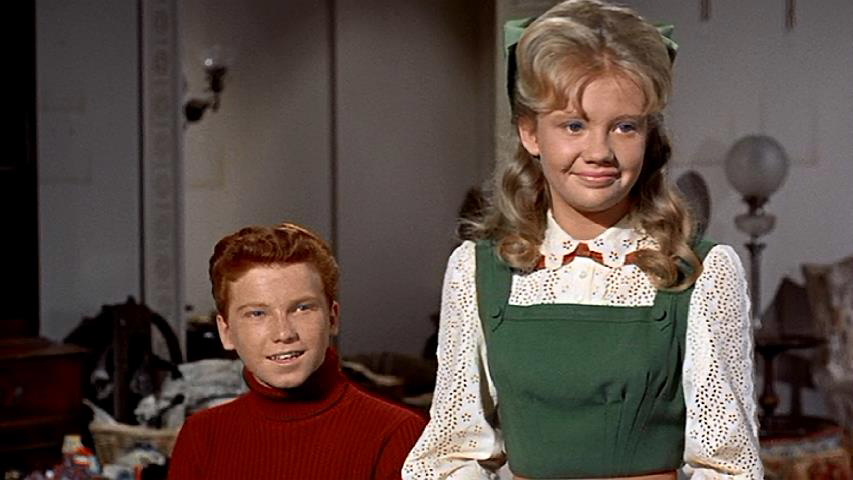
Widow Margaret Carey (Dorothy McGuire of Susan Slade) has to move her brood from Boston to a rented house in the country for financial reasons. The agent for the house, Osh Popham (Burl Ives of The Big Country), assures her that the owner is anxious for her to move in, but is he keeping secrets as his wife, Mariah (Una Merkel), suggests? Neither daughter Nancy (Hayley Mills) or older son Gilly (Eddie Hodges) are thrilled when they learn that stuck-up, pretentious cousin Julia (Deborah Walley), is moving in, but both young ladies are thrilled to meet the handsome young schoolmaster, Charles (James Stacy). Nancy is deflated when Charles seems to prefer Julia, but she may get the consolation prize when the house's real owner (Peter Brown of Violent Road) finally shows up. 

Eddie Hodges and Hayley Mills
Although there are a couple of moments when Summer Magic threatens to become dangerously sitcom-like and overly cutesy, I have to admit the darn thing has a lot of charm, not to mention several excellent performances. The gifted Hayley Mills always seems to be wonderful, and the same can be said of Dorothy McGuire. Ives and Merkel make an interesting couple, with the ever-quirky Michael J. Pollard (was there ever an actor anything like him?) playing their son with his customary shit-eatin' benevolence. Eddie Hodges is fine as Gilly, who would have preferred to stay in Boston, and little James Mathers (younger brother of Leave It to Beaver's Jerry Mathers) nearly steals the pic as the youngest member of the family. (It's somewhat annoying that when he's bullied because he has long hair and is wearing a Buster Brown outfit said bullies don't get any comeuppance.) 

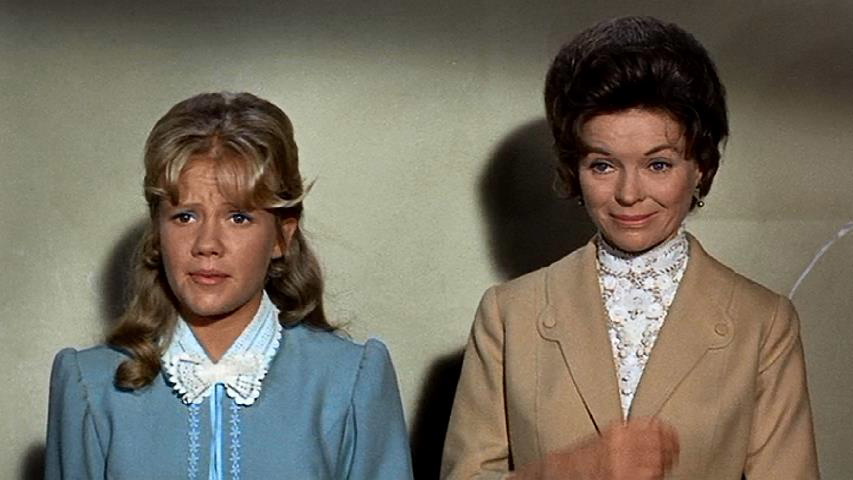
Hayley with Dorothy McGuire
Summer Magic is a musical, and while the songwriting team of the Sherman Brothers is not exactly Rodgers and Hammerstein, they have contributed some more-than-pleasant tunes, including "On the Front Porch with You," "The Ugly Bug Ball," "Beulah" and others. Hayley, Eddie and Burl do their own singing while I believe the others are dubbed. The rather abrupt character reversal of Julia is unconvincing, although Deborah Walley manages to handle it all with aplomb. A song in which the girls sing about "Femininity" and hiding your true self to snare a beau is the most dated thing about the picture, even if it takes place in the twenties. Although Dorothy McGuire was not that old and still attractive, the film doesn't give her a romantic partner, another dated aspect.

Verdict: Take it with a grain of salt and this is amusing and entertaining in equal measure. ***. 

Thursday, May 28, 2015

A SUMMER PLACE

Troy Donahue
 A SUMMER PLACE (1959).  Writer/producer/director: Delmer Daves.

 "You insist on de-sexing her, as if sex were  synonymous with dirt." -- Ken

Lifeguard Ken Jorgenson (Richard Egan) went off to make his fortune and got married to Helen (Constance Ford) after his true love, Sylvia (Dorothy McGuire), married a man of her class. Her husband Bart (Arthur Kennedy) has fallen on hard times and he and Sylvia now run an inn with their son, Johnny (Troy Donahue), on Pine Island, off the coast of Maine, where Ken and Sylvia first fell in love. Ken returns to the island with his family; feelings between him and Sylvia are rekindled even as Johnny begins an intense romance with Ken's daughter, Molly (Sandra Dee). Then Helen finds out about the affair between her husband and Sylvia ... A Summer Place is distinguished by some very good acting, a frank and positive look at sex, and Max Steiner's lushly romantic score. (This includes the main theme and the younger couple's love theme, which became a hit record; other music is recycled from Steiner's A Stolen Life.) Richard Egan [Wicked Woman] and Dorothy McGuire are excellent, and Arthur Kennedy has an outstanding scene where a drunken Bart confronts his son and Molly when they ask his permission to marry. Egan is especially good in a well-written scene when he's telling off his wife and listing her assorted prejudices. One flaw (among a few) in the film is the characterization of Helen, who is presented strictly as a one-dimension villainess. As such, Constance Ford is fine, but the script and direction (both from Delmer Daves) limit her. Sandra Dee is quite effective as young Molly, and Troy Donahue -- who obviously did his more memorable work with the coaching and encouragement of Delmer Daves -- gives one of his best performances. (Daves used Donahue in four movies, and the actor was always better than he was in such later films as My Blood Runs Cold, in which he was back to being as stiff as a board.) Beulah Bondi has a good role as Sylvia's wise old Aunt, who lives in the inn and tries to give Sylvia sage advice about the affair. A Summer Place borders on the edge of soap opera, and never becomes a great movie -- it's overlong and talky at times --  but it's full of interesting scenes, such as a certain moment between Ken and Sylvia. Sylvia tells Ken that she's sorry she's not as pretty as she used to be. You would expect Ken to immediately tell Sylvia that she's wrong, but instead there's a long pause and he says, "I love you too much to speak." The closeness between the two is so intense that there's no need to tell pretty lies or even to say anything to each other. It's hard to realize that A Summer Place was once extremely controversial, but now it serves as a time capsule detailing the difficulty of sexual and romantic relationships in a less enlightened era. This is another movie that could be filed in the category: How The Rich Suffer!

Verdict: For romantic souls and Troy Donahue fans. ***.

Thursday, December 18, 2014

THE REMARKABLE MR. PENNYPACKER

THE REMARKABLE MR. PENNYPACKER (1959). Director: Henry Levin.

"Morality is a matter of geography."

The progressive Horace Pennypacker (Clifton Webb) has one wife and many children in one town in Pennsylvania, and a whole different family in another town in the state -- sooner or later each family will learn of the other's existence and then what? Mr. Pennypacker answers that question and manages to milk much humor out of a decidedly serious situation. It also manages to be surprisingly frank at times, if a trifle unreal. Webb is, as ever, excellent, and there are fine performances from Dorothy McGuire [Invitation] as unwitting wife, Emily; Dorothy Stickney [Murder at the Vanities] as Aunt Jane; Doro Merande [The Gazebo] as the secretary, Miss Haskins; and Charles Coburn as Grandfather Pennypacker; and there's nice support from Jill St. John as Kate. Ray Stricklyn and David Nelson are two other children, and Ron Ely is a young minister who's fallen for Kate. However entertaining the film may be, there is no denying that Horace's reasons for entering into a second bigamous marriage are rather spurious and self-centered. Still, it's hard not to like the movie on its own terms, and it even has some suspense.

Verdict: Another winning Webb performance. ***.

Thursday, March 14, 2013

INVITATION (1952)

INVITATION (1952). Director: Gottfried Reinhardt.

"I'm going to be a spinster, father, all of my life -- but there's an awful lot to be said for it."

Ellen Pierce (Dorothy McGuire) is happy in her marriage to Dan (Van Johnson), but she's disturbed by bitchy comments made by Dan's old girlfriend, Maud (Ruth Roman), as well as a medical condition that often saps her energy. Dan and Ellen's father (Louis Calhern), as well as her doctor (Ray Collins), share a secret that would devastate Ellen if she knew, and which Maud is apparently determined she find out. Although like most movies of this nature you have to take Invitation with a grain of salt, it does present an interesting situation and is well-acted. All of the principal actors underplay effectively (although at times they may underplay too much), which may be attributed to director Reinhardt. This makes Maud seem like less of a caricature, although Roman's good performance might have been more fun if she played it in venomous mode, spitting out her lines; McGuire and Johnson are both fine, and Calhern is as excellent as ever. A difficult scene when Ellen's father makes a certain proposition to Dan is extremely well-played by both actors. Bronislau Kaper's overly brassy score is a disappointment and somewhat weakens the picture.

Verdict: Intriguing soap opera/drama. ***.

Thursday, January 3, 2013

FRIENDLY PERSUASION

"Will Pleasure you:" Suggestive ad for the movie


FRIENDLY PERSUASION (1956). Director: William Wyler.

Although the Quakers in a small town in South Indiana are warned that they may have to defend themselves and their homes against rebel soldiers, Jess Birdwell (Gary Cooper) is determined that his grown son, Josh (Anthony Perkins), will not fight in the Civil War as it's against his religion. Although the one battle scene late in the picture is well done, the war almost seems like an after-thought in this movie in which Cooper plays it too cute by far in a role that cries out for a more talented and appropriate character actor. Perkins is quite good, however, as is Phyllis Love as his sister Mattie; Mark Richman as her boyfriend Gardner; Richard Eyer [The 7th Voyage of Sinbad] as Josh's younger brother; and Robert Middleton as a friend and rival of Jess's. Dorothy McGuire is all wide-eyed and beatific as Jess' wife, Eliza. Although Marjorie Main is as good as ever, the whole business with her and her three marriage-minded daughters [see photo] seems dragged in from an Abbott and Costello movie. Wyler's direction is solid, and there is excellent photography courtesy of Ellsworth Fredericks/Fredricks -- he used both spellings -- and a nice score by Dimitri Tiomkin. Joel Fluellen [Monster from Green Hell] and Robert Fuller [Brain from Planet Arous] have smaller roles. The talented Phyllis Love appeared almost exclusively on television. A goose named Samantha has nearly as much to do as Gertrude the Duck in Journey to the Center of the Earth.

Verdict: Not bad for what it is, but not for every taste. **1/2.


Thursday, December 27, 2012

THREE COINS IN THE FOUNTAIN

THREE COINS IN THE FOUNTAIN (1954). Director: Jean Negulesco.

"The prospect of waking up to an unexpected arousal of passion at my age is as disturbing as it is miraculous." -- John Shadwell.

In Rome the unmarried Miss Francis (Dorothy McGuire) is secretary to confirmed bachelor-author John Shadwell (Clifton Webb). Her friend and fellow American Anita (Jean Peters), who also works as a secretary, is leaving for home, ostensibly to get married. Her replacement is the similarly single Maria (Maggie McNamara). While Miss Francis pines for Shadwell, Maria sets her cap on handsome Prince Dino (Louis Jourdan) and Anita dallies with her equally handsome co-worker Giorgio (Rossano Brazzi). There are the usual romantic complications. Frankly there isn't a heck of a lot to this movie except some good performances -- Webb is as marvelous as ever and gets the best lines -- beautiful Italian scenery and very nice photography. Despite that, the picture is smooth and reasonably entertaining. Jean Peters is very attractive and saucy; McNamara is a bit on the bland side; and McGuire is hampered by having to feign a yen for the aging "bachelor" Webb. Cathleen Nesbitt probably makes the best impression among the ladies as Jourdan's lovely old mother. Vincent Padula of The Cyclops plays a doctor and Norma Varden [Witness for the Prosecution] is a party guest who has an amusing exchange with Webb.The title tune is warbled by Frank Sinatra and the score is by Victor Young.

Verdict: At the very least it's a pretty travelogue. ***.

Wednesday, January 21, 2009

SUSAN SLADE


SUSAN SLADE (1961). Director: Delmer Daves.

This slick soap opera with a nice, if minor, score by the great Max Steiner presents the saga of young Susan Slade (Connie Stevens), a somewhat sheltered gal who has a shipboard romance (with Grant Incredible Shrinking Man Williams), discovers she's pregnant, and then learns that the father has been killed overseas in the war. But weep not for Susan, because waiting in the wings is handsome wannabee writer Hoyt Brecker, played by Troy Donahue. (It's likely that the women who saw this in the theaters in 1961 probably wondered why the hell Susan spends so much time resisting the guy, who's not only a handsome hunk but nice.) Susan's wise, warm, and womanly mother (Dorothy McGuire), decides that they will all pretend that Susan's baby boy is actually her brother, and the whole family takes off for faraway parts to aid in the deception. But Susan finds it difficult not being able to be a mother to her own child, and it all leads to a rather nice wind-up where she makes a brave and inevitable decision.

Stevens gives a nice performance in this, and Dorothy McGuire is excellent; Lloyd Nolan also has a nice turn as Susan's father, and Burt Convy, Natalie Schafer, Brian Aherne, and Kent Smith also add to the film's appeal, as does the striking cinematography of Lucien Ballard.

And then there's Troy Donahue. Well .... let's just say he's a good-lookin' fellow and leave it at that. He doesn't stink up the picture and he allows the character's sensitivity to sort of come through. Not too awful but not great. Ditto for Grant Williams, another pretty boy with a decidedly limited range.

Verdict: Somehow the stupid thing works. ***.