Lively, entertaining reviews of, and essays on, old and newer films and everything relating to them, written by professional author William Schoell.
Showing posts with label Glenn Ford. Show all posts

Thursday, January 16, 2025

LUST FOR GOLD

Jacob (Glenn Ford) stakes his claim
LUST FOR GOLD (1949). Director: S. Sylvan Simon.

Inspired by the true legends of the Lost Dutchman mine in the Superstitious Mountains of Arizona, the major portion of this film takes place in the last century with modern-day framing sequences that carry their own interest. Jacob "Dutch" Walz (Glenn Ford) commits murder to preserve the secret of the mine's location, then goes to town to stake his claim. There he encounters duplicitous Julia Thomas (Ida Lupino), who owns a bakery but dreams of a better life which she knows her husband (Gig Young) will never provide. So she begins a romance with an unsuspecting Walz. Lupino and Young are fine, and Ford is especially good as one of the more unpleasant characters he's played. If the main story's climactic gun battle near the mine weren't enough, the absorbing film also boasts a terrific cliffside fight as the modern-day story's thrilling finale. William Prince, Edgar Buchanan, Paul Ford and even Percy Helton [as a barber] are members of the supporting cast, and all are swell.

Verdict: Snappy and extremely entertaining. ***1/2.

Thursday, October 13, 2022

THE MONEY TRAP

Rita Hayworth and Glenn Ford
THE MONEY TRAP
(1965). Director: Burt Kennedy. 

Cop Joe Baron (Glenn Ford) is married to Lisa (Elke Sommer), and they have serious money troubles. When Dr. Horace Van Tilden (Joseph Cotten) shoots a burglar in his house, it turns out that the burglar's wife is Baron's old girlfriend, Rosalie (Rita Hayworth). Then there's Baron's partner, Pete (Ricardo Montalban), who would also like to get his hands on some green. I won't give away any of the twists or plot developments because that's about all this picture has going for it. Despite the gun play, love scenes, and so on, this is remarkably dull. Elke Sommer is as inadequate as ever, but the rest of the cast, especially Hayworth, is fine. This just never really comes to life. 

Verdict: A waste of money. *1/2.

Thursday, August 2, 2018

EXPERIMENT IN TERROR

Ross Martin
EXPERIMENT IN TERROR (1962). Produced and directed by Blake Edwards.

Kelly Sherwood (Lee Remick) is a bank teller who lives with her teenage sister, Toby (Stefanie Powers of Die, Die, My Darling). One night a stranger named Red Lynch (Ross Martin) sneaks up behind her in her garage and tells her she has to steal $100,000 from her bank or there will be dire consequences for her and her sister. Kelly manages to contact the FBI, and Agent Ripley (Glenn Ford) is assigned to the case, trying both to find and identify Lynch and to protect Kelly and her sister from harm. Eventually it is decided to let Kelly go along with the plot in an effort to trap Lynch, with the climax occurring in a crowded stadium. Experiment in Terror begins well and has a couple of decent sequences, but Blake Edwards is no suspense specialist, and the film becomes meandering, uninvolving, and rather dull. Remick gives a controlled and competent performance but doesn't offer one iota more for her portrayal; Powers is much better as her sister. Ford plays the "G-Man" with a quiet authority that never quite makes him seem like the best man for the job. Anita Loo and Patricia Huston have flavorful supporting roles as two women who were also in Lynch's life, to the former's advantage and the latter's regret. Ross Martin gives the most notable performance as the criminal "mastermind" who seems to have some sympathy for the little son of a woman he knows and whose hospital bills he is paying, but his character is not very well developed; three years later he gained TV fame on The Wild, Wild West and he was also outstanding in the classic TZ episode Death Ship. Henry Mancini's score is at times quite effective, and Philip Lathrop's cinematography of San Francisco and environs is also good.

Verdict: Paging Alfred Hitchcock. **. 

Thursday, June 1, 2017

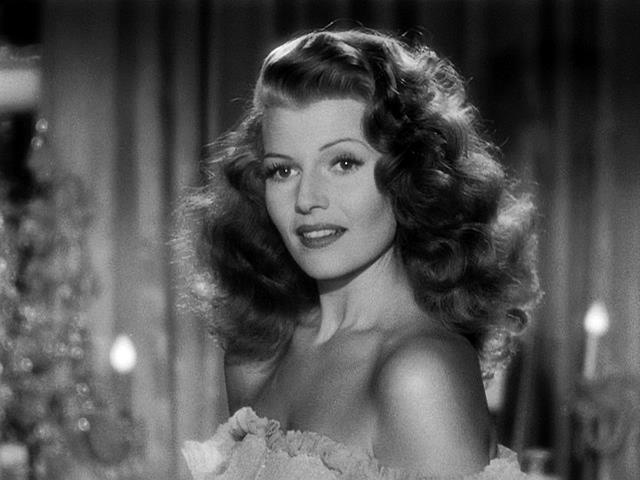
GILDA

Rita Hayworth
GILDA (1946). Director: Charles Vidor.

"Hate can be an exciting emotion. Very exciting. Hate is the only thing that can ever warm me." -- Ballin Mundson.

"If I'd been a ranch, they'd have named me the bar nothing." -- Gilda.

Down Argentine way just at the end of WW2, a hustler and crooked gambler named Johnny Farrell (Glenn Ford) is nearly robbed when a stranger on the docks with a spear in his cane comes to his rescue. The stranger is casino owner Ballin Mundson (George Macready), who hires Johnny to look after his interests. Some time later Ballin introduces Johnny to his beautiful wife, Gilda (Rita Hayworth), and both feign ignorance of the fact that they were once involved. Johnny and Gilda have a real love-hate relationship to add to the stew, and Ballin has a consortium with a bunch of Germans to add to the confusion. After a man is murdered in the casino, Ballin seems to commit suicide in his plane ... What to make of the modestly entertaining and often silly Gilda? Artificial and Hollywoodish as all get-out, with one-dimensional characters and one of the shortest climaxes in the history of the movies, Gilda has a few interesting twists and turns and is distinguished by the sex appeal and fine, constantly insinuating performance of Rita Hayworth, who makes the most of a standard role of the good-bad girl who is kept by wealthy men while loving the poor fellow she truly adores. Ford is not bad, if miscast, as the grubby borderline lowlife who winds up a kind of bodyguard/ersatz gunsel to Ballin (the narration he's given is unnecessary). Macready gives a good performance -- probably the longest and most famous of his career -- although some of his line readings are a little too matter-of-fact; one can think of other actors who might have played it in a somewhat more colorful and poetically sinister fashion. Steven Geray, Gerald Mohr, and Joseph Calleia all score as, respectively, a lowly casino employee who knows where the bodies are buried; a slimy guy with a hankering for Rita; and the police inspector who is concerned with the doings of the German consortium (even if no one in the audience is).

Some people* have had a different reading on Gilda, claiming that Johnny Farrell is a literal hustler on the bisexual side, Ballin's boyfriend, in fact, and that Johnny's self-hatred forced him to walk away from Hayworth before the story begins. This theory has it that Ballin needs to have power over attractive people of both sexes (one is reminded of Clifton Webb's character in Laura). Unfortunately, this take on the film makes it seem like a bad, regressive gay novel of the forties -- the tormented "queer" pulls away from the guy he's with and walks off into the sunset with a woman -- and while some advocates of this theory can point out certain lines and situations in scene after scene (and they may even have a point), they forget that many, many movies featured bad (and good) guys with live-in bodyguards and buddies, and this was never necessarily considered homoerotic. The proponents of this theory would have a lot to make of the Gilda imitation, Forbidden and many others as well.

Rudolph Mate has contributed some fine cinematography, but you would never know that the story takes place in Buenos Aires, as it has little Argentinian atmosphere. Gilda might be considered film noir except for the fact that its crime aspects are comparatively minimal. The pseudo-clever dialogue is often amusing.

* such as film noir specialist Eddie Muller on the Gilda DVD.

Verdict: Anyway, it's fun watching Hayworth do her "Put the Blame On Mame" number. **1/2.

Thursday, June 9, 2016

THE FOUR HORSEMEN OF THE APOCALYPSE (1962)

Glenn Ford and Ingrid Thulin with backdrop of Notre Dame
THE FOUR HORSEMEN OF THE APOCALYPSE (1962). Director: Vincente Minelli.

This remake of the silent film of the same title has been updated to WW Two. Argentinian Madriaga (Lee J. Cobb) is dispatched with rather quickly, and most of the story takes place in Paris, where an initially superficial Julio Desnoyers (Glenn Ford) has an affair with the married Marguerite Laurier (Ingrid Thulin of The Silence). Julio's father Marcelo (Charles Boyer) had deserted Army service years before and begs his son to fight the Nazis, unaware that Julio has already joined the resistance. This leads to the movie turning into a ersatz spy picture that has Julio going off on a suicide mission and a final confrontation with his cousin Heinrich (Karl Boehm of Sissi). Other characters include Julio's sister Chi Chi (Yvette Mimieux of Light in the Piazza) who joins the resistance much sooner; Marguerite's husband, Etinne (Paul Henreid); and Heinrich's father, Karl (Paul Lukas). It's amazing that adding all the excitement and peril of WW Two, plus technicolor and CinemaScope, has not resulted in a better movie than the original, but a far worse one. A middle-aged Glenn Ford is horribly miscast -- Minelli wanted a more appropriate Alain Delon but MGM nixed it -- and his love affair with Marguerite never for a minute seems passionate or believable. Scenes that should crackle with tension and drama are frittered away by Minelli's lacklustre direction. Not a single actor ever gets a close up, further distancing us from the characters, and Andre Previn's musical score can best be described as insipid. Milton R. Krasner's cinematography is a plus, but the sweeping vistas do little to pull us into the story. Other changes from the silent version include more wartime interaction between the two families -- one French, the other German -- and Etienne is not blinded. A bizarre sequence has Marguerite telling her husband she's leaving him for Julio the exact instant after he shows up, shattered by being tortured, after months away -- what perfect timing! Badly written and poorly made despite all the technological advances, this is a colossal bore. Of the cast, only Charles Boyer makes much of an impression. Like the silent version, this also has shots of phantom horsemen floating through the skies, and this time it seems even hokier.

Verdict: Stick with the original. ** out of 4.

Thursday, December 19, 2013

MR. SOFT TOUCH

Glenn Ford and Evelyn Keyes
MR. SOFT TOUCH (1949). Directors: Gordon Douglas; Henry Levin.

A man with the unlikely moniker of Joe Miracle (Glenn Ford) returns from service and discovers that hoods have taken over his nightclub and murdered his partner. We never actually see Miracle learning about this -- we're introduced to him after he steals money (his money rightfully, he feels) from the nightclub safe and is on the run from the police. He eventually winds up befriended by a do-gooder named Jenny Jones (Evelyn Keyes), who works for a settlement house where there are numerous cute youngsters and the comparatively stern but warm-hearted Mrs. Hangale (Beulah Bondi), not to mention a handyman played by Percy Kilbride (The Egg and I). John Ireland (Raw Deal) is cast against type as a bespectacled reporter who wants to get info from Miracle. The trouble with Mr. Soft Touch is that it tries for equal amounts of sentiment, comedy, and action, but these elements simply never jell. Ford's character is so unlikable for the most part that the actor gives one of his few charmless performances. Keyes and Bondi come off better, but the movie just doesn't work, and you find yourself not only not caring for anyone but even for what happens. It seems to take forever to just end.

Verdict: A misfire on virtually all levels, deservedly forgotten. **.

Thursday, December 5, 2013

THE DISAPPEARANCE OF FLIGHT 412

Robert F. Lyons and David Soul may have seen UFO


THE DISAPPEARANCE OF FLIGHT 412 (1974 telefilm). Director: Jud Taylor.

"Officers aren't supposed to act on instinct, they act on orders, and yours are to lay off!"

Two air force men are doing a test flight [412] to check for electrical problems when they see two blips appear and disappear on their radar screen, followed by the complete disappearance of two jet fighters. They are quickly taken off to be debriefed by SID officers, much to the consternation of their commanding officer, Colonel Pete Moore (Glenn Ford), who first wonders where the hell they are and then why they were taken in the first place. While the Flight 412 pilots (David Soul; Robert F. Lyons) are held and questioned along with others, Moore demands answers from General Enright (Kent Smith of Nora Prentiss) even as Major Dunning (Bradford Dillman of Jigsaw) urges him to forget the whole business. What's going on here? Well, sadly, not a hell of a lot, as this cheap production was cobbled together to take advantage of the UFO rage of the seventies but lacks a strong plot, suspense, or any pay-off. A lot of perfectly good actors are just wasted. The blaring, brassy musical score does its best to create some excitement, but can't disguise the fact that nothing much is going on here. There are a hell of a lot of good-looking men in the cast, for those who are interested.

Verdict: Not nearly as much fun as The Invaders. *.

Thursday, September 20, 2012

THE BROTHERHOOD OF THE BELL

Dean Jagger and Glenn Ford
THE BROTHERHOOD OF THE BELL (1970 telefilm). Director: Paul Wendkos.Screenplay by David Karp.

In one of the first and best of the made-for-television movies, Andrew Patterson (Glenn Ford) is the long-time member of the "Brothers of the Bell," a secret society associated with a fraternity at the College of St. George. The society helps its members get a leg up in the world, and in return they are on occasion asked to do a favor for "the Bell." But now Patterson has been asked to blackmail a dear friend of his (Eduard Franz) from accepting a certain post and has been given the names of people who helped this man defect -- of course revealing those names will mean their torture and deaths. Although Patterson tries his best to dissuade his friend from taking the post before revealing that he has the list of names, his actions nevertheless lead to tragedy. A guilt-wracked Patterson decides to take action by exposing the brotherhood, but finds his life turning into a nightmare as almost everyone thinks he's crazy. Although at times he could have been a bit more impassioned, Ford gives a notable performance in this; one of the best of his latter-day career, in fact. Eduard Franz as the blackmailed professor; Dean Jagger as a higher-up in the Bell; Rosemary Forsyth as Patterson's wife; Will Geer as his father; and Maurice Evans as his father-in-law, are all excellent, but the whole movie is nearly stolen by William Conrad as a Joe Pyne*-like talk show host who has Patterson on his show just to berate and humiliate him [this is also one of the best scenes in the movie.] Virginia Gilmore [in her last film role]  also scores as a nutty woman in the audience who calls herself "Patriot." Also notable is the uncredited black actor who says the Bell is simply the White Power Structure that has always oppressed black people. Jerry Goldsmith contributed an unusual baroque-like score.I didn't spot Robert Clarke of The Hideous Sun Demon and The Man from Planet X as a psychiatrist.

* Joe Pyne was a forerunner of Jerry Springer.

Verdict: Ultimate paranoia and a darn good movie. ***1/2.


Thursday, February 16, 2012

FATE IS THE HUNTER

FATE IS THE HUNTER (1964). Director: Ralph Nelson.

When a plane crashes killing all aboard except a stewardess (Suzanne Pleshette), an investigator for the airline, Sam McBane (Glenn Ford), tries to determine what went wrong. You'd think this would make for a compelling film, but most of the running time has McBane delving into the character of the pilot [and old friend] Jack Savage (Rod Taylor), whose irresponsibility is being blamed for the tragedy, with lots of flashbacks. McBane discovers that there was much more to Savage than met the eye. Nancy Kwan and Dorothy Malone are two of the many ladies in Savage's life, and Wally Cox and Mark Stevens [in a fine turn] are pals of his whom he's helped over the years. Mary Wickes has an interesting cameo as a landlady. Constance Towers is McBane's secretary, Nehemiah Persoff is his rival, and Jane Russell appears as herself in a flashback scene entertaining the troops. This culminates in a fairly ridiculous courtroom sequence, and then in a climax in which McBane and others try to recreate the circumstances of the crash up in the air. The picture is contrived and illogical, has little tension or suspense, and is more talky and dull than anything else. Ernest K. Gann, who wrote the novel upon which the film is based, reportedly disavowed the whole production. Ford gives a fine performance but is saddled with the screwiness of his character; the rest of the cast is very good, and Pleshette is excellent although she has only a few lines.

Verdict: This kind of movie should not be a snooze-fest. **.

Thursday, October 13, 2011

SO ENDS OUR NIGHT

SO ENDS OUR NIGHT (1941). Director: John Cromwell.

"When she dies, I'm done for anyway."

Based on Erich Maria Remarque's novel Flotsam this deals with the plight of Jewish and other political refugees from Germany just before the Nazi occupation of Austria, and then France. Josef Steiner (Fredric March) is wanted by German authorities for political actions and is afraid that his wife (Frances Dee), whom he must leave behind when he flees, will suffer because of his actions. Their long-distance relationship takes a back seat to the burgeoning love affair between two of Steiner's friends, Ludwig (Glenn Ford) and Ruth (Margaret Sullavan), both of whom are Jewish. As we see the difficulties these and others have because they are official non-persons without passports, the film builds up to a situation in which both couples are in crisis, cruelly separated, with Steiner and Ruth each racing desperately to be with the one person in the world they love above all others. Ford and Sullavan make a more compelling team than you would imagine, and March, while he "acts" a bit too much, has some excellent moments as well; Sullavan is as splendid as ever. Dee hasn't as much to do as the others but makes full use of a very expressive face. There are a host of fine character actors as well, including Erich von Stoheim as a German police officer. This film is yet another that shows that Glenn Ford was not just a merely competent pretty-boy, but an accomplished and versatile performer. Louis Gruenberg's score is a little weird at times, but overall is very effective. Two scenes stand out: Ludwig trying to sell some meagre possessions to two extremely weird old sisters, and an unexpected and very dramatic murder-suicide that comes late in the picture.

Verdict: Imperfect, perhaps, but intelligent, adult fare with fine performances. ***1/2.  

THE WHITE TOWER

THE WHITE TOWER (1950). Director: Ted Tettzlaff.

In Switzerland a beautiful young woman named Carla (Alida Valli, billed just as Valli) wants to climb the mountain upon which her father died while struggling to reach the top. Others interested in accompanying her include old friend Nicholas (Sir Cedric Hardwicke), the guide Andreas (Oscar Homolka), a writer named Paul (Claude Rains), and a "superior" Nazi-type named Hein (Lloyd Bridges). All of these people are driven for one reason or another, but the main character is Martin Ordway (Glenn Ford), who only goes along because he's fallen for Carla [not an unrealistic motivation, of course, but weak as compared to the others]. Mountain climbing movies can certainly be suspenseful and exciting, and The White Tower does have a couple of white knuckle moments, but the picture seems more interested in "saying things" in a heavy-handed manner than in providing consistent dramatic tension. Also, the mountain is called "the most unclimbable in Europe" yet Ford -- with not one bit of experience -- decides to climb it anyway. Frankly, when the obnoxious but highly-fit Hein shows contempt for him it is hard not to agree. Ford and the others give good performances, however, and Rains is, as usual, excellent. Striking scenery and a good score from Roy Webb are added pluses.

Verdict: Only in Hollywood can you climb an icy mountain without even wearing gloves. **1/2.

Thursday, October 6, 2011

THE BIG HEAT

THE BIG HEAT (1953). Director: Fritz Lang.

"I could always go through life sideways."

A violent series of events are set in play with the suicide of a cop, Duncan, who was on the take and knew where the bodies were buried. Det. Sergeant Dave Bannion (Glenn Ford) wants to do a full investigation into the activities of criminal boss Mike Lagana (Alexander Scourby) but even his boss, Lt. Wilks (Willis Bouchey), wants to tread easy, and the people that Lagana has in his pocket go all the way to the top. But then Lagana pushes Bannion too far and a tragedy ensues... Look out! Others caught up in Bannion's fury include Lagana's chief gunsel, Vince (Lee Marvin); Vince's girl, Debbie (Gloria Grahame); the dead man's widow, Bertha Duncan (Jeanette Nolan); another gunsel named Larry (Adam Williams); a pretty bar girl named Lucy (Dorothy Green); and another named Doris (Carolyn Jones); as well as Bannion's loving and lovely wife, Katie (Jocelyn Brando). The cast is terrific in this outstanding example of hard-boiled film noir, with Ford giving one of his most memorable performances, Scourby offering sophisticated villainy, Marvin and Williams scoring as young sociopaths, and Grahame dishing out another superlative portrayal as a gal who has a date with a really hot cup of coffee. Nolan and the others named are also in top form, and Lang's direction keeps things percolating and boiling over. Sure, you could quibble about some things [the burns caused by scalding coffee for one thing], but this is top notch Hollywood melodrama for sure.

Verdict: Taut, exciting, and altogether terrific. ***1/2.

ADVANCE TO THE REAR

ADVANCE TO THE REAR (1964). Director: George Marshall.

During the civil war, Union brass are so dismayed by a unit of screw-ups headed by Colonel Brackenbury (Melvyn Douglas), that they reassign them to a backwater outpost -- then realize that they made a dreadful error: a consignment of gold is coming and needs to be guarded by the screw-ups. In the meantime rebel spy, Martha Lou William (Stella Stevens), engages in a cat and mouse game with Brackenbury's second-in-command, Captain Jared Heath (Glenn Ford). Can Brackenbury's men manage to keep the gold out of rebel hands? This is a generally amiable if distinctly minor comedy with a few amusing sequences and characters. Douglas, of course, gives the best performance, but the others are good as well, including Jesse Pearson, who played Conrad in Bye, Bye Birdie, as a soldier with an odd attraction for horses. Jim Backus [I Married Joan], Whit Bissell [The Family Secret], Joan Blondell [Nightmare Alley], and Alan Hale Jr. [The Killer is Loose] are also in the cast.

Verdict: If you think the Civil War was funny ... **1/2.

Thursday, September 22, 2011

GLENN FORD: A LIFE

GLENN FORD: A LIFE. Peter Ford. University of Wisconsin Press; 2011.

This is an excellent bio of the late actor written by his son, who had a problematic relationship with his father, eventually deciding to think of himself  primarily as a "fan." The book provides a detailed look at Ford's life and work, with recollections from friends and other performers who worked with him. Peter Ford doesn't sugarcoat his father but neither does he excoriate him, so while we don't know Glenn's side in their conflicts the book still comes off as fair and balanced. Peter looks bluntly at Glenn's marriage to his first wife, Peter's mother, singer-dancer Eleanor Powell, and also examines from a personal perspective the other marriages that didn't last nearly as long. The book is not just a catalog of Glenn's infidelities but a solid look at his film performances and acting style. Although Peter writes about his own life and achievements -- declaring at one point that he's a "red-blooded heterosexual" [a dated expression if ever there were one] -- he never forgets whom this bio is really about. Like the best biographies of movie stars, Glenn Ford: A Life makes you want to revisit many of the actor's famous and not-so-famous movies. Like other tomes penned by famous people's offspring, this book makes it clear that it isn't easy being the child of a celebrity, but it nonetheless does bring its perks. There are some unintentionally eyebrow-raising passages in the book, such as when Peter lists guests at his father's artistic soirees and all of them are well-known gay men, making it seem as if Glenn hosted all gay-parties [until some women are mentioned in subsequent paragraphs]. Glenn Ford is another case of a presumably straight actor benefiting greatly from the early career ministrations of a devoted gay man. [Also recommended: Gary Crosby's book about his father, Going My Own Way.]

Verdict: A substantial, very entertaining, and long-overdue major bio of an important star. ***1/2.

Thursday, September 8, 2011

THE GAZEBO

THE GAZEBO (1959). Director: George Marshall.

"Can't you call Hitchcock again?"

"The guest room? You know how long it's been since I cleaned in there!" -- the heroine, upon learning a corpse is to be placed in a guest room.

TV writer Elliot Nash (Glenn Ford) decides to take the law into his own hands and take care of a blackmailer who threatens to send sexy old photos of his wife, Nell (Debbie Reynolds) -- just starting an important Broadway career -- to the scandal sheets. A new gazebo that the wife has just bought might come in handy as the blackmailer's resting place. Unfortunately, things don't go exactly as Elliot plans. [At one point he asks an unseen Alfred Hitchcock, for whom he's working on a script, for help! If only ..! ] Actually. this is a pleasant and reasonably entertaining black comedy with a few minor twists that only goes awry and becomes a bit labored in the final quarter. Ford is fine; Reynolds is perky and competent; Carl Reiner is okay as their friend, Harlow -- but Reiner's on-screen personality in his younger days was never exactly likable. Doro Merande is hilarious as the maid Matilda, who shouts at everyone. Martin Landau shows up late in the game as a hood. Ford and Reynolds appeared together the same year in the pretty awful It Started with a Kiss.

Verdict: Undeniably amusing but somehow unsatisfying. **1/2.

Thursday, August 20, 2009

FRAMED (1947)

FRAMED (1947). Director: Richard Wallace. 

Unemployed mining engineer Mike Lambert (Glenn Ford) encounters a duplicitous female named Paula (Janis Carter), and is unaware -- as we learn almost from the start -- that she hopes to use him in a deadly plot involving her boyfriend, Steve, a married bank executive (Barry Sullivan). Edgar Buchanan plays Jeff, a man who wants to hire Mike for his mine but can't get the capital he needs from Steve (because it will interfere with his dastardly plot). This is an entertaining melodrama with some interesting twists and turns and good performances. Carter is certainly fun as one of the most sociopathic femme fatales you've ever seen. She also had a small role in Miss Grant Takes Richmond and appeared in various "Whistler" movies. A problem with the movie is that all of the characters, even Ford's, are unlikable. 

Verdict: Nasty, nasty ... **1/2.

Thursday, June 11, 2009

HUMAN DESIRE

HUMAN DESIRE (1954). Director: Fritz Lang. 

Vicki Buckley (Gloria Grahame) is married to the rather bestial and jealous Carl (Broderick Crawford) who forces her to accompany him when he plans to murder one of her alleged lovers. Into this unpleasant mix comes railroad engineer Jeff Warren (Glenn Ford), who falls for Vicki and whom she hopes will help her get out of the trap that her marriage has become. The opening with the train zooming along is excellent, and everything that follows certainly holds the attention, but a big problem with the picture is that it has no real climax. Brockerick is terrific; Ford gives one of his better performances; and Grahame has her moments as the femme fatale but she's uneven and never altogether convincing. Well-directed by Lang and beautifully photographed by Burnett Guffey. Despite her somewhat cold nature, it's hard not to see Vicki in part as a victim, but the film doesn't encourage the audience to feel much sympathy for her. Kathleen Case as the "good girl" in the story is just as sexy as the bad girl, if not more so. Her first appearance, filling out her sweater, makes you wonder why Warren even bothered with Vicki. Inspired by a novel by Emile Zola. 

Verdict: Compelling if imperfect. ***.

Monday, July 7, 2008

JUBAL


JUBAL (1956). Director: Delmer Daves.

Shep Horgan (Ernest Borgnine) is a kindly if clueless rancher who gives a drifter named Jubal (Glenn Ford) a job, but trouble takes the form of another hand, Pinky (Rod Steiger), who takes an instant dislike to Jubal. Matters aren't helped when Horgan's overheated wife Mae (Valerie French) takes a shine to Jubal, even though she's already dallied with Pinky. This all leads to melodramatic but not very interesting complications. This silly sex-western has okay performances but the soap opera plot is predictable and the ultimate effect is tedium. A sub-plot with a group of religious wanderers and a pretty gal that Jabal falls for (played by Felicia Farr) doesn't help much. Charles Lawton Jr.'s cinematography is wonderful, however. Charles Bronson has a small role. Valerie French later wound up in The Four Skulls of Jonathan Drake.

Verdict: No jubilation in Jubal. **.

Wednesday, May 28, 2008

IT STARTED WITH A KISS


IT STARTED WITH A KISS (1959). Director: George Marshall.

"A girl who refuses to accept presents usually winds up with nothing."

Maggie Putnam (Debbie Reynolds) falls in love with and marries Sgt. Joe Fitzpatrick (Glenn Ford) practically overnight, but finds it hard adjusting to Army life -- and its restrictions, even on wives -- while he's stationed in Madrid. She decides that she and her husband must live together chastely until they really get to know each other. Yeah, right. This contrived and tedious film (of underlying vulgarity) -- scripted by Charles Lederer -- never gets off the ground. There's an attempt to add some spice by getting Reynolds involved with a handsome bullfighter (Gustavo Rojo), but all that really happens is he gets smeared with her lipstick in a wine cellar and the sergeant goes mildly berserk. Eva Gabor, Fred Clark and others are trapped in this essentially unfunny misfire. Rojo appeared mostly in Spanish productions but was also in Valley of Gwangi in 1969.

Verdict: Nothing you can't miss. *1/2.

Friday, May 9, 2008

A STOLEN LIFE


A STOLEN LIFE (1946). Director: Curtis Bernhardt.

Kate Bosworth (Bette Davis) falls for a handsome lighthouse keeper named Bill (Glenn Ford) but he finds that her twin sister Pat has a little more "frosting" on her and marries the latter, devastating Kate. This is an interesting study of unrequited love with a little melodrama thrown in for good measure. Despite some trenchant dialogue, this is essentially a pure soap opera and it's perfectly swell on that level. Davis is fine and successfully limns two separate personalities as Kate and Pat. Ford merely has to look cute and be pleasant and this he does adroitly. Walter Brennan is his usual peppery self as the other "elderly" lighthouse keeper (Brennan was only 52 at the time!) and Charlie Ruggles scores as the twins' wise and compassionate cousin. Dane Clark is okay as the bitter starving artist Karnock but frankly it would have been wiser to forget about him and show us scenes of domestic discord with Bill and Pat -- that certainly would have been more fun. Bruce Bennett has a small role as one of Pat's extracurricular interests. A bit on the slow side at times, but the photography by Sol Polito and Ernest Haller is excellent, as is Max Steiner's score. The FX blending the two sisters together -- Davis acting with herself (and doing very well!) -- are very well executed and seamless.

Verdict: Handsomely produced soaper. ***.