Lively, entertaining reviews of, and essays on, old and newer films and everything relating to them, written by professional author William Schoell.
Showing posts with label Charles Vidor. Show all posts

Thursday, January 16, 2025

RHAPSODY

Ericson, Taylor and Gassman
RHAPSODY (1954). Director: Charles Vidor.

"You have an almost neurotic need to be needed. And that man needs no one."

Hollywood always liked to hedge its bets when it came to movies with a classical music milieu, so they made sure in such pictures to include beautiful women, handsome men, and a dollop of sex -- or at least lots of romance. In Rhapsody the beautiful woman is Elizabeth Taylor, who never looked more luscious except perhaps in Elephant Walk, and she has two handsome co-stars, Vittorio Gassman and John Ericson. If that weren't enough, the movie is drenched in the music of Tchaikovsky, Rachmaninoff, and others. Louise Durant (Taylor) is in love with an up and coming violinist, Paul Bronte (Gassman) and she follows him to Zurich where he needs to finish his studies. Louise is sensitive but a bit too superficial to be able to develop an interest in classical music, so she has no real joy in her lover's eventual success. 

Meanwhile, James Guest (Ericson) an upstairs neighbor studying piano at the same conservatory, is falling for Louise and is there for her when things temporarily fall apart between her and Paul. A love triangle develops, with Louise torn between the man she thinks she loves and the other man who desperately needs her ... La Liz gives one of her best performances in Rhapsody, a spoiled but loving minx who needs the affection withheld by her father (an excellent Louis Calhern) and will do just about anything to get it from the man she loves. Gassman is wonderful as an artistic devil-may-care, for whom Louise will always take second place, and Ericson, who later appeared on TV's Honey West, has probably the best role of his career and runs with it. Other notable cast members include Michael Chekhov as Professor Cahill, Celia Lovsky as a landlady, and Stuart Whitman as another student, among others.

Verdict: Feed your inner romantic! ***.

Thursday, April 2, 2020

A SONG TO REMEMBER

Cornel Wilde and Merle Oberon
A SONG TO REMEMBER (1945). Director: Charles Vidor.

Child piano prodigy Frederic Chopin (Cornel Wilde of The Big Combo) is urged to go to Paris by his teacher, Professor Elsner (Paul Muni). Chopin's parents won't allow the boy to go so it isn't until Chopin is grown, and forced to flee Poland after insulting the Czar, that he finally arrives in Paris. There he and Elsner have trouble convincing others of his greatness. Chopin's patriotic fervor is dampened by the presence in his life of the writer George Sand (Merle Oberon of The Price of Fear), who insists that a true artist must forget about the petty struggles of the "rabble." But Professor Elsner isn't about to let Chopin forget about where he came from nor about the Polish people.

Cornel Wilde as Chopin
A Song to Remember is a very heavily fictionalized version of the life of the great composer, with some incidents simply being made up to propel the story along and add some drama. The funny thing is that the lives of Chopin and Sand were already quite dramatic and full of incident, so the fabrications weren't even necessary. Still, there are basic factoids about the composer in the film, and one could argue that it portrays his essence if not his reality. Cornel Wilde is quite good as the Hollywood version of Chopin and was nominated for a Best Actor Oscar. If there is any problem with his portrayal it is within the script, as it makes Chopin out to be an ungrateful snob who literally snubs the man who has done so much for him. He redeems himself at the end, but still ...

Paul Muni and Maurice Tauzin
George Sand doesn't fare much better, coming off as monstrously self-absorbed. In this case, Oberon doesn't help with her one-dimensional emoting. Oberon is unable to get across the possibility that it is her need for Chopin that turns her into a selfish creature who makes outrageous statements. However, Paul Muni gives an excellent performance as the professor. He can be forgiven some "cutesy" moments because his role borders at times on the comic, but he is otherwise superb. Little Maurice Tauzin [Tarzan and the Huntress] also makes an impression as the great composer at age ten. There is also very good work from Stephen Bekassy as Franz Liszt, George Coulouris as impresario Louis Pleyel, Nina Foch as Chopin's concerned sister, and Howard Freeman as the critic Kalkbrenner. Even if you're unconvinced by the dramatics, the score consists of some of Chopin's most beautiful and memorable pieces -- you might be surprised by how many works you will be familiar with.

Verdict: Fine performances, a beautiful score, and lushly romantic. ***1/4.  

Thursday, June 1, 2017

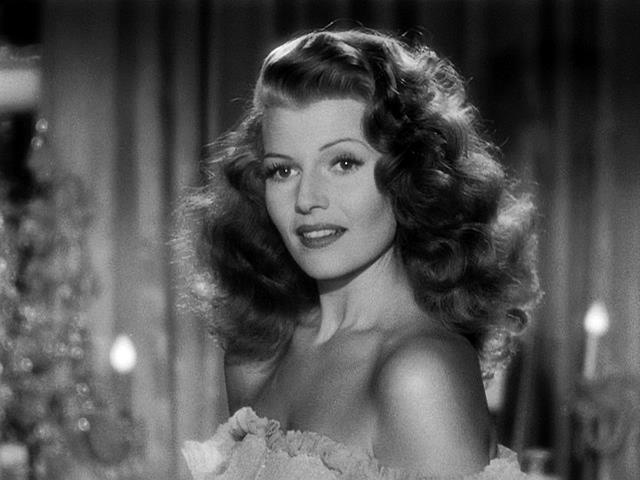
GILDA

Rita Hayworth
GILDA (1946). Director: Charles Vidor.

"Hate can be an exciting emotion. Very exciting. Hate is the only thing that can ever warm me." -- Ballin Mundson.

"If I'd been a ranch, they'd have named me the bar nothing." -- Gilda.

Down Argentine way just at the end of WW2, a hustler and crooked gambler named Johnny Farrell (Glenn Ford) is nearly robbed when a stranger on the docks with a spear in his cane comes to his rescue. The stranger is casino owner Ballin Mundson (George Macready), who hires Johnny to look after his interests. Some time later Ballin introduces Johnny to his beautiful wife, Gilda (Rita Hayworth), and both feign ignorance of the fact that they were once involved. Johnny and Gilda have a real love-hate relationship to add to the stew, and Ballin has a consortium with a bunch of Germans to add to the confusion. After a man is murdered in the casino, Ballin seems to commit suicide in his plane ... What to make of the modestly entertaining and often silly Gilda? Artificial and Hollywoodish as all get-out, with one-dimensional characters and one of the shortest climaxes in the history of the movies, Gilda has a few interesting twists and turns and is distinguished by the sex appeal and fine, constantly insinuating performance of Rita Hayworth, who makes the most of a standard role of the good-bad girl who is kept by wealthy men while loving the poor fellow she truly adores. Ford is not bad, if miscast, as the grubby borderline lowlife who winds up a kind of bodyguard/ersatz gunsel to Ballin (the narration he's given is unnecessary). Macready gives a good performance -- probably the longest and most famous of his career -- although some of his line readings are a little too matter-of-fact; one can think of other actors who might have played it in a somewhat more colorful and poetically sinister fashion. Steven Geray, Gerald Mohr, and Joseph Calleia all score as, respectively, a lowly casino employee who knows where the bodies are buried; a slimy guy with a hankering for Rita; and the police inspector who is concerned with the doings of the German consortium (even if no one in the audience is).

Some people* have had a different reading on Gilda, claiming that Johnny Farrell is a literal hustler on the bisexual side, Ballin's boyfriend, in fact, and that Johnny's self-hatred forced him to walk away from Hayworth before the story begins. This theory has it that Ballin needs to have power over attractive people of both sexes (one is reminded of Clifton Webb's character in Laura). Unfortunately, this take on the film makes it seem like a bad, regressive gay novel of the forties -- the tormented "queer" pulls away from the guy he's with and walks off into the sunset with a woman -- and while some advocates of this theory can point out certain lines and situations in scene after scene (and they may even have a point), they forget that many, many movies featured bad (and good) guys with live-in bodyguards and buddies, and this was never necessarily considered homoerotic. The proponents of this theory would have a lot to make of the Gilda imitation, Forbidden and many others as well.

Rudolph Mate has contributed some fine cinematography, but you would never know that the story takes place in Buenos Aires, as it has little Argentinian atmosphere. Gilda might be considered film noir except for the fact that its crime aspects are comparatively minimal. The pseudo-clever dialogue is often amusing.

* such as film noir specialist Eddie Muller on the Gilda DVD.

Verdict: Anyway, it's fun watching Hayworth do her "Put the Blame On Mame" number. **1/2.

Thursday, October 1, 2015

MY SON, MY SON

MY SON, MY SON (1940). Director: Charles Vidor.

"They say be good and you'll be happy, but I say be happy and you'll be good."

William Essex (Brian Aherne) was born poor but has become an established and successful author and playwright. His wife, Nellie (Josephine Hutchinson), is overly pious, while William is overly apologetic for the actions of his young son, Oliver (Scotty Beckett), who lies with abandon. One afternoon Essex is doing research for a play about miners, and is mistaken for one by an artist named Livia (Madeleine Carroll), who sketches him before realizing her mistake. The two are instantly attracted, but there's nothing to be done about it -- until later. Oliver grows up to become a spoiled, somewhat callous young man (Louis Hayward), whose actions greatly distress his father. But when Oliver is called to the trenches during WW 1, will the two men be able to reconcile their differences? My Son, My Son is a powerful, absorbing and very well-acted drama that culminates in a touching finale. Aherne is given a strong role and runs with it, on top of every scene. His love scene with Carroll [Don't Trust Your Husband] is beautifully played, and she gives a fine performance throughout. Hayward is excellent, and Beckett as the young Oliver is simply amazing. There are also very good performances from Henry Hull as William's old friend, Dermot; Laraine Day as Dermot's daughter, Maeve, who falls in love with William; and Hutchinson as William's first wife. A nice score by Edward Ward helps make this a compelling and classy picture. Hayward also played a bad boy in Vidor's Ladies in Retirement while Aherne and Day both appeared in The Locket.

Verdict: The kind of movie they truly don't make anymore. ****.

Thursday, March 19, 2015

THE SWAN

THE SWAN (1956). Director: Charles Vidor.

"[Like a swan] be a bird but never fly. Know one song but never sing it, until the moment of her death. And so it must be for you, Alexandra. Head held high, cool indifference to the staring crowds among the banks, and the song, never."

"[Albert] spends more time with the tutor than he does with Alexandra."

Beatrix (Jessie Royce Landis) has spent her whole life preparing for the marriage of her daughter, Princess Alexandra (Grace Kelly), to her cousin, the Crown Prince Albert (Alec Guinness). When he shows up at their estate, however, Beatrix and her relatives are appalled by his behavior, and worse, he hardly pays the shy Alexandra any attention [some have theorized that Albert is gay]. Beatrix hits upon the idea of inviting her young sons' tutor, Nicholas (Louis Jourdan), to the ball, with the intention of making Albert jealous. This plan seems to backfire when Nicholas declares his true feelings for the princess ... The Swan, frankly, is a highly-imperfect film -- a bit slow, neither funny nor dramatic enough until the ending -- but the acting can not be faulted. Kelly [Rear Window] offers a lovely lead performance as the princess; Guinness scores as Albert, who is resigned to a life he seems not to aspire to; Landis and Estelle Winwood (as her mother) are fine as the elder ladies of the court; Brian Aherne [The Locket] is excellent as Landis' brother, who resigned from royal life to become a monk; and Agnes Moorehead [Dark Passage] makes her mark, as usual, as the termagant mother of Albert. Jourdan is good, but he, perhaps, underplays too much during some of his romantic sequences, and the movie, as a whole, takes much too long to create any real conflict. But then there's that wonderful, bittersweet -- in fact, downright depressing -- conclusion. It's ironic that Kelly made just one more movie before becoming a princess in real life, also with a bittersweet conclusion, as she wanted to make a comeback (with Hitchcock) but was not allowed to, and apparently found herself quite disillusioned with life in the palace.

Verdict: The acting makes the movie. ***.

Thursday, March 5, 2015

LOVE ME OR LEAVE ME

LOVE ME OR LEAVE ME (1955)  Director: Charles Vidor.

"You'll never be sorry." -- Ruth

"What do you mean? I'm sorry already." -- Martin

The more or less true story of twenties singer Ruth Etting (Doris Day) and her difficult relationship to her manager and eventual husband, Martin Snyder (James Cagney). Love Me or Leave Me presents a story that was probably old even in its day and continues up until Sonny and Cher and beyond: the ambitious gal who falls in with a man who can help her and who thinks that she owes him her success and wants to control her. Cagney [Kiss Tomorrow Goodbye] is simply excellent in his highly unpleasant portrait of Snyder, although on more than one occasion he manages the significant feat of making the man sympathetic. Day [Pillow Talk] is right on top of things with Cagney  and is also excellent, never overdoing things as other actresses might have done. The biggest surprise comes from Cameron Mitchell [light years from The Toolbox Murders] who is also outstanding as Johnny, the pianist who falls in love with Ruth and vice versa. Day was a talented singer, but she isn't quite a torch singer, and while she has a couple of good numbers -- such as "I'll Never Stop Loving You" and "Look Around" -- you can hear the difference between Day in the movie and Etting's recording of "Ten Cents a Dance." Despite some sentimental hogwash at the end, this is a very good biography.

Verdict: Day and Cagney in top form. ***.

Thursday, May 29, 2014

SCARLET O'HARA'S YOUNGER SISTER Evelyn Keyes

SCARLET O HARA'S YOUNGER SISTER: My Lively Life In and Out of Hollywood. Evelyn Keyes. Lyle Stuart; 1977.

Evelyn Keyes was one of those innumerable Hollywood starlets who managed to have a few major roles in minor pictures, and small parts in big movies such as Gone With the Wind. When these "also-rans" write their memoirs they fill the pages with notes on the important people they knew and worked with, and do what they can to convince everyone that their life was fabulous even though Hollywood rejected them [or they rejected Hollywood, which sounds better]. Generally these books are about settling scores and perhaps there's a little of that in Scarlet O'Hara's Younger Sister, but what sets the book apart is that Keyes can write. This is not an "as told to" book where everything is interpreted by somebody else, but Keyes' story in her own generally well-chosen and witty words; it reads like a good novel where you're anxious to see what happens to our heroine next. The book is frank -- Keyes makes no bones that she slept with and married powerful men in the industry [directors Charles Vidor and John  Huston, among others] -- although she claims it was a daddy fixation. The book, full of amusing anecdotes, explores the sleazy underbelly of Hollywood and the crappy way that women, instantly disposable, were treated by most males in the industry. The most interesting passages deal with Keyes' several-years affair with Mike Todd, which almost led to the altar [except he met Liz Taylor], and her marriage to nutty chauvinist bandleader Artie Shaw, whose punctilious behavior would have driven anyone crazy. [Keyes was still technically married to Shaw when this book was published. When he died several years after their 1985 divorce, Keyes successfully sued for half of his estate, but she herself was gone only a couple of years later.] If you're looking for behind-the-scenes stories of the movies Keyes appeared in, look elsewhere; she doesn't even have that much to say about The Killer that Stalked New York, in which she gave an excellent performance. Keyes also gave notable performances in The Face Behind the Mask and Ladies in Retirement.

Verdict: Absorbing life of a Hollywood insider. ***1/2.

Thursday, March 20, 2014

TOGETHER AGAIN

Charles Boyer and Irene Dunne
TOGETHER AGAIN (1944). Director: Charles Vidor.

"You're a big shot in the office, and a non-entity at home!"

After making Love Affair in 1939, Irene Dunne and Charles Boyer were "together again" five years later in this slightly screwball comedy. Anne Crandell (Dunne) has been mayor of a small town in Vermont ever since the death of her husband and lives with her father-in-law, Jonathan (Charles Coburn) and neurotic stepdaughter Diana (Mona Freeman of Angel Face). Jonathan wants Anne to have more of a life, to forget his son [oddly] and her attachment to him and to the town they were happy in. When her late husband's statue is beheaded by a bolt of lightning, Jonathan sees this as a sign, but Anne only travels to Manhattan to meet with a prominent sculptor named George Corday (Boyer). After misadventures, including being mistaken for a stripper in a nightclub raid, Anne returns home convinced that George is not the right man for the job. But George follows Anne home and is determined to win her, if only he can get her to unbend ... Together Again basically gets by on the charm and abilities of its leads. A luminescent Dunne offers one of her best comic portrayals and is in absolutely top form throughout, Boyer is sauve and smooth as ever, and Coburn a delight as usual. Unfortunately, the material is second-rate, although there are a few amusing moments. Carl "Alfafa" Switzer has a funny cameo as an elevator boy, and Jerome Courtland [Sunny Side of the Street] scores as a young man who is dating the difficult Diana and often wishes that he weren't. Vidor also directed Rhapsody and many others.

Verdict: Great leads who need stronger material. **1/2.

Thursday, September 3, 2009

LADIES IN RETIREMENT

LADIES IN RETIREMENT (1941). Director: Charles Vidor. 

Ellen Creed (Ida Lupino) is secretary-companion to wealthy Leonora Fiske (Isobel Elsom) on a large, isolated estate. Learning that her two somewhat "eccentric" sisters are about to be tossed out onto the street and possibly into an institution, Ellen importunes her employer to let the women come and stay with them for awhile. But even the kindly Mrs. Fiske can only take so much, and after a time the dithering, rather batty women drive her to distraction. When Ellen protests her treatment of them, she is fired -- so now all three sisters have nowhere to go. What to do? What to do? Ellen eventually comes up with a solution... Lupino is good in the movie, as are Elsa Lanchester and Edith Barrett as the sisters. Louis Hayward, who at the time was married to Lupino, is fine as Ellen's roguish nephew, and Evelyn Keyes sparkles as maid Lucy. Isobel Elsom practically steals the picture, however, as the charming if practical Mrs. Fiske. The macabre movie is pictorially interesting and absorbing, but when all is said and done the characters are almost all unsympathetic and after awhile you don't really care what happens to them. There isn't nearly enough suspense or tension, and Vidor never really brings it to a full bloody boil. 

Verdict: Portrait of a lady not so retiring. **1/2.

Monday, January 28, 2008

THE JOKER IS WILD


THE JOKER IS WILD (1957). Director: Charles Vidor.

Hollywood-style biopic of singer-comedian Joe E. Lewis, who has his throat slashed after he leaves one mob-owned club to go to a better one against his bosses wishes. He manages to continue his career but can't commit to one woman who loves him (Jeanne Crain) and marries another (Mitzi Gaynor), but would rather drink, gamble and carouse. Frank Sinatra generally offers a perfectly good if second tier performance but does have at least two great moments: when he collapses in horror in the hospital after fully realizing what has been done to him, and when he gets drunk while giving his night club act. Sinatra introduced the song “All the Way” in this and gives a great performance of it in the opening minutes of the film. In later sequences, of course, he has to sing without his usual elan to show how Lewis' voice has been adversely affected. Crain and Gaynor are both fine, as is Eddie Albert as his pianist and friend, but Beverly Garland, a long-underrated actress, really scores as Albert's wife. After South Pacific Mitzi Gaynor was seen as kind of “white bread,” but in this she's rather sexy. Not a great movie by any means, but it holds the attention and is certainly a good bet for Sinatra fans. It also gets points for not having a standard happy ending, although some will be annoyed by its inconclusiveness.
Verdict: Worth a look. **1/2.