Lively, entertaining reviews of, and essays on, old and newer films and everything relating to them, written by professional author William Schoell.
Showing posts with label Joanne Woodward. Show all posts

Thursday, February 1, 2024

NO DOWN PAYMENT

Patricia Owens and Jeffrey Hunter

NO DOWN PAYMENT (1957). Director: Martin Ritt. Colorized

David and Jean Martin (Jeffrey Hunter of Brainstorm and Patricia Owens of The Fly) move into a lovely post-war housing community called Sunrise Hill. Their neighbors include Jerry and Isabelle Flagg (Tony Randall and Sheree North); Troy and Leola Boone (Cameron Mitchell of Garden of Evil and Joanne Woodward); and Herman and Betty Kreitzer (Pat Hingle and Barbara Rush). The last couple seem to have the most stable and successful lives and marriage. Jerry cheats on Isabelle and puts on a bluff as a supposedly successful car salesman. Troy hopes to become the chief of police but is brutal to his wife when he is upset. Both men drink too  much. When Troy doesn't get the job he wants, he takes out his anger in horrible fashion on poor Jean Martin, who fears what her husband's retaliation might be ... 

Cameron Mitchell and Joanne Woodward
No Down Payment is an absorbing drama which looks at a variety of situations and marriages and does so with a degree of sensitivity and intelligence -- as well as some fine acting. Although she's playing in her over-familiar "poor dumb Southern waif" mode, Woodward gives one of the best performances, along with the always-underrated Mitchell. Tony Randall is a bit miscast as the sleazy lover boy and doesn't quite pull it off. Sheree North successfully subdues the "sex kitten" aspect of her persona. Robert H. Harris is given a couple of good scenes as Randall's boss. There's a very interesting sub-plot with Kreitzer's store employee, the Japanese-American Iko (Aki Aleong), hoping his boss will help him get a house in Sunrise Hill. At the time he appeared in this film, Hunter had been divorced from co-star Barbara Rush for two years. 

Verdict: Notable fifties drama with a fine cast. ***. 

Thursday, January 23, 2020

THE STRIPPER

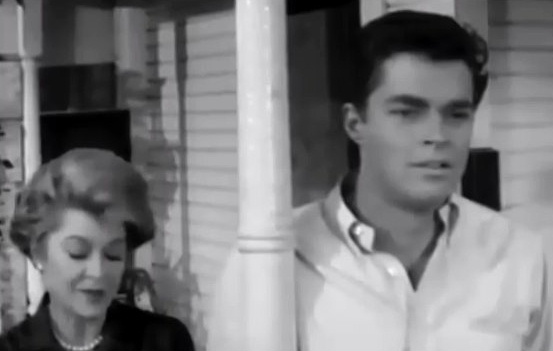
Richard Beymer and Joanne Woodward
THE STRIPPER (1963). Director: Franklin J. Schaffner. Based on the stage play "A Loss of Roses" by William Inge.

Along with her associates in a traveling magic act, Lila Green (Joanne Woodward) comes to the town where she lived as a child, but then is stranded when her boyfriend, Ricky (Robert Webber), runs off to greener pastures with all of their cash. Lila gets a room with a widow, Helen (Claire Trevor), who was her neighbor years ago, and who has a grown son named Kenny (Richard Beymer). Kenny and Lila develop an undeniable attraction to one another, but considering the age difference -- Woodward was eight years older than Beymer -- and everything else, Lila is afraid of being hurt and lonely once again. Then Ricky comes back into her life with a proposition ...

Claire Trevor and Richard Beymer
The Stripper is a lovely and absorbing film with three excellent lead performances. Although never considered a great beauty as such, Woodward [From the Terrace] has never looked better and she is excellent as Lila. (Marilyn Monroe, who was superb in the film adaptation of Inge's Bus Stop and was four years older than Woodward, might have been considered for this role had she not died tragically the previous year.) Beymer [Five Finger Exercise] gives a sensitive and intelligent performance as well, and Trevor [The Velvet Touch] is as adept as ever. Webber makes a very effective slime ball, and others in the cast include Gypsy Rose Lee and the odd Louis Nye as his associates (neither of them are especially memorable) and Carol Lynley, who makes a nice impression as a neighbor who has a crush on Beymer. Michael J. Pollard brings his own brand of quirkiness as a strange buddy of Kenny's who seems to have a thing for Lila but gets nowhere with her. The film could have used more scenes depicting the growing relationship between Kenny and Lila, but otherwise this is a very good movie.

Verdict: Strong cast and interesting situations add up to a memorable picture. ***1/2. 

Thursday, January 24, 2019

SYBIL (1976)

Nutty as a fruitcake: Sally Field
SYBIL (1976 four hour two-part mini-series. Director: Daniel Petrie.

Sybil (Sally Field) is a young substitute teacher in New York City who tries to hide the fact that she has blank spots in her memory and often wakes up days or even months later with no idea of what she's been doing. After an accident, she meets a sympathetic psychiatrist named Dr. Wilbur (Joanne Woodward), who discovers that Sybil has several different personalities. Using hypnosis and interviewing people from her patient's past, Wilbur determines to discover what happened in Sybil's childhood that made her this way, but Sybil may not like the answers.

Gullible as a guppie: Joanne Woodward
Sybil has much in common with an earlier theatrical film (this one about reincarnation) entitled The Search for Bridey Murphy. Both films were based on best-selling "non-fiction" works that caused a sensation, influenced millions of people, and, incidentally, made much money for their authors. Both books have also turned out to be, mostly, crap. Dissociative Identity Disorder, as its now called, was popularized by the book Sybil, but a new 2011 book entitled Sybil Exposed reveals that, while there may be a few genuine cases of DID, the real woman who was called Sybil was actually faking. "Sybil" confessed this to gullible Wilbur, but Wilbur chose not to believe her. Both women had very good reasons not to own up: Wilbur had her reputation to think of, as well as the money from the book (she worked with a professional writer); and Sybil, who became like a daughter to Wilbur, was virtually supported by her. 

Be a clown: Brad Davis and Sally Field
So while this strips the telefilm of much of its power, we have to look at what remains, and the answer is: not much. Three hours long without commercial breaks, Sybil eventually becomes tedious, with too many repetitious flashbacks, a slow pace, and padding. Emmy-winning Field is quite good, and she gets wonderful support from Woodward and Brad Davis as a free-spirited young neighbor that she dates, as well as others, but after awhile all of those "personalities," male and female, become rather irritating, and the whole thing nearly collapses into farce when "Sybil" turns into her own grandmother on the street. Woodward, of course, appeared in her own multiple personality picture, The Three Faces of Eve (which was also based on a non-fiction book), which engendered the similar Lizzie with Eleanor Parker. Sybil was remade as a TV movie in 2007.

Verdict: Field is impressive, but this is a turgid and unconvincing mini-series. **. 

Thursday, March 6, 2014

THE THREE FACES OF EVE

Joanne Woodward and Ken Scott
THE THREE FACES OF EVE (1957). Director: Nunnally Johnson.

Timid Eve White (Joanne Woodward of A Kiss Before Dying) acts strangely at times, so her husband, Ralph (David Wayne), takes her to see a psychiatrist, Dr. Luthor (Lee J. Cobb of Boomerang). During their interview, a different, sexier personality named Eve Black emerges. While Luthor and a colleague at first suspect that Mrs. White is faking, they come to the conclusion that she has multiple personality disorder. Her husband can't quite buy this, and her already troubled marriage begins to disintegrate. Then a third personality, "Jane," makes its presence known ... The Three Faces of Eve is based on a non-fiction book by a psychiatrist, so it's introduced and narrated by Alistair Cooke (who is himself "introduced" in this picture) to let the audience know this is real and serious. Whatever the reality of Eve and multiple personalities, this is an absorbing picture thanks primarily to the performance of Woodward, who won the best actress Oscar. [The part was originally to go to Judy Garland, who would have been interesting.] Woodward is subtle in her effects, never once over-acting, and is moving at times as well. Cobb is also excellent, but David Wayne is ludicrously miscast as the ignorant, stumbling husband, and his attempts to portray him are "Hollywood" acting at its worst. Ken Scott [Desire in the Dust] makes more of an impression as a man who falls in love with "Jane." Nancy Kulp [Strange Bedfellows] is cast as Eve's mother in a brief flashback. One suspects that the reasons for Eve's trauma and her developing this disorder have been cleaned up for the screen. The best sequence has Eve White talking to the doctor and realizing that she -- that is, her personality -- doesn't have much longer to live, and doesn't care. Which begs the question: when a personality disappears does it also, in essence, die? This is much better than the knock-off Lizzie which came out later the same year. Unlike that movie Eve doesn't equate sexuality with evil.

Verdict: Intelligent look at a weird and troubling problem. ***. 


Thursday, August 23, 2012

FROM THE TERRACE

FROM THE TERRACE (1960). Director: Mark Robson.

"I guess he hated me so much he couldn't even stand to be alive on the day I got married."

Alfred Eaton (Paul Newman) has always been in the shadow of his older brother who died, and has a terrible relationship with his father, Samuel (Leon Ames), who berates his neglected wife, Martha (Myrna Loy) for her drinking and her adulterous affair. Eaton's bad luck continues when he marries Mary (Joanne Woodward), who still has a big thing for old boyfriend Jim (Patrick O'Neal), but things look up when he meets Natalie Benzinger (Ina Balin). The trouble is that Eaton's boss thinks infidelity is worse than a divorce, Mary has no desire to stop being Mrs. Eaton, and Alfred has to choose between true love and his career. Newman saunters through the movie with aplomb and has several good moments, Woodward is sexy and interesting, Balin is lovely [if perhaps too understated at times], and Loy almost walks off with the picture as Alfred's lonely and alcoholic mother. Ames plays against type and is quite effective. This entertaining study and dissection of the American dream was based--probably loosely -- on a novel by John O'Hara. Nice score by Elmer Bernstein.

Verdict: Reasonably absorbing slice of Americana with some good performances. ***.

Thursday, August 9, 2012

THE DROWNING POOL

Paul Newman as Lew Harper
THE DROWNING POOL (1975). Director: Stuart Rosenberg.

Private detective Lew Harper (Paul Newman) is contacted by a woman, Iris (Joanne Woodward), with whom he'd once had a fling, to come to her estate and help her with some problem. Iris' husband is interested elsewhere, her teenage daughter Schuyler (Melanie Griffith) is running around doing whatever she wants, and then her harridan mother-in-law (Coral Browne) is murdered. Has it something to do with Kilbourne (Murray Hamilton), who wanted the dead woman's property for its oil, or the recently discharged chauffeur (Andrew Robinson), who was diddling around with Schuyler? While investigating, fending off Schuyler's advances, and being kidnapped and beaten, Harper tries to get at the unsavory truth. The cast, including a laid-back Newman, is good, but you never really connect with any of the characters. Tony Franciosa and Richard Jaeckel are cops with secrets of their own. Hamilton and Gail Strickland as his wife are notable. The revelations of the story may have had more impact when Ross Macdonald's novel, upon which this was based, was first published. Newman essayed Lew Harper [originally Lew Archer] once before in Harper nine years earlier. The climax in a water-logged hydrotherapy room is fairly exciting.

Verdict: No more than acceptable private eye fare. **1/2.

Wednesday, November 19, 2008

EMPIRE FALLS


EMPIRE FALLS (2005). HBO mini-series. Directed by Fred Schepesi. Screenplay by Richard Russo, from his novel.
This must be a pretty dumbed-down adaptation of the novel because otherwise one can't imagine why on earth anyone would think it was worthy of a Pulitzer Prize. Miles Roby (Ed Harris) lives in the town of Empire Falls, Maine, where he runs a diner for the local matriarch Francine Whiting (Joanne Woodward). While he deals with his ex-wife (Helen Hunt), daughter, half-drunk father (Paul Newman, pictured), and others, Miles also thinks back to when he was a young boy and he spent a summer with his mother and Francine's husband, Charlie (Philip Seymour Hoffman). Frankly, the flashbacks scattered through this meandering two-part movie only make things so confusing that many viewers may not even "get" the big secret about Miles and why Francine seems to delight in making his life miserable. The movie becomes a little more interesting when we're introduced to Francine's lame and emotionally disturbed daughter, who's been unrequitedly in love with Miles for decades, but this sub-plot sort of goes nowhere, which is true with many other situations in the movie. There are too many cliches and stereotyped, "cutesy" characters and the sappy, mediocre musical score seems to be trying to alert us that this is supposed to be something "meaningful' and "significant." Fat chance. It all comes off like superficial Stephen King without the horror except for a Columbine-like shooting scene that is thrown in for good measure. The acting is generally better than the picture deserves. Newman's performance isn't exactly a "great" one but he's not bad at all as Max. Like a soap opera without the sex.
Verdict: Phony and a bit dull all told. **.

Thursday, March 13, 2008

SUMMER WISHES, WINTER DREAMS


SUMMER WISHES, WINTER DREAMS (1973). Director: Gilbert Cates.

Joanne Woodward is superb as Rita Walden, a middle-aged woman suffering a mid-life crisis. Her mother (Sylvia Sidney) dies of a heart attack while attending the cinema with her daughter, and the family is squabbling over what to do with her farm. Her son doesn't want anything to do with her since her negative reaction to discovering he was gay. She feels emotions for her loved ones deeply but has difficulty showing them. Martin Balsam is also excellent as her husband, who has an affecting scene describing how he killed some boys during the war while at the very same spot where it happened in Europe. Stewart Stern's screenplay may be low-key but it has a quiet power and some very moving moments. His dialogue is also splendid, such as when Woodward yells at her daughter "I may love you but I don't like you at all!" and when Balsam tells his wife that "you know you have your whole life ahead of you." To which Rita replies "It'll go by like a weekend." The film was somewhat ahead of its time in that Rita's husband suggests that their gay son Bob "was gay the day he was born." Imperfect perhaps, but full of good performances and well-directed by Cates.

Verdict: Absorbing, intelligent, sensitively-played drama for adults. ***1/2.

Wednesday, January 23, 2008

A KISS BEFORE DYING

A KISS BEFORE DYING (1956). Director: Gerd Oswald. NOTE: Some plot details are discussed in this review.

Okay adaptation of Ira Levin's suspense novel features Robert Wagner as a charming sociopathic killer who shoves his pregnant girlfriend (Joanne Woodward) off of a roof and then zeros in on her equally wealthy sister (Virginia Leith). Mary Astor is pretty much wasted as Wagner's mother; Jeffrey Hunter offers an odd performance as a pipe-smoking junior detective; and George Macready is positively weird – like Igor in one of the Frankenstein movies – as Leith and Woodward's cold-hearted father. The CinemaScope photography is very good, although Oswald often employs very, very long takes [often the fashion in wide-screen movies of the period] which aren't very cinematic. However, the movie is entertaining and suspenseful, and Wagner's performance is smooth if not outstanding. [The bad remake starring Matt Dillon makes little sense, as Dillon already seems like a hoodlum before he commits a single murder.] It's hard to tell which murder is more disturbing: Woodward's high-story plunge, or the shooting death of the disk jockey that Wagner frames for the murder even as the frightened young man (Robert Quarry) pleads for his life. Woodward is as good as ever and Leith is more than adequate.

Verdict: Intriguing, if imperfect, thriller. ***.