Lively, entertaining reviews of, and essays on, old and newer films and everything relating to them, written by professional author William Schoell.
Showing posts with label Henry Fonda. Show all posts

Thursday, July 30, 2026

MARGARET SULLAVAN: THE LIFE AND CAREER OF A RELUCTANT STAR.

MARGARET SULLAVAN: THE LIFE AND CAREER OF A RELUCTANT STAR. Michael D. Rinella. McFarland; 2019. 

Margaret Sullavan drove the studios she worked for crazy because she refused to follow the rules. While other actors played ball because they knew they were being paid comparatively exorbitant salaries, Sullavan would do what she wanted and to hell with the bosses. This interesting and readable tome on the actress delves into her films, her marriages (Henry Fonda, Leland Hayward etc.), and her relationships with James Stewart and others. Whatever her flaws as a person, Sullavan rarely gave less than 100% in her performances, and although not really a great beauty by Hollywood standards, was often described as "luminescent" in her pictures. As her heart remained in the theater -- although a hearing problem in later years caused problems in that regard -- Sullavan made comparatively few movies. Among her more memorable films are No Sad Songs for Me; Back Street with Charles Boyer; So Ends Our Night; and The Shop Around the Corner; among others. This bio and career study is compelling and informative. Sullavan fans will also want to check out Lawrence Quirk's Margaret Sullavan: Child of Fate. Film buffs are aware of Sullavan, of course, but to the general public these days she's virtually unknown. 

Verdict: Solid bio and career study of talented movie star. ***. 

Thursday, July 31, 2025

JEZEBEL

Bette Davis in Jezebel
JEZEBEL (1938). Director: William Wyler. Colorized version

In pre-Civil War Louisiana, Julie Marsden (Bette Davis) is a spoiled, headstrong gal  who lives on a rambling estate with her Aunt Belle (Fay Bainter of State Fair). Her engagement to banker Preston Dillard (Henry Fonda of Lillian Russell) has already been called off more than once, but Julie is convinced that Pres will always come back to her. This notion is tested when she blatantly wears a red dress to a ball when unmarried ladies are supposed to wear white. Heading north, Preston eventually comes back South -- with a new wife, Amy (Margaret Lindsay of Emergency Hospital). Getting Pres away from Amy presents a challenge to Julie, but the fact that yellow fever (aka Yellowjack) has broken out and is ravaging the area might be even more than she can deal with ... 

Davis, Bainter, Fonda, Lindsay
Warner Brothers wouldn't let Davis play Scarlet O'Hara so they gave her another fiery Southern belle to play in Jezebel. (Jezebel was released first due to the long shooting schedule for Gone With the Wind). Whether Julie is a strong-willed woman who knows her own mind and to hell with the consequences or a pathetic creature who is hopelessly tied to one man is debatable. The soap opera of the story is bolstered by the horrific events of the plague. Whether helming romantic scenes, emotional conflagrations, or sequences detailing the horrors of Yellowjack, William Wyler is at the top of his game, and his star isn't far behind. Fay Bainter is also excellent, and Fonda is better than usual. George Brent does the best he can to keep up and is adequate, as is Margaret Lindsay, deliberately cast to seem a pale weak wren next to the fiery Davis. (Davis and Bainter both won Oscars.)

Fonda with Davis
A problematic aspect of the picture, as it is with GWTW, is the patronizing attitude towards the black characters. They are not merely servants, but slaves, but they sing and dance and smile and make merry as if this were perfectly okay with them. Each one gives an notable performance, including Theresa Harris as Zette and Eddie Anderson as Gros Bat. There's a moving scene, be it intended or not, when Fonda asks butler Uncle Cato (Lew Payton) to have a drink with him, but Cato fears it is "hardly proper" and takes his drink with him to the pantry. (We must remember that Fonda swears he is not an abolitionist.) During the plague sequences, when carts are shown taking sick and dying people to an island leper colony, the camera catches both black and white victims, as if to say, the world may discriminate, but yellow fever doesn't. There is a terrific scene in a bar when Fonda falls ill and everyone in the place pulls back in fear and horror in a sudden backwards sweep.

Davis
Whatever its flaws or dated aspects -- although they are "nice" to their slaves, the white characters are essentially racists -- Jezebel is still a memorable picture that takes place in a very different time period. In addition to the fine direction and some splendid performances, there is a notable score by the great Max Steiner and topnotch cinematography by Ernest Haller. The color adds a new dimension to the film although the infamous red dress is more black than red. 

Verdict: A resplendent Davis in a rich romantic drama. ***1/4. 

Thursday, August 3, 2023

ASH WEDNESDAY

Lovely Liz
ASH WEDNESDAY (1973). Produced by Dominick Dunne. Directed by Larry Peerce. 

Sixtyish Barbara Sawyer (Elizabeth Taylor) fearing that her husband, Mark (Henry Fonda), will leave her for a younger playmate, goes to Switzerland and has cosmetic surgery (graphically depicted) to make her look like -- gorgeous, 41-year-old Liz Taylor! After the bandages come off, Barbara goes to the resort of Cortina, Italy, staying in a fabulous hotel and wearing expensive fashions. She also turns the head of a playboy named Erich (Helmut Berger, again miscast as a heterosexual). Should Barbara succumb to her romantic feelings for Erich, and what will Mark think of her new look when he finally arrives in Cortina. She may learn that her marriage had more problems than her aged appearance ... 

Helmut Berger
With its superficial and one-dimensional characters, one really has to wonder why anyone thought making this movie was a good idea. Sure, lots of people might have loved looking at glamorous Liz (although probably not at distasteful surgery), but an actual  story might have helped. Half of the movie is taken up by scenes at the clinic, and the surgery sequence seems to last as long as the actual operation. When Barbara/Liz puts on her sweeping ultra-chic winter coat/robe that looks like it must have cost a thousand dollars, the film just suddenly seems to turn into a comical parody. Taylor's performance is generally on target, although it's not one of her best. Helmut Berger is Helmut Berger and doesn't really have to act just look enigmatic. Fonda is actually good in this -- his assorted reactions are perfect -- and Margaret Blye [The Entity] is fine as their daughter, Katie. Keith Baxter adds some zest as David, a (possibly gay?) fashion photographer who is also getting work done and befriends Barbara at the clinic and elsewhere. Monique van Vooren [What Makes Sammy Run?] plays a German celebrity who briefly chats with David at the clinic. 

Verdict: Another entry in the "Oh, how the rich suffer!" sweepstakes! **1/4. 

Thursday, May 2, 2019

SEX AND THE SINGLE GIRL

Tony Curtis and Natalie Wood
SEX AND THE SINGLE GIRL (1964). Director: Richard Quine.

Bob Weston (Tony Curtis), who writes for a sleazy expose mag called Stop, has just come out with a story on psychologist Helen Brown (Natalie Wood). Dr. Brown wrote a bestseller entitled "Sex and the Single Girl," but the article claims she is a virgin with limited experience. Weston wants to dig up more dirt on Brown, so he poses as his next door neighbor, hosiery salesman Frank (Henry Fonda), whose wife, Sylvia (Lauren Bacall), is almost pathologically jealous, and pretends to be Helen's patient. When Bob and Helen start falling in love, it causes complications for everyone.

Lauren Bacall
When someone got the bright idea of turning Helen Gurley Brown's bestseller into a movie, they should have tried for something more sophisticated than this dumb "sex comedy" that has hardly any laughs. Even the basic premise of a man getting close to a woman who hates him by pretending to be someone else is nothing new. A sequence when not only Bacall but two other women show up at Brown's office claiming to be Sylvia should at least have been fun, but it's as clunky as everything else in the movie. The picture develops a slight degree of momentum toward the end, but it all winds up in a race to the airport with everyone chasing everybody else in their cars or taxis -- a bit with Bacall and a cab driver is kind of muffed -- and an attempt to emulate the kind of zaniness you used to find in Frank Tashlin movies never really comes off. The whole sequence goes on too long in any case.

Tony Curtis
Sex and the Single Girl might have worked if Carol Burnett had played Brown instead of Natalie Wood. She and Curtis give it the old college try, but they can do little to make any of the lines -- some of which are actually funny -- come alive. Henry Fonda is out of his element and even Bacall is mostly mediocre. Others in the cast include Mel Ferrer as a psychiatrist who is interested in Helen, Fran Jeffries as an amorous friend of Bob's, and Leslie Parrish as Bob's secretary. Two veterans who add a bit to the limited fun are Edward Everett Horton as Bob's boss and Otto Kruger as one of Helen's associates, and Larry Storch shows up as a motorcycle cop driven crazy by all the goings-on. There's an inside joke about Some Like It Hot but the references to Jack Lemmon are repeated once too often. The pic tries to come up with some interesting backdrops -- a dock where Bob threatens suicide, the ape cages in the zoo -- but ultimately the movie is just deadly. Fran Jeffries, who sings and dances in the movie, had previously been married to Dick Haymes, and then married Richard Quine, the film's director, the year after this was released. The marriage only lasted four years.

Verdict: And it's nearly two hours long as well! *1/2. 

Thursday, August 10, 2017

FAIL-SAFE

Frank Overton
FAIL-SAFE (1964). Director: Sidney Lumet.

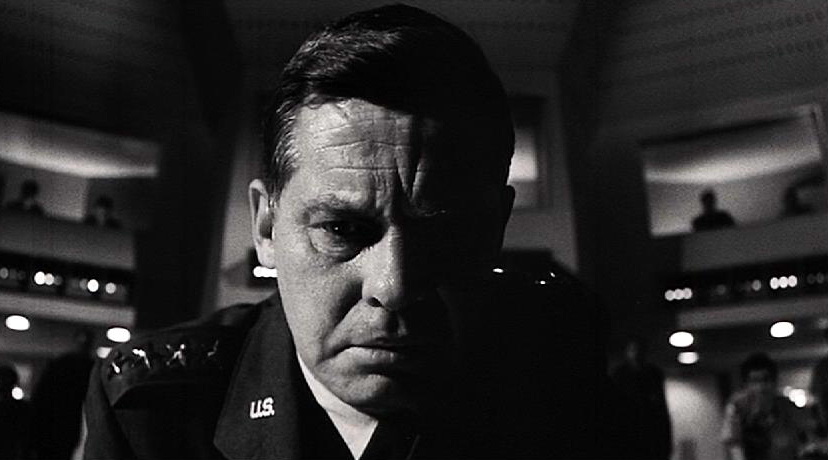
The American president (Henry Fonda) discovers that the U.S. air force accidentally launched a bomber squadron against Moscow. Now his job is two-fold: to convince his Russian counterpart that this strike was indeed accidental and prevent retaliation; and to stop or even shoot down the U.S. planes before they can drop the bombs and start WW3. The tension is thick as various characters react to what is an untenable and horrifying situation. The acting from the entire cast is first-class: Dan O Herlihy  [King of the Roaring 20's] as General Black, who must discharge the most distasteful duty of his career, to put it mildly; Fritz Weaver (who was introduced in this film) as Colonel Cascio, who is nearly driven mad by the situation and has a violent breakdown; Walter Matthau (in one of his early dramatic roles) as Groeteschele, who is coldly pragmatic when it comes to the numbers of projected casualties and the like; and especially Frank Overton [Desire Under the Elms], in the performance of his career, as the conflicted but duty-bound General Bogan. Janet Ward certainly scores in a small but pivotal role as Mrs. Grady, who desperately tries to tell her husband, the lead pilot, to turn back before it's too late. Nancy Berg, Dom DeLuise [Diary of a Bachelor]  and Larry Hagman (as a translator), among others, also do well in some flavorful supporting roles. One of the best scenes has Bogan reacting after the men in the war room cheer the downing of one of the planes -- "this isn't a football game!" I don't know if I find the controversial ending to this to be especially believable, but it certainly packs a wallop. I have no doubt that when this was released people left the theater shivering in shocked silence. This was released the same year as the satirical Dr. Strangelove, which has more or less the same plot, but the more somber Fail-Safe has the edge on it. The movie could have been cut by ten or so minutes and tightened a bit, however.

Verdict: Disturbing, high-impact, and infinitely depressing. ***1/2.

Thursday, August 22, 2013

THE WRONG MAN

The lives of this family are about to be shattered
THE WRONG MAN (1956). Director: Alfred Hitchcock.

Manny Balestrero (Henry Fonda) is an unassuming family man who plays bass fiddle in a band at New York's tony Stork Club. When he goes to an insurance company to find out how much he can borrow on his wife's policy -- they need several hundred dollars to fix her painful dental problems -- the clerks there react with fear and disbelief. Apparently Manny looks just like the man who has robbed the office on two occasions, as well as other places. Manny is arrested, identified by other people as the robber, and hires a lawyer (Anthony Quayle) he can't afford. Meanwhile his wife, Rose (Vera Miles) is so beset with fear and tension that she has to be institutionalized, leaving Manny to face this ordeal alone except for his devoted mother (Esther Minciotti). Based on a true story, The Wrong Man is a Hitchcock film in a low-key mode in all departments and this approach is very effective. Fonda, playing 38 at 51, is quite good, and although Miles is a little off in some scenes, she also gives a very nice performance. Doreen Lang, who later was the hysterical woman in the restaurant in The Birds, is excellent as one of the women in the insurance office; all of the witnesses are very well cast and quite good. William Hudson, Nehemiah Persoff, and Bonnie Franklin all have small roles. The film is expertly photographed by Robert Burks, and has a snappy if sinister theme by Bernard Herrmann. Beautifully done, The Wrong Man is, in its own way, quite disturbing and chilling, and builds up to a very moving finale. It's sad to realize that in real life there was no happy ending.

Verdict: A certified Hitchcock classic. ***1/2.

Thursday, June 30, 2011

TENTACLES

TENTACLES aka Tenticoli (1977). Director: Oliver Hellman [Ovidio G. Assonitis].

"This isn't candy -- it's passion." -- Tillie, referring to her weight.

This Italian film inspired by the success of Jaws takes place in an American coastal town where there have been a series of strange disappearances. Eventually bodies turn up that have been stripped not only of flesh but of marrow. Sheriff Robards (Claude Akins) is perplexed as to what could be responsible but reporter Ned Turner (John Huston) wonders if it has something to do with an underwater tunnel being built by a firm owned by Mr. Whitehead (Henry Fonda) of Trojan construction. He also pays a call on an oceanologist named Will Gleason (Bo Hopkins) for answers. Nearly forty minutes into the movie we finally see the octopus -- surprise! -- that's responsible for the carnage, and although it's referred to as a "giant" it never seems that big. The shame about Tentacles is that it has eerie opening scenes [a tragic, well-presented vignette involving a baby snatched off shore in the space of a few seconds stays in the memory] and a certain degree of suspense, but the movie lacks the real panache and knock-out scenes that would give the audience a big pay off. The acting is fine, with top honors going to a still kind of sexy Shelley Winters as Turner's sister, Tillie; whether she's affectionately nagging her brother or worrying what happened to her little boy who is in a sailing regatta [this leads to another sad sequence] she's excellent throughout the movie.

Verdict: Paging It Came from Beneath the Sea. **.

Thursday, March 26, 2009

THE LONG NIGHT


THE LONG NIGHT (1947). Director: Anatole Litvak.

Ann Dvorak loves Henry Fonda who loves Barbara Bel Geddes, who is loved by Vincent Price, who is ... and all with a lot of talk, talk, talk. The film begins with a murder, and the perpetrator being cornered by police in his apartment. After what seems like an hour the flashback finally begins that tells us what led up to the murder, but there are two problems: the flashback isn't that interesting, and it keeps getting interrupted by more scenes with the fugitive and the police. Fonda is back from the war, and meets Bel Geddes, who is both fascinated and repulsed by magician Vincent Price, whom was formerly carrying on with his assistant, Dvorak. It all leads to tragedy and a lot of tedium. The Long Night is turgid, pretentious and unconvincing nearly from start to finish; the wind-up takes even longer than the opening. Fonda's performance is too controlled, Price's too phony, but Dvorak is vivid and Bel Geddes is strong and fully committed; she's excellent in a movie that doesn't deserve her. The characterizations are too thin to make any of these people really matter to us -- and all that's left is talk. And when all is said and done this is just another movie about a guy who goes nutso when he discovers his gal isn't quite as "pure" as he thought she was, giving it all a very dated air. Dimitri Tiomkin's score is interesting, but too much -- this ain't exactly Grand Opera.

Verdict: A long night indeed. *1/2.

Thursday, February 26, 2009

CHAD HANNA


CHAD HANNA (1940). Director: Henry King.

"Why don't you go back to your pigs -- and stay there!"

In 1841 young Chad Hanna (Henry Fonda) runs off with a small, struggling circus to avoid a sheriff and to court pretty bare back rider Albany Yates (Dorothy Lamour). Caroline (Linda Darnell) also joins the circus to get away from her hateful father (Olin Howlin in a bigger role than usual) and winds up falling for Chad. However, this isn't the usual triangle as both women seem to like and respect one another and there is no stereotypical "bitchiness" between them. Chad Hanna is an amiable comedy-drama detailing the assorted tribulations of the circus as Chad tries to figure out whom he's in love with. Guy Kibbee and Jane Darwell are amusing and excellent as the owner and his wife. Lamour is solid, Darnell gives a lovely performance, and Fonda plays Chad as if the young man were slightly "touched" in the head. Ted North, John Carradine, and Frank Conlon are also notable. Charles Middleton isn't given enough to do as the barely-seen sheriff. Very pleasant and absorbing, and with a memorable score by David Buttolph. Funniest bit has a very hefty Darwell sizing up an elephant and saying "If he ever develops a taste for meat ..."

Verdict: Charming and different. ***.

Friday, September 5, 2008

THE BIG STREET


THE BIG STREET (1942). Director: Irving Reis.

"Love just gives you one room, two chins, and three kids!"

A simple-minded busboy named Little Pinks (Henry Fonda) develops an infatuation for a gold-digging singer named Gloria (Lucille Ball) and basically becomes her dog and slave after she loses the ability to walk. At one point he agrees to push her by wheelchair from Manhattan to Florida (although they manage to hitch a lot of rides in the back of trucks)! This absorbing (if at times draggy) comedy-drama is certainly not for all tastes, and some may find that the mix of Damon Runyan characters such as Nicely Nicely (who later turned up in Guys and Dolls) with a study of unrequited love doesn't always jell, and in truth the Runyanisms often come close to crowding out the main story. Still for those who are game The Big Street is often very funny and just as often quite touching. Although he's hardly perfect casting, Fonda manages to do a nice job as Pinks, and Lucy gives one of her best performances – a really lovely job – as Gloria, managing to be both bitchy and sympathetic at one and the same time. A lot of great character actors shore up the proceedings, especially Agnes Moorehead as a neighbor and friend of Little Pinks. Louise Beavers and Ray Collins are also especially memorable. For those who simply find the movie to be too far-fetched, think of it as a Damon Runyan fable, sort of his lighter take on Of Human Bondage. The movie is not just a study of pathetic devotion and love, but of friendship, as we see how all of Little Pink's pals – even if they think he's crazy and masochistic to do so much for the ungrateful Gloria – pull together for him because they love him and realize how much he loves Gloria. A very unusual movie, and a real tearjerker as well.

Verdict: Grab those hankies and love Lucy!***1/2.