Lively, entertaining reviews of, and essays on, old and newer films and everything relating to them, written by professional author William Schoell.
Showing posts with label Robert Cummings. Show all posts

Thursday, September 26, 2024

PAID IN FULL

Bob Cummings and Lizabeth Scott

PAID IN FULL (1950). Director: William Dieterle.  

"Youth should be a blessing, not an apology." 

Jane Langley (Lizabeth Scott) makes continual sacrifices for her spoiled sister, Nancy (Diana Lynn), and even steps aside when both women fall in love with the same man, Bill Prentice (Robert Cummings). Bill and Nancy get married but he soon realizes that he got hitched to the wrong sister. Nancy is too selfish and immature to make a good wife or mother, but both Jane and Bill are too dumb to see it. When a tragedy involving a child occurs, no one seems to be held responsible for it. Meanwhile Dean Martin sings "You're Wonderful" on the soundtrack and Eve Arden, playing an arch gal named "Tommy," delivers her advice in her usual sardonic style. 

Cummings with Diana Lynn
Paid in Full is somewhat absorbing romantic schlock with generally credible performances. Others in the cast include Ray Collins of Perry Mason as a doctor, John Bromfield and Dorothy Adams, as well as Charles Bradstreet and Carol Channing in bits. Lizabeth Scott [I Walk Alone] delivers each and every line in a beatific style that makes her come off like the biggest sap on the planet. Shot by Leo Tover and with a score by Victor Young. William Dieterle also directed Dark City with Scott.

Verdict: Not one of the great classics of Hollywood. **1/4. 

Thursday, January 17, 2019

LET'S LIVE A LITTLE

Hedy Lamarr
LET'S LIVE A LITTLE (1948). Director: Richard Wallace.

Advertising man Duke Crawford (Robert Cummings) is fed up with women after dealing with his ex-fiancee Michelle Bennett (Anna Sten), a cosmetics queen. Michelle insists upon acting as if the two were still engaged, and Duke desperately needs her to sign a contract. Hoping for a male client, Duke decides to do publicity for a shrink who's written a book, but Dr. J. O. Loring (Hedy Lamarr) turns out to be a woman -- and what a woman! Finding Duke nervous and excitable, Dr. Loring takes him on as a patient, which does not sit well with her boyfriend, Dr. Field (Robert Shayne). Which woman will Duke ultimately wind up with?

Anna Sten and Hedy Lamarr
If Let's Live a Little works at all it is strictly because of the actors, all of whom give very good performances, but they are certainly let down by a script that strains to be funny. The screenwriter even resorts to using a variation of an old Marx Brothers line, with Duke telling Michelle "If I held you any tighter I'd be in back of you." A scene when the two rivals for Duke's affections sit at the same nightclub table could have been witty and scintillating, but falls flat instead. Most of the very few amusing moments in the picture are provided by Cummings, who is at home in this kind of material, whereas he was always miscast in dramas and suspense films. Lamarr is adept, and along with Sten and Shayne there are nice turns by Mary Treen [Swing Parade of 1946] as Duke's secretary and Norma Varden [Witness for the Prosecution] as Loring's nurse. Ernest Laszlo insures that gorgeous Lamarr looks luminescent throughout. Richard Wallace also directed Kiss and Tell.

Verdict: The actors try mightily to put this over but the material just isn't there. *1/2. 

Thursday, May 19, 2016

THE LOST MOMENT

Robert Cummings and Susan Hayward
THE LOST MOMENT (1947). Director: Martin Gabel.

"It's only being with people that makes one lonely."

Publisher Lewis Venable (Robert Cummings) comes to Venice hoping to obtain letters written by the late poet Jeffrey Ashton to the now-aged Julianna Borderau (Agnes Moorehead). Lewis pretends to be an author seeking an atmospheric place to write his novel, and pays an exorbitant fee for rooms in the manor owned by Julianna, who lives with her niece, Tina (Susan Hayward). Both women seem to be keeping secrets regarding Ashton, who simply disappeared many years ago. The Lost Moment sort of uses the basic framework for Henry James' novella "The Ashton Papers," but is turned into an unconvincing psychological mystery with an expected resolution. Cummings [Saboteur] is okay, but not well-cast, and Hayward [I'll Cry Tomorrow] is better as a woman undergoing an identity crisis, while an unrecognizable Moorehead [Dark Passage] certainly scores as the crone-like Julianna. Joan Lorring, Minerva Urecal and Eduardo Ciannelli offer flavorful supporting performances.

Verdict: This dies a slow death long before the conclusion. **.

Thursday, May 12, 2016

THREE SMART GIRLS GROW UP

Bob Cummings with the three smart girls.
THREE SMART GIRLS GROW UP (1939). Director: Henry Koster.

In this inferior sequel to Three Smart Girls, the "girls" are now young ladies with romantic problems. Their parents (Charles Winninger; Nella Walker) are back together and Joan (Nan Grey) is happily affianced to Richard (William Lundigan of Andy Hardy's Double Life). Unfortunately sister Kay (Helen Parrish) has fallen in love with Richard herself, a rather interesting situation that, unfortunately, never becomes entertainingly melodramatic. Sister Penny (Deanna Durbin) keeps throwing Harry Loren (Robert Cummings) in Kay's direction, to take her mind off Richard, but Harry rather rudely makes it clear that his interest is strictly in Penny. Durbin [It Started with Eve], the sole name to appear above the title, showing how her status had grown, gives a good performance, as does Winninger, and the rest are all more than competent.

Verdict: Pleasant if forgettable. **1/2.

Thursday, June 11, 2015

FOR HEAVEN 'S SAKE

Edmund Gwenn and Clifton Webb
FOR HEAVEN'S SAKE (1950). Director: George Seaton.

"Successful angels do not use sarcasm."

Charles (Clifton Webb) and Arthur (Edmund Gwenn) are angels sent down from heaven to oversee the birth of two little angels (Gigi Perreau; Tommy Rettig) whose parents seem reluctant to bring children into the world. Charles sees actress Lydia Bolton (Joan Bennett) and her husband, Jeff (Bob Cummings) as selfish, irresponsible people when they are simply talented artists who quite sensibly don't want to have children. But snippy Charles, to the horror of prissy Arthur, decides to help things along by becoming human for a time and interfering with the lives of the Boltons. Inspired by a Gary Cooper movie, Charles takes on the persona of wealthy rancher "Slim" Charles, but will the allures of earthly passions prevent him from completing his assignment ..? For Heaven's Sake is bolstered by a good cast, with Webb and Cummings especially helping to put this weird material over. Jack La Rue [The Story of Temple Drake] also makes his mark as a tough guy actor who is not as hard as he thinks, and the dour Charles Lane [The Invisible Woman] is well-cast as an IRS man who wonders why "Slim" doesn't pay any taxes. Perreau and Rettig are suitably adorable. Harry von Zell [The Saxon Charm] and Joan Blondell make shorter appearances. Bennett was very effective in both slinky and maternal roles; in this she's sort of caught in the middle. It's interesting that the little girl is determined to be born to such wealthy parents, although nothing is ever made of this.

Verdict: Charming in spite of itself. **1/2.

Thursday, November 27, 2014

SO RED THE ROSE

Randolph Scott and Margaret Sullavan; guess who loves whom
SO RED THE ROSE (1935). Director: King Vidor.

When the Civil War breaks out it deeply affects the Southern Bedford family, run by patriarch, Malcolm (Walter Connolly), who is married to Sally (Janet Beecher), with whom he has two sons (Harry Ellerbe; Dickie Moore) and a daughter, Val (Margaret Sullavan). Val is in love with a distant cousin, Duncan (Randolph Scott), but he seems completely unaware of her feelings whereas George Pendleton (Robert Cummings) has affection for Val. At first Duncan tries to be neutral, which prompts Val to accuse him of cowardice, not exactly the right way to get a romance off to a good start. But then Duncan joins up with the confederacy and off to war he goes ... This is a more or less forgotten Civil War epic made four years before Gone With the Wind, but it's a creditable film, bolstered by fine performances by Sullavan [The Good Fairy], Connolly, and others; Elizabeth Patterson [Lady on a Train] overacts a bit as old Mary Cherry but is also good. On the debit side is a lot of phony glory and the depiction of rebellious slaves as being both lazy and criminal. Johnny Downs [Trocadero] plays a Yankee soldier, a mere boy, who is temporarily hidden by the Bedfords. The film is well-photographed by Victor Milner -- one especially striking shot shows Sullavan running past a tree into the sun.

Verdict: Anything with Sullavan in it is of interest, but this is not a bad movie despite flaws. ***.

Thursday, May 22, 2014

THE ACCUSED

Douglas Dick and Loretta Young
THE ACCUSED (1949). Director: William Dieterle.

"What do you think suicides are? Some little person thinks their little problems are all that matter in the world." -- Dr. Tuttle

College psychology professor Dr. Wilma Tuttle (Loretta Young) is concerned with a brilliant but brash and difficult student named Bill Perry (Douglas Dick). When Bill forces a smooch on her at an isolated spot, she reacts by hitting him repeatedly and killing him. Instead of coming clean, she covers up and hopes his death will be attributed to a bad dive off of a cliff into the water below; he was wearing swimming trunks. Perry's lawyer, Warren Ford (Robert Cummings), who didn't really know Perry that well nor especially like him, comes to town and begins a romance with Wilma even as homicide detective Lt. Ted Dorgan (Wendell Corey) begins to get suspicious ... The Accused features a good lead performance from Young [Because of You], fine support from an especially notable Douglas Dick and the wry, sardonic Corey [The Big Knife], but Bob Cummings is horribly miscast [as he always was in movies like this] and is terrible. Another  problem with the movie is that while Perry does kiss Wilma forcibly and without permission, it doesn't necessarily mean he would have sexually assaulted her, and her viciously hitting him over and over again seems like literal overkill. Sara Allgood and Ann Doran are also in the cast, and Sam Jaffe offers a flavorful performance as Dr. Romley, whom Wilma finds ghoulish. Victor Young's score is a plus, and Ketti Frings' screenplay has some interesting dialogue. Unfortunately The Accused runs out of gas long before it's over. Dieterle directed Dark City and many, many others.

Verdict: Physician, heal thyself. **.

Thursday, May 15, 2014

AND ONE WAS BEAUTIFUL

Laraine Day and Jean Muir
AND ONE WAS BEAUTIFUL (1940). Director: Robert B. Sinclair.

"If ever I want to make anyone wretched, I'll call on you for advice."

Kate (Laraine Day of The Locket) is the shy, younger sister of Helen Lattimer (Jean Muir of Dr. Monica), who has strong feelings for "good catch" Ridley Crane (Robert Cummings).  When Kate goes to a party in place of Helen, she meets Ridley, who is charming to her, and becomes smitten with him as well. The sisters' feelings for Ridley and for each other become all entangled when Ridley gets drunk at a club, Helen briefly takes the wheel of his car, runs over and kills a man, and flees. She allows Ridley, who's already been in trouble for drunk driving, take the blame, but her sister suspects the truth ... And One Was Beautiful is a minor drama, but it holds the attention due to its interesting situation and some good acting, with Day and Muir in fine form. Billie Burke plays the mother and Esther Dale the dyspeptic maid in their usual professional style. Bob Cummings is perfectly okay for the lighter scenes, but less convincing when he has to get all dramatic. A curious aspect of the movie is that the family of the man who is killed seem much happier and better off after his death due to Ridley's giving them lots of cash (even without his being sued). With some good dialogue, this "B" movie is at times more knowing of human emotions than one might think. One assumes the title has to do with inner beauty because both sisters are physically attractive. Sinclair also directed Mr. and Mrs. North.

Verdict: Feuding sisters are always fun. ***.

Thursday, January 23, 2014

THE CHASE (1946)

Peter Lorre, Steve Cochran, and Bob Cummings as chauffeur
THE CHASE (1946). Director: Arthur D. Ripley.

Ex-serviceman Chuck Scott (Robert Cummings) finds a wallet on the sidewalk and returns it to its owner, the quite unsavory hoodlum Eddie Roman (Steve Cochran). Roman, who has an associate named Gino (Peter Lorre) and a wife named Lorna (Michele Morgan), hires Chuck as his chauffeur. A peculiar feature of the limo is that Roman can take over the controls from the back seat whenever he wants. Roman dispatches a business rival by trapping him in his wine cellar with a vicious dog, so it's fairly likely that he won't have a good reaction when a desperate Lorna begs Chuck to help her escape to Havana ... The Chase begins well, with Cochran offering a chilling portrait of a glib sociopath, but it gets too tricky and an actual "chase" never really develops. Instead of a decent plot and some interesting developments, The Chase substitutes a lengthy dream sequence that serves little purpose besides confusing the viewer. Cummings is always miscast in film noir, but otherwise does okay, and Lorre simply isn't given enough to do. Michele Morgan is pretty and seems efficient enough, but she's also under-utilized. This movie goes nowhere slowly. Loosely based on a novel by Cornell Woolrich that just had to be much, much better.

Verdict: Cochran's picture -- and he can have it. **.

Thursday, January 16, 2014

BETWEEN US GIRLS

Diana Barrymore and Kay Francis as mother and daughter
BETWEEN US GIRLS (1942). Director: Henry Koster.

In this very oddball comedy, the actress Carrie Bishop (Diana Barrymore) learns that her mother, Chris (Kay Francis), is engaged to a man, Steven (John Boles), who thinks her daughter is just a little girl. Afraid that he will jilt her mother when he learns that the "little girl" is actually twenty-years-old, she decides to pretend to be a girl of about 12. Things get especially complicated when Steven's associate, Jimmy (Robert Cummings), accuses the "real" Carrie of child abuse after she supposedly hits the child, and then literally socks her, Carrie, in the jaw. Still Carrie stupidly continues the deception ... Francis and Cummings are fine, as is Andy Devine in a lively, likable performance as Carrie's manager, and the picture is nearly stolen by Ethel Griffies as the stony Irish housekeeper, Gallagher. [The scene when Gallagher threatens to quit and packs her bags to the consternation of mother and daughter is the best in the movie]. As for Barrymore, she reveals a real talent in this, but unfortunately is forced to play an idiotic part and perform in several embarrassing sequences. On the other hand she has a splendid moment performing with talented little Scotty Beckett when Carrie plays Queen Victoria in a play. (Her attempts at Sadie Thompson are less successful perhaps because she's deliberately playing too broadly, and her Joan of Arc at the end is only adequate.) Another scene stealer is Lillian Yarbo as the funny, ever-complaining black maid, Phoebe, who claims it was more fun when she was working in a funeral parlor. Francis' hairdo in this is especially grotesque. Between Us Girls has a couple of amusing moments, but it's too strange, poorly scripted, and has a fairly moronic premise as well, from which it never quite recovers.

Verdict: A bizarre curiosity but hardly a good movie. **.

Thursday, April 25, 2013

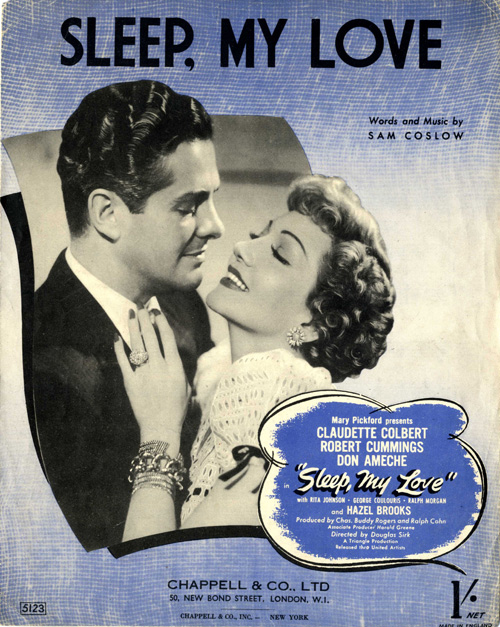
SLEEP, MY LOVE

SLEEP,  MY LOVE (1948). Director: Douglas Sirk.

Sutton Place heiress Alison Courtland (Claudette Colbert) wakes up on a train to Boston with no idea how she got there. Turns out this is not the first time that this has happened. She also has weird nightmares and swears she keeps seeing a strange man in horn-rimmed glasses who claims to be a Dr. Rhinehart (Ralph Morgan) but looks nothing like the real one. We can also see this man, whose name is Charles (George Coulouris) and are let in early on that he's involved in some scheme with Alison's faithless husband Richard (Don Ameche), who has fallen for the slinky Daphne (Hazel Brooks) and has unpleasant plans for Alison. Bruce Elcott (Bob Cummings) is a man Alison met on the train and has become friends with; he's the only one who really believes she keeps seeing creepy Charles. The Gaslight -like plot of Sleep, My Love may not hold a lot of surprises, but the film is very entertaining in spite of it, thanks to Sirk's smooth direction and fine performances from the entire cast who make the most of the material. Raymond Burr appears briefly as a cop; Rita Johnson is Alison's muddle-headed friend Barby; and Keye Luke is Bruce's honorary brother, whose honeymoon is interrupted by sinister events. Hazel Brooks is as sexy and compelling in this as she was in Body and Soul with Garfield.

Verdict: Fun if minor suspense item with a creditable cast. ***.


Friday, January 4, 2008

SABOTEUR


SABOTEUR (1942). Director: Alfred Hitchcock.

It's just possible that this wonderful movie might have become a classic if Hitchcock had gotten the two leads he really wanted – Gary Cooper and Barbara Stanwyck – instead of Robert Cummings and Priscilla Lane. While some might feel the dynamic Stanwyck would have been wasted in this movie, she would have added far more bite and intensity than the competent but mediocre Lane. Bob Cummings was certainly a skilled comedic actor (some think Cummings could also turn in fine dramatic performances in such films as Kings Row), but he's all wrong for Saboteur. Michael Curtiz once said “some men squeeze a line to death” and Cummings not only does that but rushes mush-mouthed through his readings to such a degree that the effect is not stirring or powerful as he might have intended but ludicrous. Apparently Hitch just threw up his hands and bristled at having to use these two utter lightweights in a movie that deserved so much better. Cummings is falsely accused of sabotage at a defense plant and also of incinerating his best friend by putting gasoline inside a fire extinguisher. [Cummings carries little of the resonance of this throughout the rest of the movie.] The real culprit is Norman Lloyd (who is excellent), whom Cummings – with an initially unwilling Lane in tow – pursues across the country. There are scenes which give one pause – how can a man in handcuffs manage to swim, for instance – but also some fine moments and interesting settings, such as the dusty, deserted Soda City where they encounter some of the nest of spies in an eerie moment or two. Hitch works up a lot of suspense for the scene in which Cummings gets rid of said handcuffs with a car's fan belt, and the Statue of Liberty finale is superb. Giant close ups of Norman Lloyd's jacket sleeve – held by Cummings, who wants to save the man so that he can clear him -- beginning to tear are contrasted with stunning long shots of the two men clinging horrifically to the outside of the statue. Hitchcock always said that it should have been Cummings dangling (or falling?) from the statue, not the villain, but the sequence is breath-taking all the same. An inspired touch is having the saboteurs operating in the midst of a respectable charity ball, and they are presented as being for the most part quite ordinary and mundane, with the exception of the flamboyant Mrs. Sutton and the sinister fifth columnist leader, very well-played by, respectively, Alma Kruger and Otto Kruger (no relation). Frank Skinner's opening credits music is very effective and right on the money. The strangest moment: Priscilla Lane actually pays for a milkshake brought to her by one of her captors. Talk about adding insult to injury!
Verdict: Not what it could have been but still some knock-out sequences. ***.