Lively, entertaining reviews of, and essays on, old and newer films and everything relating to them, written by professional author William Schoell.
Showing posts with label Tyrone Power. Show all posts

Thursday, February 4, 2021

THE MARK OF ZORRO (1940)

THE MARK OF ZORRO
(1940). Director: Rouben Mamoulian. 

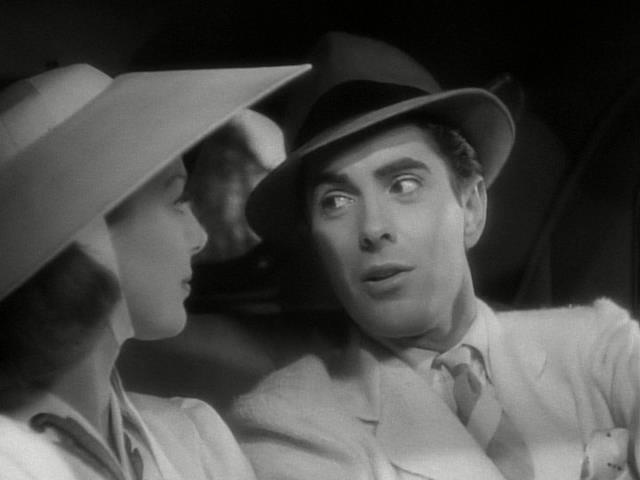
Diego Vega (Tyrone Power) returns to Los Angeles from Madrid and discovers that in his absence his elderly father (Montagu Love) has been unseated and a petty tyrant, Don Quintero (J. Edward Bromberg), is taxing the people to death and brutalizing the rebellious with the aid of nasty Captain Pasquale (Basil Rathbone). Diego's father is appalled by what his predecessor is doing but can't see himself fighting against the government, no matter how corrupt. Therefore Diego dons the mask of Zorro to fight his people's oppressor, and begins to act as a carefree, callous fop to avoid suspicion being focused upon him. This very good movie about one of the first masked "super-heroes" of sorts is fine entertainment, with smashing performances from all -- this is one of Power's best -- and an excellent sword fight between Power and Rathbone, who is also at his snarling best. Linda Darnell is lovely as the romantic interest and Gale Sondergaard splendid as Quintero's catty and unfaithful wife. Eugene Palette scores as the Padre, and there's a good scene when Power reveals his secret identity to the priest. Bromberg and Love are also in top form. Not as thrilling as the serial Zorro's Fighting Legion but much superior to Zorro Rides Again. 

 Verdict: Very entertaining classic. ***.

Thursday, November 26, 2020

GET HAPPY: THE LIFE OF JUDY GARLAND

GET HAPPY: THE LIFE OF JUDY GARLAND. Gerald Clarke. Dell/Random House. 2000.  

Here is another book that traces the life of the famous singer-actress in generally sympathetic fashion. Clarke looks at Garland's early life and her parents, her emergence as an MGM star, her struggles with diet and pills and more pills, her numerous affairs, marriages and divorces, and even her movies and concerts. There are some things in the tome that give one pause, however. The notion that Judy's mother, the homely Ethel Gumm, was trading sexual favors for consideration for her daughter, seems ludicrous, but to be fair Clarke says whether this is true or not "is impossible to say." Clarke is largely sympathetic to Judy's father, a theater owner, but there is a big difference between a man who is simply gay or bi and a married man who hits on teenage boys -- Clarke doesn't seem to get that if this was true the man was a predator. Clarke also seems too credible when presented with alleged evidence -- a letter -- that Tyrone Power was madly in love [!] with Garland. In those days (and even today) actors would have done anything to cover up even an inference of homosexuality. Clarke also states that Garland "occasionally enjoyed a frolic with another woman" but refuses to label her as bisexual -- huh? Still, Get Happy is well-written, and has some solid information to go with the more suspect material.

Verdict: Generally worthwhile if imperfect Garland bio. ***. 

Thursday, October 17, 2019

THE EDDY DUCHIN STORY

Tyrone Power and Kim Novak
THE EDDY DUCHIN STORY (1956). Director: George Sidney.

Eddy Duchin is a brash, talented pianist who comes from Boston to New York to play with a band, but discovers it's not as easy as he thought. Nevertheless he works his way up to becoming a bandleader (although how he does this is never quite shown). He also marries a socialite, Marjorie (Kim Novak), and the two have a son, Peter. Life seems wonderful for Eddy, but he doesn't know that there is more than one tragedy in his future.

Rex Thompson as Peter Duchin
The Glenn Miller Story (starring Jimmy Stewart) had already been filmed two years earlier, and eventually other musicians besides bandleaders, such as Gene Krupa, would get the biopic treatment. Although The Eddy Duchin story is heavily fictionalized with a lot of dramatic license, most of the basic facts of Duchin's life are presented unflinchingly, and in fact this is one "musical" that is quite depressing. There are many contrived, if moving, sequences in the film, such as one with Duchin bonding with a little Asian boy while in the service. Power's performance is good, but it's Hollywood acting, not the kind of consummate emoting that would signify a really great performance. Kim Novak is lovely and adept as Marjorie, and Rex Thompson is excellent as young Peter at about age ten. A sequence when Eddy has to give his son some particularly disturbing news has Thompson out-acting Power.

Victoria Shaw and Tyrone Power
Eddy Duchin also has a superior supporting cast, with James Whitmore as a club owner and loyal associate of Duchin's; Frieda Inescort and Shepperd Strudwick as relatives of Marjorie's who raise the boy; and Victoria Shaw [The Crimson Kimono] as Chiquita, another relative who befriends Peter and eventually becomes his mother. I wondered where Gloria Holden of Dracula's Daughter might be, then realized at the end that she had played  Eddy's mother (quite well by the way)! The film is greatly bolstered by a score by George Duning and especially Harry Stradling's superb widescreen cinematography.

One thing the film ignores, which might have contributed more drama to the screenplay, is that Duchin was Jewish, and Marjorie was bounced out of the social register when she married him.

Tyrone Power was 43 when he made this film, two years older than Duchin was when he died of leukemia. Power himself would be dead in two years. Even with make up and Hollywood lighting, Power, although still handsome, generally looks in his fifties or older.

Verdict: Moving if manufactured biopic with good performances and a beautiful and classy look to it, thanks to Harry Stradling. ***. 

Thursday, January 24, 2019

SECOND HONEYMOON

Loretta Young and Tyrone Power
SECOND HONEYMOON (1937). Director: Walter Lang.

Vicky Benton (Loretta Young of The Accused) and her second husband Bob (Lyle Talbot of Jail Bait) are on vacation in Florida when they run into Vicky's first husband, Raoul (Tyrone Power), who is still in love with her. Vicky has nagging feelings of affection for Raoul as well, but tries to suppress them. Then Bob is called to New York on business and Vicky stays behind. From the very first frame you know whom Vicky will wind up with, I mean -- Tyrone Power vs Lyle Talbot? If only the audience had been spared sitting through the 80 minutes that it takes for the two leads to realize whom they really wanted to be with.

Ty Power
Second Honeymoon aspires to be a frenetic screwball comedy, but the script is pedestrian, unfunny, and hopeless. Casting very, very skilled comic actors might have helped a bit, but Young, Power and Talbot are not highly skilled comic actors, although they certainly do the best they can with the material, and Talbot isn't quite as dull as usual. Surely Vicky had very good reasons for divorcing Raoul in the first place, but the movie glosses over them -- sex appeal triumphs as usual! Aside from a possible tendency to chase other women, second husband Bob doesn't seem that bad, at least not bad enough to deserve all the derision that is heaped upon him at the end. But he's not as good-looking as Power, so of course the film must make him the scapegoat.

Violet the raccoon goes a callin'
The film has only one laugh, and that is when Violet, Raoul's pet raccoon (given him by Bob) gets loose on an airplane and crawls curiously all over an old lady. Other actors trapped in this cinematic loser include Stuart Erwin as Raoul's valet; Claire Trevor (!) as Vicky's married friend, Marcia; and Marjorie Weaver as Joy, a personality-plus type gal who inexplicably marries Erwin. With her too-big lips and rather out-sized teeth, Young is definitely not as pretty as Power, but at least the raccoon is cute. The DVD of this is beautiful to look out, sharply remastered, but the movie is just pitiful. Mary Treen has a bit role as Joy's friend and co-worker. Walter Lang directed a great many much better movies, including Desk Set.

Verdict: One honeymoon too many. *. 

Thursday, November 13, 2014

TYRONE POWER EXHIBIT AT THE HOLLYWOOD MUSEUM


I got an email from Nicole Player, Manager of Media Relations & Operations at Weissman/Markovitz Communications:

Since you are an obvious fan of classic Hollywood, I wanted to forward you info about a new exhibit that might be of interest to your readers…

The Hollywood Museum, which houses the most extensive collection of Hollywood memorabilia in the world, is celebrating matinee idol TYRONE POWER’s centennial birthday year with a huge exhibit, opening this Friday, November 14. Tyrone Power was a huge heartthrob back in the 30s-50s and he has a huge following among classic Hollywood buffs like yourself.


NOTE: Some of Power's most memorable performances can be seen in Witness for the ProsecutionSon of Fury, The Mark of Zorro, Diplomatic Courier, Day-Time Wife, and Nightmare Alley.

 And here is the press release with lots of details:
 
Hollywood, CA, November 5, 2014 - The Hollywood Museum debuts “Tyrone Power: Man, Myth & Movie Idol,” celebrating Tyrone Power, sexy stage and screen idol of the 30’s, 40’s and 50’s, and his centennial birthday year with an intimate retrospective curated in collaboration with his son, Tyrone Power, Jr. This special exhibition will take an ‘inside’ look at the life, passions and career of the handsome star of more than 50 films, best known for his swashbuckler roles, romantic leads and striking good looks. The exhibit is on display November 14 through January 11, 2015, at The Hollywood Museum in the Historic Max Factor Building located at 1660 N. Highland Ave. at Hollywood Blvd.

Power was one of the top male sex symbols of Hollywood's golden era, from 1936 to 1958. He became an overnight sensation at just 22 years old and made more than 50 films during his career. Six months after his breakout role in Lloyd's of London (1936), his hand and footprints were memorialized in cement at Grauman's Chinese Theatre. Power was nicknamed "King of the Movies" by his fans and was also recognized as “King of the Fox Lot” (20th Century Fox Studios).

“We are delighted to spotlight one of Hollywood’s greatest legends and heartthrobs whose star talents transcended motion pictures, radio, live theater and television,” said Donelle Dadigan, Founder and President of The Hollywood Museum.

The “Tyrone Power: Man, Myth & Movie Idol” exhibition explores Power’s personal life including many illustrious romances, three marriages and three children. The comprehensive collection includes never before displayed items gathered from family, friends, private collectors and The Hollywood Museum archives.

Highlights of the Exhibition includes:

Costumes worn by Power include the iconic matador “suit of lights” from Blood and Sand (1941); embroidered pants from The Mark of Zorro (1940); black tailcoat with silver buttons from Son of Fury: The Story of Benjamin Blake (1942); black hat with red feathers from Captain from Castile (1947); navy suit from The Luck of the Irish (1948) and much more.

Costumes worn by Power’s co-stars include a black gown worn by Maureen O’Hara in The Long Gray Line (1955), a pink brocade gown worn by Wanda Hendrix in Prince of Foxes (1949), a crème silk with fur trim jacket and gown worn by Gene Tierney in That Wonderful Urge (1948), a red sequin costume worn by Coleen Gray in Nightmare Alley (1947), a chartreuse ball gown from Marie Antoinette (1938) starring Norma Shearer; a vest worn by Don Ameche in In Old Chicago (1937) among many others.

Behind the Scenes in Hollywood include Power’s silk brocade dressing gown; personal mementos and photos provide a private look at Power’s many romances, three marriages, cars, friends and family.

Hollywood History - Power kept a copy of scripts from all of his movies. The exhibit includes scripts from The Razor’s Edge (1946), Blood and Sand (1941) and three 1937 films: Thin Ice, Love Is News and In Old Chicago. This collection also includes lobby cards, posters, press kits, press books and sheet music from songs in his many films.


Collectors include
Tyrone Power, Jr., Taryn Power, Romina Power, Maria Ciaccia, Debbie Beno, Cindra Reaume Webber and The Hollywood Museum Archives.

For Exhibit Photos: Click here

ABOUT TYRONE POWER:
Power appeared in a wide variety of film genres, from musicals to comedies, from westerns and swashbucklers, to dramas, showing a remarkable acting range. Before he made it in Hollywood, Power began his career on Broadway, mentored by stage actress Katharine Cornell. Scouts spotted him in a play and he was signed by 20th Century-Fox, becoming their top leading man for many years. He worked with most of the famous actors and directors of his time, including directors such as King Vidor, and actors Humphrey Bogart, Raymond Massey, Jeanne Crain, Alice Faye, Al Jolson, Cesar Romero, George Sanders, Loretta Young and Lana Turner, with whom he had a well-publicized romance in 1946. He also had liaisons with Judy Garland and Mai Zetterling.

Power took time out of his career to serve his country as a U.S. Marine Corps pilot in World War II, flying wounded soldiers out of Iwo Jima and Okinawa. His father, actor Tyrone Power, Sr., died in the arms of his son while on a film set. Power Jr.’s own life was cut short at the age of 44 when he had a heart attack on the movie set of Solomon and Sheba (1959). Actor Yul Brynner replaced him in the film. During his career, Power turned down a number of powerful roles including Burt Lancaster’s role in From Here to Eternity (1953) and Richard Burton’s lead role in The Robe (1953).

ABOUT THE HOLLYWOOD MUSEUM IN THE HISTORIC MAX FACTOR BUILDING:
The Hollywood Museum in the Historic Max Factor Building houses over 10,000 real showbiz treasures and the most extensive collection of Hollywood costumes, star cars, props, posters, photographs and memorabilia in the world showcasing more than 100 years of Hollywood history. Discover the glamour of old Hollywood from Mary Pickford and Douglas Fairbanks to Marilyn Monroe, Joe DiMaggio and Elvis Presley. Experience the excitement of today’s Hollywood stars from Brad Pitt and Angelina Jolie, to Leonardo DiCaprio, J. Lo, Miley Cyrus, George Clooney among many others. The Hollywood Museum is also home to Max Factor's world-famous makeup rooms where Marilyn Monroe became a blonde and Lucille Ball first donned her signature red hair. Exhibitions spotlight Marilyn Monroe: The Exhibit, Hannibal Lecter's jail cell movie set from The Silence of the Lambs The historic photo gallery and the official walk of fame exhibit. The Hollywood Museum is a 501(c)(3) non-profit corporation.

Location
: 1660 N. Highland Ave. (at Hollywood Blvd). Hollywood, CA 90028
Hours: Wednesday - Sunday, 10am - 5pm
Tickets:
General admissions $15, $12 for students and seniors; and $5 for children five and under.
Museum information: (323) 464-7776 | The Hollywood Museum

Follow the museum on Facebook, Twitter and Instagram

MEDIA CONTACT:
Cheri Warner l Weissman/Markovitz Communications I cheri@publicity4all.com l 818.760.8995
 

Thursday, December 12, 2013

DAY-TIME WIFE

Ty Power and Linda Darnell
DAY-TIME WIFE (1939). Director: Gregory Ratoff.

"That's marriage -- if you're happy there's nothing better; if you're unhappy there's nothing worse."

Jane Norton (Linda Darnell) fears she's losing her husband, Ken (Tyrone Power), when he spends too many late nights at the office with his attractive secretary, Kitty (Wendy Barrie). This somehow gives Jane the unlikely notion of becoming a secretary herself so she can ferret out the secret of their appeal to men. So she goes to work for horny old devil Bernard Dexter (Warren William), who is also married but has quite an eye for the ladies. Jane at first refuses Dexters' invitation to dinner, but when Ken cancels plans to take Jane out for the evening, she decides to go with Dexter -- and who shows up in the supper club as their dining companions but Ken and his secretary! Oops -- what a situation. Day-Time Wife may never go down in history as one of the cinema's most brilliant comedies, but it is an awfully cute picture, with both Darnell and Power in top form [and both very charming], and is consistently amusing to boot. Barrie, William, Binnie Barnes as Jane's best friend, Blanche, and Joan Davis as Miss Applegate, who also works for Dexter but isn't pursued by him, lend expert support, as does Mildred Gover as the maid Melbourne. Amazing that this was only Darnell's second picture.

Verdict: An insubstantial but very amusing confection with wonderful leads. ***.

Thursday, July 4, 2013

GIRLS' DORMITORY

Simone Simon and Herbert Marshall
GIRLS' DORMITORY (1936). Irving Cummings.

"A boy who is graduating is just a boy, but a girl who is graduating stands before you a full-fledged woman."

Professor Anna Mathe (Ruth Chatterton) has been helping Dr. Stephen Dominik (Herbert Marshall), director of a girl's school, with a book project, and is secretly carrying a torch for him. She gets unexpected competition from Marie Claudel (Simone Simon), a pretty 19-year-old student at the school, who is also in love with the middle-aged Professor Dominik. When Professor Augusta Wimmer (Constance Collier, in a most unsympathetic role) finds a love letter Marie wrote to an unknown man in a waste basket, she convenes a council to determine if Marie should graduate. Wimmer and another male professor think her behavior -- they believe she had a rendezvous with this man -- is scandalous and brings disfavor to the school, while two other professors think they are making too much of a school girl's infatuation. As one of them puts it, "my mother was married and had two children at Marie's age." Anna and Stephen are both sympathetic to the girl. The simple story is okay, but it's the acting from all concerned, especially Simon [in her first American film] and Marshall, that put this over. [Not to give away the ending, but if this movie has a moral it's that men like 'em young.] Chatterton (Dodsworth) is not photographed at all flatteringly in this, but her warm, self-sacrificing character is not meant to be glamorous. Tyrone Power shows up very late in the picture as Marie's handsome cousin. John Qualen is a likable if rather outspoken hand around the school, and others in the cast include J. Edward Bromberg and Dixie Dunbar.

Verdict: So-so romance with good performances. **1/2.  

Thursday, April 11, 2013

THE RAZOR'S EDGE (1946)

Tyrone Power at the height of his good looks
THE RAZOR'S EDGE (1946). Director: Edmund Goulding.

Larry Darrell (Tyrone Power) is engaged to wealthy Isabel Bradley (Gene Tierney), who wants Larry to get a good job and make money. But Larry is seeking something other than mere materialism in his life, so instead of marrying Isabel he goes off to find himself in India. Observing, commenting and interacting with the others is Somerset Maugham himself (Herbert Marshall), who wrote the novel upon which the film is based. Other major characters include Isabel's uncle, Elliot Templeton (Clifton Webb) -- of Larry he says, "my feeling is he's living in the Latin Quarter with some 'bint' who's no better than she ought to be" -- and Sophie MacDonald (Anne Baxter), whose life becomes embroiled in tragedy upon tragedy. As a fairly obvious Christ figure (although in some ways Larry comes off more like an unambitious schmo), Power is adequate, but his insufficiency shows up in such scenes as when he reacts [or doesn't] to sad news about Sophie; he's hardly ever looked more handsome, however. The best performances come from a poignant Anne Baxter and from an especially superb Webb, who etches a fascinating portrait in his personification of the snobbish but likable Templeton, but Tierney and Marshall are also effective, along with Lucile Watson [Templeton's sister] and Elsa Lanchester in smaller roles. John  Payne has a fairly good part and is fine, although out-classed by the rest of the cast. At one point Maugham remarks that Templeton is "sitting pretty" -- Webb would appear in the famous film of that title two years later -- to which Templeton replies: "that is an American colloquialism, which you British seem to use, but which describes my state accurately." In addition to its over-length, The Razor's Edge has underdeveloped supporting characters whose fates never have the impact they're supposed to, and the movie never seems to get anywhere. Still, Webb and Baxter make it worth watching.

Verdict: Entertaining, in spite of itself. ***.

Sunday, May 25, 2008

THE SECRET LIFE OF TYRONE POWER

THE SECRET LIFE OF TYRONE POWER. Hector Arce. William Morrow. 1979.

Almost thirty years old, this is still a fairly interesting bio of the movie star, and is a good read, despite some questionable passages. Arce provides details about the life and career of Power's actor-father, Tyrone Power, Sr., and goes behind the scenes of some of his movies (there isn't much picture analysis, although Arce does explain why the films worked or not, and why they were or were not good choices for Power). There is a great deal about Power's private life as well, including his three marriages, and affairs with both men and women. There are some dated aspects to the discussion of Power's bisexual, and possibly homosexual, nature (some of his male lovers, who are quoted, felt that Power was an essentially homosexual man whose marriages and relationships were a cover-up and to keep his career from imploding). Some of the people Arce interviewed, however, such as a bisexual male prostitute still plying his trade in his fifties (!), are rather suspect. Whatever the facts, Power was a big star, and appeared in several memorable movies. This book can be recommended for a basic rundown of his life and career, but take it with a grain of salt. Whatever the truth of Power's sexuality, it shouldn't make a difference to his fans.

Verdict: Not bad if not the final word. ***.

Thursday, May 1, 2008

THIS ABOVE ALL


THIS ABOVE ALL (1942). Director: Anatole Litvak.

Prudence Cathaway (Joan Fontaine) appalls her snooty uppercrust British family by enlisting in the WAF during WW 2. She meets and falls in love with a bitter, disillusioned soldier, Clive Briggs (Tyrone Power), who has come to feel he's only fighting to preserve the unfair and hypocritical class structure -- although Prudence argues that the Germans must be defeated (oddly the term Nazi is never used. The film probably started production before the U.S. entered the war). Briggs has decided that he's going to be a deserter no matter what the consequences. This Above All (to thine own self be true) has some uncompromising attitudes in its depiction of Briggs, but the first half is superior to the second half. Once Prudence learns Briggs' secret, the picture veers a bit from romance into soap opera and becomes jingoistic. The business with Briggs encountering an unctuous priest who sets him straight is tiresome. However the performances are good and Alfred Newman's sensitive musical score embellishes every sequence. Fontaine is lovely in the film, although some may feel that she's borderline cloying at times. Power's performance is not so much great as rigorously earnest. Gladys Cooper is snippy and exact as Prudence's disapproving Aunt, and Nigel Bruce is excellent -- and nearly unrecognizable -- in the character part of an inn owner that is quite different from his Watson in the Sherlock Holmes movies. Certain scenes, such as a bar scene with melancholy songs, are imbued with the brave, sad, hopeless atmosphere of London during the Blitz, and an Air Raid sequence is chilling and well-done.

Verdict: Compelling if imperfect romance. ***.

Wednesday, April 23, 2008

THIN ICE


THIN ICE (1937). Director: Sidney Lanfield.

An entire Swiss village is excited to learn -- erroneously -- that Lili Heiser (Sonja Henie) is dating the handsome Prince Rudolph (Tyrone Power). Ironically, not much later Lili does meet the prince, who's incognito, but doesn't realize the man she eventually falls in love with (and vice versa) is the famous Prince. Therefore she's quite upset to learn that everyone thinks she's dallying with Prince Rudolph. That's the thin premise of this disappointing comedy that has few if any laughs, even with the presence of Joan Davis as an orchestra leader. Tyrone Power displays his usual charm and ability, but while Henie is cute and appealing in some ways, she's not much of an actress and certainly no gifted comedienne. Arthur Treacher plays Power's manservant. Pretty boring to be honest.

Verdict: Unless you're crazy for ice skating, you can miss it. *1/2.

Tuesday, March 25, 2008

DIPLOMATIC COURIER


DIPLOMATIC COURIER (1952). Director: Henry Hathaway.

With his customary assurance and suaveness, Tyrone Power plays a diplomatic courier who winds up mired in intrigue in Trieste and caught between two fascinating women, Joan (a very sexy Patricia Neal) and Janine (Hildegard Knef/Neff), both of whom have their secrets. A friend and associate of Power's is killed on a train, and various Cold War factions are after a list of secret info that, if acquired by the Americans, might save thousands of lives. Stephen McNally and Karl Malden are, respectively, a Colonel and Captain who seem ready and willing to throw Power and everyone else to the wolves. The finale has Power going against orders and attempting to save the life of one of the aforementioned ladies. This is an interesting, well-acted, fairly suspenseful spy story with great settings and a fast pace. Neal is sassy; Knef proves a fine actress and she deserved a bigger career.

Verdict: Entertaining, well-acted and unpredictable. ***.

Tuesday, March 11, 2008

NIGHTMARE ALLEY


NIGHTMARE ALLEY (1947). Director: Edmund Goulding


Tyrone Power gives one of his best performances as Stanton Carlisle, a young man who works for a carnival and inadvertently contributes to the death of an alcoholic co-worker, Pete (Ian Keith). Stan winds up performing a mind-reading act with his wife Molly (Coleen Gray), giving him gullible high society contacts and getting him into business with shady psychiatrist Lilith Ritter (Helen Walker, pictured with Power). This is an absolutely fascinating movie with interesting twists and turns and a powerful, if not entirely unexpected, wind-up (which is somewhat reminiscent of The Crowd). The supporting cast is splendid, with Joan Blondell excellent as Zeena, Pete's partner, and Helen Walker offers a diabolical portrait as the utterly amoral Lilith. There's a terrific scene when Power uses his skill to both charm and undermine an angry Marshall (a splendid James Burke) who's out to shut the carnival down. Well-directed by Edmund Goulding.

Verdict: A crackling good yarn. ***1/2.

Wednesday, March 5, 2008

BRIGHAM YOUNG


BRIGHAM YOUNG (1940). Director: Henry Hathaway.

This story of the Mormons dealing with persecution and traveling to find a new home is surprisingly entertaining and exceedingly well-made with some striking photography and adroit editing. An initially unrecognizable Dean Jagger is quite good as the self-appointed Mormon leader, and he gets some fine support from the likes of Vincent Price (as Joseph Smith, who understandably wants the Mormons to arm themselves), John Carradine, Brian Donlevy, and Mary Astor as one of Young's wives. Tyrone Power gives one of his more memorable performances as Jonathan, a young Mormon, and Linda Darnell is effectively sweet as the non-Mormon he falls in love with. As always, Jane Darwell scores as Power's mother. The film milks a lot of drama out of the persecution and troubles of the Mormons. The raids on Mormon farms which open the film with assorted shootings and whippings is chilling, and a large amount of suspense is generated by the scene in which the Mormons rush to traverse a frozen river before their tormentors can catch up to them. Joseph Smith's brutal death at the hands of a mob whose bullets force his body out of a second story window is memorable. By the time the Mormons must try and beat off a horde of hungry crickets eating their grain, you may think the picture will do just about anything to drum up some drama, but even this sequence is exciting, as is the timely intervention of a huge flock of seagulls to eat the crickets. The movie has to be taken with a grain of salt, but to its credit it doesn't cram religion down your throat and it isn't an advertisement for the Mormon faith. Although the polygamous aspects of Mormonism are played down, there are some generally amusing references to it, and we see Young with more than one wife on at least one occasion. NOTE: the film is titled Brigham Young, Frontiersman on video.

Verdict: Quite entertaining. ***.

Tuesday, March 4, 2008

SON OF FURY


SON OF FURY (1942) Director: John Cronwell.

Tyrone Power gives a highly effective "star" performance as Benjamin Blake who is born in England during the reign of George III. His evil Uncle Arthur (George Sanders) takes him away from his poor but loving grandfather (Harry Davenport) only to turn him into a servant on the huge estate that by rights should belong to him! Wanted by the authorities for the attempted slaying of Arthur, Benjamin sails to the south seas and swims to an island which a buddy Caleb (John Carradine) has told him is full of a fortune in pearls. There he meets an island beauty he christens Eve (Gene Tierney) while back home his cousin Isabel (Frances Farmer), whom he loves, wonders if he's alive or dead. Back in England the now-rich Benjamin still finds he has to fight duplicity and betrayal to finally claim his birthright. This is a rousing, handsomely produced, entertaining adventure story with fine performances, solid direction from Cromwell, and an evocative, excellent score from Alfred Newman. Elsa Lanchester has a nice bit as a prostitute who hides Ben out while he's on the run. George Sanders is at his oily, sinister best. But Tyrone Power's presence and authority add immeasurably to the picture's dramatic veracity.

Verdict: Great fun! ***.