Lively, entertaining reviews of, and essays on, old and newer films and everything relating to them, written by professional author William Schoell.
Showing posts with label Walter Lang. Show all posts

Thursday, May 11, 2023

WHEN MY BABY SMILES AT ME

Betty Grable
WHEN MY BABY SMILES AT ME (1948). Director: Walter Lang. 

Burlesque performers Bonny Kane (Betty Grable) and her husband Skid Johnson (Dan Dailey) have dreams of the big time when they learn that Skid has been offered a big part in a Broadway show. Bonny is happy with her husband's advancement but she isn't thrilled when she learns he'll be performing with her rival, a predatory blonde named Sylvia (Jean Wallace of The Big Combo). Skid has a more serious problem than Sylvia and that's his love of liquor. Will Bonny succumb to the charms of admirer and rich rancher Harvey Howell (Richard Arlen) or will she be able to overlook her husband's peccadilloes? And will Skid wind up in Bellevue's dipsomaniac ward or back on Broadway? 

Dan Dailey and Betty Grable
Although many might consider this another Betty Grable Musical and she is very good in the picture the fact remains that this is Dan Dailey's show from start to finish. Dailey earned a Best Actor Oscar nomination for his strong and demanding turn as the frustrated, sad, and alcoholic Skid, and he delivers in every scene, the charming ones as well as the more difficult moments. He gets good support from such cast members as June Havoc (of My Sister Eileen) and Jack Oakie (of Million Dollar Legs) as another burlesque team, James Gleason as theater owner Lefty Moore, and Arlen and Wallace. Betty isn't showcased all that well in a weird torch number in which her movements are more strange than sexy, but she does a nice job with a pretty new number entitled "By the Way." This is the third version of a play entitled "Burlesque," so there are plenty of cliches on hand, but the picture is smoothly directed, photographed in beautiful technicolor, and despite its dramatic moments, is colorful fun. I'll leave it to individual viewers to decide if the ending is a happy one or not. Dailey does an imitation of Ted Lewis at one point and Jack Oakie does Al Jolson.  

Verdict: Dailey's fine performance gives this show biz drama some heft. ***.  

Thursday, February 2, 2023

STAR DUST

A waiting game: John Payne and Linda Darnell
STAR DUST  (1940). Director: Walter Lang.

Thomas Brooke (Roland Young) was once a leading man in silent movies but now is a talent scout for Amalgamated Pictures and his boss Dane Wharton (William Gargan). Brooke sends two hopefuls to Hollywood -- college football star Ambrose Fillmore, better known as "Bud" (John Payne), and singer Mary Andrews (Mary Healy) -- but he fears that Carolyn Sayres (Linda Darnell) is too young, Convinced she has talent, Carolyn goes behind Brooke's back and writes to Wharton on her own, therefore there are three new candidates for stardom who wait anxiously outside Wharton's office after filming their screen tests. It may be surprising which if any of the three will be offered a contract. 

"Secrets in the Moonlight:" John Payne sings 
Star Dust
 was loosely based on Linda Darnell's life, as she was also told she was too young to work in movies. The rest is pure fiction, of course. There are those who will tell you that Darnell wasn't much of an actress but I have to disagree, as she does some very good work in this and in other films. John Payne, one of the handsomest leading men in Hollywood, could actually sing and you can hear him doing a very nice rendition of "Secrets in the Moonlight." He also gives a smooth and charming performance. Mary Healy, who married Peter Lind Hayes, is a bit too odd-looking to be attractive and has a voice that is way too deep without being sexy. She is best-known for The 5000 Fingers of Dr. T

A face meant for radio? Mary Healy
Roland Young of Topper fame is splendid, as is Charlotte Greenwood as his colleague, the acting coach for Amalgamated's young hopefuls. Donald Meek scores as one of Young's rivals at the studio, as does Mary Beth Hughes as a contract actress, June Lawrence, who acts snotty with Carolyn and gets her comeuppance. George Montgomery plays an actor who has learned that the studio dropped his option, and Robert Lowery is another actor who came out to Hollywood and wound up just another bellboy. Jessie Ralph and Irving Bacon each have a couple of good scenes as, respectively, Carolyn's non-nonsense aunt and the clerk at a small college town hotel. At one point 21-year-old Bud gives a big smooch to 16-year-old Carolyn, which is not seen as anything significant in 1940 but today would get a guy arrested! (Payne was actually 28 and Darnell 17.) 

Verdict: Snappy and entertaining musical comedy with some basic truths about Hollywood. ***.  

Thursday, January 24, 2019

SECOND HONEYMOON

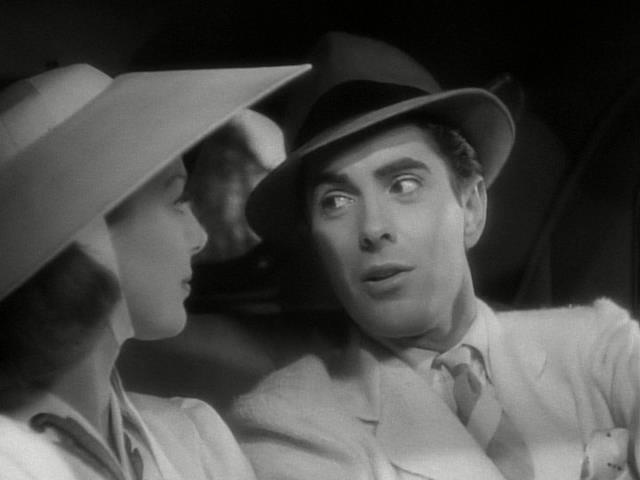
Loretta Young and Tyrone Power
SECOND HONEYMOON (1937). Director: Walter Lang.

Vicky Benton (Loretta Young of The Accused) and her second husband Bob (Lyle Talbot of Jail Bait) are on vacation in Florida when they run into Vicky's first husband, Raoul (Tyrone Power), who is still in love with her. Vicky has nagging feelings of affection for Raoul as well, but tries to suppress them. Then Bob is called to New York on business and Vicky stays behind. From the very first frame you know whom Vicky will wind up with, I mean -- Tyrone Power vs Lyle Talbot? If only the audience had been spared sitting through the 80 minutes that it takes for the two leads to realize whom they really wanted to be with.

Ty Power
Second Honeymoon aspires to be a frenetic screwball comedy, but the script is pedestrian, unfunny, and hopeless. Casting very, very skilled comic actors might have helped a bit, but Young, Power and Talbot are not highly skilled comic actors, although they certainly do the best they can with the material, and Talbot isn't quite as dull as usual. Surely Vicky had very good reasons for divorcing Raoul in the first place, but the movie glosses over them -- sex appeal triumphs as usual! Aside from a possible tendency to chase other women, second husband Bob doesn't seem that bad, at least not bad enough to deserve all the derision that is heaped upon him at the end. But he's not as good-looking as Power, so of course the film must make him the scapegoat.

Violet the raccoon goes a callin'
The film has only one laugh, and that is when Violet, Raoul's pet raccoon (given him by Bob) gets loose on an airplane and crawls curiously all over an old lady. Other actors trapped in this cinematic loser include Stuart Erwin as Raoul's valet; Claire Trevor (!) as Vicky's married friend, Marcia; and Marjorie Weaver as Joy, a personality-plus type gal who inexplicably marries Erwin. With her too-big lips and rather out-sized teeth, Young is definitely not as pretty as Power, but at least the raccoon is cute. The DVD of this is beautiful to look out, sharply remastered, but the movie is just pitiful. Mary Treen has a bit role as Joy's friend and co-worker. Walter Lang directed a great many much better movies, including Desk Set.

Verdict: One honeymoon too many. *. 

Thursday, August 31, 2017

SNOW WHITE AND THE THREE STOOGES

Stooges
SNOW WHITE AND THE THREE STOOGES (1961). Director: Walter Lang.

The evil queen (Patricia Medina) imprisons her stepdaughter, Snow White (Carol Heiss), because the queen's mirror tells her she is the more beautiful of the two. Meanwhile Prince Charming (Edson Stroll) was banished as a boy and is now a traveling player with his adoptive fathers, the Three Stooges (Joe DeRita, Larry Fine, Moe Howard), who also sell the tonic "Yuk.". When the prince discovers who he is, he determines to rescue the princess and gain back his kingdom, but the queen and Count Oga (Guy Rolfe) may put a crimp in his plans. Snow White and the Three Stooges is a very odd Stooges feature, in that there's not much of their trademark shtick, and the movie is more or less played straight! True, there have been plenty of comedies where the comedians mug while the other cast members play it seriously, but the Stooges normally made farcical films and in a lot of this picture there is not even an attempt to garner laughs. Carol Heiss was an Olympic-class figure skater -- a skating sequence is the highlight of the movie -- but while she's perfectly competent in this she only made one movie. Edson Stroll [The Three Stooges in Orbit] makes an excellent Prince Charming; Medina [The Magic Carpet] is nastily effective (as the queen), as is Rolfe [Mr. Sardonicus]; and there are also roles for Marie Blake as a nursemaid; Buddy Baer as a soldier; Edgar Barrier as the briefly-seen king; and Mel Blanc as the voice of the puppet, Quinto. The Stooges aren't given enough to do and the film is less of a parody than a rather dark fantasy film. The stooges have no problem capably handling the more "dramatic" scenes. Kids were probably bored long before the halfway mark; I was. The songs by Harry Barris  are vaguely pleasant but undistinguished. This is one of several sixties films the Stooges made when their careers were revived by television showings of their older short comedies.

Verdict: Not awful, but not the best of the Stooges, either. **1/2.

Thursday, July 27, 2017

ON THE RIVIERA

Gene Tierney and Danny Kaye 
ON THE RIVIERA (1951). Director: Walter Lang.

Entertainer Jack Martin (Danny Kaye) works on the Riviera with his girlfriend, Colette (Corinne Calvet), but he is told by club manager Gapeaux (Sig Ruman) that he is through unless he comes up with a catchier act. Jack decides to do his impression of married playboy and famous pilot Henri Duran (also Kaye) who looks just like him. To keep a business deal from collapsing along with their careers, associates of Duran importune Jack to pretend to be Duran while he is out of town, causing complications involving Colette and Duran's wife, Lili (Gene Tierney). This is a remake of That Night in Rio (itself a remake of a French film), and it has one insurmountable problem. Why do a remake unless it is an improvement over, or distinctly different from, the original? This version adds Technicolor and a few weak songs by Sylvia Fine (Kaye's wife) that you forget even as you're listening to them. Another problem is that On the Riviera casts competent but essentially unknown French actors in smaller roles instead of the flavorful and more familiar character actors that usually pepper and add enjoyment to these films. Kaye is okay, but has been seen to better advantage in other vehicles. Corinne Calvet [So This is Paris] is gorgeous and capable, as is Gene Tierney [The Pleasure Seekers]. Clinton Sundberg [The Kissing Bandit] plays the taciturn butler, Antoine, in his usual effective style. Jean Murat is Felix Periton, with whom Duran wants desperately to do business. Kaye does so-so impressions of Maurice Chevalier and Carmen Miranda, both of whom starred in previous versions.

Verdict: One dip in the well too many. **.

Thursday, July 20, 2017

MEET THE BARON

Edna May Oliver puts Ted Healy and his Stooges in line
MEET THE BARON (1933). Director: Walter Lang.

"I know I'm not good-looking, but what's my opinion against thousands of others." -- Jimmy Durante.

Two men (Jack Pearl, who is not given a name, and Jimmy Durante as "Joe McGoo") are lost in the jungles of Africa when they encounter Baron Munchausen (Henry Kolker of The Crash), who takes all of their water supply and abandons them. Jack and Joe are rescued, and the former is mistaken for the real Munchausen, and hailed as a hero. The two men are brought to Cuddle College where "Munchausen" is to lecture, and they meet the upstairs maid Zasu (Zasu Pitts of Let's Face It), janitor Ted Healy and his Stooges, and Dean Primrose (Edna May Oliver). All is well until the real Baron Munchausen shows up ... Jack Pearl had done his turn as the baron on the radio (and was still doing it on Jackie Gleason's show in the early sixties), but while he's a competent performer, he isn't that funny and his film career never amounted to much. It's easy to see why the Three Stooges (Moe Howard, Curly Howard, and Larry Fine) dumped the completely unimpressive Ted Healy, their nominal leader, and branched out on their own; nevertheless Healy did quite a few movies after Meet the Baron. Zasu Pitts is Zasu Pitts, but the film is stolen by an absolutely excellent comic performance by Edna May Oliver [Lydia], who can put those stooges in their places! A highlight is the MGM Girls doing the production number "Clean as a Whistle," not to mention the smashing final gag.

NOTE: It took me long enough to realize it, but I have been continuously misspelling Zasu Pitts name as Zazu with a "z" when it's Zasu with an "s," for shame! If only the damned lady hadn't appeared in so many movies reviewed on this blog! I have corrected some of the earlier reviews, but you'll probably still come across the misspelling now and then. Let's hope I get it right in the future, Zasu!

Verdict: Minor, but cute, comedy with enthusiastic players. **1/2.

Thursday, August 4, 2016

STATE FAIR (1945)

Dana Andrews and Jeanne Crain
STATE FAIR (1945). Director: Walter Lang.

The Frake family head for the Iowa state fair with a variety of goals: Father Abel (Charles Winninger) wants his boar, Blueboy, to win a prize; mother Melissa (Fay Bainter) also wants to win a ribbon for her mincemeat; restless daughter Margy (Jeanne Crain) has spring fever and is hoping to meet someone more exciting than her fiance, Harry (Phil Brown of Obsession); and son Wayne (Dick Haymes) just seems to want to have fun. Margy meets a newspaperman named Pat (Dana Andrews), who tells her he'll just disappear if if doesn't work out with her, and Wayne encounters singer Emily (Vivian Blaine), who has a little secret. Frankly, the romantic aspects of the movie are a little lopsided -- who really falls sincerely in love in two days? -- and the siblings blow off their respective beaus with casual, if not heartless, ease, but this is standard stuff for the period and since everything is just a framework for some excellent Rodgers and Hammerstein tunes, it doesn't really matter. "Spring Fever," "That's For Me," "I Owe Iowa" are all fine numbers, but the best songs are Haymes [Irish Eyes are Smiling] and Blaine's zesty delivery of "Isn't It Kind of Fun?" and the movie's best song, the beautiful "It's a Grand Night for Singing," a classic Rodgers melody. State Fair was not based on a Broadway show but on the first State Fair film, a non-musical starring Will Rogers made in 1933, although Oscar Hammerstein II wrote the screenplay for this remake (just as he did the librettos for their stage musicals). The acting in this is uniformly excellent, with Donald Meek nearly stealing the picture as a judge who gets drunk on Melissa's brandy-soaked mincemeat. Percy Kilbride scores as the Frakes' pessimistic neighbor, as do Jane Nigh, Harry Morgan, and William Marshall [The Phantom Planet] in smaller roles. Remade in 1962; both versions are in color.

Verdict: As stories go, this is not exactly The King and I, but the performances are good and the songs are all lilting and memorable. ***.

Thursday, June 16, 2016

THERE'S NO BUSINESS LIKE SHOW BUSINESS

The technicolor finale of There's No Business ...
THERE'S NO BUSINESS LIKE SHOW BUSINESS (1954). Director: Walter Lang.

Molly Donahue (Ethel Merman) and her husband Terence (Dan Dailey) are long-time vaudevillians who have three children who join their act: girl-happy Tim (Donald O'Connor); pretty Katy (Mitzi Gaynor); and jazz baby Steve (Johnnie Ray), who actually prefers to enter the priesthood. Tim falls hard for a sexy lady named Vicky (Marilyn Monroe), but a misadventure with her sends him running off from a role in a Broadway show on the eve of WW 2. Is this the end of the Five Donahues? Aside from the title tune (which actually comes from Annie Get Your Gun), you'd be surprised that the music is by Irving Berlin, as the new numbers are pretty terrible and the older ones are ruined by inappropriately jazzy arrangements. As Steve, Johnnie Ray over-sings everything and makes faces, and his rendition of "Alexander's Ragtime Band," which he butchers, has to be seen to be believed. Ray also delivers the pious "If You Believe" (while mimicking Elvis' movements!) while the Adorable One -- La Monroe -- sexes up "Tropical Heatwave" in her inimitable style, although she's dubbed by Delores Gray and the number is otherwise not especially memorable. Although Monroe isn't quite up to her more "serious" scenes, she's positively luminescent in this and delivers her comedy sequences with her usual panache. As for the rest of the cast, Merman is terrific, with fine support from Dailey, Gaynor [The Joker is Wild] and O'Connor; Ray is fairly pleasing when he isn't singing. Hugh O'Brian [Rocketship X-M] shows up briefly as a theater man who falls for Katy; Robin Raymond [The Glass Wall] is the crude Lillian, who dates Tim; and Chick Chandler and Lee Patrick hardly get any lines as a couple of old vaudevillians at the Donahues party. The ending is nicely sentimental, and the last production number is a positive riot of brilliant technicolor.

Verdict: It would be all too easy to quibble about this picture's general mindlessness and often hokey numbers, but it all plays in spite of it. ***.

Thursday, December 27, 2012

CHEAPER BY THE DOZEN

CHEAPER BY THE DOZEN (1950). Director: Walter Lang.

Inspired by real events, this film takes a serio-comic (mostly comic) look at the Gilbreth family, which consists of father Frank (Clifton Webb), wife Lillian (Myrna Loy), and eleven children with a twelfth on the way. Ann (Jeanne Crain), the oldest, wants to join her peers in wearing modern fashions and make up, which her father, a bit of an old poop at times, rails against. The film misrepresents Planned Parenthood with a dumb scene in which Mildred Natwick plays a representative of the organization who finds Gilbreth and his brood "disgusting" -- although the sequence when he has all the children (and his own) tonsils removed in the living room is a little strange as well. Webb is fine as the virile husband, but Loy gives an odd, once-removed performance, as if telling the world that this drab, matronly character is definitely not the real Myrna Loy. Crain and Betty Lynn as Deborah are better, but the picture is nearly stolen by talented little Jimmy Hunt as their mischievous brother, Billy. Cheaper by the Dozen is pleasant and entertaining. Steve Martin did a farcical remake many years later. Followed by Belles on Their Toes.

Verdict: Anything with Webb in it ... ***.

Tuesday, January 22, 2008

CALL ME MADAM


CALL ME MADAM (1953). Director: Walter Lang.

Entertaining if minor adaptation of Irving Berlin musical stars a vibrant Ethel Merman as Sally Adams, who becomes ambassador to the Duchy of “Lichtenbourg” (Adams thinks that “Duchy” means that the people are Dutch!) She falls hard for General Cosmo Constantine, who is very well played by George Sanders. The delightfully irritable Billy DeWolfe is annoyed by Adams' usurping of his power so he causes trouble any way he can, while her young press attaché (Donald O'Connor) finds himself falling for the princess (Vera-Ellen) who is betrothed to a handsome sourpuss (Helmut Dantine). It all works out okay in the end, of course. Merman and Sanders are a rather odd pairing, but they actually play very well together, and the other cast members are all fine. There are times, however, when some of the funny lines aren't given the best delivery. Songs include such standards as “It's a Lovely Day Today” and “I Wonder Why/You're Just in Love” (“I hear music and there's no one there”), and there are other nice tunes as well [“Old-Fashioned Idea;” “International Rag;” “The Best Thing for You”]. By the way, Sanders' singing is not dubbed. He reveals an excellent baritone voice in this. Sanders was signed to replace Ezio Pinza in the Broadway production of South Pacific – and would have been both dramatically and vocally marvelous in it – when he chickened out at the last minute.
Verdict: Not a masterpiece, but tuneful and entertaining. ***.

Thursday, January 3, 2008

DESK SET


DESK SET (1957). Director: Walter Lang.

Although it has generally been considered that this is not one of the better Katharine Hepburn/Spencer Tracy vehicles, it is actually a warm, funny, extremely well-acted and well-written comedy with heart and splendid performances. Not only is Hepburn at her most winning in this film, but she plays one of her most likable, admirable, entirely lovely characters, a head of a research department who longs desperately for her boyfriend (Gig Young) to marry her and shows real concern and kindness for the people who work under her, even the mail room boy (whom she advises in getting bonuses). Spencer Tracy is extremely charming and adept in his portrayal of a kind of efficiency expert who is helping to bring automation and computer services to the workplace via a big machine that will be used to answer research questions. Will Hepburn and her cohorts be out of a job? Hepburn worries over this particular question even as she draws closer to Tracy and Gig Young (finally) draws closer to her. At one point Joan Blondell, as one of Hepburn's colleagues, does a dead-on impression of Hepburn. The supporting cast is terrific, the pace is fast, and Hepburn is truly amazing. In one scene, when Gig Young comes by to cancel an engagement, she gets across her disappointment, hope, wearied anguish, and bewilderment over their relationship and her true placement in his life in telling fashion.

Verdict: Kate is Great! ***1/2.